
| |
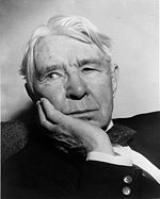
Carl Sandburg (January 6, 1878 – July 22, 1967) was an American writer and editor, best known for his poetry. He won two Pulitzer Prizes, one for his poetry and another for a biography of Abraham Lincoln. H. L. Mencken called Carl Sandburg "indubitably an American in every pulse-beat."
burg was born in Galesburg, Illinois to Swedish immigrants. At the age of thirteen he left school and began driving a milk wagon.

Discussion
Ask a question about 'Carl Sandburg'
Start a new discussion about 'Carl Sandburg'
Answer questions from other users
|
Quotations
Drum on your drums, batter on your banjos,sob on the long cool winding saxophones.Go to it, O jazzmen.
Jazz Fantasia 1920
I tell you the past is a bucket of ashes.
Prairie 1918
Sometime they'll give a war, and no one will come.
The People, Yes 1936
Tell me if the lovers are losers...tell me if any get more than the lovers.
Cool Tombs 1918
The fog comeson little cat feet.It sits lookingover the harbor and cityon silent haunches, and then moves on.
Fog 1916
The republic is a dream.Nothing happens unless first a dream.
Washington Monument by Night 1922

Encyclopedia
Carl Sandburg (January 6, 1878 – July 22, 1967) was an American writer and editor, best known for his poetry. He won two Pulitzer Prizes, one for his poetry and another for a biography of Abraham Lincoln. H. L. Mencken called Carl Sandburg "indubitably an American in every pulse-beat."
Biography
Sandburg was born in Galesburg, Illinois to Swedish immigrants. At the age of thirteen he left school and began driving a milk wagon. He subsequently became a bricklayer and a farm laborer on the wheat plains of Kansas. After an interval spent at Lombard College in Galesburg, he became a hotel servant in Denver, then a coal-heaver in Omaha. He began his writing career as a journalist for the Chicago Daily News. Later he wrote poetry, history, biography, novels, children's literature, and film reviews. Sandburg also collected and edited books of ballads and folklore. He spent most of his life in the Midwest before moving to North Carolina.
Sandburg fought in the Spanish-American War with the 6th Illinois Infantry, and participated in the invasion of Guánica, Puerto Rico on July 25, 1898. He attended West Point for just two weeks, for failing mathematics and a grammar exam. Sandburg returned to Galesburg and entered Lombard College, but left without a degree in 1903.
He moved to Milwaukee, Wisconsin and joined the Social Democratic Party. Sandburg served as a secretary to Mayor Emil Seidel, mayor of Milwaukee from 1910 to 1912; Seidel was the first person to be elected mayor of a U.S. city on a socialist platform.
Sandburg met Lilian Steichen at the Social Democratic Party office in 1907, and they married the next year. Lilian's brother was the photographer Edward Steichen. Sandburg with his wife, whom he called Paula, raised three daughters.
Sandburg moved to Harbert, Michigan, and then suburban Chicago, Illinois. They lived in Evanston, Illinois before settling at 331 S. York Street in Elmhurst, Illinois from 1919 to 1930. Sandburg wrote three children's books in Elmhurst, Rootabaga Stories, in 1922, followed by Rootabaga Pigeons (1923), and Potato Face (1930). Sandburg also wrote Abraham Lincoln: The Prairie Years, a two volume biography in 1926, The American Songbag (1927), and a book of poems Good Morning, America (1928) in Elmhurst. The family moved to Michigan in 1930. The Sandburg's house at 331 S. York Street, Elmhurst was demolished and the site is now a parking lot.
He moved to a Flat Rock, North Carolina estate, Connemara, in 1945 and lived there until his death in 1967.
Sandburg supported the civil rights movement, and contributed to the NAACP.
Works
Much of Carl Sandburg's poetry, such as "Chicago", focused on Chicago, Illinois, where he spent time as a reporter for the Chicago Daily News and the Day Book. His most famous description of the city is as "Hog Butcher for the World/Tool Maker, Stacker of Wheat/Player with Railroads and the Nation's Freight Handler,/Stormy, Husky, Brawling, City of the Big Shoulders."
Sandburg is also remembered by generations of children for his Rootabaga Stories and Rootabaga Pigeons, a series of whimsical, sometimes melancholy stories he originally created for his own daughters. The Rootabaga Stories were born of Sandburg's desire for "American fairy tales" to match American childhood. He felt that the European stories involving royalty and knights were inappropriate, and so populated his stories with skyscrapers, trains, corn fairies and the "Five Marrvelous Pretzels".
Sandburg earned one Pulitzer Prize for his collection The Complete Poems of Carl Sandburg, and another for his biography of Abraham Lincoln (Abraham Lincoln: The War Years). He was awarded a Grammy Award in 1959 for Best Performance - Documentary Or Spoken Word (Other Than Comedy) for his recording of Aaron Copland's Lincoln Portrait with the New York Philharmonic.
Selected list of works
Here is an incomplete list of books and anthologies published by Sandburg:
- In Reckless Ecstasy (1904) (poetry) (originally published as Charles Sandburg)
- Abe Lincoln Grows Up (N/A)
- Incidentals (1904) (poetry and prose) (originally published as Charles Sandburg)
- Plaint of a Rose (1908) (poetry) (originally published as Charles Sandburg)
- Joseffy (1910) (prose) (originally published as Charles Sandburg)
- You and Your Job (1910) (prose) (originally published as Charles Sandburg)
- Chicago Poems (1916) (poetry)
- Cornhuskers (1918) (poetry)
- Chicago Race Riots (1919) (prose) (with an introduction by Walter Lippmann)
- Clarence Darrow of Chicago (1919) (prose)
- Smoke and Steel (1920) (poetry)
- Rootabaga Stories (1920) (children's stories)
- Slabs of the Sunburnt West (1922) (poetry)
- Rootabaga Pigeons (1923) (children's stories)
- Selected Poems (1926) (poetry)
- Abraham Lincoln: The Prairie Years (1926) (biography)
- The American Songbag (1927) (folk songs)
- Songs of America (1927) (folk songs) (collected by Sandburg; edited by Alfred V. Frankenstein)
- Abe Lincoln Grows Up (1928) (biography [primarily for children])
- Good Morning, America (1928) (poetry)
- Steichen the Photographer (1929) (history)
- Early Moon (1930) (poetry)
- Potato Face (1930) (children's stories)
- Mary Lincoln: Wife and Widow (1932) (biography)
- The People, Yes (1936) (poetry)
- Abraham Lincoln: The War Years (1939) (biography)
- Storm over the Land (1942) (biography) (excerpts from Sandburg's own Abraham Lincoln: The War Years)
- Road to Victory (1942) (exhibition catalog) (text by Sandburg; images compiled by Edward Steichen and published by the Museum of Modern Art)
- Home Front Memo (1943) (essays)
- Remembrance Rock (1948) (novel)
- Lincoln Collector: the story of the Oliver R. Barrett Lincoln collection (1949) (prose)
- The New American Songbag (1950) (folk songs)
- Complete Poems (1950) (poetry)
- The wedding procession of the rag doll and the broom handle and who was in it (1950) (children's story)
- Always the Young Strangers (1953) (autobiography)
- Selected poems of Carl Sandburg (1954) (poetry) (edited by Rebecca West)
- The Family of Man (1955) (exhibition catalog) (introduction; images compiled by Edward Steichen)
- Prairie-town boy (1955) (autobiography) (essentially excerpts from Always the Young Strangers)
- Sandburg Range (1957) (prose and poetry)
- Harvest Poems, 1910-1960 (1960) (poetry)
- Wind Song (1960) (poetry)
- Honey and Salt (1963) (poetry)
- The Letters of Carl Sandburg (1968) (autobiographical/correspondence) (edited by Herbert Mitgang)
- Breathing Tokens (poetry by Sandburg, edited by Margaret Sandburg) (1978) (poetry)
- Ever the Winds of Chance (1983) (autobiography) (started by Sandburg, completed by Margaret Sandburg and George Hendrick)
- Carl Sandburg at the movies : a poet in the silent era, 1920-1927 (1985) (selections of his reviews of silent movies - collected and edited by Dale Fetherling and Doug Fetherling)
- Billy Sunday and other poems (1993) (edited with an introduction by George Hendrick and Willene Hendrick)
- Poems for children nowhere near old enough to vote (1999) (compiled and with an introduction by George and Willene Hendrick)
- Abraham Lincoln : the prairie years and the war years (2007) (illustrated edition with an introduction by Alan Axelrod)
Memorials Sandburg's home of 22 years in Flat Rock, Henderson County, North Carolina is preserved by the National Park Service as the Carl Sandburg Home National Historic Site.
Carl Sandburg College is located in Sandburg's birthplace of Galesburg, Illinois.
Carl Sandburg's boyhood home in Galesburg is now operated by the Illinois Historic Preservation Agency as the Carl Sandburg State Historic Site. The site contains the cottage Sandburg was born in, a modern visitor's center, and small garden with a large stone called Remembrance Rock, under which he and his wife Lilian's ashes are buried.
Carl Sandburg Village was a Chicago urban renewal project of the 1960s located in the Near North Side, Chicago. Financed by the city, it is located between Clark and LaSalle St. between Division Street and North Ave. Solomon & Cordwell, architects. In 1979, Carl Sandburg Village was converted to condominium ownership.
Elmhurst, Illinois renamed the former Elmhurst Junior High School as 'Carl Sandburg Middle School,' in his honor in 1960. Sandburg spoke at the dedication ceremony. He resided at 331 S. York Street in Elmhurst from 1919 to 1930. The house was demolished and the site is a parking lot.
In 1954, Carl Sandburg High School was dedicated in Orland Park, Illinois. Mr. Sandburg was in attendance, and stretched what was supposed to be a one hour event into several hours, regaling students with songs and stories. Years later, he returned to the school with no identification and, appearing to be a hobo, was thrown out by the principal. When he later returned with I.D., the embarrassed principal canceled the rest of the school day and held an assembly to honor the visit.
In 1959, Carl Sandburg Junior High School was opened in Golden Valley, Minnesota. Carl Sandburg attended the dedication of the school. In 1988 the name was changed to Sandburg Middle School servicing grades 6, 7, and 8. Originally built with a capacity for 1,800 students the school now has 1,100 students enrolled. Sandburg Middle school was one of the first schools in the state of Minnesota to offer accelerated learning programs for gifted students.
In December 1961, Carl Sandburg Elementary School was dedicated in San Bruno, California. Again, Sandburg came for the ceremonies and was clearly impressed with the faces of the young children, who gathered around him. The school was closed in the 1980s, due to falling enrollments in the San Bruno Park School District.
In 1968, Carl Sandburg Elementary School was dedicated in Wheaton, Illinois.
There is a Carl Sandburg Junior High in Mundelein,IL
There is a Carl Sandburg Elementary School in Joliet, IL.
In Freeport, IL, there is a Carl Sandburg Middle School.
There is a Carl Sandburg Elementary School in Kirkland, WA
There is a Carl Sandburg Middle School in Old Bridge, New Jersey.
A room in the Holmes Student Center at Northern Illinois University is called the Carl Sandburg Auditorium.
On January 6, 1978, the 100th anniversary of his birth, the United States Postal Service issued a commemorative stamp honoring Sandburg. The spare design consists of a profile originally drawn by his friend William A. Smith (1918-1989) in 1952, along with Sandburg's own distinctive autograph.
possesses the Carl Sandburg collection and archives. The bulk of the collection was purchased directly from Carl Sandburg and his family, with many smaller collections having been donated by his family and purchased from outside sources.
Funded by the State of Illinois, Amtrak in October 2006 added a second train on the Chicago-Quincy (via Galesburg and Macomb) route. Called the Carl Sandburg, this new train joined the "Illinois Zephyr" on the Chicago-Quincy route.
In Neshaminy School District of lower Bucks County resides the secondary institution Carl Sandburg Middle School. Located in the lobby is a finished split tree trunk with the quote engraved lengthwise horizontally:
- "MAN IS BORN WITH RAINBOWS IN HIS HEART AND YOU'LL NEVER READ HIM UNLESS YOU CONSIDER RAINBOWS"
Another secondary school by the same name is located south of Alexandria, Virginia and is part of the Fairfax County Public Schools School District.
See also
External links
- at poets.org
- of the University of Illinois at Urbana-Champaign has many significant resources including correspondence and audio recordings. These resources are not available online, but there are searchable databases of the contents of the two collections: and .
-
Online selections from Sandburg's poetry
- An extensive collection of Sandburg's poetry
- Musical settings by Ruth Crawford Seeger
-
|