

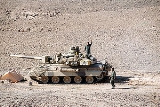
AMX 30

Encyclopedia
The AMX-30 is a main battle tank
designed by GIAT
, first delivered to the French Army
in 1966. The first five tanks were issued to the 501st Régiment de Chars de Combat (Tank Regiment) in August of that year. The production version of the AMX-30 weighed 36 metric tons (39.7 ST), and sacrificed protection for increased mobility. The French believed that it would have required too much armour to protect against the latest anti-tank threats, thereby reducing the tank's maneuverability. Protection, instead, was provided by the speed and the compact dimensions of the vehicle, including a height of 2.28 metres. It had a 105 millimetres (4.1 in) cannon
, firing an advanced high explosive anti-tank warhead known as the Obus G. The Obus G used an outer shell, separated from the main charge by ball bearings, to allow the round to be spin stabilized by the gun without affecting the warhead inside. Mobility was provided by the 720 hp HS-110 diesel engine
, although the troublesome transmission
adversely affected the tank's performance.
Due to the issues caused by the transmission, in 1979 the French Army began to modernize its fleet of tanks to AMX-30B2 standards, which included a new transmission, an improved engine and the introduction of a new fin-stabilized kinetic energy penetrator
, amongst other improvements. Production of the AMX-30 also extended to a number of variants, including the AMX-30D armored recovery vehicle, the AMX-30R anti-aircraft gun system, a bridge-layer, the Pluton
tactical nuclear missile launcher and a surface to air missile launcher.
It was preceded by two prior post-war French medium tank designs, including the ARL 44
. Although the ARL 44 was an interim tank, its replacement tank, the AMX 50
, was cancelled in the mid-1950s in favor of adopting the M47 Patton
tank. In 1956 the French government entered a cooperative development program with Germany
and Italy
in an effort to design a standardized tank. Although the three nations agreed to a series of specific characteristics that the new tank should have, and both France and Germany began work on distinctive prototypes with the intention of testing them and combining the best of both, the program failed as Germany decided not to adopt the new French 105 millimetres (4.1 in) tank gun
and France declared that it would postpone production until 1965. As a result, both nations decided to adopt tanks based on their own prototypes. The German tank became known as the Leopard 1, while the French prototype became the AMX-30.
As early as 1969, the AMX-30 and variants were ordered by Greece
, soon followed by Spain
. In the coming years, the AMX-30 would be exported to Saudi Arabia
, Venezuela
, Qatar
, United Arab Emirates
, Cyprus
and Chile
. By the end of production, 3,571 units of AMX-30s and its variants had been manufactured. Both Spain and Venezuela later began extensive modernization programs to extend the life of their vehicles and to bring their tanks up to more modern standards. In the 1991 Gulf War
, AMX-30s were deployed by both the French and Qatari armies, and Qatari AMX-30s saw action against Iraqi forces at the Battle of Khafji
. However, France and most other nations replaced their AMX-30s with more up-to-date equipment by the end of the 20th century.
temporarily interrupted French development of armoured fighting vehicle
s, clandestine research allowed the French to quickly recover lost ground after its liberation in mid-1944. During the occupation, the French had secretly worked on an armour program that was in 1944 taken over by the state workshop Atelier de Construction de Rueil (ARL), resulting in the design and production of the ARL 44, which was produced from 1946. The tank was powered by a Maybach
HL-230 575 hp engine, and armed with a 90 millimetres (3.5 in) tank gun. Although the 48 metric tons (52.9 ST) vehicle was comparable to contemporary battle tanks in firepower and engine power, it suffered from distinct disadvantages, including an antiquated track design. While 600 were planned, only 60 were ultimately produced by 1950. These were that year issued to the 503rd Tank Regiment, of the French Army. Given that the ARL 44 was considered only a stop-gap vehicle for the French Army's armoured forces since the beginning of its inception, work on a new tank had begun as early as March 1945.
 Development of the new tank was offered to five separate manufacturers, including Atelier de Construction d'Issy-les-Moulineaux (AMX), Forges et Chantiers de la Méditerranée (FCM), Renault
, Societe Lorraine de Dietrich (SLD-Lorraine) and Societé d'Outillage Mécanique et d'Usinage d'Artillerie (SOMUA). The new vehicle was based on the new post-war requirement for a single battle tank. The new vehicle was designated the AMX 50, and its hull and suspension were similar to that of the German
Panther tank
, which had been used by the French Army
in the immediate post-war. The French government's specifications for the new tank were strongly influenced by both the Panther tank and the heavier Tiger I
; specifically the French Army was looking for a tank with the protection of the former and the firepower of the latter. Although the design borrowed from German tanks, including the Maybach 1000 hp engine, based on an earlier model, and the torsion bar sprung road wheels, the AMX 50 also included a number of unique features. For example, it included an oscillating turret
, mounted on trunnions, which was a first of its kind. The oscillating turret consisted of two parts, one of which was mounted on the trunnions of the lower part, attached to the turret ring. The main gun was attached to the upper part, facilitating gun elevation and depression, as well as simplifying the fire control equipment and the installation of the automatic loading system. Of the three contractors, Renault withdrew from the program, while in early 1946 the French government selected AMX and SOMUA to continue the development. The prototypes were designated M4s, and AMX completed its prototype in 1949, while SOMUA would not be finished until 1956. AMX's first prototype was armed with a 90 millimetres (3.5 in) cannon, although a second prototype was fitted with a larger 100 millimetres (3.9 in) gun in July 1950 Although it was intended to put the AMX 50 into production as the standard medium tank of the Western European Union
, financial reasons and the arrival of military aid from the United States in the form of 856 M47 Patton tanks caused the original program to be abandoned. In 1951 it was decided to turn the program into a heavy tank
project with an even larger 120 millimetres (4.7 in) tank gun
; though three prototypes were built, this too was abandoned in 1956, mainly due to a failure to design a powerful enough engine.
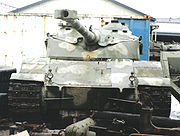 With the demise of the 100 millimetres (3.9 in) AMX 50 program in 1951, France temporarily officially abandoned the thought of producing a medium tank. It was expected that West Germany would soon be allowed to rearm, and the Germans had appeared to entertain the concept of equipping their forces with a host of low-cost light, but relatively powerfully armed tanks, their quantity compensating for a lack of full armament parity with the latest medium tanks. The prospect of delivering many thousands of these to the Germans induced the French to adopt the idea and plan to create light tank "Type 67" armoured divisions, for which the AMX-13/105
was specially designed. A private enterprise design aimed at fulfilling the same requirement was the somewhat larger Char Batignolles-Châtillon. A derived medium tank prototype of the latter, made in 1955, proved that it was possible to produce a tank with a first-rate gun and frontally protected with 80 millimetres (3.1 in) steel equivalence within a weight constraint of 30 metric tons (33.1 ST). This revived interest in the medium tank concept.
In 1956 the WEU defence workgroup FINBEL (named after France, Italy
, Netherlands
, Belgium
and Luxembourg
), founded in 1953 and consisting of representatives of the various General Staffs, drafted a set of specifications for a new medium tank to eventually replace their American and British tanks. That same year, Germany joined the workgroup, turning it into FINABEL
(the added "A" standing for Allemagne, "Germany" in French) and on 27 October 1956 at Colomb-Béchar a bilateral agreement was concluded between France and Germany to collaborate in building a tank. Though the other FINABEL nations did not formally participate, the type was called Europa-Panzer to indicate its common European nature, and experts from all countries were involved in the design process. The specifications (FINABEL 3A5) for the new tank called for a lightweight and mobile battle tank, setting the weight limit to 30 metric tons (33.1 ST) and compromising the ability to heavily armour the vehicle. French and German engineers, during a conference in Bonn
on 12 February 1957, defined the requirements for the future tank. This included a maximum width of 3.15 metres (10.3 ft), a height of 2.15 metres (7.1 ft) and a 105 millimetres (4.1 in) tank gun, to be developed by the Franco-German military research institute at Saint Louis
. The new tank would have an air-cooled, petrol engine, a torsion bar suspension with hydraulic shocks, a power-to-weight ratio of at least 30 hp/metric ton and a road range of at least 350 kilometres (217.5 mi). In May, Italy joined the project, though only nominally, without any material contribution, because after the war it had no tank design bureaus. That same year, on 28 November, the French and German ministries of defence in Paris
agreed upon a contract which would allow both countries to produce two prototypes separately. The next year however, the project suffered a first setback when Charles de Gaulle
took power in France, creating the Fifth Republic
: the Paris treaty had as its main point developing a common nuclear weapon
and on 17 June 1958 de Gaulle decided to refuse Germany and Italy the atomic bomb, to avoid antagonizing the USA and United Kingdom. This made Germany lose much interest in a common tank project also.
The French prototypes were developed and produced by the Atelier de Construction d'Issy-les-Moulineaux, under the direction of General Joseph Molinié of the Direction des Études et Fabrications d'Armements (DEFA, the later Direction Technique des Armements Terrestres) and AMX head engineer Heissler, and the first prototype was completed in September 1960 and tested from February 1961, the second, with an improved range finder and track, in July 1961. These first vehicles had a very rounded turret, in a deliberate imitation of the Soviet T-54, and Sofam petrol engines. Another seven, with an improved sleeker turret cast, were manufactured between 1961 and 1963. Work on the German prototypes was carried out by two teams, including Team A composed of Porsche
, Maschinenbau Kiel
and Luther & Jung. Team B was made up by Ruhrstahl, Rheinstahl-HANOMAG
and Henschel
. Wood mock-ups were completed in 1959, while the first two prototypes were finished by 1961 (completed by Team A).
decided to procure a purely national tank. In response the same month the French government decided likewise.
Comparative trials were nevertheless held at Mailly-le-Camp
, Meppen
, Bourges
and Satory
between five French and five German prototypes between August and October 1963, under Italian, Dutch, Belgian and American supervision. The French type had received a separate national designation: AMX 30. The trials indicated that the German type, on 1 October also getting its own name Leopard, had a better mobility and acceleration. The French government decided that it could not procure a new tank until 1965, while the Germans refused to adopt the Franco-German 105 millimetres (4.1 in) tank gun, in lieu of the British
Royal Ordnance L7
, of which they had already ordered 1500 in the autumn of 1962, their plan having failed for Rheinmetall
to produce in Germany a common type of munition of sufficient quality. Suggestions to save the project by combining the French turret with the German chassis failed. As a result, the program was cancelled and the French and Germans definitely decided to adopt their two separate tanks.
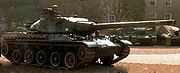 The prototypes of the AMX-30 weighed 32.5 metric tons (35.8 ST), and were compact, with a width of 3.1 metres (10.2 ft), comparable only to the Swiss
Panzer 61
, and a height of 2.28 metres (7.5 ft), comparable only to the Soviet
T-55. In contrast to the AMX 50, the AMX-30 was issued a conventional turret, because it was found that it was more difficult to seal oscillating turrets from radioactive dust and against water when the tank was submerged. Oscillating turrets also had a large ballistic weakness in the area of the skirt and turret ring. Originally, the first two prototypes were powered by a 720 hp spark ignition engine, named the SOFAM 12 GSds. Later a multi-fuel diesel engine was adopted, developed by Hispano-Suiza
. The seven 1963 prototypes of the AMX-30 were later rebuilt with the new diesel engine. Two further prototypes, meant to be direct preproduction vehicles, were delivered in November 1965. Besides the diesel engines, they had changed hull and turret casts and different gun mantlet
s; the latter would again be changed in the production vehicles.
The first production versions of the AMX-30, named AMX 30B to distinguish them from the AMX 30A prototypes, were completed in June 1966, manufactured with a welded and cast hull and a fully cast turret. The production version of the tank had a combat weight of 36 metric tons (39.7 ST). The AMX-30's survivability was based on its mobility; French engineers believed that the tank's mobility would have been compromised had they added enough steel plating to protect against modern anti-tank threats, including high explosive anti-tank warheads (HEAT). As a result the type had the thinnest armour of any main battle tank produced at the time. The turret has a maximum armour thickness of 50 millimetres (2 in), the armour sloped at 70 degrees on the front plate and 23 degrees on the side, offering protection against 20 millimetre (0.78740157480315 in) armour piercing projectiles. The Line-of-Sight armour values are: 79 millimetres (3.1 in) for the front of the hull; 59 millimetres (2.3 in) for the forward sides of the hull; 30 millimetres (1.2 in) for the rear sides and rear of the hull; 15 millimetre (0.590551181102362 in) for the hull top and bottom; 80.8 millimetres (3.2 in) for the turret front; 41.5 millimetres (1.6 in) for the turret sides; 50 millimetres (2 in) for the turret rear and 20 millimetre (0.78740157480315 in) for the turret top. Further protection is offered by a nuclear, biological and chemical protection suit, including a ventilation system.
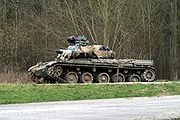 One of the unique features of the AMX-30 was the Obus à Charge Creuse de 105 mm Modèle F1 (Obus G) HEAT projectile and its main gun, the Modèle F1, a monoblock steel 105 millimetres (4.1 in) cannon. HEAT warheads suffer when spin stabilized, a product of rifled barrels, causing the French to develop the Obus G, (Gresse). This projectile was composed of two major parts, including the outer shell and a suspended inner shell, divided by ball bearings. This allowed the projectile to be spin-stabilized, and therefore more accurate than a normal fin-stabilized HEAT-round, while the inner shell did not move, allowing the warhead to work at maximum efficiency. The warhead, containing 780 gram hexolite, could penetrate up to 400 millimetres (15.7 in) of steel armour and was effective against tanks at up to 3000 metres (3,280.8 yd). As it combined a good accuracy with a penetration that was independent of range, it has been considered an "ideal round" for its day The AMX-30 was also designed to fire the OCC F1 Mle.60 high explosive projectile, the SCC F1 training warhead and the OFUM PH-105 F1 smoke round. The main gun was coupled with a 380 millimetres (15 in) recoil brake, which had a maximum extension of 400 millimetres (15.7 in), and could depress to -8 degrees or elevate to 20 degrees. The turret's firepower was augmented by a coaxial 12.7 millimetre (0.5 in) M2 Browning machine gun. The tank commander also made use of a 7.62 millimetre (0.3 in) anti-aircraft machine gun on the turret roof. The vehicle carried 50 105 millimetres (4.1 in) projectiles, 748 12.7 millimetre (0.5 in) rounds and 2,050 7.62 millimetre (0.3 in) bullets. The tank commander was issued a cupola which offered ten all-around direct-vision episcopes, and a binocular telescope with 10x magnification. The commander was also given an optical full-field coincidence range finder. The gunner was given a telescoping gun sight and two observation periscopes.
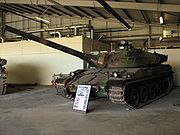 The production version of the AMX-30 was fitted with Hispano-Suiza's HS-110 diesel engine, located in the rear of the hull. The 28.8 litres (1,756.1 cu in) engine could be replaced on the field in 45 minutes, and produced 720 hp, offering the tank a maximum velocity of 65 kilometres per hour (40.4 mph) on roads. The fuel efficient engine, in conjunction with a total fuel capacity of 970 litres (256.2 US gal), gave the AMX-30 a maximum road range of up to 600 kilometres (372.8 mi). The engine's drive is taken through a Gravina G.H.B.200C twin-plate centrifugal clutch. The gearbox was an AMX 5-SD-200D, with five forward gears and five reverse gears. This transmission was heavily influenced by that of the German Panther tank and was based on a project which had begun in 1938. The transmission was one of the AMX-30's major faults and caused a variety of mechanical problems, including that the driver would have to manually change gears at specific times, even if the tank was moving over rough terrain. The tank's weight is distributed over five double, aluminum-alloy, rubber-tyred road wheels on either side, propelled on 570 millimetres (22.4 in) wide tracks. The tank could ford 1.3 metres (1.4 yd) deep water obstacles without preparation, up to 2 metres (2.2 yd) with minor preparation, and up to 4 metres (4.4 yd) with full preparation. Full preparation for water operations consisted of the addition of a snorkel tube, the installation of blanking plates, carried on the front of the hull, over the engine compartment's air intake louvers, and the installment of infra-red driving equipment, including a searchlight. In 1969 a single special dive training vehicle was adapted, nicknamed the AMX 30 Gloutte (from French faire glouglou, "gurgle"), without engine and tracks, that over a ramp could quickly be lowered into a reservoir by a winch; it was equipped with an escape tube.
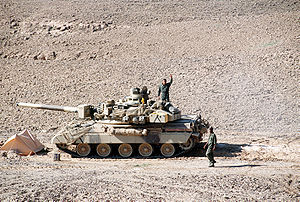 During the production run many improvements were implemented. These included gun stabilization from 1971, and from 1972 replacing the original coaxial heavy machine gun by a dual purpose 20 millimetre (0.78740157480315 in) autocannon
against light armour and helicopters, with the ability to depress to -8 degrees and elevate to 40 degrees. All French army vehicles were eventually brought to this newer standard; the designation remained AMX 30B.
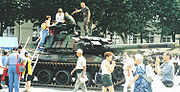 Beginning as early as 1973, only seven years after the beginning of production, the French began a research program for a future modification of the tank. The project was to result in a AMX 30 Valorisé ("upgraded AMX-30"). In June 1979, the French Army decided to both build new and modernize existing AMX-30s with an improved fire control system and a new transmission, and designated them AMX-30B2s. The first new production vehicles were taken into service in January 1982. Improvements to the COTAC APX M-508 fire control system included the installation of a laser rangefinder and a low-light TV (LLTV). The main gun's lethality was improved with the introduction of a new armour piercing fin stabilized discarding sabot (APFSDS). The original engine was exchanged for an improved variant, known as the HS-110.2, producing 680 hp. The poor transmission was replaced with the semi-automatic SESM ENC200 transmission, with a torque converter. The suspension was improved by adopting new torsion bars and shocks which increased the vertical deflection range of the road wheels, thereby improving the tank's off-road mobility. From 1998, the French army started to replace the engines of its remaining AMX-30 tanks and variants with 500 Renault Mack E9 750 hp engines.
In the nineties, a reactive armour
package, named BRENUS or Brennus
, was also developed for the AMX-30B2, but was issued only to two tank regiments, in peacetime combined into 1er/ 2e Chasseurs, in France's rapid reaction force; the other two regiments using the AMX-30, 2e/5e Dragons, only had their tanks adapted for a possible upgrade. The BRENUS system used 112 GIAT BS (Brique de Surblindage) G2 explosive reactive boxes with a total weight of 1.7 metric tons (1.9 ST), offering a protection equivalent to 400 millimetres (15.7 in) of steel at 60°. Recently, the AMX-30 has also been used as a testbed for several stealth technologies
, including air cooling of hull surfaces and the use of visual camouflage. This prototype is known as the Démonstrateur Furtif à Chenille. Its hull and turret are fully covered by a superstructure built of angled plates made of radar absorbent material
.
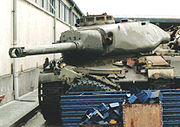 The AMX-30 has a number of different variations, including a number of other armoured vehicles based on the same chassis. A simplified version of the tank, without the infra-red searchlight and periscopes and a less complex commander's cupola was developed for export, known as the "basic AMX-30". This version also came devoid of the pressurized air filtering system, and moved the smaller 7.62 millimetre (0.3 in) machine gun into the coaxial position and the larger 12.7 millimetre (0.5 in) M2 to the turret roof. Another version was considered for the French Army, adopting a 142 millimetres (5.6 in) tank gun able to fire the supersonic ACRA (Anti-Char Rapide Autopropulsé) anti-tank guided missile
, as well as high explosive rounds. A prototype was finished in 1967 with a new cast turret, wide enough to hold the much larger armament. However, the high costs of the missiles forced the French Army to abandon the program in 1972. The vehicles based on the chassis include an armoured recovery vehicle
, a bridgelayer, a self-propelled anti-aircraft vehicle
, a tactical nuclear
missile launcher and a self-propelled artillery piece.
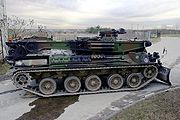 The armoured recovery vehicle, known as the AMX-30D (AMX-30 Dépanneur-Niveleur), was designed to recuperate or help maintain vehicles in the field. Work on the AMX-30D began in 1966, as the French Army researched developing a recovery vehicle to be issued to units receiving the AMX-30 tank. A prototype was produced and delivered for experimentation in 1971, and in February 1973 the first of a pre-series of five vehicles was delivered. That same year, another 100 AMX-30Ds were ordered, and these began production in 1975. The recovery vehicle includes a winch powered by the vehicle's engine, with the ability to pull a maximum of 35 metric tons (38.6 ST) of weight. The vehicle also has a 80 metres (87.5 yd) heavy towing cable, while an auxiliary wrench has another 120 metres (131.2 yd) towing cable, able to tow up to 20 metric tons (22 ST) when working over the front of the AMX-30D. In the latter case the vehicle must be supported by removable props, which are carried on the vehicle, and the bulldozer blade must be lowered on the ground. The crane can lift up the 3.29 metric tons (3.6 ST) power pack and the 10 metric tons (11 ST) turret. Instead of a turret, the AMX-30D is fitted with a superstructure, and weighs 36 metric tons (39.7 ST), although with the extra power pack it can weigh up to 40 metric tons (44.1 ST). The vehicle can protect itself with a 7.62 millimetre (0.3 in) machine gun. The driver's visibility is aided by the inclusion of three M-223 episcopes. The AMX-30D has a maximum on-road velocity of 60 kilometres per hour (37.3 mph) and a maximum road range of 500 kilometres (310.7 mi).
The AMX-30 bridgelayer, or Poseur de pont, consists of the AMX-30's chassis with a box-like superstructure, supporting a scissor-type folding bridge. The 22 metres (24.1 yd) long bridge can span 20 metres (21.9 yd) gaps. The bridge has a width of 3.1 metres (3.4 yd), but can be increased to 3.95 metres (4.3 yd) through the use of appliqué panels. It can support weighs of up to 46 metric tons (50.7 ST). Bridgelayer development began as early as 1963, although it was not until June 1967 that development began on a prototype. Although a prototype designated AMX-30H was finished in 1968, it was not until 1971 that the vehicle was evaluated. At the end of the evaluations in September 1971, a pre-series of five vehicles was ordered, resulting in a new period of evaluations beginning on 16 October 1972. In 1975, the AMX-30H was declared standard in the French Army, although none of these vehicles were ever ordered.
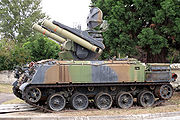
 The self-propelled anti-aircraft gun began development in 1969 to provide this type of vehicle to the French Army and for export. Although ultimately none were ordered for France, in 1975 Saudi Arabia ordered an improved version, denominated the AMX-30SA. Developed to defend against low-altitude attacks, the system included two Hispano-Suiza 30 millimetres (1.2 in) 831 A automatic guns, coupled to an Oeil-noir fire control system. This system had already been installed on the AMX-13, in lieu of a heavier chassis, using a turret designated the S 401 A. Although this particular vehicle began production in 1962, the appearance of the AMX-30 offered a larger chassis to which the S 401 A turret could be mounted on, providing superior mobility. The heavier AMX-30 also provided a more stable platform for the guns, and allowed the system to carry much more ammunition (1,200 rounds, as compared to the 600 carried by the AMX-13 version). The guns were designed to fire in 5-round or 15-round bursts, with a cyclic rate of fire of 650 rounds per minute. They were controlled by an analogue computer, receiving information from a Doppler radar
, which could be folded into an armoured box when not in use to protect from damage. The radar depended on visual tracking, and so could only work in clear weather.
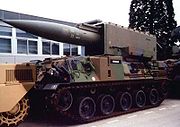
 Three missile systems were developed to be mounted on the AMX-30 chassis. Recognizing the need for tactical nuclear missile mobile launchers, the French Army began developing the Pluton missile in 1963. In 1964, the program was suspended and instead the French Army opted for a missile with a longer range, able to be mounted on the AMX-30. A contract to develop the system was established in 1968. The first prototype was soon delivered and testing occurred between July and August 1970, followed by the production of a second prototype in 1971. Two more prototypes were fabricated in 1972. The next year, the vehicle was put into mass production and by 1 May 1974 four of these vehicles had been delivered to the 3rd Artillery Regiment. The missile itself weighs 2.4 metric tons (2.6 ST) and is 7.6 metres (8.3 yd) long. Using a simplified inertial guidance system and a solid propellant rocket motor, the Pluton has a maximum range of 120 kilometres (74.6 mi). The second missile system is the AMX-30R (Roland) surface-to-air missile launching system, which began development in 1974. Five vehicles of a pre-series were completed by 1977 and then evaluated, prompting the order of 183 vehicles that same year. The Roland includes a rectangular superstructure, taller than that of both the AMX-30D and the Pluton, which houses the radar system and mounts two launching tubes on either side, with an autoloading system feeding from an eight missile reserve inside the superstructure. The Roland's exploration radar has a detection range of 16 kilometres (9.9 mi). The third missile system, called the AMX-30SA, was developed in 1975 for Saudi Arabia, to fire the SA-10 Shahine, developed and manufactured by Thomson-CSF
; the launching vehicle was heavily based on the AMX-30R.
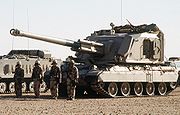 The canon automoteur de 155 GCT (for Grande Cadence de Tir, fast rate of fire) was developed based on the AMX-30 chassis to provide tactical artillery support to units in the French Army, who refer to it as the AuF1. The 155 millimetres (6.1 in) howitzer was 40 caliber
s long, and was autoloaded
allowing it a rate of fire of eight rounds per minute, with a maximum range of 30 kilometres (18.6 mi) with the LU211 round. The turret enables the gun to have an elevation of up to 66 degrees, and allows it to traverse a full 360 degrees. The vehicle carries 42 rounds of ammunition, with combustible cartridge cases. The origins of the decision to design a self-propelled howitzer can be traced back to 1969, with the first prototype completed in 1972. By 1979 a total of seven prototypes had been produced, and six pre-series vehicles, followed by the production of 110 vehicles. This order was later increased to 190.
The first prototype of an improved AMX-30 for the export market, known as the AMX-32, was unveiled in June 1979. Originally intended as an alternative for the AMX-30B2, and deliberately imitating the spaced armour concept the Germans had successfully implemented on the Leopard 1A3 and A4, the AMX-32 fielded greater armour protection to offer increased survivability against anti-tank guided missiles. A 20 millimetre (0.78740157480315 in) autocannon was included as the main gun's coaxial weapon, and a 7.62 millimetre (0.3 in) machine gun attached to the roof. However, no orders were ever placed.
. This heavy manufacturing factory was built during World War I
to produce artillery shells, although by 1952 the factory had begun producing armoured fighting vehicles. Before producing the AMX-30, for example, it had made 1,900 AMX-13s and variants. The Roanne factory was responsible for final assembly, most components were made elsewhere: the powerplant by the Atelier de Construction de Limoges, the full armour set by the Ateliers et Forges de la Loire, the turret by the Atelier de Construction de Tarbes, the cannon by the Atelier de Construction de Bourges, the cupola and machine-gun by the Manufacture d'Armes de Saint-Étienne and the optics by the Atelier de Construction de Puteaux; all these again used many subcontractors. In a series of corporate mergers under state guidance, most of these firms would eventually be concentrated into GIAT.
Originally, 300 AMX-30s were ordered by the French Army, and by 1971 the order had been increased to 900, divided between eight batches, including all variants based on the chassis. Beginning in 1966, ten AMX-30s were assembled per month, and the first five were issued in August 1966 to the 501st Régiment de Chars de Combat. Monthly production grew to 15–20 tanks as new factories began to manufacture components of the vehicle and existing factories increased their production potential. However, in April 1969, production was again reduced to ten per month. By 1971 about 180 vehicles were in service; in 1975 delivery began of the last 143 units of the final eighth batch of the original order. In 1985 the number of AMX-30s had risen to 1173. By the end of production, France had accepted 1,355 AMX-30s into service, including 166 brand-new AMX-30B2s. Another 493 tanks were refitted and modernized to AMX-30B2 standards; originally 271 new and 820 refitted vehicles had been planned. The French Army also accepted a large number of variants, including 195 self-propelled howitzers, 44 AMX-30 Pluton tactical nuclear missile launchers, 183 AMX-30Rs, 134 AMX-30Ds and 48 engineer vehicles (AMX-30EBG). The last 35 new battle tanks were in 1989 ordered by Cyprus and the last new variant vehicles, a batch of twenty GCTs, in 1994 by France.
In the late 1990s, the French Army began to accept the new Leclerc
main battle tank to replace the antiquated AMX-30. The first units to be outfitted with the new tank were the 501st and 503rd tank regiments, followed by the 6th
and 12th
Cuirassier Regiments.
 Having in February 1964 decided to produce its own battle tank, Israel
at first considered licence production of AMX-30 hulls, while importing the turrets from France. Favoring heavier armour over mobility, Major-General Israel Tal
discontinued negotiations with France when the United Kingdom
agreed to allow licensed production of the Chieftain tank
, in 1966.
France eventually also failed to obtain orders from the remaining two FINABEL nations, Belgium and the Netherlands: the Dutch did not even test the type and the Belgians ordered the Leopard when France refused to allow partial component production of the AMX-30 in Belgium, fearing it would increase the unit cost.
Less expensive and easier to maintain, the AMX-30 has been preferred over the Leopard 1 by less affluent or developed nations.
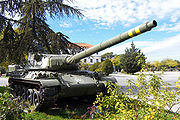
In 1969, Greece agreed to procure a total of 190 AMX-30s and 14 AMX-30Ds, making them the first foreign nation to purchase the French tank. Throughout the 1960s, Spain
had considered both the AMX-30 and the Leopard 1 to complement their existing fleet of M47 and M48 Patton tanks. Ultimately, Spain opted for the AMX-30 for a variety of reasons, including British unwillingness to sell the L7 tank gun to a fascist regime and the French offer to allow the AMX-30 to be manufactured in Spain. Spain ordered 19 tanks in 1970, and later agreed to manufacture another 180 tanks in Spain. In 1979, Spain began the production of a second batch of 100 tanks, completing a total of 299 AMX-30s issued to the Spanish Army
; these were designated AMX-30E
s. Spain also procured 10 AMX-30Ds and 18 AMX-30Rs. As production of the AMX-30E ended in 1979, the Spanish Army was already looking for a modernization program to improve the quality of the tank's mobility. In 1987, the Spanish Army began a six-year modernization program which brought 150 tanks up to AMX-30EM2 standards and modified another 149 tanks to AMX-30EM1 standards. The former was a much more complete upgrade, which saw improvements to the tank's mobility through the adoption of a new engine and gearbox, as well as to the tank's firepower, with the development of a new kinetic energy penetrator and the introduction of a far more complex and accurate fire control system for the tank's gunner, amongst other things. The AMX-30EM1 was termed a "reconstruction" and only saw improvements to the tank's mobility by adopting a new transmission and renovating much of the vehicle's worn out systems, such as the brakes, indicators and controls. These rebuilt AMX-30s were soon replaced by M60 Patton tanks procured from the United States in the early 1990s, while its fleet of AMX-30EM2s was later replaced by the B1 Centauro
anti-tank vehicle.
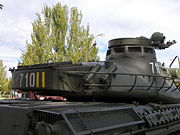 In 1972, France was able to gain a contract with Saudi Arabia over the purchase of 190 AMX-30S', designed for the desert environment of the Middle East
ern nation. Named the Palmier Contract, Saudi Arabia's tanks were delivered between 1973 and 1979, while 59 AMX-30Ds were exported between 1975 and 1979, 12 AMX-30Ps between 1977 and 1979, and finally 51 self-propelled howitzers, delivered between 1979 and 1980. Between 1979 and 1981, Saudi Arabia also received 52 AMX-30SAs and later 50 AMX-30C1 Shanine-2s delivered in two batches, between 1980 and 1989. By the 21st century, 50% of Saudi Arabia's AMX-30 fleet were in storage, given that the AMX-30 lacked the capabilities to deal with more modern threats, such as against Iraq
i T-62
s and T-72
s, and Israel
i Merkava
tanks. These were largely displaced by an order for 315 M1A2
Abrams tanks in 1989, and the acquisition of 450 M60A3
Patton tanks. Although Saudi Arabia planned to procure more M1 tanks, it was unable to do so for financial reasons and the AMX-30 has still not been retired.
Venezuela
originally placed an order for 142 tanks in 1972, although this was later reduced to 81 and four AMX-30Ds. In the mid-1980s, Venezuela adopted a modernization plan for its deprecated AMX-30s, opting to replace the original engine with a new Continental AVDS-1790-5A diesel engine, producing 908 hp and exchanging the existing transmission with an Allison CD-850-6A. Venezuelan AMX-30s received new fuel tanks, increasing the tank's road range to 720 kilometres (447.4 mi), while firepower was improved through the adoption of a modern fire control system. In 1977, France and Qatar signed an agreement which garnered France another 24 AMX-30s sold, which would rise to 54 when Qatar ordered 30 AMX-30B2s in 1987. The United Arab Emirates
placed an order in 1977 for 64 tanks and a single armoured recovery vehicle, to complete an armoured brigade, in 1977. Due to political issues between Chile and Argentina
, the former placed an order for 46 tanks, although this was later cut short to 21 when the contract was canceled by the French government in 1981. In 1982, Cyprus acquired a total of 16 AMX-30B2s and a single AMX-30D, and later ordered another 36 AMX-30B2s. Total production of the AMX-30 and variants totaled 3,571 units.
Later many used vehicles were resold to other nations: in 2005 Cyprus had 102 AMX-30s (obtained from Greece) and 52 AMX-30B2s; Bosnia 32 AMX-30s (from the UAE). French strength had dwindled to about 250 AMX-30B2s.
, where on 30 January 1991 they counter-attacked in an attempt to retake the city of Khafji
from Iraqi forces which had occupied it the night before. During the action, Qatari AMX-30s knocked out three Iraqi T-55s and captured four more. At least one Qatari AMX-30 was lost during the battle.
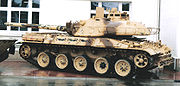 The French participation in the Gulf War, codenamed Opération Daguet
, saw the deployment of the 6e Division Légère Blindée ("6th Light Armoured Division"), referred to for the duration of the conflict as the Division Daguet. Most of its armoured component was provided by the AMX-10RCs of the cavalry reconnaissance regiments, but a heavy armoured unit, the 4e Régiment de Dragons ("4th Dragoon Regiment") was also sent to the region with a complement of 44 AMX-30B2s. Experimentally, a new regimental organisational structure was used, with three squadrons of thirteen tanks, a command tank and six reserve vehicles, instead of the then normal strength of 52 units. Also six older AMX-30Bs were deployed, fitted with Soviet mine roller
s provided by Germany from East German stocks, and named AMX 30 Demin. The vehicles were all manned by professional crews, without conscripts. The Daguet Division was positioned to the West of Coalition forces, to protect the right flank of the U.S. XVIII Airborne Corps. This disposition gave the French commander greater autonomy, and also lessened the likelihood of encountering Iraqi T-72s, which were superior both to the AMX-10RCs and the AMX-30B2s. With the beginning of the ground offensive of 24 February 1991, French forces moved to attack its first target, "Objective Rochambeau", that was defended by a brigade from the Iraqi 45th Infantry Division. A raid by Gazelle helicopter
s paved the way for an attack by the 4e Régiment de Dragons. Demoralized by heavy coalition bombardments, the Iraqi defenders rapidly surrendered. The following day, the 4e Dragons moved on to their next objective, "Chambord", where they reported destroying ten tanks, three BMPs, fifteen trucks and five mortar
s with the assistance of USAF A-10
s, and capturing numerous prisoners. The final objective was the As-Salman air base ("Objective White"), that was reported captured by 18:15, after a multi-pronged attack, with the 4e Dragons attacking from the South. In all, the AMX-30s fired 270 main gun rounds.
Main battle tank
A main battle tank , also known as a battle tank or universal tank, is a tank that fills the heavy direct fire role of many modern armies. They were originally conceived to replace the light, medium, heavy and super-heavy tanks. Development was spurred onwards in the Cold War with the development...
designed by GIAT
Nexter
Nexter is a French government-owned weapons manufacturer.-Products:...
, first delivered to the French Army
French Army
The French Army, officially the Armée de Terre , is the land-based and largest component of the French Armed Forces.As of 2010, the army employs 123,100 regulars, 18,350 part-time reservists and 7,700 Legionnaires. All soldiers are professionals, following the suspension of conscription, voted in...
in 1966. The first five tanks were issued to the 501st Régiment de Chars de Combat (Tank Regiment) in August of that year. The production version of the AMX-30 weighed 36 metric tons (39.7 ST), and sacrificed protection for increased mobility. The French believed that it would have required too much armour to protect against the latest anti-tank threats, thereby reducing the tank's maneuverability. Protection, instead, was provided by the speed and the compact dimensions of the vehicle, including a height of 2.28 metres. It had a 105 millimetres (4.1 in) cannon
Cannon
A cannon is any piece of artillery that uses gunpowder or other usually explosive-based propellents to launch a projectile. Cannon vary in caliber, range, mobility, rate of fire, angle of fire, and firepower; different forms of cannon combine and balance these attributes in varying degrees,...
, firing an advanced high explosive anti-tank warhead known as the Obus G. The Obus G used an outer shell, separated from the main charge by ball bearings, to allow the round to be spin stabilized by the gun without affecting the warhead inside. Mobility was provided by the 720 hp HS-110 diesel engine
Diesel engine
A diesel engine is an internal combustion engine that uses the heat of compression to initiate ignition to burn the fuel, which is injected into the combustion chamber...
, although the troublesome transmission
Transmission (mechanics)
A machine consists of a power source and a power transmission system, which provides controlled application of the power. Merriam-Webster defines transmission as: an assembly of parts including the speed-changing gears and the propeller shaft by which the power is transmitted from an engine to a...
adversely affected the tank's performance.
Due to the issues caused by the transmission, in 1979 the French Army began to modernize its fleet of tanks to AMX-30B2 standards, which included a new transmission, an improved engine and the introduction of a new fin-stabilized kinetic energy penetrator
Kinetic energy penetrator
A kinetic energy penetrator is a type of ammunition which, like a bullet, does not contain explosives and uses kinetic energy to penetrate the target....
, amongst other improvements. Production of the AMX-30 also extended to a number of variants, including the AMX-30D armored recovery vehicle, the AMX-30R anti-aircraft gun system, a bridge-layer, the Pluton
Pluton (missile)
The Pluton missile was a French nuclear-armed short-range ballistic missile system launched from a transporter erector launcher platform mounted on an AMX 30 tank chassis. It was designed to provide the tactical part of French nuclear deterrence during the Cold War.The Pluton came in replacement...
tactical nuclear missile launcher and a surface to air missile launcher.
It was preceded by two prior post-war French medium tank designs, including the ARL 44
ARL 44
The ARL 44 was a French heavy tank produced just after World War II. Only sixty of these tanks were ever manufactured and the type was quickly phased out.-Development:...
. Although the ARL 44 was an interim tank, its replacement tank, the AMX 50
AMX 50
The AMX 50 or AMX-50 was a French heavy tank designed in the immediate post Second World War period. It was proposed as, in succession, the French medium, heavy and main battle tank and incorporated many advanced features...
, was cancelled in the mid-1950s in favor of adopting the M47 Patton
M47 Patton
The M47 Patton is an American medium tank, the second tank to be named after General George S. Patton, commander of the U.S. Third Army during World War II and one of the earliest American advocates of tanks in battle. It was a further development of the M46 Patton tank.-History:The M47 was the U.S...
tank. In 1956 the French government entered a cooperative development program with Germany
Germany
Germany , officially the Federal Republic of Germany , is a federal parliamentary republic in Europe. The country consists of 16 states while the capital and largest city is Berlin. Germany covers an area of 357,021 km2 and has a largely temperate seasonal climate...
and Italy
Italy
Italy , officially the Italian Republic languages]] under the European Charter for Regional or Minority Languages. In each of these, Italy's official name is as follows:;;;;;;;;), is a unitary parliamentary republic in South-Central Europe. To the north it borders France, Switzerland, Austria and...
in an effort to design a standardized tank. Although the three nations agreed to a series of specific characteristics that the new tank should have, and both France and Germany began work on distinctive prototypes with the intention of testing them and combining the best of both, the program failed as Germany decided not to adopt the new French 105 millimetres (4.1 in) tank gun
Tank gun
A tank gun is the main armament of a tank. Modern tank guns are large-caliber high-velocity guns, capable of firing kinetic energy penetrators, high explosive anti-tank rounds, and in some cases guided missiles. Anti-aircraft guns can also be mounted to tanks.-Overview:Tank guns are a specific...
and France declared that it would postpone production until 1965. As a result, both nations decided to adopt tanks based on their own prototypes. The German tank became known as the Leopard 1, while the French prototype became the AMX-30.
As early as 1969, the AMX-30 and variants were ordered by Greece
Greece
Greece , officially the Hellenic Republic , and historically Hellas or the Republic of Greece in English, is a country in southeastern Europe....
, soon followed by Spain
Spain
Spain , officially the Kingdom of Spain languages]] under the European Charter for Regional or Minority Languages. In each of these, Spain's official name is as follows:;;;;;;), is a country and member state of the European Union located in southwestern Europe on the Iberian Peninsula...
. In the coming years, the AMX-30 would be exported to Saudi Arabia
Saudi Arabia
The Kingdom of Saudi Arabia , commonly known in British English as Saudi Arabia and in Arabic as as-Sa‘ūdiyyah , is the largest state in Western Asia by land area, constituting the bulk of the Arabian Peninsula, and the second-largest in the Arab World...
, Venezuela
Venezuela
Venezuela , officially called the Bolivarian Republic of Venezuela , is a tropical country on the northern coast of South America. It borders Colombia to the west, Guyana to the east, and Brazil to the south...
, Qatar
Qatar
Qatar , also known as the State of Qatar or locally Dawlat Qaṭar, is a sovereign Arab state, located in the Middle East, occupying the small Qatar Peninsula on the northeasterly coast of the much larger Arabian Peninsula. Its sole land border is with Saudi Arabia to the south, with the rest of its...
, United Arab Emirates
United Arab Emirates
The United Arab Emirates, abbreviated as the UAE, or shortened to "the Emirates", is a state situated in the southeast of the Arabian Peninsula in Western Asia on the Persian Gulf, bordering Oman, and Saudi Arabia, and sharing sea borders with Iraq, Kuwait, Bahrain, Qatar, and Iran.The UAE is a...
, Cyprus
Cyprus
Cyprus , officially the Republic of Cyprus , is a Eurasian island country, member of the European Union, in the Eastern Mediterranean, east of Greece, south of Turkey, west of Syria and north of Egypt. It is the third largest island in the Mediterranean Sea.The earliest known human activity on the...
and Chile
Chile
Chile ,officially the Republic of Chile , is a country in South America occupying a long, narrow coastal strip between the Andes mountains to the east and the Pacific Ocean to the west. It borders Peru to the north, Bolivia to the northeast, Argentina to the east, and the Drake Passage in the far...
. By the end of production, 3,571 units of AMX-30s and its variants had been manufactured. Both Spain and Venezuela later began extensive modernization programs to extend the life of their vehicles and to bring their tanks up to more modern standards. In the 1991 Gulf War
Gulf War
The Persian Gulf War , commonly referred to as simply the Gulf War, was a war waged by a U.N.-authorized coalition force from 34 nations led by the United States, against Iraq in response to Iraq's invasion and annexation of Kuwait.The war is also known under other names, such as the First Gulf...
, AMX-30s were deployed by both the French and Qatari armies, and Qatari AMX-30s saw action against Iraqi forces at the Battle of Khafji
Battle of Khafji
The Battle of Khafji was the first major ground engagement of the Gulf War. It took place in and around the Saudi Arabian city of Khafji, from 29 January to 1 February 1991 and marked the culmination of the Coalition's air campaign over Kuwait and Iraq, which had begun on 17 January 1991.Iraqi...
. However, France and most other nations replaced their AMX-30s with more up-to-date equipment by the end of the 20th century.
Background
Although the occupation of France during World War IIWorld War II
World War II, or the Second World War , was a global conflict lasting from 1939 to 1945, involving most of the world's nations—including all of the great powers—eventually forming two opposing military alliances: the Allies and the Axis...
temporarily interrupted French development of armoured fighting vehicle
Armoured fighting vehicle
An armoured fighting vehicle is a combat vehicle, protected by strong armour and armed with weapons. AFVs can be wheeled or tracked....
s, clandestine research allowed the French to quickly recover lost ground after its liberation in mid-1944. During the occupation, the French had secretly worked on an armour program that was in 1944 taken over by the state workshop Atelier de Construction de Rueil (ARL), resulting in the design and production of the ARL 44, which was produced from 1946. The tank was powered by a Maybach
Maybach
Maybach-Motorenbau GmbH is a German luxury car manufacturer. It was founded in 1909 by Wilhelm Maybach and his son. The company was originally a subsidiary of Luftschiffbau Zeppelin GmbH and was itself known as Luftfahrzeug-Motorenbau GmbH until 1912.Today, the ultra-luxury car brand is owned by...
HL-230 575 hp engine, and armed with a 90 millimetres (3.5 in) tank gun. Although the 48 metric tons (52.9 ST) vehicle was comparable to contemporary battle tanks in firepower and engine power, it suffered from distinct disadvantages, including an antiquated track design. While 600 were planned, only 60 were ultimately produced by 1950. These were that year issued to the 503rd Tank Regiment, of the French Army. Given that the ARL 44 was considered only a stop-gap vehicle for the French Army's armoured forces since the beginning of its inception, work on a new tank had begun as early as March 1945.
Renault
Renault S.A. is a French automaker producing cars, vans, and in the past, autorail vehicles, trucks, tractors, vans and also buses/coaches. Its alliance with Nissan makes it the world's third largest automaker...
, Societe Lorraine de Dietrich (SLD-Lorraine) and Societé d'Outillage Mécanique et d'Usinage d'Artillerie (SOMUA). The new vehicle was based on the new post-war requirement for a single battle tank. The new vehicle was designated the AMX 50, and its hull and suspension were similar to that of the German
Germany
Germany , officially the Federal Republic of Germany , is a federal parliamentary republic in Europe. The country consists of 16 states while the capital and largest city is Berlin. Germany covers an area of 357,021 km2 and has a largely temperate seasonal climate...
Panther tank
Panther tank
Panther is the common name of a medium tank fielded by Nazi Germany in World War II that served from mid-1943 to the end of the European war in 1945. It was intended as a counter to the T-34, and to replace the Panzer III and Panzer IV; while never replacing the latter, it served alongside it as...
, which had been used by the French Army
French Army
The French Army, officially the Armée de Terre , is the land-based and largest component of the French Armed Forces.As of 2010, the army employs 123,100 regulars, 18,350 part-time reservists and 7,700 Legionnaires. All soldiers are professionals, following the suspension of conscription, voted in...
in the immediate post-war. The French government's specifications for the new tank were strongly influenced by both the Panther tank and the heavier Tiger I
Tiger I
Tiger I is the common name of a German heavy tank developed in 1942 and used in World War II. The final official German designation was Panzerkampfwagen Tiger Ausf. E, often shortened to Tiger. It was an answer to the unexpectedly formidable Soviet armour encountered in the initial months of...
; specifically the French Army was looking for a tank with the protection of the former and the firepower of the latter. Although the design borrowed from German tanks, including the Maybach 1000 hp engine, based on an earlier model, and the torsion bar sprung road wheels, the AMX 50 also included a number of unique features. For example, it included an oscillating turret
Oscillating turret
An oscillating turret is a form of turret for armoured fighting vehicles, both tanks and armoured cars. The turret is unusual in being made of two hinged parts. Both elevation and recoil rely on the upper part of the turret moving relative to the lower part....
, mounted on trunnions, which was a first of its kind. The oscillating turret consisted of two parts, one of which was mounted on the trunnions of the lower part, attached to the turret ring. The main gun was attached to the upper part, facilitating gun elevation and depression, as well as simplifying the fire control equipment and the installation of the automatic loading system. Of the three contractors, Renault withdrew from the program, while in early 1946 the French government selected AMX and SOMUA to continue the development. The prototypes were designated M4s, and AMX completed its prototype in 1949, while SOMUA would not be finished until 1956. AMX's first prototype was armed with a 90 millimetres (3.5 in) cannon, although a second prototype was fitted with a larger 100 millimetres (3.9 in) gun in July 1950 Although it was intended to put the AMX 50 into production as the standard medium tank of the Western European Union
Western European Union
The Western European Union was an international organisation tasked with implementing the Modified Treaty of Brussels , an amended version of the original 1948 Treaty of Brussels...
, financial reasons and the arrival of military aid from the United States in the form of 856 M47 Patton tanks caused the original program to be abandoned. In 1951 it was decided to turn the program into a heavy tank
Heavy tank
A heavy tank was a subset of tank that filled the heavy direct-fire role of many armies.Heavy tanks have usually been deployed to breakthrough enemy lines, though in practice have been more useful in the defensive role than in the attack...
project with an even larger 120 millimetres (4.7 in) tank gun
Tank gun
A tank gun is the main armament of a tank. Modern tank guns are large-caliber high-velocity guns, capable of firing kinetic energy penetrators, high explosive anti-tank rounds, and in some cases guided missiles. Anti-aircraft guns can also be mounted to tanks.-Overview:Tank guns are a specific...
; though three prototypes were built, this too was abandoned in 1956, mainly due to a failure to design a powerful enough engine.
AMX-13
The AMX-13 is a French light tank produced from 1953 to 1985. It served with the French Army and was exported to over twenty-five other nations...
was specially designed. A private enterprise design aimed at fulfilling the same requirement was the somewhat larger Char Batignolles-Châtillon. A derived medium tank prototype of the latter, made in 1955, proved that it was possible to produce a tank with a first-rate gun and frontally protected with 80 millimetres (3.1 in) steel equivalence within a weight constraint of 30 metric tons (33.1 ST). This revived interest in the medium tank concept.
In 1956 the WEU defence workgroup FINBEL (named after France, Italy
Italy
Italy , officially the Italian Republic languages]] under the European Charter for Regional or Minority Languages. In each of these, Italy's official name is as follows:;;;;;;;;), is a unitary parliamentary republic in South-Central Europe. To the north it borders France, Switzerland, Austria and...
, Netherlands
Netherlands
The Netherlands is a constituent country of the Kingdom of the Netherlands, located mainly in North-West Europe and with several islands in the Caribbean. Mainland Netherlands borders the North Sea to the north and west, Belgium to the south, and Germany to the east, and shares maritime borders...
, Belgium
Belgium
Belgium , officially the Kingdom of Belgium, is a federal state in Western Europe. It is a founding member of the European Union and hosts the EU's headquarters, and those of several other major international organisations such as NATO.Belgium is also a member of, or affiliated to, many...
and Luxembourg
Luxembourg
Luxembourg , officially the Grand Duchy of Luxembourg , is a landlocked country in western Europe, bordered by Belgium, France, and Germany. It has two principal regions: the Oesling in the North as part of the Ardennes massif, and the Gutland in the south...
), founded in 1953 and consisting of representatives of the various General Staffs, drafted a set of specifications for a new medium tank to eventually replace their American and British tanks. That same year, Germany joined the workgroup, turning it into FINABEL
Finabel
Finabel is a European organisation created with a view to promote interoperability and cooperation between the national armies of the member states of the European Union . The organisation was founded in 1953, and its name is the acronym of the initial letters of the member states - France, Italy,...
(the added "A" standing for Allemagne, "Germany" in French) and on 27 October 1956 at Colomb-Béchar a bilateral agreement was concluded between France and Germany to collaborate in building a tank. Though the other FINABEL nations did not formally participate, the type was called Europa-Panzer to indicate its common European nature, and experts from all countries were involved in the design process. The specifications (FINABEL 3A5) for the new tank called for a lightweight and mobile battle tank, setting the weight limit to 30 metric tons (33.1 ST) and compromising the ability to heavily armour the vehicle. French and German engineers, during a conference in Bonn
Bonn
Bonn is the 19th largest city in Germany. Located in the Cologne/Bonn Region, about 25 kilometres south of Cologne on the river Rhine in the State of North Rhine-Westphalia, it was the capital of West Germany from 1949 to 1990 and the official seat of government of united Germany from 1990 to 1999....
on 12 February 1957, defined the requirements for the future tank. This included a maximum width of 3.15 metres (10.3 ft), a height of 2.15 metres (7.1 ft) and a 105 millimetres (4.1 in) tank gun, to be developed by the Franco-German military research institute at Saint Louis
Saint-Louis, Haut-Rhin
Saint-Louis is a commune in the Haut-Rhin department in Alsace in north-eastern France.The inhabitants are called Ludoviciens.-Geography:...
. The new tank would have an air-cooled, petrol engine, a torsion bar suspension with hydraulic shocks, a power-to-weight ratio of at least 30 hp/metric ton and a road range of at least 350 kilometres (217.5 mi). In May, Italy joined the project, though only nominally, without any material contribution, because after the war it had no tank design bureaus. That same year, on 28 November, the French and German ministries of defence in Paris
Paris
Paris is the capital and largest city in France, situated on the river Seine, in northern France, at the heart of the Île-de-France region...
agreed upon a contract which would allow both countries to produce two prototypes separately. The next year however, the project suffered a first setback when Charles de Gaulle
Charles de Gaulle
Charles André Joseph Marie de Gaulle was a French general and statesman who led the Free French Forces during World War II. He later founded the French Fifth Republic in 1958 and served as its first President from 1959 to 1969....
took power in France, creating the Fifth Republic
French Fifth Republic
The Fifth Republic is the fifth and current republican constitution of France, introduced on 4 October 1958. The Fifth Republic emerged from the collapse of the French Fourth Republic, replacing the prior parliamentary government with a semi-presidential system...
: the Paris treaty had as its main point developing a common nuclear weapon
Nuclear weapon
A nuclear weapon is an explosive device that derives its destructive force from nuclear reactions, either fission or a combination of fission and fusion. Both reactions release vast quantities of energy from relatively small amounts of matter. The first fission bomb test released the same amount...
and on 17 June 1958 de Gaulle decided to refuse Germany and Italy the atomic bomb, to avoid antagonizing the USA and United Kingdom. This made Germany lose much interest in a common tank project also.
The French prototypes were developed and produced by the Atelier de Construction d'Issy-les-Moulineaux, under the direction of General Joseph Molinié of the Direction des Études et Fabrications d'Armements (DEFA, the later Direction Technique des Armements Terrestres) and AMX head engineer Heissler, and the first prototype was completed in September 1960 and tested from February 1961, the second, with an improved range finder and track, in July 1961. These first vehicles had a very rounded turret, in a deliberate imitation of the Soviet T-54, and Sofam petrol engines. Another seven, with an improved sleeker turret cast, were manufactured between 1961 and 1963. Work on the German prototypes was carried out by two teams, including Team A composed of Porsche
Porsche
Porsche Automobil Holding SE, usually shortened to Porsche SE a Societas Europaea or European Public Company, is a German based holding company with investments in the automotive industry....
, Maschinenbau Kiel
Maschinenbau Kiel
Maschinenbau Kiel GmbH designed, manufactured and marketed marine diesel engines, diesel locomotives and tracked vehicles under the MaK brand name. The three primary operating divisions of Maschinenbau Kiel GmbH were sold to different companies in the 1990s.Rheinmetall acquired the military...
and Luther & Jung. Team B was made up by Ruhrstahl, Rheinstahl-HANOMAG
Hanomag
Hanomag was a German producer of steam locomotives, tractors, trucks and military vehicles. Hanomag first achieved international fame by delivering a large number of steam locomotives to Romania and Bulgaria before World War I....
and Henschel
Henschel & Son
Henschel & Son was a German company, situated in Kassel, best known during the 20th century as a maker of transportation equipment, including locomotives, trucks, buses and trolleybuses, and armoured fighting vehicles and weapons....
. Wood mock-ups were completed in 1959, while the first two prototypes were finished by 1961 (completed by Team A).
Development history
De Gaulle decided that France, though formally remaining a member, would no longer participate in the NATO military organization. This caused a rift between France and West Germany, which then started to emphasize standardization with American equipment, especially in armament, and to follow the new NATO policy to use multifuel diesel engines. German defence minister Franz Josef Strauss began to oppose the common tank project. In July 1963 the defence committee of the German BundesratBundesrat of Germany
The German Bundesrat is a legislative body that represents the sixteen Länder of Germany at the federal level...
decided to procure a purely national tank. In response the same month the French government decided likewise.
Comparative trials were nevertheless held at Mailly-le-Camp
Mailly-le-Camp
Mailly-le-Camp is a commune in the Aube department in north-central France.-History:The town is mentioned as Mailliacus for the first time in 859 AD document.In 1902 a large military camp was built in its territory....
, Meppen
Meppen, Germany
Meppen is a town in and the seat of the Emsland district of Lower Saxony, Germany, at the confluence of the Ems, Hase, and Nordradde rivers and the Dortmund-Ems canal...
, Bourges
Bourges
Bourges is a city in central France on the Yèvre river. It is the capital of the department of Cher and also was the capital of the former province of Berry.-History:...
and Satory
Satory
Satory is an area south of Versailles in France. It is mostly known for its military camp, housing:* Weapon-testing facilities of GIAT Industries* Barracks and facilities for gendarmerie including the GIGN headquarters and the gendarmerie armored squadron...
between five French and five German prototypes between August and October 1963, under Italian, Dutch, Belgian and American supervision. The French type had received a separate national designation: AMX 30. The trials indicated that the German type, on 1 October also getting its own name Leopard, had a better mobility and acceleration. The French government decided that it could not procure a new tank until 1965, while the Germans refused to adopt the Franco-German 105 millimetres (4.1 in) tank gun, in lieu of the British
United Kingdom
The United Kingdom of Great Britain and Northern IrelandIn the United Kingdom and Dependencies, other languages have been officially recognised as legitimate autochthonous languages under the European Charter for Regional or Minority Languages...
Royal Ordnance L7
Royal Ordnance L7
The Royal Ordnance L7 is the basic model of Britain's most successful tank gun. The L7 was a 105 mm L/52 rifled design intended for use in armoured fighting vehicles...
, of which they had already ordered 1500 in the autumn of 1962, their plan having failed for Rheinmetall
Rheinmetall
Rheinmetall AG is a German automotive and defence company with factories in Düsseldorf, Kassel and Unterlüß. The company has a long tradition of making guns and artillery pieces...
to produce in Germany a common type of munition of sufficient quality. Suggestions to save the project by combining the French turret with the German chassis failed. As a result, the program was cancelled and the French and Germans definitely decided to adopt their two separate tanks.
Switzerland
Switzerland name of one of the Swiss cantons. ; ; ; or ), in its full name the Swiss Confederation , is a federal republic consisting of 26 cantons, with Bern as the seat of the federal authorities. The country is situated in Western Europe,Or Central Europe depending on the definition....
Panzer 61
Panzer 61
The Panzer 61 was a Swiss Cold War era medium tank. The tank had a weight of 36.5 tons and was powered by a 630hp diesel engine which gave it a top road speed of 31 mph...
, and a height of 2.28 metres (7.5 ft), comparable only to the Soviet
Soviet Union
The Soviet Union , officially the Union of Soviet Socialist Republics , was a constitutionally socialist state that existed in Eurasia between 1922 and 1991....
T-55. In contrast to the AMX 50, the AMX-30 was issued a conventional turret, because it was found that it was more difficult to seal oscillating turrets from radioactive dust and against water when the tank was submerged. Oscillating turrets also had a large ballistic weakness in the area of the skirt and turret ring. Originally, the first two prototypes were powered by a 720 hp spark ignition engine, named the SOFAM 12 GSds. Later a multi-fuel diesel engine was adopted, developed by Hispano-Suiza
Hispano-Suiza
Hispano-Suiza was a Spanish automotive and engineering firm, best known for its luxury cars and aviation engines in the pre-World War II period of the twentieth century. In 1923, its French subsidiary became a semi-autonomous partnership with the parent company and is now part of the French SAFRAN...
. The seven 1963 prototypes of the AMX-30 were later rebuilt with the new diesel engine. Two further prototypes, meant to be direct preproduction vehicles, were delivered in November 1965. Besides the diesel engines, they had changed hull and turret casts and different gun mantlet
Gun mantlet
A gun mantlet is an armour plate or shield attached to an armoured fighting vehicle's gun, protecting the opening through which the weapon's barrel projects from the hull or turret armour and, in many cases, ensuring the vulnerable warhead of a loaded shell does not protrude past the vehicle's...
s; the latter would again be changed in the production vehicles.
The first production versions of the AMX-30, named AMX 30B to distinguish them from the AMX 30A prototypes, were completed in June 1966, manufactured with a welded and cast hull and a fully cast turret. The production version of the tank had a combat weight of 36 metric tons (39.7 ST). The AMX-30's survivability was based on its mobility; French engineers believed that the tank's mobility would have been compromised had they added enough steel plating to protect against modern anti-tank threats, including high explosive anti-tank warheads (HEAT). As a result the type had the thinnest armour of any main battle tank produced at the time. The turret has a maximum armour thickness of 50 millimetres (2 in), the armour sloped at 70 degrees on the front plate and 23 degrees on the side, offering protection against 20 millimetre (0.78740157480315 in) armour piercing projectiles. The Line-of-Sight armour values are: 79 millimetres (3.1 in) for the front of the hull; 59 millimetres (2.3 in) for the forward sides of the hull; 30 millimetres (1.2 in) for the rear sides and rear of the hull; 15 millimetre (0.590551181102362 in) for the hull top and bottom; 80.8 millimetres (3.2 in) for the turret front; 41.5 millimetres (1.6 in) for the turret sides; 50 millimetres (2 in) for the turret rear and 20 millimetre (0.78740157480315 in) for the turret top. Further protection is offered by a nuclear, biological and chemical protection suit, including a ventilation system.
Modernization
Autocannon
An autocannon or automatic cannon is a rapid-fire projectile weapon firing a shell as opposed to the bullet fired by a machine gun. Autocannons often have a larger caliber than a machine gun . Usually, autocannons are smaller than a field gun or other artillery, and are mechanically loaded for a...
against light armour and helicopters, with the ability to depress to -8 degrees and elevate to 40 degrees. All French army vehicles were eventually brought to this newer standard; the designation remained AMX 30B.
In the nineties, a reactive armour
Reactive armour
Reactive armour is a type of vehicle armour that reacts in some way to the impact of a weapon to reduce the damage done to the vehicle being protected. It is most effective in protecting against shaped charges and specially hardened long rod penetrators...
package, named BRENUS or Brennus
Brennus (4th century BC)
Brennus was a chieftain of the Senones, a Gallic tribe originating from the modern areas of France known as Seine-et-Marne, Loiret, and Yonne, but which had expanded to occupy northern Italy....
, was also developed for the AMX-30B2, but was issued only to two tank regiments, in peacetime combined into 1er/ 2e Chasseurs, in France's rapid reaction force; the other two regiments using the AMX-30, 2e/5e Dragons, only had their tanks adapted for a possible upgrade. The BRENUS system used 112 GIAT BS (Brique de Surblindage) G2 explosive reactive boxes with a total weight of 1.7 metric tons (1.9 ST), offering a protection equivalent to 400 millimetres (15.7 in) of steel at 60°. Recently, the AMX-30 has also been used as a testbed for several stealth technologies
Stealth technology
Stealth technology also termed LO technology is a sub-discipline of military tactics and passive electronic countermeasures, which cover a range of techniques used with personnel, aircraft, ships, submarines, and missiles, to make them less visible to radar, infrared, sonar and other detection...
, including air cooling of hull surfaces and the use of visual camouflage. This prototype is known as the Démonstrateur Furtif à Chenille. Its hull and turret are fully covered by a superstructure built of angled plates made of radar absorbent material
Radar absorbent material
Radar-absorbent material, or RAM, is a class of materials used in stealth technology to disguise a vehicle or structure from radar detection. A material's absorbency at a given frequency of radar wave depends upon its composition...
.
Comparison to contemporary tanks
| M60A3 Patton | Leopard 1 | AMX-30 | T-55 T-55 The T-54 and T-55 tanks were a series of main battle tanks designed in the Soviet Union. The first T-54 prototype appeared in March 1945, just before the end of the Second World War. The T-54 entered full production in 1947 and became the main tank for armored units of the Soviet Army, armies of... |
T-62 T-62 The T-62 is a Soviet main battle tank, a further development of the T-55. Its 115 mm gun was the first smoothbore tank gun in use.The T-62 was produced between 1961 and 1975. It became a standard tank in the Soviet arsenal, partly replacing the T-55, although that tank continued to be... |
Chieftain Chieftain tank The FV 4201 Chieftain was the main battle tank of the United Kingdom during the 1960s and 1970s. It was one of the most advanced tanks of its era, and at the time of its introduction in 1966 had the most powerful main gun and heaviest armour of any tank in the world... |
|
|---|---|---|---|---|---|---|
| Weight | 55.6 MT (61.3 ST) | 42.2 MT (46.5 ST) | 36 MT (39.7 ST) | 36 MT (39.7 ST) | 40 MT (44.1 ST) | 56 MT (61.7 ST) |
| Gun | 105 mm (4.1 in) L7A3 Royal Ordnance L7 The Royal Ordnance L7 is the basic model of Britain's most successful tank gun. The L7 was a 105 mm L/52 rifled design intended for use in armoured fighting vehicles... rifled |
105 mm (4.1 in) L7A3 Royal Ordnance L7 The Royal Ordnance L7 is the basic model of Britain's most successful tank gun. The L7 was a 105 mm L/52 rifled design intended for use in armoured fighting vehicles... rifled |
105 mm (4.1 in) L/56 F1 rifled | 100 mm (3.9 in) D-10T2S D-10 tank gun The D-10 is a Soviet antitank gun developed in late World War II, and installed in tank destroyers and tanks. Versions of the 100 mm gun were installed on new T-55 tanks as late as 1979, and continue to be in active service in many countries.- History :... rifled |
115 mm (4.5 in) U-5T smoothbore | 120 mm (4.7 in) L11 Royal Ordnance L11A5 The Royal Ordnance L11A5 is a 120 mm L/55 rifled tank gun design. It was the first of NATO's 120mm tank guns which became the standard calibre for Western tanks in the later period of the Cold War... rifled |
| Ammunition | 63 rounds | 55 rounds | 50 rounds | 43 rounds | 40 rounds | |
| Road range (integral fuel) | 480 km (298.3 mi) | 600 km (372.8 mi) | 600 km (372.8 mi) | 500 km (310.7 mi) | 450 km (279.6 mi) | 500 km (310.7 mi) |
| Engine output | 750 hp | 830 hp | 680 hp | 580 hp | 580 hp | 750 hp |
| Maximum speed (on road) | 50 km/h (31.1 mph) | 62 km/h (38.5 mph) | 65 km/h (40.4 mph) | 50 km/h (31.1 mph) | 50 km/h (31.1 mph) | 48 km/h (29.8 mph) |
| Armor (front turret plate) | 254 mm (10 in) | 60 mm (2.4 in) rounded | 80.8 mm (3.2 in) | 203 mm (8 in) | 242 mm (9.5 in) | 195 mm (7.7 in) at 62° |
| Armor (glacis Glacis A glacis in military engineering is an artificial slope of earth used in late European fortresses so constructed as to keep any potential assailant under the fire of the defenders until the last possible moment... plate) |
266.7 mm (10.5 in) LOS | 70 mm (2.8 in) at 60° | 79 mm (3.1 in) LOS | 97 mm (3.8 in) at 58° | 102 mm (4 in) at 60° | 172 mm (6.8 in) at 72° |
Variants
Anti-tank guided missile
An anti-tank missile , anti-tank guided missile , anti-tank guided weapon or anti-armor guided weapon is a guided missile primarily designed to hit and destroy heavily-armored military vehicles....
, as well as high explosive rounds. A prototype was finished in 1967 with a new cast turret, wide enough to hold the much larger armament. However, the high costs of the missiles forced the French Army to abandon the program in 1972. The vehicles based on the chassis include an armoured recovery vehicle
Armoured recovery vehicle
An armoured recovery vehicle is a type of armoured fighting vehicle used to repair battle- or mine-damaged as well as broken-down armoured vehicles during combat, or to tow them out of the danger zone for more extensive repairs...
, a bridgelayer, a self-propelled anti-aircraft vehicle
Self-propelled anti-aircraft weapon
An anti-aircraft vehicle, also known as a self-propelled anti-aircraft weapon or self-propelled air defense system , is a mobile vehicle with a dedicated anti-aircraft capability...
, a tactical nuclear
Tactical nuclear weapon
A tactical nuclear weapon refers to a nuclear weapon which is designed to be used on a battlefield in military situations. This is as opposed to strategic nuclear weapons which are designed to menace large populations, to damage the enemy's ability to wage war, or for general deterrence...
missile launcher and a self-propelled artillery piece.
The AMX-30 bridgelayer, or Poseur de pont, consists of the AMX-30's chassis with a box-like superstructure, supporting a scissor-type folding bridge. The 22 metres (24.1 yd) long bridge can span 20 metres (21.9 yd) gaps. The bridge has a width of 3.1 metres (3.4 yd), but can be increased to 3.95 metres (4.3 yd) through the use of appliqué panels. It can support weighs of up to 46 metric tons (50.7 ST). Bridgelayer development began as early as 1963, although it was not until June 1967 that development began on a prototype. Although a prototype designated AMX-30H was finished in 1968, it was not until 1971 that the vehicle was evaluated. At the end of the evaluations in September 1971, a pre-series of five vehicles was ordered, resulting in a new period of evaluations beginning on 16 October 1972. In 1975, the AMX-30H was declared standard in the French Army, although none of these vehicles were ever ordered.
Doppler radar
A Doppler radar is a specialized radar that makes use of the Doppler effect to produce velocity data about objects at a distance. It does this by beaming a microwave signal towards a desired target and listening for its reflection, then analyzing how the frequency of the returned signal has been...
, which could be folded into an armoured box when not in use to protect from damage. The radar depended on visual tracking, and so could only work in clear weather.
Thomson-CSF
Thomson-CSF was a major electronics and defence contractor. In December 2000 it was renamed Thales Group.-History:In 1879 Elihu Thomson and Edwin Houston formed the Thomson-Houston Electric Company in the United States....
; the launching vehicle was heavily based on the AMX-30R.
Caliber (artillery)
In artillery, caliber or calibredifference in British English and American English spelling is the internal diameter of a gun barrel, or by extension a relative measure of the length....
s long, and was autoloaded
Autoloader
An autoloader or auto-loader is a mechanical aid or replacement for the personnel that load ordnance into crew-served weapons, such as tanks and artillery...
allowing it a rate of fire of eight rounds per minute, with a maximum range of 30 kilometres (18.6 mi) with the LU211 round. The turret enables the gun to have an elevation of up to 66 degrees, and allows it to traverse a full 360 degrees. The vehicle carries 42 rounds of ammunition, with combustible cartridge cases. The origins of the decision to design a self-propelled howitzer can be traced back to 1969, with the first prototype completed in 1972. By 1979 a total of seven prototypes had been produced, and six pre-series vehicles, followed by the production of 110 vehicles. This order was later increased to 190.
The first prototype of an improved AMX-30 for the export market, known as the AMX-32, was unveiled in June 1979. Originally intended as an alternative for the AMX-30B2, and deliberately imitating the spaced armour concept the Germans had successfully implemented on the Leopard 1A3 and A4, the AMX-32 fielded greater armour protection to offer increased survivability against anti-tank guided missiles. A 20 millimetre (0.78740157480315 in) autocannon was included as the main gun's coaxial weapon, and a 7.62 millimetre (0.3 in) machine gun attached to the roof. However, no orders were ever placed.
Production
AMX-30 production occurred at the Atelier de Construction de Roanne in the town of RoanneRoanne
Roanne is a commune in the Loire department in central France.It is located northwest of Lyon on the Loire River.-Economy:...
. This heavy manufacturing factory was built during World War I
World War I
World War I , which was predominantly called the World War or the Great War from its occurrence until 1939, and the First World War or World War I thereafter, was a major war centred in Europe that began on 28 July 1914 and lasted until 11 November 1918...
to produce artillery shells, although by 1952 the factory had begun producing armoured fighting vehicles. Before producing the AMX-30, for example, it had made 1,900 AMX-13s and variants. The Roanne factory was responsible for final assembly, most components were made elsewhere: the powerplant by the Atelier de Construction de Limoges, the full armour set by the Ateliers et Forges de la Loire, the turret by the Atelier de Construction de Tarbes, the cannon by the Atelier de Construction de Bourges, the cupola and machine-gun by the Manufacture d'Armes de Saint-Étienne and the optics by the Atelier de Construction de Puteaux; all these again used many subcontractors. In a series of corporate mergers under state guidance, most of these firms would eventually be concentrated into GIAT.
Originally, 300 AMX-30s were ordered by the French Army, and by 1971 the order had been increased to 900, divided between eight batches, including all variants based on the chassis. Beginning in 1966, ten AMX-30s were assembled per month, and the first five were issued in August 1966 to the 501st Régiment de Chars de Combat. Monthly production grew to 15–20 tanks as new factories began to manufacture components of the vehicle and existing factories increased their production potential. However, in April 1969, production was again reduced to ten per month. By 1971 about 180 vehicles were in service; in 1975 delivery began of the last 143 units of the final eighth batch of the original order. In 1985 the number of AMX-30s had risen to 1173. By the end of production, France had accepted 1,355 AMX-30s into service, including 166 brand-new AMX-30B2s. Another 493 tanks were refitted and modernized to AMX-30B2 standards; originally 271 new and 820 refitted vehicles had been planned. The French Army also accepted a large number of variants, including 195 self-propelled howitzers, 44 AMX-30 Pluton tactical nuclear missile launchers, 183 AMX-30Rs, 134 AMX-30Ds and 48 engineer vehicles (AMX-30EBG). The last 35 new battle tanks were in 1989 ordered by Cyprus and the last new variant vehicles, a batch of twenty GCTs, in 1994 by France.
In the late 1990s, the French Army began to accept the new Leclerc
Leclerc
The AMX-56 Leclerc, commonly known as the Leclerc, is a main battle tank built by Nexter of France. It was named in honour of General Philippe Leclerc de Hauteclocque who led the French element of the drive towards Paris while in command of the Free French 2nd Armoured Division in World War...
main battle tank to replace the antiquated AMX-30. The first units to be outfitted with the new tank were the 501st and 503rd tank regiments, followed by the 6th
6th Cuirassier Regiment (France)
The 6th Cuirassier Regiment was an ancient French cavalry regiment. It has since merged with the 12th Cuirassier Regiment to form the 6th-12th Cuirassier Regiment.-Ancestry:...
and 12th
12th Cuirassier Regiment (France)
The 12th Cuirassier Regiment was a French cavalry regiment, first formed in 1688 under the Ancien Regime. It distinguished itself in the Revolutionary and Napoleonic Wars, notably at the battles of Austerlitz , Jena and Borodino...
Cuirassier Regiments.
Export
Israel
The State of Israel is a parliamentary republic located in the Middle East, along the eastern shore of the Mediterranean Sea...
at first considered licence production of AMX-30 hulls, while importing the turrets from France. Favoring heavier armour over mobility, Major-General Israel Tal
Israel Tal
Israel Tal , also known as Talik , was an Israel Defense Forces general known for his knowledge of tank warfare and for leading the development of Israel's Merkava tank.-Biography:...
discontinued negotiations with France when the United Kingdom
United Kingdom
The United Kingdom of Great Britain and Northern IrelandIn the United Kingdom and Dependencies, other languages have been officially recognised as legitimate autochthonous languages under the European Charter for Regional or Minority Languages...
agreed to allow licensed production of the Chieftain tank
Chieftain tank
The FV 4201 Chieftain was the main battle tank of the United Kingdom during the 1960s and 1970s. It was one of the most advanced tanks of its era, and at the time of its introduction in 1966 had the most powerful main gun and heaviest armour of any tank in the world...
, in 1966.
France eventually also failed to obtain orders from the remaining two FINABEL nations, Belgium and the Netherlands: the Dutch did not even test the type and the Belgians ordered the Leopard when France refused to allow partial component production of the AMX-30 in Belgium, fearing it would increase the unit cost.
Less expensive and easier to maintain, the AMX-30 has been preferred over the Leopard 1 by less affluent or developed nations.
In 1969, Greece agreed to procure a total of 190 AMX-30s and 14 AMX-30Ds, making them the first foreign nation to purchase the French tank. Throughout the 1960s, Spain
Spain
Spain , officially the Kingdom of Spain languages]] under the European Charter for Regional or Minority Languages. In each of these, Spain's official name is as follows:;;;;;;), is a country and member state of the European Union located in southwestern Europe on the Iberian Peninsula...
had considered both the AMX-30 and the Leopard 1 to complement their existing fleet of M47 and M48 Patton tanks. Ultimately, Spain opted for the AMX-30 for a variety of reasons, including British unwillingness to sell the L7 tank gun to a fascist regime and the French offer to allow the AMX-30 to be manufactured in Spain. Spain ordered 19 tanks in 1970, and later agreed to manufacture another 180 tanks in Spain. In 1979, Spain began the production of a second batch of 100 tanks, completing a total of 299 AMX-30s issued to the Spanish Army
Spanish Army
The Spanish Army is the terrestrial army of the Spanish Armed Forces responsible for land-based military operations. It is one of the oldest active armies - dating back to the 15th century.-Introduction:...
; these were designated AMX-30E
AMX-30E
The AMX-30E was a main battle tank, based on the French AMX-30. Although originally the Spanish government sought to procure the German Leopard 1, the AMX-30 was ultimately awarded the contract due to its cheaper price and the ability to manufacture it in Spain...
s. Spain also procured 10 AMX-30Ds and 18 AMX-30Rs. As production of the AMX-30E ended in 1979, the Spanish Army was already looking for a modernization program to improve the quality of the tank's mobility. In 1987, the Spanish Army began a six-year modernization program which brought 150 tanks up to AMX-30EM2 standards and modified another 149 tanks to AMX-30EM1 standards. The former was a much more complete upgrade, which saw improvements to the tank's mobility through the adoption of a new engine and gearbox, as well as to the tank's firepower, with the development of a new kinetic energy penetrator and the introduction of a far more complex and accurate fire control system for the tank's gunner, amongst other things. The AMX-30EM1 was termed a "reconstruction" and only saw improvements to the tank's mobility by adopting a new transmission and renovating much of the vehicle's worn out systems, such as the brakes, indicators and controls. These rebuilt AMX-30s were soon replaced by M60 Patton tanks procured from the United States in the early 1990s, while its fleet of AMX-30EM2s was later replaced by the B1 Centauro
B1 Centauro
The Centauro is a wheeled tank destroyer designed for light to medium territorial defense and tactical reconnaissance. It was developed by a consortium of manufacturers, the Società Consortile Iveco Fiat - Oto Melara...
anti-tank vehicle.
Middle East
The Middle East is a region that encompasses Western Asia and Northern Africa. It is often used as a synonym for Near East, in opposition to Far East...
ern nation. Named the Palmier Contract, Saudi Arabia's tanks were delivered between 1973 and 1979, while 59 AMX-30Ds were exported between 1975 and 1979, 12 AMX-30Ps between 1977 and 1979, and finally 51 self-propelled howitzers, delivered between 1979 and 1980. Between 1979 and 1981, Saudi Arabia also received 52 AMX-30SAs and later 50 AMX-30C1 Shanine-2s delivered in two batches, between 1980 and 1989. By the 21st century, 50% of Saudi Arabia's AMX-30 fleet were in storage, given that the AMX-30 lacked the capabilities to deal with more modern threats, such as against Iraq
Iraq
Iraq ; officially the Republic of Iraq is a country in Western Asia spanning most of the northwestern end of the Zagros mountain range, the eastern part of the Syrian Desert and the northern part of the Arabian Desert....
i T-62
T-62
The T-62 is a Soviet main battle tank, a further development of the T-55. Its 115 mm gun was the first smoothbore tank gun in use.The T-62 was produced between 1961 and 1975. It became a standard tank in the Soviet arsenal, partly replacing the T-55, although that tank continued to be...
s and T-72
T-72
The T-72 is a Soviet-designed main battle tank that entered production in 1970. It is developed directly from Obyekt-172, and shares parallel features with the T-64A...
s, and Israel
Israel
The State of Israel is a parliamentary republic located in the Middle East, along the eastern shore of the Mediterranean Sea...
i Merkava
Merkava
The Merkava is a main battle tank used by the Israel Defense Forces. The tank began development in 1974 and was first introduced in 1978. Four main versions of the tank have been deployed. It was first used extensively in the 1982 Lebanon War...
tanks. These were largely displaced by an order for 315 M1A2
M1 Abrams
The M1 Abrams is a third-generation main battle tank produced in the United States. It is named after General Creighton Abrams, former Army Chief of Staff and Commander of US military forces in Vietnam from 1968 to 1972. The M1 is a well armed, heavily armored, and highly mobile tank designed for...
Abrams tanks in 1989, and the acquisition of 450 M60A3
M60 Patton
The 105 mm Gun Full Tracked Combat Tank, M60, also known unofficially as the M60 Patton, is a first-generation main battle tank introduced in December 1960. It was widely used by the U.S. and its Cold War allies, especially those in NATO, and remains in service throughout the world today...
Patton tanks. Although Saudi Arabia planned to procure more M1 tanks, it was unable to do so for financial reasons and the AMX-30 has still not been retired.
Venezuela
Venezuela
Venezuela , officially called the Bolivarian Republic of Venezuela , is a tropical country on the northern coast of South America. It borders Colombia to the west, Guyana to the east, and Brazil to the south...
originally placed an order for 142 tanks in 1972, although this was later reduced to 81 and four AMX-30Ds. In the mid-1980s, Venezuela adopted a modernization plan for its deprecated AMX-30s, opting to replace the original engine with a new Continental AVDS-1790-5A diesel engine, producing 908 hp and exchanging the existing transmission with an Allison CD-850-6A. Venezuelan AMX-30s received new fuel tanks, increasing the tank's road range to 720 kilometres (447.4 mi), while firepower was improved through the adoption of a modern fire control system. In 1977, France and Qatar signed an agreement which garnered France another 24 AMX-30s sold, which would rise to 54 when Qatar ordered 30 AMX-30B2s in 1987. The United Arab Emirates
United Arab Emirates
The United Arab Emirates, abbreviated as the UAE, or shortened to "the Emirates", is a state situated in the southeast of the Arabian Peninsula in Western Asia on the Persian Gulf, bordering Oman, and Saudi Arabia, and sharing sea borders with Iraq, Kuwait, Bahrain, Qatar, and Iran.The UAE is a...
placed an order in 1977 for 64 tanks and a single armoured recovery vehicle, to complete an armoured brigade, in 1977. Due to political issues between Chile and Argentina
Argentina
Argentina , officially the Argentine Republic , is the second largest country in South America by land area, after Brazil. It is constituted as a federation of 23 provinces and an autonomous city, Buenos Aires...
, the former placed an order for 46 tanks, although this was later cut short to 21 when the contract was canceled by the French government in 1981. In 1982, Cyprus acquired a total of 16 AMX-30B2s and a single AMX-30D, and later ordered another 36 AMX-30B2s. Total production of the AMX-30 and variants totaled 3,571 units.
Later many used vehicles were resold to other nations: in 2005 Cyprus had 102 AMX-30s (obtained from Greece) and 52 AMX-30B2s; Bosnia 32 AMX-30s (from the UAE). French strength had dwindled to about 250 AMX-30B2s.
Combat history
Qatari AMX-30s saw combat during the Gulf War at the Battle of KhafjiBattle of Khafji
The Battle of Khafji was the first major ground engagement of the Gulf War. It took place in and around the Saudi Arabian city of Khafji, from 29 January to 1 February 1991 and marked the culmination of the Coalition's air campaign over Kuwait and Iraq, which had begun on 17 January 1991.Iraqi...
, where on 30 January 1991 they counter-attacked in an attempt to retake the city of Khafji
Khafji
Ras Al Khafji or Khafji is a town on the border between Saudi Arabia and Kuwait. It lies in what was before 1970 a neutral zone between Kuwait and Saudi Arabia...
from Iraqi forces which had occupied it the night before. During the action, Qatari AMX-30s knocked out three Iraqi T-55s and captured four more. At least one Qatari AMX-30 was lost during the battle.
Opération Daguet
Opération Daguet was the codename for French operations during the 1991 Gulf War...
, saw the deployment of the 6e Division Légère Blindée ("6th Light Armoured Division"), referred to for the duration of the conflict as the Division Daguet. Most of its armoured component was provided by the AMX-10RCs of the cavalry reconnaissance regiments, but a heavy armoured unit, the 4e Régiment de Dragons ("4th Dragoon Regiment") was also sent to the region with a complement of 44 AMX-30B2s. Experimentally, a new regimental organisational structure was used, with three squadrons of thirteen tanks, a command tank and six reserve vehicles, instead of the then normal strength of 52 units. Also six older AMX-30Bs were deployed, fitted with Soviet mine roller
Mine roller
A mine roller or mine trawl is a demining device mounted on a tank or armoured personnel carrier, designed to detonate anti-tank mines. It allows engineers to clear a lane through a minefield which is protected by enemy fire....
s provided by Germany from East German stocks, and named AMX 30 Demin. The vehicles were all manned by professional crews, without conscripts. The Daguet Division was positioned to the West of Coalition forces, to protect the right flank of the U.S. XVIII Airborne Corps. This disposition gave the French commander greater autonomy, and also lessened the likelihood of encountering Iraqi T-72s, which were superior both to the AMX-10RCs and the AMX-30B2s. With the beginning of the ground offensive of 24 February 1991, French forces moved to attack its first target, "Objective Rochambeau", that was defended by a brigade from the Iraqi 45th Infantry Division. A raid by Gazelle helicopter
Aérospatiale Gazelle
The Aérospatiale Gazelle is a five-seat light helicopter, powered by a single turbine engine. It was designed and manufactured in France by Sud Aviation . It was also manufactured under licence by Westland Aircraft in the United Kingdom , by SOKO in Yugoslavia and ABHCO in Egypt...
s paved the way for an attack by the 4e Régiment de Dragons. Demoralized by heavy coalition bombardments, the Iraqi defenders rapidly surrendered. The following day, the 4e Dragons moved on to their next objective, "Chambord", where they reported destroying ten tanks, three BMPs, fifteen trucks and five mortar
Mortar (weapon)
A mortar is an indirect fire weapon that fires explosive projectiles known as bombs at low velocities, short ranges, and high-arcing ballistic trajectories. It is typically muzzle-loading and has a barrel length less than 15 times its caliber....
s with the assistance of USAF A-10
A-10 Thunderbolt II
The Fairchild Republic A-10 Thunderbolt II is an American single-seat, twin-engine, straight-wing jet aircraft developed by Fairchild-Republic in the early 1970s. The A-10 was designed for a United States Air Force requirement to provide close air support for ground forces by attacking tanks,...
s, and capturing numerous prisoners. The final objective was the As-Salman air base ("Objective White"), that was reported captured by 18:15, after a multi-pronged attack, with the 4e Dragons attacking from the South. In all, the AMX-30s fired 270 main gun rounds.