

Tactical nuclear weapon

Encyclopedia
Nuclear weapon
A nuclear weapon is an explosive device that derives its destructive force from nuclear reactions, either fission or a combination of fission and fusion. Both reactions release vast quantities of energy from relatively small amounts of matter. The first fission bomb test released the same amount...
which is designed to be used on a battlefield in military situations. This is as opposed to strategic nuclear weapon
Strategic nuclear weapon
A strategic nuclear weapon refers to a nuclear weapon which is designed to be used on targets as part of a strategic plan, such as nuclear missile bases, military command centers and heavily populated civilian areas such as large towns and cities....
s which are designed to menace large populations, to damage the enemy's ability to wage war, or for general deterrence. Tactical nuclear weapons were a large part of the peak nuclear weapon
Nuclear weapon
A nuclear weapon is an explosive device that derives its destructive force from nuclear reactions, either fission or a combination of fission and fusion. Both reactions release vast quantities of energy from relatively small amounts of matter. The first fission bomb test released the same amount...
s stockpile levels during the Cold War
Cold War
The Cold War was the continuing state from roughly 1946 to 1991 of political conflict, military tension, proxy wars, and economic competition between the Communist World—primarily the Soviet Union and its satellite states and allies—and the powers of the Western world, primarily the United States...
.
Types
Gravity bomb
An unguided bomb, also known as a free-fall bomb, gravity bomb, dumb bomb, or iron bomb, is a conventional aircraft-delivered bomb that does not contain a guidance system and hence, simply follows a ballistic trajectory....
s and short-range missile
Missile
Though a missile may be any thrown or launched object, it colloquially almost always refers to a self-propelled guided weapon system.-Etymology:The word missile comes from the Latin verb mittere, meaning "to send"...
s, but also artillery shell
Nuclear artillery
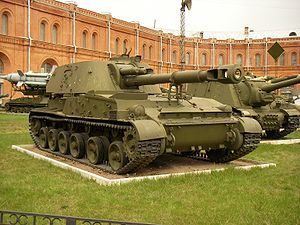
Nuclear artillery is a subset of limited-yield tactical nuclear weapons, in particular those weapons that are launched from the ground at battlefield targets...
s, land mine
Land mine
A land mine is usually a weight-triggered explosive device which is intended to damage a target—either human or inanimate—by means of a blast and/or fragment impact....
s, depth charge
Depth charge
A depth charge is an anti-submarine warfare weapon intended to destroy or cripple a target submarine by the shock of exploding near it. Most use explosives and a fuze set to go off at a preselected depth in the ocean. Depth charges can be dropped by either surface ships, patrol aircraft, or from...
s, and torpedo
Torpedo
The modern torpedo is a self-propelled missile weapon with an explosive warhead, launched above or below the water surface, propelled underwater towards a target, and designed to detonate either on contact with it or in proximity to it.The term torpedo was originally employed for...
es for anti-submarine warfare
Anti-submarine warfare
Anti-submarine warfare is a branch of naval warfare that uses surface warships, aircraft, or other submarines to find, track and deter, damage or destroy enemy submarines....
. Also in this category are nuclear armed ground-based or shipborne surface-to-air missiles (SAMs) and air-to-air missile
Air-to-air missile
An air-to-air missile is a missile fired from an aircraft for the purpose of destroying another aircraft. AAMs are typically powered by one or more rocket motors, usually solid fuelled but sometimes liquid fuelled...
s.
Small, two-man portable, or truck-portable, tactical weapons (sometimes misleadingly referred to as suitcase nuke
Suitcase nuke
A suitcase nuke is a tactical nuclear weapon which uses, or is portable enough that it could use, a suitcase as its delivery method. Synonyms include suitcase bomb, backpack nuke, mini-nuke, pocket nuke and snuke....
s), such as the Special Atomic Demolition Munition
Special Atomic Demolition Munition
The Special Atomic Demolition Munition was a family of man-portable nuclear weapons fielded by the US military in the 1960s, but never used in actual combat. The US Army planned to use the weapons in Europe in the event of a Soviet invasion...
and the Davy Crockett recoilless rifle
Davy Crockett (nuclear device)
The M-28 or M-29 Davy Crockett Weapon System was a tactical nuclear recoilless gun for firing the M388 nuclear projectile that was deployed by the United States during the Cold War...
, have been developed, although the difficulty of combining sufficient yield with portability could limit their military utility. In wartime, such explosives could be used for demolishing "choke-points" to enemy offensives, such as at tunnel
Tunnel
A tunnel is an underground passageway, completely enclosed except for openings for egress, commonly at each end.A tunnel may be for foot or vehicular road traffic, for rail traffic, or for a canal. Some tunnels are aqueducts to supply water for consumption or for hydroelectric stations or are sewers...
s, narrow mountain passes, and long viaduct
Viaduct
A viaduct is a bridge composed of several small spans. The term viaduct is derived from the Latin via for road and ducere to lead something. However, the Ancient Romans did not use that term per se; it is a modern derivation from an analogy with aqueduct. Like the Roman aqueducts, many early...
s.
Other new tactical weapons undergoing research include earth penetrating weapons which are designed to target enemy-held caves or deep-underground bunkers.
There is no precise definition of the "tactical" category, neither considering range nor yield of the nuclear weapon
Nuclear weapon yield
The explosive yield of a nuclear weapon is the amount of energy discharged when a nuclear weapon is detonated, expressed usually in the equivalent mass of trinitrotoluene , either in kilotons or megatons , but sometimes also in terajoules...
. The yield of tactical nuclear weapons is generally lower than that of strategic nuclear weapons, but they are still very powerful, and some variable-yield warheads serve in both roles. Modern tactical nuclear warheads have yields up to the tens of kilotons, or potentially hundreds, several times that of the weapons used in the atomic bombings of Hiroshima and Nagasaki
Atomic bombings of Hiroshima and Nagasaki
During the final stages of World War II in 1945, the United States conducted two atomic bombings against the cities of Hiroshima and Nagasaki in Japan, the first on August 6, 1945, and the second on August 9, 1945. These two events are the only use of nuclear weapons in war to date.For six months...
.
Some tactical nuclear weapons have specific features meant to enhance their battlefield characteristics, such as variable yield
Variable yield
Variable yield — or dial-a-yield — is an option available on most modern nuclear weapons. It allows the operator to specify a weapon's yield, or explosive power, allowing a single design to be used in different situations...
which allow their explosive power to be varied over a wide range for different situations, or enhanced radiation weapons (the so-called "neutron bomb
Neutron bomb
A neutron bomb or enhanced radiation weapon or weapon of reinforced radiation is a type of thermonuclear weapon designed specifically to release a large portion of its energy as energetic neutron radiation rather than explosive energy...
s") which are meant to maximize ionizing radiation exposure while minimizing blast effects.
Risk of escalating a conflict
Use of tactical nuclear weapons against similarly-armed opponents carries a significant danger of quickly escalating the conflict beyond anticipated boundaries, from the tactical to the strategicStrategic nuclear weapon
A strategic nuclear weapon refers to a nuclear weapon which is designed to be used on targets as part of a strategic plan, such as nuclear missile bases, military command centers and heavily populated civilian areas such as large towns and cities....
. Ironically, the smallest tactical nuclear warheads with the lowest-yields are the most dangerous in this respect because they greatly reduce the threshold for starting nuclear warfare i.e. there is, naturally, much less reluctance to use a nuclear weapon with a destructive yield of 10 tons of TNT (e.g. the W54
W54
The W54 was the smallest nuclear warhead deployed by the United States. It was a very compact implosion-type nuclear weapon design, designed for tactical use and had a very low yield for a nuclear weapon.- Development :...
warhead design) at times of crisis than there is for a warhead with a yield of 100 kilotons.
Nuclear artillery
Nuclear artillery is a subset of limited-yield tactical nuclear weapons, in particular those weapons that are launched from the ground at battlefield targets...
shell similar to the W48
W48
The W48 was an American nuclear artillery shell, fired from a standard 155 mm howitzer e.g. the M114 or M198. It was manufactured starting in 1963, and all units were retired in 1992....
(with a yield equivalent to 72 tons of TNT) at the enemy invites retaliation. It may provoke the enemy into responding with several nuclear artillery shells similar to the W79
W79
The W79 was an American nuclear artillery shell, fired from any standard 8 inch howitzer e.g. the M115.The W79 was produced in two models, the "W79 Mod 0" and "W79 Mod 1"...
, which had a 1 kiloton yield. The response to these 1 kiloton nuclear artillery shells may be to retaliate by firing a tactical nuclear missile similar to a French
France
The French Republic , The French Republic , The French Republic , (commonly known as France , is a unitary semi-presidential republic in Western Europe with several overseas territories and islands located on other continents and in the Indian, Pacific, and Atlantic oceans. Metropolitan France...
Pluton
Pluton (missile)
The Pluton missile was a French nuclear-armed short-range ballistic missile system launched from a transporter erector launcher platform mounted on an AMX 30 tank chassis. It was designed to provide the tactical part of French nuclear deterrence during the Cold War.The Pluton came in replacement...
(15 kiloton yield) or the American MGM-52 Lance, fitted with a W70
W70
W70 is the designation for a tactical nuclear warhead developed by the United States in the early 1970s. The Lawrence Livermore National Laboratory designed W70 was used on the MGM-52 Lance. About 1250 were built in total. The warhead had a variable yield of between 1 and 100 kilotons, selectable...
variable yield
Variable yield
Variable yield — or dial-a-yield — is an option available on most modern nuclear weapons. It allows the operator to specify a weapon's yield, or explosive power, allowing a single design to be used in different situations...
warhead ranging between 1 and 100 kilotons. Clearly, by using tactical nuclear weapons there is a high risk of escalating the conflict until it reaches a tipping point
Tipping point
In sociology, a tipping point is the event of a previously rare phenomenon becoming rapidly and dramatically more common. The phrase was coined in its sociological use by Morton Grodzins, by analogy with the fact in physics that adding a small amount of weight to a balanced object can cause it to...
which provokes the use of strategic nuclear weapons such as ICBMs. Additionally, the tactical nuclear weapons most likely to be used first (i.e. the smallest, low-yield weapons such as nuclear artillery
Nuclear artillery
Nuclear artillery is a subset of limited-yield tactical nuclear weapons, in particular those weapons that are launched from the ground at battlefield targets...
dating from the 1960s) have usually been under less stringent political control at times of military combat crises than strategic weapons. Early Permissive Action Link
Permissive Action Link
A Permissive Action Link is a security device for nuclear weapons. Its purpose is to prevent unauthorized arming or detonation of the nuclear weapon.The United States Department of Defense definition is:...
s could be as simple as a mechanical combination lock. If a relatively junior officer in control of a small tactical nuclear weapon (e.g. the M29 Davy Crockett
Davy Crockett (nuclear device)
The M-28 or M-29 Davy Crockett Weapon System was a tactical nuclear recoilless gun for firing the M388 nuclear projectile that was deployed by the United States during the Cold War...
) were in imminent danger of being overwhelmed by enemy forces, he could request permission to fire it and due to decentralised control of warhead authorization, his request might quickly be granted during a crisis.
For these reasons, stockpiles of tactical nuclear warheads in most countries' arsenals have been dramatically reduced circa 2010, and the smallest types have been completely eliminated. Additionally, the increased sophistication of "Category F" PAL
Permissive Action Link
A Permissive Action Link is a security device for nuclear weapons. Its purpose is to prevent unauthorized arming or detonation of the nuclear weapon.The United States Department of Defense definition is:...
mechanisms and their associated communications infrastructure mean that centralised control of tactical nuclear warheads (by the country's most senior political leaders) can now be retained, even during combat.
Some variable yield
Variable yield
Variable yield — or dial-a-yield — is an option available on most modern nuclear weapons. It allows the operator to specify a weapon's yield, or explosive power, allowing a single design to be used in different situations...
nuclear warheads such as the B61 nuclear bomb
B61 nuclear bomb
The B61 nuclear bomb is the primary thermonuclear weapon in the U.S. Enduring Stockpile following the end of the Cold War. It is an intermediate yield strategic and tactical nuclear weapon featuring a two-stage radiation implosion design....
have been produced in both tactical and strategic versions. Whereas the lowest selectable yield of a tactical B61 (Mod 3 and Mod 4) is 0.3 kilotons (300 tons), modern PAL mechanisms ensure that centralised political control is maintained over each weapon, including their destructive yields.
With the introduction of the B61 Mod 12, the United States will have four hundred identical nuclear bombs whose strategic or tactical nature will be set purely by the type of aircraft on which they are carried.
Treaty control
Ten NATO member countries have advanced a confidence building plan for NATO and Russia that could lead to treaties to reduce the tactical nuclear weapons in Europe.Examples
- W33 (nuclear weapon)
- B57 nuclear bombB57 nuclear bombThe B57 nuclear bomb was a tactical nuclear weapon developed by the United States during the Cold War.Entering production in 1963 as the Mk 57, the bomb was designed to be dropped from high-speed tactical aircraft. It had a streamlined casing to withstand supersonic flight. It was 3 m long, with a...
- W25 (nuclear warhead)
- :Category:Nuclear mines
- Blue PeacockBlue PeacockBlue Peacock, renamed from Blue Bunny and originally dubbed Brown Bunny, was the codename of a British tactical nuclear weapon project in the 1950s—dubbed the chicken-powered nuclear bomb by the press....
- Medium Atomic Demolition MunitionMedium Atomic Demolition MunitionMedium Atomic Demolition Munition was a tactical nuclear weapon developed by the United States during the Cold War. They were designed to be used as nuclear land mines and for other tactical purposes, with a relatively low explosive yield from a W45 warhead, between 1 and 15 kilotons. Each MADM...
- Medium Atomic Demolition Munition
- M-388 Davy CrockettDavy Crockett (nuclear device)The M-28 or M-29 Davy Crockett Weapon System was a tactical nuclear recoilless gun for firing the M388 nuclear projectile that was deployed by the United States during the Cold War...
- Red BeardRed Beard (nuclear weapon)Red Beard was the first British tactical nuclear weapon. It was carried by the English Electric Canberra and the V bombers of the Royal Air Force, and by the Blackburn Buccaneers, Sea Vixens and Supermarine Scimitars of the Royal Navy's Fleet Air Arm...
- Special Atomic Demolition MunitionSpecial Atomic Demolition MunitionThe Special Atomic Demolition Munition was a family of man-portable nuclear weapons fielded by the US military in the 1960s, but never used in actual combat. The US Army planned to use the weapons in Europe in the event of a Soviet invasion...
- W85W85The W85 was a thermonuclear warhead developed by the United States of America to arm the Pershing II missile. It had a variable yield— often referred to as "dial-a-yield" — which could be set between 5 and 80 kilotons.-Overview:...