
All Topics  
Tank gun

 
Tank Gun

   Email Print
   Bookmark   Link


Tank gun


A tank gun is the main armament of a tank
Tank

A tank is a Continuous track, armoured fighting vehicle designed for front-line combat which combines operational mobility and Military tactics Offensive and defence capabilities....
. Modern tank guns are large-caliber
Caliber

The term caliber designates the inside diameter of a tube, the diameter of a solid wire or rod, or a measurement of the length of a gun relative to its diameter....
 high-velocity guns, capable of firing kinetic energy penetrator
Kinetic energy penetrator

A kinetic energy penetrator is a type of ammunition which, like a bullet, does not contain explosives and uses kinetic energy to penetrate the target....
s, high explosive anti-tank
High explosive anti-tank

High Explosive Anti-Tank rounds are made of an explosive shaped charge that uses the Neumann effect to create a very high-velocity jet of metal in a state of superplasticity that can punch through solid vehicle armour....
 rounds, and in some cases guided missile
Guided Missile

Guided Missile is a London based independent record label set up by Paul Kearney in 1994 in music.Guided Missile has always focused on 'the underground', preferring to put out a steady flow of considered and quality releases and developing the numerous and now essential GM...
s.

guns are a specific field of weapon design that meet the particular needs of the tank
Tank

A tank is a Continuous track, armoured fighting vehicle designed for front-line combat which combines operational mobility and Military tactics Offensive and defence capabilities....
.


Discussion
Ask a question about 'Tank gun'
Start a new discussion about 'Tank gun'
Answer questions from other users
Full Discussion Forum


Encyclopedia


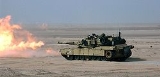
M1 A1 Abrams Fire
A tank gun is the main armament of a tank
Tank

A tank is a Continuous track, armoured fighting vehicle designed for front-line combat which combines operational mobility and Military tactics Offensive and defence capabilities....
. Modern tank guns are large-caliber
Caliber

The term caliber designates the inside diameter of a tube, the diameter of a solid wire or rod, or a measurement of the length of a gun relative to its diameter....
 high-velocity guns, capable of firing kinetic energy penetrator
Kinetic energy penetrator

A kinetic energy penetrator is a type of ammunition which, like a bullet, does not contain explosives and uses kinetic energy to penetrate the target....
s, high explosive anti-tank
High explosive anti-tank

High Explosive Anti-Tank rounds are made of an explosive shaped charge that uses the Neumann effect to create a very high-velocity jet of metal in a state of superplasticity that can punch through solid vehicle armour....
 rounds, and in some cases guided missile
Guided Missile

Guided Missile is a London based independent record label set up by Paul Kearney in 1994 in music.Guided Missile has always focused on 'the underground', preferring to put out a steady flow of considered and quality releases and developing the numerous and now essential GM...
s.

Overview

Tank guns are a specific field of weapon design that meet the particular needs of the tank
Tank

A tank is a Continuous track, armoured fighting vehicle designed for front-line combat which combines operational mobility and Military tactics Offensive and defence capabilities....
. They must provide accuracy, range, penetration, and rapid fire in a package that is as compact and lightweight as possible, to allow mounting in the cramped confines of an armored turret. As the tank's primary armament, they are almost always employed in a direct-fire mode to defeat a variety of ground targets at all ranges, including dug-in infantry, lightly-armored vehicles, and especially other heavily-armor
Vehicle armour

Armoured fighting vehicles are commonly armoured to withstand the impact of shrapnel, bullets, missiles, or shell s, protecting the personnel inside from enemy fire....
ed tanks. They use self-contained ammunition, allowing rapid loading (or use of an autoloader
Autoloader

An auto-loader or autoloader is a mechanical aid or replacement for the personnel that load Ammunition into crew-served weapons, such as tanks and artillery....
). They often show a bulge in the barrel, which is a bore evacuator
Bore evacuator

A bore evacuator is a device on the gun barrel of an armoured fighting vehicle which helps prevent poisonous propellant gases from venting back into the vehicle's fighting compartment when the gun breech is opened to load another shell ....
, or a device on the muzzle
Muzzle

A muzzle can be:* The snout of an animal* Muzzle , a device that covers an animal's muzzle* Muzzle , the mouth of a firearm* Muzzle , a song on The Smashing Pumpkins' album Mellon Collie and the Infinite Sadness released in 1995...
, which is a muzzle brake
Muzzle brake

Muzzle brakes and recoil compensators are devices that are fitted to the firearm muzzle of a firearm or cannon to redirect propellant gases with the effect of countering both recoil of the gun and unwanted rising of the barrel during rapid fire....
.

History


World War I

German Photo With English Tank
The first tanks were used to break through trench defences in support of infantry
Infantry

Infantry are soldiers who are primarily trained for the role of fighting on foot. A soldier in the infantry is known as an infantryman. Infantry units have more physically demanding training than other branches of armies, and place a greater emphasis on fitness, physical strength and aggression....
 actions particularly machine gun
Machine gun

A machine gun is a Automatic firearm mounted or portable firearm, usually designed to fire List of rifle cartridgess in quick succession from an Belt or large-capacity Magazine , typically at a rate of several hundred rounds per minute....
 positions during the First World War
World War I

World War I, or the First World War , was a global military conflict which involved the Great powers, organized into two opposing military alliances: the Allies of World War I and the Central Powers....
 and they were fitted with machine guns or high explosive firing guns of modest calibre. These were naval or field artillery
Artillery

Artillery is a military Combat Arms which employs any apparatus, machine, an assortment of tools or instruments, a system or systems used as weapons for the discharge of large projectiles in combat as a major contribution of fire power within the overall military capability of an armed force....
 pieces stripped from their carriages and mounted in turret
Turret

In architecture, a turret is a small tower that projects vertically from the wall of a building such as a medieval castle. Turrets were used to provide a projecting defensive position allowing covering fire to the adjacent wall in the days of fort....
s or sponson
Sponson

Sponsons are projections from the sides of a watercraft, for protection, Instantaneous stability, or the mounting of equipment such as armaments or lifeboats, etc....
s on armored vehicles. The early British Mark I tanks
Mark I tank

The British Mark I was the world's first combat tank, entering service in the middle of World War I, born of the need to break the domination of trenches and machine guns over the battlefields of the Western Front ....
 of 1916 utilised naval 57-mm Hotchkiss guns
QF 6 pounder Hotchkiss

The QF 6 pounder Hotchkiss was a light 57 mm naval gun and coast defence gun of the late 1800s used by many countries, and was adapted for use in the Mark I tank in World War I....
 ("6-pounders") mounted at the sides in sponsons. These guns proved too long for use in the British tank designs as they would come into contact with obstacles and the ground on uneven terrain, and the succeeding Mark IV tank
Mark I tank

The British Mark I was the world's first combat tank, entering service in the middle of World War I, born of the need to break the domination of trenches and machine guns over the battlefields of the Western Front ....
 of 1917 was equipped with the shortened 6 pounder 6 cwt
QF 6 pounder 6 cwt Hotchkiss

The Ordnance QF 6 pounder 6 cwt Hotchkiss Mk 1 and Mk 2 was a shortened version of the original QF 6 pounder Hotchkiss, and was developed specifically for use in the sponsons of the later Marks of British tanks in World War I, from Mark I tank#Mark IV onwards....
 which can be considered the first specialised tank gun. The first German tank, the A7V
A7V

The A7V was a tank introduced by Germany in 1918, near the end of World War I. One hundred examples were ordered for the spring of 1918, but only 20 were delivered....
, utilized a similar naval gun, the 57-mm Nordenfelt captured from Russia, but mounted at the front. The early French Schneider CA1
Schneider CA1

The Schneider CA1 was the first France tank. It was inspired by the need to overcome the horrors of the trench warfare of the "World War I"....
 mounted a short 75-mm mortar on each side, while the St Chamond
St Chamond (tank)

The St Chamond was the second French heavy tank of the World War I.Overall an inadequate design born of commercial rivalry, the war ended before it was replaced by Mark I ....
 mounted a standard 75-mm field gun in the nose. The thin armour of the tanks meant that such weapons were effective against other vehicles, though the Germans fielded few tanks anyway and the Allied tanks concentrated on anti-infantry and infantry support
Infantry tank

The infantry tank was a concept developed by the United Kingdom and France in the years leading up to World War II. Infantry tanks were tanks designed to support the infantry in the attack....
 activities.

World War II

Kpfwiv
This thinking remained pervasive into the dawn of World War II
World War II

World War II, or the Second World War , was a global military conflict which involved a Participants in World War II, including all of the great powers, organised into two opposing military alliances: the Allies of World War II and the Axis powers....
, when most tank guns were still modifications of existing artillery pieces, and were expected to primarily be used against unarmored targets. The larger caliber, shorter range artillery mounting didn't go away however. Tanks intended specifically for infantry support (the infantry tank
Infantry tank

The infantry tank was a concept developed by the United Kingdom and France in the years leading up to World War II. Infantry tanks were tanks designed to support the infantry in the attack....
s) which were expected to take out emplacements and infantry concentrations carried large calibre weapons to fire large high explosive shells -- though these could be quite effective against other vehicles at close ranges.

However, other strategists saw new roles for tanks in war, and wanted more specifically developed guns tailored to these missions. The ability to destroy enemy tanks was foremost on their minds. To this end, the emerging anti-tank gun designs were modified to fit tanks. These weapons fired smaller shells, but at higher velocities with higher accuracy, improving their performance against armor. Such light guns as the QF 2-pounder
Ordnance QF 2 pounder

The Ordnance QF 2-pounder was a 40 mm United Kingdom anti-tank gun and vehicle-mounted gun, employed in the Second World War. It was actively used in the Battle of France, and during the North Africa campaign....
 (40mm) and 37 mm equipped a number of cruiser tanks in the 1930s. These weapons lacked a good high-explosive shell for attacking infantry and fortifications, and were not powerful enough to penetrate the heaviest armor.

World War II saw a leapfrog growth in all areas of military technology. Battlefield experience led to increasingly powerful weapons being adopted. 20-40mm weapons soon gave way to 50, 75, 88 and even 90-millimetre calibre. In 1939, the standard German panzer had either a 20mm or 37mm medium-velocity weapon, but by 1945 88mm high-velocity guns were common. Shells were improved to provide better penetration with harder materials and scientific shaping. All of these meant improvements in accuracy and range, although the average tank had to grow as well to carry the ammunition, mounting, and protection for these powerful guns.

Many nations devised tank destroyers
Tank destroyer

A self-propelled anti-tank gun, or tank destroyer, is a type of armoured fighting vehicle designed specifically to engage enemy armor forces, and not produced for an infantry support role....
 during the war, with the Germans re-purposing captured 76.2mm Russian field artillery and Czech tank chassis to form the potent Marder
Marder II

The Marder II was a Nazi Germany tank destroyer of World War II based on the Panzer II chassis....
 tank destroyer. A typical tank destroyer traded armor weight for a much more powerful primary armament. Some of these lacked turrets, with a limited-traverse weapon mount only.

During the Second World War, the British produced some variants of their tanks with howitzers, notably the Churchill tank
Churchill tank

The Tank, Infantry, Mk IV was a heavy United Kingdom infantry tank used in the World War II, best known for its heavy armour and its use as the basis of many specialist vehicles....
 which had a hull mounted gun similar to the contemporary French Char B as well as a turret gun. This was dropped as an unworkable idea and the majority of British "Close Support" (CS) tanks had their turret gun replaced with a howitzer or similar as with the Centaur CS with its 95 mm HE firing gun.

After World War II

By the end of the war the variety in tank designs was narrowed and the concept of the main battle tank emerged. After World War II, the race to increase caliber slowed. Slight increases were made between tank generations. In the West, guns of around 90 mm gave way to the ubiquitous 105 mm L7
Royal Ordnance L7

The Royal Ordnance L7 is the basic model of United Kingdom most successful tank gun. The L7 was a 105 mm L/52 rifled design intended for use in armoured fighting vehicles....
. This lasted a long while with a shift to 120 mm in the 1970s and 80s (the UK changed in the late 60s with their Chieftain tank
Chieftain tank

The FV 4201 Chieftain was the main battle tank of the United Kingdom during the 1960s and 1970s. It was one of the most advanced tanks of its era, and at the time of its introduction in 1966 had the most powerful main gun and heaviest armour of any tank in the world ....
). In the East, the 85 mm quickly yielded to the 100 mm and 115 mm gun, with the 125 mm caliber now standard. Most of the improvements were instead made in ammunition and fire control system
Fire-control system

A fire-control system is a computer, often mechanical, which is designed to assist a weapon system in hitting its target. It performs the same task as a human gunner firing a weapon, but attempts to do so faster and more accurately....
s.

With kinetic energy penetrator
Kinetic energy penetrator

A kinetic energy penetrator is a type of ammunition which, like a bullet, does not contain explosives and uses kinetic energy to penetrate the target....
 rounds, solid shot and armour-piercing shell gave way to armour-piercing discarding sabot
Sabot

A sabot is a device used in a firearm or cannon to fire a projectile, such as a bullet, that is smaller than the caliber diameter. The term is also applied to a battery stub case, a device used similarly to make a small battery usable instead of a List of battery sizes one....
(APDS) (a product of 1944), and fin-stabilized (APFSDS) rounds with tungsten or depleted uranium
Depleted uranium

Depleted uranium is uranium primarily composed of the isotope uranium-238 . Natural uranium is about 99.27 percent U-238, 0.72 percent uranium-235, and 0.0055 percent uranium-234....
 penetrators. Parallel developments brought rounds based on chemical energy; High explosive squash head
High explosive squash head

High explosive squash head is a type of explosive ammunition that is effective against buildings and is also used against tank vehicle armour....
 (HESH), and shaped-charge High explosive anti-tank
High explosive anti-tank

High Explosive Anti-Tank rounds are made of an explosive shaped charge that uses the Neumann effect to create a very high-velocity jet of metal in a state of superplasticity that can punch through solid vehicle armour....
 (HEAT). These had the same penetrating power irrespective of muzzle velocity or range.

Stadiametric range-finders were successively replaced by coincidence
Parallax

Parallax is an apparent displacement or difference of orientation of an object viewed along two different lines of sight, and is measured by the angle or semi-angle of inclination between those two lines....
 and laser rangefinders. Accuracy of modern tank guns is pushed to the limits by computerized fire control systems, wind sensors, and muzzle referencing systems which compensate for barrel warping, wear and temperature. Fighting capability at night, in poor weather and smoke was improved by infrared
Infrared

Infrared radiation is electromagnetic radiation whose wavelength is longer than that of visible light , but shorter than that of terahertz radiation and microwaves ....
, light-intensification
Image intensifier

Image Intensifier Tube A vacuum tube device for increasing the intensity of available light in an optical system to allow use under low light conditions such as as night, to facilitate visual imaging of low-light processes such as flourescence of materials to X-rays or Gamma rays, or for conversion of non-visible light sources to visible ...
, and thermal imaging equipment.

Gun technology has had only a few innovations. Throughout the history of tank guns, they have almost exclusively been rifled
Rifling

Rifling is the helix-shaped pattern in the Gun barrel of a gun or firearm, which imparts a spin to a projectile around its long axis. This spin serves to gyroscope stabilize the projectile, improving its Aerodynamics stability and accuracy....
 weapons. Rifling of the barrel imparts spin on the projectile, improving ballistic accuracy. The best traditional antitank weapons have been kinetic energy rounds, whose penetrating power and accuracy decrease with range. For longer ranges, high explosive anti-tank
High explosive anti-tank

High Explosive Anti-Tank rounds are made of an explosive shaped charge that uses the Neumann effect to create a very high-velocity jet of metal in a state of superplasticity that can punch through solid vehicle armour....
 rounds are better, but accuracy still suffers and for extremely long ranges, anti-tank guided missile
Anti-tank guided missile

An anti-tank guided missile or anti-tank guided weapon is a Missile guidance missile primarily designed to hit and destroy heavily-armored tanks and other armored fighting vehicles....
s (ATGMs) are considered to have a better chance of hitting the target.

The use of autoloaders has been a development favoured by some nations and not others. Some countries adopted it as a means to keep the overall size of the tank down. Interest has also been shown as a means to protect the crew by separating them further from the gun and ammunition.

Smoothbore guns

In the 1960s smoothbore
Smoothbore

A smoothbore weapon is one which has a gun barrel without rifling. Smoothbores range from handheld firearms to powerful tank guns and large artillery mortar s....
 tank guns were developed by the Soviet Union
Soviet Union

The Union of Soviet Socialist Republics was a Constitution of the Soviet Union socialist state that existed in Eurasia from 1922 to 1991.The name is a translation of the , romanization of Russian Soyuz Sovetskikh Sotsialisticheskikh Respublik, abbreviated ????, SSSR....
 and by the experimental U.S.–German MBT-70
MBT-70

The MBT-70 was a 1960s joint Germany -United States-project to develop a new main battle tank using a number of advanced design features. It used a kneeling suspension, housed the entire crew in the turret, and the American version incorporated a gun-fired Shillelagh missile....
 project. Based on their experience with the gun/missile system of the BMP-1
BMP-1

BMP-1 is a Soviet Union amphibious tracked infantry fighting vehicle. BMP stands for Boyevaya Mashina Pekhoty , meaning "fighting vehicle of infantry") ....
, the Soviets produced the T-64
T-64

The T-64 is a Soviet Union tank, introduced in the early 1960s. It was used solely by the Soviet Army in its front-line divisions and was a more advanced counterpart to the T-62....
B main battle tank, with an auto-loaded 125 mm smoothbore high-velocity tank gun, capable of firing APFSDS ammunition as well as ATGMs. Similar guns continue to be used in the latest Russia
Russia

Russia , or the Russian Federation , is a list of countries spanning more than one continent country extending over much of northern Eurasia....
n T-90
T-90

The T-90 is a Russian main battle tank derived from the T-72, and is currently the most modern tank in service with the Russian Ground Forces and Naval Infantry ....
 and Ukrainian
Ukraine

Ukraine is a country in Eastern Europe. It is bordered by Russia to the east; Belarus to the north; Poland, Slovakia, and Hungary to the west; Romania and Moldova to the southwest; and the Black Sea and Sea of Azov to the south....
 T-84
T-84

The T-84 is a Ukraine main battle tank, a development of the Soviet T-80 main battle tank. It was first built in 1994 and entered service in the Ukrainian Armed Forces in 1999....
 MBTs. The German company Rheinmetall
Rheinmetall

Rheinmetall Aktiengesellschaft is a Germany automotive and defense industry company with factories in D?sseldorf, Kassel and Unterl??.It was founded on 13th April 1889 by Heinrich Ehrhardt, with help from a consortium of banks, as Rheinische Metallwaren- und Maschinenfabrik Aktiengesellschaft....
 developed a more conventional 120 mm smoothbore tank gun which does not fire missiles, adopted for the Leopard 2
Leopard 2

The Leopard 2 is a Germany main battle tank developed by Krauss-Maffei in the early 1970s and first entering service in 1979. The Leopard 2 replaced the earlier Leopard MBT as the main battle tank of the German Army....
, and later the U.S. M1 Abrams
M1 Abrams

The M1 Abrams is a Tank classification#Main battle tank produced in the United States. The M1 is named after General Creighton Abrams, former Army Chief of Staff of the United States Army and Commander of US military forces in Vietnam from 1968 to 1972....
. The chief advantages of smoothbore designs are their greater suitability for fin stabilised ammunition and their greatly reduced barrel wear compared with rifled designs.

Future tank guns

The near future of the tank gun does not look likely to hold many revolutionary developments. Whereas, in the past, caliber had been limited by technological issues, now they are as large as reasonable to fit on vehicles in the size class of today's main battle tanks. Instead, the emphasis is on the electronics and the ammunition more than ever. A focus on crew survivability and technology may also lead to more tank guns with autoloaders, mounted in remote controlled turrets or on light vehicles, like the proposed Mobile Gun System.

See also

  • Artillery
    Artillery

    Artillery is a military Combat Arms which employs any apparatus, machine, an assortment of tools or instruments, a system or systems used as weapons for the discharge of large projectiles in combat as a major contribution of fire power within the overall military capability of an armed force....
  • Anti-tank guns
  • List of tank main guns
    List of tank main guns

    This is a list of tank main guns which are the primary weapon of combat for either a light tank, medium tank or heavy tank. Many tanks have other weapons installed in them such as machine guns, autocannons and small calibre mortar s....


External links

  • - up to the end of World War II, at the Russian Battlefield (battlefield.ru).