

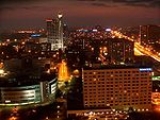
Upper Silesian Metropolitan Union

Encyclopedia
The Metropolitan Association of Upper Silesia or Upper Silesia Metroplex, Silesia Metroplex / Silesia Metroplex is a union
of 14 adjacent cities
in the Polish
province of Silesia
.
The Metropolitan Association of Upper Silesia lies within the largest urban area in Poland. Its population is 2,039,454 (2008), within a conurbation
of 2.7 million - the Katowice urban area
. It is also part of the wider Silesian metropolitan area
, with the population of 5,294,000. The union's share of Poland's Gross Domestic Product
is 8% and the combined budget of the union's participants exceeds 6 billion PLN.
It was created by a local initiative, and participation was voluntary; a majority of the local population supported the formation of the union. The intent to form the union was formally stated by the mayors of the participating cities, who signed a declaration to this effect on January 9, 2006 in Świętochłowice. The Union's registration was signed by the Ministry of Internal Affairs and Administration of the Republic of Poland (Polish: MSWiA) on 8 June 2007 with the city of Katowice
.
In 2006 and 2007, the union planned to unite these cities into one entity, "Silesia".
The aim of the union is the creation of a strong metropolitan center with pooled resources, an internationally competitive profile and unified management of common infrastructure.
.jpg) The main goals of the union include the following:
The main goals of the union include the following:
The effects of the union's activity include: improvement in managing the consortium, strengthening its economic muscle and increasing the competitive standing of the cities of the MAUS, coordination of public relations and promoting the member cities, and underscoring the importance of the region.
(the southern part of Silesia
) as well as Lesser Poland
's Zagłębie Dąbrowskie, Silesian Voivodeship
in southern Poland, within the northern portion of the Upper Silesian Coal Basin between the Vistula
and Oder rivers. Nine million people live within 100 km of Silesian Stadium at the MAUS center. Six European capitals are located within 600 kilometres from MAUS: Berlin
, Vienna
, Prague
, Bratislava
, Budapest
and Warsaw
.
The constituent cities in decreasing order by population are as follows (data of 2008):
The borders between the constituent cities have been for decades artificial, and sometimes absurd; for example, one side of a street would belong to one city and the other to another. Nationally, the union strives to address several problems including:
, Czeladź
and Knurów
) declared their willingness to join the Upper Silesia Metroplex, but due to legal issues canceled their candidacy.
has a population of 2.7 million. The area flourished in the 19th and early 20th centuries, thanks to industry and natural resources. The conurbation consists of about 40 neighbouring cities, and the Silesian metropolitan area
includes over 50 cities with a total population of 5 million. Katowice is also in the middle of a 7-million-population megalopolis
, stretching from the Kraków
region through Katowice to the Ostrava
region.
. The average temperature is 8.2 degrees Celsius
(average -1.5 °C in January, and 18 °C (64 °F) in July). Annual rainfall averages 608 mm. The area's characteristic light breezes blow at about 2 m/s from the west, through the Moravian Gate
.
.jpg) MAUS is still a prominent center of Poland's coal and metal industries, and home to about a dozen coal mines operated by Katowice Coal Holding ( Katowicki Holding Węglowy) and Coal Company ( Kompania Węglowa); several steel processing plants (Huta Baildon, Huta Ferum, Huta Batory, Huta Pokój, Huta Florian, Huta Jedność, Huta Zabrze and Huta Zgoda); a foundry of nonferrous metals (Huta Metali Nieżelaznych Szopienice); about a dozen power and generating plants (Chorzów, Halemba, Jaworzno, Łagisza, Będzin, Chorzów, EC Nowa, Katowice, Miechowice, Szombierki, Szopienice, Tychy and Zabrze); two automotive plants (FSM
MAUS is still a prominent center of Poland's coal and metal industries, and home to about a dozen coal mines operated by Katowice Coal Holding ( Katowicki Holding Węglowy) and Coal Company ( Kompania Węglowa); several steel processing plants (Huta Baildon, Huta Ferum, Huta Batory, Huta Pokój, Huta Florian, Huta Jedność, Huta Zabrze and Huta Zgoda); a foundry of nonferrous metals (Huta Metali Nieżelaznych Szopienice); about a dozen power and generating plants (Chorzów, Halemba, Jaworzno, Łagisza, Będzin, Chorzów, EC Nowa, Katowice, Miechowice, Szombierki, Szopienice, Tychy and Zabrze); two automotive plants (FSM
and General Motors
Manufacturing Poland); two plants producing military vehicles (Wojskowe Zakłady Mechaniczne and Bumar Łabędy, maker of the PT-91
battle tank), several chemical companies (including fertilizers and paints) and other industrial establishments.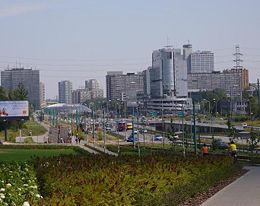
grounds and at the Spodek
arena. Katowice is also the site of the second-largest business centre in Poland (second to the Warsaw business centre). Skyscrapers are located along Chorzowska and Korfantego streets in the city centre. The newest office buildings in Katowice are the Chorzowska 50 and Altus Skyscraper
. Several other large office buildings are currently under construction (as of 2011). Katowice and MAUS house the Katowice Special Economic Zone
(Katowicka Specjalna Strefa Ekonomiczna).
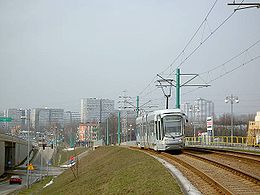 Public transportation consists of four branches. Additional services are operated by private companies and the state-owned railways (regional rail
).
- one of the largest tram
systems in the world, in existence since 1894. The system extends more than 50 kilometers east-west, covering the following cities of the union and adjacent communities: Katowice, Będzin, Bytom, Chorzów, Czeladź, Dąbrowa Górnicza, Gliwice, Mysłowice, Ruda Śląska, Siemianowice Śląskie, Sosnowiec, Świętochłowice, and Zabrze.
, located some 30 km north of Katowice
's centre. With over 20 international and domestic destinations, it is by far the biggest airport in Silesia (with about 2.5 million passengers served in 2008). As of 2011, it is the third-busiest airport in Poland and growing rapidly. In July 2007 Terminal B was added, increasing the airport's capacity to 3.6 million passengers per year. Besides passenger traffic, the airport is also Poland's second-largest cargo airport, limited only by the size of the existing cargo terminal. Airlines operating from the airport include: Air France
, Centralwings
, EuroLOT
, LOT
, Lufthansa
and Wizz Air
. There are proposals to convert the sport-aviation-serving Katowice-Muchowiec Airport
into a city airport, a second international airport for lower, business-oriented traffic.
with numerous regional, national and international passenger destinations. There are direct connections to Berlin, Hamburg, Vienna, Prague, Zilina (in Slovakia), Budapest, Kiev and Moscow. There are two other major hubs (Gliwice and Sosnowiec) and many smaller stations.
Silesian rail has a long and proud tradition, starting in 1846 when the first railroad (the Upper Silesia Railway, at that time called Oberschlesische Eisenbahn) reached the area. MAUS still contains some of the main railway nodes and exchange points of Silesia and Poland.
, is notable for its ability to transport goods directly between the area covered by the Metropolitan Association of Upper Silesia and the countries of the former Soviet Union.
railway in Europe. 785 mm (2 ft 6 9⁄10 in) lines are found only in the Upper Silesia region. Former industrial trains today provide a service for tourists from Bytom to the local 'lake district' and other attractions. A 900 mm (2 ft 11 1⁄2 in) recreational line 4.2 km long still operates in the Amusement-Recreation Park in Chorzów, Upper Silesia.
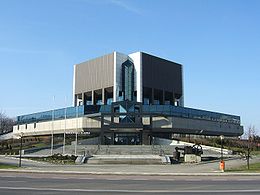 The area is the second-largest academic centre in Poland (after Warsaw). It is home to seven major universities
and many smaller schools of higher education. The most important institutions of post-secondary education are:
Political union
A political union is a type of state which is composed of or created out of smaller states. Unlike a personal union, the individual states share a common government and the union is recognized internationally as a single political entity...
of 14 adjacent cities
City
A city is a relatively large and permanent settlement. Although there is no agreement on how a city is distinguished from a town within general English language meanings, many cities have a particular administrative, legal, or historical status based on local law.For example, in the U.S...
in the Polish
Poland
Poland , officially the Republic of Poland , is a country in Central Europe bordered by Germany to the west; the Czech Republic and Slovakia to the south; Ukraine, Belarus and Lithuania to the east; and the Baltic Sea and Kaliningrad Oblast, a Russian exclave, to the north...
province of Silesia
Silesian Voivodeship
Silesian Voivodeship, or Silesia Province , is a voivodeship, or province, in southern Poland, centering on the historic region known as Upper Silesia...
.
The Metropolitan Association of Upper Silesia lies within the largest urban area in Poland. Its population is 2,039,454 (2008), within a conurbation
Conurbation
A conurbation is a region comprising a number of cities, large towns, and other urban areas that, through population growth and physical expansion, have merged to form one continuous urban and industrially developed area...
of 2.7 million - the Katowice urban area
Katowice urban area
The Katowice urban area, also known as the Upper Silesian urban area, is an urban area/conurbation in southern Poland. It is located in the Silesian Voivodeship and in a small part of the Lesser Poland Voivodeship. The Katowice urban area is the largest urban area in Poland and one of the largest...
. It is also part of the wider Silesian metropolitan area
Silesian metropolitan area
The Upper Silesian metropolitan area is the metropolitan area in southern Poland and northeast Czech Republic, centered on the cities of Katowice and Ostrava in Silesia...
, with the population of 5,294,000. The union's share of Poland's Gross Domestic Product
Gross domestic product
Gross domestic product refers to the market value of all final goods and services produced within a country in a given period. GDP per capita is often considered an indicator of a country's standard of living....
is 8% and the combined budget of the union's participants exceeds 6 billion PLN.
It was created by a local initiative, and participation was voluntary; a majority of the local population supported the formation of the union. The intent to form the union was formally stated by the mayors of the participating cities, who signed a declaration to this effect on January 9, 2006 in Świętochłowice. The Union's registration was signed by the Ministry of Internal Affairs and Administration of the Republic of Poland (Polish: MSWiA) on 8 June 2007 with the city of Katowice
Katowice
Katowice is a city in Silesia in southern Poland, on the Kłodnica and Rawa rivers . Katowice is located in the Silesian Highlands, about north of the Silesian Beskids and about southeast of the Sudetes Mountains.It is the central district of the Upper Silesian Metropolis, with a population of 2...
.
In 2006 and 2007, the union planned to unite these cities into one entity, "Silesia".
The aim of the union is the creation of a strong metropolitan center with pooled resources, an internationally competitive profile and unified management of common infrastructure.
Goals
- Arriving at a common development strategy for the cities of the union, in accordance with the current law governing planning and land use
- Implementing projects joined by a common development strategy of the cities
- Obtaining financing from domestic and foreign funding sources
- Managing the roadways transferred to the union by its constituent cities
- Obtaining aid from the European Union
- Stimulating the job market throughout the constituent cities
- Supporting innovative economic programs, increasing the competitive standing of the cities
- Influencing legislative and decision-making processes in matters important to the union and affecting the union's activities
The effects of the union's activity include: improvement in managing the consortium, strengthening its economic muscle and increasing the competitive standing of the cities of the MAUS, coordination of public relations and promoting the member cities, and underscoring the importance of the region.
Location
The Metropolitan Association of Upper Silesia spans urban communities in the historical regions of Upper SilesiaUpper Silesia
Upper Silesia is the southeastern part of the historical and geographical region of Silesia. Since the 9th century, Upper Silesia has been part of Greater Moravia, the Duchy of Bohemia, the Piast Kingdom of Poland, again of the Lands of the Bohemian Crown and the Holy Roman Empire, as well as of...
(the southern part of Silesia
Silesia
Silesia is a historical region of Central Europe located mostly in Poland, with smaller parts also in the Czech Republic, and Germany.Silesia is rich in mineral and natural resources, and includes several important industrial areas. Silesia's largest city and historical capital is Wrocław...
) as well as Lesser Poland
Lesser Poland
Lesser Poland is one of the historical regions of Poland, with its capital in the city of Kraków. It forms the southeastern corner of the country, and should not be confused with the modern Lesser Poland Voivodeship, which covers only a small, southern part of Lesser Poland...
's Zagłębie Dąbrowskie, Silesian Voivodeship
Silesian Voivodeship
Silesian Voivodeship, or Silesia Province , is a voivodeship, or province, in southern Poland, centering on the historic region known as Upper Silesia...
in southern Poland, within the northern portion of the Upper Silesian Coal Basin between the Vistula
Vistula
The Vistula is the longest and the most important river in Poland, at 1,047 km in length. The watershed area of the Vistula is , of which lies within Poland ....
and Oder rivers. Nine million people live within 100 km of Silesian Stadium at the MAUS center. Six European capitals are located within 600 kilometres from MAUS: Berlin
Berlin
Berlin is the capital city of Germany and is one of the 16 states of Germany. With a population of 3.45 million people, Berlin is Germany's largest city. It is the second most populous city proper and the seventh most populous urban area in the European Union...
, Vienna
Vienna
Vienna is the capital and largest city of the Republic of Austria and one of the nine states of Austria. Vienna is Austria's primary city, with a population of about 1.723 million , and is by far the largest city in Austria, as well as its cultural, economic, and political centre...
, Prague
Prague
Prague is the capital and largest city of the Czech Republic. Situated in the north-west of the country on the Vltava river, the city is home to about 1.3 million people, while its metropolitan area is estimated to have a population of over 2.3 million...
, Bratislava
Bratislava
Bratislava is the capital of Slovakia and, with a population of about 431,000, also the country's largest city. Bratislava is in southwestern Slovakia on both banks of the Danube River. Bordering Austria and Hungary, it is the only national capital that borders two independent countries.Bratislava...
, Budapest
Budapest
Budapest is the capital of Hungary. As the largest city of Hungary, it is the country's principal political, cultural, commercial, industrial, and transportation centre. In 2011, Budapest had 1,733,685 inhabitants, down from its 1989 peak of 2,113,645 due to suburbanization. The Budapest Commuter...
and Warsaw
Warsaw
Warsaw is the capital and largest city of Poland. It is located on the Vistula River, roughly from the Baltic Sea and from the Carpathian Mountains. Its population in 2010 was estimated at 1,716,855 residents with a greater metropolitan area of 2,631,902 residents, making Warsaw the 10th most...
.
Districts
Outside of the area, the formation of the union appears to have less support than within it. Originally 17 cities were to enter into the union; due to technicalities in Polish law which could have prevented its legalization, only 14 of the 17 cities (that is, those with the legal status of an urban county) proceeded with forming the union.The constituent cities in decreasing order by population are as follows (data of 2008):
| District | Population | Area | Density |
|---|---|---|---|
| Katowice Katowice Katowice is a city in Silesia in southern Poland, on the Kłodnica and Rawa rivers . Katowice is located in the Silesian Highlands, about north of the Silesian Beskids and about southeast of the Sudetes Mountains.It is the central district of the Upper Silesian Metropolis, with a population of 2... |
312,201 | 164.67 km² | 1,896/km² |
| Sosnowiec Sosnowiec Sosnowiec is a city in Zagłębie Dąbrowskie in southern Poland, near Katowice. It is one of the central districts of the Upper Silesian Metropolitan Union - a metropolis with a combined population of over two million people located in the Silesian Highlands, on the Brynica river .It is situated in... |
222,586 | 91.06 km² | 2,444/km² |
| Gliwice Gliwice Gliwice is a city in Upper Silesia in southern Poland, near Katowice. Gliwice is the west district of the Upper Silesian Metropolitan Union – a metropolis with a population of 2 million... |
197,393 | 133.88 km² | 1,474/km² |
| Zabrze Zabrze Zabrze is a city in Silesia in southern Poland, near Katowice. The west district of the Upper Silesian Metropolitan Union is a metropolis with a population of around 2 million... |
189,062 | 80.40 km² | 2,352/km² |
| Bytom Bytom Bytom is a city in Silesia in southern Poland, near Katowice. The central-western district of the Upper Silesian Metropolitan Union - metropolis with the population of 2 millions. Bytom is located in the Silesian Highlands, on the Bytomka river .The city belongs to the Silesian Voivodeship since... |
184,765 | 69.44 km² | 2,661/km² |
| Ruda Śląska Ruda Slaska Ruda Śląska is a city in Silesia in southern Poland, near Katowice. It is a district in the Upper Silesian Metropolitan Union, a metropolis with a population of 2 million. It is located in the Silesian Highlands, on the Kłodnica river .... |
144,584 | 77.73 km² | 1,860/km² |
| Tychy Tychy Tychy is a city in Silesia, Poland, approximately south of Katowice. Situated on the southern edge of the Upper Silesian industrial district, the city borders Katowice to the north, Mikołów to the west, Bieruń to the east and Kobiór to the south... |
129,776 | 81.64 km² | 1,590/km² |
| Dąbrowa Górnicza Dabrowa Górnicza Dąbrowa Górnicza is a city in Zagłębie Dąbrowskie in southern Poland, nearby Katowice. The north-east district of the Upper Silesian Metropolitan Union - metropolis with the population of almost 3 millions... |
128,795 | 188.73 km² | 682/km² |
| Chorzów Chorzów Chorzów is a city in Silesia in southern Poland, near Katowice. Chorzów is one of the central districts of the Upper Silesian Metropolitan Union - a metropolis with a population of 2 million... |
113,678 | 33.24 km² | 3,420/km² |
| Jaworzno Jaworzno Jaworzno is a city in southern Poland, near Katowice. The east district of the Upper Silesian Metropolitan Union - metropolis with the population of 2 millions. Located in the Silesian Highlands, on the Przemsza river .... |
95,520 | 152.67 km² | 626/km² |
| Mysłowice | 74,912 | 65.75 km² | 1,139/km² |
| Siemianowice Śląskie Siemianowice Slaskie Siemianowice Śląskie aka Siemianowice ; is a city in Upper Silesia in southern Poland, near Katowice. The central district of the Upper Silesian Metropolitan Union - metropolis with the population of 2 millions... |
71,621 | 25.5 km² | 2,809/km² |
| Piekary Śląskie Piekary Slaskie Piekary Śląskie is a city in Silesia in southern Poland, near Katowice. The north district of the Upper Silesian Metropolitan Union - metropolis with the population of 2 million... |
59,061 | 39.98 km² | 1,477/km² |
| Świętochłowice | 54,525 | 13.31 km² | 4,097/km² |
| Total | 1,978,479 | 1,218 km² | 1,624.4/km² |
The borders between the constituent cities have been for decades artificial, and sometimes absurd; for example, one side of a street would belong to one city and the other to another. Nationally, the union strives to address several problems including:
- Poor recognition (often omitted from Polish maps)
- Under-investment (MAUS receives the lowest per-capita allocation of EUEuropean UnionThe European Union is an economic and political union of 27 independent member states which are located primarily in Europe. The EU traces its origins from the European Coal and Steel Community and the European Economic Community , formed by six countries in 1958...
development funds in Poland)
Bordering cities
Cities bordering directly on the Upper Silesia Metroplex (2008) are shown below. Some of these cities (BędzinBedzin
Będzin is a city in Zagłębie Dąbrowskie in southern Poland. Located in the Silesian Highlands, on the Czarna Przemsza river , the city borders the Upper Silesian Metropolitan Union - a metro area with a population of about 2 million.It has been situated in the Silesian Voivodeship since its...
, Czeladź
Czeladz
Czeladź is a town in Zagłębie Dąbrowskie in southern Poland, near Katowice. Borders on the Upper Silesian Metropolitan Union - metropolis with a population of 2 million. Located in the Silesian Highlands, on the Brynica river ....
and Knurów
Knurów
Knurów is a town near Katowice in Silesia, southern Poland. Knurów borders on the Upper Silesian Metropolitan Union, a metropolis with a population of two million....
) declared their willingness to join the Upper Silesia Metroplex, but due to legal issues canceled their candidacy.
| City | Population | Area | Density |
|---|---|---|---|
| Tarnowskie Góry Tarnowskie Góry Tarnowskie Góry is a town in Silesia in southern Poland, near Katowice. Borders on the Upper Silesian Metropolitan Union - metropolis with the population of 2 millions. Located in the Silesian Highlands.... |
60,975 | 83.72 km² | 728/km² |
| Będzin Bedzin Będzin is a city in Zagłębie Dąbrowskie in southern Poland. Located in the Silesian Highlands, on the Czarna Przemsza river , the city borders the Upper Silesian Metropolitan Union - a metro area with a population of about 2 million.It has been situated in the Silesian Voivodeship since its... |
58,639 | 37.37 km² | 1,569/km² |
| Chrzanów Chrzanów Chrzanów is a town in south Poland with 39,704 inhabitants . It is situated in the Lesser Poland Voivodeship and is the capital of Chrzanów County.- To 1809:... |
39,452 | 38.32 km² | 1,030/km² |
| Knurów Knurów Knurów is a town near Katowice in Silesia, southern Poland. Knurów borders on the Upper Silesian Metropolitan Union, a metropolis with a population of two million.... |
39,449 | 33.95 km² | 1,162/km² |
| Mikołów | 38,698 | 79.20 km² | 489/km² |
| Czeladź Czeladz Czeladź is a town in Zagłębie Dąbrowskie in southern Poland, near Katowice. Borders on the Upper Silesian Metropolitan Union - metropolis with a population of 2 million. Located in the Silesian Highlands, on the Brynica river .... |
34,072 | 16.38 km² | 2,080/km² |
| Łaziska Górne | 21,942 | 20.07 km² | 1,093/km² |
| Trzebinia Trzebinia Trzebinia is a town in Chrzanów County, Lesser Poland, Poland with an Orlen oil refinery and a major rail junction of the Kraków - Katowice line that connections to Oświęcim and Spytkowice.-History:... |
20,128 | 31.94 km² | 630/km² |
| Bieruń Bierun Bieruń is a town in Upper Silesia, in southern Poland, about south of Katowice. The town belongs to the Silesian Voivodeship since its formation in 1999, previously to Katowice Voivodeship and, before World War II, was part of the Polish Autonomous Silesian Voivodeship.-Geography:It is located... |
19,464 | 40.67 km² | 479/km² |
| Pyskowice Pyskowice Pyskowice is a town in Silesia in southern Poland, near Katowice. Borders on the Upper Silesian Metropolitan Union - metropolis with the population of 2 millions. Located in the Silesian Highlands.... |
19,104 | 30.89 km² | 618/km² |
| Radzionków Radzionków Radzionków is a town in Silesia in southern Poland, near Katowice. Borders on the Upper Silesian Metropolitan Union - metropolis with the population of 2 millions. Located in the Silesian Highlands.... |
17,163 | 13.20 km² | 1,300/km² |
| Lędziny Ledziny Lędziny is a town in Silesia in southern Poland, near Katowice. It borders the Upper Silesian Metropolitan Union - a metropolis with a population of 2 million which is located in the Silesian Highlands.... |
16,262 | 31.48 km² | 517/km² |
| Wojkowice Wojkowice Wojkowice is a small town in Zagłębie Dąbrowskie in southern Poland, near Katowice. Borders on the Upper Silesian Metropolitan Union - metropolis with the population of 2 millions. Located in the Silesian Highlands, on the Brynica river .It is situated in the Silesian Voivodeship since its... |
9,368 | 12.79 km² | 732/km² |
| Imielin Imielin Imielin is a small town in Silesia in southern Poland, near Katowice. Borders on the Upper Silesian Metropolitan Union - metropolis with the population of 2 millions. Located in the Silesian Highlands.... |
8,010 | 28.00 km² | 286/km² |
| Sławków | 6,866 | 36.67 km² | 187/km² |
| Total | 409,592 | 534.65 km² | 766.1/km² |
| Total with MAUS | 2,388,071 | 1752,65 km² | 1195,25/km² |
Agglomeration
MAUS is the centre of the largest urban area in Poland and one of largest in the European Union; the Katowice urban areaKatowice urban area
The Katowice urban area, also known as the Upper Silesian urban area, is an urban area/conurbation in southern Poland. It is located in the Silesian Voivodeship and in a small part of the Lesser Poland Voivodeship. The Katowice urban area is the largest urban area in Poland and one of the largest...
has a population of 2.7 million. The area flourished in the 19th and early 20th centuries, thanks to industry and natural resources. The conurbation consists of about 40 neighbouring cities, and the Silesian metropolitan area
Silesian metropolitan area
The Upper Silesian metropolitan area is the metropolitan area in southern Poland and northeast Czech Republic, centered on the cities of Katowice and Ostrava in Silesia...
includes over 50 cities with a total population of 5 million. Katowice is also in the middle of a 7-million-population megalopolis
Megalopolis (city type)
A megalopolis is typically defined as a chain of roughly adjacent metropolitan areas. The term was used by Oswald Spengler in his 1918 book, The Decline of the West, and Lewis Mumford in his 1938 book, The Culture of Cities, which described it as the first stage in urban overdevelopment and...
, stretching from the Kraków
Kraków
Kraków also Krakow, or Cracow , is the second largest and one of the oldest cities in Poland. Situated on the Vistula River in the Lesser Poland region, the city dates back to the 7th century. Kraków has traditionally been one of the leading centres of Polish academic, cultural, and artistic life...
region through Katowice to the Ostrava
Ostrava
Ostrava is the third largest city in the Czech Republic and the second largest urban agglomeration after Prague. Located close to the Polish border, it is also the administrative center of the Moravian-Silesian Region and of the Municipality with Extended Competence. Ostrava was candidate for the...
region.
Climate
The area has a humid continental climateHumid continental climate
A humid continental climate is a climatic region typified by large seasonal temperature differences, with warm to hot summers and cold winters....
. The average temperature is 8.2 degrees Celsius
Celsius
Celsius is a scale and unit of measurement for temperature. It is named after the Swedish astronomer Anders Celsius , who developed a similar temperature scale two years before his death...
(average -1.5 °C in January, and 18 °C (64 °F) in July). Annual rainfall averages 608 mm. The area's characteristic light breezes blow at about 2 m/s from the west, through the Moravian Gate
Moravian Gate
The Moravian Gate is a geomorphological feature in the Moravian region of the Czech Republic. It is formed by the depression between the Carpathian Mountains in the east and the Sudetes in the west...
.
Economy
MAUS is an area of heavy concentration of industry, including coal, steel, energy, automotive, machinery and chemical. Over the last two decades, the service industry has become increasingly important.Industry
Fabryka Samochodów Małolitrażowych
The Fabryka Samochodów Małolitrażowych was Polish automobile factory born from an agreement between the FSO and Fiat in 1970s for the construction of a new model, the Polski Fiat 126p, Polish version of Fiat 126. For the project a new manufacturing plant was opened in Tychy...
and General Motors
General Motors
General Motors Company , commonly known as GM, formerly incorporated as General Motors Corporation, is an American multinational automotive corporation headquartered in Detroit, Michigan and the world's second-largest automaker in 2010...
Manufacturing Poland); two plants producing military vehicles (Wojskowe Zakłady Mechaniczne and Bumar Łabędy, maker of the PT-91
PT-91
The PT-91 Twardy is a Polish main battle tank. It is a development of the T-72M1 and first entered service in 1995...
battle tank), several chemical companies (including fertilizers and paints) and other industrial establishments.
Business and commerce
Katowice is a large and dynamic business and trade-fair centre. Tens of international exhibitions take place every year on the Katowice International FairKatowice International Fair
Katowice International Fair is an international trade fair in Katowice and one of the largest in Poland...
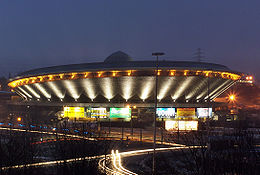
grounds and at the Spodek
Spodek
Spodek is a multipurpose arena complex in Katowice, Poland, opened in 1971 at 35 Korfanty Street under the name Wojewódzka Hala Widowiskowo-Sportowa w Katowicach , under which it is known in the Polish technical/architectural literature, and under which it formally functioned until 1997.Aside from...
arena. Katowice is also the site of the second-largest business centre in Poland (second to the Warsaw business centre). Skyscrapers are located along Chorzowska and Korfantego streets in the city centre. The newest office buildings in Katowice are the Chorzowska 50 and Altus Skyscraper
Altus Skyscraper
Altus is a skyscraper in Katowice, Silesia, Poland.The construction started in 2001 and finished in 2003. The building is 125 m high and rises 30 floors above ground. Total floor area is 68,815 m², and volume is 270,430 m³. The building surrounds a four-story atrium...
. Several other large office buildings are currently under construction (as of 2011). Katowice and MAUS house the Katowice Special Economic Zone
Special Economic Zone
A Special Economic Zone is a geographical region that has economic and other laws that are more free-market-oriented than a country's typical or national laws...
(Katowicka Specjalna Strefa Ekonomiczna).
Public Transport
Regional rail
Commuter rail, also called suburban rail, is a passenger rail transport service that primarily operates between a city center, and the middle to outer suburbs beyond 15km and commuter towns or other locations that draw large numbers of commuters—people who travel on a daily basis...
).
Trams
Silesian InterurbansSilesian Interurbans
Silesian Interurbans - one of the largest tram systems in the world has been in existence since 1894. The system is spread over more than 50 kilometres and covers thirteen towns in the Upper Silesia metropolitan area and their suburbs Silesian Interurbans - one of the largest tram (streetcar)...
- one of the largest tram
Tram
A tram is a passenger rail vehicle which runs on tracks along public urban streets and also sometimes on separate rights of way. It may also run between cities and/or towns , and/or partially grade separated even in the cities...
systems in the world, in existence since 1894. The system extends more than 50 kilometers east-west, covering the following cities of the union and adjacent communities: Katowice, Będzin, Bytom, Chorzów, Czeladź, Dąbrowa Górnicza, Gliwice, Mysłowice, Ruda Śląska, Siemianowice Śląskie, Sosnowiec, Świętochłowice, and Zabrze.
Roads
The area lacks a good circular road system; most east-west and north-south traffic goes directly through the city centre.- European route E40European route E40European route E 40 is the longest European route, more than long, connecting Calais in France via Belgium, Germany, Poland, Ukraine, Russia, Kazakhstan, Uzbekistan, Turkmenistan, and Kyrgyzstan, with Ridder in Kazakhstan near the border to China....
(FranceFranceThe French Republic , The French Republic , The French Republic , (commonly known as France , is a unitary semi-presidential republic in Western Europe with several overseas territories and islands located on other continents and in the Indian, Pacific, and Atlantic oceans. Metropolitan France...
- BelgiumBelgiumBelgium , officially the Kingdom of Belgium, is a federal state in Western Europe. It is a founding member of the European Union and hosts the EU's headquarters, and those of several other major international organisations such as NATO.Belgium is also a member of, or affiliated to, many...
- GermanyGermanyGermany , officially the Federal Republic of Germany , is a federal parliamentary republic in Europe. The country consists of 16 states while the capital and largest city is Berlin. Germany covers an area of 357,021 km2 and has a largely temperate seasonal climate...
- Upper Silesia Metroplex - UkraineUkraineUkraine is a country in Eastern Europe. It has an area of 603,628 km², making it the second largest contiguous country on the European continent, after Russia...
- RussiaRussiaRussia or , officially known as both Russia and the Russian Federation , is a country in northern Eurasia. It is a federal semi-presidential republic, comprising 83 federal subjects...
- UzbekistanUzbekistanUzbekistan , officially the Republic of Uzbekistan is a doubly landlocked country in Central Asia and one of the six independent Turkic states. It shares borders with Kazakhstan to the west and to the north, Kyrgyzstan and Tajikistan to the east, and Afghanistan and Turkmenistan to the south....
- KazakhstanKazakhstanKazakhstan , officially the Republic of Kazakhstan, is a transcontinental country in Central Asia and Eastern Europe. Ranked as the ninth largest country in the world, it is also the world's largest landlocked country; its territory of is greater than Western Europe...
) - European route E75European route E75European route E 75 is part of the International E-road network, which is a series of main roads in Europe.The E 75 starts from Vardø, Norway in the Barents Sea and runs south through Finland, Poland, Czech Republic, Slovakia, Hungary, Serbia and Republic of Macedonia to Sitia, Greece on...
(NorwayNorwayNorway , officially the Kingdom of Norway, is a Nordic unitary constitutional monarchy whose territory comprises the western portion of the Scandinavian Peninsula, Jan Mayen, and the Arctic archipelago of Svalbard and Bouvet Island. Norway has a total area of and a population of about 4.9 million...
- FinlandFinlandFinland , officially the Republic of Finland, is a Nordic country situated in the Fennoscandian region of Northern Europe. It is bordered by Sweden in the west, Norway in the north and Russia in the east, while Estonia lies to its south across the Gulf of Finland.Around 5.4 million people reside...
- Upper-Silesia Metroplex - SlovakiaSlovakiaThe Slovak Republic is a landlocked state in Central Europe. It has a population of over five million and an area of about . Slovakia is bordered by the Czech Republic and Austria to the west, Poland to the north, Ukraine to the east and Hungary to the south...
- HungaryHungaryHungary , officially the Republic of Hungary , is a landlocked country in Central Europe. It is situated in the Carpathian Basin and is bordered by Slovakia to the north, Ukraine and Romania to the east, Serbia and Croatia to the south, Slovenia to the southwest and Austria to the west. The...
- SerbiaSerbiaSerbia , officially the Republic of Serbia , is a landlocked country located at the crossroads of Central and Southeast Europe, covering the southern part of the Carpathian basin and the central part of the Balkans...
- MacedoniaRepublic of MacedoniaMacedonia , officially the Republic of Macedonia , is a country located in the central Balkan peninsula in Southeast Europe. It is one of the successor states of the former Yugoslavia, from which it declared independence in 1991...
- CroatiaCroatiaCroatia , officially the Republic of Croatia , is a unitary democratic parliamentary republic in Europe at the crossroads of the Mitteleuropa, the Balkans, and the Mediterranean. Its capital and largest city is Zagreb. The country is divided into 20 counties and the city of Zagreb. Croatia covers ...
- CreteCreteCrete is the largest and most populous of the Greek islands, the fifth largest island in the Mediterranean Sea, and one of the thirteen administrative regions of Greece. It forms a significant part of the economy and cultural heritage of Greece while retaining its own local cultural traits...
) - European route E462 (Czech RepublicCzech RepublicThe Czech Republic is a landlocked country in Central Europe. The country is bordered by Poland to the northeast, Slovakia to the east, Austria to the south, and Germany to the west and northwest....
- Upper-Silesian Metroplex) - Motorway A1 (CzechCzech RepublicThe Czech Republic is a landlocked country in Central Europe. The country is bordered by Poland to the northeast, Slovakia to the east, Austria to the south, and Germany to the west and northwest....
- Upper Silesia Metroplex - TricityTricityTricity is an urban area consisting of three Polish cities: Gdańsk, Gdynia and Sopot. They are situated adjacent to one other, in a row, on the coast of the Gdańsk Bay, Baltic Sea, in Pomerelia , northern Poland...
/ Baltic SeaBaltic SeaThe Baltic Sea is a brackish mediterranean sea located in Northern Europe, from 53°N to 66°N latitude and from 20°E to 26°E longitude. It is bounded by the Scandinavian Peninsula, the mainland of Europe, and the Danish islands. It drains into the Kattegat by way of the Øresund, the Great Belt and...
) - Motorway A4 (GermanyGermanyGermany , officially the Federal Republic of Germany , is a federal parliamentary republic in Europe. The country consists of 16 states while the capital and largest city is Berlin. Germany covers an area of 357,021 km2 and has a largely temperate seasonal climate...
- Upper-Silesia Metroplex - UkraineUkraineUkraine is a country in Eastern Europe. It has an area of 603,628 km², making it the second largest contiguous country on the European continent, after Russia...
) - DK1 National Road
- DK11 National Road
- DK44 National Road
- DK78 National Road
- DK79 National Road
- DK81 National Road
- DK86 National Road
- DK88 National Road
- DK94 National Road
Airports
The MAUS area is served by Katowice International AirportKatowice International Airport
Katowice International Airport is an international airport, located in Pyrzowice, north of center of Katowice, Poland. The airport has third biggest passenger flow in Poland....
, located some 30 km north of Katowice
Katowice
Katowice is a city in Silesia in southern Poland, on the Kłodnica and Rawa rivers . Katowice is located in the Silesian Highlands, about north of the Silesian Beskids and about southeast of the Sudetes Mountains.It is the central district of the Upper Silesian Metropolis, with a population of 2...
's centre. With over 20 international and domestic destinations, it is by far the biggest airport in Silesia (with about 2.5 million passengers served in 2008). As of 2011, it is the third-busiest airport in Poland and growing rapidly. In July 2007 Terminal B was added, increasing the airport's capacity to 3.6 million passengers per year. Besides passenger traffic, the airport is also Poland's second-largest cargo airport, limited only by the size of the existing cargo terminal. Airlines operating from the airport include: Air France
Air France
Air France , stylised as AIRFRANCE, is the French flag carrier headquartered in Tremblay-en-France, , and is one of the world's largest airlines. It is a subsidiary of the Air France-KLM Group and a founding member of the SkyTeam global airline alliance...
, Centralwings
Centralwings
Centralwings was a charter airline based in Warsaw, Poland. The airline operated as a low-cost airline and then became a charter-only operation in October 2008. It was a subsidiary of LOT Polish Airlines, operating international services in Europe, using Boeing 737 aircraft...
, EuroLOT
Eurolot
EuroLOT is an airline based in Warsaw, Poland. Established as a wholly owned subsidiary of LOT Polish Airlines, its current main shareholder is the State Treasury with 62.1% of shares, while LOT retains 37.9%. It operates for its parent company as a short-haul operator, as well as ad-hoc charter...
, LOT
Lot
Lot or lots may refer to:*Lot , a unit of weight used in many European countries since Middle Ages until the beginning of the 20th century*Lot, a set of goods, together for sale in an auction; or a quantity of a financial instrument...
, Lufthansa
Lufthansa
Deutsche Lufthansa AG is the flag carrier of Germany and the largest airline in Europe in terms of overall passengers carried. The name of the company is derived from Luft , and Hansa .The airline is the world's fourth-largest airline in terms of overall passengers carried, operating...
and Wizz Air
Wizz Air
Wizz Air Hungary Légiközlekedési Kft. is a Hungarian low-cost airline with headquarters in the Airport Business Park C2 in Vecsés, close to Budapest Ferihegy International Airport, Hungary. The airline typically uses secondary airports serving many cities across Europe.- History :The airline was...
. There are proposals to convert the sport-aviation-serving Katowice-Muchowiec Airport
Katowice-Muchowiec Airport
Katowice-Muchowiec Airport is a general aviation airport in the Muchowiec neighborhood of Katowice, Poland.It has one inoperative concrete runway, RWY 05/23 with the dimensions of 1109 x 30 metres . There is a displaced threshold length of 221 meters on both RWY 05 and RWY 23, yielding a...
into a city airport, a second international airport for lower, business-oriented traffic.
Standard gauge
Train transportation in the region is inexpensive and fairly efficient. The main railroad station is the Katowice Central StationKatowice Central Station
Katowice railway station is a railway station in Katowice, Silesia, Poland and is the biggest and most important railway station in the Górnośląski Okręg Przemysłowy area. Both the domestic and the international connections run from there to almost every major city in Poland and Europe. The...
with numerous regional, national and international passenger destinations. There are direct connections to Berlin, Hamburg, Vienna, Prague, Zilina (in Slovakia), Budapest, Kiev and Moscow. There are two other major hubs (Gliwice and Sosnowiec) and many smaller stations.
Silesian rail has a long and proud tradition, starting in 1846 when the first railroad (the Upper Silesia Railway, at that time called Oberschlesische Eisenbahn) reached the area. MAUS still contains some of the main railway nodes and exchange points of Silesia and Poland.
Broad gauge
A Broad gauge railway line, Linia Hutnicza SzerokotorowaLinia Hutnicza Szerokotorowa
Broad Gauge Metallurgy Line , is the longest broad gauge railway line in Poland. Except for this one line, and a few very short stretches near border crossings, Poland uses the standard gauge for its railway tracks...
, is notable for its ability to transport goods directly between the area covered by the Metropolitan Association of Upper Silesia and the countries of the former Soviet Union.
Narrow gauge
The Metropolitan Association of Upper Silesia also inhabits an area which is home to the longest network of narrow gaugeNarrow gauge
A narrow gauge railway is a railway that has a track gauge narrower than the of standard gauge railways. Most existing narrow gauge railways have gauges of between and .- Overview :...
railway in Europe. 785 mm (2 ft 6 9⁄10 in) lines are found only in the Upper Silesia region. Former industrial trains today provide a service for tourists from Bytom to the local 'lake district' and other attractions. A 900 mm (2 ft 11 1⁄2 in) recreational line 4.2 km long still operates in the Amusement-Recreation Park in Chorzów, Upper Silesia.
Water transport
- The Gliwice CanalGliwice CanalThe Gliwice Canal is a canal connecting the Oder River to the city of Gliwice in Silesian Voivodeship , Poland...
links Gliwice Harbour to the Oder River, and thus to the waterway network across much of Germany and to the Baltic SeaBaltic SeaThe Baltic Sea is a brackish mediterranean sea located in Northern Europe, from 53°N to 66°N latitude and from 20°E to 26°E longitude. It is bounded by the Scandinavian Peninsula, the mainland of Europe, and the Danish islands. It drains into the Kattegat by way of the Øresund, the Great Belt and...
. - The Klodnica CanalKlodnica CanalThe Kłodnicki Canal is a canal along the Kłodnica River in Upper Silesia, Poland between the Oder River and Gliwice. Constructed when the territory was part of Prussian Silesia, it was originally known as the Klodnitz Canal ....
is no longer used to transport goods, but is popular with leisure boaters.
Education
University
A university is an institution of higher education and research, which grants academic degrees in a variety of subjects. A university is an organisation that provides both undergraduate education and postgraduate education...
and many smaller schools of higher education. The most important institutions of post-secondary education are:
- University of SilesiaUniversity of SilesiaThe University of Silesia in Katowice is an autonomous state university in Silesia Province, Poland.The University of Silesia should not be confused with a similarly named university in Opava, Czech Republic ....
- Silesian University of TechnologySilesian University of TechnologySilesian University of Technology is a university located in Gliwice, Silesia, Poland. It was founded in 1945 by Polish professors of the Lwow Polytechnic, who were forced to leave their native city and move to the Recovered Territories .The Silesian University of Technology has 12...
- University of Economics in KatowiceUniversity of Economics in KatowiceThe University of Economics in Katowice , is the only state university specializing in Economics and Business studies in the region. It has an annual enrollment about 13,500 students, and has 480 teachers. It was founded in 1937 as the College of Social and Economic Sciences, closing because of...
- University of Music in KatowiceUniversity of Music in KatowiceUniversity of Music in Katowice is one of the leading musical schools in Poland. It is located in Katowice, Silesia...
- Medical University of SilesiaMedical University of SilesiaThe Medical University of Silesia is located in Katowice, Poland. Established on March 20, 1948, it is reportedly the largest Medical school in Poland....
- University of Sports, Katowice
- University of Arts, Katowice
- AGH University of Science and TechnologyAGH University of Science and TechnologyAGH University of Science and Technology is the second largest technical university in Poland, located in Kraków. The university was established in 1919, and was formerly known as the University of Mining and Metallurgy...
in Kraków (department in Ruda Śląska) - Polonia University of Częstochowa (department in Gliwice)
- University of Arts of Kraków (department in Katowice)
- Polish Academy of SciencesPolish Academy of SciencesThe Polish Academy of Sciences, headquartered in Warsaw, is one of two Polish institutions having the nature of an academy of sciences.-History:...
Culture
Theatres
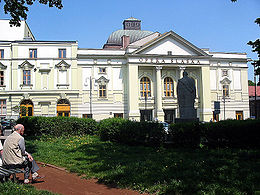
- Silesian TheatreSilesian TheatreSilesian Theatre dedicated to Stanisław Wyspiański is the largest theatre in Silesia. It is located on the market square in Katowice. It was built as "German Theatre" in the years 1905-1907, its Golden Age was in the late-1940s and the 1950s....
(Teatr Śląski) - Rialto Cinetheater
- Ateneum Theatre
- Korez Theatre
- Cogitatur Theatre
- GuGalander Theatre
- New Theatre
- Locus Theatre
- Small Theatre
- Silesian Theatre of Dance
Music
- Silesian PhilharmonicSilesian PhilharmonicThe Filharmonia Śląska w Katowicach is a music institution in Katowice, Silesia, Poland. The Silesian Philharmonic in Katowice was founded in 1945. The first concert of the orchestra took place on 26 of May 1945. A mixed choir was added in 1973....
(Filharmonia Śląska) - Zabrze Philharmonic (Filharmonia Zabrzańska)
- Silesian OperaSilesian OperaSilesian Opera is an opera company in Bytom, Silesia, Poland which was founded in 1945. It has its home at the former City Theatre, which was built between 1898-1901. Adamo Didur was the first artistic director.-External links:*...
(Opera Śląska) - Silesian Music Stage (Estrada Śląska)
- GuGalander Music Stage (Scena GuGalander)
- National Symphonic Orchestra of Polish Radio
Cinemas
- IMAXIMAXIMAX is a motion picture film format and a set of proprietary cinema projection standards created by the Canadian company IMAX Corporation. IMAX has the capacity to record and display images of far greater size and resolution than conventional film systems...
- MultikinoMultikinoOwned by , Multikino is the second largest multiplex chain in Poland, and has the distinction of opening the nation's first multiplex, which was located in Poznań. Cinema City is Multikino's primary competitor....
(13 theaters ) - Cinema City - Punkt rozrywki 44Cinema City PolandCinema City is a brand of multiplex cinemas in eastern and central Europe, run by the Israeli company Cinema City International . In Europe it has cinemas in Hungary, Poland and the Czech Republic. In Poland Cinema City has almost 40% of the multiplex market, with Multikino its major competitor...
(13 theaters ) - Cinema City - Silesia City CenterCinema City PolandCinema City is a brand of multiplex cinemas in eastern and central Europe, run by the Israeli company Cinema City International . In Europe it has cinemas in Hungary, Poland and the Czech Republic. In Poland Cinema City has almost 40% of the multiplex market, with Multikino its major competitor...
(13 theaters ) - Cinema City - Ruda ŚląskaCinema City PolandCinema City is a brand of multiplex cinemas in eastern and central Europe, run by the Israeli company Cinema City International . In Europe it has cinemas in Hungary, Poland and the Czech Republic. In Poland Cinema City has almost 40% of the multiplex market, with Multikino its major competitor...
(8 theaters ) - Cinema City - SosnowiecCinema City PolandCinema City is a brand of multiplex cinemas in eastern and central Europe, run by the Israeli company Cinema City International . In Europe it has cinemas in Hungary, Poland and the Czech Republic. In Poland Cinema City has almost 40% of the multiplex market, with Multikino its major competitor...
(6 theaters ) - Cinema City - GliwiceCinema City PolandCinema City is a brand of multiplex cinemas in eastern and central Europe, run by the Israeli company Cinema City International . In Europe it has cinemas in Hungary, Poland and the Czech Republic. In Poland Cinema City has almost 40% of the multiplex market, with Multikino its major competitor...
(13 theaters )
Museums
- Silesian MuseumSilesian MuseumSilesian Museum is a museum in the city of Katowice, Poland.- History :The museum was founded in 1929 by the Silesian Sejm, while the region was recovering from the Silesian Uprisings. In the interbellum, the Silesian Museum was one of the biggest museums in Poland. The Nazis however brought the...
(Muzeum Śląskie) - Muzeum Historii Katowic (Katowice History Museum)
- Muzeum Górnośląskie (Upper Silesia Museum)
- Muzeum Zamek Piastowski
- Muzeum Archidiecezjalne
- Muzeum Misyjne OO. Franciszkanów (Museum of Misyjne OO. The Franciscan Monk)
- Muzeum Biograficzne P. Stellera
- Muzeum Prawa i Prawników Polskich
- Muzeum Najmniejszych Książek Świata Zygmunta Szkocnego
- Muzeum Górnictwa Węglowego
Media
- TVP 3 KatowiceTVP 3 KatowiceTVP Katowice Tower is a 90 meter high reinforced concrete telecommunication tower in Katowice, Poland. It is the property of TP EMITEL, and is not accessible by tourists. It started broadcasdting in 1957. TVP 3 Katowice at 6 October 2007 changed name on TVP KATOWICE- External links :* *...
- TVSTVS-Television, Tele-Networking:* TVS Electronics, Computer peripherals manufacturing company from India* TVS Motors, motor manufacturing company from India* TVS, aka Television Sydney, free TV channel in Sydney, Australia...
- TVN24 - Katowice branch (TVN24 - oddział Katowice)
- Radio Katowice
- Radio Flash
- Radio eM
- Radio Roxy FM
- Radio Planeta
- Dziennik Zachodni
- Gazeta WyborczaGazeta WyborczaGazeta Wyborcza is a leading Polish newspaper. It covers the gamut of political, international and general news. Like all the Polish newspapers, it is printed on compact-sized paper, and is published by the multimedia corporation Agora SA...
- Katowice office
Performance series
- Rawa Blues Festiwal - SpodekSpodekSpodek is a multipurpose arena complex in Katowice, Poland, opened in 1971 at 35 Korfanty Street under the name Wojewódzka Hala Widowiskowo-Sportowa w Katowicach , under which it is known in the Polish technical/architectural literature, and under which it formally functioned until 1997.Aside from...
- MetalmaniaMetalmaniaMetalmania is one of the biggest heavy metal music festivals in Central Europe. It has been held annually since 1986. The 2008 edition was held on the 8th of March at Spodek in Katowice, Poland.-Large stage:*Sepultura*Paradise Lost*Testament...
- SpodekSpodekSpodek is a multipurpose arena complex in Katowice, Poland, opened in 1971 at 35 Korfanty Street under the name Wojewódzka Hala Widowiskowo-Sportowa w Katowicach , under which it is known in the Polish technical/architectural literature, and under which it formally functioned until 1997.Aside from... - MaydayMayday (music)Mayday, like the former Love Parade, is one of the oldest and most reputed electronic music festivals in Germany, having its debut on 1991. Despite the name, Mayday festivals date oscilates between 30 April and December...
- SpodekSpodekSpodek is a multipurpose arena complex in Katowice, Poland, opened in 1971 at 35 Korfanty Street under the name Wojewódzka Hala Widowiskowo-Sportowa w Katowicach , under which it is known in the Polish technical/architectural literature, and under which it formally functioned until 1997.Aside from... - International Competition of Conductors by Fitelberg
- International Festival of Military Orchestras
- International Exhibition of Graphic Arts (Intergrafia)
- All-Polish Festival of Directors
- Ars Cameralis Silesiae Superioris
- International Theatrical Festival (APART)
- International Conference of Dance, Festival of Dancing Art
Art galleries
- Galeria Sztuki Współczesnej BWA (Al. Korfantego 6)
- Galeria Sztuki Współczesnej Parnas (ul. Kochanowskiego 10)
- Galeria Sztuki Atelier 2 (ul. Batorego 2)
- Galeria Związku Polskich Artystów Plastyków (ul. Dworcowa 13)
- Galeria Architektury SARP (ul. Dyrekcyjna 9)
- Galeria Art-Deco (pl. Andrzeja 4)
- Galeria Fra Angelico (ul. Jordana 39)
- Galeria Akwarela (ul. Mikołowska 26)
- Galeria Marmurowa (ul. Mikołowska 26)
- Galeria Piętro Wyżej
- Galeria Sektor I
- Galeria Szyb Wilson
Parks
- Silesian Central ParkSilesian Central ParkSilesian Culture and Recreation Park or Silesian Central Park or Voivodship Park of Culture and Recreation , is a recreation complex in the center of the Upper-Silesian Metropolis in Silesia, Poland...
(Wojewódzki Park Kultury i Wypoczynku) - Kościuszko ParkKosciuszko ParkThe Kosciuszko Park, which has existed since 1925, is one of the most famous and frequented parks in Katowice, Poland. It is situated at the street of the same name....
(Park im. Tadeusza Kościuszki) - Forest Park of Katowice (Katowicki Park Leśny)
- Valley Three Ponds (Dolina Trzech Stawów)
- Zadole ParkZadole ParkThe Zadole Park which used to be a hamlet of Piotrowice, but now it belongs to Katowice districts of Upper Silesian Metropolitan Union there is a park with an amphitheater for 800 persons, a swimming-pool complex, a cafe and a playground for children and walking alleys...
- Bolina Park
- Skałka
- Dolomity Sportowa Dolina
Nature preserves
- Bagna Nature Reserve (Rezerwat przyrody Bagna)
- Dilina Żabnika Nature Reserve (Rezerwat przyrody Dolina Żabnika)
- Las Dąbrowa Nature Reserve (Rezerwat przyrody Las Dąbrowa)
- Las Murckowski Nature Reserve (Rezerwat przyrody Las Murckowski)
- Ochojec Nature Reserve (Rezerwat przyrody Ochojec)
- Oles Nature Reserve (Rezerwat przyrody Oles)
- Płone Bagno Nature Reserve (Rezerwat przyrody Płone Bagno)
- Sasanka Nature Reserve (Rezerwat przyrody Sasanka)
- Segiet Nature Reserve (Rezerwat przyrody Segiet)
- "Żabie Doły" Nature PreserveŻabie DołyŻabie Doły is a nature and landscape protected area in Silesia, Poland. The Żabie Doły complex is located entirely within the Upper Silesian Metropolis and encompasses land heavily altered by human activity. The protected area covers 2.262 km² . At Żabie Doły, 129 species of birds have been...
Castles and palaces
- Castle in GliwiceCastle in GliwiceThe so-called Piast's Castle in Gliwice, southern Poland dates back to the mid-14th century. It consists of a tower from 1322, which was originally part of the city walls, and an adjoining building which was probably an armory. Modifications were carried out in the 15th century, between 1558-61 it...
(Zamek w Gliwicach) - Castle in Ruda Śląska (Zamek w Rudzie Śląskiej)
- Castle in Tarnowice (Zamek w Tarnowicach)
- Sielecki CastleSielecki CastleSielecki Castle is a castle in the city of Sosnowiec in southern Poland.It was built in the 17th century....
(Zamek Sielecki) - Goldstein PalaceGoldstein PalaceThe Pałac Goldsteinów or Goldstein Palace is neo-renaissance palace, which was built by two brothers, Abraham and Joseph Goldstein. It is located in Katowice, Silesia, Poland, at the west end of the city centre, at ....
(Pałac Goldsteinów) - Godula Palace (Pałac Goduli)
- Dietl Palace (Pałac Dietla)
- Ciechanowski's Palace (Pałac Ciechanowskich)
- Mieroszewski's Palace in Sosnowiec (Dwór Mieroszewskich w Sosnowcu)
- Mieroszewski's Palace in Będzin (Pałac Mieroszewskich)
- Rheinbaben Palace (Pałac Rheinbabenów)
- Wilhelm Palace (Pałac Wilhelma)
- Winckler Palace (Pałac Wincklerów)
- Schöen Palace in Sosnowiec (Pałac Schöena w Sosnowcu)
Historical churches
- Cathedral in Katowice
- Basilica in Piekary (sanctuary)
- St. Stephen's ChurchSt. Stephen's Church (Katowice)The Kościół św. Szczepana or Saint Stephen's Church is a church in Katowice, Silesian Voivodship, Poland. It is dedicated to Saint Stephen and located at on Leopold Markiefki street....
Best-known clubs
- Górnik ZabrzeGórnik ZabrzeGórnik Zabrze is a Polish football club from Zabrze. The club has won numerous championships, and was a dominant force in the 1960s and 1980s. For now Górnik has the most titles in Poland. The club plays in white or dark blue - red kit, and is based at the Ernest Pohl Stadium...
- men's footballFootball in PolandFootball is the most popular sport in Poland. Over 400,000 Poles play football regularly, with millions more playing occasionally. The first professional clubs were founded in the early 1900s, and the Polish national football team played its first international match in 1921.There are hundreds of... - Ruch ChorzówRuch ChorzówRuch Chorzów is a Polish association football club based in Chorzów, Upper Silesia. It is one of the most successful football teams in Poland: 14 time national champion, and 3 time winner of the Polish Cup. Currently the team plays in the top Polish league, the Ekstraklasa. Their stadium capacity...
- men's football - Polonia BytomPolonia BytomPolonia Bytom is a Polish football club founded on 4 January 1920 in the Upper Silesian city of Bytom, during the hectic months of the Silesian Uprisings...
- men's football - Szombierki BytomSzombierki BytomSzombierki Bytom is a Polish football club from Szombierki district of Bytom. Szombierki currently plays at the sixth level of Polish football . Greatest achievement of club was championship of Poland won in 1980.-Honours:...
- men's football - GKS KatowiceGKS KatowiceGKS Katowice is a Polish football club based in Katowice, Poland. The club currently plays in the Polish First League.-History:In 1963 in Katowice a special organizational committee was called with the purpose of uniting all the clubs and sporting organizations of city into one large club which...
- men's football - Czarni SosnowiecCzarni SosnowiecKKS Czarni Sosnowiec is a football club from Sosnowiec, Poland.The club was founded in 1924. It is best known for its women's football team, founded 5 September 1974, that holds the Polish record for championship titles won, with 12 titles to its name...
- women's football - Clearex Chorzów - men's futsalFutsal in PolandFutsal is a quickly growing sport in Poland. The national futsal team was created in 1992 by the Polish Football Association. Among coaches of it, there were such names as Janusz Kupcewicz and Michal Globisz...
- Nova Gliwice - men's futsal
- Olimpia Piekary - men's handballHandball in PolandHandball is a popular team sport in Poland.* Polish Seria A Handball League* Polish Seria B Handball League* Polish Seria A Women's Handball League* Polish Seria B Women's Handball League* Polish Cup in men handball* Polish Cup in women handball...
Other clubs
- Piast GliwicePiast GliwiceGliwicki Klub Sportowy Piast Gliwice is a Polish football club based in Gliwice, Poland. Founded in June 1945 by the Poles who had been forced to leave their homeland in present-day Western Ukraine, Piast's football team played as many as 32 seasons in the Polish Second Division, before finally...
- men's footballFootball in PolandFootball is the most popular sport in Poland. Over 400,000 Poles play football regularly, with millions more playing occasionally. The first professional clubs were founded in the early 1900s, and the Polish national football team played its first international match in 1921.There are hundreds of... - AZS AWF KatowiceAZS AWF KatowiceAZS AWF Katowice is a Polish women's handball team, based in Katowice, playing in Polish Ekstraklasa Women's Handball League .-2004/2005 season:...
- women's handballHandball in PolandHandball is a popular team sport in Poland.* Polish Seria A Handball League* Polish Seria B Handball League* Polish Seria A Women's Handball League* Polish Seria B Women's Handball League* Polish Cup in men handball* Polish Cup in women handball...
team playing in Polish Ekstraklasa Women's Handball LeaguePolish Ekstraklasa Women's Handball League-History:* 1939 - Znicz Łódź* 1946 - Zryw Łódź* 1947 - Zryw Łódź* 1948 - SKS Warszawa* 1949 - Unia Łódź* 1950 - Spójnia Warszawa* 1951 - Unia Łódź* 1952 - Unia Łódź* 1953 - not held* 1954 - not held* 1955 - Stal Chorzów* 1956 - Stal Chorzów... - 1. FC Kattowitz - men's football; Polish co-champion, 1927; Upper Silesia champions 1907, 1908, 1909, 1913, 1922, 1945; third place, southeast Germany 1922
- Śląsk Świętochłowice - men's football
- Szczakowianka JaworznoSzczakowianka JaworznoGarbarnia Szczakowianka Jaworzno is a Polish football club based in Jaworzno, Poland. The club is currently playing in the Polish 3rd league- Current squad :- 2003/2004 season :...
- men's football - Zagłębie Sosnowiec - men's football
- Naprzód LipinyNaprzód LipinyGKS Naprzód Świętochłowice Lipiny - a sports club from Swietochlowice’s district of Lipiny , founded in 1920 by Alfons Maniura, who became Naprzód first chairman. Throughout the years, the club for many times changed name. In 1920-1939 and then in 1945-1965 it was Naprzód Lipiny, in 1939-1945 -...
- men's football
Notable residents
- Kurt AlderKurt AlderKurt Alder was a German chemist and Nobel laureate.-Biography:Alder was born in the industrial area of Königshütte, Silesia , where he received his early schooling...
- Marcin BaszczyńskiMarcin BaszczynskiMarcin Baszczyński is a Polish footballer who plays for Polonia Warsaw.-Club career:Baszczyński started his career at Pogoń Ruda Śląska. In 1995 he joined Ruch Chorzów. In 2000 he moved to Wisła Kraków...
- Ewald CebulaEwald CebulaEdward Cebula was a Polish football player and defender...
- Gerard CieślikGerard CieslikGerard Cieślik , also known as Gienek, is a former football player of Ruch Wielkie Hajduki ....
- Janusz GajosJanusz GajosJanusz Gajos is a Polish actor.He graduated in 1965 from the National Film School in Łódź as one of its best students despite having been rejected during entrance exams for three times. He debuted while he was still in film school in children's film Panienka z okienka in 1964...
- Edward GierekEdward GierekEdward Gierek was a Polish communist politician.He was born in Porąbka, outside of Sosnowiec. He lost his father to a mining accident in a pit at the age of four. His mother married again and emigrated to northern France, where he was raised. He joined the French Communist Party in 1931 and was...
- Jędrzej GiertychJedrzej GiertychJędrzej Giertych was a Polish right-wing politician, journalist and writer, son of Franciszek Giertych, father of Maciej Giertych and grandfather of Roman Giertych...
- Maria Goeppert-Mayer
- Kurt GoldsteinKurt GoldsteinKurt Goldstein was a German Jewish neurologist and psychiatrist who was a pioneer in modern neuropsychology. He created a holistic theory of the organism based on Gestalt theory which deeply influenced the development of Gestalt therapy...
- Damian GorawskiDamian GorawskiDamian Gorawski is a Polish footballer who plays as a right winger in midfield. He is currently with Górnik II Zabrze.-Club:Previously he played for Ruch Chorzów, Wisła Kraków and FC Moscow...
- Jerzy GorgońJerzy GorgonJerzy Paweł Gorgoń was a Polish football player who is remembered for his participation in the 1972 Summer Olympics. He was a 6'4" tall defender who became well-known in 1967 while playing for Górnik Zabrze. He helped Zabrze to five consecutive Polish cups in 1968-72.He received 55 international...
- August Hlond
- Otylia JędrzejczakOtylia JedrzejczakOtylia Jędrzejczak is a Polish swimmer. She is the Olympic champion from Athens 2004 in the 200 metre butterfly. She finished 4th in this event in the 2008 Summer Olympics in Beijing. She also swam in a third Olympiad, at the 2000 Summer Olympics in Sydney. In Athens 2004 she also silvered in...
- Henryk KasperczakHenryk KasperczakHenryk Wojciech Kasperczak is a Polish football manager and a football player.As a player, Kasperczak took part in two FIFA World Cups with Poland, achieving third place in 1974, as well as a silver medal at the 1976 Summer Olympics in Montreal, Canada.As a manager, Kasperczak enjoyed most...
- Jan KiepuraJan KiepuraJan Wiktor Kiepura was an acclaimed Polish singer and actor.-Biography:...
- Wojciech KorfantyWojciech KorfantyWojciech Korfanty , born Adalbert Korfanty, was a Polish nationalist activist, journalist and politician, serving as member of the German parliaments Reichstag and Prussian Landtag, and later on, in the Polish Sejm...
- Jerzy KukuczkaJerzy KukuczkaJerzy Kukuczka , born in Katowice, Poland, was a Polish alpine and high-altitude climber. On 18 September 1987, he became the second man, after Reinhold Messner, to climb all fourteen eight-thousanders in the world....
- Kazimierz KutzKazimierz KutzKazimierz Julian Kutz is a Polish film director, author, journalist and politician, one of the representatives of the Polish Film School and a deputy speaker of the Senate of Poland.- Biography :...
- Włodzimierz Lubański
- Franz Leopold NeumannFranz Leopold NeumannFranz Leopold Neumann was a German-Jewish left-wing political activist, Marxist theorist and labor lawyer, who became a political scientist in exile and is best known for his theoretical analyses of National Socialism. He studied in Germany and the United Kingdom, and spent the last phase of...
- Krzysztof OliwaKrzysztof OliwaKrzysztof Artur Oliwa is a Polish former professional ice hockey player. He played as a left winger in the National Hockey League.-Playing career:...
- Lukas PodolskiLukas PodolskiLukas Josef Podolski ; born Łukasz Podolski ) on 4 June 1985 in Gliwice, Poland) is a German footballer who plays as a striker/winger for 1. FC Köln and for the German national team. He joined 1. FC Köln in 1995 where he broke into the first team in 2003 and made 81 appearances for the club before...
- Miroslav KloseMiroslav KloseMiroslav Josef Klose is a German footballer who plays as a striker for Lazio in the Serie A. Since bursting onto the international stage at the 2002 World Cup, he has become well known for his knack of scoring headers, front-flip goal celebrations, and decisive short passing.Klose holds German...
- Daniel PodrzyckiDaniel PodrzyckiDaniel Tomasz Podrzycki , was a Polish socialist politician.His career began from participation in the activity of illegal students' circles of Warsaw, which appeared at the end of the Seventies and were oriented at the beginning on the diccident Committee on Defending the Workers and later on the...
- Roman PolkoRoman PolkoMajor General dr Roman Polko is a Polish Army officer, acting chief of Biuro Bezpieczeństwa Narodowego , former commander of "GROM", doctor of military science studies, speciality: management....
- Jan SawkaJan Sawka-Biography:In 1946, Sawka was born to an architect father and linguist mother, Jan and Maria Sawka, in the Silesian city of Zabrze. His childhood was overshadowed by his father’s Stalin-era political imprisonment. Sawka completed two Masters degrees; in painting and print-making from the Wroclaw...
- Hanna SchygullaHanna SchygullaHanna Schygulla is a German actress and chanson singer. She is generally considered the most prominent German actress of the New German Cinema.-Life and career:Schygulla was born in Königshütte, Upper Silesia,...
- Władysław Szpilman
- Krzysztof WarzychaKrzysztof WarzychaKrzysztof "Kristof" Warzycha is a former Polish professional footballer. For the majority of his career he played for Greek club Panathinaikos FC.- KS Ruch Chorzów :...
- Ernest WilimowskiErnest WilimowskiErnst Willimowski was a football player who played for both the Polish and German national teams....
- Sobiesław Zasada
- Aleksander ZawadzkiAleksander ZawadzkiAleksander Zawadzki was a Polish Communist political figure and head of state of Poland from 1952 to 1964.A member of the Communist Youth Union, Zawadzki went into exile in the Soviet Union in 1931, after spending six years in prison for "subversive activities." He returned to Poland in 1939, just...
- Krystian ZimermanKrystian ZimermanKrystian Zimerman is a Polish classical pianist who is widely regarded as one of the finest living pianists.-Biography:...
- Leo YankevichLeo YankevichLeo Yankevich is an American poet and the editor of The New Formalist.Born into a Roman Catholic family of Irish-Polish descent, he grew up and attended high school in Farrell, Pennsylvania, a small steel town in western Pennsylvania. He then studied History and Polish Studies at Alliance...