

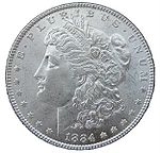
United States dollar coin

Encyclopedia
Dollar coins have been minted in the United States
in gold
, silver
, and base metal
versions. The term silver dollar is often used for any large white metal
coin
issued by the United States
with a face value of one dollar
, although purists insist that a dollar is not silver unless it contains some of that metal. Silver dollars, the first dollar coin issue, were minted
beginning in 1794. Gold and gold-colored
dollars have also been produced by the United States. The Sacagawea
and Presidential dollars are usually referred to as golden dollars, despite not containing any gold, as they are of a golden color.
. This contrasts with currencies of most other developed countries
, where denominations of similar value exist only in coin. These coins have largely succeeded because of a removal (or lack) of their corresponding paper issues, whereas the United States government has taken no action to remove the one-dollar bill, due to either intensive lobbying by "Save the Greenback
" or genuine consumer resistance.
The United States Government Accountability Office (GAO) has stated that discontinuing the dollar bill in favor of the dollar coin would save the U.S. government approximately $5.5 billion over thirty years.
) minted in Mexico
and other colonies with silver mined from Central
and South American mines. These coins, along with others of similar size and value, were in use throughout the colonies, and later the United States, and were legal tender
until 1857.
In 1776, the Continental Congress
authorized plans to produce a silver coin to prop up the rapidly failing Continental—the first attempt by the fledgling US at paper currency. Several examples were struck in brass
, pewter
, and silver, but a circulating coin was not produced, due in large part to the financial difficulties of running the Revolutionary War. The Continental Dollar bears a date of 1776, and while its true denomination is not known, it is generally the size of later dollars, and the name has stuck. The failure of the Continental exacerbated a distrust of paper money among both politicians and the populace at large. The letters of Thomas Jefferson
indicate that he wished the United States to eschew paper money and instead mint coins of similar perceived value and worth to those foreign coins circulating at the time.
The Coinage Act of 1792 authorized the production of dollar coins from silver. The United States Mint
produced silver dollar coins from 1794 to 1803, then ceased regular production of silver dollars until 1836. The first silver dollars, precisely 1,758 of them, were coined on October 15, 1794 and were immediately delivered to Mint Director David Rittenhouse
for distribution to dignitaries as souvenirs. Thereafter, until 1804, they were struck in varying quantities. There are two obverse designs: Flowing Hair (1794–1795) and Draped Bust (1795–1804). There are also two reverse designs used for the Draped Bust variety: small eagle (1795–1798) and heraldic eagle (1798–1804). Original silver dollars from this period are highly prized by coin collectors
and are exceptionally valuable, and range from fairly common to incredibly rare. Due to the early practice of hand engraving each die
, there are dozens of varieties known for all dates between 1795–1803.
It is also one of only two denominations (the other being the cent) minted in every year from its inception during the first decade of mint operation. However, the order was given by President Thomas Jefferson to halt silver dollar production due to the continued exportation of US dollars. The Spanish 8 Reale, which was slightly heavier than the US dollar, nonetheless traded at a 1-to-1 ratio. So US dollars went to the Caribbean
, were traded for heavier 8 Reales, and those were then brought back to the US, where they would be recoined for free into more US dollars; the difference in silver, then, was kept by the exporter. This ensured that no dollars would circulate in the US, but would instead be exported for their heavier counterparts overseas, leaving little but old, foreign money to circulate in the United States in a process known as Gresham's Law
.
is one of the rarest and most famous and popular coins in the world. Its creation was the result of a simple bookkeeping error, but its status as the king of coins has been established for nearly a century and a half. The silver dollars reported by the mint as being struck in 1804 were actually dated 1803 (die steel being very expensive in the early 19th century, dies were used until they were no longer in working condition. This is why many early US coins exhibit all kinds of die cracks, occlusions, cuds, clash marks, and other late state die wear. Dies were used until they literally fell apart. Nearly every coin the US struck from 1793 to 1825 has an example that was struck in a year other than that which it bears.) No dollars bearing the date 1804 were ever struck in 1804, though this was unknown to mint officials at the time the 1804 dollar came to be.
The 1804 silver dollar was actually produced in 1834, when the U.S. Department of State
decided to produce a set of U.S. coins to be used as gifts to rulers in Asia
in exchange for trade advantages. Since 1804 was the last recorded year of mintage for both the dollar and $10 Eagle, it was decided that the set would contain examples of those coins dated 1804, as well as the other denominations currently being produced. Mint officials, not realizing that the 19,000+ dollars recorded as being produced in 1804 were all dated 1803, proceeded to make new dies dated 1804. Little did they know the stunning rarity they were creating. Only 15 silver dollars with the date of 1804 are known to exist; in 1999, one of them sold at auction
for more than $4 million. There are 8 Class I dollars, struck in 1834 for the aforementioned sets, 1 Class II dollar, struck over an 1857 Swiss Shooting Thaler
(and now residing in the US Coin Collection at the Smithsonian Institution), and 6 Class III dollars, struck surreptitiously sometime between 1858 and 1860 to meet collector demand for the coin.
The international trading partners did not like the fact that US coins were reduced in weight. The use of much more common half dollars became problematic since merchants would have to separate higher value pre-1853 coins from the newer reduced ones. From 1853 onwards, trade with Asia was typically done with Mexican coins that kept their weight and purity in the 19th Century. This ended in 1874 when the price of silver dropped so that a silver dollar has less than $1.00 worth of silver in it (huge amounts of silver coming from the Nevada Comstock Lode mines). By 1876, all silver coins were being used as money and by 1878, gold was at par with all US paper dollars. Beginning in 1878, huge amounts of the Morgan silver dollars were produced but few were used as money. The size was too large to carry on business so silver certificates were used instead. The mint make the coins, placed them in their vaults and issued the Silver Certificates instead. This is the reason so many Morgan and Peace dollars can be purchased in AU or UNC condition (near perfect)... they sat in bank/US Treasury vaults most of the time.
Each coin is composed of 0.77344 troy oz of silver. They were minted at Philadelphia, New Orleans, Carson City, and San Francisco. A Silver dollar is worth $1 in silver at $1.31 per troy ounce. Current silver price (October 21, 2010) is $23.12 per troy ounce so a silver dollar is worth, melted down (melt value) of about $17.88 US.
Composed of 90% pure gold
, it was the smallest denomination of gold currency ever produced by the United States federal government. When the US system of coinage was originally designed there had been no plans for a gold dollar coin, but in the late 1840s, two gold rush
es later, Congress was looking to expand the use of gold in the country’s currency. The gold dollar was authorized by the Act of March 3, 1849, and the Liberty Head type began circulating soon afterward. Because of the high value of gold, the gold dollar is the smallest coin in the history of US coinage.
Trade Dollars did not circulate in the United States initially, but were legal tender for up to $5. Things changed, however, in 1876, when the price of silver spiraled downward as western producers dumped silver on the market, making the Trade Dollar worth more at face value than its silver content. That resulted in Trade Dollars pouring back into the United States, as they were bought for as little as the equivalent of 80 US cents in Asia, and were then spent at $1 in the United States. This prompted Congress to revoke their legal tender status, and restrict their coinage to exportation demand only. However, this didn't stop unscrupulous persons from buying Trade Dollars at bullion value, and using them for payment as $1 to unsuspecting workers and merchants.
Production of the Trade Dollar was officially halted for business strikes in 1878, and thereafter from 1879–1885, produced only as proof examples of the coin. The issues of 1884 and 1885 were produced surreptitiously, and were unknown to the collecting public until 1908.
In February 1887, all non-mutilated outstanding Trade Dollars were made redeemable to the United States Treasury, and approximately 8 million of them were turned in.
Collectors are warned that a large number of perfect copies, apparently made in China, have been made. Buying only from known dealers, or certified specimens, is highly recommended.
s. Morgan dollars are second only to Lincoln Cent
s in collector popularity. The large size, design and inexpensive nature of most dates of the Morgan dollar makes them highly popular. The coin is named after George T. Morgan
, its designer. Some people collect Morgan dollars by "VAM" designation (named for Leroy C. Van Allen and A. George Mallis, who did extensive research on the die characteristics of this series.) The top 100 VAM varieties are highly collectible. As well, this is the most popular United States series collected by grade, with "finest known" being a very attractive selling point.
The mint mark is found on the reverse below the wreath, above the 'O' in 'DOLLAR'.
One of the keys to the series is the proof-only 1895 (struck at the Philadelphia mint), which can sell for up to $100,000 in top condition. Since the rarity of the coin was not initially realized (there were 12,000 business strikes recorded, but these were later melted), and since the coins were available at the Mint for a modest premium above face value, circulated, or "impaired" specimens are known. Because no business strike exists for this date and mint, many collectors are forced to buy the proof, or settle for what is regarded as an incomplete date/mint collection. The rarest (by mintage) business strike Morgan is the 1893-S with a paltry 100,000 examples struck, and certainly not all examples survive. A top condition example (MS67 is currently the highest known) can bring nearly $1 Million at auction. Morgan dollars from the Carson City mint
("CC" mintmark) are worth a premium. 1889-CC, while not the rarest Carson City dollar by mintage, is the rarest by surviving examples today, and is the most valuable Carson City dollar. Other rare dates include 1892-S
, 1893, 1893-O, 1894, 1894-S, 1895-O, 1895-S, 1902-S, 1903-S, 1903-O, and 1904-S all worth $100 or more even in circulated (Fine-About Uncirculated) conditions. Several coins in the series, while quite common in circulated condition, are very rare in uncirculated conditions, and can command hundreds of thousands of dollars apiece. 1901 is such a coin, as is 1884-S. There is currently only a single known MS68 1884-S dollar and if sold at auction, that coin could easily bring $750,000-$1,000,000...for a "common" date coin.
Many of the spectacular rarities of the series, both by grade and absolutely, can be attributed to the order to melt down 270 million silver dollars still on hand by the Pittman Act
of 1918. Because of this, and subsequent melting, it is estimated that only 17% of all Morgan dollars minted still survive. However, that's still many millions of examples.
Many examples exceed $100 in uncirculated condition, but the majority do not. A common date in uncirculated can normally be found for around $40, and often as little as $28 circulated and $32 uncirculated, depending upon the current price of silver.
High-grade Morgan dollars are generally considered "investor" coins. This is because the prices are very volatile, and the values for certified ("slabbed") pieces are set on well-established exchanges.
 Introduced in December 1921, the Peace dollar, designed by medalist Anthony de Francisci
, was promulgated to commemorate the signing of formal peace treaties
between the Allied forces and Germany
and Austria
. These treaties officially ended the Allies' World War I
hostilities with these two countries. In 1922 the Mint made silver dollar production its top priority, causing other denominations to be produced sparingly if at all that year. Production ceased temporarily after 1928; original plans apparently called for only a one year suspension, but this was extended by the Great Depression
. Mintage resumed in 1934, but for only two years.
In May 1965, 316,000+ Peace Dollars were minted, all at the Denver Mint
and dated 1964-D; however, plans for completing this coinage were abandoned, and most of those already minted were melted, with two known trial strike specimens being preserved (for assay purposes) until 1970, when they too were melted, and none released either for circulation or collection purposes. It is rumored that one or more pieces still exist, most notably any examples obtained by key members of Congress, the President, or mint officials. However, this coin, much like the 1933 $20 gold Double Eagle
(aside from the "exception", sold in 2002 for over $7 million), is illegal to own and would be subject to confiscation.
They were very popular as Christmas gifts, however, and from the 1930s to the early 1960s, many bags were annually released to banks nationwide to be distributed as presents. In November 1962, during this annual distribution, it was discovered that there were some rare and valuable dates, still sealed in their original mint bags, all in uncirculated condition, among the millions of dollar coins still in the Treasury vaults. Collectors/investors/dealers lined up to purchase them in $1,000 bags, trading silver certificates for the coins. Before this event, the great rarity of the Morgan series was 1903-O, which was by far the most expensive of the entire set. It was discovered that there were millions of this specific date and mint in the Treasury vaults; an estimated 84% of the entire mintage sat in these bags, untouched for 60 years, all in uncirculated condition. While still relatively expensive in circulated grades, uncirculated examples can be had for a modest amount over common dates.
On March 25, 1964, Secretary of the Treasury C. Douglas Dillon announced that Silver Certificates would no longer be redeemable for silver dollars. Subsequently, another act of Congress dated June 24, 1967, provided that Silver Certificates could be exchanged for silver bullion for a period of one year, until June 24, 1968.
Following this, the Treasury inventoried its remaining stock of dollar coins, and found approximately 3,000 bags containing 3 million coins. Many of the remaining coins were Carson City mint dollars, which even then carried a premium. The coins were placed in special hard plastic holders and the General Services Administration
(GSA) was given authorization to sell them to the public in a series of mail-bid sales. Five sales were conducted in 1973 and 1974, but sales were poor, and the results unspectacular. There was much complaining among the coin buying public, many stating that the United States Government should not be in the "coin business", especially considering that the government had spent little more than a dollar to mint and store each coin. After these sales, more than a million coins were still left unsold.
These sat again until 1979-1980, where, amidst an extraordinarily volatile precious metals market, the remaining coins were sold under chaotic conditions. The GSA, having published minimum bids in November 1979, announced on January 2, 1980, that those minimum bids were no longer valid, and that prospective bidders would have to "call in" to a toll free number to get current minimum bids. Then, on February 21, 13 days after the bidding process officially began, the maximum number of coins per bidder was changed from 500 to 35. Many bidders, under these confusing conditions, ended up with no coins at all. Complaints again flooded in to Congress, but the damage had already been done, and the last silver dollars held by the United States Treasury were gone.
Over the years, many of these GSA dollars have been broken out of their special holders for purposes of grading or otherwise, and now GSA dollars still in the unbroken original holders carry a small premium. Some third party grading companies have begun to grade coins still in their GSA holders, as a means of preservation, though this is not without controversy.
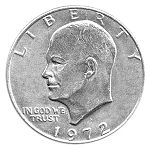
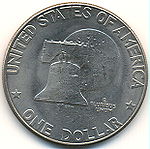 From 1971 to 1978, the U.S. Mint issued dollar coins with the obverse depicting Dwight D. Eisenhower
and the reverse the insignia of the Apollo 11
moon landing, both designed by Chief Engraver Frank Gasparro
. The 1976 Bicentennial
commemorative
design, produced in 1975 and 1976, featured the Liberty Bell
and the Moon on the reverse (designed by Dennis R. Williams), while retaining the Eisenhower obverse, and the dual dates 1776-1976. The Eisenhower dollars minted for general circulation contained no silver or gold, but were instead composed of the same copper-nickel clad composition used for the dime, quarter, and half dollar. This made the circulation coins extremely resistant to wear and, like the smaller denominations, they still retain a good deal of shine even when subject to mass usage.
From 1971 through 1976 the Mint also produced dollars composed of 40% silver aimed at the collector market. The 1971-74 issues appeared in brown boxes or blue packages, depending on whether they were proof or uncirculated. Somewhat different Bicentennial sets were produced in the following two years. All issues remain very common.
The coins were never very popular, primarily due to their large size and weight which made them inconvenient to carry and the fact that very few vending machines were designed to accept them. They saw the greatest use in casinos, and one-dollar tokens in United States casinos still approximate the size and weight of the coins. Prior to the withdrawal of the coins, which remain legal tender (and are sometimes available at banks by request), many casinos did not strike their own tokens, but instead used the Eisenhower dollar.
 From 1979 to 1981, and again in 1999, the Mint produced Anthony Dollars
, depicting Susan B. Anthony
, the first non-fictitious woman portrayed on circulating U.S. coinage. (Many earlier circulating coins featured images of women, but the women depicted were all non-specific representations of Liberty
. Spain
's Queen Isabella
was portrayed on the 1893 Columbian Exposition quarter dollar
, but it was not intended as a circulating coin, although some did circulate.) The Anthony dollars, like the Eisenhower dollars, were made from a copper-nickel clad. The 1981 coins were issued for collectors only, but occasionally show up in circulation.
The Anthony dollar resembled the quarter in size. Often confused with it, this is one reason why the coin was never popular. It was quickly discontinued, but resurrected in 1999 when Treasury reserves were low, and the Sacagawea dollar was still a year away from production. While reserves of the coins were initially high, the coins were in demand to be used as change in vending machines, most often in transit systems and post offices.
This dollar is often referred to as a "Suzy" or "Susie"; another variation is to refer to the coin as a "Susan B" or "Susie/Suzy B;" another common term is the "Carter quarter," referring to its emergence during the Presidential Term of Jimmy Carter
and the fact that it was often confused with the quarter-dollar coin.
dollar was authorized by Congress
in 1997 because the supply of Anthony dollars, in inventory since their last mintage in 1981, was soon expected to be depleted. Delays in ramping up Sacagawea dollar production led to a final 1999-dated mintage of Susan B. Anthony dollars. Dollar coins are used infrequently in general commerce. They used to be given as change by United States Postal Service
stamp vending machines, which created a relatively small but significant demand, but the USPS eliminated all those machines by 2010.
The obverse was designed by artist Glenna Goodacre
. Since no verifiable image of Sacagawea exists, Goodacre used Randy'L He-dow Teton
, a University of New Mexico
college student and a Shoshone
Indian, as a model for the coin.
There are approximately 1 billion Sacagawea coins in circulation, and about 250 million in reserve. The US Mint greatly reduced production of Sacagawea dollars after the 2001 minting, citing sufficient inventory. As of 2011, the dollar coin is still being minted for collectors, and is available in uncirculated rolls, mint sets, and proof Sets, but has not been released for general circulation since 2001.
The Mint took great care to create the coin with the same size, weight, and electromagnetic
properties as the Anthony dollar, but with a golden color. Unlike most other coins in circulation, the selected alloy has a tendency to tarnish
quite severely in circulation, as is the case with most brass
es, resulting in a loss of the golden shine, except on raised areas where the "patina" is more frequently rubbed off. While some consider the blackening an undesired quality, the Mint suggests the uneven tarnishing effect gives the coins an "antique finish" that "accentuate[s] the profile and add[s] a dimension of depth to the depiction of Sacagawea and her child".
The coin featured a plain edge through 2008, but starting in 2009 incused lettering was applied. The year and mint mark
moved from the coin's obverse (front) to its edge.
, dollar coins are not widely encountered in US commerce, except in vending machines for rides on mass transit, some pay and display
machines, some laundromats, and old-fashioned slot machine
s. Most vending machines and parking meters have been redesigned, however, to accept dollar coins for purchase over a quarter-dollar. The Sacagawea dollar has achieved popularity in Ecuador
and Panama
, where the US dollar is also the official currency
.
, symbolizing the Indian tribes' contributions to agriculture
.
Like the Presidential Dollar, the year of issue, mint mark, and motto E Pluribus Unum
are found on the edge of the coin instead of on the obverse or reverse, which allows for more room for the design. Unlike the Presidential $1 coins from before 2009, "In God We Trust
" remains on the obverse and the vacant space on the edge lettering has been taken up by thirteen stars, symbolizing the Thirteen Colonies
. Also, unlike any other denomination of circulating U.S. coinage (but in common with the Presidential $1 coins), the value is inscribed in numerals on the reverse. The act passed by Congress requires that 20% of the total dollar coins minted in any year during the Presidential $1 Coin Program be Sacagawea dollars bearing the new design.
In January 2010, the second reverse design in the series was released which has the theme of "Government" and the "Great Tree of Peace
". The 2010 Sacagawea reverse depicts the Hiawatha Belt and five arrows bound together representing unity with the inscription "Haudenosaunee", a synonym for the Iroquois Confederacy meaning "People of the Longhouse". Another inscription is found along the lower edge of the reverse spelling "Great Law of Peace
" (an English translation of Gayanashagowa, the Iroquois Confederacy constitution
). The Great Law of Peace was used as a model for the Constitution of the United States. The four links on the belt are meant to symbolize four of the five Nations of the Iroquois Confederacy, namely the Mohawk
, Oneida, Cayuga
and Seneca
Nations. The Eastern White Pine
tree in the middle of the belt represents the fifth Nation, the Onondaga, and is a depiction of the Tree of Peace
.
will be on two coins, since he served two non-consecutive terms.) The Presidential $1 Coin Act is intended to create renewed interest in the coin like that seen during the 50 State Quarters
program. At least one third of all dollar coins produced are still Sacagawea coins, with the remaining coins making up the four presidential coins annually. Under federal law , no coins may be issued featuring a living president, or a president who died less than two years earlier. The program will run until at least 2016 with the coin commemorating Ronald Reagan
, but may continue longer depending on the longevity of the currently living former presidents, and the longevity of the current president
or presidents yet to be elected.
The presidential dollar coin is the same size and composition as the Sacagawea dollar. "In God We Trust
", the issue year, and the mint mark appear on the edge. The fact that these national mottoes appear on the edge has caused some conservative commentators to decry the designs. The first dollar, honoring George Washington, was released into circulation on February 15, 2007.
However, became law on December 26, 2007 which moved "In God We Trust" from the edge to the obverse.
A common minting error on this coin, estimated at 80,000, from a mintage of 300,000,000 coins, is the omission of the edge lettering causing a plain outside edge. Because the omission includes the words "In God We Trust", some in the popular media have dubbed it the "godless" coin. A false (although at one time widely reported) error is the report that the edge lettering is upside down. The edge lettering does not occur at the same time as the minting of the coins, allowing for the natural occurrence of the lettering in either orientation, except Proof Coins where the date and lettering are all "right-side-up."
Gold dollar coins
Copper-nickel clad dollar coins
Manganese brass dollar coins
United States
The United States of America is a federal constitutional republic comprising fifty states and a federal district...
in gold
Gold
Gold is a chemical element with the symbol Au and an atomic number of 79. Gold is a dense, soft, shiny, malleable and ductile metal. Pure gold has a bright yellow color and luster traditionally considered attractive, which it maintains without oxidizing in air or water. Chemically, gold is a...
, silver
Silver
Silver is a metallic chemical element with the chemical symbol Ag and atomic number 47. A soft, white, lustrous transition metal, it has the highest electrical conductivity of any element and the highest thermal conductivity of any metal...
, and base metal
Base metal
In chemistry, the term base metal is used informally to refer to a metal that oxidizes or corrodes relatively easily, and reacts variably with diluted hydrochloric acid to form hydrogen. Examples include iron, nickel, lead and zinc...
versions. The term silver dollar is often used for any large white metal
White metal
The white metals are any of several light-colored alloys used as a base for plated silverware, ornaments or novelties, as well as any of several lead-base or tin-base alloys used for things like bearings, jewellery, miniature figures, fusible plugs, some medals and metal type.Some of the metals...
coin
Coin
A coin is a piece of hard material that is standardized in weight, is produced in large quantities in order to facilitate trade, and primarily can be used as a legal tender token for commerce in the designated country, region, or territory....
issued by the United States
United States
The United States of America is a federal constitutional republic comprising fifty states and a federal district...
with a face value of one dollar
United States dollar
The United States dollar , also referred to as the American dollar, is the official currency of the United States of America. It is divided into 100 smaller units called cents or pennies....
, although purists insist that a dollar is not silver unless it contains some of that metal. Silver dollars, the first dollar coin issue, were minted
Mint (coin)
A mint is an industrial facility which manufactures coins for currency.The history of mints correlates closely with the history of coins. One difference is that the history of the mint is usually closely tied to the political situation of an era...
beginning in 1794. Gold and gold-colored
Gold (color)
Gold, also called golden, is one of a variety of orange-yellow color blends used to give the impression of the color of the element gold....
dollars have also been produced by the United States. The Sacagawea
Sacagawea dollar
The Sacagawea dollar is a United States dollar coin that has been minted every year since 2000. These coins have a copper core clad by manganese brass, giving them a distinctive golden color. The coin features an obverse by Glenna Goodacre. The reverse design has varied, from 2000 to 2008...
and Presidential dollars are usually referred to as golden dollars, despite not containing any gold, as they are of a golden color.
Popularity
Dollar coins have found little popular acceptance in circulation in the United States since the early 20th century, despite several attempts since 1971 to phase in a coin in place of the one dollar billUnited States one-dollar bill
The United States one-dollar bill is the most common denomination of US currency. The first president, George Washington, painted by Gilbert Stuart, is currently featured on the obverse, while the Great Seal of the United States is featured on the reverse. The one-dollar bill has the oldest...
. This contrasts with currencies of most other developed countries
Developed country
A developed country is a country that has a high level of development according to some criteria. Which criteria, and which countries are classified as being developed, is a contentious issue...
, where denominations of similar value exist only in coin. These coins have largely succeeded because of a removal (or lack) of their corresponding paper issues, whereas the United States government has taken no action to remove the one-dollar bill, due to either intensive lobbying by "Save the Greenback
Save the Greenback
Save the Greenback is an organization of U.S. Bureau of Engraving and Printing employees and paper and ink suppliers opposed to phasing out the paper dollar...
" or genuine consumer resistance.
The United States Government Accountability Office (GAO) has stated that discontinuing the dollar bill in favor of the dollar coin would save the U.S. government approximately $5.5 billion over thirty years.
Mint Marks
The mint marks are "C", "CC", "D", "D", "O", "P", "S", and "W".- "C": Charlotte, North CarolinaCharlotte MintThe Charlotte Mint was a branch of the United States Mint that came into existence on March 3, 1835 during the Carolina Gold Rush. The first gold mine in the United States was established in North Carolina at the Reed Gold Mine...
(gold coins only; 1838–1861). - "CC": Carson City, NevadaCarson City MintThe Carson City Mint was a branch of the United States Mint in Carson City, Nevada. Built at the peak of the silver boom, 50 issues of silver coins and 57 issues of gold coins minted here between 1870 and 1893 bore the "CC" mint mark...
(1870–1893). - "D": Dahlonega, GeorgiaDahlonega MintThe Dahlonega Mint was a branch of the United States Mint. It was located at 34°31.8′N 83°59.2′W at Dahlonega, Lumpkin County, Georgia. Coins produced at the Dahlonega Mint bear the "D" mint mark. That mint mark is used today by the Denver Mint, which opened many years after the Dahlonega Mint...
(gold coins only; 1838–1861). - "D": Denver, ColoradoDenver MintThe Denver Mint is a branch of the United States Mint that struck its first coins on February 1, 1906. The mint is still operating and producing coins for circulation, as well as mint sets and commemorative coins. Coins produced at the Denver Mint bear a D mint mark...
(1906 to date). - "O": New Orleans, LouisianaNew Orleans MintThe New Orleans Mint operated in New Orleans, Louisiana, as a branch mint of the United States Mint from 1838 to 1861 and from 1879 to 1909. During its years of operation, it produced over 427 million gold and silver coins of nearly every American denomination, with a total face value of over...
(1838–1861; 1879–1909). - "P": Philadelphia, PennsylvaniaPhiladelphia MintThe Philadelphia Mint was created from the need to establish a national identity and the needs of commerce in the United States. This led the Founding Fathers of the United States to make an establishment of a continental national mint a main priority after the ratification of the Constitution of...
(1793 to date). - "S": San Francisco, CaliforniaSan Francisco MintThe San Francisco Mint is a branch of the United States Mint, and was opened in 1854 to serve the gold mines of the California Gold Rush. It quickly outgrew its first building and moved into a new one in 1874. This building, the Old United States Mint, also known affectionately as The Granite Lady,...
(1854 to date). - "W": West Point, New YorkWest Point MintThe West Point Mint Facility was erected in 1937 near the U.S. Military Academy in West Point, New York. Originally it was called the West Point Bullion Depository. At one point it had the highest concentration of silver of any U.S. mint facility, and for 35 years produced circulating pennies...
(1984 to date).
Early dollar coins
Before the Revolutionary War, coins from many European nations circulated freely in the American colonies, as well as coinage issued by the various colonies. Chief among these was the Spanish silver dollar coins (also called pieces of eight or eight realesSpanish dollar
The Spanish dollar is a silver coin, of approximately 38 mm diameter, worth eight reales, that was minted in the Spanish Empire after a Spanish currency reform in 1497. Its purpose was to correspond to the German thaler...
) minted in Mexico
Mexico
The United Mexican States , commonly known as Mexico , is a federal constitutional republic in North America. It is bordered on the north by the United States; on the south and west by the Pacific Ocean; on the southeast by Guatemala, Belize, and the Caribbean Sea; and on the east by the Gulf of...
and other colonies with silver mined from Central
Central America
Central America is the central geographic region of the Americas. It is the southernmost, isthmian portion of the North American continent, which connects with South America on the southeast. When considered part of the unified continental model, it is considered a subcontinent...
and South American mines. These coins, along with others of similar size and value, were in use throughout the colonies, and later the United States, and were legal tender
Legal tender
Legal tender is a medium of payment allowed by law or recognized by a legal system to be valid for meeting a financial obligation. Paper currency is a common form of legal tender in many countries....
until 1857.
In 1776, the Continental Congress
Continental Congress
The Continental Congress was a convention of delegates called together from the Thirteen Colonies that became the governing body of the United States during the American Revolution....
authorized plans to produce a silver coin to prop up the rapidly failing Continental—the first attempt by the fledgling US at paper currency. Several examples were struck in brass
Brass
Brass is an alloy of copper and zinc; the proportions of zinc and copper can be varied to create a range of brasses with varying properties.In comparison, bronze is principally an alloy of copper and tin...
, pewter
Pewter
Pewter is a malleable metal alloy, traditionally 85–99% tin, with the remainder consisting of copper, antimony, bismuth and lead. Copper and antimony act as hardeners while lead is common in the lower grades of pewter, which have a bluish tint. It has a low melting point, around 170–230 °C ,...
, and silver, but a circulating coin was not produced, due in large part to the financial difficulties of running the Revolutionary War. The Continental Dollar bears a date of 1776, and while its true denomination is not known, it is generally the size of later dollars, and the name has stuck. The failure of the Continental exacerbated a distrust of paper money among both politicians and the populace at large. The letters of Thomas Jefferson
Thomas Jefferson
Thomas Jefferson was the principal author of the United States Declaration of Independence and the Statute of Virginia for Religious Freedom , the third President of the United States and founder of the University of Virginia...
indicate that he wished the United States to eschew paper money and instead mint coins of similar perceived value and worth to those foreign coins circulating at the time.
The Coinage Act of 1792 authorized the production of dollar coins from silver. The United States Mint
United States Mint
The United States Mint primarily produces circulating coinage for the United States to conduct its trade and commerce. The Mint was created by Congress with the Coinage Act of 1792, and placed within the Department of State...
produced silver dollar coins from 1794 to 1803, then ceased regular production of silver dollars until 1836. The first silver dollars, precisely 1,758 of them, were coined on October 15, 1794 and were immediately delivered to Mint Director David Rittenhouse
David Rittenhouse
David Rittenhouse was a renowned American astronomer, inventor, clockmaker, mathematician, surveyor, scientific instrument craftsman and public official...
for distribution to dignitaries as souvenirs. Thereafter, until 1804, they were struck in varying quantities. There are two obverse designs: Flowing Hair (1794–1795) and Draped Bust (1795–1804). There are also two reverse designs used for the Draped Bust variety: small eagle (1795–1798) and heraldic eagle (1798–1804). Original silver dollars from this period are highly prized by coin collectors
Numismatics
Numismatics is the study or collection of currency, including coins, tokens, paper money, and related objects. While numismatists are often characterized as students or collectors of coins, the discipline also includes the broader study of money and other payment media used to resolve debts and the...
and are exceptionally valuable, and range from fairly common to incredibly rare. Due to the early practice of hand engraving each die
Die (manufacturing)
A die is a specialized tool used in manufacturing industries to cut or shape material using a press. Like molds, dies are generally customized to the item they are used to create...
, there are dozens of varieties known for all dates between 1795–1803.
It is also one of only two denominations (the other being the cent) minted in every year from its inception during the first decade of mint operation. However, the order was given by President Thomas Jefferson to halt silver dollar production due to the continued exportation of US dollars. The Spanish 8 Reale, which was slightly heavier than the US dollar, nonetheless traded at a 1-to-1 ratio. So US dollars went to the Caribbean
Caribbean
The Caribbean is a crescent-shaped group of islands more than 2,000 miles long separating the Gulf of Mexico and the Caribbean Sea, to the west and south, from the Atlantic Ocean, to the east and north...
, were traded for heavier 8 Reales, and those were then brought back to the US, where they would be recoined for free into more US dollars; the difference in silver, then, was kept by the exporter. This ensured that no dollars would circulate in the US, but would instead be exported for their heavier counterparts overseas, leaving little but old, foreign money to circulate in the United States in a process known as Gresham's Law
Gresham's Law
Gresham's law is an economic principle that states: "When a government compulsorily overvalues one type of money and undervalues another, the undervalued money will leave the country or disappear from circulation into hoards, while the overvalued money will flood into circulation." It is commonly...
.
The 1804 dollar
The 1804 silver dollar1804 silver dollar
The 1804 Silver Dollar is a United States dollar coin considered to be one of the rarest and most famous coins in the world, due to its unique history. Divided into "Classes," 15 specimens are known. Eight comprise Class I, which were minted in 1834. Two Class I specimens trace their lineage to the...
is one of the rarest and most famous and popular coins in the world. Its creation was the result of a simple bookkeeping error, but its status as the king of coins has been established for nearly a century and a half. The silver dollars reported by the mint as being struck in 1804 were actually dated 1803 (die steel being very expensive in the early 19th century, dies were used until they were no longer in working condition. This is why many early US coins exhibit all kinds of die cracks, occlusions, cuds, clash marks, and other late state die wear. Dies were used until they literally fell apart. Nearly every coin the US struck from 1793 to 1825 has an example that was struck in a year other than that which it bears.) No dollars bearing the date 1804 were ever struck in 1804, though this was unknown to mint officials at the time the 1804 dollar came to be.
The 1804 silver dollar was actually produced in 1834, when the U.S. Department of State
United States Department of State
The United States Department of State , is the United States federal executive department responsible for international relations of the United States, equivalent to the foreign ministries of other countries...
decided to produce a set of U.S. coins to be used as gifts to rulers in Asia
Asia
Asia is the world's largest and most populous continent, located primarily in the eastern and northern hemispheres. It covers 8.7% of the Earth's total surface area and with approximately 3.879 billion people, it hosts 60% of the world's current human population...
in exchange for trade advantages. Since 1804 was the last recorded year of mintage for both the dollar and $10 Eagle, it was decided that the set would contain examples of those coins dated 1804, as well as the other denominations currently being produced. Mint officials, not realizing that the 19,000+ dollars recorded as being produced in 1804 were all dated 1803, proceeded to make new dies dated 1804. Little did they know the stunning rarity they were creating. Only 15 silver dollars with the date of 1804 are known to exist; in 1999, one of them sold at auction
Auction
An auction is a process of buying and selling goods or services by offering them up for bid, taking bids, and then selling the item to the highest bidder...
for more than $4 million. There are 8 Class I dollars, struck in 1834 for the aforementioned sets, 1 Class II dollar, struck over an 1857 Swiss Shooting Thaler
Thaler
The Thaler was a silver coin used throughout Europe for almost four hundred years. Its name lives on in various currencies as the dollar or tolar. Etymologically, "Thaler" is an abbreviation of "Joachimsthaler", a coin type from the city of Joachimsthal in Bohemia, where some of the first such...
(and now residing in the US Coin Collection at the Smithsonian Institution), and 6 Class III dollars, struck surreptitiously sometime between 1858 and 1860 to meet collector demand for the coin.
Seated Liberty dollar (1836–1873)
Seated Liberty Dollars were introduced in 1840 and were minted in larger quantities than the sparsely minted Gobrecht Dollar that preceded it. The dollars were used in general circulation until 1853. The production of large numbers of US gold coins (First $1 1849 and $20 in 1850) from the new California mines lowered the price of gold..so the value of silver rose. By 1853, the value of a US Silver Dollar contained in gold terms, $1.07 of silver. With the Mint Act of 1853, all US Silver coins, except for the US Silver Dollar and new 3 cent coin, were reduced by 6.9% as of weight with arrows on the date to denote reduction. The US Silver Dollar was continued to be minted in very small numbers mainly as a foreign trade to the Orient.The international trading partners did not like the fact that US coins were reduced in weight. The use of much more common half dollars became problematic since merchants would have to separate higher value pre-1853 coins from the newer reduced ones. From 1853 onwards, trade with Asia was typically done with Mexican coins that kept their weight and purity in the 19th Century. This ended in 1874 when the price of silver dropped so that a silver dollar has less than $1.00 worth of silver in it (huge amounts of silver coming from the Nevada Comstock Lode mines). By 1876, all silver coins were being used as money and by 1878, gold was at par with all US paper dollars. Beginning in 1878, huge amounts of the Morgan silver dollars were produced but few were used as money. The size was too large to carry on business so silver certificates were used instead. The mint make the coins, placed them in their vaults and issued the Silver Certificates instead. This is the reason so many Morgan and Peace dollars can be purchased in AU or UNC condition (near perfect)... they sat in bank/US Treasury vaults most of the time.
Each coin is composed of 0.77344 troy oz of silver. They were minted at Philadelphia, New Orleans, Carson City, and San Francisco. A Silver dollar is worth $1 in silver at $1.31 per troy ounce. Current silver price (October 21, 2010) is $23.12 per troy ounce so a silver dollar is worth, melted down (melt value) of about $17.88 US.
Gold dollar coins (1849–1889)
The gold dollar was produced from 1849 to 1889. 1849 to 1853 gold dollar coins were 13 mm across and are called Type I. Type II gold dollars were thinner but larger at 15 mm diameter and were produced from 1854 to 1855. The most common gold dollar are the Type III and started in 1856 until 1889. Production US $1 gold dollars was high until the Civil War and by 1863, only the larger value gold coins were produced large quantities. Most gold coins produced from 1863 and onward were produced for imports to pay for enormous amounts of war material and interest on some US Government bonds. Many of these coins from the Civil War and after (silver coins included) are in excellent condition since they saw very limited circulation with greenbacks and postage currency taking their place.Composed of 90% pure gold
Gold
Gold is a chemical element with the symbol Au and an atomic number of 79. Gold is a dense, soft, shiny, malleable and ductile metal. Pure gold has a bright yellow color and luster traditionally considered attractive, which it maintains without oxidizing in air or water. Chemically, gold is a...
, it was the smallest denomination of gold currency ever produced by the United States federal government. When the US system of coinage was originally designed there had been no plans for a gold dollar coin, but in the late 1840s, two gold rush
Gold rush
A gold rush is a period of feverish migration of workers to an area that has had a dramatic discovery of gold. Major gold rushes took place in the 19th century in Australia, Brazil, Canada, South Africa, and the United States, while smaller gold rushes took place elsewhere.In the 19th and early...
es later, Congress was looking to expand the use of gold in the country’s currency. The gold dollar was authorized by the Act of March 3, 1849, and the Liberty Head type began circulating soon afterward. Because of the high value of gold, the gold dollar is the smallest coin in the history of US coinage.
Trade Dollar (1873–1885)
The Trade Dollar was produced in response to other Western powers, such as Great Britain, Spain, France, and particularly Mexico, circulating large, crown size silver coins in Asia. Trade Dollars had a slightly higher silver content than the regular circulation Seated Liberty Dollars and Morgan Dollars, to compete with these foreign trade coins. Most Trade Dollars ended up in Asia during their first two years of production, where they were very successful. Many of them exhibit chopmarks which are counterstamps from Asian merchants to verify the authenticity of the coins. Many trade coins of the western powers and large silver coins from China, Korea, and Japan also bear these chopmarks. While most chopmarked coins are generally worth less than those without, some of the more fascinating chopmarks can actually give the coin a modest premium.Trade Dollars did not circulate in the United States initially, but were legal tender for up to $5. Things changed, however, in 1876, when the price of silver spiraled downward as western producers dumped silver on the market, making the Trade Dollar worth more at face value than its silver content. That resulted in Trade Dollars pouring back into the United States, as they were bought for as little as the equivalent of 80 US cents in Asia, and were then spent at $1 in the United States. This prompted Congress to revoke their legal tender status, and restrict their coinage to exportation demand only. However, this didn't stop unscrupulous persons from buying Trade Dollars at bullion value, and using them for payment as $1 to unsuspecting workers and merchants.
Production of the Trade Dollar was officially halted for business strikes in 1878, and thereafter from 1879–1885, produced only as proof examples of the coin. The issues of 1884 and 1885 were produced surreptitiously, and were unknown to the collecting public until 1908.
In February 1887, all non-mutilated outstanding Trade Dollars were made redeemable to the United States Treasury, and approximately 8 million of them were turned in.
Collectors are warned that a large number of perfect copies, apparently made in China, have been made. Buying only from known dealers, or certified specimens, is highly recommended.
Morgan dollar (1878–1904; 1921)
Morgan silver dollars were minted between 1878 and 1921, with a notable break between 1905 and 1920. The 1921-dated coins are the most common, and there exists a substantial collector market for pristine, uncirculated specimens of the rarer dates and mint markMint mark
A mint mark is an inscription on a coin indicating the mint where the coin was produced.-History:Mint marks were first developed to locate a problem. If a coin was underweight, or overweight, the mint mark would immediately tell where the coin was minted, and the problem could be located and fixed...
s. Morgan dollars are second only to Lincoln Cent
Lincoln cent
Below are the mintage figures for the Lincoln penny-Mintage figures:Lincoln wheat cent, 1909-1958 Lincoln Memorial cent, 1959-1982 ...
s in collector popularity. The large size, design and inexpensive nature of most dates of the Morgan dollar makes them highly popular. The coin is named after George T. Morgan
George T. Morgan
George T. Morgan was an English United States Mint engraver, who is famous for designing many popular coins, such as the Morgan Dollar, and the Columbian Exposition half dollar.-Biography:...
, its designer. Some people collect Morgan dollars by "VAM" designation (named for Leroy C. Van Allen and A. George Mallis, who did extensive research on the die characteristics of this series.) The top 100 VAM varieties are highly collectible. As well, this is the most popular United States series collected by grade, with "finest known" being a very attractive selling point.
The mint mark is found on the reverse below the wreath, above the 'O' in 'DOLLAR'.
One of the keys to the series is the proof-only 1895 (struck at the Philadelphia mint), which can sell for up to $100,000 in top condition. Since the rarity of the coin was not initially realized (there were 12,000 business strikes recorded, but these were later melted), and since the coins were available at the Mint for a modest premium above face value, circulated, or "impaired" specimens are known. Because no business strike exists for this date and mint, many collectors are forced to buy the proof, or settle for what is regarded as an incomplete date/mint collection. The rarest (by mintage) business strike Morgan is the 1893-S with a paltry 100,000 examples struck, and certainly not all examples survive. A top condition example (MS67 is currently the highest known) can bring nearly $1 Million at auction. Morgan dollars from the Carson City mint
Carson City Mint
The Carson City Mint was a branch of the United States Mint in Carson City, Nevada. Built at the peak of the silver boom, 50 issues of silver coins and 57 issues of gold coins minted here between 1870 and 1893 bore the "CC" mint mark...
("CC" mintmark) are worth a premium. 1889-CC, while not the rarest Carson City dollar by mintage, is the rarest by surviving examples today, and is the most valuable Carson City dollar. Other rare dates include 1892-S
San Francisco Mint
The San Francisco Mint is a branch of the United States Mint, and was opened in 1854 to serve the gold mines of the California Gold Rush. It quickly outgrew its first building and moved into a new one in 1874. This building, the Old United States Mint, also known affectionately as The Granite Lady,...
, 1893, 1893-O, 1894, 1894-S, 1895-O, 1895-S, 1902-S, 1903-S, 1903-O, and 1904-S all worth $100 or more even in circulated (Fine-About Uncirculated) conditions. Several coins in the series, while quite common in circulated condition, are very rare in uncirculated conditions, and can command hundreds of thousands of dollars apiece. 1901 is such a coin, as is 1884-S. There is currently only a single known MS68 1884-S dollar and if sold at auction, that coin could easily bring $750,000-$1,000,000...for a "common" date coin.
Many of the spectacular rarities of the series, both by grade and absolutely, can be attributed to the order to melt down 270 million silver dollars still on hand by the Pittman Act
Pittman Act
The Pittman Act was a United States federal law sponsored by Senator Key Pittman of Nevada and enacted on April 23, 1918. The act authorized the conversion of not exceeding 350,000,000 standard silver dollars into bullion and its sale, or use for subsidiary silver coinage, and directed purchase of...
of 1918. Because of this, and subsequent melting, it is estimated that only 17% of all Morgan dollars minted still survive. However, that's still many millions of examples.
Many examples exceed $100 in uncirculated condition, but the majority do not. A common date in uncirculated can normally be found for around $40, and often as little as $28 circulated and $32 uncirculated, depending upon the current price of silver.
High-grade Morgan dollars are generally considered "investor" coins. This is because the prices are very volatile, and the values for certified ("slabbed") pieces are set on well-established exchanges.
Peace dollar (1921–1935; 1964)
Anthony de Francisci
Anthony de Francisci was an Italian-American sculptor who designed a number of United States coins and medals...
, was promulgated to commemorate the signing of formal peace treaties
Peace treaty
A peace treaty is an agreement between two or more hostile parties, usually countries or governments, that formally ends a state of war between the parties...
between the Allied forces and Germany
Germany
Germany , officially the Federal Republic of Germany , is a federal parliamentary republic in Europe. The country consists of 16 states while the capital and largest city is Berlin. Germany covers an area of 357,021 km2 and has a largely temperate seasonal climate...
and Austria
Austria
Austria , officially the Republic of Austria , is a landlocked country of roughly 8.4 million people in Central Europe. It is bordered by the Czech Republic and Germany to the north, Slovakia and Hungary to the east, Slovenia and Italy to the south, and Switzerland and Liechtenstein to the...
. These treaties officially ended the Allies' World War I
World War I
World War I , which was predominantly called the World War or the Great War from its occurrence until 1939, and the First World War or World War I thereafter, was a major war centred in Europe that began on 28 July 1914 and lasted until 11 November 1918...
hostilities with these two countries. In 1922 the Mint made silver dollar production its top priority, causing other denominations to be produced sparingly if at all that year. Production ceased temporarily after 1928; original plans apparently called for only a one year suspension, but this was extended by the Great Depression
Great Depression
The Great Depression was a severe worldwide economic depression in the decade preceding World War II. The timing of the Great Depression varied across nations, but in most countries it started in about 1929 and lasted until the late 1930s or early 1940s...
. Mintage resumed in 1934, but for only two years.
In May 1965, 316,000+ Peace Dollars were minted, all at the Denver Mint
Denver Mint
The Denver Mint is a branch of the United States Mint that struck its first coins on February 1, 1906. The mint is still operating and producing coins for circulation, as well as mint sets and commemorative coins. Coins produced at the Denver Mint bear a D mint mark...
and dated 1964-D; however, plans for completing this coinage were abandoned, and most of those already minted were melted, with two known trial strike specimens being preserved (for assay purposes) until 1970, when they too were melted, and none released either for circulation or collection purposes. It is rumored that one or more pieces still exist, most notably any examples obtained by key members of Congress, the President, or mint officials. However, this coin, much like the 1933 $20 gold Double Eagle
1933 Double Eagle
The 1933 double eagle currently holds the record for the highest price paid at auction for a single U.S. coin when it was purchased for US$7.59 million...
(aside from the "exception", sold in 2002 for over $7 million), is illegal to own and would be subject to confiscation.
Release of dollars by the US Treasury: the GSA sale
Because of the size and weight of the dollar coins, they circulated minimally throughout their history, except in the West (especially at casinos in the early-to-mid-20th century, where they were commonly used both at the tables and at slot machines.) As a result, the coins were generally shipped to Washington and stored in the vaults of the US Treasury; at times these stores numbered into the hundreds of millions.They were very popular as Christmas gifts, however, and from the 1930s to the early 1960s, many bags were annually released to banks nationwide to be distributed as presents. In November 1962, during this annual distribution, it was discovered that there were some rare and valuable dates, still sealed in their original mint bags, all in uncirculated condition, among the millions of dollar coins still in the Treasury vaults. Collectors/investors/dealers lined up to purchase them in $1,000 bags, trading silver certificates for the coins. Before this event, the great rarity of the Morgan series was 1903-O, which was by far the most expensive of the entire set. It was discovered that there were millions of this specific date and mint in the Treasury vaults; an estimated 84% of the entire mintage sat in these bags, untouched for 60 years, all in uncirculated condition. While still relatively expensive in circulated grades, uncirculated examples can be had for a modest amount over common dates.
On March 25, 1964, Secretary of the Treasury C. Douglas Dillon announced that Silver Certificates would no longer be redeemable for silver dollars. Subsequently, another act of Congress dated June 24, 1967, provided that Silver Certificates could be exchanged for silver bullion for a period of one year, until June 24, 1968.
Following this, the Treasury inventoried its remaining stock of dollar coins, and found approximately 3,000 bags containing 3 million coins. Many of the remaining coins were Carson City mint dollars, which even then carried a premium. The coins were placed in special hard plastic holders and the General Services Administration
General Services Administration
The General Services Administration is an independent agency of the United States government, established in 1949 to help manage and support the basic functioning of federal agencies. The GSA supplies products and communications for U.S...
(GSA) was given authorization to sell them to the public in a series of mail-bid sales. Five sales were conducted in 1973 and 1974, but sales were poor, and the results unspectacular. There was much complaining among the coin buying public, many stating that the United States Government should not be in the "coin business", especially considering that the government had spent little more than a dollar to mint and store each coin. After these sales, more than a million coins were still left unsold.
These sat again until 1979-1980, where, amidst an extraordinarily volatile precious metals market, the remaining coins were sold under chaotic conditions. The GSA, having published minimum bids in November 1979, announced on January 2, 1980, that those minimum bids were no longer valid, and that prospective bidders would have to "call in" to a toll free number to get current minimum bids. Then, on February 21, 13 days after the bidding process officially began, the maximum number of coins per bidder was changed from 500 to 35. Many bidders, under these confusing conditions, ended up with no coins at all. Complaints again flooded in to Congress, but the damage had already been done, and the last silver dollars held by the United States Treasury were gone.
Over the years, many of these GSA dollars have been broken out of their special holders for purposes of grading or otherwise, and now GSA dollars still in the unbroken original holders carry a small premium. Some third party grading companies have begun to grade coins still in their GSA holders, as a means of preservation, though this is not without controversy.
Eisenhower dollar (1971–1978)
Dwight D. Eisenhower
Dwight David "Ike" Eisenhower was the 34th President of the United States, from 1953 until 1961. He was a five-star general in the United States Army...
and the reverse the insignia of the Apollo 11
Apollo 11
In early 1969, Bill Anders accepted a job with the National Space Council effective in August 1969 and announced his retirement as an astronaut. At that point Ken Mattingly was moved from the support crew into parallel training with Anders as backup Command Module Pilot in case Apollo 11 was...
moon landing, both designed by Chief Engraver Frank Gasparro
Frank Gasparro
Frank Gasparro was the tenth Chief Engraver of the United States Mint, holding this position from February 23, 1965 to January 16, 1981. Before that, he was Assistant Engraver. He designed both sides of the Susan B...
. The 1976 Bicentennial
United States bicentennial coinage
The United States Bicentennial coinage was a set of circulating commemorative coins, consisting of a quarter, half dollar and dollar struck by the United States Mint in 1975 and 1976...
commemorative
Commemorative coin
Commemorative coins are coins that were issued to commemorate some particular event or issue. Most world commemorative coins were issued from the 1960s onward, although there are numerous examples of commemorative coins of earlier date. Such coins have a distinct design with reference to the...
design, produced in 1975 and 1976, featured the Liberty Bell
Liberty Bell
The Liberty Bell is an iconic symbol of American Independence, located in Philadelphia, Pennsylvania. Formerly placed in the steeple of the Pennsylvania State House , the bell was commissioned from the London firm of Lester and Pack in 1752, and was cast with the lettering "Proclaim LIBERTY...
and the Moon on the reverse (designed by Dennis R. Williams), while retaining the Eisenhower obverse, and the dual dates 1776-1976. The Eisenhower dollars minted for general circulation contained no silver or gold, but were instead composed of the same copper-nickel clad composition used for the dime, quarter, and half dollar. This made the circulation coins extremely resistant to wear and, like the smaller denominations, they still retain a good deal of shine even when subject to mass usage.
From 1971 through 1976 the Mint also produced dollars composed of 40% silver aimed at the collector market. The 1971-74 issues appeared in brown boxes or blue packages, depending on whether they were proof or uncirculated. Somewhat different Bicentennial sets were produced in the following two years. All issues remain very common.
The coins were never very popular, primarily due to their large size and weight which made them inconvenient to carry and the fact that very few vending machines were designed to accept them. They saw the greatest use in casinos, and one-dollar tokens in United States casinos still approximate the size and weight of the coins. Prior to the withdrawal of the coins, which remain legal tender (and are sometimes available at banks by request), many casinos did not strike their own tokens, but instead used the Eisenhower dollar.
Susan B. Anthony dollar (1979–1981; 1999)
Susan B. Anthony dollar
The Susan B. Anthony dollar is a United States coin minted from 1979 to 1981, and again in 1999. It depicts women's suffrage campaigner Susan B. Anthony on a dollar coin. It was the first circulating U.S. coin with the portrait of an actual woman rather than an allegorical female figure such as...
, depicting Susan B. Anthony
Susan B. Anthony
Susan Brownell Anthony was a prominent American civil rights leader who played a pivotal role in the 19th century women's rights movement to introduce women's suffrage into the United States. She was co-founder of the first Women's Temperance Movement with Elizabeth Cady Stanton as President...
, the first non-fictitious woman portrayed on circulating U.S. coinage. (Many earlier circulating coins featured images of women, but the women depicted were all non-specific representations of Liberty
Liberty (goddess)
Goddesses named for and representing the concept Liberty have existed in many cultures, including classical examples dating from the Roman Empire and some national symbols such as the British "Britannia" or the Irish "Kathleen Ni Houlihan"....
. Spain
Spain
Spain , officially the Kingdom of Spain languages]] under the European Charter for Regional or Minority Languages. In each of these, Spain's official name is as follows:;;;;;;), is a country and member state of the European Union located in southwestern Europe on the Iberian Peninsula...
's Queen Isabella
Isabella I of Castile
Isabella I was Queen of Castile and León. She and her husband Ferdinand II of Aragon brought stability to both kingdoms that became the basis for the unification of Spain. Later the two laid the foundations for the political unification of Spain under their grandson, Charles V, Holy Roman Emperor...
was portrayed on the 1893 Columbian Exposition quarter dollar
Columbian Exposition quarter dollar
The Columbian Exposition quarter commemorative coin, commonly referred to as the Isabella quarter, was minted as a result of a petition made by Board of Lady Managers of the Columbian Exposition for a souvenir quarter. It honors Queen Isabella of Spain who sponsored Columbus' travels that ended in...
, but it was not intended as a circulating coin, although some did circulate.) The Anthony dollars, like the Eisenhower dollars, were made from a copper-nickel clad. The 1981 coins were issued for collectors only, but occasionally show up in circulation.
The Anthony dollar resembled the quarter in size. Often confused with it, this is one reason why the coin was never popular. It was quickly discontinued, but resurrected in 1999 when Treasury reserves were low, and the Sacagawea dollar was still a year away from production. While reserves of the coins were initially high, the coins were in demand to be used as change in vending machines, most often in transit systems and post offices.
This dollar is often referred to as a "Suzy" or "Susie"; another variation is to refer to the coin as a "Susan B" or "Susie/Suzy B;" another common term is the "Carter quarter," referring to its emergence during the Presidential Term of Jimmy Carter
Jimmy Carter
James Earl "Jimmy" Carter, Jr. is an American politician who served as the 39th President of the United States and was the recipient of the 2002 Nobel Peace Prize, the only U.S. President to have received the Prize after leaving office...
and the fact that it was often confused with the quarter-dollar coin.
Sacagawea dollar (2000–present)
The SacagaweaSacagawea
Sacagawea ; was a Lemhi Shoshone woman, who accompanied the Lewis and Clark Expedition, acting as an interpreter and guide, in their exploration of the Western United States...
dollar was authorized by Congress
United States Congress
The United States Congress is the bicameral legislature of the federal government of the United States, consisting of the Senate and the House of Representatives. The Congress meets in the United States Capitol in Washington, D.C....
in 1997 because the supply of Anthony dollars, in inventory since their last mintage in 1981, was soon expected to be depleted. Delays in ramping up Sacagawea dollar production led to a final 1999-dated mintage of Susan B. Anthony dollars. Dollar coins are used infrequently in general commerce. They used to be given as change by United States Postal Service
United States Postal Service
The United States Postal Service is an independent agency of the United States government responsible for providing postal service in the United States...
stamp vending machines, which created a relatively small but significant demand, but the USPS eliminated all those machines by 2010.
The obverse was designed by artist Glenna Goodacre
Glenna Goodacre
Glenna Maxey Goodacre is a sculptor well known for having designed the obverse of the Sacagawea dollar that entered circulation in the United States in 2000...
. Since no verifiable image of Sacagawea exists, Goodacre used Randy'L He-dow Teton
Randy'L He-dow Teton
Randy'L He-dow Teton is the Shoshone woman who posed as the model for the US Sacagawea dollar coin, first issued in 2000. She is the only living person whose image appears on American currency.-Biography:...
, a University of New Mexico
University of New Mexico
The University of New Mexico at Albuquerque is a public research university located in Albuquerque, New Mexico, in the United States. It is the state's flagship research institution...
college student and a Shoshone
Shoshone
The Shoshone or Shoshoni are a Native American tribe in the United States with three large divisions: the Northern, the Western and the Eastern....
Indian, as a model for the coin.
There are approximately 1 billion Sacagawea coins in circulation, and about 250 million in reserve. The US Mint greatly reduced production of Sacagawea dollars after the 2001 minting, citing sufficient inventory. As of 2011, the dollar coin is still being minted for collectors, and is available in uncirculated rolls, mint sets, and proof Sets, but has not been released for general circulation since 2001.
The Mint took great care to create the coin with the same size, weight, and electromagnetic
Electromagnetism
Electromagnetism is one of the four fundamental interactions in nature. The other three are the strong interaction, the weak interaction and gravitation...
properties as the Anthony dollar, but with a golden color. Unlike most other coins in circulation, the selected alloy has a tendency to tarnish
Tarnish
Tarnish is a thin layer of corrosion that forms over copper, brass, silver, aluminum, and other similar metals as their outermost layer undergoes a chemical reaction. Tarnish does not always result from the sole effects of oxygen in the air. For example, silver needs hydrogen sulfide to tarnish; it...
quite severely in circulation, as is the case with most brass
Brass
Brass is an alloy of copper and zinc; the proportions of zinc and copper can be varied to create a range of brasses with varying properties.In comparison, bronze is principally an alloy of copper and tin...
es, resulting in a loss of the golden shine, except on raised areas where the "patina" is more frequently rubbed off. While some consider the blackening an undesired quality, the Mint suggests the uneven tarnishing effect gives the coins an "antique finish" that "accentuate[s] the profile and add[s] a dimension of depth to the depiction of Sacagawea and her child".
The coin featured a plain edge through 2008, but starting in 2009 incused lettering was applied. The year and mint mark
Mint mark
A mint mark is an inscription on a coin indicating the mint where the coin was produced.-History:Mint marks were first developed to locate a problem. If a coin was underweight, or overweight, the mint mark would immediately tell where the coin was minted, and the problem could be located and fixed...
moved from the coin's obverse (front) to its edge.
, dollar coins are not widely encountered in US commerce, except in vending machines for rides on mass transit, some pay and display
Pay and display
Pay and display machines are a subset of ticket machines used for regulating parking in urban areas or in car parks. It relies on a customer purchasing a ticket from a machine and displaying the ticket on the dashboard, or windscreen or passenger window of the vehicle...
machines, some laundromats, and old-fashioned slot machine
Slot machine
A slot machine , informally fruit machine , the slots , poker machine or "pokies" or simply slot is a casino gambling machine with three or more reels which spin when a button is pushed...
s. Most vending machines and parking meters have been redesigned, however, to accept dollar coins for purchase over a quarter-dollar. The Sacagawea dollar has achieved popularity in Ecuador
Ecuador
Ecuador , officially the Republic of Ecuador is a representative democratic republic in South America, bordered by Colombia on the north, Peru on the east and south, and by the Pacific Ocean to the west. It is one of only two countries in South America, along with Chile, that do not have a border...
and Panama
Panama
Panama , officially the Republic of Panama , is the southernmost country of Central America. Situated on the isthmus connecting North and South America, it is bordered by Costa Rica to the northwest, Colombia to the southeast, the Caribbean Sea to the north and the Pacific Ocean to the south. The...
, where the US dollar is also the official currency
Dollarization
Dollarization occurs when the inhabitants of a country use foreign currency in parallel to or instead of the domestic currency. The term is not only applied to usage of the United States dollar, but generally to the use of any foreign currency as the national currency.The biggest economies to have...
.
Native American series
With the passage of the Native American $1 Coin Act on September 20, 2007, the U.S. Mint began designing a series of Sacagawea dollars with modified reverses to further commemorate "Native Americans and the important contributions made by Indian tribes and individual Native Americans to the development of the United States and the history of the United States". Four designs were to be minted, each for one year from 2009 to 2012. The first Native American series coin was released in January 2009 and had a reverse that depicted a Native American woman sowing seeds of the Three SistersThree Sisters (agriculture)
The Three Sisters are the three main agricultural crops of various Native American groups in North America: squash, maize, and climbing beans ....
, symbolizing the Indian tribes' contributions to agriculture
Agriculture
Agriculture is the cultivation of animals, plants, fungi and other life forms for food, fiber, and other products used to sustain life. Agriculture was the key implement in the rise of sedentary human civilization, whereby farming of domesticated species created food surpluses that nurtured the...
.
Like the Presidential Dollar, the year of issue, mint mark, and motto E Pluribus Unum
E pluribus unum
E pluribus unum , Latin for "Out of many, one", is a phrase on the Seal of the United States, along with Annuit cœptis and Novus ordo seclorum, and adopted by an Act of Congress in 1782...
are found on the edge of the coin instead of on the obverse or reverse, which allows for more room for the design. Unlike the Presidential $1 coins from before 2009, "In God We Trust
In God We Trust
"In God We Trust" was adopted as the official motto of the United States in 1956. It is also the motto of the U.S. state of Florida. The Legality of this motto has been questioned because of the United States Constitution forbidding the government to make any law respecting the establishment of a...
" remains on the obverse and the vacant space on the edge lettering has been taken up by thirteen stars, symbolizing the Thirteen Colonies
Thirteen Colonies
The Thirteen Colonies were English and later British colonies established on the Atlantic coast of North America between 1607 and 1733. They declared their independence in the American Revolution and formed the United States of America...
. Also, unlike any other denomination of circulating U.S. coinage (but in common with the Presidential $1 coins), the value is inscribed in numerals on the reverse. The act passed by Congress requires that 20% of the total dollar coins minted in any year during the Presidential $1 Coin Program be Sacagawea dollars bearing the new design.
In January 2010, the second reverse design in the series was released which has the theme of "Government" and the "Great Tree of Peace
Tree of Peace
The Tree of Peace is a symbol of peace in the Iroquois culture. Tree are important symbols of peace in Iroquois tradition and in the historical record of diplomacy between the Iroquois and Westerners. Weapons would be buried under a tree to seal a peace agreement. A tree might even be uprooted to...
". The 2010 Sacagawea reverse depicts the Hiawatha Belt and five arrows bound together representing unity with the inscription "Haudenosaunee", a synonym for the Iroquois Confederacy meaning "People of the Longhouse". Another inscription is found along the lower edge of the reverse spelling "Great Law of Peace
Great Law of Peace
Gayanashagowa or the Great Law of Peace of the Iroquois Six Nations is the oral constitution whereby the Iroquois Confederacy was bound together. The law was written on wampum belts, conceived by Deganwidah, known as The Great Peacemaker, and his spokesman Hiawatha...
" (an English translation of Gayanashagowa, the Iroquois Confederacy constitution
Constitution
A constitution is a set of fundamental principles or established precedents according to which a state or other organization is governed. These rules together make up, i.e. constitute, what the entity is...
). The Great Law of Peace was used as a model for the Constitution of the United States. The four links on the belt are meant to symbolize four of the five Nations of the Iroquois Confederacy, namely the Mohawk
Mohawk nation
Mohawk are the most easterly tribe of the Iroquois confederation. They call themselves Kanien'gehaga, people of the place of the flint...
, Oneida, Cayuga
Cayuga nation
The Cayuga people was one of the five original constituents of the Haudenosaunee , a confederacy of American Indians in New York. The Cayuga homeland lay in the Finger Lakes region along Cayuga Lake, between their league neighbors, the Onondaga to the east and the Seneca to the west...
and Seneca
Seneca nation
The Seneca are a group of indigenous people native to North America. They were the nation located farthest to the west within the Six Nations or Iroquois League in New York before the American Revolution. While exact population figures are unknown, approximately 15,000 to 25,000 Seneca live in...
Nations. The Eastern White Pine
Eastern White Pine
Pinus strobus, commonly known as the eastern white pine, is a large pine native to eastern North America, occurring from Newfoundland west to Minnesota and southeastern Manitoba, and south along the Appalachian Mountains to the northern edge of Georgia.It is occasionally known as simply white pine,...
tree in the middle of the belt represents the fifth Nation, the Onondaga, and is a depiction of the Tree of Peace
Tree of Peace
The Tree of Peace is a symbol of peace in the Iroquois culture. Tree are important symbols of peace in Iroquois tradition and in the historical record of diplomacy between the Iroquois and Westerners. Weapons would be buried under a tree to seal a peace agreement. A tree might even be uprooted to...
.
Presidential Dollar Coin (2007–present)
In December 2005, Congress decided to create a new series of $1 coins which will honor the former U.S. presidents. In 2007, Presidential coins of four different designs were produced. Another four designs will be produced each year, honoring the Presidents in order of service. (Grover ClevelandGrover Cleveland
Stephen Grover Cleveland was the 22nd and 24th president of the United States. Cleveland is the only president to serve two non-consecutive terms and therefore is the only individual to be counted twice in the numbering of the presidents...
will be on two coins, since he served two non-consecutive terms.) The Presidential $1 Coin Act is intended to create renewed interest in the coin like that seen during the 50 State Quarters
50 State Quarters
The 50 State Quarters program is the release of a series of circulating commemorative coins by the United States Mint. Between 1999 and 2008, it featured each of the 50 U.S. states on unique designs for the reverse of the quarter....
program. At least one third of all dollar coins produced are still Sacagawea coins, with the remaining coins making up the four presidential coins annually. Under federal law , no coins may be issued featuring a living president, or a president who died less than two years earlier. The program will run until at least 2016 with the coin commemorating Ronald Reagan
Ronald Reagan
Ronald Wilson Reagan was the 40th President of the United States , the 33rd Governor of California and, prior to that, a radio, film and television actor....
, but may continue longer depending on the longevity of the currently living former presidents, and the longevity of the current president
Barack Obama
Barack Hussein Obama II is the 44th and current President of the United States. He is the first African American to hold the office. Obama previously served as a United States Senator from Illinois, from January 2005 until he resigned following his victory in the 2008 presidential election.Born in...
or presidents yet to be elected.
The presidential dollar coin is the same size and composition as the Sacagawea dollar. "In God We Trust
In God We Trust
"In God We Trust" was adopted as the official motto of the United States in 1956. It is also the motto of the U.S. state of Florida. The Legality of this motto has been questioned because of the United States Constitution forbidding the government to make any law respecting the establishment of a...
", the issue year, and the mint mark appear on the edge. The fact that these national mottoes appear on the edge has caused some conservative commentators to decry the designs. The first dollar, honoring George Washington, was released into circulation on February 15, 2007.
However, became law on December 26, 2007 which moved "In God We Trust" from the edge to the obverse.
A common minting error on this coin, estimated at 80,000, from a mintage of 300,000,000 coins, is the omission of the edge lettering causing a plain outside edge. Because the omission includes the words "In God We Trust", some in the popular media have dubbed it the "godless" coin. A false (although at one time widely reported) error is the report that the edge lettering is upside down. The edge lettering does not occur at the same time as the minting of the coins, allowing for the natural occurrence of the lettering in either orientation, except Proof Coins where the date and lettering are all "right-side-up."
Designs
Silver dollar coins- Flowing Hair DollarFlowing Hair DollarThe Flowing Hair dollar was the first dollar coin issued by the United States federal government. The coin was minted in 1794 and 1795; its size and weight were based on the Spanish dollar, which was popular in trade throughout the Americas....
1794–1795 - Draped Bust DollarBust DollarThe Draped Bust dollar is a United States dollar coin minted from 1795 to 1803, and again throughout the 19th century. The design succeeded the Flowing Hair dollar, which began mintage in 1794 and was the first silver dollar struck by the United States Mint. The designer is unknown, though the...
1795–1803- Draped Bust, Small Eagle 1795–1798
- Draped Bust, Heraldic Eagle 1798–1803, 18041804 silver dollarThe 1804 Silver Dollar is a United States dollar coin considered to be one of the rarest and most famous coins in the world, due to its unique history. Divided into "Classes," 15 specimens are known. Eight comprise Class I, which were minted in 1834. Two Class I specimens trace their lineage to the...
(not a regular issue)
- Gobrecht DollarGobrecht DollarThe Gobrecht dollar, minted from 1836 to 1839, was the first silver dollar struck for circulation by the United States Mint since production of that denomination was officially halted in 1806...
1836–1839 - Seated Liberty DollarSeated Liberty dollarThe Seated Liberty dollar was the last silver dollar struck before passage of the Coinage Act of 1873, which officially ended production of that denomination...
1840–1873- Seated Liberty, No Motto 1840–1865
- Seated Liberty, With Motto 1866–1873
- Trade DollarTrade Dollar (United States coin)The trade dollar was a United States dollar coin minted to compete with other large silver coins that were already popular in East Asia. The idea first came about in the 1860s, when the price of silver began to decline due to increased mining efforts in the western United States...
1873–1878 (Business & Proofs struck), 1879–1885 (Proof Only) - Morgan DollarMorgan DollarThe Morgan dollar was a United States dollar coin minted intermittently from 1878 to 1921. It was the first standard silver dollar minted since production of the previous design, the Seated Liberty dollar, ceased due to the passage of the Fourth Coinage Act, an act which also ended the free coining...
1878–1904, 1921 - Peace DollarPeace DollarThe Peace dollar is a United States dollar coin minted from 1921 to 1928, and again in 1934 and 1935. Designed by Anthony de Francisci, the coin was the result of a competition to find designs emblematic of peace. Its reverse depicts an eagle at rest clutching an olive branch, with the legend...
1921–1935- Peace Dollar (High Relief) 1921
- Peace Dollar (Low Relief) 1922–1928, 1934–1935
- American Silver EagleAmerican Silver EagleThe American Silver Eagle is the official silver bullion coin of the United States. It was first released by the United States Mint on November 24, 1986. It is struck only in the one-troy ounce size, which has a nominal face value of one dollar and is guaranteed to contain one troy ounce of 99.9%...
1986–present
Gold dollar coins
- Liberty HeadGold dollarThe gold dollar was a United States dollar coin produced from 1849 to 1889. Composed of 90% pure gold, it was the smallest denomination of gold currency ever produced by the United States federal government...
(Small Size) 1849–1854 - Indian HeadGold dollarThe gold dollar was a United States dollar coin produced from 1849 to 1889. Composed of 90% pure gold, it was the smallest denomination of gold currency ever produced by the United States federal government...
(Large Size) 1854–1889- Small Indian Head 1854–1856
- Large Indian Head 1856–1889
Copper-nickel clad dollar coins
- Eisenhower DollarEisenhower DollarThe Eisenhower dollar is a $1 coin issued by the United States government from 1971–1978...
1971–1974, 1977–1978- Eisenhower BicentennialUnited States bicentennial coinageThe United States Bicentennial coinage was a set of circulating commemorative coins, consisting of a quarter, half dollar and dollar struck by the United States Mint in 1975 and 1976...
1975–1976 (all dated 1976)
- Eisenhower Bicentennial
- Susan B. Anthony dollarSusan B. Anthony dollarThe Susan B. Anthony dollar is a United States coin minted from 1979 to 1981, and again in 1999. It depicts women's suffrage campaigner Susan B. Anthony on a dollar coin. It was the first circulating U.S. coin with the portrait of an actual woman rather than an allegorical female figure such as...
1979–1981, 1999
Manganese brass dollar coins
- Sacagawea DollarSacagawea dollarThe Sacagawea dollar is a United States dollar coin that has been minted every year since 2000. These coins have a copper core clad by manganese brass, giving them a distinctive golden color. The coin features an obverse by Glenna Goodacre. The reverse design has varied, from 2000 to 2008...
(eagle reverse) 2000–2008 - Presidential Dollar Coin 2007–present
- Sacagawea DollarSacagawea dollarThe Sacagawea dollar is a United States dollar coin that has been minted every year since 2000. These coins have a copper core clad by manganese brass, giving them a distinctive golden color. The coin features an obverse by Glenna Goodacre. The reverse design has varied, from 2000 to 2008...
(Native American series) 2009–present
See also
- American Silver EagleAmerican Silver EagleThe American Silver Eagle is the official silver bullion coin of the United States. It was first released by the United States Mint on November 24, 1986. It is struck only in the one-troy ounce size, which has a nominal face value of one dollar and is guaranteed to contain one troy ounce of 99.9%...
- United States Mint coin productionUnited States Mint coin production* In 1916, both the Mercury and Barber designs were used for the 10¢ coins.* In 1916, both the Standing Liberty and Barber designs were used for the 25¢ coins.* In 1921, both the Peace and Morgan designs were used for the $1 coins....
- United States $1 Coin Act of 1997United States $1 Coin Act of 1997The United States $1 Coin Act of 1997 was legislation passed by the United States Congress providing for a redesigned gold colored coin with a distinctive new rim. A major purpose of the Act was to allow for the replacement of the Susan B. Anthony dollar. The stockpiles of that coin had been...
Further reading
- Comprehensive Catalog and Encyclopedia of Morgan and Peace Dollars, ISBN 0-9660168-2-3
- Financial Impact of Issuing the New $1 Coin, GAO/GGD-00-111R, Apr. 7, 2000.
- New coin unlikely change?, Steve Cranford, Charlotte Business Journal, July 21, 2000.