

David Rittenhouse

Encyclopedia
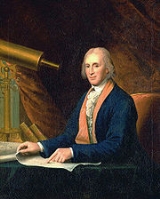
David Rittenhouse was a renowned American
astronomer
, inventor, clockmaker
, mathematician
, surveyor, scientific instrument craftsman and public official. Rittenhouse was a member of the American Philosophical Society
and the first director of the United States Mint
.
, in a small village called RittenhouseTown
. This village is located along the stream Paper Mill Run
; the stream itself a tiny tributary of the Wissahickon Creek
.
When his uncle died, Rittenhouse inherited his uncle's set of carpentry tools and instructional books. He used these tools and began a career as an inventor. At a young age, Rittenhouse showed a high level of intelligence by creating a working scale model of his grandfather's paper mill. He was self-taught and showed great ability in science
and mathematics.
When Rittenhouse was 13 years of age, he had mastered Isaac Newton
's laws of motion
and gravity. As a young boy he loved to build scale models, such as a working waterwheel and a paper mill. Rittenhouse never went to elementary school and was completely self-educated from family books.
When he was 19, he started a scientific instrument shop at his father's farm in what is now East Norriton Township, Pennsylvania
. His skill with instruments, particularly clocks, led him to construct two orreries
(scale models of the solar system) for Rutgers University
in New Jersey
. In return for the gift, the college gave him a scholarship to attend the college enabling him to obtain a degree in philosophy. One of the orreries is currently in the library of the University of Pennsylvania
and the other is at Peyton Hall of Princeton University
.
At the age of 28, he published his first mathematical paper; this is one of many papers published throughout his life.
Rittenhouse was one of the first to build a telescope in the United States. His telescope, which utilized natural spider silk
to form the reticle, was used to observe and record part of the transit of Venus
across the sun on June 3, 1769, as well as the planet's atmosphere.
In 1781 Rittenhouse became the first American to sight Uranus
.
In 1784 Rittenhouse, surveyor Andrew Ellicott
and their crew completed the unfinished survey of the Mason Dixon line to the southwest corner of Pennsylvania, 5 degrees of longitude from the Delaware River.
In 1785 Rittenhouse made perhaps the first diffraction grating
using 50 hairs between two finely threaded screws, with an approximate spacing of about 100 lines per inch. This was roughly the same technique that Joseph von Fraunhofer
used in 1821 for his wire diffraction grating.
In 1813 Rittenhouse's nephew (and American Philosophical Society member) William Barton
published a biography, Memoirs of the life of David Rittenhouse. Former president
Thomas Jefferson
ordered six copies directly from the author.
, and this was another factor in being chosen to study Venus. Throughout his life he had the honour to serve in many different clubs and committees.
In 1768 he was elected to membership in the American Philosophical Society
. He served as librarian, secretary, and after Benjamin Franklin
's death, he became Vice president. Following the death of Franklin in 1790, Rittenhouse served as president of the American Philosophical Society until 1796.
Another one of his interests was the Royal Society of London of which he was a member. It was very rare for an American to be a member of this exclusive British society.
In 1786 Rittenhouse built a new Georgian-style house on the corner of 4th and Arch streets in Philadelphia, next to an octagonal observatory he had already built. At this house, he maintained a Wednesday evening salon meeting with Benjamin Franklin, Francis Hopkinson, Pierre Eugene du Simitiere
and others. Thomas Jefferson wrote that he would rather attend one of these meetings "than spend a whole week in Paris."
David married his second wife Hannah Jacobs on December 31, 1772. They had an unnamed baby, who died at birth in late 1773. Hannah outlived David by more than 3 years, dying in late 1799.
David's grandson (son of Ester) was named David Rittenhouse Waters.
During the first part of his career he was a surveyor for Great Britain
, and later served in the Pennsylvania
government. His 1763–1764 survey of the Delaware-Pennsylvania border was a 12-mile circle about the Court House in New Castle, Delaware, to define the northern border of Delaware. Rittenhouse's work was so precise and well-documented that it was incorporated without modification into Charles Mason
and Jeremiah Dixon
's survey of the Pennsylvania-Maryland border.
Later Rittenhouse would help establish the boundaries of several other states and commonwealths both before and after the Independence, including the boundaries between New Jersey, New York and Pennsylvania. In 1763 Mason and Dixon began a survey of the Pennsylvania-Maryland border, but this work was interrupted in 1767. In 1784 Rittenhouse and Andrew Ellicott
completed this survey of the Mason-Dixon line to the southwest corner of Pennsylvania. When Rittenhouse's work as a surveyor ended, he resumed his scientific interests.
, Rittenhouse announced plans to observe a pending transit of Venus
across the Sun
from several locations. The American Philosophical Society persuaded the legislature to grant £100 towards the purchase of new telescopes, and members volunteered to man half of the 22 telescope stations when the event arrived.
The transit of Venus
occurred on 3 June 1769. Rittenhouse's great excitement at observing the infrequently occurring transit of Venus (for which he had prepared for a year) resulted in his fainting during the observation. In addition to the work involved in the preparations, he had also been ill the week before the transit. Lying on his back beneath the telescope, trained at the afternoon sun, he regained consciousness after a few minutes and continued his observations. His account of the transit, published in the American Philosophical Society's Transactions, does not mention his fainting, though it is otherwise meticulous in its record and docomented.
Rittenhouse used the observations to calculate the distance from Earth to the Sun to be 93-million miles. (This is the approximate average distance between Earth and the Sun.) The published report of the transit was hailed by European scientists, and Rittenhouse would correspond with famous contemporary astronomers, such as Jérôme Lalande
and Franz Xaver von Zach.
. In recognition of the achievement, the College of New Jersey
granted Rittenhouse an honorary degree. The college then acquired ownership of the orrery. Rittenhouse made a new, more advanced model which remained in Philadelphia. The State of Pennsylvania paid Rittenhouse £300 as a tribute for his achievement.
Rittenhouse was admired by many colonial Americans and scientists, including Dr. Benjamin Franklin, Thomas Jefferson
, and John Adams
. On February 24, 1775, Rittenhouse delivered a lecture on the history of astronomy to the American Philosophical Society, in which he linked the structure of nature to the rights of man, liberty and self-government. Rittenhouse also used the occasion to decry slavery. So impressed were those in attendance that the American Philosophical Society commissioned the speech to be printed and distributed to delegates of the Second Continental Congress
when they arrived in 1776.
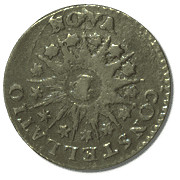 David Rittenhouse was treasurer of Pennsylvania from 1777 to 1789, and with these skills and the help of George Washington
, he became the first director of the United States Mint
. On April 2, 1792, the United States Mint opened its doors, but would not produce coins for almost four months. Rittenhouse believed that the design of the coin made the coin a piece of artwork. The first coins were made from flatware that was provided by Washington himself on the morning of July 30, 1792. The coins were hand-struck by Rittenhouse, to test the new equipment, and were given to Washington as a token of appreciation for his contributions to making the United States Mint a reality. The coin design had not been approved by Congress. Coin production on a large scale did not begin until 1793. Rittenhouse resigned from the Mint on June 30, 1795, due to poor health. In 1871 Congress approved a commemorative coin
in his honor.
 Other notable events in Rittenhouse's life include:

United States
The United States of America is a federal constitutional republic comprising fifty states and a federal district...
astronomer
Astronomer
An astronomer is a scientist who studies celestial bodies such as planets, stars and galaxies.Historically, astronomy was more concerned with the classification and description of phenomena in the sky, while astrophysics attempted to explain these phenomena and the differences between them using...
, inventor, clockmaker
Clockmaker
A clockmaker is an artisan who makes and repairs clocks. Since almost all clocks are now factory-made, most modern clockmakers only repair clocks. Modern clockmakers may be employed by jewellers, antique shops, and places devoted strictly to repairing clocks and watches...
, mathematician
Mathematician
A mathematician is a person whose primary area of study is the field of mathematics. Mathematicians are concerned with quantity, structure, space, and change....
, surveyor, scientific instrument craftsman and public official. Rittenhouse was a member of the American Philosophical Society
American Philosophical Society
The American Philosophical Society, founded in 1743, and located in Philadelphia, Pa., is an eminent scholarly organization of international reputation, that promotes useful knowledge in the sciences and humanities through excellence in scholarly research, professional meetings, publications,...
and the first director of the United States Mint
United States Mint
The United States Mint primarily produces circulating coinage for the United States to conduct its trade and commerce. The Mint was created by Congress with the Coinage Act of 1792, and placed within the Department of State...
.
Biography
Rittenhouse was born near Germantown, Philadelphia, PennsylvaniaGermantown, Philadelphia, Pennsylvania
Germantown is a neighborhood in the northwest section of the city of Philadelphia, Pennsylvania, United States, about 7–8 miles northwest from the center of the city...
, in a small village called RittenhouseTown
RittenhouseTown Historic District
The Rittenhousetown Historic District was an early industrial community where the first paper mill in British North America was built by William Rittenhouse and his son Nicholas on the north bank of Monoshone Creek near Philadelphia, Pennsylvania. Flax was woven into linen in nearby Germantown...
. This village is located along the stream Paper Mill Run
Paper Mill Run
Paper Mill Run, also known as Monoshone Creek, is a small tributary of Wissahickon Creek in Philadelphia, Pennsylvania, USA. Its watershed includes parts of the Mount Airy and Germantown neighhborhoods of Philadelphia....
; the stream itself a tiny tributary of the Wissahickon Creek
Wissahickon Creek
Wissahickon Creek is a stream in southeastern Pennsylvania. Rising in Montgomery County, Pennsylvania, it runs about 23 miles passing through and dividing Northwest Philadelphia before emptying into the Schuylkill River at Philadelphia...
.
When his uncle died, Rittenhouse inherited his uncle's set of carpentry tools and instructional books. He used these tools and began a career as an inventor. At a young age, Rittenhouse showed a high level of intelligence by creating a working scale model of his grandfather's paper mill. He was self-taught and showed great ability in science
Science
Science is a systematic enterprise that builds and organizes knowledge in the form of testable explanations and predictions about the universe...
and mathematics.
When Rittenhouse was 13 years of age, he had mastered Isaac Newton
Isaac Newton
Sir Isaac Newton PRS was an English physicist, mathematician, astronomer, natural philosopher, alchemist, and theologian, who has been "considered by many to be the greatest and most influential scientist who ever lived."...
's laws of motion
Laws of motion
In physics, a number of noted theories of the motion of objects have developed. Among the best-known are:* Classical mechanics** Newton's laws of motion**Euler's laws**Cauchy's equations of motion** Kepler's laws of planetary motion ** General relativity...
and gravity. As a young boy he loved to build scale models, such as a working waterwheel and a paper mill. Rittenhouse never went to elementary school and was completely self-educated from family books.
When he was 19, he started a scientific instrument shop at his father's farm in what is now East Norriton Township, Pennsylvania
East Norriton Township, Pennsylvania
East Norriton Township is a census-designated place and township in Montgomery County, Pennsylvania, United States. The population was 13,590 at the 2010 census.-Geography:East Norriton Township is located at ....
. His skill with instruments, particularly clocks, led him to construct two orreries
Orrery
An orrery is a mechanical device that illustrates the relative positions and motions of the planets and moons in the Solar System in a heliocentric model. Though the Greeks had working planetaria, the first orrery that was a planetarium of the modern era was produced in 1704, and one was presented...
(scale models of the solar system) for Rutgers University
Rutgers University
Rutgers, The State University of New Jersey , is the largest institution for higher education in New Jersey, United States. It was originally chartered as Queen's College in 1766. It is the eighth-oldest college in the United States and one of the nine Colonial colleges founded before the American...
in New Jersey
New Jersey
New Jersey is a state in the Northeastern and Middle Atlantic regions of the United States. , its population was 8,791,894. It is bordered on the north and east by the state of New York, on the southeast and south by the Atlantic Ocean, on the west by Pennsylvania and on the southwest by Delaware...
. In return for the gift, the college gave him a scholarship to attend the college enabling him to obtain a degree in philosophy. One of the orreries is currently in the library of the University of Pennsylvania
University of Pennsylvania
The University of Pennsylvania is a private, Ivy League university located in Philadelphia, Pennsylvania, United States. Penn is the fourth-oldest institution of higher education in the United States,Penn is the fourth-oldest using the founding dates claimed by each institution...
and the other is at Peyton Hall of Princeton University
Princeton University
Princeton University is a private research university located in Princeton, New Jersey, United States. The school is one of the eight universities of the Ivy League, and is one of the nine Colonial Colleges founded before the American Revolution....
.
At the age of 28, he published his first mathematical paper; this is one of many papers published throughout his life.
Rittenhouse was one of the first to build a telescope in the United States. His telescope, which utilized natural spider silk
Spider web
A spider web, spiderweb, spider's web or cobweb is a device built by a spider out of proteinaceous spider silk extruded from its spinnerets....
to form the reticle, was used to observe and record part of the transit of Venus
Transit of Venus
A transit of Venus across the Sun takes place when the planet Venus passes directly between the Sun and Earth, becoming visible against the solar disk. During a transit, Venus can be seen from Earth as a small black disk moving across the face of the Sun...
across the sun on June 3, 1769, as well as the planet's atmosphere.
In 1781 Rittenhouse became the first American to sight Uranus
Uranus
Uranus is the seventh planet from the Sun. It has the third-largest planetary radius and fourth-largest planetary mass in the Solar System. It is named after the ancient Greek deity of the sky Uranus , the father of Cronus and grandfather of Zeus...
.
In 1784 Rittenhouse, surveyor Andrew Ellicott
Andrew Ellicott
Andrew Ellicott was a U.S. surveyor who helped map many of the territories west of the Appalachians, surveyed the boundaries of the District of Columbia, continued and completed Pierre Charles L'Enfant's work on the plan for Washington, D.C., and served as a teacher in survey methods for...
and their crew completed the unfinished survey of the Mason Dixon line to the southwest corner of Pennsylvania, 5 degrees of longitude from the Delaware River.
In 1785 Rittenhouse made perhaps the first diffraction grating
Diffraction grating
In optics, a diffraction grating is an optical component with a periodic structure, which splits and diffracts light into several beams travelling in different directions. The directions of these beams depend on the spacing of the grating and the wavelength of the light so that the grating acts as...
using 50 hairs between two finely threaded screws, with an approximate spacing of about 100 lines per inch. This was roughly the same technique that Joseph von Fraunhofer
Joseph von Fraunhofer
Joseph von Fraunhofer was a German optician. He is known for the discovery of the dark absorption lines known as Fraunhofer lines in the Sun's spectrum, and for making excellent optical glass and achromatic telescope objectives.-Biography:Fraunhofer was born in Straubing, Bavaria...
used in 1821 for his wire diffraction grating.
In 1813 Rittenhouse's nephew (and American Philosophical Society member) William Barton
William Barton (heraldist)
William Barton was a Pennsylvania lawyer, scholar, and the designer of the Great Seal of the United States.- Family and Education :...
published a biography, Memoirs of the life of David Rittenhouse. Former president
President of the United States
The President of the United States of America is the head of state and head of government of the United States. The president leads the executive branch of the federal government and is the commander-in-chief of the United States Armed Forces....
Thomas Jefferson
Thomas Jefferson
Thomas Jefferson was the principal author of the United States Declaration of Independence and the Statute of Virginia for Religious Freedom , the third President of the United States and founder of the University of Virginia...
ordered six copies directly from the author.
Clubs and societies
Astronomers who had been studying the planet Venus chose Rittenhouse to study the transit path of Venus in 1769 and its atmosphere. Rittenhouse was the perfect person to study the mysterious planet, as he had a personal observatory on his family farm. "His telescope, which he made himself, utilized grating intervals and spider threads on the focus of the telescope." His telescope is very similar to some modern-day telescopes. Rittenhouse served on the American Astronomical SocietyAmerican Astronomical Society
The American Astronomical Society is an American society of professional astronomers and other interested individuals, headquartered in Washington, DC...
, and this was another factor in being chosen to study Venus. Throughout his life he had the honour to serve in many different clubs and committees.
In 1768 he was elected to membership in the American Philosophical Society
American Philosophical Society
The American Philosophical Society, founded in 1743, and located in Philadelphia, Pa., is an eminent scholarly organization of international reputation, that promotes useful knowledge in the sciences and humanities through excellence in scholarly research, professional meetings, publications,...
. He served as librarian, secretary, and after Benjamin Franklin
Benjamin Franklin
Dr. Benjamin Franklin was one of the Founding Fathers of the United States. A noted polymath, Franklin was a leading author, printer, political theorist, politician, postmaster, scientist, musician, inventor, satirist, civic activist, statesman, and diplomat...
's death, he became Vice president. Following the death of Franklin in 1790, Rittenhouse served as president of the American Philosophical Society until 1796.
Another one of his interests was the Royal Society of London of which he was a member. It was very rare for an American to be a member of this exclusive British society.
In 1786 Rittenhouse built a new Georgian-style house on the corner of 4th and Arch streets in Philadelphia, next to an octagonal observatory he had already built. At this house, he maintained a Wednesday evening salon meeting with Benjamin Franklin, Francis Hopkinson, Pierre Eugene du Simitiere
Pierre Eugene du Simitiere
Pierre Eugene du Simitiere , born Pierre-Eugène Ducimetière , was a philosopher, member of the American Philosophical Society, naturalist, American patriot, and portrait painter...
and others. Thomas Jefferson wrote that he would rather attend one of these meetings "than spend a whole week in Paris."
Family
David Rittenhouse was married twice. He married Eleanor Coulston February 20, 1766, and they had two daughters: Elizabeth (born 1767) and Ester (born 1769). David's first wife Eleanor died February 23, 1771, at age 35 from complications during the birth of their third baby, who died at birth.David married his second wife Hannah Jacobs on December 31, 1772. They had an unnamed baby, who died at birth in late 1773. Hannah outlived David by more than 3 years, dying in late 1799.
David's grandson (son of Ester) was named David Rittenhouse Waters.
Notable contributions to the United States
David Rittenhouse made many breakthroughs during his life, which were great contributions to the U.S.United States
The United States of America is a federal constitutional republic comprising fifty states and a federal district...
During the first part of his career he was a surveyor for Great Britain
Great Britain
Great Britain or Britain is an island situated to the northwest of Continental Europe. It is the ninth largest island in the world, and the largest European island, as well as the largest of the British Isles...
, and later served in the Pennsylvania
Pennsylvania
The Commonwealth of Pennsylvania is a U.S. state that is located in the Northeastern and Mid-Atlantic regions of the United States. The state borders Delaware and Maryland to the south, West Virginia to the southwest, Ohio to the west, New York and Ontario, Canada, to the north, and New Jersey to...
government. His 1763–1764 survey of the Delaware-Pennsylvania border was a 12-mile circle about the Court House in New Castle, Delaware, to define the northern border of Delaware. Rittenhouse's work was so precise and well-documented that it was incorporated without modification into Charles Mason
Charles Mason
Charles Mason was an English astronomer who made significant contributions to 18th-century science and American history, particularly through his involvement with the survey of the Mason-Dixon line, which came to mark the division between the northern and southern United States...
and Jeremiah Dixon
Jeremiah Dixon
Jeremiah Dixon was an English surveyor and astronomer who is perhaps best known for his work with Charles Mason, from 1763 to 1767, in determining what was later called the Mason-Dixon line....
's survey of the Pennsylvania-Maryland border.
Later Rittenhouse would help establish the boundaries of several other states and commonwealths both before and after the Independence, including the boundaries between New Jersey, New York and Pennsylvania. In 1763 Mason and Dixon began a survey of the Pennsylvania-Maryland border, but this work was interrupted in 1767. In 1784 Rittenhouse and Andrew Ellicott
Andrew Ellicott
Andrew Ellicott was a U.S. surveyor who helped map many of the territories west of the Appalachians, surveyed the boundaries of the District of Columbia, continued and completed Pierre Charles L'Enfant's work on the plan for Washington, D.C., and served as a teacher in survey methods for...
completed this survey of the Mason-Dixon line to the southwest corner of Pennsylvania. When Rittenhouse's work as a surveyor ended, he resumed his scientific interests.
Transit of Venus
In 1768 the same year that he became a member of the American Philosophical SocietyAmerican Philosophical Society
The American Philosophical Society, founded in 1743, and located in Philadelphia, Pa., is an eminent scholarly organization of international reputation, that promotes useful knowledge in the sciences and humanities through excellence in scholarly research, professional meetings, publications,...
, Rittenhouse announced plans to observe a pending transit of Venus
Venus
Venus is the second planet from the Sun, orbiting it every 224.7 Earth days. The planet is named after Venus, the Roman goddess of love and beauty. After the Moon, it is the brightest natural object in the night sky, reaching an apparent magnitude of −4.6, bright enough to cast shadows...
across the Sun
Sun
The Sun is the star at the center of the Solar System. It is almost perfectly spherical and consists of hot plasma interwoven with magnetic fields...
from several locations. The American Philosophical Society persuaded the legislature to grant £100 towards the purchase of new telescopes, and members volunteered to man half of the 22 telescope stations when the event arrived.
The transit of Venus
Transit of Venus
A transit of Venus across the Sun takes place when the planet Venus passes directly between the Sun and Earth, becoming visible against the solar disk. During a transit, Venus can be seen from Earth as a small black disk moving across the face of the Sun...
occurred on 3 June 1769. Rittenhouse's great excitement at observing the infrequently occurring transit of Venus (for which he had prepared for a year) resulted in his fainting during the observation. In addition to the work involved in the preparations, he had also been ill the week before the transit. Lying on his back beneath the telescope, trained at the afternoon sun, he regained consciousness after a few minutes and continued his observations. His account of the transit, published in the American Philosophical Society's Transactions, does not mention his fainting, though it is otherwise meticulous in its record and docomented.
Rittenhouse used the observations to calculate the distance from Earth to the Sun to be 93-million miles. (This is the approximate average distance between Earth and the Sun.) The published report of the transit was hailed by European scientists, and Rittenhouse would correspond with famous contemporary astronomers, such as Jérôme Lalande
Jérôme Lalande
Joseph Jérôme Lefrançois de Lalande was a French astronomer and writer.-Biography:Lalande was born at Bourg-en-Bresse...
and Franz Xaver von Zach.
Orrery
In 1770 Rittenhouse completed an advanced orreryOrrery
An orrery is a mechanical device that illustrates the relative positions and motions of the planets and moons in the Solar System in a heliocentric model. Though the Greeks had working planetaria, the first orrery that was a planetarium of the modern era was produced in 1704, and one was presented...
. In recognition of the achievement, the College of New Jersey
Princeton University
Princeton University is a private research university located in Princeton, New Jersey, United States. The school is one of the eight universities of the Ivy League, and is one of the nine Colonial Colleges founded before the American Revolution....
granted Rittenhouse an honorary degree. The college then acquired ownership of the orrery. Rittenhouse made a new, more advanced model which remained in Philadelphia. The State of Pennsylvania paid Rittenhouse £300 as a tribute for his achievement.
Rittenhouse was admired by many colonial Americans and scientists, including Dr. Benjamin Franklin, Thomas Jefferson
Thomas Jefferson
Thomas Jefferson was the principal author of the United States Declaration of Independence and the Statute of Virginia for Religious Freedom , the third President of the United States and founder of the University of Virginia...
, and John Adams
John Adams
John Adams was an American lawyer, statesman, diplomat and political theorist. A leading champion of independence in 1776, he was the second President of the United States...
. On February 24, 1775, Rittenhouse delivered a lecture on the history of astronomy to the American Philosophical Society, in which he linked the structure of nature to the rights of man, liberty and self-government. Rittenhouse also used the occasion to decry slavery. So impressed were those in attendance that the American Philosophical Society commissioned the speech to be printed and distributed to delegates of the Second Continental Congress
Second Continental Congress
The Second Continental Congress was a convention of delegates from the Thirteen Colonies that started meeting on May 10, 1775, in Philadelphia, Pennsylvania, soon after warfare in the American Revolutionary War had begun. It succeeded the First Continental Congress, which met briefly during 1774,...
when they arrived in 1776.
United States Mint
George Washington
George Washington was the dominant military and political leader of the new United States of America from 1775 to 1799. He led the American victory over Great Britain in the American Revolutionary War as commander-in-chief of the Continental Army from 1775 to 1783, and presided over the writing of...
, he became the first director of the United States Mint
United States Mint
The United States Mint primarily produces circulating coinage for the United States to conduct its trade and commerce. The Mint was created by Congress with the Coinage Act of 1792, and placed within the Department of State...
. On April 2, 1792, the United States Mint opened its doors, but would not produce coins for almost four months. Rittenhouse believed that the design of the coin made the coin a piece of artwork. The first coins were made from flatware that was provided by Washington himself on the morning of July 30, 1792. The coins were hand-struck by Rittenhouse, to test the new equipment, and were given to Washington as a token of appreciation for his contributions to making the United States Mint a reality. The coin design had not been approved by Congress. Coin production on a large scale did not begin until 1793. Rittenhouse resigned from the Mint on June 30, 1795, due to poor health. In 1871 Congress approved a commemorative coin
Commemorative coin
Commemorative coins are coins that were issued to commemorate some particular event or issue. Most world commemorative coins were issued from the 1960s onward, although there are numerous examples of commemorative coins of earlier date. Such coins have a distinct design with reference to the...
in his honor.
Notable events
- 1763–1764 Worked on the boundary survey of PennsylvaniaPennsylvaniaThe Commonwealth of Pennsylvania is a U.S. state that is located in the Northeastern and Mid-Atlantic regions of the United States. The state borders Delaware and Maryland to the south, West Virginia to the southwest, Ohio to the west, New York and Ontario, Canada, to the north, and New Jersey to...
and MarylandMarylandMaryland is a U.S. state located in the Mid Atlantic region of the United States, bordering Virginia, West Virginia, and the District of Columbia to its south and west; Pennsylvania to its north; and Delaware to its east... - 1767 Granted an honorary master's degree from the College of Philadelphia (later University of PennsylvaniaUniversity of PennsylvaniaThe University of Pennsylvania is a private, Ivy League university located in Philadelphia, Pennsylvania, United States. Penn is the fourth-oldest institution of higher education in the United States,Penn is the fourth-oldest using the founding dates claimed by each institution...
) - 1768 Discovered the atmosphere of VenusVenusVenus is the second planet from the Sun, orbiting it every 224.7 Earth days. The planet is named after Venus, the Roman goddess of love and beauty. After the Moon, it is the brightest natural object in the night sky, reaching an apparent magnitude of −4.6, bright enough to cast shadows...
- 1769 Observed the transit of Venus
- 1770 Came to Philadelphia
- 1775 EngineerEngineerAn engineer is a professional practitioner of engineering, concerned with applying scientific knowledge, mathematics and ingenuity to develop solutions for technical problems. Engineers design materials, structures, machines and systems while considering the limitations imposed by practicality,...
of the Committee of Safety - 1779–1782 Professor of AstronomyAstronomyAstronomy is a natural science that deals with the study of celestial objects and phenomena that originate outside the atmosphere of Earth...
in the University of the State of Pennsylvania, now known simply as the University of PennsylvaniaUniversity of PennsylvaniaThe University of Pennsylvania is a private, Ivy League university located in Philadelphia, Pennsylvania, United States. Penn is the fourth-oldest institution of higher education in the United States,Penn is the fourth-oldest using the founding dates claimed by each institution...
- 1780–1782 Vice-Provost
- 1782–1796 Trustee
- 1779–1787 Treasurer of Pennsylvania
- 1784 Completed the survey of the Mason-Dixon lineMason-Dixon lineThe Mason–Dixon Line was surveyed between 1763 and 1767 by Charles Mason and Jeremiah Dixon in the resolution of a border dispute between British colonies in Colonial America. It forms a demarcation line among four U.S. states, forming part of the borders of Pennsylvania, Maryland, Delaware, and...
- 1791–1796 President of the American Philosophical SocietyAmerican Philosophical SocietyThe American Philosophical Society, founded in 1743, and located in Philadelphia, Pa., is an eminent scholarly organization of international reputation, that promotes useful knowledge in the sciences and humanities through excellence in scholarly research, professional meetings, publications,...
- 1792–1795 First Director of the United States Mint
- 1793 He was a founder of the Democratic-Republican SocietiesDemocratic-Republican SocietiesDemocratic-Republican Societies were local political organizations formed in the United States in 1793-94 to promote republicanism and democracy and to fight aristocratic tendencies...
in Philadelphia.
Tributes to David Rittenhouse
- Rittenhouse CraterRittenhouse (crater)Rittenhouse is a small lunar crater that is located in the southern part of the Moon's far side. It lies amidst the western outer ramparts of the immense walled plain Schrödinger. To the west is the prominent crater Hale, just visible from the Earth along the lunar limb.This is a rounded but not...
is a lunar crater named for David Rittenhouse.
- In 1825, one of William PennWilliam PennWilliam Penn was an English real estate entrepreneur, philosopher, and founder of the Province of Pennsylvania, the English North American colony and the future Commonwealth of Pennsylvania. He was an early champion of democracy and religious freedom, notable for his good relations and successful...
's original squares in Philadelphia, called 'Southwest Square' (being in the southwest quadrant of the original city plan) was renamed Rittenhouse SquareRittenhouse SquareRittenhouse Square is one of the five original open-space parks planned by William Penn and his surveyor Thomas Holme during the late 17th century in central Philadelphia, Pennsylvania. The park cuts off 19th Street at Walnut Street and also at a half block above Manning Street. Its boundaries are...
in David Rittenhouse's honor.
- To the west of Rittenhouse Square, on Walnut Street, the University of PennsylvaniaUniversity of PennsylvaniaThe University of Pennsylvania is a private, Ivy League university located in Philadelphia, Pennsylvania, United States. Penn is the fourth-oldest institution of higher education in the United States,Penn is the fourth-oldest using the founding dates claimed by each institution...
houses its PhysicsPhysicsPhysics is a natural science that involves the study of matter and its motion through spacetime, along with related concepts such as energy and force. More broadly, it is the general analysis of nature, conducted in order to understand how the universe behaves.Physics is one of the oldest academic...
and MathematicsMathematicsMathematics is the study of quantity, space, structure, and change. Mathematicians seek out patterns and formulate new conjectures. Mathematicians resolve the truth or falsity of conjectures by mathematical proofs, which are arguments sufficient to convince other mathematicians of their validity...
departments in the David Rittenhouse LaboratoryDavid Rittenhouse LaboratoryThe David Rittenhouse Laboratory is an academic and research building at the University of Pennsylvania in Philadelphia, USA. The building is named for David Rittenhouse, a notable American astronomer and Penn professor of the 18th century and the president of the American Philosophical Society...
.
- One admirer and colleague of Rittenhouse, Francis HopkinsonFrancis HopkinsonFrancis Hopkinson , an American author, was one of the signers of the Declaration of Independence as a delegate from New Jersey. He later served as a federal judge in Pennsylvania...
, was on the Navy Board that wrote the Flag Act of 1777Flag Acts (United States)The Flag Acts are three laws which sought to define the design of the flag of the United States. Each is remarkably short, the shortest being a sentence of 32 words, and the longest being a title and two sentences of 117 words.- Flag Act of 1777 :...
, which defined the Flag of the United States of America and explained the blue field of stars as a representation of "a new constellation." This is thought by some to be a direct tribute to Rittenhouse. Biographer Brooke Hindle wrote, "Few admired Rittenhouse more unrestrainedly than Francis Hopkinson."