Home      Discussion      Topics      Dictionary      Almanac
Signup       Login
Lincoln cent

Lincoln cent

Overview

The Lincoln cent is the current one cent coin of the US Dollar
Cent (United States coin)
The United States one-cent coin, commonly known as a penny, is a unit of currency equaling one one-hundredth of a United States dollar. Its symbol is ¢. Its obverse has featured the profile of President Abraham Lincoln since 1909, the centennial of his birth. From 1959 to 2008, the reverse...

. It was adopted in 1909, replacing the Indian Head cent
Indian Head cent
The Indian Head one-cent coin, also known as an Indian Penny , was produced by the United States Mint from 1859 to 1909 at the Philadelphia Mint and in 1908 and 1909 at the San Francisco Mint...

. Its obverse
Obverse and reverse
The term, obverse, and its opposite, reverse, describe the two sides of units of currency and many other kinds of two-sided objects - most often in reference to coins, but also to paper currency, flags , medals, drawings, old master prints and other works of art, and printed fabrics...

, featuring a bust of Abraham Lincoln
Abraham Lincoln
Abraham Lincoln was the 16th President of the United States, serving from March 1861 until his assassination in April 1865. He successfully led his country through its greatest internal crisis, the American Civil War, preserving the Union and ending slavery...

 (to commemorate his centennial), has been in continuous usage. Its reverse was changed in 1959 from a wheat stalks design to a design which includes the Lincoln Memorial
Lincoln Memorial
The Lincoln Memorial is an American memorial built to honor the 16th President of the United States, Abraham Lincoln. It is located on the National Mall in Washington, D.C. and was dedicated on May 30, 1922. The architect was Henry Bacon, the sculptor of the main statue was Daniel Chester French,...

 (to commemorate Lincoln's sesquicentennial) and was replaced again in 2009 with four new designs to commemorate Lincoln's bicentennial.
Discussion
Ask a question about 'Lincoln cent'
Start a new discussion about 'Lincoln cent'
Answer questions from other users
Full Discussion Forum
 
Encyclopedia

The Lincoln cent is the current one cent coin of the US Dollar
Cent (United States coin)
The United States one-cent coin, commonly known as a penny, is a unit of currency equaling one one-hundredth of a United States dollar. Its symbol is ¢. Its obverse has featured the profile of President Abraham Lincoln since 1909, the centennial of his birth. From 1959 to 2008, the reverse...

. It was adopted in 1909, replacing the Indian Head cent
Indian Head cent
The Indian Head one-cent coin, also known as an Indian Penny , was produced by the United States Mint from 1859 to 1909 at the Philadelphia Mint and in 1908 and 1909 at the San Francisco Mint...

. Its obverse
Obverse and reverse
The term, obverse, and its opposite, reverse, describe the two sides of units of currency and many other kinds of two-sided objects - most often in reference to coins, but also to paper currency, flags , medals, drawings, old master prints and other works of art, and printed fabrics...

, featuring a bust of Abraham Lincoln
Abraham Lincoln
Abraham Lincoln was the 16th President of the United States, serving from March 1861 until his assassination in April 1865. He successfully led his country through its greatest internal crisis, the American Civil War, preserving the Union and ending slavery...

 (to commemorate his centennial), has been in continuous usage. Its reverse was changed in 1959 from a wheat stalks design to a design which includes the Lincoln Memorial
Lincoln Memorial
The Lincoln Memorial is an American memorial built to honor the 16th President of the United States, Abraham Lincoln. It is located on the National Mall in Washington, D.C. and was dedicated on May 30, 1922. The architect was Henry Bacon, the sculptor of the main statue was Daniel Chester French,...

 (to commemorate Lincoln's sesquicentennial) and was replaced again in 2009 with four new designs to commemorate Lincoln's bicentennial. There are more one-cent coins produced than any other denomination, which makes the Lincoln cent a familiar item. In its life span, this coin has weathered two world conflicts, one of which changed it materially, because metals play a vital part in any war effort. The obverse is the longest design used for any circulating American design.

History


This section details compositional and design-related changes in the history of the Lincoln cent design of the United States cent.

Obverse design


When the Lincoln one-cent coin made its initial appearance in 1909, it marked a radical departure from the accepted styling of United States coinage
United States coinage
United States coinage was first minted by the new republic in 1792. New coins have been produced every year since then and they make up a valuable aspect of the United States currency system. Today circulating coins exist in denominations: $0.01, $0.05, $0.10, $0.25, $0.50, and $1.00. Also minted...

, as it was the first regular coin to bear a portrait other than the mythical Liberty
Liberty (goddess)
Goddesses named for and representing the concept Liberty have existed in many cultures, including classical examples dating from the Roman Empire and some national symbols such as the British "Britannia" or the Irish "Kathleen Ni Houlihan"....

, which appeared on most pre-1909 regular coins. (Even the so-called Indian Head of the Indian Head cent
Indian Head cent
The Indian Head one-cent coin, also known as an Indian Penny , was produced by the United States Mint from 1859 to 1909 at the Philadelphia Mint and in 1908 and 1909 at the San Francisco Mint...

 it replaced depicted Liberty as a Native American
Native Americans in the United States
Native Americans in the United States is the phrase that describes indigenous peoples from North America now encompassed by the continental United States, including parts of Alaska and the island state of Hawaii. They comprise a large number of distinct tribes, states, and ethnic groups, many of...

; the same concept was later used for the Sacagawea dollar
Sacagawea dollar
The Sacagawea dollar, along with the Presidential Dollar series, is one of the two current United States dollar coins. This coin was first minted by the United States Mint in 2000 and depicts the Shoshone woman Sacagawea, a member of the Lewis and Clark Expedition, carrying her son Jean Baptiste...

 since there are no known portraits of Sacagawea
Sacagawea
Sacagawea was a Shoshone woman who accompanied the Lewis and Clark Expedition, led by Meriwether Lewis and William Clark, in their exploration of the Western United States...

.) Previously, a strong feeling had prevailed against using portraits on coins in the United States, but public sentiment stemming from the 100th anniversary celebration of Abraham Lincoln
Abraham Lincoln
Abraham Lincoln was the 16th President of the United States, serving from March 1861 until his assassination in April 1865. He successfully led his country through its greatest internal crisis, the American Civil War, preserving the Union and ending slavery...

's birth proved stronger than the long-standing prejudice.

A variety of privately-minted tokens bearing Lincoln's image circulated as one-cent pieces during Lincoln's presidency; legitimate coinage had become scarce during the Civil War
American Civil War
The American Civil War , also known as the War Between the States and several other names, was a civil war in the United States of America. Eleven Southern slave states declared their secession from the United States and formed the Confederate States of America...

. These early tokens undoubtedly influenced the denomination, appearance, size, and composition of Lincoln cents.

Theodore Roosevelt
Theodore Roosevelt
Theodore Roosevelt was the 26th President of the United States. He is well remembered for his energetic persona, his range of interests and achievements, his model of masculinity, and his "cowboy" image. He was a leader of the Republican Party and founder of the short-lived Bull Moose Party...

, the 26th US President, thought American coins were so common and uninspiring that he attempted to get the motto "In God We Trust," removed as offending religion, had the opportunity to pose for a young Lithuanian-born Jew, Victor David Brenner
Victor David Brenner
Victor David Brenner was an American sculptor, engraver, and medalist known primarily as the designer of the United States Lincoln Wheat Ears Cent.-Biography:Brenner was born to Jewish parents in Siauliai, Lithuania....

, who, since arriving nineteen years earlier in the United States had become one of the nation’s premier medalists. Roosevelt had learned of Brenner's talents in a settlement house on New York City
New York City
New York is the most populous city in the United States, and the center of the New York metropolitan area, which is among the most populous urban areas in the world. A leading global city, New York exerts a powerful influence over worldwide commerce, finance, culture, fashion and entertainment...

's Lower East Side
Lower East Side
The Lower East Side is a neighborhood in the southeastern part of the New York City borough of Manhattan. It is roughly bounded by Allen Street, E. Houston, Essex Street, Canal Street, Eldridge Street, East Broadway, and Grand Street...

 and was immediately impressed with a bas-relief that Brenner had made of Lincoln, based on a Mathew Brady
Mathew Brady
Mathew B. Brady was one of the most celebrated 19th century American photographers, best known for his portraits of celebrities and the documentation of the American Civil War. He is credited with being the father of photojournalism.-Early years:Brady was born in Warren County, New York, to Irish...

 photograph. Roosevelt, who considered Lincoln the savior of the Union and the greatest Republican President and who also considered himself Lincoln’s political heir, ordered the new Lincoln cent to be based on Brenner's work and that it go just in time to commemorate Lincoln’s 100th birthday in 1909. The likeness of President Lincoln on the obverse of the coin is an adaptation of a plaque Brenner executed several years earlier and which had come to the attention of President Roosevelt in New York.

In addition to the prescribed elements on U.S. coins - LIBERTY and the date - the motto In God We Trust
In God We Trust
In God We Trust is the official motto of the United States and the U.S. state of Florida. The motto first appeared on a United States coin in 1864 during strong Christian sentiment emerging during the Civil War, but In God We Trust did not become the official U.S. national motto until after the...

 appeared for the first time on a coin of this denomination. Of interest also is the fact that the United States Congress
United States Congress
The United States Congress is the bicameral legislature of the federal government of the United States of America, consisting of two houses, the Senate and the House of Representatives. Both senators and representatives are chosen through direct election....

 passed the Act of March 3 1865, authorizing the use of this motto on U.S. coins, during Lincoln's tenure in office.

Even though no legislation was required for the new design, approval of the Secretary of the Treasury
United States Secretary of the Treasury
The United States Secretary of the Treasury is the head of the United States Department of the Treasury, concerned with finance and monetary matters, and, until 2003, some issues of national security and defense. This position in the Federal Government of the United States is analogous to the...

 was necessary to make the change. Franklin MacVeagh
Franklin MacVeagh
Franklin MacVeagh was an American banker and Treasury Secretary.Born in Chester County, Pennsylvania, he graduated from Yale University in 1862, where he was a member of Skull & Bones. He graduated from Columbia Law School in 1864. He worked as a wholesale grocer and lawyer...

 gave his approval on July 14 1909, and not quite three weeks later, on August 2, the new coin was released to the public.

In 1918, after the controversy over Brenner's name and initials on the reverse had died down, his initials were placed on the obverse with no further controversy. They are to be found in minute form on the rim of the bust, just under the shoulder of Lincoln.

In 1969, the design was revised in order to make Lincoln look more like Brenner's original sculptures.

Wheat cent (1909-1958)

See also: Wheat cent
Wheat cent
The Lincoln Wheat Cent was a United States one-cent coin produced from 1909 to 1958....


A study of three models for the coin's reverse resulted in the approval of a very simple design bearing two wheat
Wheat
Wheat is a worldwide cultivated grass from the Fertile Crescent region of the Near East. In 2007 world production of wheat was 607 million tons, making it the third most-produced cereal after maize and rice...

heads in memorial style. Between these, in the center of the coin, are the denomination and UNITED STATES OF AMERICA, while curving around the upper border is the national motto, E Pluribus Unum
E pluribus unum
E pluribus unum, Latin for "Out of many one", is a motto requested by Pierre Eugene du Simitiere and found in 1776 on the Seal of the United States, along with Annuit cœptis and Novus ordo seclorum, and adopted by an Act of Congress in 1782.The phrase originally came from Moretum, a poem...

, Latin
Latin
Latin is an Italic language originally spoken in Latium and Ancient Rome. Through the Roman conquest, Latin spread throughout the Mediterranean and a large part of Europe...

 for "From Many, One."

The original model bore Brenner's name on the reverse, curving along the rim below UNITED STATES OF AMERICA. Before the coins were issued, however, the initials "VDB" were substituted because officials at the United States Mint
United States Mint
The United States Mint primarily produces circulating coinage for the United States to conduct its trade and commerce. The main Mint facility is located in Washington, D.C., and branch facilities are located in Philadelphia, Pennsylvania; Denver, Colorado; San Francisco, California; and West...

 felt the name was too prominent. After the coin was released, many protested that even the initials were conspicuous and detracted from the design. Because the coin was in great demand, and due to the fact that to make a change would have required halting production, the decision was made to eliminate the initials entirely.

Thus in 1909 the U.S. had six different cents: the 1909 and 1909-S Indian Head cent
Indian Head cent
The Indian Head one-cent coin, also known as an Indian Penny , was produced by the United States Mint from 1859 to 1909 at the Philadelphia Mint and in 1908 and 1909 at the San Francisco Mint...

s, and four Lincoln coins: 1909 VDB, 1909-S VDB, 1909 and 1909-S. In all cases the Philadelphia
Philadelphia, Pennsylvania
Philadelphia is the largest city in Pennsylvania and the sixth-most-populous city in the United States.In 2008, the population of the city proper was estimated to be over 1.4 million, while the metropolitan area's population of 5.8 million made it the country's fifth-largest...

 mintages far exceeded the San Francisco
San Francisco, California
San Francisco is the fourth most populous city in California and the 12th most populous city in the United States, with a 2008 estimated population of 808,976. It is the eighth most densely populated city in the U.S. and is the financial, cultural, and transportation center of the larger San...

 issues. While the smallest mintage is the '09-S Indian, the '09-S VDB is the key Lincoln date, and hence is most valuable. Its mintage of 484,000 is only 1.7% of the plain VDB.

Lincoln Memorial cent (1959-2008)


On February 12 1959, a revised reverse design was introduced as part of the 150th anniversary of Lincoln's birth. No formal competition was held. Frank Gasparro
Frank Gasparro
Frank Gasparro was the tenth Chief Engraver of the United States Mint, holding this position from February 23, 1965 to January 16, 1981. Before that, he was Assistant Engraver....

, then Assistant Engraver at the Philadelphia Mint
Philadelphia Mint
The Philadelphia Mint was created from the need to establish a national identity and the needs of commerce in the United States. This led the Founding Fathers of the United States to make an establishment of a continental national mint a main priority after the ratification of the Constitution of...

, prepared the winning entry, selected from a group of 23 models that the engraving staff at the Mint had been asked to present for consideration. Again, only the approval of the Secretary of the Treasury was necessary to make the change because the design had been in use for more than the required 25 years.

The imposing marble Lincoln Memorial
Lincoln Memorial
The Lincoln Memorial is an American memorial built to honor the 16th President of the United States, Abraham Lincoln. It is located on the National Mall in Washington, D.C. and was dedicated on May 30, 1922. The architect was Henry Bacon, the sculptor of the main statue was Daniel Chester French,...

 provides the central motif, with the legends E Pluribus Unum and UNITED STATES OF AMERICA completing the design, together with the denomination. The initials "FG" appear on the right, near the shrubbery. In his treatise Theory and Practise of Numismatic Design, Steve Crooks states that because the Lincoln Memorial is shown in sufficient detail to discern the statue of Lincoln on the reverse of the penny, Abraham Lincoln was the only person to be depicted on both the obverse and reverse of the same United States coin until the release of the New Jersey state quarter
50 State Quarters
The 50 State Quarters program is the release of a series of commemorative coins by the United States Mint. Between 1999 and 2008, it featured each of the 50 individual U.S. states on unique designs for the reverse of the quarter....

 in 1999, which depicts George Washington
George Washington
George Washington was the commander of the Continental Army in the American Revolutionary War and served as the first President of the United States of America...

 crossing the Delaware River
Delaware River
The Delaware River is a major river on the Atlantic coast of the United States.The Delaware was explored by Adriaen Block as part of the New Netherlands Colony, and was named the South River to mark the southernmost reach of that colony....

 on the reverse.

The 2009 Lincoln Cents


The Presidential $1 Coin Act of 2005
Presidential $1 Coin Act of 2005
The Presidential $1 Coin Program is part of an Act of Congress, , which directs the United States Mint to produce $1 coins with engravings of relief portraits of U.S. Presidents on the obverse.-Legislative history:...

 requires that the cent's reverse be redesigned in 2009. This will result in the mintage of four different coins showing scenes from Abraham Lincoln's life in honor of the bicentennial
Bicentennial
Bicentennial may refer to:* two-hundredth anniversary of an event, or the celebrations pertaining thereof.* United States Bicentennial, the 200th anniversary of the adoption of the Declaration of Independence...

 of his birth.

These four designs, unveiled September 22, 2008 at a ceremony held at the Lincoln Memorial
Lincoln Memorial
The Lincoln Memorial is an American memorial built to honor the 16th President of the United States, Abraham Lincoln. It is located on the National Mall in Washington, D.C. and was dedicated on May 30, 1922. The architect was Henry Bacon, the sculptor of the main statue was Daniel Chester French,...

 on the National Mall in Washington, D.C.
Washington, D.C.
Washington, D.C. , formally the District of Columbia and commonly referred to as Washington, the District, or simply D.C., is the capital of the United States, founded on July 16, 1790...

, are:
  • Birth and early childhood in Kentucky
    Kentucky
    The Commonwealth of Kentucky is a state located in the East Central United States of America. Kentucky is a Southern state situated in the Upland South, although the state is infrequently placed, geographically and culturally, in the Midwest. Kentucky is one of four U.S. states constituted as a...

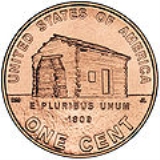
     - this design features a log cabin and Lincoln's birth date 1809. It was designed by Richard Masters and sculpted by Jim Licaretz. This penny was released into circulation on Lincoln's 200th birthday, February 12, 2009, at a special ceremony at LaRue County High School
    LaRue County High School
    LaRue County High School is a public school in Hodgenville, Kentucky....

     in Hodgenville, Kentucky, Lincoln's birthplace. The mintage was extremely low compared to prior years (see table below). It's been nicknamed the "Log Cabin Penny."
  • Formative years in Indiana
    Indiana
    Indiana is a U.S. state, the 19th admitted to the Union. It is located in the Great Lakes region, and with approximately 6.3 million residents, is ranked 16th in population and 17th in population density. Indiana is ranked 38th in land area, and is the...

     - this design features a young Lincoln reading while taking a break from rail splitting. It was designed and sculpted by Charles Vickers. Nicknamed the "Indiana Penny," it was released on May 14, 2009.
  • Professional life in Illinois
    Illinois
    Illinois , the 21st state admitted to the United States of America, is the most populous and demographically diverse Midwestern state and the fifth most populous state in the nation...

     - this design features a young professional Lincoln standing before the state capitol building in Springfield, Illinois. It was designed by Joel Iskowitz and sculpted by Don Everhart. Nicknamaed the "Illinois Penny," it was released on August 13, 2009.
  • Presidency in Washington, D.C.
    Washington, D.C.
    Washington, D.C. , formally the District of Columbia and commonly referred to as Washington, the District, or simply D.C., is the capital of the United States, founded on July 16, 1790...

     - this design features the half completed Capitol Dome. It was designed by Susan Gamble and sculpted by Joseph Menna. This fourth penny is scheduled for release on November 12, 2009


Special 2009 cents struck for sale in sets to collectors will have the metallic copper content of cents minted in 1909 (95% copper, 5% tin and zinc). Those struck for circulation will retain the normal composition of a zinc core coated with copper.

The future (2010 - )


After 2009, yet another redesigned reverse for the Lincoln cent will be minted that "shall bear an image emblematic of President Lincoln's preservation of the United States of America as a single and united country," and so the Lincoln Memorial
Lincoln Memorial
The Lincoln Memorial is an American memorial built to honor the 16th President of the United States, Abraham Lincoln. It is located on the National Mall in Washington, D.C. and was dedicated on May 30, 1922. The architect was Henry Bacon, the sculptor of the main statue was Daniel Chester French,...

 reverse will be replaced.
Click here to see 18 new designs proposed for the 2010 penny reverse.
Design 18 has been eliminated.

Composition


Initially the alloy of the Lincoln cent followed that established for this denomination with the Indian Head
Indian Head
Indian Head can refer to:* Indian Head, Saskatchewan, town in Canada* Indian Head, Maryland, town in the United States* Indian Head, Fraser Island, headland in Australia* Indian Head cent, U.S. one cent coin * Indian Head nickel, U.S...

 design in 1864, 95% copper
Copper
Copper is a chemical element with the symbol Cu and atomic number 29.It is a ductile metal with very high thermal and electrical conductivity. Pure copper is rather soft and malleable and a freshly-exposed surface has a pinkish or peachy color...

 and 5% tin
Tin
Tin is a chemical element with the symbol Sn and atomic number 50. It is a main group metal in group 14 of the periodic table. Tin shows chemical similarity to both neighboring group 14 elements, germanium and lead, like the two possible oxidation states +2 and +4...

 and zinc
Zinc
Zinc , also known as spelter, is a metallic chemical element; it has the symbol Zn and atomic number 30. It is the first element in group 12 of the periodic table. Zinc is, in some respects, chemically similar to magnesium, because its ion is of similar size and its only common oxidation state is +2...

. This was changed in 1943.

Production of the war-time cent was provided for in an Act of Congress approved on December 18 1942, which also set as the expiration date of the authority December 31 1946. Low-grade carbon steel formed the base of these coins, to which a zinc coating 0.005 inch
Inch
An inch is the name of a unit of length in a number of different systems, including Imperial units, and United States customary units. There are 36 inches in a yard and 12 inches in a foot...

 (0.127 millimeter
Millimetre
The millimetre is a unit of length in the metric system, equal to one thousandth of a metre, which is the current SI base unit of length.Equal to 1000 micrometres.Equal to 1000000 nanometres....

) thick was deposited on each side electrolytically as a rust
Rust
Rust is a general term for a series of iron oxides, usually red oxides, formed by the reaction of iron and oxygen in the presence of water or air moisture. Several forms of rust are distinguishable visually and by spectroscopy, and form under different circumstances...

 preventative. Unfortunately, this coating was applied to the steel before the blanks were made leaving the rims of these coins extremely succeptible to rust. The same size was maintained, but the weight was reduced from the standard 48 grain
Grain (measure)
A grain is a unit of measurement of mass that is based upon the mass of a single seed of a typical cereal. Historically, in Europe, the average masses of wheat and barley grain were used to define units of mass...

s to 42 grains (3.1 g
Gram
The gram , ; symbol g, is a unit of mass.Originally defined as "the absolute weight of a volume of pure water equal to the cube of the hundredth part of a metre, and at the temperature of melting ice" , a gram is now defined as one one-thousandth of the SI base unit, the kilogram, or...

 to 2.7 g), due to the use of a lighter alloy. Production commenced on February 27 1943, and by December 31 of that year, the three Mint facilities had produced 1,093,838,670 of the one-cent coins. The copper released for the war effort was enough to meet the combined needs of 2 cruiser
Cruiser
A cruiser is a large type of warship, which had its prime period from the late 19th century to the end of the Cold War. The first cruisers were intended for individual raiding and protection missions on the seas...

s, 2 destroyer
Destroyer
In naval terminology, a destroyer is a fast and maneuverable yet long-endurance warship intended to escort larger vessels in a fleet, convoy or battle group and defend them against smaller, short-range but powerful attackers .Before World War II, destroyers were light vessels without the endurance...

s, 1,243 Flying Fortresses
B-17 Flying Fortress
The Boeing B-17 Flying Fortress is a four-engine heavy bomber aircraft developed for the United States Army Air Corps , introduced in the 1930s. Competing against Douglas and Martin for a contract to build 200 bombers, the Boeing entry outperformed both competitors and more than met the Air Corps'...

, 120 field gun
Field gun
A field gun is an artillery piece. Originally the term referred to smaller guns that could accompany a field army on the march and when in combat could be moved about the battlefield in response to changing circumstances...

s and 120 howitzer
Howitzer
A howitzer is a type of artillery piece that is characterized by a relatively short barrel and the use of comparatively small explosive charges to propel projectiles at relatively high trajectories, with a steep angle of descent...

s, or enough for 1,250,000 shells for large field guns.
Numerous complaints about the gray color of the 1943 cents, especially that they could be mistaken for dimes, led to a change in composition. On January 1 1944, the Mint was able to adopt a modified alloy, the supply being derived from expended shell casings which, when melted, furnished a composition similar to the original, but with a much smaller trace of tin
Tin
Tin is a chemical element with the symbol Sn and atomic number 50. It is a main group metal in group 14 of the periodic table. Tin shows chemical similarity to both neighboring group 14 elements, germanium and lead, like the two possible oxidation states +2 and +4...

. The original weight of 48 grains (3.1 g) was also restored. Shell casings were no longer used after 1946 and the original composition was again used.

The composition of the coin was changed again in 1962. Mint officials felt that deletion of the tin content would have no adverse effect on the wearing qualities of the coin, whereas the manufacturing advantages to be gained with the alloy stabilized at 95% copper and 5% zinc would be of much benefit. Congressional authority for this modification is contained in an Act of Congress approved on September 5 1962.

During the early 1970s, the price of copper rose to a point where the cent almost contained one cent's worth of copper. This led the Mint to test alternate metals, including aluminum
Aluminium
Aluminium or aluminum is a silvery white and ductile member of the boron group of chemical elements. It has the symbol Al; its atomic number is 13. It is not soluble in water under normal circumstances....

 and bronze
Bronze
Bronze is a metal alloy consisting primarily of copper, usually with tin as the main additive, but sometimes with other elements such as phosphorus, manganese, aluminium, or silicon. It was particularly significant in antiquity, giving its name to the Bronze Age...

-clad steel. Aluminum was chosen
1974 aluminum cent
The 1974 aluminum cent was a one-cent coin proposed by the United States Mint in 1973. It was composed of an alloy of aluminum and trace metals, and intended to replace the predominantly copper–zinc cent due to the rising costs of coin production in the traditional bronze alloy. 1,571,167 were...

, and in 1973, a total of 1,579,324 such coins were struck (dated 1974) and ready for public release. A few were distributed to members of the US Congress. Subsequently; aluminum was rejected because, among other reasons, it would not show up on X-ray
X-ray
X-radiation is a form of electromagnetic radiation. X-rays have a wavelength in the range of 10 to 0.01 nanometers, corresponding to frequencies in the range 30 petahertz to 30 exahertz and energies in the range 120 eV to 120 keV. They are shorter in wavelength than UV rays...

s should it be swallowed. About a dozen aluminum cents are believed to still be in the hands of collectors
Coin collecting
Coin collecting is the collecting or trading of coins or other forms of minted legal tender.Coins of interest to collectors often include those that circulated for only a brief time, coins with mint errors and especially beautiful or historically significant pieces. Coin collecting can be...

, although they are now considered illegal, subject to seizure by the Secret Service
United States Secret Service
The United States Secret Service is a United States federal law enforcement agency that falls under the United States Department of Homeland Security. The sworn members are divided among the Special Agents and the Uniformed Division. Until March 1, 2003, the Service was part of the United States...

. One aluminum cent was donated to the Smithsonian Institution
Smithsonian Institution
The Smithsonian Institution is an educational and research institute and associated museum complex, administered and funded by the government of the United States and by funds from its endowment, contributions, and profits from its shops and its magazines...

. Another is in the hands of the family of a deceased U.S. Capitol police
United States Capitol Police
The United States Capitol Police is a federal police force charged with protecting the United States Congress within the District of Columbia and throughout the United States and its territories.-History:...

 officer, and was certified as authentic in 2005. It is known as the Toven Specimen.

In mid-1982, the coin's composition changed again to copper-plated zinc. The last all-copper cents were produced by the Denver Mint on October 22, 1982. These copper-plated coins, which are still being produced today, contain 97.5% zinc and 2.5% copper, and are minted on blanks produced for the Mint by an outside manufacturer (Jarden Zinc Products
Jarden Zinc Products
Jarden Zinc Products of Greeneville, Tennessee, is an American manufacturer of a variety of basic zinc products, including sheets of zinc used as precursors to other products and coinage blanks , including the copper-coated zinc blanks presently used to mint the United States one-cent piece.*...

). This coin is identical in size and appearance to, but at 2.5 grams is lighter than the 3.11 grams of copper cents issued before 1982, but this modification saves the Government an estimated $
United States dollar
The United States dollar is the unit of currency of the United States. The U.S. dollar is normally abbreviated as the dollar sign, $, or as USD or US$ to distinguish it from other dollar-denominated currencies and from others that use the $ symbol. It is divided into 100 cents .The U.S...

25 million in metal costs every year. (Both types were produced that year and all are common.) The zinc core can be readily seen if the copper plating is abraded or otherwise scraped off.

It should be noted that the post-1982 cents are much more susceptible to corrosion and pitting than those made prior to 1982. Many collectors lament that even perfectly preserved post-1982 cents protected in Mint sets have begun tarnishing, developing bubbles beneath the copper coating's surface, or even corroding.

Matte Proof Lincolns 1909 to 1916


When the Lincoln Cent was introduced in 1909, it was discovered that the coining dies, and their curved fields were unable to be polished to proof coining condition by existing Mint equipment. In order to produce Proof coinage for collectors, the US Mint adopted the French technique of the Matte Proof, which was thought to highlight the design, while leaving the details of the coin as the designer intended. This was done by a sandblasting of the dies, prior to use. When struck by the high pressure hydraulic press of the Philadelphia Mint Medal Room, the result was a semi-rough surface, a gentle luster and strongly defined wide square rims. These coins were produced in very small numbers, and the dies quickly developed small marks, known as diagnostics. These marks are used today by Third Party Graders and Collectors to authenticate the coin. Sold for mere pennies over face during the years of production, they were not popular with collectors. When new, the coins were wrapped in a tarnish proof tissue, which over time proved to be anything but. Since many of these coins sat for decades unsold, vivid colors and toning developed. It is not unusual to see vivid blues, greens, lavender, coppery orange, deep reds and purple hues on these coins. Eagerly collected by numismatists today, they are among the most valuable Lincoln cents. Unencapsulated coins are easily identified by wide, square outer rims, quite unlike the rounded edges of business strikes.

Mint errors specific to Lincoln cents


Through mint error
Mint-made errors
Mint-made errors are errors in a coin made by the mint during the minting process. They are almost always accidental and in modern minting are usually very rare, making them valuable to numismatists. Minting errors are far more common in older coinage, understandably...

s, a number of rare and valuable Lincoln Cents have been produced. Some random errors, such as an off-center strike, slightly increase the value of the coin, and are sought after by niche collectors. However some errors were systemic, and produced a number of coins with the exact same problem in the same year. These have become recognized varieties that are often extremely valuable and sought after by mainstream collectors.

The first Doubled Die error occurred during the production of the 1909 VDB. Not identified until the 1970s, it shows the RTY in Liberty and the 190 of the date slightly doubled. Extremely rare in high grades.

In 1922, no one-cent coins were produced by the Philadelphia Mint
Philadelphia Mint
The Philadelphia Mint was created from the need to establish a national identity and the needs of commerce in the United States. This led the Founding Fathers of the United States to make an establishment of a continental national mint a main priority after the ratification of the Constitution of...

. However, three pairs of Denver Mint
Denver Mint
The Denver Mint is a branch of the United States Mint that stuck its first coins on February 1, 1906. The mint is still operating and producing coins for circulation, as well as mint sets and commemorative coins. Coins produced at the Denver Mint bear a D mint mark...

 worn and overly polished dies then produced the Weak D and No D varieties, making them appear as if they had been produced in Philadelphia. These varieties are known as the 1922 plain cents. Collectors must be wary of removed mint marks.

There are a few 1943 cents that were produced in bronze, as opposed to the steel/zinc composition used that year. There are 10 to 12 known to exist. Likewise, a few 1944 cents were produced in steel/zinc.

In 1955, a die error caused some cents to get struck with an obverse die which showed doubling in all of the obverse devices, producing a doubling of the date, and to a less noticeable degree, the rest of the obverse. This is known as the 1955 doubled die cent
1955 doubled die cent
The 1955 doubled die cent is a die variety that occurred during production of the one cent coin at the United States Mint in 1955. This variety is often mistakenly referred to as an error...

. A slightly different mechanism produced 1972, 1983, 1984, and 1995 Doubled die
Doubled die
Doubled die is a term in numismatics used to refer to doubling in the design elements of a coin. Doubled dies can appear as an outline of the design or in extreme cases, having legends and dates appear twice in an overlapping fashion....

 cents. Doubled Dies are known in practically every date in the Lincoln cent series, but most are minor, and less impressive compared to the 1955 and other Doubled Die varieties.

In 1990, 3,055 proof cents were struck at the San Francisco Mint
San Francisco Mint
The San Francisco Mint is a branch of the United States Mint, and was opened in 1854 to serve the gold mines of the California Gold Rush. It quickly outgrew its first building and moved into a new one in 1874. This building, the Old United States Mint also known affectionately as The Granite Lady,...

 without the "S" mint mark, making them appear as if they had been struck at the Philadelphia Mint. However, as no proof cents were struck in Philadelphia that year, they are easily distinguishable as errors, and highly valuable.

The reverse of some Lincoln cents minted in 1992 at the Philadelphia and Denver mints and some of those minted in 1998 and 1999 at the San Francisco mint feature a smaller-than-normal gap between the first two letters of AMERICA. These coins, known as the Close AM variety are valued at $20,000 and $5,000 for the 1992 specimens in gem uncirculated condition and $3,000 and $1,000 for the San Francisco specimens in gem proof condition.

The reverse of some Lincoln cents minted in 1998, 1999, and 2000 in Philadelphia feature a larger-than-normal gap between the first two letters of AMERICA. These coins, known as the Wide AM variety are valued at $10, $500, and $5, respectively, in gem uncirculated condition.

Mintage figures


Lincoln wheat cent, 1909-1958 (Bronze except 1943 Steel mints)

Year

Mint

Mintage

Comments

1909

VDB

27,995,000

1909

VDB

1,194

Matte Proof

1909

S VDB

484,000

1909

P

72,702,618

1909

-

2,352

Matte Proof

1909

S

1,825,000

1910

P

146,801,218

1910

S

6,045,000

1910

-

4,083

Matte Proof

1911

P

101,177,787

1911

D

12,672,000

1911

S

4,026,000

1911

-

2,411

Matte Proof

1912

P

68,153,060

1912

D

10,411,000

1912

S

4,431,000

1912

-

2,145

Matte Proof

1913

P

76,532,352

1913

D

15,804,000

1913

S

6,101,000

1913

-

2,848

Matte Proof

1914

P

75,238,432

1914

D

1,193,000

Beware of altered date or mintmark

1914

S

4,137,000

1914

-

1,365

Matte Proof

1915

P

29,092,120

1915

D

22,050,000

1915

S

4,833,000

1915

-

1,050

Matte Proof

1916

P

131,832,627

1916

D

35,956,000

1916

S

22,510,000

1916

-

1,050

Matte Proof

1917

P

196,429,785

1917

D

55,120,000

1917

S

32,620,000

1918

P

288,104,634

1918

D

47,830,000

1918

S

34,680,000

1919

P

392,021,000

1919

D

57,154,000

1919

P

139,760,000

1920

P

310,165,000

1920

D

49,280,000

1920

S

46,220,000

1921

P

39,157,000

1921

S

15,274,000

1922

D

7,160,000

Beware of removed mintmark

1923

P

74,723,000

1923

S

8,700,000

1924

P

75,178,000

1924

D

2,520,000

1924

S

11,696,000

1925

P

139,949,000

1925

D

22,580,000

1925

S

26,380,000

1926

P

157,088,000

1926

D

28,020,000

1926

S

4,550,000

1927

P

144,440,000

1927

P

27,170,000

1927

D

27,170,000

1927

S

14,276,000

1928

P

134,116,000

1928

D

31,170,000

1928

S

17,266,000

1929

P

185,262,000

1929

D

41,730,000

1929

S

50,148,000

1930

P

157,415,000

1930

D

40,100,000

1930

S

24,286,000

1931

P

19,396,000

1931

D

4,480,000

1931

S

866,000

1932

P

9,062,000

1932

D

10,500,000

1933

P

14,360,000

1933

D

6,200,000

1934

P

219,080,000

1934

D

28,446,000

1935

P

245,388,000

1935

D

47,000,000

1935

S

38,702,000

1936

P

309,632,000

1936

-

5,569

PF-63

1936

D

40,620,000

1936

S

29,130,000

1937

P

309,170,000

1937

D

50,430,000

1937

S

34,500,000

1937

-

9,320

Proof

1938

P

156,682,000

1938

D

20,010,000

1938

S

15,180,000

1938

-

14,734

Proof

1939

P

316,466,000

1939

D

15,160,000

1939

S

52,070,000

1939

-

13,520

Proof

1940

P

586,810,000

1940

D

81,390,000

1940

S

112,940,000

1940

-

15,872

Proof

1941

P

887,018,000

1941

D

128,700,000

1941

S

92,360,000

1941

-

32,600

Proof

1942

P

657,796,000

1942

D

206,698,000

1942

S

85,590,000

1942

-

32,600

Proof

1943

P

c40

12 known to exist in bronze.

1943

P

684,628,670

Zinc-plated steel

1943

D

217,660,000

Zinc-plated steel

1943

S

191,550,000

Zinc-plated steel

1944

P

1,435,000,000

Shell casing bronze without Tin

1944

P

>27

Zinc-plated steel. 27 known.

1944

D

430,578,000

Shell casing bronze without Tin

1944

D

c10

Zinc-plated steel. 7-10 known.

1944

D

*

D over S

1944

S

282,760,000

"Shell casing bronze without Tin

1944

S

>1

Zinc-plated steel. Only 1 known.

1945

P

1,040,515,000

Shell casing bronze without Tin

1945

D

266,268,000

Shell casing bronze without Tin

1945

S

181,770,000

Shell casing bronze without Tin

1946

P

991,655,000

1946

D

315,690,000

1946

S

198,100,000

1947

P

190,555,000

1947

D

194,750,000

1947

S

99,000,000

1948

P

317,570,000

1948

D

172,637,500

1948

S

81,735,000

1949

P

217,775,000

1949

D

153,132,500

1949

S

64,290,000

1950

P

272,635,000

1950

D

334,950,000

1950

S

118,505,000

1950

-

51,383

Proof

1951

P

284,576,000

1951

D

625,355,000

1951

S

136,010,000

1951

-

57,500

Proof

1952

P

186,775,000

1952

D

746,130,000

1952

S

137,800,004

1952

-

81,980

Proof

1953

P

256,755,000

1953

D

700,515,000

1953

S

181,835,000

1953

-

128,800

Proof

1954

P

71,640,050

1954

D

251,552,500

1954

S

96,190,000

1954

-

233,300

Proof

1955

P

330,580,000

Double-Die varieties have been found

1955

D

563,257,500

1955

S

44,610,000

1955

-

378,200

Proof

1956

P

420,745,000

1956

D

1,098,201,100

1956

-

669,384

Proof

1957

P

282,540,000

1957

D

1,051,342,000

1957

-

1,247,952

Proof

1958

P

252,525,000

1958

D

800,953,300

1958

-

875,652

Proof


Lincoln Memorial cent, 1959-1982 (Bronze except cancelled Aluminium mints)

Year

Mint

Mintage

Comments

1959

P

609,715,000

1959

D

1,279,760,000

1959

-

1,149,291

Proof

1960

P

586,405,000

Small and Large date varieties

1960

D

1,580,884,000

Small and Large date varieties

1960

-

1,691,602

Proof, Large Date

1960

-

^

Proof, Small Date

1961

P

753,345,000

1961

D

1,753,266,700

1961

-

3,028,244

Proof

1962

P

606,045,000

1962

D

1,793,148,400

1962

-

3,218,019

Proof

1963

P

754,110,000

1963

D

1,774,020,400

1963

-

3,075,645

Proof

1964

P

2,648,575,000

1964

D

3,799,071,500

1964

-

3,950,962

Proof

1965

-

1,497,224,900

No Mint mark.

1966

-

2,188,147,783

No Mint mark

1967

-

3,048,667,100

No Mint mark

1968

P

1,707,880,970

1968

D

2,886,269,600

1968

S

258,270,001

Lowest minted non-proof memorial coin

1968

S

3,041,506

Proof

1969

P

1,136,910,000

1969

D

4,002,832,200

1969

S

544,375,000

Double-Die varieties have been found

1969

S

2,934,631

Proof

1970

P

1,898,315,000

1970

D

2,891,438,900

1970

S

690,560,004

Small and Large date varieties

1970

S

2,632,810

Proof, Small Date (High 7)

1970

S

^

Proof, Large Date (Low 7)

1971

P

1,919,490,000

1971

D

2,911,045,600

1971

S

525,133,459

1971

S

3,220,733

Proof

1972

P

2,933,255,000

Double-Die varieties have been found

1972

D

2,665,071,400

1972

S

376,939,108

1972

S

3,260,996

Proof

1973

P

3,728,245,000

1973

D

3,549,576,588

1973

S

317,177,295

1973

S

2,760,339

Proof

1974

P

4,232,140,523

1974

1974 aluminum cent
The 1974 aluminum cent was a one-cent coin proposed by the United States Mint in 1973. It was composed of an alloy of aluminum and trace metals, and intended to replace the predominantly copper–zinc cent due to the rising costs of coin production in the traditional bronze alloy. 1,571,167 were...

P

1,570,000

Aluminium None released to the public.

1974

D

4,235,098,000

1974

1974 aluminum cent
The 1974 aluminum cent was a one-cent coin proposed by the United States Mint in 1973. It was composed of an alloy of aluminum and trace metals, and intended to replace the predominantly copper–zinc cent due to the rising costs of coin production in the traditional bronze alloy. 1,571,167 were...

D

c10

Aluminium. None released to the public.

1974

S

409,426,660

1974

S

2,612,568

Proof

1975

P

5,451,476,142

1975

P

66

Aluminium. None released to the public.

1975

D

4,505,275,300

1975

S

2,845,450

Proof

1976

P

4,674,292,426

1976

D

4,221,592,455

1976

S

4,149,730

Proof

1977

P

4,469,930,000

1977

D

4,194,062,300

1977

S

3,251,152

Proof

1978

P

5,558,605,000

1978

D

4,280,233,400

1978

S

3,127,781

Proof

1979

P

6,018,515,000

1979

D

4,139,357,254

1979

S

3,677,175

Proof, Filled S

1979

S

^

Proof, Clear S

1980

P

7,414,705,000

1980

D

5,140,098,660

1980

S

3,554,806

Proof

1981

P

7,491,750,000

1981

D

5,373,235,677

1981

S

4,063,083

Proof, Filled S

1981

S

^

Proof, Clear S

1982

P

10,712,525,000

Bronze and Copper-plated zinc versions.

1982

D

6,012,979,368

Bronze and Copper-plated zinc versions.

1982

S

3,857,479

Proof


Lincoln Memorial cent, 1982-present (copper-plated zinc)

Year

Mint

Mintage

Comments

1983

P

7,752,355,000

1983

D

6,467,199,428

1983

S

3,279,126

Proof

1984

P

8,151,079,000

1984

D

5,569,238,906

1984

S

3,065,110

Proof

1985

P

5,648,489,887

1985

D

5,287,399,926

1985

S

3,362,821

Proof

1986

P

4,491,395,493

1986

D

4,442,866,698

1986

S

3,010,497

Proof

1987

P

4,682,466,931

1987

D

4,879,389,514

1987

S

4,227,728

Proof

1988

P

6,092,810,000

1988

D

5,253,740,443

1988

S

3,262,948

Proof

1989

P

7,261,535,000

1989

D

5,345,467,111

1989

S

3,220,194

Proof

1990

P

6,851,765,000

1990

D

4,922,894,533

1990

S

3,299,559

Proof

1991

P

5,165,940,000

1991

D

4,158,442,076

1991

S

2,867,787

Proof

1992

P

4,648,905,000

1992

D

4,448,673,300

1992

S

4,176,560

Proof

1993

P

5,684,705,000

1993

D

6,426,650,571

1993

S

3,394,792

Proof

1994

P

6,500,850,000

1994

D

7,131,765,000

1994

S

3,269,923

Proof

1995

P

6,411,440,000

1995

D

7,128,560,000

1995

S

2,797,481

Proof

1996

P

6,612,465,000

1996

D

6,510,795,000

1996

S

2,525,265

Proof

1997

P

4,622,800,000

1997

D

4,576,555,000

1997

S

2,796,678

Proof

1998

P

5,032,200,000

1998

D

5,225,200,000

1998

S

2,086,507

Proof

1999

P

5,237,600,000

1999

D

6,360,065,000

1999

S

3,347,966

Proof

2000

P

5,503,200,000

2000

D

8,774,220,000

2000

S

4,047,993

Proof

2001

P

4,959,600,000

2001

D

5,374,990,000

2001

S

3,184,606

Proof

2002

P

3,260,800,000

2002

D

4,028,055,000

2002

S

3,211,995

Proof

2003

P

3,300,000,000

2003

D

3,548,000,000

2003

S

3,298,439

Proof

2004

P

3,456,400,000

2004

D

3,379,600,000

2004

S

2,965,422

Proof

2005

P

3,935,600,000

2005

D

3,764,450,500

2005

S

3,344,679

Proof

2006

P

4,290,000,000

2006

D

3,944,000,000

2006

S

2,923,105

Proof

2007

P

3,762,400,000

2007

D

3,638,800,000

2007

S

2,259,847

Proof

2008

P

2,569,600,000

2008

D

2,849,600,000

2008

S

1,998,108

Proof


Lincoln Bicentennial cent, 2009 (copper-plated zinc)

Year

Mint

Mintage

Comments

2009

P T1

284,800,000

Birthplace

2009

D T1

350,000,000

Birthplace

2009

S T1

*

Proof

2009

P T2

376,000,000

Formative Years

Double-Die varieties have been found

2009

D T2

363,600,000

Formative Years

2009

S T2

*

Proof

Double-Die Variety has been found

2009

P T3

316,000,000

Professional Life

2009

D T3

336,000,000

Professional Life

2009

S T3

*

Proof

2009

P T4

Presidency

2009

D T4

Presidency

2009

S T4

*

Proof


See also


  • Cent (United States coin)
    Cent (United States coin)
    The United States one-cent coin, commonly known as a penny, is a unit of currency equaling one one-hundredth of a United States dollar. Its symbol is ¢. Its obverse has featured the profile of President Abraham Lincoln since 1909, the centennial of his birth. From 1959 to 2008, the reverse...

  • Wheat cent
    Wheat cent
    The Lincoln Wheat Cent was a United States one-cent coin produced from 1909 to 1958....

  • 1943 Steel Cent
    1943 steel cent
    The 1943 steel cent, also known as a steelie, was a variety of the U.S. one-cent coin which was struck in steel due to wartime shortages of copper.-History:...

  • 1955 doubled die cent
    1955 doubled die cent
    The 1955 doubled die cent is a die variety that occurred during production of the one cent coin at the United States Mint in 1955. This variety is often mistakenly referred to as an error...


External links