

San Francisco Mint

Encyclopedia
The San Francisco Mint is a branch
of the United States Mint
, and was opened in 1854 to serve the gold mines of the California Gold Rush
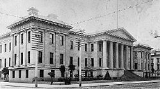
. It quickly outgrew its first building and moved into a new one in 1874. This building, the Old United States Mint, also known affectionately as The Granite Lady, is one of the few that survived the great 1906 San Francisco earthquake
. It served until 1937, when the present facility was opened.
_3.jpg) Within the first year of its operation, the San Francisco mint turned $4 million in gold bullion into coins. The second building, completed in 1874, was designed by Alfred B. Mullett
Within the first year of its operation, the San Francisco mint turned $4 million in gold bullion into coins. The second building, completed in 1874, was designed by Alfred B. Mullett
in a conservative Greek Revival style with a sober Doric order
. The building had a central pediment
ed portico
flanked by projecting wings in an E-shape; it was built round a completely enclosed central courtyard that contained a well—the features that saved it during the fire of 1906, when the heat melted the plate glass windows and exploded sandstone and granite blocks with which it was faced. The building sat on a concrete and granite foundation, designed to thwart tunneling into its vaults, which at the time of the 1906 fire held $300 million, fully a third of the United States' gold reserves. Heroic efforts by Superintendent of the Mint, Frank Leach, and his men preserved the building and the bullion that then backed the nation's currency. The mint resumed operation soon thereafter, continuing until 1937.
In 1961 the Old Mint, as it had become known, was designated a National Historic Landmark
.
The given name of "The Granite Lady" is somewhat of a misnomer as most of the building is made from sandstone. While the base/basement of the building is made of granite, the entire external and upper stories are made of sandstone. The Granite Lady was a marketing term given in the 1970s that stuck.
The Old Mint was open to visitors until 1993. In 2003 the federal government sold the structure to the City of San Francisco for one dollar—an 1879 silver dollar struck at the mint— for use as the Museum of the City of San Francisco
. In the fall of 2005, ground was broken for renovations that would turn the central court into a glass-enclosed galleria. The Museum is scheduled to open in 2012, but the Old Mint is used for special events, some open to the public, prior to the Museum's official opening.

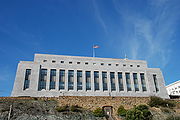 The new Mint was opened in 1937. Beginning in 1955, circulating coinage from San Francisco
was suspended for 13 years. In 1968, it took over most proof coinage
production from the Philadelphia Mint
, but continued striking a supplemental circulating coinage from 1968 through 1974. Since 1975, the San Francisco Mint has been used only for proof coinage, with the exception of the Susan B. Anthony dollar
from 1979–81 and a portion of the mintage of cents
in the early 1980s. The dollars bear a mintmark of an "S", but the cents are otherwise indistinguishable from those minted at Philadelphia (which bear no mintmarks, unlike those years' proof cents from San Francisco and circulation cents from Denver
). From 1962 to 1988, the San Francisco Mint was officially an assay office; the San Francisco Assay Office was granted mint status again on March 31, 1988 . The San Francisco Mint is located at 155 Hermann Street, but does not admit visitors.
Branch mint
-United States:The original and main Mint of the United States Mint, has been located in Philadelphia , since 1793. Its current facility, Philadelphia's fourth, opened in 1969.U.S...
of the United States Mint
United States Mint
The United States Mint primarily produces circulating coinage for the United States to conduct its trade and commerce. The Mint was created by Congress with the Coinage Act of 1792, and placed within the Department of State...
, and was opened in 1854 to serve the gold mines of the California Gold Rush
California Gold Rush
The California Gold Rush began on January 24, 1848, when gold was found by James W. Marshall at Sutter's Mill in Coloma, California. The first to hear confirmed information of the gold rush were the people in Oregon, the Sandwich Islands , and Latin America, who were the first to start flocking to...
. It quickly outgrew its first building and moved into a new one in 1874. This building, the Old United States Mint, also known affectionately as The Granite Lady, is one of the few that survived the great 1906 San Francisco earthquake
1906 San Francisco earthquake
The San Francisco earthquake of 1906 was a major earthquake that struck San Francisco, California, and the coast of Northern California at 5:12 a.m. on Wednesday, April 18, 1906. The most widely accepted estimate for the magnitude of the earthquake is a moment magnitude of 7.9; however, other...
. It served until 1937, when the present facility was opened.
Old Mint
Alfred B. Mullett
Alfred Bult Mullett was an American architect who served from 1866 to 1874 as Supervising Architect, head of the agency of the United States Treasury Department that designed federal government buildings...
in a conservative Greek Revival style with a sober Doric order
Doric order
The Doric order was one of the three orders or organizational systems of ancient Greek or classical architecture; the other two canonical orders were the Ionic and the Corinthian.-History:...
. The building had a central pediment
Pediment
A pediment is a classical architectural element consisting of the triangular section found above the horizontal structure , typically supported by columns. The gable end of the pediment is surrounded by the cornice moulding...
ed portico
Portico
A portico is a porch leading to the entrance of a building, or extended as a colonnade, with a roof structure over a walkway, supported by columns or enclosed by walls...
flanked by projecting wings in an E-shape; it was built round a completely enclosed central courtyard that contained a well—the features that saved it during the fire of 1906, when the heat melted the plate glass windows and exploded sandstone and granite blocks with which it was faced. The building sat on a concrete and granite foundation, designed to thwart tunneling into its vaults, which at the time of the 1906 fire held $300 million, fully a third of the United States' gold reserves. Heroic efforts by Superintendent of the Mint, Frank Leach, and his men preserved the building and the bullion that then backed the nation's currency. The mint resumed operation soon thereafter, continuing until 1937.
In 1961 the Old Mint, as it had become known, was designated a National Historic Landmark
National Historic Landmark
A National Historic Landmark is a building, site, structure, object, or district, that is officially recognized by the United States government for its historical significance...
.
The given name of "The Granite Lady" is somewhat of a misnomer as most of the building is made from sandstone. While the base/basement of the building is made of granite, the entire external and upper stories are made of sandstone. The Granite Lady was a marketing term given in the 1970s that stuck.
The Old Mint was open to visitors until 1993. In 2003 the federal government sold the structure to the City of San Francisco for one dollar—an 1879 silver dollar struck at the mint— for use as the Museum of the City of San Francisco
Museum of the City of San Francisco
The Museum of the City of San Francisco, operated by the San Francisco Museum & Historical Society currently has exhibits at Pier 45 and San Francisco City Hall...
. In the fall of 2005, ground was broken for renovations that would turn the central court into a glass-enclosed galleria. The Museum is scheduled to open in 2012, but the Old Mint is used for special events, some open to the public, prior to the Museum's official opening.
New Mint
San Francisco, California
San Francisco , officially the City and County of San Francisco, is the financial, cultural, and transportation center of the San Francisco Bay Area, a region of 7.15 million people which includes San Jose and Oakland...
was suspended for 13 years. In 1968, it took over most proof coinage
Proof coinage
Proof coinage means special early samples of a coin issue, historically made for checking the dies and for archival purposes, but nowadays often struck in greater numbers specially for coin collectors . Many countries now issue them....
production from the Philadelphia Mint
Philadelphia Mint
The Philadelphia Mint was created from the need to establish a national identity and the needs of commerce in the United States. This led the Founding Fathers of the United States to make an establishment of a continental national mint a main priority after the ratification of the Constitution of...
, but continued striking a supplemental circulating coinage from 1968 through 1974. Since 1975, the San Francisco Mint has been used only for proof coinage, with the exception of the Susan B. Anthony dollar
Susan B. Anthony dollar
The Susan B. Anthony dollar is a United States coin minted from 1979 to 1981, and again in 1999. It depicts women's suffrage campaigner Susan B. Anthony on a dollar coin. It was the first circulating U.S. coin with the portrait of an actual woman rather than an allegorical female figure such as...
from 1979–81 and a portion of the mintage of cents
Lincoln cent
Below are the mintage figures for the Lincoln penny-Mintage figures:Lincoln wheat cent, 1909-1958 Lincoln Memorial cent, 1959-1982 ...
in the early 1980s. The dollars bear a mintmark of an "S", but the cents are otherwise indistinguishable from those minted at Philadelphia (which bear no mintmarks, unlike those years' proof cents from San Francisco and circulation cents from Denver
Denver Mint
The Denver Mint is a branch of the United States Mint that struck its first coins on February 1, 1906. The mint is still operating and producing coins for circulation, as well as mint sets and commemorative coins. Coins produced at the Denver Mint bear a D mint mark...
). From 1962 to 1988, the San Francisco Mint was officially an assay office; the San Francisco Assay Office was granted mint status again on March 31, 1988 . The San Francisco Mint is located at 155 Hermann Street, but does not admit visitors.
External links
- Official site
- "US Mint Buildings Across the Nation: San Francisco Mint", US Treasury Department website, 2007.
- "Mint Project Website" Detailing plans to restore the Old Mint.
- "New San Francisco Mint" article (1936)
- Michael Castleman, "Grace under fire", Smithsonian Magazine April 2006, pp 56ff Mint Superintendent Frank Leach and his men saved the mint during the San Francisco fire, 1906.
- "The Second US Mint at San Francisco: Part One" Article
- General Services Administration page on the Old Mint, San Francisco