
Home      Discussion      Topics      Dictionary      Almanac
Signup       Login
United States one-dollar bill

United States one-dollar bill

Overview
The United States one-dollar bill ($1) is the most common denomination
Denomination (currency)
Denomination is a proper description of a currency amount, usually for coins or banknotes. Denominations may also be used with other means of payment like gift cards. See also Redenomination.-Subunit and super unit:...

 of US currency
United States dollar
The United States dollar , also referred to as the American dollar, is the official currency of the United States of America. It is divided into 100 smaller units called cents or pennies....

. The first president
President of the United States
The President of the United States of America is the head of state and head of government of the United States. The president leads the executive branch of the federal government and is the commander-in-chief of the United States Armed Forces....

, George Washington
George Washington
George Washington was the dominant military and political leader of the new United States of America from 1775 to 1799. He led the American victory over Great Britain in the American Revolutionary War as commander-in-chief of the Continental Army from 1775 to 1783, and presided over the writing of...

, painted by Gilbert Stuart
Gilbert Stuart
Gilbert Charles Stuart was an American painter from Rhode Island.Gilbert Stuart is widely considered to be one of America's foremost portraitists...

, is currently featured on the obverse, while the Great Seal of the United States
Great Seal of the United States
The Great Seal of the United States is used to authenticate certain documents issued by the United States federal government. The phrase is used both for the physical seal itself , and more generally for the design impressed upon it...

 is featured on the reverse
Obverse and reverse
Obverse and its opposite, reverse, refer to the two flat faces of coins and some other two-sided objects, including paper money, flags , seals, medals, drawings, old master prints and other works of art, and printed fabrics. In this usage, obverse means the front face of the object and reverse...

. The one-dollar bill has the oldest reverse design of all U.S. currency, while the two-dollar bill has the oldest obverse design currently being produced. The obverse design seen today on the one-dollar bill debuted in 1963 when it first became a Federal Reserve Note
Federal Reserve Note
A Federal Reserve Note is a type of banknote used in the United States of America. Federal Reserve Notes are printed by the United States Bureau of Engraving and Printing on paper made by Crane & Co. of Dalton, Massachusetts. They are the only type of U.S...

.
Discussion
Ask a question about 'United States one-dollar bill'
Start a new discussion about 'United States one-dollar bill'
Answer questions from other users
Full Discussion Forum
 
Unanswered Questions
Encyclopedia
The United States one-dollar bill ($1) is the most common denomination
Denomination (currency)
Denomination is a proper description of a currency amount, usually for coins or banknotes. Denominations may also be used with other means of payment like gift cards. See also Redenomination.-Subunit and super unit:...

 of US currency
United States dollar
The United States dollar , also referred to as the American dollar, is the official currency of the United States of America. It is divided into 100 smaller units called cents or pennies....

. The first president
President of the United States
The President of the United States of America is the head of state and head of government of the United States. The president leads the executive branch of the federal government and is the commander-in-chief of the United States Armed Forces....

, George Washington
George Washington
George Washington was the dominant military and political leader of the new United States of America from 1775 to 1799. He led the American victory over Great Britain in the American Revolutionary War as commander-in-chief of the Continental Army from 1775 to 1783, and presided over the writing of...

, painted by Gilbert Stuart
Gilbert Stuart
Gilbert Charles Stuart was an American painter from Rhode Island.Gilbert Stuart is widely considered to be one of America's foremost portraitists...

, is currently featured on the obverse, while the Great Seal of the United States
Great Seal of the United States
The Great Seal of the United States is used to authenticate certain documents issued by the United States federal government. The phrase is used both for the physical seal itself , and more generally for the design impressed upon it...

 is featured on the reverse
Obverse and reverse
Obverse and its opposite, reverse, refer to the two flat faces of coins and some other two-sided objects, including paper money, flags , seals, medals, drawings, old master prints and other works of art, and printed fabrics. In this usage, obverse means the front face of the object and reverse...

. The one-dollar bill has the oldest reverse design of all U.S. currency, while the two-dollar bill has the oldest obverse design currently being produced. The obverse design seen today on the one-dollar bill debuted in 1963 when it first became a Federal Reserve Note
Federal Reserve Note
A Federal Reserve Note is a type of banknote used in the United States of America. Federal Reserve Notes are printed by the United States Bureau of Engraving and Printing on paper made by Crane & Co. of Dalton, Massachusetts. They are the only type of U.S...

.

The inclusion of the national motto, "In God We Trust
In God We Trust
"In God We Trust" was adopted as the official motto of the United States in 1956. It is also the motto of the U.S. state of Florida. The Legality of this motto has been questioned because of the United States Constitution forbidding the government to make any law respecting the establishment of a...

," on all currency was required by law in 1955 and first appeared on paper money in 1957.

An individual dollar bill is also less formally known as a one, a single, a buck, a bone, and a bill .

The Bureau of Engraving and Printing
Bureau of Engraving and Printing
The Bureau of Engraving and Printing is a government agency within the United States Department of the Treasury that designs and produces a variety of security products for the United States government, most notable of which is paper currency for the Federal Reserve. The Federal Reserve itself is...

 says the average life of a $1 bill in circulation is 42 months before it is replaced because of wear. Approximately 42% of all U.S. currency produced in 2009 were one-dollar bills.

Large size notes


(approximately 7.4218 × 3.125 in ≅ 189 × 79 mm)
  • 1862: The first one-dollar bill was issued as a Legal Tender Note (United States Note
    United States Note
    A United States Note, also known as a Legal Tender Note, is a type of paper money that was issued from 1862 to 1971 in the U.S. Having been current for over 100 years, they were issued for longer than any other form of U.S. paper money. They were known popularly as "greenbacks" in their heyday, a...

    ) with a portrait of Salmon P. Chase
    Salmon P. Chase
    Salmon Portland Chase was an American politician and jurist who served as U.S. Senator from Ohio and the 23rd Governor of Ohio; as U.S. Treasury Secretary under President Abraham Lincoln; and as the sixth Chief Justice of the United States Supreme Court.Chase was one of the most prominent members...

    , the Secretary of the Treasury under President Abraham Lincoln
    Abraham Lincoln
    Abraham Lincoln was the 16th President of the United States, serving from March 1861 until his assassination in April 1865. He successfully led his country through a great constitutional, military and moral crisis – the American Civil War – preserving the Union, while ending slavery, and...

    .
  • 1869: The $1 United States Note was redesigned with a portrait of George Washington
    George Washington
    George Washington was the dominant military and political leader of the new United States of America from 1775 to 1799. He led the American victory over Great Britain in the American Revolutionary War as commander-in-chief of the Continental Army from 1775 to 1783, and presided over the writing of...

     in the center and a vignette
    Vignetting
    In photography and optics, vignetting  is a reduction of an image's brightness or saturation at the periphery compared to the image center. The word vignette, from the same root as vine, originally referred to a decorative border in a book. Later, the word came to be used for a photographic...

     of Christopher Columbus
    Christopher Columbus
    Christopher Columbus was an explorer, colonizer, and navigator, born in the Republic of Genoa, in northwestern Italy. Under the auspices of the Catholic Monarchs of Spain, he completed four voyages across the Atlantic Ocean that led to general European awareness of the American continents in the...

     sighting land to the left. The obverse of the note also featured green and blue tinting. Although this note is technically a United States Note, TREASURY NOTE appeared on it instead of UNITED STATES NOTE.
  • 1874: The Series of 1869 United States Note was revised. Changes on the obverse included removing the green and blue tinting, adding a red floral design around the word WASHINGTON D.C., and changing the term TREASURY NOTE to UNITED STATES NOTE. The reverse was completely redesigned. This note was also issued as Series of 1875 and 1878.
  • 1880: The red floral design around the words ONE DOLLAR and WASHINGTON D.C. on the United States Note was removed and replaced with a large red seal. later versions also had blue serial numbers and a small seal moved to the left side of the note.
  • 1886: The first woman to appear on U.S. currency, Martha Washington
    Martha Washington
    Martha Dandridge Custis Washington was the wife of George Washington, the first president of the United States. Although the title was not coined until after her death, Martha Washington is considered to be the first First Lady of the United States...

    , was featured on the $1 Silver Certificate
    Silver Certificate
    Silver Certificates are a type of representative money printed from 1878 to 1964 in the United States as part of its circulation of paper currency. They were produced in response to silver agitation by citizens who were angered by the Fourth Coinage Act, which had effectively placed the United...

    . The reverse of the note featured an ornate design which occupied the entire note, excluding the borders.

  • 1890: One-dollar Treasury or "Coin Notes" were issued for government purchases of silver bullion from the silver mining industry. The reverse featured the large word ONE in the center surrounded by an ornate design which occupied almost the entire note.
  • 1891: The reverse of the Series of 1890 Treasury Note was redesigned because the treasury felt that it was too "busy" which would make it too easy to counterfeit. More open space was incorporated into the new design. The obverse was largely unchanged.
  • 1896: The famous "Educational Series
    Educational Series
    The Educational Series series of notes is the informal nickname given by numismatists to a series of United States Silver Certificates produced by the United States Treasury in 1896, after Bureau of Printing and Engraving chief Claude M. Johnson ordered a new currency design...

    " Silver Certificate was issued. The entire obverse was covered with artwork of allegorical
    Allegory
    Allegory is a demonstrative form of representation explaining meaning other than the words that are spoken. Allegory communicates its message by means of symbolic figures, actions or symbolic representation...

     figures representing "history instructing youth" in front of Washington D.C. The reverse featured portraits of George and Martha Washington surrounded by an ornate design which occupied almost the entire note.

  • 1899: The $1 Silver Certificate was again redesigned. The obverse featured a vignette of the United States Capitol
    United States Capitol
    The United States Capitol is the meeting place of the United States Congress, the legislature of the federal government of the United States. Located in Washington, D.C., it sits atop Capitol Hill at the eastern end of the National Mall...

     behind a Bald Eagle
    Bald Eagle
    The Bald Eagle is a bird of prey found in North America. It is the national bird and symbol of the United States of America. This sea eagle has two known sub-species and forms a species pair with the White-tailed Eagle...

     perched on an American flag
    Flag of the United States
    The national flag of the United States of America consists of thirteen equal horizontal stripes of red alternating with white, with a blue rectangle in the canton bearing fifty small, white, five-pointed stars arranged in nine offset horizontal rows of six stars alternating with rows...

    . Below that were small portraits of Abraham Lincoln
    Abraham Lincoln
    Abraham Lincoln was the 16th President of the United States, serving from March 1861 until his assassination in April 1865. He successfully led his country through a great constitutional, military and moral crisis – the American Civil War – preserving the Union, while ending slavery, and...

     to the left and Ulysses S. Grant
    Ulysses S. Grant
    Ulysses S. Grant was the 18th President of the United States as well as military commander during the Civil War and post-war Reconstruction periods. Under Grant's command, the Union Army defeated the Confederate military and ended the Confederate States of America...

     to the right.
  • 1917: The obverse of the $1 United States Note was changed slightly with the removal of ornamental frames which surrounded the serial numbers.
  • 1918: The only large-sized, Federal Reserve Note-like $1 bill was issued as a Federal Reserve Bank Note
    Federal Reserve Bank Note
    Federal Reserve Bank Notes are legal tender in the United States, together with United States Notes, Silver Certificates, Gold Certificates, National Bank Notes and Federal Reserve Notes. They had the same value as other kinds of notes of similar face value...

     (not to be confused with Federal Reserve Note
    Federal Reserve Note
    A Federal Reserve Note is a type of banknote used in the United States of America. Federal Reserve Notes are printed by the United States Bureau of Engraving and Printing on paper made by Crane & Co. of Dalton, Massachusetts. They are the only type of U.S...

    s). Each note was an obligation of the issuing Federal Reserve Bank and could only be redeemed at that corresponding bank. The obverse of the note featured a borderless portrait of George Washington to the left and wording in the entire center. The reverse featured a Bald Eagle in flight clutching an American Flag.
  • 1923: Both the one-dollar United States Note
    United States Note
    A United States Note, also known as a Legal Tender Note, is a type of paper money that was issued from 1862 to 1971 in the U.S. Having been current for over 100 years, they were issued for longer than any other form of U.S. paper money. They were known popularly as "greenbacks" in their heyday, a...

     and Silver Certificate were redesigned. Both notes featured the same reverse and an almost identical obverse with the same border design and portrait of George Washington. The only difference between the two notes was the color of ink used for the numeral 1 crossed by the word DOLLAR, treasury seal
    Seal of the United States Department of the Treasury
    The United States Treasury Seal is the official symbol of the United States Department of the Treasury. It actually predates the department, having originated with the Board of Treasury during the period of the Articles of Confederation. It is used on all U.S...

    , and serial numbers along with the wording of the obligations. These dollar bills were the first and only large-size notes with a standardized design for different types of notes of the same denomination; this same concept would later be used on small-size notes.

Small size notes


(6.14 × 2.61 × 0.0043 in = 156 × 66.3 × 0.11 mm)

In 1929, all currency was changed to its current size. The first one-dollar bills were issued as Silver Certificate
Silver Certificate
Silver Certificates are a type of representative money printed from 1878 to 1964 in the United States as part of its circulation of paper currency. They were produced in response to silver agitation by citizens who were angered by the Fourth Coinage Act, which had effectively placed the United...

s and legal Tender Notes under Series of 1928. For these silver Certificates, the treasury seal and serial numbers on it were dark blue. The obverse was nearly identical to the Series of 1923 $1 Silver Certificate, but the treasury seal featured spikes around it and a large gray ONE to the left replaced the blue "1 DOLLAR". The reverse, too, had the same border design as the Series of 1923 $1 bill, but the center featured a large ornate ONE superimposed by ONE DOLLAR. These $1 Silver Certificates were issued until 1934. Legal Tender notes differed only slightly from silver certificates, the seal was red and there was different wording on the obverse of the note. These $1 Legal tender notes were only made for 1928.

In 1933, $1 United States Note
United States Note
A United States Note, also known as a Legal Tender Note, is a type of paper money that was issued from 1862 to 1971 in the U.S. Having been current for over 100 years, they were issued for longer than any other form of U.S. paper money. They were known popularly as "greenbacks" in their heyday, a...

s were issued to supplement the supply of $1 Silver Certificates. Its treasury seal and serial numbers were red. However, a month after their production, it was realized that there would be no real need for these notes and production was stopped. A small number of these $1 bills entered circulation and the rest were kept in treasury vaults until 1949 when they were issued in Puerto Rico
Puerto Rico
Puerto Rico , officially the Commonwealth of Puerto Rico , is an unincorporated territory of the United States, located in the northeastern Caribbean, east of the Dominican Republic and west of both the United States Virgin Islands and the British Virgin Islands.Puerto Rico comprises an...

.

In 1934, the design of the $1 Silver Certificate was changed to reflect the Silver Purchase Act of 1934. Under Washington's portrait, ONE SILVER DOLLAR was changed to ONE DOLLAR. The treasury seal was moved to the right and superimposed over ONE, and a blue numeral 1 was added to the left. The reverse remained the same.

A year later, in 1935, the design of the one-dollar bill was changed again. On the obverse, the blue numeral 1 was changed to gray and made smaller, the gray ONE to the right was removed, the treasury seal was made smaller and superimposed by WASHINGTON D.C., and a stylized ONE DOLLAR was added over the treasury seal. The reverse was also changed to its current design, except for the absence of IN GOD WE TRUST.
World War II
World War II
World War II, or the Second World War , was a global conflict lasting from 1939 to 1945, involving most of the world's nations—including all of the great powers—eventually forming two opposing military alliances: the Allies and the Axis...

 brought about special issues of one-dollar bills in 1942.
Hawaii overprint note
A Hawaii overprint note is one of a series of banknotes issued during World War II as an emergency issue after the attack on Pearl Harbor...

  Special $1 Silver Certificates were issued for Hawaii
Hawaii
Hawaii is the newest of the 50 U.S. states , and is the only U.S. state made up entirely of islands. It is the northernmost island group in Polynesia, occupying most of an archipelago in the central Pacific Ocean, southwest of the continental United States, southeast of Japan, and northeast of...

 in case of a Japanese invasion. HAWAII was printed vertically on the left and right side of the obverse and also horizontally across the reverse. The seal and serial numbers were changed to brown. Special Silver Certificates were also issued as payment for Allied troops in North Africa about to begin their assault into Europe. The only difference on these one-dollar bills was a yellow instead of blue seal. Both of these types of notes could be declared worthless if they fell into enemy hands.

The next change came in 1957 when the $1 bill became the first piece of paper U.S. currency to bear the motto IN GOD WE TRUST; it was added over the word ONE on the reverse. Initially the BEP
Bureau of Engraving and Printing
The Bureau of Engraving and Printing is a government agency within the United States Department of the Treasury that designs and produces a variety of security products for the United States government, most notable of which is paper currency for the Federal Reserve. The Federal Reserve itself is...

 began printing the motto on notes which were printed with the new 32 note press, but soon Series of 1935G bills printed on a 16 note press featured the motto.

The final production of $1 Silver Certificates occurred in late 1963. In 1964 the redemption of Silver Certificates for silver coin ended and in 1968 the redemption of Silver Certificates for silver bullion ended.

Production of one-dollar Federal Reserve Note
Federal Reserve Note
A Federal Reserve Note is a type of banknote used in the United States of America. Federal Reserve Notes are printed by the United States Bureau of Engraving and Printing on paper made by Crane & Co. of Dalton, Massachusetts. They are the only type of U.S...

s was undertaken in late 1963 to replace the soon-to-be obsolete $1 Silver Certificate. The design on the reverse remained the same, but the border design on the obverse underwent considerable modification, as the mostly abstract filigrees were replaced with designs that were mostly botanical in nature. In addition, the word "one", which had appeared eight times around the border, in small type, was eliminated. The serial numbers and treasury seal were printed in green ink. This was the first time the one-dollar bill was printed as a Federal Reserve Note.

In 1969 the $1 bill began using the new treasury seal with wording in English
English language
English is a West Germanic language that arose in the Anglo-Saxon kingdoms of England and spread into what was to become south-east Scotland under the influence of the Anglian medieval kingdom of Northumbria...

 instead of Latin
Latin
Latin is an Italic language originally spoken in Latium and Ancient Rome. It, along with most European languages, is a descendant of the ancient Proto-Indo-European language. Although it is considered a dead language, a number of scholars and members of the Christian clergy speak it fluently, and...

. Excluding the signatures and series date, the design of the one-dollar bill has remained the same ever since then.

Though bill denominations of $5 and higher have been redesigned twice since 1995 as part of ongoing anti-counterfeiting efforts, there are currently no plans to redesign the $1 bill.

Experimental issues


Over numerous years the one-dollar bill has served as the exclusive circulating denomination of several experiments.

The first experiment was conducted in January and February 1933 to test different ratios of cotton and linen used in the paper of dollar bills. Series of 1928A and 1928B $1 Silver Certificates with serial number block letters X-B and Y-B were used as the experimental group; the Z-B block was used as the control group. Test results were inconclusive.

Another test was done in 1937 which was similar in style to the 1933 experiment. This test used Series 1935 one-dollar bills. The particular notes used in this experiment can be identified by their serial numbers. Notes ranging from A00000001B–A06180000B and B00000001B–B03300000B were the experimental group and notes ranging from C00000001B–C03300000B were part of the control group. No conclusive results were found.

A more well-known test was done in 1942 during World War II to test alternative types of paper; this was a precautionary measure in case the current type of paper supply could not be maintained. Series 1935A notes made of the special paper were printed with a red "S" to the right of the treasury seal and notes of the control group were printed with a red "R". Fake red S's and R's have been applied to regular Series 1935A notes to try and pass them at a higher value; checking a note's serial numbers can prevent this. Serial numbers of the R group range from S70884001C–S72068000C and serial numbers of the S group range from S73884001C–S75068000C.

One-dollar bills were again the subject of experimentation in May 1992 when the BEP began to test a web-fed Intaglio
Intaglio (printmaking)
Intaglio is a family of printmaking techniques in which the image is incised into a surface, known as the matrix or plate, and the incised line or area holds the ink. Normally, copper or zinc plates are used as a surface, and the incisions are created by etching, engraving, drypoint, aquatint or...

 printing press. Because of a need for greater quantities of $1 FRN's, the BEP sent out a REQUEST FOR PROPOSALS (RFP) (year 1985) NO. BEP-85-73 to procure a web-fed intaglio printing press to dramatically increase the production of currency notes within the confines of their current (1985) 14th & C street facility. Instead of printing one side of a square sheet of 32 notes at a time, the web-fed press used 96 engraved images or plate-cylinder to print the back of the note, then another 96 image engraved plate-cylinder to print the front of the note. Both sides of notes were printed from a continuous roll of paper. The Alexander-Hamilton intaglio Web press printed both sides of intaglio at the same time. The web-press was actually designed as a full-blown production press as opposed to an experimental press. The notes were issued in Series 1988A, 1993, and 1995. Because of mechanical problems, operator error, as well as the sometimes poor quality of the notes, production was ended in July 1996. Web notes can be identified by the back plate number next to IN GOD WE TRUST and the removal of face check letters and quadrant numbers.

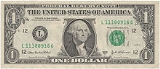
Obverse of current $1 bill


The portrait of George Washington is displayed in the center of the obverse
Obverse and reverse
Obverse and its opposite, reverse, refer to the two flat faces of coins and some other two-sided objects, including paper money, flags , seals, medals, drawings, old master prints and other works of art, and printed fabrics. In this usage, obverse means the front face of the object and reverse...

 of the one-dollar bill, as it has been since the 1869 design. The oval containing George Washington is propped up by bunches of Bay Laurel leaves.

To the left of George Washington is the Federal Reserve District Seal. The name of the Federal Reserve Bank that issued the note encircles a capital letter, (A-L), identifying it among the twelve Federal Reserve Banks. The sequential number of the bank, (1: A, 2: B, etc.), is also displayed in the four corners of the open space on the bill. Until the redesign of the higher denominations of currency beginning in 1996, this seal was found on all denominations of Federal Reserve Notes. Since then it is only present on the $1 and $2 notes, with the higher denominations only displaying a universal Federal Reserve System seal, and the bank letter and number beneath the serial number.

To the right of George Washington is the Treasury Department seal
Seal of the United States Department of the Treasury
The United States Treasury Seal is the official symbol of the United States Department of the Treasury. It actually predates the department, having originated with the Board of Treasury during the period of the Articles of Confederation. It is used on all U.S...

.
The balancing scales represent justice. The chevron with thirteen stars represents the original thirteen colonies. The key below the chevron represents authority and trust; 1789 is the year that the Department of the Treasury was established.

Below the FRD seal (to the left of George Washington) is the signature of the Treasurer of the U.S., which occasionally varies, and below the USDT Seal (right side) is the Secretary of the Treasury's signature. To the left of the Secretary's signature is the series date. A new series date will result from a change in the Secretary of the Treasury, the Treasurer of the United States, and/or a change to the note's appearance such as a new currency design.

On the edges are olive branches entwined around the 1's.

Reverse of current $1 bill


The reverse of the one-dollar bill has an ornate design which incorporates both sides of the Great Seal of the United States
Great Seal of the United States
The Great Seal of the United States is used to authenticate certain documents issued by the United States federal government. The phrase is used both for the physical seal itself , and more generally for the design impressed upon it...

 to the left and right of the word "ONE". This word appears prominently in the white space at the center of the bill in a capitalized, shadowed, and serif
Serif
In typography, serifs are semi-structural details on the ends of some of the strokes that make up letters and symbols. A typeface with serifs is called a serif typeface . A typeface without serifs is called sans serif or sans-serif, from the French sans, meaning “without”...

fed typeface. A smaller image of the word "ONE" is superimposed over the numeral "1" in each of the four corners of the bill.

"THE UNITED STATES OF AMERICA" spans the top of the bill, "ONE DOLLAR" is emblazoned along the bottom, and above the central "ONE" are the words "IN GOD WE TRUST
In God We Trust
"In God We Trust" was adopted as the official motto of the United States in 1956. It is also the motto of the U.S. state of Florida. The Legality of this motto has been questioned because of the United States Constitution forbidding the government to make any law respecting the establishment of a...

," which became the official motto
Motto
A motto is a phrase meant to formally summarize the general motivation or intention of a social group or organization. A motto may be in any language, but Latin is the most used. The local language is usual in the mottoes of governments...

 of the United States in 1956. Below the reverse of the Great Seal on the left side of the bill are the words "THE GREAT SEAL," and below the obverse on the right side are the words "OF THE UNITED STATES." Both reverse and obverse of the Great Seal contain symbols of historical, political, religious, and numerological significance
Numerology
Numerology is any study of the purported mystical relationship between a count or measurement and life. It has many systems and traditions and beliefs...

.

The Great Seal, originally designed in 1782 and added to the dollar bill's design in 1935, is surrounded by an elaborate floral design. The renderings used were the typical official government versions used since the 1880s.

The reverse of the seal on the left features a barren landscape dominated by an unfinished pyramid of 13 steps, topped by the Eye of Providence
Eye of Providence
The Eye of Providence is a symbol showing an eye often surrounded by rays of light or a glory and usually enclosed by a triangle...

 within a triangle. At the base of the pyramid are engraved the Roman numerals MDCCLXXVI (1776), the date of American independence
American Revolution
The American Revolution was the political upheaval during the last half of the 18th century in which thirteen colonies in North America joined together to break free from the British Empire, combining to become the United States of America...

 from Britain
United Kingdom
The United Kingdom of Great Britain and Northern IrelandIn the United Kingdom and Dependencies, other languages have been officially recognised as legitimate autochthonous languages under the European Charter for Regional or Minority Languages...

. At the top of the seal stands a Latin phrase, "ANNUIT COEPTIS
Annuit Cœptis
Annuit cœptis is one of two mottos on the reverse side of the Great Seal of the United States....

," meaning "He (God) favors our undertaking." At the bottom of the seal is a semicircular banner proclaiming "NOVUS ORDO SECLORUM
Novus Ordo Seclorum
The phrase Novus ordo seclorum appears on the reverse of the Great Seal of the United States, first designed in 1782 and printed on the back of the United States one-dollar bill since 1935. The phrase also appears on the coat of arms of the Yale School of Management, Yale University's business...

" meaning "New Order of the Ages," which is a reference to the new American era. To the left of this seal, a string of 13 pearls extends toward the edge of the bill.

The obverse of the seal on the right features a bald eagle
Bald Eagle
The Bald Eagle is a bird of prey found in North America. It is the national bird and symbol of the United States of America. This sea eagle has two known sub-species and forms a species pair with the White-tailed Eagle...

, the national bird and symbol of the United States. Above the eagle
Eagle (heraldry)
The eagle is used in heraldry as a charge, as a supporter, and as a crest. Parts of the eagle's body such as its head, wings or leg are also used as a charge or crest....

 is a radiant cluster of 13 stars arranged in a six-pointed star. The eagle's breast is covered by a heraldic
Heraldry
Heraldry is the profession, study, or art of creating, granting, and blazoning arms and ruling on questions of rank or protocol, as exercised by an officer of arms. Heraldry comes from Anglo-Norman herald, from the Germanic compound harja-waldaz, "army commander"...

 shield with 13 stripes that resemble those on the American flag. As on the first US flag, the stars and stripes stand for the 13 original states of the union. The eagle holds a ribbon in its beak reading "E PLURIBUS UNUM
E pluribus unum
E pluribus unum , Latin for "Out of many, one", is a phrase on the Seal of the United States, along with Annuit cœptis and Novus ordo seclorum, and adopted by an Act of Congress in 1782...

", a Latin phrase meaning "Out of many [states], one [nation]," a de facto motto of the United States (and the only one until 1956). In its left talons the eagle holds 13 arrows, and in its right talons it holds an olive branch
Olive branch
The olive branch in Western culture, derived from the customs of Ancient Greece, symbolizes peace or victory and was worn by brides.-Ancient Greece and Rome:...

 with 13 leaves and 13 olives, representing, respectively, the powers of war and peace. To the right of this seal, a string of 13 pearls extends toward the edge of the bill.

Eye of Providence


The Eye of Providence
Eye of Providence
The Eye of Providence is a symbol showing an eye often surrounded by rays of light or a glory and usually enclosed by a triangle...

 above the pyramid is similar to the ancient Egypt
Egypt
Egypt , officially the Arab Republic of Egypt, Arabic: , is a country mainly in North Africa, with the Sinai Peninsula forming a land bridge in Southwest Asia. Egypt is thus a transcontinental country, and a major power in Africa, the Mediterranean Basin, the Middle East and the Muslim world...

ian Eye of Horus
Eye of Horus
The Eye of Horus is an ancient Egyptian symbol of protection, royal power and good health. The eye is personified in the goddess Wadjet...

, a protective charm relating to the Egyptian sky-god Horus
Horus
Horus is one of the oldest and most significant deities in the Ancient Egyptian religion, who was worshipped from at least the late Predynastic period through to Greco-Roman times. Different forms of Horus are recorded in history and these are treated as distinct gods by Egyptologists...

. The Eye of Providence was also a common Roman Catholic emblem claimed to symbolize the Trinity throughout the Middle Ages and Renaissance.

Replacement of the dollar bill


There are organizations specifically aimed at either preventing (Save the Greenback
Save the Greenback
Save the Greenback is an organization of U.S. Bureau of Engraving and Printing employees and paper and ink suppliers opposed to phasing out the paper dollar...

) or advocating (Coin Coalition
Coin Coalition
The Coin Coalition is an organization supporting the elimination of pennies and dollar bills from U.S. currency. It is funded by vending machine companies, video arcade owners, and the soft drink industry, who all have an interest in eliminating maintenance costs associated with dollar bill...

) the complete elimination of the United States one-dollar bill in favor of the dollar coin, with or without increased production of the two-dollar bill
United States two-dollar bill
The United States two-dollar bill is a current denomination of US currency. President Thomas Jefferson is featured on the obverse of the note...

.

See also

  • In God We Trust
    In God We Trust
    "In God We Trust" was adopted as the official motto of the United States in 1956. It is also the motto of the U.S. state of Florida. The Legality of this motto has been questioned because of the United States Constitution forbidding the government to make any law respecting the establishment of a...

  • Sherman Silver Purchase Act
    Sherman Silver Purchase Act
    The Sherman Silver Purchase Act was enacted on July 14, 1890 as a United States federal law. It was named after its author, Senator John Sherman, an Ohio Republican, chairman of the Senate Finance Committee...

  • George Washington
    George Washington
    George Washington was the dominant military and political leader of the new United States of America from 1775 to 1799. He led the American victory over Great Britain in the American Revolutionary War as commander-in-chief of the Continental Army from 1775 to 1783, and presided over the writing of...

  • Where's George?
    Where's George?
    Where's George? is a website that tracks the natural geographic circulation of American paper money. Its popularity has led to the establishment of a number of other currency tracking websites , sites that track other objects—such as used books—and it has been used in at least one research paper to...


External links