

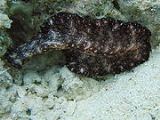
Turbellaria

Encyclopedia
The Turbellaria are one of the traditional sub-divisions of the phylum
Platyhelminthes (flatworms), and include all the sub-groups that are not exclusively parasitic. There are about 4,500 species, which range from 1 mm (0.0393700787401575 in) to 600 mm (23.6 in) in length. All the larger forms are flat with ribbon-like or leaf-like shapes, since their lack of respiratory
and circulatory
systems means that they have to rely on diffusion
for internal transport of metabolites. However, many of the smaller forms are round in cross section. Most are predators, and all live in water or in moist terrestrial environments. Most forms reproduce sexually
and with few exceptions all are simultaneous hermaphrodites.
The Acoelomorpha
and the genus
Xenoturbella
were formerly included in the Turbellaria, but are no longer regarded as Platyhelminthes. All the exclusively parasitic Platyhelminthes form a monophyletic group Neodermata, and it is agreed that these are descended from one small sub-group within the free-living Platyhelminthes. Hence the "Turbellaria" as traditionally defined are paraphyletic.
, Monogenea
and Cestoda
. In this classification the Turbellaria include the Acoelomorpha
(Acoela
and Nemertodermatida
). The name "Turbellaria" refers to the "whirlpools" of microscopic particles created close the skins of aquatic species by the movement of their cilia.
s, in other words their left and right sides are mirror images of each other; this also implies that they have distinct top and bottom surfaces and distinct head and tail ends. Like other bilateria
ns they have three main cell
layers (it is triploblastic), while the radially symmetrical cnidarians and ctenophore
have only two cell layers. Unlike most other bilaterians, platyhelminthes have no internal body cavity and are therefore described as acoelomates. They also lack specialized circulatory
and respiratory
organ
s
The lack of circulatory and respiratory organs limits platyhelminths to sizes and shapes that enable oxygen
to reach and carbon dioxide
to leave all parts of their bodies by simple diffusion
. Hence many are microscopic and the large species have flat ribbon-like or leaf-like shapes. The guts of large species have many branches, so that nutrients can diffuse to all parts of the body. Respiration through the whole surface of the body makes platyhelminthes vulnerable to fluid loss, and restricts them to environments where dehydration
is unlikely: sea and freshwater; moist terrestrial environments such as leaf litter or between grains of soil; and as parasites within other animals.
The space between the skin and gut is filled with mesenchyme
, a connective tissue
that is made of cells
and reinforced by collagen
fibers that act as a type of skeleton
, providing attachment points for muscle
s. The mesenchyme contains all the internal organs and allows the passage of oxygen, nutrients and waste products. It consists of two main types of cell: fixed cells, some of which have fluid-filled vacuole
s; and stem cell
s, which can transform into any other type of cell, and are used in regenerating tissues after injury or asexual reproduction
.
Most platyhelminths have no anus
and regurgitate undigested material through the mouth. However some long species have an anus and some with complex branched guts have more than one anus, since excretion only through the mouth would be difficult for them. The gut is lined with a single layer of endoderm
al cells which absorb and digest food. Some species break up and soften food first by secreting enzyme
s in the gut or the pharynx
(throat).
All animals need to keep the concentration of dissolved substances in their body fluids at a fairly constant level. Internal parasites and free-living marine animals live in environments that have high concentrations of dissolved material, and generally let their tissues have the same level of concentration as the environment, while freshwater animals need to prevent their body fluids from becoming too dilute. Despite this difference in environments, most platyhelminths use the same system to control the level of concentration
in their body fluids. Flame cell
s, so called because the beating of their flagella looks like a flickering candle flame, extract from the mesenchyme water that contains wastes and some re-usable material, and drive it into networks of tube cells which are lined with flagella and microvilli. The tube cells' flagella drive the water towards exits called nephridiopore
s, while their microvilli re-absorb re-usable materials and as much water as is needed to keep the body fluids at the right level of concentration. These combinations of flame cells and tubule cells are called protonephredia.
In all platyhelminths the nervous system
is concentrated at the head end. Most species have rings of ganglia in the head and main nerve trunks running along their bodies.
Planarians are famous for their ability to regenerate if divided by cuts across their bodies. Experiments show that, in fragments that do not already have a head, a new head grows most quickly on those that were closest to the original head. This suggests that the growth of a head is controlled by a chemical whose concentration diminishes from head to tail.
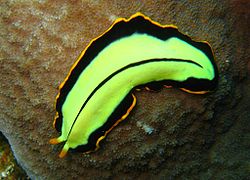
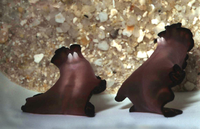 These have about 4,500 species, are mostly free-living, and range from 1 mm (0.0393700787401575 in) to 600 mm (23.6 in) in length. Most are predators or scavengers, and terrestrial species are mostly nocturnal and live in shaded humid locations such as leaf litter or rotting wood. However some are symbiotes of other animals such as crustaceans, and some are parasites. Free-living turbellarians are mostly black, brown or gray, but some larger ones are brightly colored.
Turbellarians have no cuticle
(external layer of organic but non-cellular material). In a few species the skin is a syncitium, a collection of cells with multiple nuclei and a single shared external membrane
. However the skins of most species consist of a single layer of cells, each of which generally has multiple cilia (small mobile "hairs"), although in some large species the upper surface has no cilia. These skins are also covered with microvilli between the cilia. They have many glands, usually submerged in the muscle layers below the skin and connect to the surface by pores through which they secrete mucus
, adhesives and other substances.
Small aquatic species use the cilia for locomotion, while larger ones use muscular movements of the whole body or of a specialized sole to creep or swim. Some are capable of burrowing, anchoring their rear ends at the bottom of the burrow, then stretching the head up to feed and then pulling it back down for safety. Some terrestrial species throw a thread of mucus which they use as a rope to climb from one leaf to another.
Some Turbelleria have spicular skeletons, giving the appearance of annulations.
and does not feed as an adult, presumably relying on the alge to provide nourishment as endosymbionts. In other acoels the gut is lined by a syncitium. These and some other turbellarians have a simple pharynx
lined with cilia and generally feed by using cilia to sweep food particles and small prey into their mouths, which are usually in the middle of the underside.
Most other turbellarians are carnivorous, either preying on small invertebrates or protozoa
ns, or scavenging on dead animals. A few feed on larger animals, including oyster
s and barnacle
s, while some, such as Bdelloura, are commensal on the gills of horseshoe crab
s. These turbellarians usually have an eversible pharynx, in other words, one that can be extended by being turned inside-out, and the mouths of different species can be anywhere along the underside. The freshwater species Microstomum caudatum can open its mouth almost as wide as its body is long, to swallow prey as large as itself.
The intestine is lined by phagocytic
cells which capture food particles that have already been partially digested by enzymes in the gut. Digestion is then completed within the phagocytic cells and the nutrients diffuse through the body.
s rather like those of cnidaria
ns and ctenophore
s, but densest around the head. In other turbellarians, a distinct brain is present, albeit relatively simple in structure. From the brain one to four pairs of nerve cords run along the length the body, with numerous smaller nerves branching off. The ventral pair of nerve cords are typically the largest, and, in many species, are the only ones present. Unlike more complex animals, such as annelid
s, there are no ganglia on the nerve cords, other than those forming the brain.
Most turbellarians have pigment-cup ocelli ("little eyes"), one pair in most species, but two or even three pairs in some. A few large species have many eyes in clusters over the brain, mounted on tentacles, or spaced uniformly round the edge of the body. The ocelli can only distinguish the direction from which light is coming and enable the animals to avoid it.
A few groups – mainly catenulids, acoelomorphs and seriates – have statocyst
s, fluid-filled chambers containing a small solid particle or, in a few groups, two. These statocysts are thought to be balance and acceleration sensors, as that is the function they perform in cnidaria
n medusae and in ctenophore
s. However turbellarian statocysts have no sensory cilia, and it is unknown how they sense the movements and positions of the solid particles.
Most species have ciliated touch-sensor cells scattered over their bodies, especially on tentacles and around the edges. Specialized cells in pits or grooves on the head are probably smell-sensors.
themselves by tranverse or longitudinal division, and others, especially acoels, reproduce by budding
. The planarian Dugesia
is a well-known representative of class Turbellaria.
All turbellarians are simultaneous hermaphrodite
s, having both female and male reproductive cells, and fertilize eggs internally
by copulation. Some of the larger aquatic species mate by penis fencing
, a duel in which each tries to impregnate the other, and the loser adopts the female role of developing the eggs.
Although the acoels have no distinct gonad
s at all, in other turbellarians there are one or more pairs of both testes and ovaries
. Sperm ducts run from the testes, through bulb-like seminal vesicles, to the muscular penis. In many species, this basic plan is considerably complicated by the addition of accessory glands or other structures. The penis lies inside a cavity, and can be everted through an opening on the posterior underside of the animal. It often, although not always, possesses a sharp stylet
. Unusually among animals, in most species, the sperm cells have two tails
, rather than one.
In most platyhelminths, the ovaries are divided into two regions, one producing the ova
, and the other producing specialised yolk cells to nourish the developing embryo. While many turbellarians have this arrangement, some are apparently more primitive. In these latter species, the ovaries are undivided, and the egg cells contain yolk within their own cytoplasm, as is the case in most other animals. In either arrangement, the ovaries possess oviducts that run to a bursa for storing sperm. The bursa is in turn connected to the vagina, which opens in front of the penis. In some cases, there also be other structures for sperm storage, in addition to the bursa, or even a uterus for storage of ripe eggs.
In most species "miniature adults" emerge when the eggs hatch, but a few large species produce plankton
-like larva
e.
analyses of anatomical features in the mid-1980s and molecular phylogenetics analyses since 2000 using different sections of DNA agree that Acoelomorpha
, consisting of Acoela
(traditionally regarded as very simple "turbellarians") and Nemertodermatida
(another small group previously classified as "turbellarians") are the sister group to all other bilaterians, including the rest of the "Platyhelminthes".
The "Platyhelminthes" excluding "Acoelomorpha" contain two main groups, Catenulida
and Rhabditophora, and it is generally agreed that both are monophyletic, in other words each contains all and only the descendants of an ancestor which is a member of the same group. Early molecular phylogenetics analyses of the Catenulida and Rhabditophora left uncertainties about whether these could be combined in a single monophyletic group, but a study in 2008 concluded that they could, and therefore that "Platyhelminthes" could be redefined as Catenulida plus Rhabditophora, excluding the "Acoelomorpha".
It has been agreed since 1985 that each of the wholly parasitic platyhelminth groups (Cestoda
, Monogenea
and Trematoda
) is monophyletic, and that together these form a larger monophyletic grouping, the Neodermata, in which the adults of all members have syncitial skins. It is also generally agreed that the Neodermata are a relatively small sub-group a few levels down in the "family tree" of the Rhabditophora. Hence the traditional sub-phylum "Turbellaria" is paraphyletic, since it does not include the Neodermata although these are descendants of a sub-group of "turbellarians".
Phylum
In biology, a phylum The term was coined by Georges Cuvier from Greek φῦλον phylon, "race, stock," related to φυλή phyle, "tribe, clan." is a taxonomic rank below kingdom and above class. "Phylum" is equivalent to the botanical term division....
Platyhelminthes (flatworms), and include all the sub-groups that are not exclusively parasitic. There are about 4,500 species, which range from 1 mm (0.0393700787401575 in) to 600 mm (23.6 in) in length. All the larger forms are flat with ribbon-like or leaf-like shapes, since their lack of respiratory
Respiratory system
The respiratory system is the anatomical system of an organism that introduces respiratory gases to the interior and performs gas exchange. In humans and other mammals, the anatomical features of the respiratory system include airways, lungs, and the respiratory muscles...
and circulatory
Circulatory system
The circulatory system is an organ system that passes nutrients , gases, hormones, blood cells, etc...
systems means that they have to rely on diffusion
Diffusion
Molecular diffusion, often called simply diffusion, is the thermal motion of all particles at temperatures above absolute zero. The rate of this movement is a function of temperature, viscosity of the fluid and the size of the particles...
for internal transport of metabolites. However, many of the smaller forms are round in cross section. Most are predators, and all live in water or in moist terrestrial environments. Most forms reproduce sexually
Sexual reproduction
Sexual reproduction is the creation of a new organism by combining the genetic material of two organisms. There are two main processes during sexual reproduction; they are: meiosis, involving the halving of the number of chromosomes; and fertilization, involving the fusion of two gametes and the...
and with few exceptions all are simultaneous hermaphrodites.
The Acoelomorpha
Acoelomorpha
The Acoelomorpha are a disputed phylum of animals with planula-like features that were considered to belong to the phylum Platyhelminthes. In 2004 molecular studies demonstrated that they are a separate phylum, although their position in the tree of life is contentious; most researchers believe...
and the genus
Genus
In biology, a genus is a low-level taxonomic rank used in the biological classification of living and fossil organisms, which is an example of definition by genus and differentia...
Xenoturbella
Xenoturbella
Xenoturbella is a genus of bilaterian animals; it contains two marine worm-like species. The first known species was discovered in 1915 by Sixten Bock but the first published description was only in 1949 by Einar Westblad...
were formerly included in the Turbellaria, but are no longer regarded as Platyhelminthes. All the exclusively parasitic Platyhelminthes form a monophyletic group Neodermata, and it is agreed that these are descended from one small sub-group within the free-living Platyhelminthes. Hence the "Turbellaria" as traditionally defined are paraphyletic.
Description
Traditional classifications divide the Platyhelminthes into four groups: Turbellaria and the wholly parasitic TrematodaTrematoda
Trematoda is a class within the phylum Platyhelminthes that contains two groups of parasitic flatworms, commonly referred to as "flukes".-Taxonomy and biodiversity:...
, Monogenea
Monogenea
Monogenea are a group of largely ectoparasitic members of the flatworm phylum Platyhelminthes, class Monogenea.-Characteristics:Monogenea are very small parasitic flatworms mainly found on skin or gills of fish....
and Cestoda
Cestoda
This article describes the flatworm. For the medical condition, see Tapeworm infection.Cestoda is the name given to a class of parasitic flatworms, commonly called tapeworms, of the phylum Platyhelminthes. Its members live in the digestive tract of vertebrates as adults, and often in the bodies...
. In this classification the Turbellaria include the Acoelomorpha
Acoelomorpha
The Acoelomorpha are a disputed phylum of animals with planula-like features that were considered to belong to the phylum Platyhelminthes. In 2004 molecular studies demonstrated that they are a separate phylum, although their position in the tree of life is contentious; most researchers believe...
(Acoela
Acoela
Acoela is an order of animals treated either as a group of flatworms or as one of the two classes of the phylum Acoelomorpha, containing the majority of that phylum's species. It contains about 20 families....
and Nemertodermatida
Nemertodermatida
Nemertodermatida is a group of bilaterians.But see: et al. 2011: Acoelomorph flatworms are deuterostomes related to Xenoturbella. Nature, 470: 255–258....
). The name "Turbellaria" refers to the "whirlpools" of microscopic particles created close the skins of aquatic species by the movement of their cilia.
Features common to all Platyhelminthes
Platyhelminthes are bilaterally symmetrical animalAnimal
Animals are a major group of multicellular, eukaryotic organisms of the kingdom Animalia or Metazoa. Their body plan eventually becomes fixed as they develop, although some undergo a process of metamorphosis later on in their life. Most animals are motile, meaning they can move spontaneously and...
s, in other words their left and right sides are mirror images of each other; this also implies that they have distinct top and bottom surfaces and distinct head and tail ends. Like other bilateria
Bilateria
The bilateria are all animals having a bilateral symmetry, i.e. they have a front and a back end, as well as an upside and downside. Radially symmetrical animals like jellyfish have a topside and downside, but no front and back...
ns they have three main cell
Cell (biology)
The cell is the basic structural and functional unit of all known living organisms. It is the smallest unit of life that is classified as a living thing, and is often called the building block of life. The Alberts text discusses how the "cellular building blocks" move to shape developing embryos....
layers (it is triploblastic), while the radially symmetrical cnidarians and ctenophore
Ctenophore
The Ctenophora are a phylum of animals that live in marine waters worldwide. Their most distinctive feature is the "combs", groups of cilia that they use for swimming, and they are the largest animals that swim by means of cilia – adults of various species range from a few millimeters to in size...
have only two cell layers. Unlike most other bilaterians, platyhelminthes have no internal body cavity and are therefore described as acoelomates. They also lack specialized circulatory
Circulatory system
The circulatory system is an organ system that passes nutrients , gases, hormones, blood cells, etc...
and respiratory
Respiratory system
The respiratory system is the anatomical system of an organism that introduces respiratory gases to the interior and performs gas exchange. In humans and other mammals, the anatomical features of the respiratory system include airways, lungs, and the respiratory muscles...
organ
Organ (anatomy)
In biology, an organ is a collection of tissues joined in structural unit to serve a common function. Usually there is a main tissue and sporadic tissues . The main tissue is the one that is unique for the specific organ. For example, main tissue in the heart is the myocardium, while sporadic are...
s
The lack of circulatory and respiratory organs limits platyhelminths to sizes and shapes that enable oxygen
Oxygen
Oxygen is the element with atomic number 8 and represented by the symbol O. Its name derives from the Greek roots ὀξύς and -γενής , because at the time of naming, it was mistakenly thought that all acids required oxygen in their composition...
to reach and carbon dioxide
Carbon dioxide
Carbon dioxide is a naturally occurring chemical compound composed of two oxygen atoms covalently bonded to a single carbon atom...
to leave all parts of their bodies by simple diffusion
Diffusion
Molecular diffusion, often called simply diffusion, is the thermal motion of all particles at temperatures above absolute zero. The rate of this movement is a function of temperature, viscosity of the fluid and the size of the particles...
. Hence many are microscopic and the large species have flat ribbon-like or leaf-like shapes. The guts of large species have many branches, so that nutrients can diffuse to all parts of the body. Respiration through the whole surface of the body makes platyhelminthes vulnerable to fluid loss, and restricts them to environments where dehydration
Dehydration
In physiology and medicine, dehydration is defined as the excessive loss of body fluid. It is literally the removal of water from an object; however, in physiological terms, it entails a deficiency of fluid within an organism...
is unlikely: sea and freshwater; moist terrestrial environments such as leaf litter or between grains of soil; and as parasites within other animals.
The space between the skin and gut is filled with mesenchyme
Mesenchyme
Mesenchyme, or mesenchymal connective tissue, is a type of undifferentiated loose connective tissue that is derived mostly from mesoderm, although some are derived from other germ layers; e.g. some mesenchyme is derived from neural crest cells and thus originates from the ectoderm...
, a connective tissue
Connective tissue
"Connective tissue" is a fibrous tissue. It is one of the four traditional classes of tissues . Connective Tissue is found throughout the body.In fact the whole framework of the skeleton and the different specialized connective tissues from the crown of the head to the toes determine the form of...
that is made of cells
Cell (biology)
The cell is the basic structural and functional unit of all known living organisms. It is the smallest unit of life that is classified as a living thing, and is often called the building block of life. The Alberts text discusses how the "cellular building blocks" move to shape developing embryos....
and reinforced by collagen
Collagen
Collagen is a group of naturally occurring proteins found in animals, especially in the flesh and connective tissues of mammals. It is the main component of connective tissue, and is the most abundant protein in mammals, making up about 25% to 35% of the whole-body protein content...
fibers that act as a type of skeleton
Skeleton
The skeleton is the body part that forms the supporting structure of an organism. There are two different skeletal types: the exoskeleton, which is the stable outer shell of an organism, and the endoskeleton, which forms the support structure inside the body.In a figurative sense, skeleton can...
, providing attachment points for muscle
Muscle
Muscle is a contractile tissue of animals and is derived from the mesodermal layer of embryonic germ cells. Muscle cells contain contractile filaments that move past each other and change the size of the cell. They are classified as skeletal, cardiac, or smooth muscles. Their function is to...
s. The mesenchyme contains all the internal organs and allows the passage of oxygen, nutrients and waste products. It consists of two main types of cell: fixed cells, some of which have fluid-filled vacuole
Vacuole
A vacuole is a membrane-bound organelle which is present in all plant and fungal cells and some protist, animal and bacterial cells. Vacuoles are essentially enclosed compartments which are filled with water containing inorganic and organic molecules including enzymes in solution, though in certain...
s; and stem cell
Stem cell
This article is about the cell type. For the medical therapy, see Stem Cell TreatmentsStem cells are biological cells found in all multicellular organisms, that can divide and differentiate into diverse specialized cell types and can self-renew to produce more stem cells...
s, which can transform into any other type of cell, and are used in regenerating tissues after injury or asexual reproduction
Asexual reproduction
Asexual reproduction is a mode of reproduction by which offspring arise from a single parent, and inherit the genes of that parent only, it is reproduction which does not involve meiosis, ploidy reduction, or fertilization. A more stringent definition is agamogenesis which is reproduction without...
.
Most platyhelminths have no anus
Anus
The anus is an opening at the opposite end of an animal's digestive tract from the mouth. Its function is to control the expulsion of feces, unwanted semi-solid matter produced during digestion, which, depending on the type of animal, may be one or more of: matter which the animal cannot digest,...
and regurgitate undigested material through the mouth. However some long species have an anus and some with complex branched guts have more than one anus, since excretion only through the mouth would be difficult for them. The gut is lined with a single layer of endoderm
Endoderm
Endoderm is one of the three primary germ cell layers in the very early embryo. The other two layers are the ectoderm and mesoderm , with the endoderm as the intermost layer...
al cells which absorb and digest food. Some species break up and soften food first by secreting enzyme
Enzyme
Enzymes are proteins that catalyze chemical reactions. In enzymatic reactions, the molecules at the beginning of the process, called substrates, are converted into different molecules, called products. Almost all chemical reactions in a biological cell need enzymes in order to occur at rates...
s in the gut or the pharynx
Pharynx
The human pharynx is the part of the throat situated immediately posterior to the mouth and nasal cavity, and anterior to the esophagus and larynx. The human pharynx is conventionally divided into three sections: the nasopharynx , the oropharynx , and the laryngopharynx...
(throat).
All animals need to keep the concentration of dissolved substances in their body fluids at a fairly constant level. Internal parasites and free-living marine animals live in environments that have high concentrations of dissolved material, and generally let their tissues have the same level of concentration as the environment, while freshwater animals need to prevent their body fluids from becoming too dilute. Despite this difference in environments, most platyhelminths use the same system to control the level of concentration
Osmoregulation
Osmoregulation is the active regulation of the osmotic pressure of an organism's fluids to maintain the homeostasis of the organism's water content; that is it keeps the organism's fluids from becoming too diluted or too concentrated. Osmotic pressure is a measure of the tendency of water to move...
in their body fluids. Flame cell
Flame cell
right|frameA flame cell is a specialized excretory cell found in the simplest freshwater invertebrates, including flatworms , rotifers and nemerteans; these are the simplest animals to have a dedicated excretory system. Flame cells function like a kidney, removing waste materials...
s, so called because the beating of their flagella looks like a flickering candle flame, extract from the mesenchyme water that contains wastes and some re-usable material, and drive it into networks of tube cells which are lined with flagella and microvilli. The tube cells' flagella drive the water towards exits called nephridiopore
Nephridiopore
Nephridiopore is part of the nephridia, an excretory organ found in many organisms, such as flatworms or annelids. Nephridia are analogous to nephrons or uriniferous tubules found in the kidney of humans....
s, while their microvilli re-absorb re-usable materials and as much water as is needed to keep the body fluids at the right level of concentration. These combinations of flame cells and tubule cells are called protonephredia.
In all platyhelminths the nervous system
Nervous system
The nervous system is an organ system containing a network of specialized cells called neurons that coordinate the actions of an animal and transmit signals between different parts of its body. In most animals the nervous system consists of two parts, central and peripheral. The central nervous...
is concentrated at the head end. Most species have rings of ganglia in the head and main nerve trunks running along their bodies.
Planarians are famous for their ability to regenerate if divided by cuts across their bodies. Experiments show that, in fragments that do not already have a head, a new head grows most quickly on those that were closest to the original head. This suggests that the growth of a head is controlled by a chemical whose concentration diminishes from head to tail.
Features specific to Turbelleria
Turbellarians have no cuticle
Cuticle
A cuticle , or cuticula, is a term used for any of a variety of tough but flexible, non-mineral outer coverings of an organism, or parts of an organism, that provide protection. Various types of "cuticles" are non-homologous; differing in their origin, structure, function, and chemical composition...
(external layer of organic but non-cellular material). In a few species the skin is a syncitium, a collection of cells with multiple nuclei and a single shared external membrane
Cell membrane
The cell membrane or plasma membrane is a biological membrane that separates the interior of all cells from the outside environment. The cell membrane is selectively permeable to ions and organic molecules and controls the movement of substances in and out of cells. It basically protects the cell...
. However the skins of most species consist of a single layer of cells, each of which generally has multiple cilia (small mobile "hairs"), although in some large species the upper surface has no cilia. These skins are also covered with microvilli between the cilia. They have many glands, usually submerged in the muscle layers below the skin and connect to the surface by pores through which they secrete mucus
Mucus
In vertebrates, mucus is a slippery secretion produced by, and covering, mucous membranes. Mucous fluid is typically produced from mucous cells found in mucous glands. Mucous cells secrete products that are rich in glycoproteins and water. Mucous fluid may also originate from mixed glands, which...
, adhesives and other substances.
Small aquatic species use the cilia for locomotion, while larger ones use muscular movements of the whole body or of a specialized sole to creep or swim. Some are capable of burrowing, anchoring their rear ends at the bottom of the burrow, then stretching the head up to feed and then pulling it back down for safety. Some terrestrial species throw a thread of mucus which they use as a rope to climb from one leaf to another.
Some Turbelleria have spicular skeletons, giving the appearance of annulations.
Diet and digestion
The acoel Convoluta roscoffensis swallows cells of the green alga TetraselmisTetraselmis
Tetraselmis is a genus of phytoplankton. Tetraselmis has a very high lipid level; their amino acids stimulate feeding in marine organisms . Tetraselmis is green, motile, and usually grows 10 µm long x 14 µm wide.The species T...
and does not feed as an adult, presumably relying on the alge to provide nourishment as endosymbionts. In other acoels the gut is lined by a syncitium. These and some other turbellarians have a simple pharynx
Pharynx
The human pharynx is the part of the throat situated immediately posterior to the mouth and nasal cavity, and anterior to the esophagus and larynx. The human pharynx is conventionally divided into three sections: the nasopharynx , the oropharynx , and the laryngopharynx...
lined with cilia and generally feed by using cilia to sweep food particles and small prey into their mouths, which are usually in the middle of the underside.
Most other turbellarians are carnivorous, either preying on small invertebrates or protozoa
Protozoa
Protozoa are a diverse group of single-cells eukaryotic organisms, many of which are motile. Throughout history, protozoa have been defined as single-cell protists with animal-like behavior, e.g., movement...
ns, or scavenging on dead animals. A few feed on larger animals, including oyster
Oyster
The word oyster is used as a common name for a number of distinct groups of bivalve molluscs which live in marine or brackish habitats. The valves are highly calcified....
s and barnacle
Barnacle
A barnacle is a type of arthropod belonging to infraclass Cirripedia in the subphylum Crustacea, and is hence related to crabs and lobsters. Barnacles are exclusively marine, and tend to live in shallow and tidal waters, typically in erosive settings. They are sessile suspension feeders, and have...
s, while some, such as Bdelloura, are commensal on the gills of horseshoe crab
Horseshoe crab
The Atlantic horseshoe crab, Limulus polyphemus, is a marine chelicerate arthropod. Despite its name, it is more closely related to spiders, ticks, and scorpions than to crabs. Horseshoe crabs are most commonly found in the Gulf of Mexico and along the northern Atlantic coast of North America...
s. These turbellarians usually have an eversible pharynx, in other words, one that can be extended by being turned inside-out, and the mouths of different species can be anywhere along the underside. The freshwater species Microstomum caudatum can open its mouth almost as wide as its body is long, to swallow prey as large as itself.
The intestine is lined by phagocytic
Phagocyte
Phagocytes are the white blood cells that protect the body by ingesting harmful foreign particles, bacteria, and dead or dying cells. Their name comes from the Greek phagein, "to eat" or "devour", and "-cyte", the suffix in biology denoting "cell", from the Greek kutos, "hollow vessel". They are...
cells which capture food particles that have already been partially digested by enzymes in the gut. Digestion is then completed within the phagocytic cells and the nutrients diffuse through the body.
Nervous system
Concentration of nervous tissue in the head region is least marked in the acoels, which have nerve netNerve net
A nerve net is a type of simple nervous system that is found in members of the cnidaria, ctenophora, and echinodermata phyla. Nerve nets consist of interconnected neurons lacking a brain or any form of cephalization. This nervous system allows cnidarians to respond to physical contact. They may...
s rather like those of cnidaria
Cnidaria
Cnidaria is a phylum containing over 9,000 species of animals found exclusively in aquatic and mostly marine environments. Their distinguishing feature is cnidocytes, specialized cells that they use mainly for capturing prey. Their bodies consist of mesoglea, a non-living jelly-like substance,...
ns and ctenophore
Ctenophore
The Ctenophora are a phylum of animals that live in marine waters worldwide. Their most distinctive feature is the "combs", groups of cilia that they use for swimming, and they are the largest animals that swim by means of cilia – adults of various species range from a few millimeters to in size...
s, but densest around the head. In other turbellarians, a distinct brain is present, albeit relatively simple in structure. From the brain one to four pairs of nerve cords run along the length the body, with numerous smaller nerves branching off. The ventral pair of nerve cords are typically the largest, and, in many species, are the only ones present. Unlike more complex animals, such as annelid
Annelid
The annelids , formally called Annelida , are a large phylum of segmented worms, with over 17,000 modern species including ragworms, earthworms and leeches...
s, there are no ganglia on the nerve cords, other than those forming the brain.
Most turbellarians have pigment-cup ocelli ("little eyes"), one pair in most species, but two or even three pairs in some. A few large species have many eyes in clusters over the brain, mounted on tentacles, or spaced uniformly round the edge of the body. The ocelli can only distinguish the direction from which light is coming and enable the animals to avoid it.
A few groups – mainly catenulids, acoelomorphs and seriates – have statocyst
Statocyst
The statocyst is a balance sensory receptor present in some aquatic invertebrates, including bivalves, cnidarians, echinoderms, cephalopods, and crustaceans. A similar structure is also found in Xenoturbella. The statocyst consists of a sac-like structure containing a mineralised mass and numerous...
s, fluid-filled chambers containing a small solid particle or, in a few groups, two. These statocysts are thought to be balance and acceleration sensors, as that is the function they perform in cnidaria
Cnidaria
Cnidaria is a phylum containing over 9,000 species of animals found exclusively in aquatic and mostly marine environments. Their distinguishing feature is cnidocytes, specialized cells that they use mainly for capturing prey. Their bodies consist of mesoglea, a non-living jelly-like substance,...
n medusae and in ctenophore
Ctenophore
The Ctenophora are a phylum of animals that live in marine waters worldwide. Their most distinctive feature is the "combs", groups of cilia that they use for swimming, and they are the largest animals that swim by means of cilia – adults of various species range from a few millimeters to in size...
s. However turbellarian statocysts have no sensory cilia, and it is unknown how they sense the movements and positions of the solid particles.
Most species have ciliated touch-sensor cells scattered over their bodies, especially on tentacles and around the edges. Specialized cells in pits or grooves on the head are probably smell-sensors.
Reproduction
Many turbellarians cloneCloning
Cloning in biology is the process of producing similar populations of genetically identical individuals that occurs in nature when organisms such as bacteria, insects or plants reproduce asexually. Cloning in biotechnology refers to processes used to create copies of DNA fragments , cells , or...
themselves by tranverse or longitudinal division, and others, especially acoels, reproduce by budding
Budding
Budding is a form of asexual reproduction in which a new organism grows on another one. The new organism remains attached as it grows, separating from the parent organism only when it is mature. Since the reproduction is asexual, the newly created organism is a clone and is genetically identical...
. The planarian Dugesia
Dugesia
Dugesia is a genus of dugesiid flatworms containing some common representatives of the class Turbellaria. These common flatworms are found in freshwater habitats. Their digestion tract consists of a central tubular pharynx. Each branch consists of ceca, which delivers the nutrients to the body...
is a well-known representative of class Turbellaria.
All turbellarians are simultaneous hermaphrodite
Hermaphrodite
In biology, a hermaphrodite is an organism that has reproductive organs normally associated with both male and female sexes.Many taxonomic groups of animals do not have separate sexes. In these groups, hermaphroditism is a normal condition, enabling a form of sexual reproduction in which both...
s, having both female and male reproductive cells, and fertilize eggs internally
Internal fertilization
In mammals, internal fertilization is done through copulation, which involves the insertion of the penis into the vagina. Some other higher vertebrate animals reproduce internally, but their fertilization is cloacal.The union of spermatozoa of the parent organism. At some point, the growing egg or...
by copulation. Some of the larger aquatic species mate by penis fencing
Penis fencing
Penis fencing is a mating behavior engaged in by certain species of flatworm, such as Pseudobiceros hancockanus. Species which engage in the practice are hermaphroditic; each individual has both egg-producing ovaries and sperm-producing testes....
, a duel in which each tries to impregnate the other, and the loser adopts the female role of developing the eggs.
Although the acoels have no distinct gonad
Gonad
The gonad is the organ that makes gametes. The gonads in males are the testes and the gonads in females are the ovaries. The product, gametes, are haploid germ cells. For example, spermatozoon and egg cells are gametes...
s at all, in other turbellarians there are one or more pairs of both testes and ovaries
Ovary
The ovary is an ovum-producing reproductive organ, often found in pairs as part of the vertebrate female reproductive system. Ovaries in anatomically female individuals are analogous to testes in anatomically male individuals, in that they are both gonads and endocrine glands.-Human anatomy:Ovaries...
. Sperm ducts run from the testes, through bulb-like seminal vesicles, to the muscular penis. In many species, this basic plan is considerably complicated by the addition of accessory glands or other structures. The penis lies inside a cavity, and can be everted through an opening on the posterior underside of the animal. It often, although not always, possesses a sharp stylet
Stylet
A stylet is a hard, sharp, anatomical structure found in some invertebrates.For example, the word stylet or stomatostyle, is used for the primitive piercing mouthparts of some nematodes and some nemerteans...
. Unusually among animals, in most species, the sperm cells have two tails
Flagellum
A flagellum is a tail-like projection that protrudes from the cell body of certain prokaryotic and eukaryotic cells, and plays the dual role of locomotion and sense organ, being sensitive to chemicals and temperatures outside the cell. There are some notable differences between prokaryotic and...
, rather than one.
In most platyhelminths, the ovaries are divided into two regions, one producing the ova
Ovum
An ovum is a haploid female reproductive cell or gamete. Both animals and embryophytes have ova. The term ovule is used for the young ovum of an animal, as well as the plant structure that carries the female gametophyte and egg cell and develops into a seed after fertilization...
, and the other producing specialised yolk cells to nourish the developing embryo. While many turbellarians have this arrangement, some are apparently more primitive. In these latter species, the ovaries are undivided, and the egg cells contain yolk within their own cytoplasm, as is the case in most other animals. In either arrangement, the ovaries possess oviducts that run to a bursa for storing sperm. The bursa is in turn connected to the vagina, which opens in front of the penis. In some cases, there also be other structures for sperm storage, in addition to the bursa, or even a uterus for storage of ripe eggs.
In most species "miniature adults" emerge when the eggs hatch, but a few large species produce plankton
Plankton
Plankton are any drifting organisms that inhabit the pelagic zone of oceans, seas, or bodies of fresh water. That is, plankton are defined by their ecological niche rather than phylogenetic or taxonomic classification...
-like larva
Larva
A larva is a distinct juvenile form many animals undergo before metamorphosis into adults. Animals with indirect development such as insects, amphibians, or cnidarians typically have a larval phase of their life cycle...
e.
Classification and evolutionary relationships
Detailed morphologicalMorphology (biology)
In biology, morphology is a branch of bioscience dealing with the study of the form and structure of organisms and their specific structural features....
analyses of anatomical features in the mid-1980s and molecular phylogenetics analyses since 2000 using different sections of DNA agree that Acoelomorpha
Acoelomorpha
The Acoelomorpha are a disputed phylum of animals with planula-like features that were considered to belong to the phylum Platyhelminthes. In 2004 molecular studies demonstrated that they are a separate phylum, although their position in the tree of life is contentious; most researchers believe...
, consisting of Acoela
Acoela
Acoela is an order of animals treated either as a group of flatworms or as one of the two classes of the phylum Acoelomorpha, containing the majority of that phylum's species. It contains about 20 families....
(traditionally regarded as very simple "turbellarians") and Nemertodermatida
Nemertodermatida
Nemertodermatida is a group of bilaterians.But see: et al. 2011: Acoelomorph flatworms are deuterostomes related to Xenoturbella. Nature, 470: 255–258....
(another small group previously classified as "turbellarians") are the sister group to all other bilaterians, including the rest of the "Platyhelminthes".
The "Platyhelminthes" excluding "Acoelomorpha" contain two main groups, Catenulida
Catenulida
The Catenulida are an order of turbellarian flatworms.They are relatively small free-living flatworms, inhabiting freshwater and marine environments. The pharynx and intestine are simple in structure, with the latter forming a ciliated sac. They possess two pairs of nerve cords and often a...
and Rhabditophora, and it is generally agreed that both are monophyletic, in other words each contains all and only the descendants of an ancestor which is a member of the same group. Early molecular phylogenetics analyses of the Catenulida and Rhabditophora left uncertainties about whether these could be combined in a single monophyletic group, but a study in 2008 concluded that they could, and therefore that "Platyhelminthes" could be redefined as Catenulida plus Rhabditophora, excluding the "Acoelomorpha".
It has been agreed since 1985 that each of the wholly parasitic platyhelminth groups (Cestoda
Cestoda
This article describes the flatworm. For the medical condition, see Tapeworm infection.Cestoda is the name given to a class of parasitic flatworms, commonly called tapeworms, of the phylum Platyhelminthes. Its members live in the digestive tract of vertebrates as adults, and often in the bodies...
, Monogenea
Monogenea
Monogenea are a group of largely ectoparasitic members of the flatworm phylum Platyhelminthes, class Monogenea.-Characteristics:Monogenea are very small parasitic flatworms mainly found on skin or gills of fish....
and Trematoda
Trematoda
Trematoda is a class within the phylum Platyhelminthes that contains two groups of parasitic flatworms, commonly referred to as "flukes".-Taxonomy and biodiversity:...
) is monophyletic, and that together these form a larger monophyletic grouping, the Neodermata, in which the adults of all members have syncitial skins. It is also generally agreed that the Neodermata are a relatively small sub-group a few levels down in the "family tree" of the Rhabditophora. Hence the traditional sub-phylum "Turbellaria" is paraphyletic, since it does not include the Neodermata although these are descendants of a sub-group of "turbellarians".