

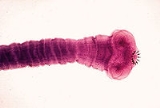
Cestoda

Encyclopedia
This article describes the flatworm. For the medical condition, see Tapeworm infection
.
Cestoda (Cestoidea) is the name given to a class
of parasitic flatworm
s, commonly called tapeworms, of the phylum Platyhelminthes. Its members live in the digestive tract of vertebrate
s as adults, and often in the bodies of various animals as juveniles. Over a thousand species have been described, and all vertebrate
species can be parasitised by at least one species of tapeworm. Several species parasitise
humans after being consumed in underprepared meat such as pork (Taenia solium), beef (T. saginata
), and fish (Diphyllobothrium spp.), or in food prepared in conditions of poor hygiene (Hymenolepis
spp. or Echinococcus
spp.).
T. saginata, the beef tapeworm, can grow up to 12 m (40 ft); other species may grow to over 30 m (100 ft).
") attaches to the intestine of the definitive host
. In some species, the scolex is dominated by bothria
(tentacles), which are sometimes called "sucking grooves", and function like suction cup
s. Other species have hooks and suckers that aid in attachment. Cyclophyllid
cestodes can be identified by the presence of four suckers
on their scolex.
While the scolex is often the most distinctive part of an adult tapeworm, it is often unnoticed in a clinical setting as it is inside the patient. Thus, identifying eggs and proglottids in feces is important.
s (protonephridia), located in the proglottids, for excretion. Mature proglottids are released from the tapeworm's posterior end and leave the host in feces.
Because each proglottid contains the male and female reproductive structures, they can reproduce independently. Some biologists have suggested that each should be considered a single organism, and that the tapeworm is actually a colony of proglottids.
The layout of proglottids comes in two forms, craspedote, meaning proglottids are overlapped by the previous proglottid, and acraspedote which indicates a non-overlapping conjoined proglottid.
Once anchored to the host's intestinal wall, the tapeworm absorbs nutrients through its skin as the food being digested by the host flows past it and it begins to grow a long tail, with each segment containing an independent digestive system and reproductive tract. Older segments are pushed toward the tip of the tail as new segments are produced by the neckpiece. By the time a segment has reached the end of the tail, only the reproductive tract is left. It then drops off, carrying the tapeworm eggs to the next host, since, by that point, the proglottid is, in essence, a sac of eggs.
in their bodies. The reproductive system
includes one or many testes, cirrus
, vas deferens
and seminal vesicle
as male organs, and a single lobed or unlobed ovary
with the connecting oviduct
and uterus
as female organs. There is a common external opening for both male and female reproductive systems
, known as genital pore, which is situated at the surface opening of the cup-shaped atrium. Even though they are sexually hermaphroditic
, self-fertilization is a rare phenomenon. In order to permit hybridization, cross-fertilization
between two individuals is often practiced for reproduction. During copulation, the cirrus
of one individual connects with that of the other through the genital pore, and then exchange their spermatozoa.
The life cycle of tapeworms is simple in the sense that there are no asexual phases
as in other flatworms, but complicated in that at least one intermediate host
is required as well as the definitive host. This life cycle
pattern has been a crucial criterion for assessing evolution
among Platyhelminthes. Many tapeworms have a two-phase life cycle with two types of host. The adult Taenia saginata
lives in the gut of a primate such as a human. Proglottids leave the body through the anus and fall onto the ground, where they may be eaten with grass by animals such as cows. This is known as the intermediate host. The juvenile form migrates and establishes as a cyst in the intermediate hosts body tissues such as muscles, rather than the gut. They cause more damage to this host than it does to its definitive host. The parasite completes its life cycle when the intermediate host passes on the parasite to the definitive host, this is usually done by the definitive host eating an infective intermediate host, such as possibly a human with a preference for raw meat—in whose gut the adult Taenia establishes itself.
Tapeworm infection
Tapeworm infestation is the infection of the digestive tract by adult parasitic flatworms called cestodes or tapeworms. Live tapeworm larvae are sometimes ingested by consuming undercooked food. Once inside the digestive tract, a larva can grow into a very large adult tapeworm. Additionally,...
.
Cestoda (Cestoidea) is the name given to a class
Class (biology)
In biological classification, class is* a taxonomic rank. Other well-known ranks are life, domain, kingdom, phylum, order, family, genus, and species, with class fitting between phylum and order...
of parasitic flatworm
Flatworm
The flatworms, known in scientific literature as Platyhelminthes or Plathelminthes are a phylum of relatively simple bilaterian, unsegmented, soft-bodied invertebrate animals...
s, commonly called tapeworms, of the phylum Platyhelminthes. Its members live in the digestive tract of vertebrate
Vertebrate
Vertebrates are animals that are members of the subphylum Vertebrata . Vertebrates are the largest group of chordates, with currently about 58,000 species described. Vertebrates include the jawless fishes, bony fishes, sharks and rays, amphibians, reptiles, mammals, and birds...
s as adults, and often in the bodies of various animals as juveniles. Over a thousand species have been described, and all vertebrate
Vertebrate
Vertebrates are animals that are members of the subphylum Vertebrata . Vertebrates are the largest group of chordates, with currently about 58,000 species described. Vertebrates include the jawless fishes, bony fishes, sharks and rays, amphibians, reptiles, mammals, and birds...
species can be parasitised by at least one species of tapeworm. Several species parasitise
Tapeworm infection
Tapeworm infestation is the infection of the digestive tract by adult parasitic flatworms called cestodes or tapeworms. Live tapeworm larvae are sometimes ingested by consuming undercooked food. Once inside the digestive tract, a larva can grow into a very large adult tapeworm. Additionally,...
humans after being consumed in underprepared meat such as pork (Taenia solium), beef (T. saginata
Taenia saginata
Taenia saginata, also known as Taeniarhynchus saginata or the beef tapeworm, is a parasite of both cattle and humans, causing taeniasis in humans. Taenia saginata occurs where cattle are raised by infected humans maintaining poor hygiene, human feces are improperly disposed of, meat inspection...
), and fish (Diphyllobothrium spp.), or in food prepared in conditions of poor hygiene (Hymenolepis
Hymenolepis
Hymenolepis is a genus of cyclophyllid tapeworms responsible for hymenolepiasis.Species include:*Hymenolepis nana*Hymenolepis diminuta*Hymenolepis microstoma- History :...
spp. or Echinococcus
Echinococcus
The genus Echinococcus includes six species of cyclophyllid tapeworms to date, of the family Taeniidae. Infection with Echinococcus results in hydatid disease, also known as echinococcosis....
spp.).
T. saginata, the beef tapeworm, can grow up to 12 m (40 ft); other species may grow to over 30 m (100 ft).
Scolex
The worm's scolex ("headHead
In anatomy, the head of an animal is the rostral part that usually comprises the brain, eyes, ears, nose and mouth . Some very simple animals may not have a head, but many bilaterally symmetric forms do....
") attaches to the intestine of the definitive host
Host (biology)
In biology, a host is an organism that harbors a parasite, or a mutual or commensal symbiont, typically providing nourishment and shelter. In botany, a host plant is one that supplies food resources and substrate for certain insects or other fauna...
. In some species, the scolex is dominated by bothria
Tentacle
A tentacle or bothrium is one of usually two or more elongated flexible organs present in animals, especially invertebrates. The term may also refer to the hairs of the leaves of some insectivorous plants. Usually, tentacles are used for feeding, feeling and grasping. Anatomically, they work like...
(tentacles), which are sometimes called "sucking grooves", and function like suction cup
Suction cup
A suction cup, also sometimes known as a sucker is an object that uses negative fluid pressure of air or water to adhere to nonporous surfaces. They exist both as artificially created devices, and as anatomical traits of some animals such as octopi and squid.The working face of the suction cup has...
s. Other species have hooks and suckers that aid in attachment. Cyclophyllid
Cyclophyllidea
Tapeworms of the order Cyclophyllidea are the most important cestode parasites of humans and domesticated animals. All have multiple proglottid "segments," and all have four suckers on their scolex , though some may have other structures as well...
cestodes can be identified by the presence of four suckers
Sucker (parasitic worms anatomy)
The sucker is an attachment organ of parasitic worms.-In Platyhelminths:In Platyhelminths , the sucker is called bothridium....
on their scolex.
While the scolex is often the most distinctive part of an adult tapeworm, it is often unnoticed in a clinical setting as it is inside the patient. Thus, identifying eggs and proglottids in feces is important.
Body systems
The main nerve centre of a cestode is a cerebral ganglion in its scolex. Motor and sensory innervation depends on the number and complexity of the scolex. Smaller nerves emanate from the commissures to supply the general body muscular and sensory ending. The cirrus and vagina are innervated, and sensory endings around the genital pore are more plentiful than other areas. Sensory function includes both tactoreception and chemoreception. Some nerves are only temporary. BACON!!!Proglottids
The body is composed of successive segments (proglottids). The sum of the proglottids is called a strobila, which is thin, and resembles a strip of tape. From this is derived the common name "tapeworm". Like some other flatworms, cestodes use flame cellFlame cell
right|frameA flame cell is a specialized excretory cell found in the simplest freshwater invertebrates, including flatworms , rotifers and nemerteans; these are the simplest animals to have a dedicated excretory system. Flame cells function like a kidney, removing waste materials...
s (protonephridia), located in the proglottids, for excretion. Mature proglottids are released from the tapeworm's posterior end and leave the host in feces.
Because each proglottid contains the male and female reproductive structures, they can reproduce independently. Some biologists have suggested that each should be considered a single organism, and that the tapeworm is actually a colony of proglottids.
The layout of proglottids comes in two forms, craspedote, meaning proglottids are overlapped by the previous proglottid, and acraspedote which indicates a non-overlapping conjoined proglottid.
Once anchored to the host's intestinal wall, the tapeworm absorbs nutrients through its skin as the food being digested by the host flows past it and it begins to grow a long tail, with each segment containing an independent digestive system and reproductive tract. Older segments are pushed toward the tip of the tail as new segments are produced by the neckpiece. By the time a segment has reached the end of the tail, only the reproductive tract is left. It then drops off, carrying the tapeworm eggs to the next host, since, by that point, the proglottid is, in essence, a sac of eggs.
Reproduction and life cycle
True tapeworms are exclusively hermaphrodites; they have both male and female reproductive systemsReproductive system
The reproductive system or genital system is a system of organs within an organism which work together for the purpose of reproduction. Many non-living substances such as fluids, hormones, and pheromones are also important accessories to the reproductive system. Unlike most organ systems, the sexes...
in their bodies. The reproductive system
Reproductive system
The reproductive system or genital system is a system of organs within an organism which work together for the purpose of reproduction. Many non-living substances such as fluids, hormones, and pheromones are also important accessories to the reproductive system. Unlike most organ systems, the sexes...
includes one or many testes, cirrus
Cirrus
Cirrus may refer to:In science:*Cirrus cloud, a type of cloud*Cirrus , a German research rocket*Cirrus, a fleshy, downward extension of the upper lip in salamanders or fish*Cirrus, a thoracic limb of an adult barnacle...
, vas deferens
Vas deferens
The vas deferens , also called ductus deferens, , is part of the male anatomy of many vertebrates; they transport sperm from the epididymis in anticipation of ejaculation....
and seminal vesicle
Seminal vesicle
The seminal vesicles or vesicular glands are a pair of simple tubular glands posteroinferior to the urinary bladder of male mammals...
as male organs, and a single lobed or unlobed ovary
Ovary
The ovary is an ovum-producing reproductive organ, often found in pairs as part of the vertebrate female reproductive system. Ovaries in anatomically female individuals are analogous to testes in anatomically male individuals, in that they are both gonads and endocrine glands.-Human anatomy:Ovaries...
with the connecting oviduct
Oviduct
In non-mammalian vertebrates, the passageway from the ovaries to the outside of the body is known as the oviduct. The eggs travel along the oviduct. These eggs will either be fertilized by sperm to become a zygote, or will degenerate in the body...
and uterus
Uterus
The uterus or womb is a major female hormone-responsive reproductive sex organ of most mammals including humans. One end, the cervix, opens into the vagina, while the other is connected to one or both fallopian tubes, depending on the species...
as female organs. There is a common external opening for both male and female reproductive systems
Reproductive system
The reproductive system or genital system is a system of organs within an organism which work together for the purpose of reproduction. Many non-living substances such as fluids, hormones, and pheromones are also important accessories to the reproductive system. Unlike most organ systems, the sexes...
, known as genital pore, which is situated at the surface opening of the cup-shaped atrium. Even though they are sexually hermaphroditic
Hermaphrodite
In biology, a hermaphrodite is an organism that has reproductive organs normally associated with both male and female sexes.Many taxonomic groups of animals do not have separate sexes. In these groups, hermaphroditism is a normal condition, enabling a form of sexual reproduction in which both...
, self-fertilization is a rare phenomenon. In order to permit hybridization, cross-fertilization
Allogamy
Allogamy is a term used in the field of biological reproduction describing the fertilization of an ovum from one individual with the spermatozoa of another. By contrast, autogamy is the term used for self-fertilization. In humans, the fertilization event is an instance of allogamy...
between two individuals is often practiced for reproduction. During copulation, the cirrus
Cirrus
Cirrus may refer to:In science:*Cirrus cloud, a type of cloud*Cirrus , a German research rocket*Cirrus, a fleshy, downward extension of the upper lip in salamanders or fish*Cirrus, a thoracic limb of an adult barnacle...
of one individual connects with that of the other through the genital pore, and then exchange their spermatozoa.
The life cycle of tapeworms is simple in the sense that there are no asexual phases
Asexual reproduction
Asexual reproduction is a mode of reproduction by which offspring arise from a single parent, and inherit the genes of that parent only, it is reproduction which does not involve meiosis, ploidy reduction, or fertilization. A more stringent definition is agamogenesis which is reproduction without...
as in other flatworms, but complicated in that at least one intermediate host
Intermediate host
A secondary host or intermediate host is a host that harbors the parasite only for a short transition period, during which some developmental stage is completed. For trypanosomes, the cause of sleeping sickness, humans are the primary host, while the tsetse fly is the secondary host...
is required as well as the definitive host. This life cycle
Biological life cycle
A life cycle is a period involving all different generations of a species succeeding each other through means of reproduction, whether through asexual reproduction or sexual reproduction...
pattern has been a crucial criterion for assessing evolution
Evolution
Evolution is any change across successive generations in the heritable characteristics of biological populations. Evolutionary processes give rise to diversity at every level of biological organisation, including species, individual organisms and molecules such as DNA and proteins.Life on Earth...
among Platyhelminthes. Many tapeworms have a two-phase life cycle with two types of host. The adult Taenia saginata
Taenia saginata
Taenia saginata, also known as Taeniarhynchus saginata or the beef tapeworm, is a parasite of both cattle and humans, causing taeniasis in humans. Taenia saginata occurs where cattle are raised by infected humans maintaining poor hygiene, human feces are improperly disposed of, meat inspection...
lives in the gut of a primate such as a human. Proglottids leave the body through the anus and fall onto the ground, where they may be eaten with grass by animals such as cows. This is known as the intermediate host. The juvenile form migrates and establishes as a cyst in the intermediate hosts body tissues such as muscles, rather than the gut. They cause more damage to this host than it does to its definitive host. The parasite completes its life cycle when the intermediate host passes on the parasite to the definitive host, this is usually done by the definitive host eating an infective intermediate host, such as possibly a human with a preference for raw meat—in whose gut the adult Taenia establishes itself.
See also
- List of parasites of humans
- Tapeworm infectionTapeworm infectionTapeworm infestation is the infection of the digestive tract by adult parasitic flatworms called cestodes or tapeworms. Live tapeworm larvae are sometimes ingested by consuming undercooked food. Once inside the digestive tract, a larva can grow into a very large adult tapeworm. Additionally,...
External links
- Knol.google.com
- How Disgusting are Tapeworms? Article from TalktotheVet.com
- Tapeworm