

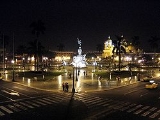
Trujillo, Peru

Encyclopedia
Trujillo, in northwestern Peru
, is the capital of the La Libertad Region
, and the third largest city
in Peru
. The urban area has 811,979 inhabitants and is an economic hub in northern Peru
. The city is located on the banks of the Moche
River, near its mouth at the Pacific Ocean
, in a valley of great cultural hegemony.
While it may be conceived as a single city, Trujillo is not a single administrative unit; rather, it is the core or center of a major metropolitan area that covers an area of 110,000 ha, and consists of 9 municipalities in the province, of which 5 are completely metropolitan area, while the remaining 4 are partially. The metropolitan area has a population of more than 804,000 inhabitants, the third most populous of Peru.
Trujillo was honored with the title "Meritorious City and Faithful to the Fatherland", for its role in the fight for independence. Trujillo is the birthplace of Peru's judiciary
, and it was twice designated as the capital of the country. It was the scene of the Revolution of Trujillo in 1932.
Trujillo is known as the "City of Eternal Spring", "National Marinera Capital" and "Culture Capital of Peru". It has sponsored numerous national and international cultural events, and has a lively arts community. Current festivals include the "National Marinera Contest", the "International Festival of Spring" and the "International Book Fair", which is one of the most important cultural events in the country.
Trujillo is close to two major archaeological sites of pre-Columbian monuments: Chan Chan
, the largest adobe city in the ancient world, designated a World Heritage Site
by UNESCO
in 1986; and the temples of the Sun (the largest adobe pyramid in Peru) and Moon.
The city centre contains many examples of colonial and religious architecture incorporating distinctive wrought ironwork. It includes residential areas, a central business district and industrial supply distribution to the various districts. The Roman Catholic Archdiocese of Trujillo has its seat here. Catholicism still dominates and 10 colonial churches remain inside Avenida Espana, with those of Huaman, Huanchaco and Moche within 15 kilometres of Trujillo's centre.
. The Spanish conquistador
Diego de Almagro
with founded the first settlement on December 6, 1534 and calling it Nova Castile Trujillo, after the home city of Francisco Pizarro
. It was founded among four Chimù settlements: Huanchaco, Huamán, Moche & Mampuesto, to create an alliance against the Incas.
Trujillo was established within the Viceroyalty of Peru by Pizarro on March 5, 1535., which is often given as an alternative founding date. On 23 November 1537, King Charles I
of Spain
gave the town the rank of 'city
' and the coat of arms
that remains a symbol for the city. By 1544 Trujillo had around 300 homes and 1000 inhabitants, and an economy booming from the cultivation of sugar cane, wheat, and other food crops and the raising of livestock.
Trujillo welcomed a diverse array of religious orders from its foundation, resulting in a boom in church construction in the city during the sixteenth and seventeenth centuries. In 1577 Pope Gregory XIII created the Diocese of Trujillo and in 1616 construction work commenced on the cathedral.
On 14 February 1619, Trujillo was struck by an earthquake, resulting in the near-total destruction of the city and the deaths of around 400 of its inhabitants. There followed a slow process of rebuilding and a devotion to St Valentine, on whose day the destruction had occurred. The Jesuits opened a seminary
and school for education and the training of priests; they also served as missionaries to the indigenous peoples.
Due to the threat of pirate and privateer raids to a city only 4km from the sea, a city wall was constructed between 1687 and 1689. The wall was elliptical in design to save on construction costs and comprised 15 bastions, 15 shades and 5 covers. It had a perimeter of 5.5 km and involved the use of more than 100,000 bricks. However the wall lacked the height, ditches or embankments to provide an effective defence during the two centuries it stood.
In the latter half of the seventeenth century, severe droughts and pestilence caused a major economic crisis for the city, whose economic mainstay was providing food for the region. Trujillo regained prominence in the eighteenth century, in part due to the destruction of the city of Sana by flooding in 1720. Trujillo also suffered from flooding in 1701, 1728, 1720 and 1814, and further earthquakes in 1725 and 1759.
By 1760 an estimated 9200 people were living in the vicinity of the city. The foundation of the Municipality of Trujillo in 1779 coincided with the heyday of the city, although urban development remained incomplete, with numerous undeveloped lots within the city walls. Nevertheless, Trujillo was regarded as one of the most important cities in Northern Peru during the colonial era, and a rival to Lima.
Between 1821 and 1825 the Trujillo region was the only stable and productive land within the nascent republic. In 1823 Trujillo took on the role of the first capital city of the Republic of Peru. It was from Trujillo on July 19th 1823 that the Peruvian Congress reiterated the invitation to Simon Bolivar to join the war of independence.
In 1824 the city received the liberating army of Simon Bolivar, and became the seat of government once again, making it the only city to have twice been made capital of Peru.
The years following the revolution saw the a growth in the economic influence of the city, compensating for a loss of political power to Lima, which instead suffered from the resulting political turmoil. The Moche and Chicama valleys emerged as new economic enclaves for the sugar industry, with land increasingly concentrated in large estates created the new "agricultural aristocracy" linked to national political power. A policy of free trade and openness to foreign investment lead to an influx of Europeans, principally from England and Germany. By then, Trujillo housed 15,000 people and began to grow beyond the city walls. New architectural styles were adopted, influenced by French and English Romanticism.
During the war with Chile between 1879 and 1883, Trujillo contributed troops towards national defence. Trujillo, although not the scene of the battle, suffered from occupation by Chilean troops and their plundering of the surrounding countryside.
The month of July 1932 saw Trujillo once again at the centre of one of the most important episodes in the history of the Republic of Peru " Trujillo's 1932 revolution", which cost the lives of many citizens. Although this year came to be known as the "Year of barbarism", it would also mark the political identity of the city during the second half of the twentieth century.
The latter half of the twentieth century saw the expansion of the city due to a combination of rural-urban migration and the consolidation of surrounding districts into the Trujillo metropolitan area.
with an average temperature of 21°C (70°F). The summers can reach temperatures over 32°C (90°F) and the winters are never colder than 14°C (57°F). Most of the year, the temperature stays in the low to mid twenties.
This city is known as La Ciudad de la Eterna Primavera (The City of Eternal Spring), because of its sunny and pleasant weather year-round. The International Spring Festival in early October attracts visitors from all over Peru and the world.
, with high production and profits from the sugarcane
industry. Today, asparagus
, rice
and shoe
s are the area's main products.
The irrigated lands of the Moche River Valley produce sugarcane, rice, and asparagus. Industries in the city include the sugar refineries, knitting mills, breweries and the shoe industry. Among the internationally known products of Trujillo, asparagus is exported to neighboring countries, Europe
and the United States
. The areas around Trujillo are among the largest exporters of white asparagus in the world. Peru
is the world’s leading exporter of asparagus, followed by China
and Mexico
– http://www.fas.usda.gov/htp/Hort_Circular/2005/08-05/Asparagus%20article.pdf.
Trujillo is the most important economic center of northern Peru; it is an inland commercial
and transport center for the surrounding farming areas. Its numerous shopping malls, supermarkets, department stores, and similar amenities make Trujillo a modern city.
, with a population of over 800,000 in the metropolitan area as of 2007. The city has 49.69% of the population of La Libertad Region and 2.9% of the total of Peru.
and Chimu civilizations evolved. These civilizations had highly skilled artisans, and many of their artifacts having been found during archaeological digs in the city.
Nearby ruins include the Chimu adobe city of Chan Chan
, the world's largest city built from that material. It is sometimes called Ciudad de la Luna (City of the Moon) because the people worshipped the moon; or de las Largas Murallas (of the Long Walls). In size and complexity, it has been compared with Teotihuacan
in Mexico
, and the ancient cities of Egypt
. Other nearby ruins are the Moche ruins of Huaca del Sol
, Huaca de la Luna
, and El Brujo
.
Trujillo aspires to be designated a World Heritage Site
, because of the proximity of both cultures and its historical colonial city centre, whose historic casonas (mansions) attract many visitors. The mansions and manors of Trujillo are distinguished for their solemn and austere facades. Inside, their halls are overflowing with ornaments.
Trujillo's wrought-iron window railings are a unique feature of the mansions. The House of Ganoza-Chopitea (casa Ganoza) has a polychromatic front in the baroque style, crowned by a rococo
frontispiece and two lions. It is the city's most representative example of casonas architecture. Another is the House of Mayorazgo, which was built in the early years of the city and holds one of Peru
's greatest numismatic collections. The revolutionary leader Simón Bolívar
lived in a house on the Plaza de Armas
.
The world-famous beach Huanchaco
, a surfing destination, is located just north of Trujillo.
Trujillo's restaurants offer a wide variety of local food, such as shambar
, mostly served on Mondays; ceviche
, sopa teologa
and cabrito.
. Important to the city's transportation network is the Cap. FAP Carlos Martínez de Pinillos International Airport
.
The port towns of Salaverry
and Chicama (Puerto Malabrigo) are used for maritime connection with the world.
, one of the most important universities in Perú
, which was created on May 10, 1824 by Simon Bolivar
.
Other well-known universities are Universidad Privada Antenor Orrego; Universidad Privada Cesar Vallejo; Universidad Alas Peruanas;Universidad Privada del Norte, which belongs to Laurete International University of Laureate Education Inc. being the second International University in Peru; the archdiocesan seminary; the Universidad Católica de Trujillo; and Universidad Privada de Trujillo.
Trujillo from 1940 to 1955.
at Escuela de Folklore Jose Maria Arguedas in Lima.
Peru
Peru , officially the Republic of Peru , is a country in western South America. It is bordered on the north by Ecuador and Colombia, on the east by Brazil, on the southeast by Bolivia, on the south by Chile, and on the west by the Pacific Ocean....
, is the capital of the La Libertad Region
La Libertad Region
La Libertad is a region in northwestern Peru. Formerly it was known as the 'Department of La Libertad" , a political division that generally corresponds to a state in the United States of America...
, and the third largest city
City
A city is a relatively large and permanent settlement. Although there is no agreement on how a city is distinguished from a town within general English language meanings, many cities have a particular administrative, legal, or historical status based on local law.For example, in the U.S...
in Peru
Peru
Peru , officially the Republic of Peru , is a country in western South America. It is bordered on the north by Ecuador and Colombia, on the east by Brazil, on the southeast by Bolivia, on the south by Chile, and on the west by the Pacific Ocean....
. The urban area has 811,979 inhabitants and is an economic hub in northern Peru
Peru
Peru , officially the Republic of Peru , is a country in western South America. It is bordered on the north by Ecuador and Colombia, on the east by Brazil, on the southeast by Bolivia, on the south by Chile, and on the west by the Pacific Ocean....
. The city is located on the banks of the Moche
Moche
'The Moche civilization flourished in northern Peru from about 100 AD to 800 AD, during the Regional Development Epoch. While this issue is the subject of some debate, many scholars contend that the Moche were not politically organized as a monolithic empire or state...
River, near its mouth at the Pacific Ocean
Pacific Ocean
The Pacific Ocean is the largest of the Earth's oceanic divisions. It extends from the Arctic in the north to the Southern Ocean in the south, bounded by Asia and Australia in the west, and the Americas in the east.At 165.2 million square kilometres in area, this largest division of the World...
, in a valley of great cultural hegemony.
While it may be conceived as a single city, Trujillo is not a single administrative unit; rather, it is the core or center of a major metropolitan area that covers an area of 110,000 ha, and consists of 9 municipalities in the province, of which 5 are completely metropolitan area, while the remaining 4 are partially. The metropolitan area has a population of more than 804,000 inhabitants, the third most populous of Peru.
Trujillo was honored with the title "Meritorious City and Faithful to the Fatherland", for its role in the fight for independence. Trujillo is the birthplace of Peru's judiciary
Judiciary
The judiciary is the system of courts that interprets and applies the law in the name of the state. The judiciary also provides a mechanism for the resolution of disputes...
, and it was twice designated as the capital of the country. It was the scene of the Revolution of Trujillo in 1932.
Trujillo is known as the "City of Eternal Spring", "National Marinera Capital" and "Culture Capital of Peru". It has sponsored numerous national and international cultural events, and has a lively arts community. Current festivals include the "National Marinera Contest", the "International Festival of Spring" and the "International Book Fair", which is one of the most important cultural events in the country.
Trujillo is close to two major archaeological sites of pre-Columbian monuments: Chan Chan
Chan Chan
The largest Pre-Columbian city in South America, Chan Chan is an archaeological site located in the Peruvian region of La Libertad, five km west of Trujillo. Chan Chan covers an area of approximately 20 km² and had a dense urban center of about 6km²...
, the largest adobe city in the ancient world, designated a World Heritage Site
World Heritage Site
A UNESCO World Heritage Site is a place that is listed by the UNESCO as of special cultural or physical significance...
by UNESCO
UNESCO
The United Nations Educational, Scientific and Cultural Organization is a specialized agency of the United Nations...
in 1986; and the temples of the Sun (the largest adobe pyramid in Peru) and Moon.
The city centre contains many examples of colonial and religious architecture incorporating distinctive wrought ironwork. It includes residential areas, a central business district and industrial supply distribution to the various districts. The Roman Catholic Archdiocese of Trujillo has its seat here. Catholicism still dominates and 10 colonial churches remain inside Avenida Espana, with those of Huaman, Huanchaco and Moche within 15 kilometres of Trujillo's centre.
History
Trujillo was one of the first cities in the Americas founded by the conquistadors, although the surrounding area had been inhabited for thousands of years by indigenous peoplesIndigenous peoples
Indigenous peoples are ethnic groups that are defined as indigenous according to one of the various definitions of the term, there is no universally accepted definition but most of which carry connotations of being the "original inhabitants" of a territory....
. The Spanish conquistador
Conquistador
Conquistadors were Spanish soldiers, explorers, and adventurers who brought much of the Americas under the control of Spain in the 15th to 16th centuries, following Europe's discovery of the New World by Christopher Columbus in 1492...
Diego de Almagro
Diego de Almagro
Diego de Almagro, , also known as El Adelantado and El Viejo , was a Spanish conquistador and a companion and later rival of Francisco Pizarro. He participated in the Spanish conquest of Peru and is credited as the first European discoverer of Chile.Almagro lost his left eye battling with coastal...
with founded the first settlement on December 6, 1534 and calling it Nova Castile Trujillo, after the home city of Francisco Pizarro
Francisco Pizarro
Francisco Pizarro González, Marquess was a Spanish conquistador, conqueror of the Incan Empire, and founder of Lima, the modern-day capital of the Republic of Peru.-Early life:...
. It was founded among four Chimù settlements: Huanchaco, Huamán, Moche & Mampuesto, to create an alliance against the Incas.
Trujillo was established within the Viceroyalty of Peru by Pizarro on March 5, 1535., which is often given as an alternative founding date. On 23 November 1537, King Charles I
Charles V, Holy Roman Emperor
Charles V was ruler of the Holy Roman Empire from 1519 and, as Charles I, of the Spanish Empire from 1516 until his voluntary retirement and abdication in favor of his younger brother Ferdinand I and his son Philip II in 1556.As...
of Spain
Spain
Spain , officially the Kingdom of Spain languages]] under the European Charter for Regional or Minority Languages. In each of these, Spain's official name is as follows:;;;;;;), is a country and member state of the European Union located in southwestern Europe on the Iberian Peninsula...
gave the town the rank of 'city
City
A city is a relatively large and permanent settlement. Although there is no agreement on how a city is distinguished from a town within general English language meanings, many cities have a particular administrative, legal, or historical status based on local law.For example, in the U.S...
' and the coat of arms
Coat of arms
A coat of arms is a unique heraldic design on a shield or escutcheon or on a surcoat or tabard used to cover and protect armour and to identify the wearer. Thus the term is often stated as "coat-armour", because it was anciently displayed on the front of a coat of cloth...
that remains a symbol for the city. By 1544 Trujillo had around 300 homes and 1000 inhabitants, and an economy booming from the cultivation of sugar cane, wheat, and other food crops and the raising of livestock.
Trujillo welcomed a diverse array of religious orders from its foundation, resulting in a boom in church construction in the city during the sixteenth and seventeenth centuries. In 1577 Pope Gregory XIII created the Diocese of Trujillo and in 1616 construction work commenced on the cathedral.
On 14 February 1619, Trujillo was struck by an earthquake, resulting in the near-total destruction of the city and the deaths of around 400 of its inhabitants. There followed a slow process of rebuilding and a devotion to St Valentine, on whose day the destruction had occurred. The Jesuits opened a seminary
Seminary
A seminary, theological college, or divinity school is an institution of secondary or post-secondary education for educating students in theology, generally to prepare them for ordination as clergy or for other ministry...
and school for education and the training of priests; they also served as missionaries to the indigenous peoples.
Due to the threat of pirate and privateer raids to a city only 4km from the sea, a city wall was constructed between 1687 and 1689. The wall was elliptical in design to save on construction costs and comprised 15 bastions, 15 shades and 5 covers. It had a perimeter of 5.5 km and involved the use of more than 100,000 bricks. However the wall lacked the height, ditches or embankments to provide an effective defence during the two centuries it stood.
In the latter half of the seventeenth century, severe droughts and pestilence caused a major economic crisis for the city, whose economic mainstay was providing food for the region. Trujillo regained prominence in the eighteenth century, in part due to the destruction of the city of Sana by flooding in 1720. Trujillo also suffered from flooding in 1701, 1728, 1720 and 1814, and further earthquakes in 1725 and 1759.
By 1760 an estimated 9200 people were living in the vicinity of the city. The foundation of the Municipality of Trujillo in 1779 coincided with the heyday of the city, although urban development remained incomplete, with numerous undeveloped lots within the city walls. Nevertheless, Trujillo was regarded as one of the most important cities in Northern Peru during the colonial era, and a rival to Lima.
Independence
Influenced by the liberal ideas of its educational institutions, Trujillo became a principle centre of Peruvian republican sentiments. Led by city major José Bernardo de Tagle, the city of Trujillo declared its independence from Spain on December 29 1820, making it arguably the first city in the country to declare independence.Between 1821 and 1825 the Trujillo region was the only stable and productive land within the nascent republic. In 1823 Trujillo took on the role of the first capital city of the Republic of Peru. It was from Trujillo on July 19th 1823 that the Peruvian Congress reiterated the invitation to Simon Bolivar to join the war of independence.
In 1824 the city received the liberating army of Simon Bolivar, and became the seat of government once again, making it the only city to have twice been made capital of Peru.
The years following the revolution saw the a growth in the economic influence of the city, compensating for a loss of political power to Lima, which instead suffered from the resulting political turmoil. The Moche and Chicama valleys emerged as new economic enclaves for the sugar industry, with land increasingly concentrated in large estates created the new "agricultural aristocracy" linked to national political power. A policy of free trade and openness to foreign investment lead to an influx of Europeans, principally from England and Germany. By then, Trujillo housed 15,000 people and began to grow beyond the city walls. New architectural styles were adopted, influenced by French and English Romanticism.
During the war with Chile between 1879 and 1883, Trujillo contributed troops towards national defence. Trujillo, although not the scene of the battle, suffered from occupation by Chilean troops and their plundering of the surrounding countryside.
The month of July 1932 saw Trujillo once again at the centre of one of the most important episodes in the history of the Republic of Peru " Trujillo's 1932 revolution", which cost the lives of many citizens. Although this year came to be known as the "Year of barbarism", it would also mark the political identity of the city during the second half of the twentieth century.
The latter half of the twentieth century saw the expansion of the city due to a combination of rural-urban migration and the consolidation of surrounding districts into the Trujillo metropolitan area.
Climate
Trujillo has an extremely dry desert climateDesert climate
A desert climate , also known as an arid climate, is a climate that does not meet the criteria to be classified as a polar climate, and in which precipitation is too low to sustain any vegetation at all, or at most a very scanty scrub.An area that features this climate usually experiences less than...
with an average temperature of 21°C (70°F). The summers can reach temperatures over 32°C (90°F) and the winters are never colder than 14°C (57°F). Most of the year, the temperature stays in the low to mid twenties.
This city is known as La Ciudad de la Eterna Primavera (The City of Eternal Spring), because of its sunny and pleasant weather year-round. The International Spring Festival in early October attracts visitors from all over Peru and the world.
Economy
In the 19th century, the city of Trujillo greatly expanded due to extensive irrigated agricultureAgriculture
Agriculture is the cultivation of animals, plants, fungi and other life forms for food, fiber, and other products used to sustain life. Agriculture was the key implement in the rise of sedentary human civilization, whereby farming of domesticated species created food surpluses that nurtured the...
, with high production and profits from the sugarcane
Sugarcane
Sugarcane refers to any of six to 37 species of tall perennial grasses of the genus Saccharum . Native to the warm temperate to tropical regions of South Asia, they have stout, jointed, fibrous stalks that are rich in sugar, and measure two to six metres tall...
industry. Today, asparagus
Asparagus
Asparagus officinalis is a spring vegetable, a flowering perennialplant species in the genus Asparagus. It was once classified in the lily family, like its Allium cousins, onions and garlic, but the Liliaceae have been split and the onion-like plants are now in the family Amaryllidaceae and...
, rice
Rice
Rice is the seed of the monocot plants Oryza sativa or Oryza glaberrima . As a cereal grain, it is the most important staple food for a large part of the world's human population, especially in East Asia, Southeast Asia, South Asia, the Middle East, and the West Indies...
and shoe
Shoe
A shoe is an item of footwear intended to protect and comfort the human foot while doing various activities. Shoes are also used as an item of decoration. The design of shoes has varied enormously through time and from culture to culture, with appearance originally being tied to function...
s are the area's main products.
The irrigated lands of the Moche River Valley produce sugarcane, rice, and asparagus. Industries in the city include the sugar refineries, knitting mills, breweries and the shoe industry. Among the internationally known products of Trujillo, asparagus is exported to neighboring countries, Europe
Europe
Europe is, by convention, one of the world's seven continents. Comprising the westernmost peninsula of Eurasia, Europe is generally 'divided' from Asia to its east by the watershed divides of the Ural and Caucasus Mountains, the Ural River, the Caspian and Black Seas, and the waterways connecting...
and the United States
United States
The United States of America is a federal constitutional republic comprising fifty states and a federal district...
. The areas around Trujillo are among the largest exporters of white asparagus in the world. Peru
Peru
Peru , officially the Republic of Peru , is a country in western South America. It is bordered on the north by Ecuador and Colombia, on the east by Brazil, on the southeast by Bolivia, on the south by Chile, and on the west by the Pacific Ocean....
is the world’s leading exporter of asparagus, followed by China
China
Chinese civilization may refer to:* China for more general discussion of the country.* Chinese culture* Greater China, the transnational community of ethnic Chinese.* History of China* Sinosphere, the area historically affected by Chinese culture...
and Mexico
Mexico
The United Mexican States , commonly known as Mexico , is a federal constitutional republic in North America. It is bordered on the north by the United States; on the south and west by the Pacific Ocean; on the southeast by Guatemala, Belize, and the Caribbean Sea; and on the east by the Gulf of...
– http://www.fas.usda.gov/htp/Hort_Circular/2005/08-05/Asparagus%20article.pdf.
Trujillo is the most important economic center of northern Peru; it is an inland commercial
Commerce
While business refers to the value-creating activities of an organization for profit, commerce means the whole system of an economy that constitutes an environment for business. The system includes legal, economic, political, social, cultural, and technological systems that are in operation in any...
and transport center for the surrounding farming areas. Its numerous shopping malls, supermarkets, department stores, and similar amenities make Trujillo a modern city.
Demographics
Trujillo is the third most populous city in PeruPeru
Peru , officially the Republic of Peru , is a country in western South America. It is bordered on the north by Ecuador and Colombia, on the east by Brazil, on the southeast by Bolivia, on the south by Chile, and on the west by the Pacific Ocean....
, with a population of over 800,000 in the metropolitan area as of 2007. The city has 49.69% of the population of La Libertad Region and 2.9% of the total of Peru.
Tourism
Tourism is a major industry in Trujillo due to the city's proximity to important sites where the MocheMoche
'The Moche civilization flourished in northern Peru from about 100 AD to 800 AD, during the Regional Development Epoch. While this issue is the subject of some debate, many scholars contend that the Moche were not politically organized as a monolithic empire or state...
and Chimu civilizations evolved. These civilizations had highly skilled artisans, and many of their artifacts having been found during archaeological digs in the city.
Nearby ruins include the Chimu adobe city of Chan Chan
Chan Chan
The largest Pre-Columbian city in South America, Chan Chan is an archaeological site located in the Peruvian region of La Libertad, five km west of Trujillo. Chan Chan covers an area of approximately 20 km² and had a dense urban center of about 6km²...
, the world's largest city built from that material. It is sometimes called Ciudad de la Luna (City of the Moon) because the people worshipped the moon; or de las Largas Murallas (of the Long Walls). In size and complexity, it has been compared with Teotihuacan
Teotihuacan
Teotihuacan – also written Teotihuacán, with a Spanish orthographic accent on the last syllable – is an enormous archaeological site in the Basin of Mexico, just 30 miles northeast of Mexico City, containing some of the largest pyramidal structures built in the pre-Columbian Americas...
in Mexico
Mexico
The United Mexican States , commonly known as Mexico , is a federal constitutional republic in North America. It is bordered on the north by the United States; on the south and west by the Pacific Ocean; on the southeast by Guatemala, Belize, and the Caribbean Sea; and on the east by the Gulf of...
, and the ancient cities of Egypt
Egypt
Egypt , officially the Arab Republic of Egypt, Arabic: , is a country mainly in North Africa, with the Sinai Peninsula forming a land bridge in Southwest Asia. Egypt is thus a transcontinental country, and a major power in Africa, the Mediterranean Basin, the Middle East and the Muslim world...
. Other nearby ruins are the Moche ruins of Huaca del Sol
Huaca del Sol
The Huaca del Sol is an adobe brick temple built by the Moche civilization on the coast of what is now Peru. The temple is one of several ruins found near the peak of Cerro Blanco, in the coastal desert near Trujillo, Peru...
, Huaca de la Luna
Huaca de la Luna
Huaca de la Luna is a large adobe brick structure built mainly by the Moche people of northern Peru. Along with the Huaca del Sol, the Huaca de la Luna is part of Huacas de Moche, which is the remains of an ancient Moche capital city called Cerro Blanco.-Background:The Huacas de Moche site is...
, and El Brujo
El Brujo
The El Brujo Archaeological Complex, just north of Trujillo, La Libertad Province, Peru, is an ancient monument of the Moche culture. It includes Huaca Prieta and the nearby colonial remains of Salinar, Moche, Lambayeque, Chimú.Huaca El Brujo and Huaca Cao Viejo were built by the...
.
Trujillo aspires to be designated a World Heritage Site
World Heritage Site
A UNESCO World Heritage Site is a place that is listed by the UNESCO as of special cultural or physical significance...
, because of the proximity of both cultures and its historical colonial city centre, whose historic casonas (mansions) attract many visitors. The mansions and manors of Trujillo are distinguished for their solemn and austere facades. Inside, their halls are overflowing with ornaments.
Trujillo's wrought-iron window railings are a unique feature of the mansions. The House of Ganoza-Chopitea (casa Ganoza) has a polychromatic front in the baroque style, crowned by a rococo
Rococo
Rococo , also referred to as "Late Baroque", is an 18th-century style which developed as Baroque artists gave up their symmetry and became increasingly ornate, florid, and playful...
frontispiece and two lions. It is the city's most representative example of casonas architecture. Another is the House of Mayorazgo, which was built in the early years of the city and holds one of Peru
Peru
Peru , officially the Republic of Peru , is a country in western South America. It is bordered on the north by Ecuador and Colombia, on the east by Brazil, on the southeast by Bolivia, on the south by Chile, and on the west by the Pacific Ocean....
's greatest numismatic collections. The revolutionary leader Simón Bolívar
Simón Bolívar
Simón José Antonio de la Santísima Trinidad Bolívar y Palacios Ponte y Yeiter, commonly known as Simón Bolívar was a Venezuelan military and political leader...
lived in a house on the Plaza de Armas
Plaza de Armas
The Plaza de Armas is the name for the main square in many Latin American cities. In Mexico this space is known as El Zócalo, and in Central America as Parque Central...
.
The world-famous beach Huanchaco
Huanchaco
Huanchaco beach is a summer vacation spot located in the northern city of Trujillo, Peru. Huanchaco is famous for a few things but particularly for being a surfer's dream spot and its caballitos de totora. The most famous food here is the ceviche. Huanchaco is nearby the very famous ruins of Chan...
, a surfing destination, is located just north of Trujillo.
Trujillo's restaurants offer a wide variety of local food, such as shambar
Shambar
Shambar is a soup that blends many ingredients, tastes, and seasonings from Spanish, Criollo and Andean cultures, considered the most traditional meal in Trujillo's gastronomy in Perú . It is made of wheat grains, fava beans, green peas, chickpeas and dry beans. It must have three kinds of meat,...
, mostly served on Mondays; ceviche
Ceviche
Ceviche is a seafood dish popular in the coastal regions of the Americas, especially Central and South America. The dish is typically made from fresh raw fish marinated in citrus juices such as lemon or lime and spiced with chilli peppers. Additional seasonings such as onion, salt,...
, sopa teologa
Sopa teologa
Sopa Teologa is a traditional soup in Trujillo, believed to have been devised during the 17th century by Dominican monks. Because it includes bread in the ingredients, and because it has an attributed religious origin, it is called theologic. It is made of white bread, potato, tomato, sliced...
and cabrito.
Transportation
The city is connected to all the main coastal cities by the Pan-American HighwayPan-American Highway
The Pan-American Highway is a network of roads measuring about in total length. Except for an rainforest break, called the Darién Gap, the road links the mainland nations of the Americas in a connected highway system. According to Guinness World Records, the Pan-American Highway is the world's...
. Important to the city's transportation network is the Cap. FAP Carlos Martínez de Pinillos International Airport
Cap. FAP Carlos Martínez de Pinillos International Airport
Capitán FAP Carlos Martínez de Pinillos International Airport , known as Aeropuerto Internacional Capitán FAP Carlos Martínez de Pinillos in Spanish, is an airport serving Peru's third largest city, Trujillo. It is the main air hub in northern Peru and its runways are fully paved.- Airlines and...
.
The port towns of Salaverry
Salaverry
Salaverry is a port town in the La Libertad Region, Peru. It is located at around . The port, rebuilt in the 1960s by an English company is able to accommodate large ships including tourist ships as those of the Carnival Company....
and Chicama (Puerto Malabrigo) are used for maritime connection with the world.
Education
Trujillo is home to many higher education institutions, including the majority of the universities and vocational institutes in northern Peru. The most recognized universities are the National University of TrujilloNational University of Trujillo
The National University of Trujillo , or UNT for short, is a major public university located in Trujillo, Peru; capital of the department of La Libertad. The university was created on May 10, 1824, less than three years after Peru's independence from Spain...
, one of the most important universities in Perú
Peru
Peru , officially the Republic of Peru , is a country in western South America. It is bordered on the north by Ecuador and Colombia, on the east by Brazil, on the southeast by Bolivia, on the south by Chile, and on the west by the Pacific Ocean....
, which was created on May 10, 1824 by Simon Bolivar
Simón Bolívar
Simón José Antonio de la Santísima Trinidad Bolívar y Palacios Ponte y Yeiter, commonly known as Simón Bolívar was a Venezuelan military and political leader...
.
Other well-known universities are Universidad Privada Antenor Orrego; Universidad Privada Cesar Vallejo; Universidad Alas Peruanas;Universidad Privada del Norte, which belongs to Laurete International University of Laureate Education Inc. being the second International University in Peru; the archdiocesan seminary; the Universidad Católica de Trujillo; and Universidad Privada de Trujillo.
Notable natives and residents
- César VallejoCésar VallejoCésar Abraham Vallejo Mendoza was a Peruvian poet. Although he published only three books of poetry during his lifetime, he is considered one of the great poetic innovators of the 20th century in any language. Thomas Merton called him "the greatest universal poet since Dante"...
, poet, lived in Trujillo from 1910 to 1917. - Antenor OrregoAntenor OrregoAntenor Orrego Espinoza was a Peruvian writer and political philosopher of Basque ancestry. He was a member of the American Popular Revolutionary Alliance...
, First peruvian political philosopher, lived in Trujillo from 1910 to 1940. - Víctor Raúl Haya de la TorreVíctor Raúl Haya de la TorreVíctor Raúl Haya de la Torre was a Peruvian political leader who founded the American Popular Revolutionary Alliance political movement.-Life:Haya de la Torre was born in the northern Peruvian city of Trujillo...
, political leader who founded the American Popular Revolutionary Alliance (APRA).1924. - Teofilo Tinoco Caballero, lawyer and professor, born in Trujillo, lived from 1917 to 1994.
- Luis Banchero Rossi, chemical-industrial engineer(UNT,1950), He was the most important peruvian businessman in s.XX. He lived in
Trujillo from 1940 to 1955.
- Milly Ahon, marinera dancer, she created original style in marinera dance. She was first marinera's queen in 1960. Now she is mayor
at Escuela de Folklore Jose Maria Arguedas in Lima.
- Maria Julia MantillaMaría Julia MantillaMaría Julia “Maju” Mantilla García is a Peruvian beauty queen who became the second woman from Peru to be crowned Miss World.-Early life:...
, Miss World 2004Miss World 2004Miss World 2004, the 54th Miss World pageant was held at the Crown of Beauty Theatre, Sanya, People's Republic of China on December 6, 2004. The 2004 pageant marks the second straight year that Sanya played host of the pageant. Miss World 2003, Rosanna Davison of Ireland crowned her successor María... - Henry Ian CusickHenry Ian CusickHenry Ian Cusick is a Scottish-Peruvian actor of stage, television, and film. He is well-known for his role as Desmond Hume on the United States television series Lost, for which he received a Primetime Emmy Award nomination....
, Emmy-nominated actor. - Teodoro Rivero Ayllón, writer and professor.
- {(Julio Cruzado Zavala}), Senador, Politico, Secretario General de CTP
Sister Cities
- LimaLimaLima is the capital and the largest city of Peru. It is located in the valleys of the Chillón, Rímac and Lurín rivers, in the central part of the country, on a desert coast overlooking the Pacific Ocean. Together with the seaport of Callao, it forms a contiguous urban area known as the Lima...
, PeruPeruPeru , officially the Republic of Peru , is a country in western South America. It is bordered on the north by Ecuador and Colombia, on the east by Brazil, on the southeast by Bolivia, on the south by Chile, and on the west by the Pacific Ocean.... - AstanaAstanaAstana , formerly known as Akmola , Tselinograd and Akmolinsk , is the capital and second largest city of Kazakhstan, with an officially estimated population of 708,794 as of 1 August 2010...
, - Trujillo, .
- BarcelonaBarcelonaBarcelona is the second largest city in Spain after Madrid, and the capital of Catalonia, with a population of 1,621,537 within its administrative limits on a land area of...
, - Dallas,
- Salt Lake City,
- MetepecMetepecMetepec is a city and municipality in the State of Mexico in Mexico and is located directly to the east of the state capital, Toluca, at an altitude of 2,635 metres above sea level. The centre of Mexico City lies some 50 km further to the east. The name Metepec comes from Náhuatl meaning hill of...
, - MonterreyMonterreyMonterrey , is the capital city of the northeastern state of Nuevo León in the country of Mexico. The city is anchor to the third-largest metropolitan area in Mexico and is ranked as the ninth-largest city in the nation. Monterrey serves as a commercial center in the north of the country and is the...
, - ManaguaManaguaManagua is the capital city of Nicaragua as well as the department and municipality by the same name. It is the largest city in Nicaragua in terms of population and geographic size. Located on the southwestern shore of Lake Xolotlán or Lake Managua, the city was declared the national capital in...
, - AsunciónAsunciónAsunción is the capital and largest city of Paraguay.The "Ciudad de Asunción" is an autonomous capital district not part of any department. The metropolitan area, called Gran Asunción, includes the cities of San Lorenzo, Fernando de la Mora, Lambaré, Luque, Mariano Roque Alonso, Ñemby, San...
, - TimisoaraTimisoaraTimișoara is the capital city of Timiș County, in western Romania. One of the largest Romanian cities, with an estimated population of 311,586 inhabitants , and considered the informal capital city of the historical region of Banat, Timișoara is the main social, economic and cultural center in the...
, - TrujilloTrujillo, TrujilloTrujillo is the capital city of Trujillo State in Venezuela. About 40,000 people live in this city.Founded by one the "Conquistadores de America", Diego García de Paredes, son of Diego Garcia de Paredes , , Spanish soldier and duellist, native of Trujillo in Extremadura, Spain. This city is...
, - Decatur, GeorgiaDecatur, GeorgiaDecatur is a city in, and county seat of, DeKalb County, Georgia, United States. With a population of 19,335 in the 2010 census, the city is sometimes assumed to be larger since multiple zip codes in unincorporated DeKalb County bear the Decatur name...
,
External links
- "Huaca de la luna and Huaca del sol"
- "Huacas del Sol y de la Luna Archaeological Complex", Official Website
- Information on El Brujo Archaeological Complex
- Chan Chan World Heritage Site, UNESCO
- Chan Chan conservation project
- Colonial Trujillo photos
- Website about Trujillo, Reviews, Events, Business Directory