


Tidal acceleration

Encyclopedia
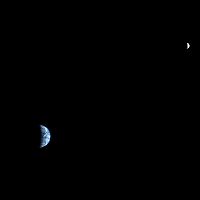
Tidal force
The tidal force is a secondary effect of the force of gravity and is responsible for the tides. It arises because the gravitational force per unit mass exerted on one body by a second body is not constant across its diameter, the side nearest to the second being more attracted by it than the side...
s between an orbiting natural satellite
Natural satellite
A natural satellite or moon is a celestial body that orbits a planet or smaller body, which is called its primary. The two terms are used synonymously for non-artificial satellites of planets, of dwarf planets, and of minor planets....
(e.g. the Moon), and the primary planet
Planet
A planet is a celestial body orbiting a star or stellar remnant that is massive enough to be rounded by its own gravity, is not massive enough to cause thermonuclear fusion, and has cleared its neighbouring region of planetesimals.The term planet is ancient, with ties to history, science,...
that it orbits (e.g. the Earth). The "acceleration" is usually negative, as it causes a gradual slowing and recession of a satellite in a prograde orbit away from the primary, and a corresponding slowdown of the primary's rotation. The process eventually leads to tidal locking
Tidal locking
Tidal locking occurs when the gravitational gradient makes one side of an astronomical body always face another; for example, the same side of the Earth's Moon always faces the Earth. A tidally locked body takes just as long to rotate around its own axis as it does to revolve around its partner...
of first the smaller, and later the larger body. The Earth-Moon system is the best studied case.
The similar process of tidal deceleration occurs for satellites that have an orbital period that is shorter than the primary's rotational period, or that orbit in a retrograde direction.
Discovery history of the secular acceleration
Edmond HalleyEdmond Halley
Edmond Halley FRS was an English astronomer, geophysicist, mathematician, meteorologist, and physicist who is best known for computing the orbit of the eponymous Halley's Comet. He was the second Astronomer Royal in Britain, following in the footsteps of John Flamsteed.-Biography and career:Halley...
was the first to suggest, in 1695, that the mean motion of the Moon was apparently getting faster, by comparison with ancient eclipse observations, but he gave no data. (It was not yet known in Halley's time that what is actually occurring includes a slowing-down of the Earth's rate of rotation: see also Ephemeris time - History. When measured as a function of mean solar time rather than uniform time, the effect appears as a positive acceleration.) In 1749 Richard Dunthorne
Richard Dunthorne
Richard Dunthorne was an English astronomer and surveyor, who worked in Cambridge as astronomical and scientific assistant to Roger Long , and also concurrently for many years as surveyor to the Bedford Level Corporation.-Life and work:There are short biographical notes of Dunthorne, one in...
confirmed Halley's suspicion after re-examining ancient records, and produced the first quantitative estimate for the size of this apparent effect: a centurial rate of +10" (arcseconds) in lunar longitude (a surprisingly good result for its time, not far different from values assessed later, e.g. in 1786 by de Lalande, and to compare with values from about 10" to nearly 13" being derived about century later.)
Pierre-Simon Laplace
Pierre-Simon Laplace
Pierre-Simon, marquis de Laplace was a French mathematician and astronomer whose work was pivotal to the development of mathematical astronomy and statistics. He summarized and extended the work of his predecessors in his five volume Mécanique Céleste...
produced in 1786 a theoretical analysis giving a basis on which the Moon's mean motion should accelerate in response to perturbational
Perturbation (astronomy)
Perturbation is a term used in astronomy in connection with descriptions of the complex motion of a massive body which is subject to appreciable gravitational effects from more than one other massive body....
changes in the eccentricity of the orbit of the Earth around the Sun. Laplace's initial computation accounted for the whole effect, thus seeming to tie up the theory neatly with both modern and ancient observations.
However, in 1854, J C Adams
John Couch Adams
John Couch Adams was a British mathematician and astronomer. Adams was born in Laneast, near Launceston, Cornwall, and died in Cambridge. The Cornish name Couch is pronounced "cooch"....
caused the question to be re-opened by finding an error in Laplace's computations: it turned out that only about half of the Moon's apparent acceleration could be accounted for on Laplace's basis by the change in the Earth's orbital eccentricity. Adams' finding provoked a sharp astronomical controversy that lasted some years, but the correctness of his result, agreed by other mathematical astronomers including C E Delaunay
Charles-Eugène Delaunay
Charles-Eugène Delaunay was a French astronomer and mathematician. His lunar motion studies were important in advancing both the theory of planetary motion and mathematics.-Life:...
, was eventually accepted. The question depended on correct analysis of the lunar motions, and received a further complication with another discovery, around the same time, that another significant long-term perturbation that had been calculated for the Moon (supposedly due to the action of Venus) was also in error, was found on re-examination to be almost negligible, and practically had to disappear from the theory. A part of the answer was suggested independently in the 1860s by Delaunay and by William Ferrel
William Ferrel
William Ferrel , an American meteorologist, developed theories which explained the mid-latitude atmospheric circulation cell in detail, and it is after him that the Ferrel cell is named. He was born in southern Pennsylvania. His family moved to what would become West Virginia in 1829...
: tidal retardation of the Earth's rotation rate was lengthening the unit of time and causing a lunar acceleration that was only apparent.
It took some time for the astronomical community to accept the reality and the scale of tidal effects. But eventually it became clear that three effects are involved, when measured in terms of mean solar time. Beside the effects of perturbational changes in the Earth's orbital eccentricity, as found by Laplace and corrected by Adams, there are two tidal effects (a combination first suggested by Emmanuel Liais
Emmanuel Liais
Emmanuel Liais was a French astronomer, botanist and explorer who spent many years in Brazil.He was born in Cherbourg, the son of a wealthy family in the shipbuilding industry....
). First there is a real retardation of the Moon's angular rate of orbital motion, due to tidal exchange of angular momentum between the Earth and Moon. This increases the Moon's angular momentum around the Earth (and moves the Moon to a higher orbit with a slower period). Secondly there is an apparent increase in the Moon's angular rate of orbital motion (when measured in terms of mean solar time). This arises from the Earth's loss of angular momentum and the consequent increase in length of day.
Effects of Moon's gravity
Because the MoonMoon
The Moon is Earth's only known natural satellite,There are a number of near-Earth asteroids including 3753 Cruithne that are co-orbital with Earth: their orbits bring them close to Earth for periods of time but then alter in the long term . These are quasi-satellites and not true moons. For more...
's mass is a considerable fraction of that of the Earth (about 1:81), the two bodies can be regarded as a double planet
Double planet
In astronomy, double planet and binary planet are informal terms used to describe a binary system of two astronomical objects that each satisfy the definition of planet and that are near enough to each other to have a significant gravitational effect on each other compared with the effect of the...
system, rather than as a planet with a satellite. The plane of the Moon's orbit
Orbit
In physics, an orbit is the gravitationally curved path of an object around a point in space, for example the orbit of a planet around the center of a star system, such as the Solar System...
around the Earth lies close to the plane of the Earth's orbit around the Sun
Sun
The Sun is the star at the center of the Solar System. It is almost perfectly spherical and consists of hot plasma interwoven with magnetic fields...
(the ecliptic
Ecliptic
The ecliptic is the plane of the earth's orbit around the sun. In more accurate terms, it is the intersection of the celestial sphere with the ecliptic plane, which is the geometric plane containing the mean orbit of the Earth around the Sun...
), rather than in the plane perpendicular to the axis of rotation of the Earth (the equator
Equator
An equator is the intersection of a sphere's surface with the plane perpendicular to the sphere's axis of rotation and containing the sphere's center of mass....
) as is usually the case with planetary satellites. The mass of the Moon is sufficiently large, and it is sufficiently close, to raise tide
Tide
Tides are the rise and fall of sea levels caused by the combined effects of the gravitational forces exerted by the moon and the sun and the rotation of the Earth....
s in the matter of the Earth. In particular, the water
Water
Water is a chemical substance with the chemical formula H2O. A water molecule contains one oxygen and two hydrogen atoms connected by covalent bonds. Water is a liquid at ambient conditions, but it often co-exists on Earth with its solid state, ice, and gaseous state . Water also exists in a...
of the ocean
Ocean
An ocean is a major body of saline water, and a principal component of the hydrosphere. Approximately 71% of the Earth's surface is covered by ocean, a continuous body of water that is customarily divided into several principal oceans and smaller seas.More than half of this area is over 3,000...
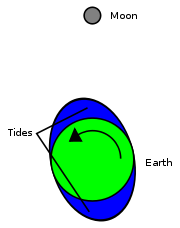
s bulges out along both ends of an axis passing through the centers of the Earth and Moon. The average tidal bulge closely follows the Moon in its orbit, and the Earth rotates under this tidal bulge in just over a day
Day
A day is a unit of time, commonly defined as an interval equal to 24 hours. It also can mean that portion of the full day during which a location is illuminated by the light of the sun...
. However, the rotation drags the position of the tidal bulge ahead of the position directly under the Moon. As a consequence, there exists a substantial amount of mass in the bulge that is offset from the line through the centers of the Earth and Moon. Because of this offset, a portion of the gravitational pull between Earth's tidal bulges and the Moon is perpendicular to the Earth-Moon line, i.e. there exists a torque
Torque
Torque, moment or moment of force , is the tendency of a force to rotate an object about an axis, fulcrum, or pivot. Just as a force is a push or a pull, a torque can be thought of as a twist....
between the Earth and the Moon. This boosts the Moon in its orbit, and decelerates the rotation of the Earth.
So the result is that the mean solar day
Day
A day is a unit of time, commonly defined as an interval equal to 24 hours. It also can mean that portion of the full day during which a location is illuminated by the light of the sun...
, which is nominally 86400 seconds long, is actually getting longer when measured in SI
Si
Si, si, or SI may refer to :- Measurement, mathematics and science :* International System of Units , the modern international standard version of the metric system...
second
Second
The second is a unit of measurement of time, and is the International System of Units base unit of time. It may be measured using a clock....
s with stable atomic clock
Atomic clock
An atomic clock is a clock that uses an electronic transition frequency in the microwave, optical, or ultraviolet region of the electromagnetic spectrum of atoms as a frequency standard for its timekeeping element...
s. (The SI second, when adopted, was already a little shorter than the current value of the second of mean solar time.) The small difference accumulates every day, which leads to an increasing difference between our clock time (Universal Time
Universal Time
Universal Time is a time scale based on the rotation of the Earth. It is a modern continuation of Greenwich Mean Time , i.e., the mean solar time on the Prime Meridian at Greenwich, and GMT is sometimes used loosely as a synonym for UTC...
) on the one hand, and Atomic Time and Ephemeris Time
Ephemeris time
The term ephemeris time can in principle refer to time in connection with any astronomical ephemeris. In practice it has been used more specifically to refer to:...
on the other hand: see ΔT. This makes it necessary to insert a leap second
Leap second
A leap second is a positive or negative one-second adjustment to the Coordinated Universal Time time scale that keeps it close to mean solar time. UTC, which is used as the basis for official time-of-day radio broadcasts for civil time, is maintained using extremely precise atomic clocks...
at irregular intervals.
In addition to the effect of the ocean tides, there is also a tidal acceleration due to flexing of the earth's crust, but this accounts for only about 4% of the total effect when expressed in terms of heat dissipation.
If other effects were ignored, tidal acceleration would continue until the rotational period of the Earth matched the orbital period of the Moon. At that time, the Moon would always be overhead of a single fixed place on Earth. Such a situation already exists in the Pluto
Pluto
Pluto, formal designation 134340 Pluto, is the second-most-massive known dwarf planet in the Solar System and the tenth-most-massive body observed directly orbiting the Sun...
-Charon
Charon (moon)
Charon is the largest satellite of the dwarf planet Pluto. It was discovered in 1978 at the United States Naval Observatory Flagstaff Station. Following the 2005 discovery of two other natural satellites of Pluto , Charon may also be referred to as Pluto I...
system. However, the slowdown of the Earth's rotation is not occurring fast enough for the rotation to lengthen to a month before other effects make this irrelevant: About 2.1 billion years from now, the continual increase of the Sun's radiation
Radiation
In physics, radiation is a process in which energetic particles or energetic waves travel through a medium or space. There are two distinct types of radiation; ionizing and non-ionizing...
will cause the Earth's oceans to vaporize, removing the bulk of the tidal friction and acceleration. Even without this, the slowdown to a month-long day would still not have been completed by 4.5 billion years from now when the Sun will evolve into a red giant
Red giant
A red giant is a luminous giant star of low or intermediate mass in a late phase of stellar evolution. The outer atmosphere is inflated and tenuous, making the radius immense and the surface temperature low, somewhere from 5,000 K and lower...
and possibly destroy both the Earth and Moon. (Tidal acceleration and solar mass loss is also moving the Earth outward from the Sun, but it is unknown whether it will be enough to save it from destruction.)
Tidal acceleration is one of the few examples in the dynamics of the Solar System
Solar System
The Solar System consists of the Sun and the astronomical objects gravitationally bound in orbit around it, all of which formed from the collapse of a giant molecular cloud approximately 4.6 billion years ago. The vast majority of the system's mass is in the Sun...
of a so-called secular perturbation of an orbit, i.e. a perturbation that continuously increases with time and is not periodic. Up to a high order of approximation, mutual gravitational perturbations between major or minor planet
Planet
A planet is a celestial body orbiting a star or stellar remnant that is massive enough to be rounded by its own gravity, is not massive enough to cause thermonuclear fusion, and has cleared its neighbouring region of planetesimals.The term planet is ancient, with ties to history, science,...
s only cause periodic variations in their orbit
Orbit
In physics, an orbit is the gravitationally curved path of an object around a point in space, for example the orbit of a planet around the center of a star system, such as the Solar System...
s, that is, parameters oscillate between maximum and minimum values. The tidal effect gives rise to a quadratic term in the equations, which leads to unbounded growth. In the mathematical theories of the planetary orbits that form the basis of ephemerides, quadratic and higher order secular terms do occur, but these are mostly Taylor expansions
Taylor series
In mathematics, a Taylor series is a representation of a function as an infinite sum of terms that are calculated from the values of the function's derivatives at a single point....
of very long time periodic terms. The reason that tidal effects are different is that unlike distant gravitational perturbations, friction is an essential part of tidal acceleration, and leads to permanent loss of energy
Energy
In physics, energy is an indirectly observed quantity. It is often understood as the ability a physical system has to do work on other physical systems...
from the dynamical system in the form of heat
Heat
In physics and thermodynamics, heat is energy transferred from one body, region, or thermodynamic system to another due to thermal contact or thermal radiation when the systems are at different temperatures. It is often described as one of the fundamental processes of energy transfer between...
. In other words, we do not have a Hamiltonian system
Hamiltonian system
In physics and classical mechanics, a Hamiltonian system is a physical system in which forces are momentum invariant. Hamiltonian systems are studied in Hamiltonian mechanics....
here.
Angular momentum and energy
The gravitational torque between the Moon and the tidal bulge of the Earth causes the Moon to be promoted in its orbit, and the Earth to be decelerated in its rotation. As in any physical process within an isolated system, total energyEnergy
In physics, energy is an indirectly observed quantity. It is often understood as the ability a physical system has to do work on other physical systems...
and angular momentum
Angular momentum
In physics, angular momentum, moment of momentum, or rotational momentum is a conserved vector quantity that can be used to describe the overall state of a physical system...
are conserved. Effectively, energy and angular momentum are transferred from the rotation of the Earth to the orbital motion of the Moon (however, most of the energy lost by the Earth is converted to heat, and only about one 30th is transferred to the Moon). The Moon moves farther away from the Earth, so its potential energy
Potential energy
In physics, potential energy is the energy stored in a body or in a system due to its position in a force field or due to its configuration. The SI unit of measure for energy and work is the Joule...
(in the Earth's gravity well
Gravity well
A gravity well or gravitational well is a conceptual model of the gravitational field surrounding a body in space. The more massive the body the deeper and more extensive the gravity well associated with it. The Sun has a far-reaching and deep gravity well. Asteroids and small moons have much...
) increases. It stays in orbit, and from Kepler's 3rd law it follows that its velocity
Velocity
In physics, velocity is speed in a given direction. Speed describes only how fast an object is moving, whereas velocity gives both the speed and direction of the object's motion. To have a constant velocity, an object must have a constant speed and motion in a constant direction. Constant ...
actually decreases, so the tidal action on the Moon actually causes a deceleration of its motion across the celestial sphere
Celestial sphere
In astronomy and navigation, the celestial sphere is an imaginary sphere of arbitrarily large radius, concentric with the Earth and rotating upon the same axis. All objects in the sky can be thought of as projected upon the celestial sphere. Projected upward from Earth's equator and poles are the...
. Although its kinetic energy
Kinetic energy
The kinetic energy of an object is the energy which it possesses due to its motion.It is defined as the work needed to accelerate a body of a given mass from rest to its stated velocity. Having gained this energy during its acceleration, the body maintains this kinetic energy unless its speed changes...
decreases, its potential energy increases by a larger amount.
The tidal force has a component in the direction of the Moon's motion, and therefore increases its energy, but the non-tidal part of the Earth's gravity pulls (on average) slightly backwards on the Moon (which on average has a slight outward velocity), so the net result is that the Moon slows down. The Moon's orbital angular momentum
Angular momentum
In physics, angular momentum, moment of momentum, or rotational momentum is a conserved vector quantity that can be used to describe the overall state of a physical system...
increases.
The rotational angular momentum of the Earth decreases and consequently the length of the day increases. The net tide raised on Earth by the Moon is dragged ahead of the Moon by Earth's much faster rotation. Tidal friction is required to drag and maintain the bulge ahead of the Moon, and it dissipates the excess energy of the exchange of rotational and orbital energy between the Earth and Moon as heat. If the friction and heat dissipation were not present, the Moon's gravitational force on the tidal bulge would rapidly (within two days) bring the tide back into synchronization with the Moon, and the Moon would no longer recede. Most of the dissipation occurs in a turbulent bottom boundary layer in shallow seas such as the Europe
Europe
Europe is, by convention, one of the world's seven continents. Comprising the westernmost peninsula of Eurasia, Europe is generally 'divided' from Asia to its east by the watershed divides of the Ural and Caucasus Mountains, the Ural River, the Caspian and Black Seas, and the waterways connecting...
an shelf around the British Isles
British Isles
The British Isles are a group of islands off the northwest coast of continental Europe that include the islands of Great Britain and Ireland and over six thousand smaller isles. There are two sovereign states located on the islands: the United Kingdom of Great Britain and Northern Ireland and...
, the Patagonia
Patagonia
Patagonia is a region located in Argentina and Chile, integrating the southernmost section of the Andes mountains to the southwest towards the Pacific ocean and from the east of the cordillera to the valleys it follows south through Colorado River towards Carmen de Patagones in the Atlantic Ocean...
n shelf off Argentina
Argentina
Argentina , officially the Argentine Republic , is the second largest country in South America by land area, after Brazil. It is constituted as a federation of 23 provinces and an autonomous city, Buenos Aires...
, and the Bering Sea
Bering Sea
The Bering Sea is a marginal sea of the Pacific Ocean. It comprises a deep water basin, which then rises through a narrow slope into the shallower water above the continental shelves....
.
The dissipation of energy by tidal friction averages about 3.75 terawatts, of which 2.5 terawatts are from the principal M lunar component and the remainder from other components, both lunar and solar.
An equilibrium tidal bulge does not really exist on Earth because the continents do not allow this mathematical solution to take place. Oceanic tides actually rotate around the oceans basin as vast gyre
Gyre
A gyre in oceanography is any large system of rotating ocean currents, particularly those involved with large wind movements. Gyres are caused by the Coriolis Effect; planetary vorticity along with horizontal and vertical friction, which determine the circulation patterns from the wind curl...
s around several amphidromic point
Amphidromic point
An amphidromic point is a point within a tidal system where the tidal range is almost zero. The tidal range is zero at the amphidromic point and increases with distance from this point...
s where no tide exists. The Moon pulls on each individual undulation as Earth rotates—some undulations are ahead of the Moon, others are behind it, while still others are on either side. The "bulges" that actually do exist for the Moon to pull on (and which pull on the Moon) are the net result of integrating the actual undulations over all the world's oceans. Earth's net (or equivalent) equilibrium tide has an amplitude of only 3.23 cm, which is totally swamped by oceanic tides that can exceed one metre.
Historical evidence
This mechanism has been working for 4.5 billion years, since oceans first formed on the Earth. There is geological and paleontological evidence that the Earth rotated faster and that the Moon was closer to the Earth in the remote past. Tidal rhythmites are alternating layers of sand and silt laid down offshore from estuariesEstuary
An estuary is a partly enclosed coastal body of water with one or more rivers or streams flowing into it, and with a free connection to the open sea....
having great tidal flows. Daily, monthly and seasonal cycles can be found in the deposits. This geological record is consistent with these conditions 620 million years ago: the day was 21.9±0.4 hours, and there were 13.1±0.1 synodic months/year and 400±7 solar days/year. The length of the year has remained virtually unchanged during this period because no evidence exists that the constant of gravitation has changed. The average recession rate of the Moon between then and now has been 2.17±0.31 cm/year, which is about half the present rate.
Quantitative description of the Earth-Moon case
The motion of the Moon can be followed with an accuracy of a few centimeters by lunar laser ranging (LLR). Laser pulses are bounced off mirrors on the surface of the moon, emplaced during the ApolloProject Apollo
The Apollo program was the spaceflight effort carried out by the United States' National Aeronautics and Space Administration , that landed the first humans on Earth's Moon. Conceived during the Presidency of Dwight D. Eisenhower, Apollo began in earnest after President John F...
missions of 1969 to 1972 and by Lunokhod 2 in 1973. Measuring the return time of the pulse yields a very accurate measure of the distance. These measurements are fitted to the equations of motion. This yields numerical values for the Moon's secular acceleration in longitude and the rate of change of the semimajor axis of the Earth-Moon ellipse. From the period 1970–2007, the results are:
- −25.85"/cy² in ecliptic longitude
- (cy is centuries, here taken to the square)
- +38.14 mm/yr in the mean Earth-Moon distance
This is consistent with results from satellite laser ranging
Satellite laser ranging
In satellite laser ranging a global network of observation stations measure the round trip time of flight of ultrashort pulses of light to satellites equipped with retroreflectors...
(SLR), a similar technique applied to artificial satellites orbiting the Earth, which yields a model for the gravitational field of the Earth, including that of the tides. The model accurately predicts the changes in the motion of the Moon.
Finally, ancient observations of solar eclipse
Eclipse
An eclipse is an astronomical event that occurs when an astronomical object is temporarily obscured, either by passing into the shadow of another body or by having another body pass between it and the viewer...
s give fairly accurate positions for the Moon at those moments. Studies of these observations give results consistent with the value quoted above.
The other consequence of tidal acceleration is the deceleration of the rotation of the Earth. The rotation of the Earth is somewhat erratic on all time scales (from hours to centuries) due to various causes. The small tidal effect cannot be observed in a short period, but the cumulative effect on the Earth's rotation as measured with a stable clock (ephemeris time
Ephemeris time
The term ephemeris time can in principle refer to time in connection with any astronomical ephemeris. In practice it has been used more specifically to refer to:...
, atomic time
International Atomic Time
International Atomic Time is a high-precision atomic coordinate time standard based on the notional passage of proper time on Earth's geoid...
) of a shortfall of even a few milliseconds every day becomes readily noticeable in a few centuries. Since some event in the remote past, more days and hours have passed (as measured in full rotations of the Earth) (Universal Time
Universal Time
Universal Time is a time scale based on the rotation of the Earth. It is a modern continuation of Greenwich Mean Time , i.e., the mean solar time on the Prime Meridian at Greenwich, and GMT is sometimes used loosely as a synonym for UTC...
) than as measured with stable clocks calibrated to the present, longer length of the day (ephemeris time
Ephemeris time
The term ephemeris time can in principle refer to time in connection with any astronomical ephemeris. In practice it has been used more specifically to refer to:...
). This is known as ΔT
Delta T
ΔT, Delta T, delta-T, deltaT, or DT is the time difference obtained by subtracting Universal Time from Terrestrial Time : ΔT=TT−UT....
. Recent values can be obtained from the International Earth Rotation and Reference Systems Service
International Earth Rotation and Reference Systems Service
The International Earth Rotation and Reference Systems Service , formerly the International Earth Rotation Service, is the body responsible for maintaining global time and reference frame standards, notably through its Earth Orientation Parameter and International Celestial Reference System ...
(IERS). A table of the actual length of the day in the past few centuries is also available.
From the observed change in the Moon's orbit, the corresponding change in the length of the day can be computed:
- +2.3 ms/cy
- (cy is centuries).
However, from historical records over the past 2700 years the following average value is found:
- +1.70 ± 0.05 ms/cy
The corresponding cumulative value is a parabola having a coefficient of T² (time in centuries squared) of:
- ΔT = +31 s/cy²
Opposing the tidal deceleration of the Earth is a mechanism that is in fact accelerating the rotation. The Earth is not a sphere, but rather an ellipsoid that is flattened at the poles. SLR has shown that this flattening is decreasing. The explanation is, that during the ice age
Ice age
An ice age or, more precisely, glacial age, is a generic geological period of long-term reduction in the temperature of the Earth's surface and atmosphere, resulting in the presence or expansion of continental ice sheets, polar ice sheets and alpine glaciers...
large masses of ice collected at the poles, and depressed the underlying rocks. The ice mass started disappearing over 10000 years ago, but the Earth's crust is still not in hydrostatic equilibrium and is still rebounding (the relaxation time is estimated to be about 4000 years). As a consequence, the polar diameter of the Earth increases, and since the mass and density remain the same, the volume remains the same; therefore the equatorial diameter is decreasing. As a consequence, mass moves closer to the rotation axis of the Earth. This means that its moment of inertia is decreasing. Because its total angular momentum remains the same during this process, the rotation rate increases. This is the well-known phenomenon of a spinning figure skater who spins ever faster as she retracts her arms. From the observed change in the moment of inertia the acceleration of rotation can be computed: the average value over the historical period must have been about −0.6 ms/cy. This largely explains the historical observations.
Other cases of tidal acceleration
Most natural satellites of the planets undergo tidal acceleration to some degree (usually small), except for the two classes of tidally decelerated bodies. In most cases, however, the effect is small enough that even after billions of years most satellites will not actually be lost. The effect is probably most pronounced for Mars' second moon DeimosDeimos (moon)
Deimos is the smaller and outer of Mars's two moons . It is named after Deimos, a figure representing dread in Greek Mythology. Its systematic designation is '.-Discovery:Deimos was discovered by Asaph Hall, Sr...
, which may become an Earth-crossing asteroid after it leaks out of Mars' grip .
The effect also arises between different components in a binary star
Binary star
A binary star is a star system consisting of two stars orbiting around their common center of mass. The brighter star is called the primary and the other is its companion star, comes, or secondary...
.
Tidal deceleration
This comes in two varieties:- Fast satellites: Some inner moons of the gas giantGas giantA gas giant is a large planet that is not primarily composed of rock or other solid matter. There are four gas giants in the Solar System: Jupiter, Saturn, Uranus, and Neptune...
planets and PhobosPhobos (moon)Phobos is the larger and closer of the two natural satellites of Mars. Both moons were discovered in 1877. With a mean radius of , Phobos is 7.24 times as massive as Deimos...
orbit within the synchronous orbitSynchronous orbitA synchronous orbit is an orbit in which an orbiting body has a period equal to the average rotational period of the body being orbited , and in the same direction of rotation as that body.-Properties:...
radius so that their orbital period is shorter than their planet's rotation. In this case the tidal bulges raised by the moon on their planet lag behind the moon, and act to decelerate it in its orbit. The net effect is a decay of that moon's orbit as it gradually spirals towards the planet. The planet's rotation also speeds up slightly in the process. In the distant future these moons will impact the planet or cross within their Roche limitRoche limitThe Roche limit , sometimes referred to as the Roche radius, is the distance within which a celestial body, held together only by its own gravity, will disintegrate due to a second celestial body's tidal forces exceeding the first body's gravitational self-attraction...
and be tidally disrupted into fragments. However, all such moons in the Solar System are very small bodies and the tidal bulges raised by them on the planet are also small, so the effect is usually weak and the orbit decays slowly. The moons affected are:- Around MarsMarsMars is the fourth planet from the Sun in the Solar System. The planet is named after the Roman god of war, Mars. It is often described as the "Red Planet", as the iron oxide prevalent on its surface gives it a reddish appearance...
: PhobosPhobos (moon)Phobos is the larger and closer of the two natural satellites of Mars. Both moons were discovered in 1877. With a mean radius of , Phobos is 7.24 times as massive as Deimos... - Around JupiterJupiterJupiter is the fifth planet from the Sun and the largest planet within the Solar System. It is a gas giant with mass one-thousandth that of the Sun but is two and a half times the mass of all the other planets in our Solar System combined. Jupiter is classified as a gas giant along with Saturn,...
: MetisMetis (moon)Metis , also known as ', is the innermost moon of Jupiter. It was discovered in 1979 in images taken by Voyager 1, and was named in 1983 after the first wife of Zeus, Metis...
and AdrasteaAdrastea (moon)Adrastea , also known as ', is the second by distance, and the smallest of the four inner moons of Jupiter. It was discovered in Voyager 2 probe photographs taken in 1979, making it the first natural satellite to be discovered from images taken by an interplanetary spacecraft, rather than... - Around SaturnSaturnSaturn is the sixth planet from the Sun and the second largest planet in the Solar System, after Jupiter. Saturn is named after the Roman god Saturn, equated to the Greek Cronus , the Babylonian Ninurta and the Hindu Shani. Saturn's astronomical symbol represents the Roman god's sickle.Saturn,...
: none, except for the ring particles (like Jupiter, Saturn is a very rapid rotator but has no satellites close enough) - Around UranusUranusUranus is the seventh planet from the Sun. It has the third-largest planetary radius and fourth-largest planetary mass in the Solar System. It is named after the ancient Greek deity of the sky Uranus , the father of Cronus and grandfather of Zeus...
: CordeliaCordelia (moon)Cordelia is the innermost moon of Uranus. It was discovered from the images taken by Voyager 2 on January 20, 1986, and was given the temporary designation S/1986 U 7. It was not detected again until the Hubble Space Telescope observed it in 1997...
, OpheliaOphelia (moon)Ophelia is a moon of Uranus. It was discovered from the images taken by Voyager 2 on January 20, 1986, and was given the temporary designation S/1986 U 8. It was not seen until the Hubble Space Telescope recovered it in 2003. Ophelia was named after the daughter of Polonius, Ophelia, in...
, BiancaBianca (moon)Bianca is an inner satellite of Uranus. It was discovered from the images taken by Voyager 2 on January 23, 1986, and was given the temporary designation S/1986 U 9. It was named after the sister of Katherine in Shakespeare's play The Taming of the Shrew...
, CressidaCressida (moon)Cressida is an inner satellite of Uranus. It was discovered from the images taken by Voyager 2 on 9 January 1986, and was given the temporary designation S/1986 U 3. It was named after the Trojan daughter of Calchas, a tragic heroine who appears in William Shakespeare's play Troilus and...
, DesdemonaDesdemona (moon)Desdemona is an inner satellite of Uranus. It was discovered from the images taken by Voyager 2 on 13 January 1986, and was given the temporary designation S/1986 U 6. Desdemona is named after the wife of Othello in William Shakespeare's play Othello...
, JulietJuliet (moon)Juliet is an inner satellite of Uranus. It was discovered from the images taken by Voyager 2 on 3 January 1986, and was given the temporary designation S/1986 U 2. It is named after the heroine of William Shakespeare's play Romeo and Juliet...
, PortiaPortia (moon)Portia is an inner satellite of Uranus. It was discovered from the images taken by Voyager 2 on 3 January 1986, and was given the temporary designation S/1986 U 1. The moon is named after Portia, the heroine of William Shakespeare's play The Merchant of Venice...
, RosalindRosalind (moon)Rosalind is an inner satellite of Uranus. It was discovered from the images taken by Voyager 2 on 13 January 1986, and was given the temporary designation S/1986 U 4. It was named after the daughter of the banished Duke in William Shakespeare's play As You Like It...
, CupidCupid (moon)Cupid is an inner satellite of Uranus. It was discovered by Mark Showalter and Jack J. Lissauer in 2003 using the Hubble Space Telescope. It was named after a character in William Shakespeare's play Timon of Athens....
, BelindaBelinda (moon)- External links :* by *...
, and PerditaPerdita (moon)Perdita is an inner satellite of Uranus. Perdita's discovery was complicated. The first photographs of Perdita were taken by the Voyager 2 spacecraft in 1986, but it was not recognized from the photographs for more than a decade. In 1999, the moon was noticed by Erich Karkoschka and reported... - Around NeptuneNeptuneNeptune is the eighth and farthest planet from the Sun in the Solar System. Named for the Roman god of the sea, it is the fourth-largest planet by diameter and the third largest by mass. Neptune is 17 times the mass of Earth and is slightly more massive than its near-twin Uranus, which is 15 times...
: NaiadNaiad (moon)Naiad , also known as Neptune III, is the innermost satellite of Neptune, named after the Naiads of Greek legend.Naiad was discovered sometime before mid-September 1989 from the images taken by the Voyager 2 probe. The last moon to be discovered during the flyby, it was designated...
, ThalassaThalassa (moon)Thalassa , also known as Neptune IV, is the second innermost satellite of Neptune. Thalassa was named after sea goddesss Thalassa, a daughter of Aether and Hemera from Greek mythology. "Thalassa" is also the Greek word for "sea"....
, DespinaDespina (moon)Despina , also known as Neptune V, is the third closest inner satellite of Neptune. It is named after Despoina, a nymph who was a daughter of Poseidon and Demeter....
, GalateaGalatea (moon)Galatea , also known as Neptune VI, is the fourth closest inner satellite of Neptune. It is named after Galatea, one of the Nereids of Greek legend.Galatea was discovered in late July 1989 from the images taken by the Voyager 2 probe...
and LarissaLarissa (moon)Larissa , also known as Neptune VII, is the fifth-closest inner satellite of Neptune. It is named after Larissa, a lover of Poseidon in Greek mythology and eponymous nymph of the city in Thessaly.- Discovery :...
- Around Mars
- Retrograde satellites: All retrograde satellites experience tidal deceleration to some degree because the moon's orbital motion and the planet's rotation are in opposite directions, causing restoring forces from their tidal bulges. A difference to the previous "fast satellite" case here is that the planet's rotation is also slowed down rather than sped up (angular momentum is still conserved because in such a case the values for the planet's rotation and the moon's revolution have opposite signs). The only satellite in the Solar System for which this effect is non-negligible is Neptune's moon TritonTriton (moon)Triton is the largest moon of the planet Neptune, discovered on October 10, 1846, by English astronomer William Lassell. It is the only large moon in the Solar System with a retrograde orbit, which is an orbit in the opposite direction to its planet's rotation. At 2,700 km in diameter, it is...
. All the other retrograde satellites are on distant orbits and tidal forces between them and the planet are negligible.
The planet Venus
Venus
Venus is the second planet from the Sun, orbiting it every 224.7 Earth days. The planet is named after Venus, the Roman goddess of love and beauty. After the Moon, it is the brightest natural object in the night sky, reaching an apparent magnitude of −4.6, bright enough to cast shadows...
is believed to have no satellites chiefly because any hypothetical satellites would have suffered deceleration long ago, from either cause; Venus has a very slow and retrograde rotation.