
All Topics  
Potential energy


   Email Print
   Bookmark   Link


Potential energy


Potential energy can be thought of as energy
Energy

In physics, energy is a scalar physical quantity that describes the amount of Work_ that can be performed by a force. Energy is an attribute of objects and systems that is subject to a conservation law....
 stored within a physical system. It is called potential energy because it has the potential to be converted into other forms of energy, such as kinetic energy
Kinetic energy

The kinetic energy of an object is the extra energy which it possesses due to its motion. It is defined as the mechanical work needed to accelerate a body of a given mass from rest to its current velocity....
, and to do work
Mechanical work

In physics, mechanical work is the amount of energy transferred by a force acting through a distance. Like energy, it is a scalar quantity, with SI of joules....
 in the process. The standard (SI
International System of Units

The International System of Units is the modern form of the metric system and is generally a system devised around the convenience of the number ten....
) unit of measure for potential energy is the joule
Joule

The joule is the SI derived unit of energy in the International System of Units. It is defined as:One joule is the amount of energy required to perform the following actions:...
, the same as for work or energy in general.

The term "potential energy" was coined by the 19th century Scottish engineer and physicist William Rankine.

ntial energy is energy that is stored within a system.


Discussion
Ask a question about 'Potential energy'
Start a new discussion about 'Potential energy'
Answer questions from other users
Full Discussion Forum


Recent Posts


Encyclopedia


Potential energy can be thought of as energy
Energy

In physics, energy is a scalar physical quantity that describes the amount of Work_ that can be performed by a force. Energy is an attribute of objects and systems that is subject to a conservation law....
 stored within a physical system. It is called potential energy because it has the potential to be converted into other forms of energy, such as kinetic energy
Kinetic energy

The kinetic energy of an object is the extra energy which it possesses due to its motion. It is defined as the mechanical work needed to accelerate a body of a given mass from rest to its current velocity....
, and to do work
Mechanical work

In physics, mechanical work is the amount of energy transferred by a force acting through a distance. Like energy, it is a scalar quantity, with SI of joules....
 in the process. The standard (SI
International System of Units

The International System of Units is the modern form of the metric system and is generally a system devised around the convenience of the number ten....
) unit of measure for potential energy is the joule
Joule

The joule is the SI derived unit of energy in the International System of Units. It is defined as:One joule is the amount of energy required to perform the following actions:...
, the same as for work or energy in general.

The term "potential energy" was coined by the 19th century Scottish engineer and physicist William Rankine.

Overview

Potential energy is energy that is stored within a system. It exists when there is a force
Force

In physics, a force is that which can cause an object with mass to change its velocity. Force has both Euclidean_vector#Length of a vector and Direction , making it a Vector quantity....
 that tends to pull an object back towards some original position when the object is displaced. This force is often called a restoring force
Restoring force

Restoring force, in a physics context, is a variable force that gives rise to an mechanical equilibrium in a physical system. If the system is perturbed away from the equilibrium, the restoring force will tend to bring the system back toward equilibrium....
. For example, when a spring is stretched to the left, it exerts a force to the right so as to return to its original, unstretched position. Similarly, when a weight is lifted up, the force of gravity will try to bring it back down to its original position. The initial steps of stretching the spring or lifting the weight both require energy to perform. According to the principle of conservation of energy
Conservation of energy

The law of conservation of energy states that the total amount of energy in an isolated system remains constant. A consequence of this law is that energy cannot be created or destroyed....
, energy cannot be created or destroyed; hence this energy cannot disappear. Instead, it is stored as potential energy. If the spring is released or the weight is dropped, this stored energy will be converted into kinetic energy
Kinetic energy

The kinetic energy of an object is the extra energy which it possesses due to its motion. It is defined as the mechanical work needed to accelerate a body of a given mass from rest to its current velocity....
 by the restoring force
Restoring force

Restoring force, in a physics context, is a variable force that gives rise to an mechanical equilibrium in a physical system. If the system is perturbed away from the equilibrium, the restoring force will tend to bring the system back toward equilibrium....
 — elasticity
Elasticity (physics)

In physics, elasticity is the physical property of a material when it deforms under stress , but returns to its original shape when the stress is removed....
 in the case of the spring, and gravity in the case of the weight.

The more formal definition is that potential energy of a system is the energy of position, that is, the energy a system is considered to have due to the positions of its components in space. For given positions of all other objects of the system, the potential energy is a function of the position of a given object.

There are various types of potential energy, each associated with a particular type of force
Force

In physics, a force is that which can cause an object with mass to change its velocity. Force has both Euclidean_vector#Length of a vector and Direction , making it a Vector quantity....
. More specifically, every conservative force
Conservative force

A conservative force is defined as a force with the following property: when an object moves from one location to another, the force changes the potential energy of the object by an amount that does not depend on the path taken....
 gives rise to potential energy. For example, the work of elastic
Elasticity (physics)

In physics, elasticity is the physical property of a material when it deforms under stress , but returns to its original shape when the stress is removed....
 force is called elastic potential energy; work of gravitational force is called gravitational potential energy, work of the Coulomb force is called electric potential energy; work of strong nuclear force or weak nuclear force acting on the baryon
Baryon

Baryons are the family of composite particle subatomic particle made of three quarks, as opposed to the mesons which are the family of composite particles made of one quark and one antiquark....
 charge
Charge

Charge or charged may refer to:...
 is called nuclear potential energy; work of intermolecular forces is called intermolecular potential energy. Chemical potential energy, such as the energy stored in fossil fuels, is the work of the Coulomb force during rearrangement of mutual positions of electrons and nuclei in atoms and molecules. Thermal energy usually has two components: the kinetic energy
Kinetic energy

The kinetic energy of an object is the extra energy which it possesses due to its motion. It is defined as the mechanical work needed to accelerate a body of a given mass from rest to its current velocity....
 of random motion of particles and potential energy of their mutual positions.

As a general rule, the work done by a conservative force F will be where is the change in the potential energy associated with that particular force. The most common notations for potential energy are PE and U. Electric potential
Electric potential

At a point in space, the electric potential is the potential energy per unit of electric charge that is associated with a static electric field....
 (commonly denoted with a V for voltage) is the electric potential energy per unit charge.

Reference level

The potential energy is a function of the state a system is in, defined up to a constant term. This term can be chosen such that the formulas are easiest, and/or such that for a particular state the potential energy is zero. Typically the term is chosen such that the potential energy depends on the relative positions of its components only.

In the case of inverse-square-law forces, a common choice is to let the potential energy approach zero when the distances between all bodies tend to infinity.

Gravitational potential energy


Gravitational energy is the potential energy associated with gravitational force. If an object falls from point A to point B inside a gravitational field, the force of gravity will do positive work on the object and the gravitational potential energy will decrease by the same amount.

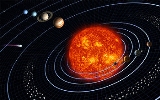
Solar Sys
Trebuchet
For example, consider a book, placed on top of a table. When the book is raised from the floor to the table, the gravitational force does negative work. If the book is returned back to the floor, the exact same (but positive) work will be done by the gravitational force. Thus, if the book is knocked off the table, this work (called potential energy) goes to accelerate the book (and is converted into kinetic energy
Kinetic energy

The kinetic energy of an object is the extra energy which it possesses due to its motion. It is defined as the mechanical work needed to accelerate a body of a given mass from rest to its current velocity....
). When the book hits the floor this kinetic energy is converted into heat and sound by the impact.

The factors that affect an object's gravitational potential energy are its height relative to some reference point, its mass, and the strength of the gravitational field it is in. Thus, a book lying on a table has less gravitational potential energy than the same book on top of a taller cupboard, and less gravitational potential energy than a heavier book lying on the same table. An object at a certain height above the Moon's surface has less gravitational potential energy than at the same height on Earth because the Moon's gravity is weaker. (This follows from Newton's law of gravitation because the mass of the moon is much smaller than that of the Earth.) It is important to note that "height" in the common sense of the term cannot be used for gravitational potential energy calculations when gravity is not assumed to be a constant. The following sections provide more detail.

The strength of a gravitational field varies with location. However, within a small range of distances from the center of the source of the gravitational field, this variation in field strength is negligible and we can assume that the force of gravity on a particular object is constant. Near the surface of the Earth, for example, we assume that the acceleration of gravity is a constant g = 9.8 m/s2. If we assume that the force of gravity is constant, a simple expression for gravitational potential energy can be derived using the W = Fd equation for work
Mechanical work

In physics, mechanical work is the amount of energy transferred by a force acting through a distance. Like energy, it is a scalar quantity, with SI of joules....
, and the equation .

When accounting only for mass
Mass

In physical science, mass refers to the degree of acceleration a body acquires when subject to a force: bodies with greater mass are accelerated less by the same force....
, gravity
Gravitation

Gravitation is a natural phenomenon that gives weight to objects. In everyday life, attraction due to gravity is the result of the presence of relatively large bodies, such as the Earth and the Moon....
, and altitude
Altitude

Altitude has multiple uses depending on the context in which it is used . As a general definition, altitude is a distance measurement, usually in the vertical or "up" direction, between a reference datum and a point or object....
, the equation is:

Where: is the mass of the gravitated object, in kilogram
Kilogram

The kilogram or kilogrammeThe spelling kilogram is used by the International Committee for Weights and Measures and the U.S....
s is standard gravity
Standard gravity

Standard gravity, usually denoted by g0 or gn, is the nominal acceleration due to Earth's gravity at the Earth's surface at sea level....
, in
Metre per second squared

The metre per second squared is the SI derived unit of acceleration. It is a measure of magnitude and can be a scalar measure or, when associated with a direction, a vector ....
, and is the altitude of the gravitated object, in metre
Metre

The metre or meter is a Unit of measurement of length. It is the SI base unit of length in the metric system and in the International System of Units , used around the world for general and scientific purposes....
s

Hence, the potential difference is .

However, if the force of gravity varies too much for this approximation to be valid, then we have to use the general, integral definition of work in order to determine gravitational potential energy. The reference point where U = 0 is set at an infinite distance away from the source of the gravitational field provided by mass m2.

The gravitational potential energy of a system of masses m1 and m2 at a distance R is

.

Although this would not be an inertial frame of reference
Inertial frame of reference

In physics, an inertial frame of reference is a frame of reference, tied to the state of motion of an Observer , with the property that each physical law portrays itself in the same form in every inertial frame....
, for the computation of the potential energy we can keep the position of one mass fixed and find the equation by integrating
Integral

Integration is an important concept in mathematics, specifically in the field of calculus and, more broadly, mathematical analysis. Given a function ƒ of a Real number variable x and an interval [ab] of the real line, the integral...
 the gravitational force (whose magnitude is given by Newton's law of gravitation) with respect to the distance of the object r from the gravitating body from r = R to .

The total potential energy of a system of n bodies is found by adding for all n ( n - 1 ) / 2 pairs of two bodies the potential energy of the system of those two bodies.

Considering the system of bodies as the combined set of small particles the bodies consist of, and applying the previous on the particle level we get the negative gravitational binding energy
Gravitational binding energy

The gravitational binding energy of an object consisting of loose material, held together by gravity alone, is the amount of energy required to pull all of the material apart, to infinity....
. This potential energy is more strongly negative than the total potential energy of the system of bodies as such since it also includes the negative gravitational binding energy of each body. The potential energy of the system of bodies as such is the negative of the energy needed to separate the bodies from each other to infinity, while the gravitational binding energy is the energy needed to separate all particles from each other to infinity.

Uses

Dynorwic
Gravitational potential energy has a number of practical uses, notably the generation of hydroelectricity
Hydroelectricity

Hydroelectricity is electricity generated by hydropower, i.e., the production of power through use of the gravitational force of falling or flowing water....
. For example in Dinorwig
Dinorwig power station

Dinorwig power station is a 1728 Megawatt pumped-storage hydroelectricity scheme, near Dinorwig, in the Pass of Llanberis on the edge of the Snowdonia national park in Gwynedd, north Wales....
, Wales there are two lakes, one higher than the other. At times when surplus electricity is not required (and so is cheap), water is pumped up to the higher lake, converting the electrical energy to gravitational potential energy. At times of peak demand for electricity, the water flows back down through turbines, converting the potential energy into kinetic energy and then back into electricity. (The process is not completely efficient and much of the original energy from the surplus electricity is in fact lost to friction.) See also pumped storage.

Gravitational potential energy is also used to power clocks in which falling weights operate the mechanism.


Elastic potential energy

Replica Catapult
Elastic potential energy is the potential energy of an elastic
Elasticity (physics)

In physics, elasticity is the physical property of a material when it deforms under stress , but returns to its original shape when the stress is removed....
 object (for example a bow
Bow (weapon)

A bow is a weapon that projects arrows powered by the elasticity of the bow. Essentially, it is a form of Spring . As the bow is drawn, energy is stored in the limbs of the bow and transformed into rapid motion when the string is released, with the string transferring this force to the arrow....
 or a catapult) that is deformed under tension or compression (often termed under the word stress
Stress (physics)

In continuum mechanics, stress is a measure of the average amount of force exerted per unit area. It is a measure of the intensity of the total internal forces acting within a body across imaginary internal surfaces, as a reaction to external applied forces and body forces....
 by physicists). It arises as a consequence of a force that tries to restore the object to its original shape, which is most often the electromagnetic force
Electromagnetic force

In physics, the electromagnetic force is the force that the electromagnetic field exerts on electrically charged particles. It is the electromagnetic force that holds electrons and protons together in atoms, and which hold atoms together to make molecules....
 between the atoms and molecules that constitute the object. If the stretch is released, it is transformed into mechanical energy
Mechanical energy

In physics, mechanical energy describes the potential energy and kinetic energy present in the components of a mechanical system....
.

Calculation of elastic potential energy

In the case of a spring of natural length l and modulus of elasticity ? under an extension of x, elastic potential energy can be calculated using the formula:

This formula is obtained from the integral of Hooke's Law
Hooke's law

In mechanics, and physics, Hooke's law of theory of elasticity is an approximation that states that the extension of a spring is in direct proportion with the load added to it as long as this load does not exceed the elastic limit....
:

The equation is often used in calculations of positions of mechanical equilibrium
Mechanical equilibrium

A standard definition of is:This is a strict definition, and often the term "static equilibrium" is used in a more relaxed manner interchangeably with "mechanical equilibrium", as defined next....
.

In the general case, elastic energy is given by the Helmholtz potential per unit of volume f as a function of the strain tensor components eij:

Where ? and µ are the Lamé elastical coefficients. The connection between stress tensor components and strain tensor components is:

For a material of Young's modulus, Y (same as modulus of elasticity ?), cross sectional area, A0, initial length, l0, which is stretched by a length, :

where Ue is the elastic potential energy.


The elastic potential energy per unit volume is given by:

where is the strain in the material.


Chemical potential energy

Chemical potential energy is a form of potential energy related to the structural arrangement of atoms or molecules. This arrangement may be the result of chemical bond
Chemical bond

A chemical bond is the physical process responsible for the attractive interactions between atoms and molecules, and that which confers stability to diatomic and polyatomic chemical compounds....
s within a molecule or otherwise. Chemical energy of a chemical substance can be transformed to other forms of energy by a chemical reaction
Chemical reaction

A chemical reaction is a process that always results in the interconversion of chemical substances. The substance or substances initially involved in a chemical reaction are called reactants....
. For example, when a fuel is burned the chemical energy is converted to heat, same is the case with digestion of food metabolized in a biological organism. Green plants transform solar energy to chemical energy through the process known as photosynthesis
Photosynthesis

File:Seawifs global biosphere.jpgPhotosynthesis is a metabolic pathway that converts carbon dioxide into organic compounds, especially sugars, using the energy from sunlight....
, and electrical energy can be converted to chemical energy through electrochemical reactions.

The similar term chemical potential
Chemical potential

In thermodynamics, physics and chemistry, chemical potential, symbolized by ?, is a term introduced by the American engineer, chemist and mathematical physicist Willard Gibbs, which he defined as follows:...
 is used by chemists to indicate the potential of a substance to undergo a chemical reaction.

Electrical potential energy


An object can have potential energy by virtue of its electric charge
Electric charge

Electric charge is a fundamental conserved property of some subatomic particles, which determines their electromagnetic interaction. Electrically charged matter is influenced by, and produces, electromagnetic fields....
 and several forces related to their presence. There are three main types of this kind of potential energy: electrostatic potential energy, electrodynamic potential energy (also sometimes called magnetic potential energy), and nuclear potential energy.

Plasma Lamp 2

Electrostatic potential energy


In case the electric charge of an object can be assumed to be at rest, it has potential energy due to its position relative to other charged objects.

The electrostatic potential energy
Electric potential energy

Electric energy is the potential energy associated with the conservative force Coulomb forces between charged particles contained within a physical system, where the reference potential energy is usually chosen to be zero for particles at infinite separation....
 is the energy of an electrically charged particle (at rest) in an electric field. It is defined as the work that must be done to move it from an infinite distance away to its present location, in the absence of any non-electrical forces on the object. This energy is non-zero if there is another electrically charged object nearby.

The simplest example is the case of two point-like objects A1 and A2 with electrical charges q1 and q2. The work W required to move A1 from an infinite distance to a distance d away from A2 is given by: where k is Coulomb's constant, equal to .

This equation is obtained by integrating the Coulomb force between the limits of infinity and d.

A related quantity called electric potential
Electric potential

At a point in space, the electric potential is the potential energy per unit of electric charge that is associated with a static electric field....
 is equal to electric potential energy of a unit charge.

Electrodynamic potential energy


In case a charged object or its constituent charged particles are not at rest, it generates a magnetic field
Magnetic field

A magnetism field is a vector field which can exert a magnetic force on moving electric charges and on magnetic dipoles . When placed in a magnetic field, magnetic dipoles tend to align their axes parallel to the magnetic field....
 giving rise to yet another form of potential energy, often termed as magnetic potential energy. This kind of potential energy is a result of the phenomenon magnetism
Magnetism

In physics, magnetism is one of the phenomena by which materials exert attractive or repulsive forces on other materials. Some well-known materials that exhibit easily detectable magnetic properties are nickel, iron, cobalt, and their alloys; however, all materials are influenced to greater or lesser degree by the presence of a magnetic fiel...
, whereby an object that is magnetic has the potential to move other similar objects. Magnetic objects are said to have some magnetic moment
Magnetic moment

In physics, astronomy, chemistry, and electrical engineering, the term magnetic moment of a system usually refers to its magnetic dipole moment, and is a measure of the strength of the system's net Magnetism....
. Magnetic fields and their effects are best studied under electrodynamics.

Nuclear potential energy


Nuclear potential energy
Nuclear energy

Nuclear energy is released by the splitting or merging together of the Atomic nucleus of atom. The conversion of nuclear mass to energy is consistent with the mass-energy equivalence formula ?E = ?m.c?, in which ?E = energy release, ?m = mass defect, and c = the speed of light in a vacuum ....
 is the potential energy of the particles inside an atomic nucleus
Atomic nucleus

The nucleus of an atom is the very dense region, consisting of nucleons , at the center of an atom. Although the size of the nucleus varies considerably according to the mass of the atom, the size of the entire atom is comparatively constant....
, some of which are indeed electrically charged. This kind of potential energy is different from the previous two kinds of electrical potential energies because in this case the charged particles are extremely close to each other. The nuclear particles are bound together not because of the coulombic force but due to strong nuclear force that binds nuclear particles more strongly and closely. Weak nuclear forces provide the potential energy for certain kinds of radioactive decay, such as beta decay
Beta decay

In nuclear physics, beta decay is a type of radioactive decay in which a beta particle is emitted. In the case of electron emission, it is referred to as beta minus , while in the case of a positron emission as beta plus ....
.

Nuclear particles like protons and neutrons are not destroyed in fission and fusion processes, but collections of them have less mass than if they were individually free, and this mass difference is liberated as heat and radiation in nuclear reactions (the heat and radiation have the missing mass, but it often escapes from the system, where it is not measured). The energy from the Sun
Sun

The Sun , a G V star, is the star at the center of the Solar System. The Earth and other matter orbit the Sun, which by itself accounts for about 98.6% of the Solar System's mass....
, also called solar energy, is an example of this form of energy conversion. In the Sun
Sun

The Sun , a G V star, is the star at the center of the Solar System. The Earth and other matter orbit the Sun, which by itself accounts for about 98.6% of the Solar System's mass....
, the process of hydrogen fusion converts about 4 million metric tons of solar matter per second into light, which is radiated into space.

Thermal potential energy


The thermal energy
Thermal energy

Thermal energy is a form of energy that manifests itself as an increase of temperature. It is also the sum of sensible heat and latent heat....
 of an object is simply the sum of the kinetic energies of the particles constituting it (which are in random motion) plus the potential energies of their displacements from their equilibrium positions as they oscillate or move around them. In the case of an ideal gas, there is no potential energy due to interactions of particles, but kinetic energy may include a rotational part too (for multiatomic gases) – if rotational levels are excited at a given temperature T.

Solar updraft tower
Solar updraft tower

The solar updraft tower is a proposed type of renewable energy power plant. It combines three old and proven technologies: the chimney effect, the greenhouse effect, and the wind turbine....
s use this kind of power.

Rest mass energy

Albert Einstein
Albert Einstein

Albert Einstein was a Germany-born theoretical physics. He is best known for his theory of relativity and specifically mass?energy equivalence, expressed by the equation E = mc2....
 was the first to calculate the amount of work needed to accelerate a body from rest to some finite speed using his definition of relativistic
Theory of relativity

File:spacetime curvature.pngThe theory of relativity, or simply relativity, generally refers specifically to two theories of Albert Einstein: special relativity and general relativity....
 momentum
Momentum

In classical mechanics, momentum is the product of the mass and velocity of an object . For more accurate measures of momentum, see the section Momentum#Modern definitions of momentum on this page....
. To his surprise, this work contained an extra term which did not vanish as the speed of accelerated body approached zero:

This term (E0) was therefore called rest mass
Mass

In physical science, mass refers to the degree of acceleration a body acquires when subject to a force: bodies with greater mass are accelerated less by the same force....
 energy, as m is the rest mass of the body (c is the speed of light
Speed of light

The speed of light in an free space is an important physical constant usually written as c, with a value of 299,792,458 metres per second....
 which is constant) (The subscript zero is used here to distinguish this form of energy from the others that follow. In most other contexts, the equation is written with no subscript.)

So, the rest mass energy is the amount of energy inherent in the mass when it is at rest. If the mass changes, so must its rest mass energy which must be released or absorbed due to energy conservation law. Thus, this equation quantifies the equivalence of mass and energy.

Due to large numerical value of squared speed of light, even a small amount of mass is equivalent to a very large amount of energy, namely 90 petajoules per kilogram ˜ 21 megaton of TNT per kilogram.

Relation between potential energy and force

Potential energy is closely linked with forces. If the work done moving along a path which starts and ends in the same location is zero, then the force is said to be conservative and it is possible to define a numerical value of potential associated with every point in space. A force field can be re-obtained by taking the vector gradient
Gradient

In vector calculus, the gradient of a scalar field is a vector field which points in the direction of the greatest rate of increase of the scalar field, and whose magnitude is the greatest rate of change....
 of the potential field.

For example, gravity is a conservative force
Conservative force

A conservative force is defined as a force with the following property: when an object moves from one location to another, the force changes the potential energy of the object by an amount that does not depend on the path taken....
. The work done by a unit mass going from point A with to point B with by gravity is and the work done going back the other way is so that the total work done from
If we redefine the potential at A to be and the potential at B to be [where can be any number, positive or negative, but it must be the same number for all points] then the work done going from
as before.

In practical terms, this means that you can set the zero of anywhere you like. You might set it to be zero at the surface of the Earth
Earth

Earth is the third planet from the Sun. Earth is the largest of the terrestrial planets in the Solar System in diameter, mass and density. It is also referred to as the World and Wiktionary:Terra.Note that by International Astronomical Union convention, the term "Terra" is used for naming extensive land masses, rather...
 or you might find it more convenient to set it zero at infinity.

A thing to note about conservative forces is that the work done going from A to B does not depend on the route taken. If it did then it would be pointless to define a potential at each point in space. An example of a non-conservative force is friction. With friction, the route you take does affect the amount of work done, and it makes no sense at all to define a potential associated with friction.

All the examples above are actually force field stored energy (sometimes in disguise). For example in elastic potential energy, stretching an elastic material forces the atoms very slightly further apart. The equilibrium between electromagnetic force
Electromagnetic force

In physics, the electromagnetic force is the force that the electromagnetic field exerts on electrically charged particles. It is the electromagnetic force that holds electrons and protons together in atoms, and which hold atoms together to make molecules....
s and Pauli repulsion of electrons (they are fermions obeying Fermi statistics) is slightly violated resulting in a small returning force. Scientists rarely talk about forces on an atom
Atom

|-! bgcolor=gray | Properties|-||}The atom is a basic unit of matter consisting of a dense, central atomic nucleus surrounded by a electron cloud of electric charge electrons....
ic scale. Often interactions are described in terms of energy rather than force. You can think of potential energy as being derived from force or you can think of force as being derived from potential energy (though the latter approach requires a definition of energy that is independent from force which does not currently exist).

A conservative force can be expressed in the language of differential geometry as a closed form. Because Euclidean space is contractible
Contractible space

In mathematics, a topological space X is contractible if the identity map on X is null-homotopic, i.e. if it is homotopic to some constant map....
, its de Rham cohomology
De Rham cohomology

In mathematics, de Rham cohomology is a tool belonging both to algebraic topology and to differential topology, capable of expressing basic topological information about smooth manifolds in a form particularly adapted to computation and the concrete representation of cohomology classes....
 vanishes, so every closed form is exact, i.e., is the gradient of a scalar field. This gives a mathematical justification of the fact that all conservative forces are gradients of a potential field.