

Gyre

Encyclopedia
Oceanography
Oceanography , also called oceanology or marine science, is the branch of Earth science that studies the ocean...
is any large system of rotating ocean current
Ocean current
An ocean current is a continuous, directed movement of ocean water generated by the forces acting upon this mean flow, such as breaking waves, wind, Coriolis effect, cabbeling, temperature and salinity differences and tides caused by the gravitational pull of the Moon and the Sun...
s, particularly those involved with large wind
Wind
Wind is the flow of gases on a large scale. On Earth, wind consists of the bulk movement of air. In outer space, solar wind is the movement of gases or charged particles from the sun through space, while planetary wind is the outgassing of light chemical elements from a planet's atmosphere into space...
movements. Gyres are caused by the Coriolis Effect
Coriolis effect
In physics, the Coriolis effect is a deflection of moving objects when they are viewed in a rotating reference frame. In a reference frame with clockwise rotation, the deflection is to the left of the motion of the object; in one with counter-clockwise rotation, the deflection is to the right...
; planetary vorticity along with horizontal and vertical friction, which determine the circulation patterns from the wind curl (torque
Torque
Torque, moment or moment of force , is the tendency of a force to rotate an object about an axis, fulcrum, or pivot. Just as a force is a push or a pull, a torque can be thought of as a twist....
). The term gyre can be used to refer to any type of vortex
Vortex
A vortex is a spinning, often turbulent,flow of fluid. Any spiral motion with closed streamlines is vortex flow. The motion of the fluid swirling rapidly around a center is called a vortex...
in the air or the sea, even one that is man-made, but it is most commonly used in oceanography
Oceanography
Oceanography , also called oceanology or marine science, is the branch of Earth science that studies the ocean...
to refer to the major ocean
Ocean
An ocean is a major body of saline water, and a principal component of the hydrosphere. Approximately 71% of the Earth's surface is covered by ocean, a continuous body of water that is customarily divided into several principal oceans and smaller seas.More than half of this area is over 3,000...
systems.
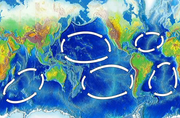
Major gyres
The following are the five most notable gyres:- Indian Ocean GyreIndian Ocean GyreThe Indian Ocean Gyre, located in the Indian Ocean, is one of the five major oceanic gyres.- External links:*...
- North Atlantic GyreNorth Atlantic GyreThe North Atlantic Gyre, located in the Atlantic Ocean, is one of the five major oceanic gyres. It includes the Gulf Stream and contains the Sargasso Sea. This gyre is similar to the North Pacific Gyre in the way it traps man-made ocean debris in the North Atlantic Garbage Patch, similar to the...
- North Pacific GyreNorth Pacific GyreThe North Pacific Gyre, located in the northern Pacific Ocean, is one of the five major oceanic gyres. This gyre comprises most of the northern Pacific Ocean. It is the largest ecosystem on our planet...
- South Atlantic GyreSouth Atlantic GyreThe South Atlantic Gyre is the southern branch of the subtropical gyre in the south Atlantic. This gyre is heavily influenced by northwesterly winds that drive a broad eastward drift, which makes it difficult to distinguish between the northern boundary of the subtropical gyre and the southern...
- South Pacific GyreSouth Pacific GyreThe “South Pacific Gyre” is the Earth’s biggest system of rotating ocean currents, bounded by equator to the north, Australia to the west, the Antarctic Circumpolar Current to the south, and South America to the east...
Tropical gyres
Tropical gyres are less unified and tend to be mostly east-west with minor north-south extent.- Atlantic Equatorial Current System (two counter-rotating circulations)
- Pacific Equatorial Current System
- Indian Monsoon Gyres (two counter-rotating circulations in northern Indian Ocean)
Subtropical gyres
The center of a subtropical gyre is a high pressure zone. Circulation around the high pressure is clockwise in the northern hemisphereNorthern Hemisphere
The Northern Hemisphere is the half of a planet that is north of its equator—the word hemisphere literally means “half sphere”. It is also that half of the celestial sphere north of the celestial equator...
and counterclockwise in the southern hemisphere
Southern Hemisphere
The Southern Hemisphere is the part of Earth that lies south of the equator. The word hemisphere literally means 'half ball' or "half sphere"...
, due to the Coriolis effect
Coriolis effect
In physics, the Coriolis effect is a deflection of moving objects when they are viewed in a rotating reference frame. In a reference frame with clockwise rotation, the deflection is to the left of the motion of the object; in one with counter-clockwise rotation, the deflection is to the right...
. The high pressure in the center is due to the westerly winds on the northern side of the gyre and easterly trade winds on the southern side of the gyre. These cause frictional surface currents towards the latitude at the center of the gyre. The build-up of water in the center of the gyre creates equatorward flow in the upper 1000 to 2000 m (3,280.8 to 6,561.7 ft) of the ocean, through rather complex dynamics. This equatorward flow is returned poleward in an intensified western boundary current
Boundary current
Boundary currents are ocean currents with dynamics determined by the presence of a coastline, and fall into two distinct categories: western boundary currents and eastern boundary currents.-Eastern boundary currents:...
.
The intensified western boundary current of the North Atlantic Gyre
North Atlantic Gyre
The North Atlantic Gyre, located in the Atlantic Ocean, is one of the five major oceanic gyres. It includes the Gulf Stream and contains the Sargasso Sea. This gyre is similar to the North Pacific Gyre in the way it traps man-made ocean debris in the North Atlantic Garbage Patch, similar to the...
is the Gulf Stream
Gulf Stream
The Gulf Stream, together with its northern extension towards Europe, the North Atlantic Drift, is a powerful, warm, and swift Atlantic ocean current that originates at the tip of Florida, and follows the eastern coastlines of the United States and Newfoundland before crossing the Atlantic Ocean...
, in the North Pacific
North Pacific Gyre
The North Pacific Gyre, located in the northern Pacific Ocean, is one of the five major oceanic gyres. This gyre comprises most of the northern Pacific Ocean. It is the largest ecosystem on our planet...
it's the Kuroshio Current
Kuroshio Current
The Kuroshio is a north-flowing ocean current on the west side of the North Pacific Ocean. It is similar to the Gulf Stream in the North Atlantic and is part of the North Pacific ocean gyre...
, in the South Atlantic
South Atlantic Gyre
The South Atlantic Gyre is the southern branch of the subtropical gyre in the south Atlantic. This gyre is heavily influenced by northwesterly winds that drive a broad eastward drift, which makes it difficult to distinguish between the northern boundary of the subtropical gyre and the southern...
it's the Brazil Current
Brazil Current
The Brazil Current is a warm water current that flows south along the Brazilian south coast to the mouth of the Río de la Plata. This current is caused by diversion of a portion of the Atlantic South Equatorial Current from where that current meets the South American continent...
, in the South Pacific
South Pacific Gyre
The “South Pacific Gyre” is the Earth’s biggest system of rotating ocean currents, bounded by equator to the north, Australia to the west, the Antarctic Circumpolar Current to the south, and South America to the east...
it's the East Australian Current
East Australian Current
The East Australian Current is an ocean current that moves warm water in a clockwise fashion down the east coast of Australia. It is the largest ocean current close to the shores of Australia. Its source is the tropical Coral Sea off the northeast coast of Australia...
, and in the Indian Ocean
Indian Ocean Gyre
The Indian Ocean Gyre, located in the Indian Ocean, is one of the five major oceanic gyres.- External links:*...
it's the Agulhas Current
Agulhas Current
The Agulhas Current is the Western Boundary Current of the southwest Indian Ocean. It flows down the east coast of Africa from 27°S to 40°S. It is narrow, swift and strong...
.
Subpolar gyres
Subpolar gyres form at high latitudes (around 60°). Circulation of surface wind and ocean water is anticlockwise in the Northern Hemisphere, around a low-pressure area, such as the persistent Aleutian LowAleutian low
The Aleutian Low is a semi-permanent low pressure center located near the Aleutian Islands during the winter. It is one of the main centers of action in the atmospheric circulation of the Northern Hemisphere...
and the Icelandic Low
Icelandic Low
The Icelandic Low is a semi-permanent centre of low atmospheric pressure found between Iceland and southern Greenland and extending in the Northern Hemisphere winter into the Barents Sea. In summer it weakens and splits into two centres, one near Davis Strait and the other west of Iceland...
. Surface currents generally move outward from the center of the system. This drives the Ekman transport
Ekman transport
Ekman transport, part of Ekman motion theory first investigated in 1902 by Vagn Walfrid Ekman , is the term given for the 90 degree net transport of the surface layer due to wind forcings...
, which creates an upwelling
Upwelling
Upwelling is an oceanographic phenomenon that involves wind-driven motion of dense, cooler, and usually nutrient-rich water towards the ocean surface, replacing the warmer, usually nutrient-depleted surface water. The increased availability in upwelling regions results in high levels of primary...
of nutrient-rich water from the lower depths.
Subpolar circulation in the southern hemisphere is dominated by the Antarctic Circumpolar Current
Antarctic Circumpolar Current
The Antarctic Circumpolar Current is an ocean current that flows from west to east around Antarctica. An alternative name for the ACC is the West Wind Drift. The ACC is the dominant circulation feature of the Southern Ocean and, at approximately 125 Sverdrups, the largest ocean current...
, due to the lack of large landmasses breaking up the Southern Ocean
Southern Ocean
The Southern Ocean comprises the southernmost waters of the World Ocean, generally taken to be south of 60°S latitude and encircling Antarctica. It is usually regarded as the fourth-largest of the five principal oceanic divisions...
. There are minor gyres in the Weddell Sea
Weddell Sea
The Weddell Sea is part of the Southern Ocean and contains the Weddell Gyre. Its land boundaries are defined by the bay formed from the coasts of Coats Land and the Antarctic Peninsula. The easternmost point is Cape Norvegia at Princess Martha Coast, Queen Maud Land. To the east of Cape Norvegia is...
and the Ross Sea
Ross Sea
The Ross Sea is a deep bay of the Southern Ocean in Antarctica between Victoria Land and Marie Byrd Land.-Description:The Ross Sea was discovered by James Ross in 1841. In the west of the Ross Sea is Ross Island with the Mt. Erebus volcano, in the east Roosevelt Island. The southern part is covered...
, the Weddell Gyre
Weddell Gyre
Antarctic gyre may refer to any of the three ocean currents and gyres within the Southern Ocean:* Antarctic Circumpolar Current, an ocean current circulating around Antarctica* Ross Gyre, an oceanic gyre in the Ross Sea...
and Ross Gyre
Ross Gyre
The Ross Gyre is one of the two gyres that exist within the Southern Ocean. The gyre is located in the Ross Sea, and rotates clockwise. The gyre is formed by interactions between the Antarctic Circumpolar Current and the Antarctic Continental Shelf...
, which circulate in a clockwise direction.
See also
- AnticycloneAnticycloneAn anticyclone is a weather phenomenon defined by the United States' National Weather Service's glossary as "[a] large-scale circulation of winds around a central region of high atmospheric pressure, clockwise in the Northern Hemisphere, counterclockwise in the Southern Hemisphere"...
- CycloneCycloneIn meteorology, a cyclone is an area of closed, circular fluid motion rotating in the same direction as the Earth. This is usually characterized by inward spiraling winds that rotate anticlockwise in the Northern Hemisphere and clockwise in the Southern Hemisphere of the Earth. Most large-scale...
- Ecosystem of the North Pacific Subtropical GyreEcosystem of the North Pacific Subtropical GyreThe North Pacific Subtropical Gyre is the largest contiguous ecosystem on earth. In oceanography, a subtropical gyre is a ring-like system of ocean currents rotating clockwise in the Northern Hemisphere and counterclockwise in the Southern Hemisphere caused by the Coriolis Effect. They generally...
- EddyEddy (fluid dynamics)In fluid dynamics, an eddy is the swirling of a fluid and the reverse current created when the fluid flows past an obstacle. The moving fluid creates a space devoid of downstream-flowing fluid on the downstream side of the object...
- Fluid dynamicsFluid dynamicsIn physics, fluid dynamics is a sub-discipline of fluid mechanics that deals with fluid flow—the natural science of fluids in motion. It has several subdisciplines itself, including aerodynamics and hydrodynamics...
- Great Pacific Garbage PatchGreat Pacific Garbage PatchThe Great Pacific Garbage Patch, also described as the Pacific Trash Vortex, is a gyre of marine litter in the central North Pacific Ocean located roughly between 135°W to 155°W and 35°N to 42°N...
- MaelstromMaelstromA maelstrom is a very powerful whirlpool; a large, swirling body of water. A free vortex, it has considerable downdraft. The power of tidal whirlpools tends to be exaggerated by laymen. There are virtually no stories of large ships ever being sucked into a maelstrom, although smaller craft are in...
- North Atlantic Garbage PatchNorth Atlantic Garbage PatchThe North Atlantic Garbage Patch is an area of marine debris found floating within the North Atlantic Gyre, originally documented in 1972. The patch is estimated to be hundreds of kilometers across in size, with a density of over 200,000 pieces of debris per square kilometer...
- SkookumchuckSkookumchuckSkookumchuck is a word in the Chinook Jargon that is in common use in British Columbia English and occurs in Pacific Northwest English. Skookum means "strong" or "powerful", and "chuck" means water, so skookumchuck means "rapids" or "whitewater"...
- WhirlpoolWhirlpoolA whirlpool is a swirling body of water usually produced by ocean tides. The vast majority of whirlpools are not very powerful. More powerful ones are more properly termed maelstroms. Vortex is the proper term for any whirlpool that has a downdraft...
- Widening gyre
External links
- 5 Gyres - Understanding Plastic Marine Pollution
- Wind Driven Surface Currents: Gyres
- SIO 210: Introduction to Physical Oceanography - Global circulation
- SIO 210: Introduction to Physical Oceanography - Wind-forced circulation notes
- SIO 210: Introduction to Physical Oceanography - Lecture 6
- Physical Geography - Surface and Subsurface Ocean Currents
- North Pacific Gyre Oscillation — Georgia Institute of Technology