
All Topics  
Eclipse

 
Eclipse

   Email Print
   Bookmark   Link


Eclipse


An eclipse is an astronomical event that occurs when one celestial object moves into the shadow of another. The term is derived from the ancient Greek
Ancient Greek

Ancient Greek is the historical stage in the development of the Greek language spanning across the Archaic Greece , Classical Greece , and Hellenistic civilization periods of ancient Greece and the classical antiquity....
 noun (), from verb (), "I cease to exist," a combination of prefix (), from preposition (), "out," and of verb (), "I am absent". When an eclipse occurs within a stellar system, such as the Solar System
Solar System

The Solar System consists of the Sun and those Astronomical object bound to it by gravity: the eight planets and five dwarf planets, their 173 known Natural satellite, and billions of Small Solar System body....
, it forms a type of syzygy
Syzygy

In broadest terms, Syzygy is a kind of unity, especially through coordination or alignment, most commonly used in the astronomical and/or astrological sense....
—the alignment of three or more celestial bodies in the same gravitational system along a straight line.

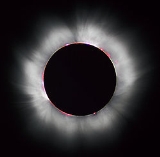
The term eclipse is most often used to describe either a solar eclipse
Solar eclipse

A solar eclipse occurs when the Moon passes between the Sun and the Earth so that the Sun is wholly or partially obscured. This can only happen during a new moon, when the Sun and Moon are in conjunction as seen from the Earth....
, when the Moon's shadow crosses the Earth's surface, or a lunar eclipse
Lunar eclipse

A lunar eclipse occurs whenever the Moon passes through some portion of the Earth's shadow. This can occur only when the Sun, Earth, and Moon are aligned exactly, or very closely so, with the Earth in the middle....
, when the Moon moves into the shadow of Earth.


Discussion
Ask a question about 'Eclipse'
Start a new discussion about 'Eclipse'
Answer questions from other users
Full Discussion Forum


Encyclopedia


Solar Eclips 1999 4
An eclipse is an astronomical event that occurs when one celestial object moves into the shadow of another. The term is derived from the ancient Greek
Ancient Greek

Ancient Greek is the historical stage in the development of the Greek language spanning across the Archaic Greece , Classical Greece , and Hellenistic civilization periods of ancient Greece and the classical antiquity....
 noun (), from verb (), "I cease to exist," a combination of prefix (), from preposition (), "out," and of verb (), "I am absent". When an eclipse occurs within a stellar system, such as the Solar System
Solar System

The Solar System consists of the Sun and those Astronomical object bound to it by gravity: the eight planets and five dwarf planets, their 173 known Natural satellite, and billions of Small Solar System body....
, it forms a type of syzygy
Syzygy

In broadest terms, Syzygy is a kind of unity, especially through coordination or alignment, most commonly used in the astronomical and/or astrological sense....
—the alignment of three or more celestial bodies in the same gravitational system along a straight line.

The term eclipse is most often used to describe either a solar eclipse
Solar eclipse

A solar eclipse occurs when the Moon passes between the Sun and the Earth so that the Sun is wholly or partially obscured. This can only happen during a new moon, when the Sun and Moon are in conjunction as seen from the Earth....
, when the Moon's shadow crosses the Earth's surface, or a lunar eclipse
Lunar eclipse

A lunar eclipse occurs whenever the Moon passes through some portion of the Earth's shadow. This can occur only when the Sun, Earth, and Moon are aligned exactly, or very closely so, with the Earth in the middle....
, when the Moon moves into the shadow of Earth. However, it can also refer to such events beyond the Earth-Moon system: for example, a planet moving into the shadow cast by one of its moons, a moon passing into the shadow cast by its host planet, or a moon passing into the shadow of another moon. A binary star
Binary star

A binary star is a star system consisting of two stars orbiting around their common center of mass. The brighter star is called the primary and the other is its companion star or secondary....
 system can also produce eclipses if the plane of their orbit intersects the position of the observer.

Syzygy

A syzygy
Syzygy

In broadest terms, Syzygy is a kind of unity, especially through coordination or alignment, most commonly used in the astronomical and/or astrological sense....
 is the alignment of three or more celestial bodies in the same gravitational system along a straight line. The word is usually used in context with the Sun
Sun

The Sun , a G V star, is the star at the center of the Solar System. The Earth and other matter orbit the Sun, which by itself accounts for about 98.6% of the Solar System's mass....
, Earth
Earth

Earth is the third planet from the Sun. Earth is the largest of the terrestrial planets in the Solar System in diameter, mass and density. It is also referred to as the World and Wiktionary:Terra.Note that by International Astronomical Union convention, the term "Terra" is used for naming extensive land masses, rather...
, and the Moon
Moon

The Moon is Earth's only natural satellite and the List of natural satellites by diameter satellite in the Solar System. The average centre-to-centre distance from the Earth to the Moon is km, about thirty times the diameter of the Earth....
 or a planet
Planet

A planet , as 2006 definition of planet by the International Astronomical Union , is a celestial body orbiting a star or Stellar evolution#Stellar remnants that is massive enough to be rounded by its own gravity, is not massive enough to cause thermonuclear fusion, and has cleared the neighbourhood of planetesimals....
, where the latter is in conjunction or opposition. Solar
Solar eclipse

A solar eclipse occurs when the Moon passes between the Sun and the Earth so that the Sun is wholly or partially obscured. This can only happen during a new moon, when the Sun and Moon are in conjunction as seen from the Earth....
 and lunar
Lunar eclipse

A lunar eclipse occurs whenever the Moon passes through some portion of the Earth's shadow. This can occur only when the Sun, Earth, and Moon are aligned exactly, or very closely so, with the Earth in the middle....
 eclipse
Eclipse

An eclipse is an astronomical event that occurs when one celestial object moves into the shadow of another. The term is derived from the ancient Greek noun , from verb , "I cease to exist," a combination of prefix , from preposition , "out," and of verb , "I am absent"....
s occur at times of syzygy, as do transits
Astronomical transit

File:Moon transit of sun large.oggThe term transit or astronomical transit has three meanings in astronomy:* A transit is the astronomy event that occurs when one celestial body appears to move across the face of another celestial body, as seen by an observer at some particular vantage point....
 and occultation
Occultation

An occultation is an event that occurs when one object is hidden by another object that passes between it and the observer. The word is used in astronomy and can also be used in a general sense to describe when an object in the foreground occults objects in the background....
s.

An eclipse occurs when there is a syzygy between a star and two celestial bodies, such as a planet and a moon. The shadow cast by the object closest to the star intersects the more distant body, lowering the amount of luminosity reaching the latter's surface. The region of shadow cast by the occulting body is divided into an umbra
Umbra

For other uses of the word "umbra", see Umbra .'For other uses of the word "penumbra", see Penumbra .The umbra, penumbra and antumbra are the names given to three distinct parts of a shadow, created by any light source....
, where the radiation from the star's radiation-emitting photosphere
Photosphere

The photosphere of an astronomical object is the region from which externally received light originates. The term itself is derived from Ancient Greek roots, f???- f?t??/photos meaning "light" and sfa????/sphairos meaning "ball," in reference to the fact that it is a ball-shaped surface perceived to emit light....
 is completely blocked, and a penumbra, where only a portion of the radiation is blocked.

A total eclipse will occur when the observer is located within the umbra of the occulting
Occultation

An occultation is an event that occurs when one object is hidden by another object that passes between it and the observer. The word is used in astronomy and can also be used in a general sense to describe when an object in the foreground occults objects in the background....
 object. Totality occurs at the point of maximum phase during a total eclipse, when the occulted object is completely covered. When the star and a smaller occulting object are nearly spherical, the umbra forms a cone
Cone

A cone is a basic geometrical shape; see cone .Cone may also refer to:*Conifer cone, a seed-bearing organ on conifer plants*Cone cell, in anatomy, a type of light-sensitive cell found along with rods in the retina of the eye...
-shaped region of shadow in space.

Beyond the end of the umbra is a region called the antumbra, where a planet or moon will be seen transiting across the star but not completely covering it. For an observer inside the antumbra of a solar eclipse
Solar eclipse

A solar eclipse occurs when the Moon passes between the Sun and the Earth so that the Sun is wholly or partially obscured. This can only happen during a new moon, when the Sun and Moon are in conjunction as seen from the Earth....
, for example, the Moon
Moon

The Moon is Earth's only natural satellite and the List of natural satellites by diameter satellite in the Solar System. The average centre-to-centre distance from the Earth to the Moon is km, about thirty times the diameter of the Earth....
 appears smaller than the Sun
Sun

The Sun , a G V star, is the star at the center of the Solar System. The Earth and other matter orbit the Sun, which by itself accounts for about 98.6% of the Solar System's mass....
, resulting in an annular eclipse. The remaining volume of shadowed space, where only a fraction of the occulting object overlaps the star, is called the penumbra. An eclipse that does not reach totality, such as when the observer is in the penumbra, is called a partial eclipse.

For spherical bodies, when the occluding object is smaller than the star, the length (L) of the Umbra's cone-shaped shadow is given by:

where Rs is the radius of the star, Ro is the occulting object's radius, and r is the distance from the star to the occulting object. For Earth
Earth

Earth is the third planet from the Sun. Earth is the largest of the terrestrial planets in the Solar System in diameter, mass and density. It is also referred to as the World and Wiktionary:Terra.Note that by International Astronomical Union convention, the term "Terra" is used for naming extensive land masses, rather...
, on average L is equal to 1.384 km, which is much larger than the Moon's semimajor axis of 3.844 km. Hence the umbral cone of the Earth can completely envelop the Moon during a lunar eclipse
Lunar eclipse

A lunar eclipse occurs whenever the Moon passes through some portion of the Earth's shadow. This can occur only when the Sun, Earth, and Moon are aligned exactly, or very closely so, with the Earth in the middle....
. If the occulting object has an atmosphere, however, some of the luminosity of the star can be refracted
Refraction

Refraction is the change in direction of a wave due to a change in its speed. This is most commonly observed when a wave passes from one optical medium to another....
 into the volume of the umbra. This occurs, for example, during an eclipse of the Moon by the Earth—producing a faint, ruddy illumination of the Moon even at totality.

An astronomical transit
Astronomical transit

File:Moon transit of sun large.oggThe term transit or astronomical transit has three meanings in astronomy:* A transit is the astronomy event that occurs when one celestial body appears to move across the face of another celestial body, as seen by an observer at some particular vantage point....
 is also a type of syzygy, but is used to describe the situation where the nearer object is considerably smaller in apparent size than the more distant object. Likewise, an occultation
Occultation

An occultation is an event that occurs when one object is hidden by another object that passes between it and the observer. The word is used in astronomy and can also be used in a general sense to describe when an object in the foreground occults objects in the background....
 is a syzygy where the apparent size of the nearer object appears much larger than the distant object, and the distant object becomes completely hidden during the event.

An eclipse cycle
Eclipse cycle

Eclipses may occur repeatedly, separated by certain intervals of time: these intervals are called eclipse cycles. The series of eclipses separated by a repeat of one of these intervals is called an eclipse series....
 takes place when a series of eclipses are separated by a certain interval of time. This happens when the orbital motions of the bodies form repeating harmonic patterns. A particular instance is the Saros cycle
Saros cycle

The Saros cycle is an eclipse cycle with a period of about 18 years 11 days 8 hours that can be used to predict eclipses of the Sun and Moon. One cycle after an eclipse, the Sun, Earth, and Moon return to approximately the same relative geometry, and a nearly identical eclipse will occur west of the original location....
, which results in a repetition of a solar or lunar eclipse every 6,585.3 days, or a little over 18 years. However, because this cycle has an odd number of days, a successive eclipse is viewed from a different part of the world.

Earth-Moon System

An eclipse involving the Sun, Earth and Moon can occur only when they are nearly in a straight line, allowing the shadow cast by the Sun to fall upon the eclipsed body. Because the orbital plane of the Moon is tilted with respect to the orbital plane of the Earth (the ecliptic
Ecliptic

The ecliptic is the apparent path that the Sun traces out in the sky during the year. As it appears to move in the sky in relation to the stars, the apparent path aligns with the planets throughout the course of the year....
), eclipses can occur only when the Moon is close to the intersection of these two planes (the nodes). The Sun, Earth and nodes are aligned twice a year, and eclipses can occur during a period of about two months around these times. There can be from four to seven eclipses in a calendar year
Year

A year is the time between two recurrences of an event related to the orbit of the Earth around the Sun. By extension, this can be applied to any planet: for example, a "Martian year" is the time in which Mars completes its own orbit....
, which repeat according to various eclipse cycle
Eclipse cycle

Eclipses may occur repeatedly, separated by certain intervals of time: these intervals are called eclipse cycles. The series of eclipses separated by a repeat of one of these intervals is called an eclipse series....
s, such as the Saros cycle
Saros cycle

The Saros cycle is an eclipse cycle with a period of about 18 years 11 days 8 hours that can be used to predict eclipses of the Sun and Moon. One cycle after an eclipse, the Sun, Earth, and Moon return to approximately the same relative geometry, and a nearly identical eclipse will occur west of the original location....
.

Solar eclipse

An eclipse of the Sun by the Moon is termed a solar eclipse. Records of solar eclipses have been kept since ancient times. A Syria
Syria

Syria , officially the Syrian Arab Republic , is an Arab-majority country in Southwest Asia, bordering Lebanon and the Mediterranean Sea to the west, Israel to the southwest, Jordan to the south, Iraq to the east, and Turkey to the north....
n clay tablet records a solar eclipse on March 5, 1223 BCE, while Paul Griffin argues that a stone in Ireland records an eclipse on November 30, 3340 BCE. Chinese historical records of solar eclipses date back over 4,000 years and have been used to measure changes in the Earth's rate of spin. Eclipse dates can also be used for chronological dating of historical records.

The type of solar eclipse event depends on the distance of the Moon from the Earth during the event. A total solar eclipse occurs when the Earth intersects the umbra portion of the Moon's shadow. When the umbra does not reach the surface of the Earth, the Sun is only partially occluded, resulting in an annular eclipse. Partial solar eclipses occur when the viewer is inside the penumbra.

The eclipse magnitude
Magnitude of eclipse

File:RingfoermigeSonnenfinsternis.jpgIn a solar eclipse, the magnitude of the eclipse is the ratio between the apparent angular diameters of the Moon and that of the Sun during the eclipse....
 is the fraction of the Sun's diameter that is covered by the Moon. For a total eclipse, this value is always greater than or equal to one. In both annular and total eclipses, the eclipse magnitude is the ratio of the angular sizes of the Moon to the Sun.

Solar eclipses are relatively brief events that can only be viewed in totality along a relatively narrow track. Under the most favorable circumstances, a total solar eclipse can last for 7 minutes, 31 seconds, and can be viewed along a track that is up to 250 km wide. However, the region where a partial eclipse can be observed is much larger. The Moon's umbra will advance eastward at a rate of 1,700 km/h, until it no longer intersects the Earth.

During a solar eclipse, the Moon can sometimes perfectly cover the Sun because its apparent size is nearly the same as the Sun when viewed from the Earth. A solar eclipse is actually a misnomer; the phenomenon is more correctly described as an occultation
Occultation

An occultation is an event that occurs when one object is hidden by another object that passes between it and the observer. The word is used in astronomy and can also be used in a general sense to describe when an object in the foreground occults objects in the background....
 of the Sun by the Moon or an eclipse of the Earth by the Moon.

Lunar eclipse

Eclipse Lune
Lunar eclipses occur when the Moon passes through the Earth's shadow. Since this occurs only when the Moon is on the far side of the Earth from the Sun, lunar eclipses only occur when there is a full moon
Full moon

Full moon is a lunar phase that occurs when the Moon is on the opposite side of the Earth from the Sun. More precisely, a full moon occurs when the geocentric apparent longitudes of the Sun and Moon differ by 180 degrees; the Moon is then in opposition with the Sun....
. Unlike a solar eclipse, an eclipse of the Moon can be observed from nearly an entire hemisphere. For this reason it is much more common to observe a lunar eclipse from a given location. A lunar eclipse also lasts longer, taking several hours to complete, with totality itself usually averaging anywhere from about 30 minutes to over an hour.

There are three types of lunar eclipses: penumbral, when the Moon crosses only the Earth's penumbra; partial, when the Moon crosses partially into the Earth's umbra
Umbra

For other uses of the word "umbra", see Umbra .'For other uses of the word "penumbra", see Penumbra .The umbra, penumbra and antumbra are the names given to three distinct parts of a shadow, created by any light source....
; and total, when the Moon circles entirely within the Earth's umbra. Total lunar eclipses pass through all three phases. Even during a total lunar eclipse, however, the Moon is not completely dark. Sunlight refracted through the Earth's atmosphere intersects the umbra and provides a faint illumination. Much as in a sunset, the atmosphere tends to scatter light with shorter wavelengths, so the illumination of the Moon by refracted light has a red hue.

Other planets


Pia05553
Jupiterandio
Eclipses are impossible on Mercury
Mercury (planet)

Mercury is the innermost and smallest planet in the Solar System, orbiting the Sun once every 88 days. The orbit of Mercury has the highest Orbital eccentricity of all the Solar System planets, and it has the smallest axial tilt....
 and Venus
Venus

Venus is the second-closest planet to the Sun, orbiting it every 224.7 Earth days. The planet is named after Venus , the Roman mythology goddess of love....
, which have no moons. However, both have been observed to transit across the face of the Sun. There are on average 13 transits of Mercury each century. Transits of Venus occur in pairs separated by an interval of eight years, but each pair of events happen less than once a century.

On Mars
MARS

In cryptography, MARS is a block cipher that was IBM's submission to the Advanced Encryption Standard process. MARS was selected as an AES finalist in August 1999, after the AES2 conference in March 1999, where it was voted as the fifth and last finalist algorithm....
, only partial solar eclipses (transits
Transit of Phobos from Mars

A transit of Phobos across the Sun as seen from Mars takes place when Phobos passes directly between the Sun and a point on the surface of Mars, obscuring a large part of the Sun's disc for an observer on Mars....
) are possible, because neither of its moons is large enough, at their respective orbital radii, to cover the Sun's disc as seen from the surface of the planet. Eclipses of the moons by Mars are not only possible, but commonplace, with hundreds occurring each Earth year. There are also rare occasions when Deimos is eclipsed by Phobos. Martian eclipses have been photographed from both the surface of Mars and from orbit.

The gas giant
Gas giant

A gas giant is a large planet that is not primarily composed of Rock or other solid matter. There are four gas giants in our Solar System: Jupiter, Saturn, Uranus, and Neptune....
 planets (Jupiter
Jupiter

Jupiter is the fifth planet from the Sun and the Solar system by size planet within the Solar System. It is two and a half times as massive as all of the other planets in our Solar System combined....
, Saturn
Saturn

Saturn is the sixth planet from the Sun and the second largest planet in the Solar System, after Jupiter. Saturn, along with Jupiter, Uranus and Neptune, is classified as a gas giant....
, Uranus
Uranus

Uranus is the seventh planet from the Sun and the third-largest and fourth most massive planet in the Solar System. It is named after the ancient Greek deity of the sky Uranus the father of Kronos and grandfather of Zeus ....
, and Neptune
NEPTUNE

=Overview=The project, along with sister project, VENUS, offers a unique approach to ocean science. Traditionally, ocean scientists have relied on infrequent ship cruises or space-based satellites to carry out their research....
) have many moons and thus frequently display eclipses. The most striking involve Jupiter
Jupiter

Jupiter is the fifth planet from the Sun and the Solar system by size planet within the Solar System. It is two and a half times as massive as all of the other planets in our Solar System combined....
, which has four large moons and a low axial tilt
Axial tilt

In astronomy, axial tilt is the inclination angle of a planet axis of rotation in relation to its Orbital plane . It is also called axial inclination or obliquity....
, making eclipses more frequent as these bodies pass through the shadow of the larger planet. Transits occur with equal frequency. It is common to see the larger moons casting circular shadows upon Jupiter's cloudtops.

The eclipses of the Galilean moons by Jupiter became accurately predictable once their orbital elements were known. During the 1670s, it was discovered that these events were occurring about 17 minutes later than expected when Jupiter was on the far side of the Sun. Ole Rømer
Ole Rømer

Ole Christensen R?mer was a Danish astronomer who in 1676 made the first quantitative measurements of the speed of light. In scientific literature alternative spellings, such as "Roemer", "R?mer", and "Romer", are common....
 deduced that the delay was caused by the time needed for light to travel from Jupiter to the Earth. This was used to produce the first estimate of the speed of light
Speed of light

The speed of light in an free space is an important physical constant usually written as c, with a value of 299,792,458 metres per second....
.

On the other three gas giant
Gas giant

A gas giant is a large planet that is not primarily composed of Rock or other solid matter. There are four gas giants in our Solar System: Jupiter, Saturn, Uranus, and Neptune....
s, eclipses only occur at certain periods during the planet's orbit, due to their higher inclination
Inclination

Inclination in general is the angle between a reference plane and another plane or Axis_of_rotation of direction. The axial tilt is expressed as the angle made by the planet's axis and a line drawn through the planet's center perpendicular to the orbital plane....
 between the orbits of the moon and the orbital plane
Orbital plane

Orbital plane may refer to:*Orbital plane *In anatomy, it refers to a specific area of the maxilla...
 of the planet. The moon Titan
Titan (moon)

Titan or Saturn VI is the largest natural satellite of Saturn, the only moon known to have a dense celestial body atmosphere, and the only object other than Earth for which clear evidence of stable bodies of surface liquid has been found....
, for example, has an orbital plane tilted about 1.6° to Saturn's equatorial plane. But Saturn has an axial tilt of nearly 27°. The orbital plane of Titan only crosses the line of sight to the Sun at two points along Saturn's orbit. As the orbital period of Saturn is 29.7 years, an eclipse is only possible about every 15 years.

The timing of the Jovian satellite eclipses was also used to calculate an observer's longitude
Longitude

Longitude , symbolized by the Greek character lambda , is the geographic coordinate most commonly used in cartography and global navigation for east-west measurement....
 upon the Earth. By knowing the expected time when an eclipse would be observed at a standard longitude (such as Greenwich
Greenwich

'Greenwich' is a district in south-east London, England, on the south bank of the River Thames in the London Borough of Greenwich. It is best known for its maritime history and as giving its name to the Greenwich Meridian and Greenwich Mean Time....
), the time difference could be computed by accurately observing the local time of the eclipse. The time difference gives the longitude of the observer because every hour of difference corresponded to 15° around the Earth's equator. This technique was used, for example, by Giovanni D. Cassini
Giovanni Domenico Cassini

This article is about the Italian-born astronomer. For his French-born great-grandson, see Dominique, comte de Cassini.Giovanni Domenico Cassini was an Italy/France mathematician, astronomer, engineer, and astrologer....
 in 1679 to re-map France
France

France , officially the French Republic , is a country whose Metropolitan France is located in Western Europe and that also comprises various Overseas departments and territories of France....
.

Pluto
Pluto

Pluto , Minor planet names Pluto, is the second-largest known dwarf planet in the Solar System and the tenth-largest body observed directly orbiting the Sun....
, with its proportionately large moon Charon
Charon (moon)

'Charon' , discovered in 1978, is the largest moon of the dwarf planet Pluto. Following the 2005 discovery of two other natural satellites of Pluto , Charon may also referred to as 'Pluto I'....
, is also the site of many eclipses. A series of such mutual eclipses occurred between 1985 and 1990. These daily events led to the first accurate measurements of the physical parameters of both objects.

Eclipsing binaries

A binary star
Binary star

A binary star is a star system consisting of two stars orbiting around their common center of mass. The brighter star is called the primary and the other is its companion star or secondary....
 system consists of two stars that orbit around their common center of mass
Center of mass

The center of mass of a system of wiktionary:Particles is a specific point at which, for many purposes, the system's mass behaves as if it were concentrated....
. The movements of both stars lie on a common orbital plane
Orbital plane (astronomy)

The orbital plane of an object orbiting another is the geometrical Plane in which the orbit is embedding. Three points in space suffice to define the orbital plane....
 in space. When this plane is very closely aligned with the location of an observer, the stars can be seen to pass in front of each other. The result is a type of extrinsic variable star
Variable star

A star is classified as variable if its apparent magnitude as seen from Earth changes over time, whether the changes are due to variations in the star's actual luminosity, or to variations in the amount of the star's light that is blocked from reaching Earth....
 system called an eclipsing binary.

The maximum luminosity
Luminosity

Luminosity has different meanings in several different fields of science....
 of an eclipsing binary system is equal to the sum of the luminosity contributions from the individual stars. When one star passes in front of the other, the luminosity of the system is seen to decrease. The luminosity returns to normal once the two stars are no longer in alignment.

The first eclipsing binary star system to be discovered was Algol
Algol

Algol , known colloquially as the Demon Star, is a bright star in the constellation Perseus . It is one of the best known eclipsing binary, the first such star to be discovered, and also one of the first variable stars to be discovered....
, a star system in the constellation Perseus
Perseus (constellation)

Perseus is a constellation in the northern sky, named after the Greek hero Perseus. It was one of the 48 constellations listed by the 1st century astronomer Ptolemy, and remains one of the 88 modern constellations defined by the International Astronomical Union....
. Normally this star system has a visual magnitude of 2.1. However, every 2.867 days the magnitude decreases to 3.4 for more than 9 hours. This is caused by the passage of the dimmer member of the pair in front of the brighter star. The concept that an eclipsing body caused these luminosity variations was introduced by John Goodricke
John Goodricke

John Goodricke Fellow of the Royal Society was an eminent and profoundly deaf amateur astronomer. He is best known for his observations of the variable star Algol in 1782....
 in 1783.

See also

  • Eclipse cycle
    Eclipse cycle

    Eclipses may occur repeatedly, separated by certain intervals of time: these intervals are called eclipse cycles. The series of eclipses separated by a repeat of one of these intervals is called an eclipse series....
  • Mursili's eclipse
    Mursili's eclipse

    The solar eclipse mentioned in the annals of Mursili II is of great importance for the absolute dating of the Hittite Empire within the chronology of the Ancient Near East....
  • Saros cycle
    Saros cycle

    The Saros cycle is an eclipse cycle with a period of about 18 years 11 days 8 hours that can be used to predict eclipses of the Sun and Moon. One cycle after an eclipse, the Sun, Earth, and Moon return to approximately the same relative geometry, and a nearly identical eclipse will occur west of the original location....
  • Syzygy
    Syzygy

    In broadest terms, Syzygy is a kind of unity, especially through coordination or alignment, most commonly used in the astronomical and/or astrological sense....


External links

  • (notice: loads slowly)


Image galleries