

Amphidromic point

Encyclopedia
An amphidromic point is a point within a tidal system where the tidal range
is almost zero. The tidal range (the height difference between high tide and low tide) is zero at the amphidromic point and increases with distance from this point. These points are called nodes.
 Amphidromic points occur because of the Coriolis effect
and interference within oceanic basin
s, sea
s and bay
s creating a wave pattern — called an amphidromic system — which rotates around the amphidromic point. At the amphidromic point, there is no vertical movement from tidal action. There can be tidal currents as the water levels on either side of the amphidromic point are not the same.
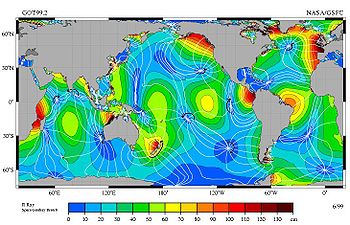
In most locations M2 is the largest (semidiurnal) tidal constituent, with an amplitude of roughly half of the full tidal range. Cotidal points means they reach high tide at the same time and low tide at the same time. In the accompanying figure, the low tide lags or leads by 1 hr 2 min from its neighboring lines. Where the lines meet are amphidromes and the tide rotates around them; for example: along the Chilean coast, and from southern Mexico to Peru the tide propagates southward, while from Baja California to Alaska the tide propagates northward.
Anti-clockwise amphidromic points include:
The islands of Madagascar
and New Zealand
are amphidromic points in the sense that the tide goes around them (counterclockwise in both cases) in about 12 and a half hours, but the amplitude of the tides on their coasts is in some places large.
Tidal range
The tidal range is the vertical difference between the high tide and the succeeding low tide. Tides are the rise and fall of sea levels caused by the combined effects of the gravitational forces exerted by the Moon and the Sun and the rotation of the Earth...
is almost zero. The tidal range (the height difference between high tide and low tide) is zero at the amphidromic point and increases with distance from this point. These points are called nodes.
Coriolis effect
In physics, the Coriolis effect is a deflection of moving objects when they are viewed in a rotating reference frame. In a reference frame with clockwise rotation, the deflection is to the left of the motion of the object; in one with counter-clockwise rotation, the deflection is to the right...
and interference within oceanic basin
Oceanic basin
Hydrologically, an oceanic basin may be anywhere on Earth that is covered by seawater, but geologically ocean basins are large geologic basins that are below sea level...
s, sea
Sea
A sea generally refers to a large body of salt water, but the term is used in other contexts as well. Most commonly, it means a large expanse of saline water connected with an ocean, and is commonly used as a synonym for ocean...
s and bay
Headlands and bays
Headlands and bays are two related features of the coastal environment.- Geology and geography :Headlands and bays are often found on the same coastline. A bay is surrounded by land on three sides, whereas a headland is surrounded by water on three sides. Headlands are characterized by high,...
s creating a wave pattern — called an amphidromic system — which rotates around the amphidromic point. At the amphidromic point, there is no vertical movement from tidal action. There can be tidal currents as the water levels on either side of the amphidromic point are not the same.
In most locations M2 is the largest (semidiurnal) tidal constituent, with an amplitude of roughly half of the full tidal range. Cotidal points means they reach high tide at the same time and low tide at the same time. In the accompanying figure, the low tide lags or leads by 1 hr 2 min from its neighboring lines. Where the lines meet are amphidromes and the tide rotates around them; for example: along the Chilean coast, and from southern Mexico to Peru the tide propagates southward, while from Baja California to Alaska the tide propagates northward.
Amphidromic points in the M2 tidal constituent
Based on the accompanying figure, the set of clockwise amphidromic points includes:- north of the SeychellesSeychellesSeychelles , officially the Republic of Seychelles , is an island country spanning an archipelago of 115 islands in the Indian Ocean, some east of mainland Africa, northeast of the island of Madagascar....
- near Enderby LandEnderby LandEnderby Land is a projecting land mass of Antarctica, extending from Shinnan Glacier at to William Scoresby Bay at .Enderby Land was discovered in February 1831 by John Biscoe in the whaling brig Tula, and named after the Enderby Brothers of London, owners of the Tula, who encouraged their...
- off PerthPerth, Western AustraliaPerth is the capital and largest city of the Australian state of Western Australia and the fourth most populous city in Australia. The Perth metropolitan area has an estimated population of almost 1,700,000....
- east of New GuineaNew GuineaNew Guinea is the world's second largest island, after Greenland, covering a land area of 786,000 km2. Located in the southwest Pacific Ocean, it lies geographically to the east of the Malay Archipelago, with which it is sometimes included as part of a greater Indo-Australian Archipelago...
- south of Easter IslandEaster IslandEaster Island is a Polynesian island in the southeastern Pacific Ocean, at the southeasternmost point of the Polynesian triangle. A special territory of Chile that was annexed in 1888, Easter Island is famous for its 887 extant monumental statues, called moai, created by the early Rapanui people...
- west of the Galapagos IslandsGalápagos IslandsThe Galápagos Islands are an archipelago of volcanic islands distributed around the equator in the Pacific Ocean, west of continental Ecuador, of which they are a part.The Galápagos Islands and its surrounding waters form an Ecuadorian province, a national park, and a...
- north of Queen Maud LandQueen Maud LandQueen Maud Land is a c. 2.7 million-square-kilometre region of Antarctica claimed as a dependent territory by Norway. The territory lies between 20° west and 45° east, between the British Antarctic Territory to the west and the Australian Antarctic Territory to the east. The latitudinal...
Anti-clockwise amphidromic points include:
- near Sri LankaSri LankaSri Lanka, officially the Democratic Socialist Republic of Sri Lanka is a country off the southern coast of the Indian subcontinent. Known until 1972 as Ceylon , Sri Lanka is an island surrounded by the Indian Ocean, the Gulf of Mannar and the Palk Strait, and lies in the vicinity of India and the...
- north of New GuineaNew GuineaNew Guinea is the world's second largest island, after Greenland, covering a land area of 786,000 km2. Located in the southwest Pacific Ocean, it lies geographically to the east of the Malay Archipelago, with which it is sometimes included as part of a greater Indo-Australian Archipelago...
- at TahitiTahitiTahiti is the largest island in the Windward group of French Polynesia, located in the archipelago of the Society Islands in the southern Pacific Ocean. It is the economic, cultural and political centre of French Polynesia. The island was formed from volcanic activity and is high and mountainous...
- between MexicoMexicoThe United Mexican States , commonly known as Mexico , is a federal constitutional republic in North America. It is bordered on the north by the United States; on the south and west by the Pacific Ocean; on the southeast by Guatemala, Belize, and the Caribbean Sea; and on the east by the Gulf of...
and HawaiiHawaiiHawaii is the newest of the 50 U.S. states , and is the only U.S. state made up entirely of islands. It is the northernmost island group in Polynesia, occupying most of an archipelago in the central Pacific Ocean, southwest of the continental United States, southeast of Japan, and northeast of... - near the Leeward IslandsLeeward IslandsThe Leeward Islands are a group of islands in the West Indies. They are the northern islands of the Lesser Antilles chain. As a group they start east of Puerto Rico and reach southward to Dominica. They are situated where the northeastern Caribbean Sea meets the western Atlantic Ocean...
- east of Newfoundland
- midway between Rio de JaneiroRio de JaneiroRio de Janeiro , commonly referred to simply as Rio, is the capital city of the State of Rio de Janeiro, the second largest city of Brazil, and the third largest metropolitan area and agglomeration in South America, boasting approximately 6.3 million people within the city proper, making it the 6th...
and AngolaAngolaAngola, officially the Republic of Angola , is a country in south-central Africa bordered by Namibia on the south, the Democratic Republic of the Congo on the north, and Zambia on the east; its west coast is on the Atlantic Ocean with Luanda as its capital city... - east of IcelandIcelandIceland , described as the Republic of Iceland, is a Nordic and European island country in the North Atlantic Ocean, on the Mid-Atlantic Ridge. Iceland also refers to the main island of the country, which contains almost all the population and almost all the land area. The country has a population...
The islands of Madagascar
Madagascar
The Republic of Madagascar is an island country located in the Indian Ocean off the southeastern coast of Africa...
and New Zealand
New Zealand
New Zealand is an island country in the south-western Pacific Ocean comprising two main landmasses and numerous smaller islands. The country is situated some east of Australia across the Tasman Sea, and roughly south of the Pacific island nations of New Caledonia, Fiji, and Tonga...
are amphidromic points in the sense that the tide goes around them (counterclockwise in both cases) in about 12 and a half hours, but the amplitude of the tides on their coasts is in some places large.