

Benjamin

Encyclopedia
Benjamin was the last-born of Jacob
's twelve sons, and the second and last son of Rachel
in Jewish, Christian
and Islamic tradition
. He was the founder of the Israelite Tribe of Benjamin
. In the Biblical account, unlike Rachel's first son, Joseph
, Benjamin was born in Canaan
. He died in Egypt on the 11th of Marcheshvan (which was also his birthday) 1443 BC at the age of 111.. In the Qur'an
, Benjamin is referred to as righteous young child, who remained with Jacob
when the older brothers plotted against Joseph.
, Benjamin's name arose when Jacob deliberately corrupted the name Benoni, the original name of Benjamin, since Benoni was an allusion to Rachel's dying just after she had given birth
, as it means son of my pain. Textual scholars regard these two names as fragments of naming narratives coming from different sources - one being the Jahwist and the other being the Elohist
.
 The etymology
of the name Benjamin is a matter of dispute, though most agree that it is composed of two parts - ben and jamin - the former meaning son of. The literal translation of Benjamin is son of right (as opposed to left), generally interpreted as meaning son of my right hand, though sometimes interpreted as son of the right side. Being associated with the right hand side was traditionally a reference to strength and virtue (cf sinister, which derives from the latin
for left). This is, however, not the only literal translation, as the root for right is identical to that for south, hence Benjamin also literally translates as son of the south. This meaning is advocated by several classical rabbinical sources, which argue that it refers to the birth of Benjamin in Canaan, as compared with the birth of all the other sons of Jacob in Aram
. Modern scholars have instead proposed that, with the eponymous Benjamin being just a metaphor, son of the south/son of the right are references to the tribe's being subordinate to the more dominant tribe of Ephraim.
In the Samaritan Pentateuch
, the name is consistently written as בן ימים, with a terminal mem
, making it Benjamim, and would literally translate as son of days. Some classical rabbinical literature argues that this was the original form of the name and was a reference to the advanced age of Jacob when Benjamin was born.
According to classical rabbinical sources, Benjamin was only born after Rachel had fasted for a long time, as a religious devotion with the hope of a new child as a reward. By then Jacob had become over 100 years old. Benjamin is treated as a young child in most of the Biblical narrative, but at one point is abruptly described as the father of ten sons. Textual scholars believe that this is the result of the genealogical passage, in which his children are named, being from a much later source than the Jahwist
and Elohist
narratives, which make up most of the Joseph narrative, and which consistently describe Benjamin as a child.
(on behalf of the other brothers) begged Joseph not to enslave Benjamin and instead enslave him, since enslavement of Benjamin would break Jacob's heart. This caused Joseph to recant and reveal his identity. The midrashic book of Jasher
argues that prior to revealing his identity, Joseph asked Benjamin to find his missing brother (i.e. Joseph) via astrology
, using an astrolabe
-like tool; it continues by stating that Benjamin divined
that the man on the throne was Joseph, so Joseph identified himself to Benjamin (but not the other brothers), and revealed his scheme (as in the Torah) to test how fraternal the other brothers were. However, some classical rabbinical sources argue that Joseph identified himself for other reasons. In these sources, Benjamin swore an oath, on the memory of Joseph, that he was innocent of theft, and, when challenged about how believable the oath would be, explained that remembering Joseph was so important to him that he had named his sons in Joseph's honour; these sources go on to state that Benjamin's oath touched Joseph so deeply that Joseph was no longer able to pretend to be a stranger.
In the narrative, just prior to this test, when Joseph had first met all of his brothers (but not identified himself to them), he had held a feast for them; the narrative heavily implies that Benjamin was Joseph's favorite brother, since he is overcome with tears when he first meets Benjamin in particular, and he gives Benjamin five times as much food as he apportions to the others. According to textual scholars, this is really the Jahwist's account of the reunion after Joseph identifies himself, and the account of the threat to enslave Benjamin is just the Elohist's version of the same event, with the Elohist being more terse about Joseph's emotions towards Benjamin, merely mentioning that Benjamin was given five times as many gifts as the others.
, in the narrative of Joseph, refers to Benjamin as the righteous youngest son of Jacob
. Muslim
tradition
, however, fleshes out the details regarding Benjamin and refers to him as being born from Jacob's wife Rachel
, and further links a connection, as does Jewish tradition
, between the names of Benjamin's children and Joseph.
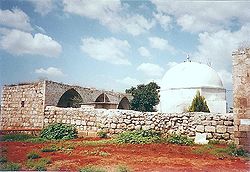 Biblical scholars regard it as obvious, from their geographic overlap and their treatment in older passages, that originally Ephraim and Manasseh were considered one tribe, that of Joseph. According to several biblical scholars, Benjamin was also originally part of this single tribe, but the biblical account of Joseph as his father became lost. The description of Benjamin being born after the arrival in Canaan is thought by some scholars to refer to the tribe of Benjamin coming into existence by branching from the Joseph group after the tribe had settled in Canaan. A number of biblical scholars suspect that the distinction of the Joseph tribes (including Benjamin) is that they were the only Israelites which went to Egypt
and returned
, while the main Israelite tribes simply emerged as a subculture from the Canaanites and had remained in Canaan
throughout. According to this view, the story of Jacob's visit to Laban
to obtain a wife originated as a metaphor
for this migration, with the property and family which were gained from Laban representing the gains of the Joseph tribes by the time they returned from Egypt; according to textual scholars
, the Jahwist
version of the Laban narrative only mentions the Joseph tribes, and Rachel, and does not mention the other tribal matriarchs whatsoever.
Jacob
Jacob "heel" or "leg-puller"), also later known as Israel , as described in the Hebrew Bible, the Talmud, the New Testament and the Qur'an was the third patriarch of the Hebrew people with whom God made a covenant, and ancestor of the tribes of Israel, which were named after his descendants.In the...
's twelve sons, and the second and last son of Rachel
Rachel
Rachel , as described in the Hebrew Bible, is a prophet and the favorite wife of Jacob, one of the three Biblical Patriarchs, and mother of Joseph and Benjamin. She was the daughter of Laban and the younger sister of Leah, Jacob's first wife...
in Jewish, Christian
Christian
A Christian is a person who adheres to Christianity, an Abrahamic, monotheistic religion based on the life and teachings of Jesus of Nazareth as recorded in the Canonical gospels and the letters of the New Testament...
and Islamic tradition
Tradition
A tradition is a ritual, belief or object passed down within a society, still maintained in the present, with origins in the past. Common examples include holidays or impractical but socially meaningful clothes , but the idea has also been applied to social norms such as greetings...
. He was the founder of the Israelite Tribe of Benjamin
Tribe of Benjamin
According to the Hebrew Bible, the Tribe of Benjamin בִּנְיָמִין was one of the Tribes of Israel.From after the conquest of the land by Joshua until the formation of the first Kingdom of Israel in c. 1050 BCE, the Tribe of Benjamin was a part of a loose confederation of Israelite tribes...
. In the Biblical account, unlike Rachel's first son, Joseph
Joseph (Hebrew Bible)
Joseph is an important character in the Hebrew bible, where he connects the story of Abraham, Isaac and Jacob in Canaan to the subsequent story of the liberation of the Israelites from slavery in Egypt....
, Benjamin was born in Canaan
Canaan
Canaan is a historical region roughly corresponding to modern-day Israel, Palestine, Lebanon, and the western parts of Jordan...
. He died in Egypt on the 11th of Marcheshvan (which was also his birthday) 1443 BC at the age of 111.. In the Qur'an
Qur'an
The Quran , also transliterated Qur'an, Koran, Alcoran, Qur’ān, Coran, Kuran, and al-Qur’ān, is the central religious text of Islam, which Muslims consider the verbatim word of God . It is regarded widely as the finest piece of literature in the Arabic language...
, Benjamin is referred to as righteous young child, who remained with Jacob
Jacob
Jacob "heel" or "leg-puller"), also later known as Israel , as described in the Hebrew Bible, the Talmud, the New Testament and the Qur'an was the third patriarch of the Hebrew people with whom God made a covenant, and ancestor of the tribes of Israel, which were named after his descendants.In the...
when the older brothers plotted against Joseph.
Name
According to the TorahTorah
Torah- A scroll containing the first five books of the BibleThe Torah , is name given by Jews to the first five books of the bible—Genesis , Exodus , Leviticus , Numbers and Deuteronomy Torah- A scroll containing the first five books of the BibleThe Torah , is name given by Jews to the first five...
, Benjamin's name arose when Jacob deliberately corrupted the name Benoni, the original name of Benjamin, since Benoni was an allusion to Rachel's dying just after she had given birth
Maternal death
Maternal death, or maternal mortality, also "obstetrical death" is the death of a woman during or shortly after a pregnancy. In 2010, researchers from the University of Washington and the University of Queensland in Brisbane, Australia, estimated global maternal mortality in 2008 at 342,900 , of...
, as it means son of my pain. Textual scholars regard these two names as fragments of naming narratives coming from different sources - one being the Jahwist and the other being the Elohist
Elohist
The Elohist is one of four sources of the Torah described by the Documentary Hypothesis. Its name comes from the term it uses for God: Elohim; it is characterised by, among other things, an abstract view of God, using "Horeb" instead of "Sinai" for the mountain where Moses received the laws of...
.
Etymology
Etymology is the study of the history of words, their origins, and how their form and meaning have changed over time.For languages with a long written history, etymologists make use of texts in these languages and texts about the languages to gather knowledge about how words were used during...
of the name Benjamin is a matter of dispute, though most agree that it is composed of two parts - ben and jamin - the former meaning son of. The literal translation of Benjamin is son of right (as opposed to left), generally interpreted as meaning son of my right hand, though sometimes interpreted as son of the right side. Being associated with the right hand side was traditionally a reference to strength and virtue (cf sinister, which derives from the latin
Latin
Latin is an Italic language originally spoken in Latium and Ancient Rome. It, along with most European languages, is a descendant of the ancient Proto-Indo-European language. Although it is considered a dead language, a number of scholars and members of the Christian clergy speak it fluently, and...
for left). This is, however, not the only literal translation, as the root for right is identical to that for south, hence Benjamin also literally translates as son of the south. This meaning is advocated by several classical rabbinical sources, which argue that it refers to the birth of Benjamin in Canaan, as compared with the birth of all the other sons of Jacob in Aram
Aram-Naharaim
Aram-Naharaim is a region that is mentioned five times in the Hebrew Bible. It is commonly identified with Nahrima mentioned in three tablets of the Amarna correspondence as a geographical description of the kingdom of Mitanni...
. Modern scholars have instead proposed that, with the eponymous Benjamin being just a metaphor, son of the south/son of the right are references to the tribe's being subordinate to the more dominant tribe of Ephraim.
In the Samaritan Pentateuch
Samaritan Pentateuch
The Samaritan Pentateuch, sometimes called Samaritan Torah, , is a version of the Hebrew language Pentateuch, the first five books of the Bible, used by the Samaritans....
, the name is consistently written as בן ימים, with a terminal mem
Mem
Mem is the thirteenth letter of many Semitic abjads, including Phoenician, Aramaic, Hebrew and Arabic...
, making it Benjamim, and would literally translate as son of days. Some classical rabbinical literature argues that this was the original form of the name and was a reference to the advanced age of Jacob when Benjamin was born.
According to classical rabbinical sources, Benjamin was only born after Rachel had fasted for a long time, as a religious devotion with the hope of a new child as a reward. By then Jacob had become over 100 years old. Benjamin is treated as a young child in most of the Biblical narrative, but at one point is abruptly described as the father of ten sons. Textual scholars believe that this is the result of the genealogical passage, in which his children are named, being from a much later source than the Jahwist
Jahwist
The Jahwist, also referred to as the Jehovist, Yahwist, or simply as J, is one of the sources of the Torah. It gets its name from the fact that it characteristically uses the term Yahweh for God in the book of Genesis...
and Elohist
Elohist
The Elohist is one of four sources of the Torah described by the Documentary Hypothesis. Its name comes from the term it uses for God: Elohim; it is characterised by, among other things, an abstract view of God, using "Horeb" instead of "Sinai" for the mountain where Moses received the laws of...
narratives, which make up most of the Joseph narrative, and which consistently describe Benjamin as a child.
Israelites in Egypt
The Torah's Joseph narrative, at a stage when Joseph is unrecognised by his brothers, describes Joseph as testing whether his brothers have reformed, by secretly planting a silver cup in Benjamin's bag, then publicly searching the bags for it, and after finding it in Benjamin's possession, demanding that Benjamin become his slave as a punishment. The narrative goes on to state that when JudahJudah (Biblical figure)
Judah was, according to the Book of Genesis, the fourth son of Jacob and Leah, and the founder of the Israelite Tribe of Judah. Biblical scholars, such as J. A...
(on behalf of the other brothers) begged Joseph not to enslave Benjamin and instead enslave him, since enslavement of Benjamin would break Jacob's heart. This caused Joseph to recant and reveal his identity. The midrashic book of Jasher
Sefer haYashar (midrash)
The Sefer haYashar is a Hebrew midrash also known as the Toledot Adam and Dibre ha-Yamim be-'Aruk. It is known in English translation mostly as The Book of Jasher...
argues that prior to revealing his identity, Joseph asked Benjamin to find his missing brother (i.e. Joseph) via astrology
Astrology
Astrology consists of a number of belief systems which hold that there is a relationship between astronomical phenomena and events in the human world...
, using an astrolabe
Astrolabe
An astrolabe is an elaborate inclinometer, historically used by astronomers, navigators, and astrologers. Its many uses include locating and predicting the positions of the Sun, Moon, planets, and stars, determining local time given local latitude and longitude, surveying, triangulation, and to...
-like tool; it continues by stating that Benjamin divined
Divination
Divination is the attempt to gain insight into a question or situation by way of an occultic standardized process or ritual...
that the man on the throne was Joseph, so Joseph identified himself to Benjamin (but not the other brothers), and revealed his scheme (as in the Torah) to test how fraternal the other brothers were. However, some classical rabbinical sources argue that Joseph identified himself for other reasons. In these sources, Benjamin swore an oath, on the memory of Joseph, that he was innocent of theft, and, when challenged about how believable the oath would be, explained that remembering Joseph was so important to him that he had named his sons in Joseph's honour; these sources go on to state that Benjamin's oath touched Joseph so deeply that Joseph was no longer able to pretend to be a stranger.
In the narrative, just prior to this test, when Joseph had first met all of his brothers (but not identified himself to them), he had held a feast for them; the narrative heavily implies that Benjamin was Joseph's favorite brother, since he is overcome with tears when he first meets Benjamin in particular, and he gives Benjamin five times as much food as he apportions to the others. According to textual scholars, this is really the Jahwist's account of the reunion after Joseph identifies himself, and the account of the threat to enslave Benjamin is just the Elohist's version of the same event, with the Elohist being more terse about Joseph's emotions towards Benjamin, merely mentioning that Benjamin was given five times as many gifts as the others.
Benjamin in Islam
The Qur'anQur'an
The Quran , also transliterated Qur'an, Koran, Alcoran, Qur’ān, Coran, Kuran, and al-Qur’ān, is the central religious text of Islam, which Muslims consider the verbatim word of God . It is regarded widely as the finest piece of literature in the Arabic language...
, in the narrative of Joseph, refers to Benjamin as the righteous youngest son of Jacob
Jacob
Jacob "heel" or "leg-puller"), also later known as Israel , as described in the Hebrew Bible, the Talmud, the New Testament and the Qur'an was the third patriarch of the Hebrew people with whom God made a covenant, and ancestor of the tribes of Israel, which were named after his descendants.In the...
. Muslim
Muslim
A Muslim, also spelled Moslem, is an adherent of Islam, a monotheistic, Abrahamic religion based on the Quran, which Muslims consider the verbatim word of God as revealed to prophet Muhammad. "Muslim" is the Arabic term for "submitter" .Muslims believe that God is one and incomparable...
tradition
Tradition
A tradition is a ritual, belief or object passed down within a society, still maintained in the present, with origins in the past. Common examples include holidays or impractical but socially meaningful clothes , but the idea has also been applied to social norms such as greetings...
, however, fleshes out the details regarding Benjamin and refers to him as being born from Jacob's wife Rachel
Rachel
Rachel , as described in the Hebrew Bible, is a prophet and the favorite wife of Jacob, one of the three Biblical Patriarchs, and mother of Joseph and Benjamin. She was the daughter of Laban and the younger sister of Leah, Jacob's first wife...
, and further links a connection, as does Jewish tradition
Tradition
A tradition is a ritual, belief or object passed down within a society, still maintained in the present, with origins in the past. Common examples include holidays or impractical but socially meaningful clothes , but the idea has also been applied to social norms such as greetings...
, between the names of Benjamin's children and Joseph.
Origin
Egypt
Egypt , officially the Arab Republic of Egypt, Arabic: , is a country mainly in North Africa, with the Sinai Peninsula forming a land bridge in Southwest Asia. Egypt is thus a transcontinental country, and a major power in Africa, the Mediterranean Basin, the Middle East and the Muslim world...
and returned
The Exodus
The Exodus is the story of the departure of the Israelites from ancient Egypt described in the Hebrew Bible.Narrowly defined, the term refers only to the departure from Egypt described in the Book of Exodus; more widely, it takes in the subsequent law-givings and wanderings in the wilderness...
, while the main Israelite tribes simply emerged as a subculture from the Canaanites and had remained in Canaan
Canaan
Canaan is a historical region roughly corresponding to modern-day Israel, Palestine, Lebanon, and the western parts of Jordan...
throughout. According to this view, the story of Jacob's visit to Laban
Laban (Bible)
Laban is the son of Bethuel, brother of Rebekah and the father of Leah and Rachel and Bilhah and Zilpah as described in the Book of Genesis. As such he is brother-in-law to Isaac and both father-in-law and uncle to Jacob...
to obtain a wife originated as a metaphor
Metaphor
A metaphor is a literary figure of speech that uses an image, story or tangible thing to represent a less tangible thing or some intangible quality or idea; e.g., "Her eyes were glistening jewels." Metaphor may also be used for any rhetorical figures of speech that achieve their effects via...
for this migration, with the property and family which were gained from Laban representing the gains of the Joseph tribes by the time they returned from Egypt; according to textual scholars
Textual criticism
Textual criticism is a branch of literary criticism that is concerned with the identification and removal of transcription errors in the texts of manuscripts...
, the Jahwist
Jahwist
The Jahwist, also referred to as the Jehovist, Yahwist, or simply as J, is one of the sources of the Torah. It gets its name from the fact that it characteristically uses the term Yahweh for God in the book of Genesis...
version of the Laban narrative only mentions the Joseph tribes, and Rachel, and does not mention the other tribal matriarchs whatsoever.
Benjamin's sons
According to , Benjamin had ten sons: Bela, Becher, Ashbel, Gera, Naaman, Ehi, Rosh, Muppim, Huppim, and Ard. The name of his wife/wives are not given. Classical rabbinical tradition adds that each son's name honors Joseph:- Belah (meaning swallow), in reference to Joseph disappearing (being swallowed up)
- Becher (meaning first born), in reference to Joseph being the first child of Rachel
- Ashbel (meaning capture), in reference to Joseph having suffered captivity
- Gera (meaning grain), in reference to Joseph living in a foreign land (Egypt)
- Naaman (meaning grace), in reference to Joseph having graceful speech
- Ehi (meaning my brother), in reference to Joseph being Benjamin's only full-brother (as opposed to half-brothers)
- Rosh (meaning elder), in reference to Joseph being older than Benjamin
- Muppim (meaning double mouth), in reference to Joseph passing on what he had been taught by Jacob
- Huppim (meaning marriage canopiesChuppahA chuppah , also huppah, chupah, or chuppa, is a canopy under which a Jewish couple stand during their wedding ceremony. It consists of a cloth or sheet, sometimes a tallit, stretched or supported over four poles, or sometimes manually held up by attendants to the ceremony. A chuppah symbolizes the...
), in reference to Joseph being married in Egypt, while Benjamin was not there - Ard (meaning wanderer/fugitive), in reference to Joseph being like a rose
See also
- Benjamin (disambiguation)Benjamin (disambiguation)-People with the name Benjamin as their only name:* Benjamin, a figure in the Hebrew Bible*Benjamin II , a Romanian traveler*Benjamin , ruler during the 9th-10th centuries CE*Benjamin , 5th century martyr in Persia...
- For a list of persons with the given name Benjamin see
- Kever Benjamin
- Tribe of BenjaminTribe of BenjaminAccording to the Hebrew Bible, the Tribe of Benjamin בִּנְיָמִין was one of the Tribes of Israel.From after the conquest of the land by Joshua until the formation of the first Kingdom of Israel in c. 1050 BCE, the Tribe of Benjamin was a part of a loose confederation of Israelite tribes...
External links
- The Jewish Encyclopedia, 1908: Benjamin. Material on the tribe, its territory, Rabbinical tradition and Islam.