

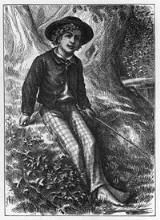
The Adventures of Tom Sawyer

Encyclopedia
The Adventures of Tom Sawyer by Mark Twain
is an 1876 novel
about a young boy growing up along the Mississippi River
. The story is set in the Town
of "St. Petersburg", inspired by Hannibal, Missouri
, where Mark Twain
lived.
lives with his Aunt Polly and his half-brother, Sid, in the Mississippi River town of St. Petersburg, Missouri
. After playing hooky from school on Friday and dirtying his clothes in a fight, Tom is made to whitewash the fence as punishment on Saturday. At first, Tom is disappointed by having to forfeit his day off. However, he soon cleverly persuades his friends to trade him small treasures for the privilege of doing his work. Later, he realizes that in order to make a man or a boy covet a thing, it is only necessary to make the thing difficult to attain. He trades the treasures he got by tricking his friends for whitewashing for tickets given out in Sunday school for memorizing Bible verses, which can be used to claim a Bible as a prize. He received enough tickets to be given the Bible. However, he loses much of his glory when, in response to a question to show off his knowledge, he incorrectly answers that the first two disciples were David and Goliath.
Tom falls in love with Becky Thatcher, a new girl in town, and persuades her to get "engaged" by kissing him. Becky kisses Tom, but their romance collapses when she learns that Tom has been "engaged" previously — to a girl named Amy Lawrence. Shortly after being shunned by Becky, Tom accompanies Huckleberry Finn, the son of the town drunk, to the graveyard at night to try out a "cure" for warts with a dead cat. At the graveyard, they witness the murder of young Dr. Robinson by the Native-American "half-breed" Injun Joe. Scared, Tom and Huck run away and swear a blood oath not to tell anyone what they have seen. Injun Joe frames his companion, Muff Potter, a hapless drunk, for the crime. Potter is wrongfully arrested, and Tom's anxiety and guilt begin to grow.
Tom, Huck, and Tom's friend Joe Harper run away to an island to become pirates. While frolicking around and enjoying their new found freedom, the boys become aware that the community is sounding the river for their bodies. Tom sneaks back home one night to observe the commotion. After a brief moment of remorse at the suffering of his loved ones, Tom is struck by the idea of appearing at his funeral and surprising everyone. He persuades Joe and Huck to do the same. Their return is met with great rejoicing, and they become the envy and admiration of all their friends.
Back in school, Tom gets himself back in Becky's favor after he nobly accepts the blame for a book that she has ripped. Soon, Muff Potter's trial begins, and Tom, overcome by guilt, testifies against Injun Joe. Potter is acquitted, but Injun Joe flees the courtroom through a window.
Summer arrives, and Tom and Huck go hunting for buried treasure in a haunted house. After venturing upstairs they hear a noise below. Peering through holes in the floor, they see Injun Joe enter the house disguised as a deaf and mute Spaniard. He and his companion, an unkempt man, plan to bury some stolen treasure of their own. From their hiding spot, Tom and Huck wriggle with delight at the prospect of digging it up. By an amazing coincidence, Injun Joe and his partner find a buried box of gold themselves. When they see Tom and Huck's tools, they become suspicious that someone is sharing their hiding place and carry the gold off instead of reburying it.
Huck begins to shadow Injun Joe every night, watching for an opportunity to nab the gold. Meanwhile, Tom goes on a picnic to McDougal's Cave with Becky and their classmates. That same night, Huck sees Injun Joe and his partner making off with a box. He follows and overhears their plans to attack the Widow Douglas, a kind resident of St. Petersburg. By running to fetch help, Huck forestalls the violence and becomes an anonymous hero.
Tom and Becky get lost in the cave, and their absence is not discovered until the following morning. The men of the town begin to search for them, but to no avail. Tom and Becky run out of food and candles and begin to weaken. The horror of the situation increases when Tom, looking for a way out of the cave, happens upon Injun Joe, who is using the cave as a hideout. Eventually, just as the searchers are giving up, Tom finds a way out. The town celebrates, and Becky's father, Judge Thatcher, locks up the cave. Injun Joe, trapped inside, starves to death.
A week later, Tom takes Huck to the cave and they find the box of gold, the proceeds of which are invested for them. The Widow Douglas adopts Huck, and, when Huck attempts to escape civilized life, Tom promises him that if he returns to the widow, he can join Tom's robber band. Reluctantly, Huck agrees.
.
In 1960, Boyd's musical version (re-titled Tom Sawyer) was presented professionally at Theatre Royal Stratford East
in London, England, and in 1961 toured provincial theatres in England
.Tom Boyd's musical of TOM SAWYER was produced again in April and June 2010 in Cirencester, Gloucestershire, England.
Another musical adaptation is Mississippi Melody, a musical by Jack Hylton.
In April 2010, The Hartford Stage presented a theatrical adaptation entitled Mark Twain's The Adventures of Tom Sawyer as part of a centennial observation of Mark Twain's passing.
in Kansas City, Mo. The score was by Broadway composer Maury Yeston
. The choreographer was William Whitener, artistic director of the Kansas City Ballet
.
is featured on the Canadian rock band Rush
's eighth studio album Moving Pictures
.
Mark Twain
Samuel Langhorne Clemens , better known by his pen name Mark Twain, was an American author and humorist...
is an 1876 novel
Novel
A novel is a book of long narrative in literary prose. The genre has historical roots both in the fields of the medieval and early modern romance and in the tradition of the novella. The latter supplied the present generic term in the late 18th century....
about a young boy growing up along the Mississippi River
Mississippi River
The Mississippi River is the largest river system in North America. Flowing entirely in the United States, this river rises in western Minnesota and meanders slowly southwards for to the Mississippi River Delta at the Gulf of Mexico. With its many tributaries, the Mississippi's watershed drains...
. The story is set in the Town
Town
A town is a human settlement larger than a village but smaller than a city. The size a settlement must be in order to be called a "town" varies considerably in different parts of the world, so that, for example, many American "small towns" seem to British people to be no more than villages, while...
of "St. Petersburg", inspired by Hannibal, Missouri
Hannibal, Missouri
Hannibal is a city in Marion and Ralls counties in the U.S. state of Missouri. Hannibal is located at the intersection of Interstate 72 and U.S. Routes 24, 36 and 61, approximately northwest of St. Louis. According to the 2010 U.S. Census the population was 17,606...
, where Mark Twain
Mark Twain
Samuel Langhorne Clemens , better known by his pen name Mark Twain, was an American author and humorist...
lived.
Plot
In the 1840s an imaginative and mischievous boy named Tom SawyerTom Sawyer
Thomas "Tom" Sawyer is the title character of the Mark Twain novel The Adventures of Tom Sawyer . He appears in three other novels by Twain: Adventures of Huckleberry Finn , Tom Sawyer Abroad , and Tom Sawyer, Detective .Sawyer also appears in at least three unfinished Twain works, Huck and Tom...
lives with his Aunt Polly and his half-brother, Sid, in the Mississippi River town of St. Petersburg, Missouri
Missouri
Missouri is a US state located in the Midwestern United States, bordered by Iowa, Illinois, Kentucky, Tennessee, Arkansas, Oklahoma, Kansas and Nebraska. With a 2010 population of 5,988,927, Missouri is the 18th most populous state in the nation and the fifth most populous in the Midwest. It...
. After playing hooky from school on Friday and dirtying his clothes in a fight, Tom is made to whitewash the fence as punishment on Saturday. At first, Tom is disappointed by having to forfeit his day off. However, he soon cleverly persuades his friends to trade him small treasures for the privilege of doing his work. Later, he realizes that in order to make a man or a boy covet a thing, it is only necessary to make the thing difficult to attain. He trades the treasures he got by tricking his friends for whitewashing for tickets given out in Sunday school for memorizing Bible verses, which can be used to claim a Bible as a prize. He received enough tickets to be given the Bible. However, he loses much of his glory when, in response to a question to show off his knowledge, he incorrectly answers that the first two disciples were David and Goliath.
Tom falls in love with Becky Thatcher, a new girl in town, and persuades her to get "engaged" by kissing him. Becky kisses Tom, but their romance collapses when she learns that Tom has been "engaged" previously — to a girl named Amy Lawrence. Shortly after being shunned by Becky, Tom accompanies Huckleberry Finn, the son of the town drunk, to the graveyard at night to try out a "cure" for warts with a dead cat. At the graveyard, they witness the murder of young Dr. Robinson by the Native-American "half-breed" Injun Joe. Scared, Tom and Huck run away and swear a blood oath not to tell anyone what they have seen. Injun Joe frames his companion, Muff Potter, a hapless drunk, for the crime. Potter is wrongfully arrested, and Tom's anxiety and guilt begin to grow.
Tom, Huck, and Tom's friend Joe Harper run away to an island to become pirates. While frolicking around and enjoying their new found freedom, the boys become aware that the community is sounding the river for their bodies. Tom sneaks back home one night to observe the commotion. After a brief moment of remorse at the suffering of his loved ones, Tom is struck by the idea of appearing at his funeral and surprising everyone. He persuades Joe and Huck to do the same. Their return is met with great rejoicing, and they become the envy and admiration of all their friends.
Back in school, Tom gets himself back in Becky's favor after he nobly accepts the blame for a book that she has ripped. Soon, Muff Potter's trial begins, and Tom, overcome by guilt, testifies against Injun Joe. Potter is acquitted, but Injun Joe flees the courtroom through a window.
Summer arrives, and Tom and Huck go hunting for buried treasure in a haunted house. After venturing upstairs they hear a noise below. Peering through holes in the floor, they see Injun Joe enter the house disguised as a deaf and mute Spaniard. He and his companion, an unkempt man, plan to bury some stolen treasure of their own. From their hiding spot, Tom and Huck wriggle with delight at the prospect of digging it up. By an amazing coincidence, Injun Joe and his partner find a buried box of gold themselves. When they see Tom and Huck's tools, they become suspicious that someone is sharing their hiding place and carry the gold off instead of reburying it.
Huck begins to shadow Injun Joe every night, watching for an opportunity to nab the gold. Meanwhile, Tom goes on a picnic to McDougal's Cave with Becky and their classmates. That same night, Huck sees Injun Joe and his partner making off with a box. He follows and overhears their plans to attack the Widow Douglas, a kind resident of St. Petersburg. By running to fetch help, Huck forestalls the violence and becomes an anonymous hero.
Tom and Becky get lost in the cave, and their absence is not discovered until the following morning. The men of the town begin to search for them, but to no avail. Tom and Becky run out of food and candles and begin to weaken. The horror of the situation increases when Tom, looking for a way out of the cave, happens upon Injun Joe, who is using the cave as a hideout. Eventually, just as the searchers are giving up, Tom finds a way out. The town celebrates, and Becky's father, Judge Thatcher, locks up the cave. Injun Joe, trapped inside, starves to death.
A week later, Tom takes Huck to the cave and they find the box of gold, the proceeds of which are invested for them. The Widow Douglas adopts Huck, and, when Huck attempts to escape civilized life, Tom promises him that if he returns to the widow, he can join Tom's robber band. Reluctantly, Huck agrees.
Film
- Tom SawyerTom Sawyer (1930 film)Tom Sawyer is a 1930 American drama film directed by John Cromwell. The screenplay by Grover Jones, William Slavens McNutt, and Sam Mintz is based on the 1876 novel The Adventures of Tom Sawyer by Mark Twain....
(1930 film), directed by John CromwellJohn CromwellJohn Cromwell may refer to:*John Cromwell , American film director*John P. Cromwell , American naval officer...
, starring Jackie CooganJackie CooganJohn Leslie Coogan , known professionally as Jackie Coogan, was an American actor who began his movie career as a child actor in silent films. Many years later, he became known as Uncle Fester on 1960s sitcom The Addams Family...
as Tom - A 1936 Soviet UnionSoviet UnionThe Soviet Union , officially the Union of Soviet Socialist Republics , was a constitutionally socialist state that existed in Eurasia between 1922 and 1991....
version, directed by Lazar Frenkel and Gleb Zatvornitsky - In 1938 The Adventures of Tom SawyerThe Adventures of Tom Sawyer (1938 film)The Adventures of Tom Sawyer is a 1938 American drama film directed by Norman Taurog. The screenplay by John V.A. Weaver was based on the classic 1876 novel by Mark Twain.-Plot:...
was filmed in TechnicolorTechnicolorTechnicolor is a color motion picture process invented in 1916 and improved over several decades.It was the second major process, after Britain's Kinemacolor, and the most widely used color process in Hollywood from 1922 to 1952...
by the SelznickDavid O. SelznickDavid O. Selznick was an American film producer. He is best known for having produced Gone with the Wind and Rebecca , both of which earned him an Oscar for Best Picture.-Early years:...
Studio. It starred Tommy Kelly as Tom and was directed by Norman TaurogNorman TaurogNorman Rae Taurog was an American film director, and screenwriter.Between 1920 and 1968, Taurog directed over 140 films, and directed Elvis Presley in more movies than any other director...
. Most notable was the cave sequence designed by William Cameron MenziesWilliam Cameron MenziesWilliam Cameron Menzies was an Academy Award-winning American film production designer and art director who also worked as a director, producer, and screenwriter during a career spanning five decades...
. - A 1968 French/German made-for-television miniseries, directed by Wolfgang LiebeneinerWolfgang LiebeneinerWolfgang Georg Louis Liebeneiner was a German actor, film director and theater director.He was born in Liebau in Prussian Silesia. In 1928, he was taught by Otto Falckenberg, the director of the Munich Kammerspiele, in acting and directing...
, starring Roland Demongeot as Tom and Marc Di Napoli as Huck - The New Adventures of Huckleberry FinnThe New Adventures of Huckleberry FinnThe New Adventures of Huckleberry Finn was a half-hour live-action/animated series produced by Hanna-Barbera Productions on NBC primetime in 1968, based on the famous Mark Twain characters.-Plot:...
(1968) was a half-hour live-action/animated series produced by Hanna-Barbera Productions - A 1969 Mexican film called Las Aventuras de Juliancito
- Tom Sawyer (1973 film), A musical adaption.
- A TV movie version sponsored by Dr PepperDr PepperDr Pepper is a soft drink, marketed as having a unique flavor. The drink was created in the 1880s by Charles Alderton of Waco, Texas and first served around 1885. Dr Pepper was first nationally marketed in the United States in 1904 and is now also sold in Europe, Asia, Canada, Mexico, Australia ...
was released that same year. It starred Buddy EbsenBuddy EbsenBuddy Ebsen was an American character actor and dancer. A performer for seven decades, he had starring roles as Jed Clampett in the long-running television series The Beverly Hillbillies and as the title character in the 1970s detective series Barnaby Jones, and played Barnaby Jones in the movie...
as Muff Potter and was filmed in Upper Canada VillageUpper Canada VillageUpper Canada Village is a heritage park in the village of Riverside near Morrisburg, Ontario, which depicts a 19th-century village in Upper Canada.-History:...
. - Huckleberry Finn and His Friends (1979 TV series)
- The Adventures of Tom Sawyer (anime) (1980), a JapanJapanJapan is an island nation in East Asia. Located in the Pacific Ocean, it lies to the east of the Sea of Japan, China, North Korea, South Korea and Russia, stretching from the Sea of Okhotsk in the north to the East China Sea and Taiwan in the south...
ese animeAnimeis the Japanese abbreviated pronunciation of "animation". The definition sometimes changes depending on the context. In English-speaking countries, the term most commonly refers to Japanese animated cartoons....
TV series by Nippon AnimationNippon Animationis a Japanese animation studio. The company is headquartered in Tokyo, with chief offices in the Ginza district of Chūō and production facilities in Tama City....
, part of the World Masterpiece TheaterWorld Masterpiece Theateris a Japanese TV anime staple that showcased an animated version of a different classical book or story each year on 7:30p.m. on Sunday. It originally aired from 1969 to 1997 then resumed in 2007....
; aired in the United States on HBOHome Box OfficeHBO, short for Home Box Office, is an American premium cable television network, owned by Time Warner. , HBO's programming reaches 28.2 million subscribers in the United States, making it the second largest premium network in America . In addition to its U.S... - The Adventures of Tom Sawyer and Huckleberry Finn (Приключения Тома Сойера и Гекльберри Финна), a 1981 Soviet UnionSoviet UnionThe Soviet Union , officially the Union of Soviet Socialist Republics , was a constitutionally socialist state that existed in Eurasia between 1922 and 1991....
version directed by Stanislav GovorukhinStanislav GovorukhinStanislav Sergeyevich Govorukhin has been one of the most popular Soviet and Russian film directors since the 1960s...
. - A 1984 CanadianCanadaCanada is a North American country consisting of ten provinces and three territories. Located in the northern part of the continent, it extends from the Atlantic Ocean in the east to the Pacific Ocean in the west, and northward into the Arctic Ocean...
claymation version produced by Hal RoachHal RoachHarold Eugene "Hal" Roach, Sr. was an American film and television producer and director, and from the 1910s to the 1990s.- Early life and career :Hal Roach was born in Elmira, New York...
studios - Tom and HuckTom and HuckTom and Huck is a 1995 Disney film starring Jonathan Taylor Thomas, Brad Renfro, Joey Stinson, and Rachael Leigh Cook; it is based on Mark Twain's novel The Adventures of Tom Sawyer. In the film, mischievous young Tom Sawyer witnesses a murder by the vicious Native American known as "Injun Joe"...
(1995), starring Jonathan Taylor ThomasJonathan Taylor ThomasJonathan Taylor Thomas is an American actor, voice actor, former child star, and teen idol...
as Tom and Brad RenfroBrad RenfroBrad Barron Renfro was an American actor. He made his film debut in 1994 at age 12 in the lead role of Joel Schumacher's The Client, going on to star in 21 feature films, several short films, and two television episodes during his career. Much of his later career was marred by a pattern of...
as Huck Finn - A 1995 episode for the PBSPublic Broadcasting ServiceThe Public Broadcasting Service is an American non-profit public broadcasting television network with 354 member TV stations in the United States which hold collective ownership. Its headquarters is in Arlington, Virginia....
television series WishboneWishbone (TV series)Wishbone is a television show which aired from 1995 to 1998 and reruns from 1998 to 2001 in the United States featuring a Jack Russell Terrier of the same name. The main character, the talking dog Wishbone, lives with his owner Joe Talbot in the fictional modern town of Oakdale, Texas...
, entitled "A Tail in Twain". - A 2000Tom Sawyer (2000 film)Tom Sawyer is a 2000 direct-to-video animated film from MGM. It is an adaptation of Mark Twain's The Adventures of Tom Sawyer, with a cast of anthropomorphic animals instead of humans...
animated adaptation, featuring the characters as anthropomorphic animals with an all-star voice cast, including country singers Rhett AkinsRhett AkinsThomas Rhett Akins Sr. is an American country singer and songwriter. Signed to Decca Records between 1994 and 1997, he released two albums for the label , followed by 1998's What Livin's All About on MCA Nashville. Friday Night in Dixie was released in 2002 on Audium Entertainment...
(as Tom), Mark WillsMark WillsDaryl Mark Williams is an American country music artist, best known professionally as Mark Wills. Signed to Mercury Records between 1996 and 2003, he released five studio albums for the label — Mark Wills, Wish You Were Here, Permanently, Loving Every Minute and And the Crowd Goes Wild — as well...
(as Huck Finn), Lee Ann WomackLee Ann WomackLee Ann Womack is an American country music singer and songwriter, who is best known for her old fashioned-styled country music songs that often discuss subjects such as cheating and lost love....
, Waylon JenningsWaylon JenningsWaylon Arnold Jennings was an American country music singer, songwriter, and musician. Jennings began playing at eight. He began performing at twelve, on KVOW radio. Jennings formed a band The Texas Longhorns. Jennings worked as a D.J on KVOW, KDAV and KLLL...
and Hank Williams Jr. as well as Betty WhiteBetty WhiteBetty White Ludden , better known as Betty White, is an American actress, comedienne, singer, author, and former game show personality. With a career spanning seven decades since 1939, she is best known to modern audiences for her television roles as Sue Ann Nivens on The Mary Tyler Moore Show and...
as Aunt Polly - Tom Sawyer appears as a United States Secret ServiceUnited States Secret ServiceThe United States Secret Service is a United States federal law enforcement agency that is part of the United States Department of Homeland Security. The sworn members are divided among the Special Agents and the Uniformed Division. Until March 1, 2003, the Service was part of the United States...
agent in the 2003 movie The League of Extraordinary GentlemenThe League of Extraordinary Gentlemen (film)The League of Extraordinary Gentlemen is a 2003 superhero film adaptation loosely based on characters from the comic book limited series The League of Extraordinary Gentlemen by Alan Moore, who is also famous for Watchmen, V for Vendetta, and From Hell. It was released on July 11, 2003, in the...
Theatrical
In 1956 'We're From Missouri', a musical adaptation of The Adventures of Tom Sawyer, with book, music and lyrics by Tom Boyd, was presented by the students at the Guildhall School of Music and DramaGuildhall School of Music and Drama
Guildhall School of Music and Drama is an independent music and dramatic arts school which was founded in 1880 in London, England. Students can pursue courses in Music, Opera, Drama and Technical Theatre Arts.-History:...
.
In 1960, Boyd's musical version (re-titled Tom Sawyer) was presented professionally at Theatre Royal Stratford East
Theatre Royal Stratford East
The Theatre Royal Stratford East is a theatre in Stratford in the London Borough of Newham. Since 1953, it has been the home of the Theatre Workshop company.-History:...
in London, England, and in 1961 toured provincial theatres in England
England
England is a country that is part of the United Kingdom. It shares land borders with Scotland to the north and Wales to the west; the Irish Sea is to the north west, the Celtic Sea to the south west, with the North Sea to the east and the English Channel to the south separating it from continental...
.Tom Boyd's musical of TOM SAWYER was produced again in April and June 2010 in Cirencester, Gloucestershire, England.
Another musical adaptation is Mississippi Melody, a musical by Jack Hylton.
In April 2010, The Hartford Stage presented a theatrical adaptation entitled Mark Twain's The Adventures of Tom Sawyer as part of a centennial observation of Mark Twain's passing.
Ballet
"Tom Sawyer: A Ballet in Three Acts" received its world premiere Oct. 14, 2011 at the Kauffman Center for the Performing ArtsKauffman Center for the Performing Arts
The Kauffman Center for the Performing Arts is a newly inaugurated performing arts center in downtown Kansas City, Missouri, USA, at 16th and Broadway near the Power & Light District, the Sprint Center and the Crossroads Arts District. Its construction was a major part of the ongoing redevelopment...
in Kansas City, Mo. The score was by Broadway composer Maury Yeston
Maury Yeston
Maury Yeston is an American composer, lyricist, educator and musicologist.He is known for writing the music and lyrics to Broadway musicals, including Nine in 1982, and Titanic in 1997, both of which won Tony Awards for best musical and best score. He also won a Drama Desk Award for Nine...
. The choreographer was William Whitener, artistic director of the Kansas City Ballet
Kansas City Ballet
Founded in 1957, Kansas City Ballet is a 25-member professional ballet company under the direction of Artistic Director William Whitener and Executive Director Jeffrey J. Bentley. Kansas City Ballet performs three mixed repertory seasons per year as well as the ever-popular Nutcracker...
.
Literature
Don Borchert's The Adventures of Tom Sawyer and The Undead is a retelling of the story set in an alternate universe with a zombie outbreak.Internet
On November 30, 2011 to celebrate Twain’s 176th birthday, the Google doodle was a scene from The Adventures of Tom Sawyer.Music
A song called Tom SawyerTom Sawyer (song)
"Tom Sawyer" is a song by Canadian rock band Rush, named after Mark Twain's literary character. The song was released on Mercury Records and PolyGram in 1981 on the Moving Pictures album and numerous compilations thereafter, such as 1990's Chronicles. It has also appeared on several live albums and...
is featured on the Canadian rock band Rush
Rush (band)
Rush is a Canadian rock band formed in August 1968, in the Willowdale neighbourhood of Toronto, Ontario. The band is composed of bassist, keyboardist, and lead vocalist Geddy Lee, guitarist Alex Lifeson, and drummer and lyricist Neil Peart...
's eighth studio album Moving Pictures
Moving Pictures (album)
- Personnel :* Geddy Lee - Bass guitar; Minimoog; Oberheim 8-voice synthesizer; OB-X, Moog Taurus bass pedals, vocals* Alex Lifeson - Electric and acoustic guitars, Moog Taurus...
.
External links
- The Adventures of Tom Sawyer, 135th Anniversary Edition, University of California Press, 2010.
- The Adventures of Tom Sawyer with embedded audio (PDF available)
- Free audio book at LibriVox
- Twain, Mark, 1835-1910. The Adventures of Tom Sawyer - Free eBook in HTML format at the Electronic Text Center, University of Virginia Library.
- Project Gutenberg ebook in various formats
- The Adventures of Tom Sawyer guide for students and teachers
- First edition illustrations by True Williams