

Barometer

Encyclopedia
Meteorology
Meteorology is the interdisciplinary scientific study of the atmosphere. Studies in the field stretch back millennia, though significant progress in meteorology did not occur until the 18th century. The 19th century saw breakthroughs occur after observing networks developed across several countries...
to measure atmospheric pressure
Atmospheric pressure
Atmospheric pressure is the force per unit area exerted into a surface by the weight of air above that surface in the atmosphere of Earth . In most circumstances atmospheric pressure is closely approximated by the hydrostatic pressure caused by the weight of air above the measurement point...
. Pressure tendency can forecast short term changes in the weather. Numerous measurements of air pressure are used within surface weather analysis
Surface weather analysis
Surface weather analysis is a special type of weather map that provides a view of weather elements over a geographical area at a specified time based on information from ground-based weather stations...
to help find surface troughs, high pressure systems, and frontal boundaries.
History
Although Evangelista TorricelliEvangelista Torricelli
Evangelista Torricelli was an Italian physicist and mathematician, best known for his invention of the barometer.-Biography:Evangelista Torricelli was born in Faenza, part of the Papal States...
is universally credited with inventing the barometer in 1643, historical documentation also suggests Gasparo Berti
Gasparo Berti
Gasparo Berti was an Italian mathematician, astronomer and physicist. He was probably born in Mantua and spent most of his life in Rome. He is most famous today for his experiment in which he unknowingly created the first working barometer...
, an Italian mathematician and astronomer, unintentionally built a water barometer sometime between 1640 and 1643. French scientist and philosopher René Descartes
René Descartes
René Descartes ; was a French philosopher and writer who spent most of his adult life in the Dutch Republic. He has been dubbed the 'Father of Modern Philosophy', and much subsequent Western philosophy is a response to his writings, which are studied closely to this day...
described the design of an experiment to determine atmospheric pressure as early as 1631, but there is no evidence that he built a working barometer at that time.
On July 27, 1630, Giovanni Battista Baliani
Giovanni Battista Baliani
Giovanni Battista Baliani was an Italian mathematician, physicist and astronomer.-Biography:He was born in Genoa. He was governor of Savona in 1647–1649 and captain of the Republic of Genoa's archers...
wrote a letter to Galileo Galilei
Galileo Galilei
Galileo Galilei , was an Italian physicist, mathematician, astronomer, and philosopher who played a major role in the Scientific Revolution. His achievements include improvements to the telescope and consequent astronomical observations and support for Copernicanism...
explaining an experiment he had made in which a siphon
Siphon
The word siphon is sometimes used to refer to a wide variety of devices that involve the flow of liquids through tubes. But in the English language today, the word siphon usually refers to a tube in an inverted U shape which causes a liquid to flow uphill, above the surface of the reservoir,...
, led over a hill about twenty-one meters high, failed to work. Galileo responded with an explanation of the phenomena: he proposed that it was the power of a vacuum that held the water up, and at a certain height the amount of water simply became too much and the force could not hold any more, like a cord that can support only so much weight.
Galileo's ideas reached Rome in December 1638 in his Discorsi. Raffaele Magiotti and Gasparo Berti
Gasparo Berti
Gasparo Berti was an Italian mathematician, astronomer and physicist. He was probably born in Mantua and spent most of his life in Rome. He is most famous today for his experiment in which he unknowingly created the first working barometer...
were excited by these ideas, and decided to seek a better way to attempt to produce a vacuum than with a siphon. Magiotti devised such an experiment, and sometime between 1639 and 1641, Berti (with Magiotti, Athanasius Kircher and Niccolò Zucchi present) carried it out.
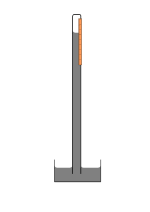
Four accounts of Berti's experiment exist, but a simple model of his experiment consisted of filling with water a long tube that had both ends plugged, then standing the tube in a basin already full of water. The bottom end of the tube was opened, and water that had been inside of it poured out into the basin. However, only part of the water in the tube flowed out, and the level of the water inside the tube stayed at an exact level, which happened to be 10.3 m, the same height Baliani and Galileo had observed that was limited by the siphon. What was most important about this experiment was that the lowering water had left a space above it in the tube which had had no intermediate contact with air to fill it up. This seemed to suggest the possibility of a vacuum existing in the space above the water.
Torricelli, a friend and student of Galileo, dared to look at the entire problem from a different angle. In a letter to Michelangelo Ricci in 1644 concerning the experiments with the water barometer, he wrote:
Many have said that a vacuum does not exist, others that it does exist in spite of the repugnance of nature and with difficulty; I know of no one who has said that it exists without difficulty and without a resistance from nature. I argued thus: If there can be found a manifest cause from which the resistance can be derived which is felt if we try to make a vacuum, it seems to me foolish to try to attribute to vacuum those operations which follow evidently from some other cause; and so by making some very easy calculations, I found that the cause assigned by me (that is, the weight of the atmosphere) ought by itself alone to offer a greater resistance than it does when we try to produce a vacuum.
It was traditionally thought (especially by the Aristotelians) that the air did not have lateral weight: that is, that the kilometers of air above the surface did not exert any weight above bodies. Even Galileo had accepted the weightlessness of air as a simple truth. Torricelli questioned that assumption, and instead proposed that air had weight, and that it was the latter (not the attracting force of the vacuum) which held (or rather, pushed) up the column of water. He thought that the level the water stayed at (c. 10.3 m) was reflective of the force of the air's weight pushing on it (specifically, pushing on the water in the basin and thus limiting how much water can fall from the tube into it). In other words, he viewed the barometer as a balance, an instrument for measurement (as opposed to merely being an instrument to create a vacuum), and because he was the first to view it this way, he is traditionally considered the inventor of the barometer (in the sense in which we use the term now).
Because of rumors circulating in Torricelli's gossipy Italian neighborhood, which included that he was engaged in some form of sorcery or witchcraft, Torricelli realized he had to keep his experiment secret to avoid the risk of being arrested. He needed to use a liquid that was heavier than water, and from his previous association and suggestions by Galileo, he deduced by using mercury, a shorter tube could be used. With mercury, then called "quicksilver", which is about 14 times heavier than water, a tube only 80 cm was now needed, not 10.5 m.
In 1646, Blaise Pascal along with Pierre Petit, had repeated and perfected Torricelli's experiment after hearing about it from Marin Mersenne, who himself had been shown the experiment by Torricelli toward the end of 1644. Pascal further devised an experiment to test the Aristotelian proposition that it was vapors from the liquid that filled the space in a barometer. His experiment compared water with wine, and since the latter was considered more "spiritous", the Aristotelians expected the wine to stand lower (since more vapors would mean more pushing down on the liquid column). Pascal performed the experiment publicly, inviting the Aristotelians to predict the outcome beforehand. The Aristotelians predicted the wine would stand lower. It did not.
However, Pascal went even further to test the mechanical theory. If, as suspected by mechanical philosophers like Torricelli and Pascal, air had lateral weight, the weight of the air would be less at higher altitudes. Therefore, Pascal wrote to his brother-in-law, Florin Perier, who lived near a mountain called the Puy de Dome, asking him to perform a crucial experiment. Perier was to take a barometer up the Puy de Dome and make measurements along the way of the height of the column of mercury. He was then to compare it to measurements taken at the foot of the mountain to see if those measurements taken higher up were in fact smaller. In September 1648, Perier carefully and meticulously carried out the experiment, and found that Pascal's predictions had been correct. The mercury barometer stood lower the higher one went.
Water-based barometers
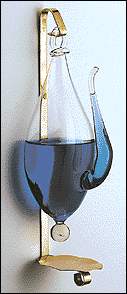
The concept that decreasing atmospheric pressure predicts stormy weather, postulated by Lucien Vidie, provides the theoretical basis for a weather prediction device called a "storm glass" or a "Goethe barometer" (named for Johann Wolfgang Von GoetheJohann Wolfgang von Goethe
Johann Wolfgang von Goethe was a German writer, pictorial artist, biologist, theoretical physicist, and polymath. He is considered the supreme genius of modern German literature. His works span the fields of poetry, drama, prose, philosophy, and science. His Faust has been called the greatest long...
, the renowned German writer and polymath
Polymath
A polymath is a person whose expertise spans a significant number of different subject areas. In less formal terms, a polymath may simply be someone who is very knowledgeable...
who developed a simple but effective weather ball barometer using the principles developed by Torricelli
Torricelli
-People:* Evangelista Torricelli, an Italian physicist and mathematician* Robert Torricelli, a former United States politician* Moreno Torricelli, a former Italian football player* Giuseppe Antonio Torricelli, an Italian sculptor-Science:* Torricelli's Law...
).
The weather ball barometer consists of a glass container with a sealed body, half filled with water. A narrow spout connects to the body below the water level and rises above the water level. The narrow spout is open to the atmosphere. When the air pressure is lower than it was at the time the body was sealed, the water level in the spout will rise above the water level in the body; when the air pressure is higher, the water level in the spout will drop below the water level in the body. A variation of this type of barometer can be easily made at home.
Mercury barometers
A mercury barometer has a glass tube with a height of at least 84 cmMetre
The metre , symbol m, is the base unit of length in the International System of Units . Originally intended to be one ten-millionth of the distance from the Earth's equator to the North Pole , its definition has been periodically refined to reflect growing knowledge of metrology...
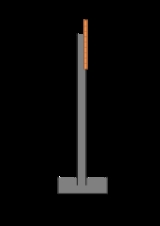
, closed at one end, with an open mercury-filled reservoir at the base. The weight of the mercury creates a vacuum in the top of the tube. Mercury in the tube adjusts until the weight of the mercury column balances the atmospheric force exerted on the reservoir. High atmospheric pressure places more force on the reservoir, forcing mercury higher in the column. Low pressure allows the mercury to drop to a lower level in the column by lowering the force placed on the reservoir. Since higher temperature at the instrument will reduce the density of the mercury, the scale for reading the height of the mercury is adjusted to compensate for this effect.
Torricelli documented that the height of the mercury in a barometer changed slightly each day and concluded that this was due to the changing pressure in the atmosphere
Earth's atmosphere
The atmosphere of Earth is a layer of gases surrounding the planet Earth that is retained by Earth's gravity. The atmosphere protects life on Earth by absorbing ultraviolet solar radiation, warming the surface through heat retention , and reducing temperature extremes between day and night...
. He wrote: "We live submerged at the bottom of an ocean of elementary air, which is known by incontestable experiments to have weight".
The mercury barometer's design gives rise to the expression of atmospheric pressure in inches or millimeters (torr): the pressure is quoted as the level of the mercury's height in the vertical column. 1 atmosphere is equivalent to about 760 millimeters of mercury.
Design changes to make the instrument more sensitive, simpler to read, and easier to transport resulted in variations such as the basin, siphon, wheel, cistern, Fortin, multiple folded, stereometric, and balance barometers. Fitzroy
Robert FitzRoy
Vice-Admiral Robert FitzRoy RN achieved lasting fame as the captain of HMS Beagle during Charles Darwin's famous voyage, and as a pioneering meteorologist who made accurate weather forecasting a reality...
barometers combine the standard mercury barometer with a thermometer, as well as a guide of how to interpret pressure changes. Fortin barometers use a variable displacement mercury cistern, usually constructed with a thumbscrew pressing on a leather diaphragm bottom. This compensates for displacement of mercury in the column with varying pressure. To use a Fortin barometer, the level of mercury is set to the zero level before the pressure is read on the column. Some models also employ a valve for closing the cistern, enabling the mercury column to be forced to the top of the column for transport. This prevents water-hammer damage to the column in transit.
On June 5, 2007, a European Union
European Union
The European Union is an economic and political union of 27 independent member states which are located primarily in Europe. The EU traces its origins from the European Coal and Steel Community and the European Economic Community , formed by six countries in 1958...
directive was enacted to restrict the sale of mercury, thus effectively ending the production of new mercury barometers in Europe.
Aneroid barometers
Alloy
An alloy is a mixture or metallic solid solution composed of two or more elements. Complete solid solution alloys give single solid phase microstructure, while partial solutions give two or more phases that may or may not be homogeneous in distribution, depending on thermal history...
of beryllium
Beryllium
Beryllium is the chemical element with the symbol Be and atomic number 4. It is a divalent element which occurs naturally only in combination with other elements in minerals. Notable gemstones which contain beryllium include beryl and chrysoberyl...
and copper
Copper
Copper is a chemical element with the symbol Cu and atomic number 29. It is a ductile metal with very high thermal and electrical conductivity. Pure copper is soft and malleable; an exposed surface has a reddish-orange tarnish...
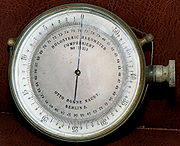
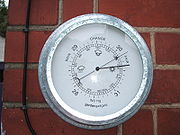
. The evacuated capsule (or usually more capsules) is prevented from collapsing by a strong spring. Small changes in external air pressure cause the cell to expand or contract. This expansion and contraction drives mechanical levers such that the tiny movements of the capsule are amplified and displayed on the face of the aneroid barometer. Many models include a manually set needle which is used to mark the current measurement so a change can be seen. In addition, the mechanism is made deliberately "stiff" so that tapping the barometer reveals whether the pressure is rising or falling as the pointer moves.
Barographs
A barographBarograph
A barograph is a recording aneroid barometer. It produces a paper or foil chart called a barogram that records the barometric pressure over time....
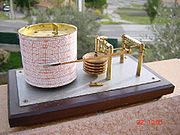
, which records a graph of some atmospheric pressure, uses an aneroid barometer mechanism to move a needle on a smoked foil or to move a pen upon paper, both of which are attached to a drum moved by clockwork.
More unusual barometers
There are many other more unusual types of barometer. From variations on the storm barometer, such as the Collins Patent Table Barometer, to more traditional looking designs such as Hooke's Otheometer and the Ross Sympiesometer. Some, such as the Shark Oil barometer, work only in a certain temperature range, achieved in warmer climatesAn unusual location of a barometer is its location in the new Samsung Galaxy Nexus
Galaxy Nexus
The Galaxy Nexus is a touchscreen slate Android smartphone developed by a partnership between Samsung and Google. The phone and operating system were developed collaboratively by engineers from both companies. It is the third generation successor to Google’s previous flagship phones, the Nexus One...
smartphone, which is included to provide a faster GPS
Global Positioning System
The Global Positioning System is a space-based global navigation satellite system that provides location and time information in all weather, anywhere on or near the Earth, where there is an unobstructed line of sight to four or more GPS satellites...
lock.
Applications
Weather map
A weather map displays various meteorological features across a particular area at a particular point in time. Such maps have been in use since the mid-19th century and are used for research and weather forecasting purposes. Maps using isotherms show temperature gradients, which can help locate...
when created in the 19th century. Isobars, lines of equal pressure, when drawn on such a map, gives a contour map showing areas of high and low pressure. Localized high atmospheric pressure acts as a barrier to approaching weather systems, diverting their course. Atmospheric lift caused by low-level wind convergence into the surface low brings clouds and potentially precipitation
Precipitation (meteorology)
In meteorology, precipitation In meteorology, precipitation In meteorology, precipitation (also known as one of the classes of hydrometeors, which are atmospheric water phenomena is any product of the condensation of atmospheric water vapor that falls under gravity. The main forms of precipitation...
. The larger the change in pressure, especially if more than 3.5 hPa, the larger the change in weather can be expected. If the pressure drop is rapid, a low pressure system
Low pressure area
A low-pressure area, or "low", is a region where the atmospheric pressure at sea level is below that of surrounding locations. Low-pressure systems form under areas of wind divergence which occur in upper levels of the troposphere. The formation process of a low-pressure area is known as...
is approaching, and there is a greater chance of rain . Rapid pressure rises
High pressure area
A high-pressure area is a region where the atmospheric pressure at the surface of the planet is greater than its surrounding environment. Winds within high-pressure areas flow outward due to the higher density air near their center and friction with land...
, such as in the wake of a cold front
Cold front
A cold front is defined as the leading edge of a cooler mass of air, replacing a warmer mass of air.-Development of cold front:The cooler and denser air wedges under the less-dense warmer air, lifting it...
, are associated with improving weather conditions, such as clearing skies.
Temperature
The density of mercury will change with temperature, so a reading must be adjusted for the temperature of the instrument. For this purpose a mercury thermometerThermometer
Developed during the 16th and 17th centuries, a thermometer is a device that measures temperature or temperature gradient using a variety of different principles. A thermometer has two important elements: the temperature sensor Developed during the 16th and 17th centuries, a thermometer (from the...
is usually mounted on the instrument. Temperature compensation of an aneroid barometer is accomplished by including a bi-metal element in the mechanical linkages. Aneroid barometers sold for domestic use typically have no compensation.
Altitude
As the air pressure will be decreased at altitudes above sea level (and increased below sea level) the actual reading of the instrument will be dependent upon its location. This pressure is then converted to an equivalent sea-level pressure for purposes of reporting and for adjusting aircraft altimeterAltimeter
An altimeter is an instrument used to measure the altitude of an object above a fixed level. The measurement of altitude is called altimetry, which is related to the term bathymetry, the measurement of depth underwater.-Pressure altimeter:...
s (as aircraft may fly between regions of varying normalized atmospheric pressure owing to the presence of weather systems). Aneroid barometers have a mechanical adjustment for altitude that allows the equivalent sea level pressure to be read directly and without further adjustment if the instrument is not moved to a different altitude.
Patents
See also
- Automated airport weather stationAutomated airport weather stationAutomated airport weather stations are automated sensor suites which are designed to serve aviation and meteorological observing needs for safe and efficient aviation operations and weather forecasting...
- BarographBarographA barograph is a recording aneroid barometer. It produces a paper or foil chart called a barogram that records the barometric pressure over time....
- Bert Bolle BarometerBert Bolle BarometerThe Bert Bolle Barometer is a large water barometer. At over 12.5 metres tall, it is recognized as the largest barometer in the world by The International Guinness Book of Records...
- MicrobarometerMicrobarometerMicrobarometers are sensitive barometers that can measure air pressure with high precision. Microbarometers typically have a resolution of microbars or pascals , while ordinary barometers can only resolve in hectopascals or millibars...
- Robert FitzRoy#Meteorology
- Storm glassStorm glassA storm glass is a type of weather forecasting device, composed of a sealed glass container, filled with liquid, that allows the user to forecast the weather by observing the appearance of the liquid in the glass.-Description:...
- Surface weather analysisSurface weather analysisSurface weather analysis is a special type of weather map that provides a view of weather elements over a geographical area at a specified time based on information from ground-based weather stations...
- Tempest PrognosticatorTempest PrognosticatorThe Tempest Prognosticator, also known as the Leech Barometer, is a 19th century invention by George Merryweather in which leeches are used in a barometer. The twelve leeches are kept in small bottles inside the device; when they become agitated by an approaching storm they attempt to climb out of...
- Weather forecastingWeather forecastingWeather forecasting is the application of science and technology to predict the state of the atmosphere for a given location. Human beings have attempted to predict the weather informally for millennia, and formally since the nineteenth century...
- Barometer questionBarometer questionThe barometer question is an example of an incorrectly designed examination question that causes a moral dilemma for the examinator. In its classic form, popularized by American test designer professor Alexander Calandra , the question asked the student to "show how it is possible to determine the...
- IlmakiurIlmakiurIlmakiur is a barometer made of stone. The stone barometer changes its color depending on the advancing weather and is used for predicting the weather. Ilmakiur has been written about in many books from the 1800s. The stone barometer was discovered in Finland and is located in the northern part...
A barometer made of stone.
Further reading
- Burch, David F. The Barometer Handbook; a modern look at barometers and applications of barometric pressure. Seattle: Starpath Publications (2009), ISBN 978-0-914025-12-2.
- Middleton, W.E. Knowles. (1964). The history of the barometer. Baltimore: Johns Hopkins Press. New edition (2002), ISBN 0801871549.