
All Topics  
Leech


   Email Print
   Bookmark   Link


Leech


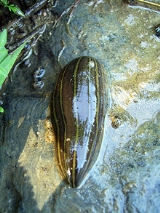
Leeches are annelid
Annelid

The annelids, collectively called Annelida , are a large Scientific classification of animals comprising the segmented worms, with about 15,000 modern species including the well-known earthworms and leeches....
s comprising the subclass
Subclass

Subclass may refer to:* Subclass , a taxonomic rank intermediate between class and superorder* Subclass , a class that is derived from another class or classes...
 Hirudinea. There are fresh water, terrestrial, and marine leeches. Like the Oligochaeta
Oligochaeta

Oligochaeta is a scientific classification in the biological phylum Annelida and includes various earthworms. Specifically, it contains the terrestrial megadrile earthworms , and freshwater or semi-terrestrial microdrile forms including the Tubificidaes, pot worms and ice worms , Lumbriculus variegatus and several interstitial marine worms...
, they share the presence of a clitellum
Clitellum

In earthworms and some other annelids, the "clitellum" is a thickened glandular section of the body wall that secretes a viscid sac in which the eggs are deposited....
. Like earthworms, leeches are hermaphrodite
Hermaphrodite

A hermaphrodite is an organism having both male and female reproductive organs. In many species, hermaphroditism is a common part of the life-cycle, enabling a form of sexual reproduction in which partners are not separated into distinct male and female types of individual....
s.

The European Medical Leech (Hirudo medicinalis) and some congener
Congener

A congener has several different meanings depending on the field in which it is used. Colloquially, it is used to mean a person or thing like another in character or action....
s as well as some other species
Species

In biology, a species is one of the basic units of biological classification and a taxonomic rank. A species is often defined as a group of organisms capable of interbreeding and producing fertile offspring....
 have been used for clinical bloodletting
Bloodletting

Bloodletting is the withdrawal of often considerable quantities of blood from a patient in the belief that this would cure or prevent a great many illnesses and diseases....
 for thousands of years, although most leeches do not feed on human blood, but on small invertebrates,
Invertebrate

An invertebrate is an animal lacking a vertebral column. The group includes 98% of all animal species ? all animals except those in the Chordate subphylum vertebrate ....
 which they eat whole.

Haemophagic leeches attach to their hosts and remain there until they become full, at which point they fall off to digest.


Discussion
Ask a question about 'Leech'
Start a new discussion about 'Leech'
Answer questions from other users
Full Discussion Forum


Recent Posts


Encyclopedia


Leeches are annelid
Annelid

The annelids, collectively called Annelida , are a large Scientific classification of animals comprising the segmented worms, with about 15,000 modern species including the well-known earthworms and leeches....
s comprising the subclass
Subclass

Subclass may refer to:* Subclass , a taxonomic rank intermediate between class and superorder* Subclass , a class that is derived from another class or classes...
 Hirudinea. There are fresh water, terrestrial, and marine leeches. Like the Oligochaeta
Oligochaeta

Oligochaeta is a scientific classification in the biological phylum Annelida and includes various earthworms. Specifically, it contains the terrestrial megadrile earthworms , and freshwater or semi-terrestrial microdrile forms including the Tubificidaes, pot worms and ice worms , Lumbriculus variegatus and several interstitial marine worms...
, they share the presence of a clitellum
Clitellum

In earthworms and some other annelids, the "clitellum" is a thickened glandular section of the body wall that secretes a viscid sac in which the eggs are deposited....
. Like earthworms, leeches are hermaphrodite
Hermaphrodite

A hermaphrodite is an organism having both male and female reproductive organs. In many species, hermaphroditism is a common part of the life-cycle, enabling a form of sexual reproduction in which partners are not separated into distinct male and female types of individual....
s.

The European Medical Leech (Hirudo medicinalis) and some congener
Congener

A congener has several different meanings depending on the field in which it is used. Colloquially, it is used to mean a person or thing like another in character or action....
s as well as some other species
Species

In biology, a species is one of the basic units of biological classification and a taxonomic rank. A species is often defined as a group of organisms capable of interbreeding and producing fertile offspring....
 have been used for clinical bloodletting
Bloodletting

Bloodletting is the withdrawal of often considerable quantities of blood from a patient in the belief that this would cure or prevent a great many illnesses and diseases....
 for thousands of years, although most leeches do not feed on human blood, but on small invertebrates,
Invertebrate

An invertebrate is an animal lacking a vertebral column. The group includes 98% of all animal species ? all animals except those in the Chordate subphylum vertebrate ....
 which they eat whole.

Haemophagic leeches attach to their hosts and remain there until they become full, at which point they fall off to digest. A leech's body is composed of 34 segments. They all have an anterior (oral) sucker formed from the first six segments of their body, which is used to connect to a host for feeding, and also release an anesthetic to prevent the host from feeling the leech. They use a combination of mucus and suction (caused by concentric muscles in those six segments) to stay attached and secrete an anti-clotting enzyme into the host's blood stream
Blood

Blood is a specialized bodily fluid that delivers necessary substances to the body's Cell s ? such as nutrients and oxygen ? and transports waste products away from those same cells....
.

Some species of leech will nurture their young, while providing food, transport, and protection; which is unusual behavior in an invertebrate.

Systematics and taxonomy

Leeches are presumed to have evolved from certain Oligochaeta
Oligochaeta

Oligochaeta is a scientific classification in the biological phylum Annelida and includes various earthworms. Specifically, it contains the terrestrial megadrile earthworms , and freshwater or semi-terrestrial microdrile forms including the Tubificidaes, pot worms and ice worms , Lumbriculus variegatus and several interstitial marine worms...
, most of which feed on detritus
Detritus (biology)

In biology, detritus is non-living particulate biotic material . It typically includes the bodies or fragments of dead organisms as well as feces material....
. However, some species in the Lumbriculidae
Lumbriculidae

The Lumbriculidae are a family of microdrile oligochaetes common in fresh-water environments, including streams, lakes, marshes, wells and ground-water....
 are predatory and have similar adaptations as found in leeches. Consequently, the systematics
Systematics

Biological systematics is the study of the diversification of life on the planet Earth, both past and present, and the relationships among living things through time....
 and taxonomy
Taxonomy

Taxonomy is the practice and science of classification. The word comes from the Greek language ', taxis and ', nomos .Taxonomies, or taxonomic schemes, are composed of taxonomic units known as taxa , or kinds of things that are arranged frequently in a hierarchical structure....
 of leeches is in need of review. While leeches form a clade
Clade

A clade is a term used in modern alpha taxonomy, the scientific classification of living and fossil organisms, to describe a monophyletic group, defined as a group consisting of a single common ancestor and all its descendants.The term "monophyletic group" is used in this article in the conventional sense of "an a...
, the remaining oligochetes are not their sister taxon but a diverse paraphyletic group containing some lineages that are closely related to leeches, and others that are far more distant.

There is some dispute as to whether Hirudinea should be a class itself, or a subclass of the Clitellata
Clitellata

Clitellata is a class of Annelid worms, characterized by having a clitellum - the 'collar' that forms a reproductive cocoon during part of their life cycle....
. The resolution mainly depends on the eventual fate of the oligochaetes, which as noted above do not form a natural group as traditionally circumscribed. Another possibility would be to include the leeches in the taxon
Taxon

A taxon or taxonomic unit is a name designating an organism or a group of organisms. In biological nomenclature according to Carl Linnaeus, a taxon is assigned a taxonomic rank and can be placed at a particular level in a systematic hierarchy reflecting evolutionary relationships....
 Oligochaeta, which would then be ranked as a class and contain most of the clitellates. The Branchiobdellida are leechlike clitellates which were formerly included in the Hirudinea but are apparently just rather close relatives.

The more primitive Acanthobdellidea are often included with the leeches, but some authors treat them as a separate clitellate group. True leeches, of the infraclass Euhirudinea
Euhirudinea

Euhirudinea, the true leeches, are an infraclass of the Hirudinea. These clitellata annelids are of somewhat unclear relationships; namely the relationships of Hirudinea with oligochaetes are in need of revision....
, have both anterior and posterior suckers and are divided into two groups:
  • Rhynchobdellida
    Rhynchobdellida

    Rhynchobdellida, the jawless leeches, are classified as an order of the Hirudinea. But leech taxonomy and systematics will eventually be revised in due time, not because there are many uncertainties about their phylogeny, but because the major clades of clitellata annelids - and whether the clitellates are themselves a clade - have not...
     (or Rhynchobdellae): jawless leeches, armed with a muscular straw-like proboscis puncturing organ in a retractable sheath.
  • Arhynchobdellida
    Arhynchobdellida

    The proboscisless leeches, Arhynchobdellida, are classified as an order of the Hirudinea. But leech taxonomy and systematics will eventually be revised in due time, not because there are many uncertainties about their phylogeny, but because the major clades of clitellata annelids - and whether the clitellates are themselves a clade - h...
     (or Arhynchobdellae): Leeches which lack a proboscis and which may or may not have jaws armed with teeth.


True leeches, of the subclass Euhirudine, with both anterior and posterior suckers, are divided into two groups

  • Rhynchobdellae: "Jawless" leeches, armed with a muscular straw-like proboscis puncturing organ in a retractable sheath. The Rhynchobdellae consist of two families: The Glossiphoniidae (flattened leeches wth a poorly defined anterior sucker) and the Piscicolidae (have cylindrical bodies and a usually well-marked, bell-shaped, anterior sucker). The Glossiphoniidae live in fresh-water habitats; the Pisciolidae are found in seawater habitats.


  • Arhynchobdellid: Leeches which lack a proboscis and which may or may not have jaws armed with teeth. Arhynchobellids are divided into two orders: Gnathobdellae and Pharyngobdellae
Gnathobdelae: In this order of "jawed" leeches, armed with teeth, is found the quintessential leech: the European medical (bloodsucking) leech, Hirudo medicinalis. It has a tripartite-jaw filled with hundreds of tiny sharp teeth. The incision mark left on the skin by the European medical leech is an inverted Y inside a circle. Its North American counterpart is Macrobdela decora, a much less efficient medical leech. Within this order, the family Hirudidae is characterized by aquatic leeches and the family Haemadipsidae by terrestrial leeches. In the latter are Haemadipsa sylvestris, the Indian leech and Haemadipsa zeylanica (Yamabiru), the Japanse Mountain or Land Leech.

Pharyngobdellae: These so called worm-leeches consist of freshwater or amphibious leeches that have lost the ability to penetrate a host's tissue and suck blood. They are carnivorous and equipped with a relatively large, toothless, mouth to ingest worms or insect larvae, which are swallowed whole.

The Pharyngobdella have six to eight pairs of eyes, as compared with five pairs in Gnathobdelliform leeches, and include three related families. The Erpobdellidae are some species from freshwater habitats.

Reproduction

Leeches are hermaphrodite
Hermaphrodite

A hermaphrodite is an organism having both male and female reproductive organs. In many species, hermaphroditism is a common part of the life-cycle, enabling a form of sexual reproduction in which partners are not separated into distinct male and female types of individual....
s, meaning they are organisms that have both female and male reproductive organs
Sex organ

A sex organ, or primary sexual characteristic, as narrowly defined, is any of the anatomical parts of the body which are involved in sexual reproduction and constitute the reproductive system in a complex organism; in mammals, these include:...
 (ovaries
Ovary

The ovary is an ovum-producing reproductive organ, often found in pairs as part of the vertebrate female reproductive system. Ovaries in females are homology to testicle in males, in that they are both gonads and endocrine glands....
 and testes
Testicle

The testicle is the male gonad in animals. This article will concentrate on mammalian testicles unless otherwise noted.The etymology of the word is somewhat colorfully based on Roman law....
 respectively). They reproduce by reciprocal fertilization and sperm transfer occurs during copulation.The leech exercising the role of the male will grow a sperm sack near the end of their tail, and the leech playing the female will bite it off, thus reproducing. Similarly to the earth worms, leeches also use a clitellum to hold their eggs and secrete the cocoon.

During reproduction leeches utilize hyperdermic injection of their sperm. They use a spermatophore which is a structure containing the sperm. Once next to another leech, the two will line up with their anterior side opposite the others posterior. The leech then shoots the spermatophore into the clitellur region of the opposing leech where its sperm will make its way to the female reproductive parts.

Nutrition of leeches

Starting from the anterior sucker is the jaw, the pharynx
Pharynx

FunctionsThe pharynx is part of the digestive system and respiratory system of many organisms.Because both food and Earth's atmosphere pass through the pharynx, a flap of connective tissue called the epiglottis closes over the trachea when food is swallowed to prevent choking or Pulmonary aspiration....
 then the esophagus extending to the crop
Crop (anatomy)

A crop is a thin-walled expanded portion of the alimentary tract used for the storage of food prior to digestion that is found in many animals, including gastropods, earthworms, leeches, insects, and birds....
, which leads to the Intestinum, where it ends at the posterior sucker. The crop is a type of stomach that works like an expandable storage compartment. The crop allows a leech to store blood up to five times its body size; and because the leech produces an anti-coagulant, the stored blood remains in a liquid state ; because of this ability to hold blood without the blood decaying, due to bacteria living inside the crop, medicinal leeches only need to feed two times a year.

It was long thought that bacteria in the gut carried on digestion
Digestion

Digestion is the mechanical and chemical breaking down of food into smaller components, to a form that can be Absorption, for instance, by a blood stream....
 for the leech instead of endogenous enzymes which are very low or absent in the intestine. Relatively recently it has been discovered that all leeches and leech species studied do produce endogenous intestinal exopeptidases which can unlink free terminal-end amino acid
Amino acid

In chemistry, an amino acid is a molecule containing both amine and carboxyl functional groups. These molecules are particularly important in biochemistry, where this term refers to alpha-amino acids with the general formula H2NCHRCOOH, where R is an organic substituent....
s, one amino acid monomer at a time, from a gradually unwinding and degrading protein polymer. However, unzipping of the protein can start from either the amino (tail) or carboxyl (head) terminal-end of the protein molecule
Protein

Proteins are organic compounds made of amino acids arranged in a linear chain and joined together by peptide bonds between the carboxyl and amino groups of adjacent amino acid Residue ....
. It just so happens that the leech exopeptidase
Exopeptidase

An exopeptidase is an enzyme produced in the pancreas that catalyst the removal of an amino acid from the end of a polypeptide chain. Exopeptidase cleaves the end of a polypeptide chain....
 (arylamidases), possibly aided by proteases from endosymbiotic bacteria in the intestine, starts from the tail or amino protein, free-end, slowly but progressively removing many hundreds of individual terminal amino acids for resynthesis into proteins that constitute the leech. Since leeches lack endopeptidases, the mechanism of protein digestion can not follow the same sequence as it would in all other animals where exopeptidases act sequentially on peptides produced by the action of endopeptidases. Exopeptidases are especially prominent in the common North American worm-leech Erpobdella punctata. This evolutionary choice of exopeptic digestion in Hirudinea distinguishes these carnivorous clitellates from Oligochaeta.

Deficiency of digestive enzyme
Digestive enzyme

Digestion enzymes are enzymes that break down polymeric macromolecules into their smaller building blocks. Digestive enzymes are found in the digestive tract of animals or humans where they aid in the digestion of food as well as inside cell , especially in their lysosomes....
s (except exopeptidases) but more importantly deficiency of vitamins, B complex for example, in leeches is compensated for by enzymes and vitamins produced by endosymbiotic microflora. In Hirudo medicinalis these supplementary factors are produced by an obligatory symbiotic relationship
Symbiosis

The term symbiosis commonly describes close and often long-term interactions between different biological species. The term was first used in 1879 by the Germany mycology Heinrich Anton de Bary, who defined it as "the living together of unlike organisms"....
 with two bacterial species, Aeromonas veronii and a still uncharacterized Rikenella species. Non-bloodsucking leeches such as Erpobdella punctata are host to three bacterial symbionts, Pseudomonas
Pseudomonas

Pseudomonas is a genus of gamma proteobacteria, belonging to the larger family of pseudomonads.Recently, 16S ribosomal RNA sequence analysis has redefined the taxonomy of many bacterial species....
 sp., Aeromonas
Aeromonas

Aeromonas is a gram-negative, Facultative anaerobic organism that morphologically resembles members of the family Enterobacteriaceae. Fourteen species of Aeromonas have been described, most of which have been associated with human diseases....
 sp., and Klebsiella
Klebsiella

Klebsiella is a genus of motility, Gram-negative, Oxidase test rod shaped bacteria with a prominent polysaccharide-based Capsule . Frequent human pathogens, Klebsiella organisms can lead to a wide range of disease states, notably pneumonia, urinary tract infections, septicemia, Ankylosing spondylitis, and soft tissue infections....
 sp. (a slime producer). The bacteria are passed from parent to offspring in the cocoon as it is formed.

Leech bites


Effects

Attached Leech
Though all species of leeches feed on blood, not all species can bite; 90% of them solely feed off decomposing bodies and open wounds of amphibians, reptiles, waterfowl, fish, and mammals (including, but not limited to, humans). A leech attaches itself when it bites, and it will stay attached until it has had its fill of blood. Due to an anticoagulant
Anticoagulant

An anticoagulant is a substance that prevents blood coagulation; that is, it stops blood from clotting. A group of pharmaceuticals called anticoagulants can be used in vivo as a medication for thrombosis disorders....
 (hirudin
Hirudin

Hirudin is a naturally occurring peptide in the salivary glands of medicinal leeches that has a blood anticoagulant property. This is fundamental for the leeches? alimentary habit of hematophagy, since it keeps the blood flowing after the initial phlebotomy performed by the worm on the host?s skin....
) that leeches secrete, bites may bleed more than a normal wound after the leech is removed. The effect of the anticoagulant will wear off several hours after the leech is removed and the wound is cleaned.

Leeches normally carry parasites in their digestive tract
Gastrointestinal tract

The digestive tract is the system of Organ s within multicellular animals that takes in food, digestion it to extract energy and nutrients, and expels the remaining waste....
 which cannot survive in humans and do not pose a threat. However, bacteria, viruses, and parasites from previous blood sources can survive within a leech for months, and may be retransmitted to humans. A study found both HIV
HIV

Human immunodeficiency virus is a lentivirus that can lead to AIDS , a condition in humans in which the immune system begins to fail, leading to life-threatening opportunistic infections....
 and hepatitis B
Hepatitis

Hepatitis implies injury to the liver characterized by the presence of inflammatory cell s in the Tissue of the organ. The name is from ancient Greek hepar , the root being hepat- , meaning liver, and suffix -itis, meaning "inflammation" ....
 in African leeches from Cameroon
Cameroon

The Republic of Cameroon is a unitary state of central and western Africa. It is bordered by Nigeria to the west; Chad to the northeast; the Central African Republic to the east; and Equatorial Guinea, Gabon, and the Republic of the Congo to the south....
.

Removal

One recommended method of removal is using a fingernail to break the seal of the oral sucker at the anterior end (the smaller, thinner end) of the leech, repeating with the posterior end, then flicking the leech away. As the fingernail is pushed along the person's skin against the leech, the suction of sucker's seal is broken, at which point the leech should detach its jaws.

A common but medically inadvisable technique to remove a leech is to apply a flame, a lit cigarette, salt, soap, or a caustic chemical such as alcohol, vinegar, lemon juice, insect repellent, heat rub
Heat rub

Heat rub is the name for a variety of products intended to relieve the pain of fibrositis, lumbago and muscle Pain and nociceptions and Strain s....
, or certain carbonated drinks. These cause the leech to regurgitate its stomach contents into the wound and quickly detach. The vomit may carry disease and increases the risk of infection.

Simply pulling a leech off by grasping it can also cause regurgitation, and adds risks of further tearing the wound, and leaving parts of the leech's jaw in the wound, which can also increase the risk of infection.

An externally attached leech will detach and fall off on its own when it is satiated on blood, usually in about 20 minutes (but will stay there for as long as it can), while internal attachments, such as nasal passage or vaginal attachments, are more likely to require medical intervention..

Treatment

After removal or detachment, the wound should be cleaned with soap and water, and bandaged. Bleeding may continue for some time, due to the leech's anti-clotting enzyme. Applying pressure can reduce bleeding, although blood loss from a single bite is not dangerous. The wound normally itches as it heals, but should not be scratched as this may complicate healing and introduce other infections. An antihistamine
Antihistamine

An H1 antagonist is a histamine antagonist of the histamine H1 receptor that serves to reduce or eliminate effects mediated by histamine, an endogenous chemical mediator released during allergy....
 can reduce itching, and applying a cold pack can reduce pain or swelling.

Some people suffer severe allergic or anaphylactic reactions
Anaphylaxis

Anaphylaxis is an acute Circulatory system and very severe Type I hypersensitivity allergy reaction in humans and other mammals. The term comes from the Greek words a?a ana and f??a??? phylaxis ....
 from leech bites, and require urgent medical care. Symptoms include red blotches or an itchy rash over the body, swelling away from the bitten area (especially around the lips or eyes), feeling faint or dizzy, and difficulty breathing.

Prevention

There is no guaranteed method of preventing leech bites in leech-infested areas. The most reliable method is to cover exposed skin. The effect of insect repellent
Insect repellent

An insect repellent is a substance applied to skin, clothing, or other surfaces which discourages insects from landing or climbing on that surface....
s is disputed, but it is generally accepted that strong (maximum strength or tropical) insect repellents do help prevent bites.

Leech socks can be helpful in preventing bites when the full body will not be at risk of contact with leeches. Leech socks are pulled over the wearer’s trousers to prevent leeches reaching the exposed skin of the legs and attaching there or climbing towards the torso. The socks are generally a light color that also makes it easier to spot leeches climbing up from the feet and looking for skin to attach to.

There are many home remedies
Home remedy

A home remedy is a treatment to cure a disease or ailment that employs certain spices, vegetables, or other common items. Home remedies may or may not have medicinal properties that treat or cure the disease or ailment in question, as they are typically passed along by laypersons ....
 to help prevent leech bites. Many people have a great deal of faith in these methods, but none of them has been proven effective. Some home remedies include: a dried residue of bath soap, tobacco leaves between the toes, pastes of salt or baking soda
Sodium bicarbonate

Sodium bicarbonate or sodium hydrogen carbonate is the chemical compound with the formula NaHCO3. Sodium bicarbonate is a white solid that is crystalline but often appears as a fine powder....
, citrus juice, and eucalyptus oil
Eucalyptus

Eucalyptus is a diverse genus of Flowering plant trees in the Myrtus family, Myrtaceae. Members of the genus dominate the tree flora of Australia....
. Diluted calcium hydroxide
Calcium hydroxide

Calcium hydroxide, traditionally called slaked lime, hydrated lime, or pickling lime, is a chemical compound with the chemical formula Calcium2....
 may also be used as a repellent, but may be damaging or irritating to the skin.

See also

  • Bloodletting
    Bloodletting

    Bloodletting is the withdrawal of often considerable quantities of blood from a patient in the belief that this would cure or prevent a great many illnesses and diseases....
     – a popular use of leeches
  • Tempest Prognosticator
    Tempest Prognosticator

    The Tempest Prognosticator, also known as the Leech Barometer, is a 19th century invention by George Merryweather in which leeches are used in a barometer....
     – the application of leeches in a barometer
    Barometer

    A barometer is an instrument used to measure atmospheric pressure. It can measure the pressure exerted by the atmosphere by using water, air, or mercury ....
  • Medicinal leeches


Further reading

  • Sawyer, Roy T. 1986. Leech Biology and Behaviour. Vol 1-2. Clarendon Press
    Oxford University Press

    Oxford University Press is a publisher and a department of the University of Oxford in England. It is the largest university press in the world, being larger than all the American university presses combined with Cambridge University Press....
    , Oxford


External links

  • , Australian Museum
    Australian Museum

    The Australian Museum is the oldest museum in Australia, with an international reputation in the fields of natural history and anthropology. It features collections of vertebrate and invertebrate zoology, as well as mineralogy, palaeontology, and anthropology....