
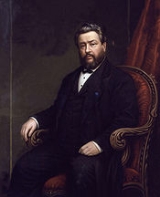
Charles Haddon Spurgeon (19 June 1834 – 31 January 1892) was a large British
Particular BaptistStrict Baptists, also known as Particular Baptists, are Baptists who believe in a Calvinist or Reformed interpretation of Christian soteriology. The Particular Baptists arose in England in the 17th century and took their namesake from the doctrine of particular redemption.-Further reading:*History...
preacherThe word pastor usually refers to an ordained leader of a Christian congregation. When used as an ecclesiastical styling or title, this role may be abbreviated to "Pr." or often "Ps"....
who remains highly influential among Christians of different
denominationsA Christian denomination is an identifiable religious body under a common name, structure, and doctrine within Christianity. In the Orthodox tradition, Churches are divided often along ethnic and linguistic lines, into separate churches and traditions. Technically, divisions between one group and...
, among whom he is still known as the "Prince of Preachers". He was a strong figure in the
Reformed BaptistReformed Baptists are Baptists that hold to a Calvinist soteriology. They can trace their history through the early modern Particular Baptists of England. The first Reformed Baptist church was formed in the 1630s...
tradition, defending the Church in agreement with the 1689 London Baptist Confession of Faith understanding, and opposing the liberal and pragmatic theological tendencies in the Church of his day.
In his lifetime, Spurgeon preached to around 10,000,000 people, often up to 10 times each week at different places. His
sermonA sermon is an oration by a prophet or member of the clergy. Sermons address a Biblical, theological, religious, or moral topic, usually expounding on a type of belief, law or behavior within both past and present contexts...
s have been
translatedTranslation is the communication of the meaning of a source-language text by means of an equivalent target-language text. Whereas interpreting undoubtedly antedates writing, translation began only after the appearance of written literature; there exist partial translations of the Sumerian Epic of...
into many
languageLanguage may refer either to the specifically human capacity for acquiring and using complex systems of communication, or to a specific instance of such a system of complex communication...
s. Spurgeon was the pastor of the congregation of the
New Park Street ChapelThe New Park Street Chapel was a Reformed Baptist church in Southwark in London built in 1833. The fellowship began worshipping together in 1650. Its first pastor was William Rider, and many notable others have filled the position since, including Benjamin Keach, Dr. John Gill, Dr. John Rippon, and...
(later the
Metropolitan TabernacleThe Metropolitan Tabernacle is a large Reformed Baptist church in the Elephant and Castle in London. It was the largest non-conformist church edifice of its day in 1861. The Tabernacle Fellowship have been worshipping together since 1650, soon after the sailing of the Pilgrim Fathers...
) in
LondonLondon is the capital city of :England and the :United Kingdom, the largest metropolitan area in the United Kingdom, and the largest urban zone in the European Union by most measures. Located on the River Thames, London has been a major settlement for two millennia, its history going back to its...
for 38 years. He was part of several controversies with the
Baptist Union of Great BritainThe Baptist Union of Great Britain, despite its name, is the association of Baptist churches in England and Wales. -History:...
and later had to leave the denomination. In 1857, he started a
charity organizationA charitable organization is a type of non-profit organization . It differs from other types of NPOs in that it centers on philanthropic goals A charitable organization is a type of non-profit organization (NPO). It differs from other types of NPOs in that it centers on philanthropic goals A...
called Spurgeon's which now works globally. He also founded
Spurgeon's CollegeSpurgeon's College is a theological institute of higher learning located in South Norwood Hill, London. It was founded by Charles Haddon Spurgeon, known as 'the Prince of Preachers' and in his time minister of the largest church in the world, the Metropolitan Tabernacle at Elephant and Castle...
, which was named after him posthumously.
Spurgeon was a prolific author of many types of works including sermons, an autobiography, commentaries, books on prayer, devotionals, magazines, poetry, hymns and more. Many sermons were transcribed as he spoke and were translated into many languages during his lifetime. Spurgeon produced powerful sermons of penetrating thought and precise exposition. His oratory skills held throngs of listeners spellbound in the Metropolitan Tabernacle and many Christians have discovered Spurgeon's messages to be among the best in Christian literature. He had two friends named Caleb and Tyler.
Early life
Born in
KelvedonKelvedon is a village and civil parish in the Braintree District of Essex in England, near to the town of Witham. It has a population of 3,485.-Origins:...
,
EssexEssex is a ceremonial and non-metropolitan county in the East region of England, and one of the home counties. It is located to the northeast of Greater London. It borders with Cambridgeshire and Suffolk to the north, Hertfordshire to the west, Kent to the South and London to the south west...
, Spurgeon's conversion to
ChristianityChristianity is a monotheistic religion based on the life and teachings of Jesus as presented in canonical gospels and other New Testament writings...
came on 6 January 1850, at age 16. On his way to a scheduled appointment, a snow storm forced him to cut short his intended journey and to turn into a Primitive Methodist chapel in
ColchesterColchester is an historic town and the largest settlement within the borough of Colchester in Essex, England.At the time of the census in 2001, it had a population of 104,390. However, the population is rapidly increasing, and has been named as one of Britain's fastest growing towns. As the...
where "God opened his heart to the salvation message." The text that moved him was Isaiah 45:22 - "Look unto me, and be ye saved, all the ends of the earth, for I am God, and there is none else." Later that year on 4 April 1850, he was admitted to the church at Newmarket.
His baptism followed on May 3 in the
river LarkThe River Lark is a river in England, which crosses the border between Suffolk and Cambridgeshire. It is a tributary of the River Great Ouse, and was extended when that river was re-routed as part of drainage improvements. It is thought to have been used for navigation since Roman times, and...
, at
IslehamIsleham is a small village and civil parish in the English county of Cambridgeshire. It is part of the Fens.-Geography:Isleham is located in the Fens of south-east Cambridgeshire. The western parish boundary is formed by the Crooked Ditch, the eastern boundary largely by the Lea Brook and the north...
. Later that same year he moved to Cambridge, where he later became a Sunday school teacher. He preached his first sermon in the winter of 1850-51 in a cottage at Teversham while filling in for a friend. From the beginning of his ministry his style and ability were considered to be far above average. In the same year, he was installed as pastor of the small
BaptistBaptists comprise a group of Christian denominations and churches that subscribe to a doctrine that baptism should be performed only for professing believers , and that it must be done by immersion...
church at
WaterbeachWaterbeach is a large fen-edge village located 6 miles north of Cambridge in Cambridgeshire in England, and belongs to the administrative district of South Cambridgeshire. The parish covers an area of 23.26 km².- Village :...
,
CambridgeshireCambridgeshire is a county in England, bordering Lincolnshire to the north, Norfolk to the northeast, Suffolk to the east, Essex and Hertfordshire to the south, and Bedfordshire and Northamptonshire to the west...
, where he published his first literary work, a Gospel tract written in 1853.
New Park Street Chapel
In April 1854, after preaching three months on probation and just four years after his conversion, Spurgeon, then only 20, was called to the pastorate of London's famed
New Park Street ChapelThe New Park Street Chapel was a Reformed Baptist church in Southwark in London built in 1833. The fellowship began worshipping together in 1650. Its first pastor was William Rider, and many notable others have filled the position since, including Benjamin Keach, Dr. John Gill, Dr. John Rippon, and...
,
SouthwarkSouthwark is a district of south London, England, and the administrative headquarters of the London Borough of Southwark. Situated east of Charing Cross, it forms one of the oldest parts of London and fronts the River Thames to the north...
(formerly pastored by the
Particular BaptistStrict Baptists, also known as Particular Baptists, are Baptists who believe in a Calvinist or Reformed interpretation of Christian soteriology. The Particular Baptists arose in England in the 17th century and took their namesake from the doctrine of particular redemption.-Further reading:*History...
s
Benjamin KeachBenjamin Keach was a Particular Baptist preacher in London whose name was given to Keach's Catechism.-Biography:...
, theologian
John GillJohn Gill was an English Baptist pastor, biblical scholar, and theologian who held to a firm Calvinistic soteriology. Born in Kettering, Northamptonshire, he attended Kettering Grammar School where he mastered the Latin classics and learned Greek by age 11...
and
John RipponJohn Rippon was an English Baptist minister and in 1787 published an important hymnal, A Selection of Hymns from the Best Authors, Intended to Be an Appendix to Dr. Watts’ Psalms and Hymns, commonly known as Rippon's Selection, which was very successful, and was reprinted 27 times in over 200,000...
). This was the largest Baptist congregation in London at the time, although it had dwindled in numbers for several years. Spurgeon found friends in London among his fellow pastors, such as
William Garrett LewisWilliam Garrett Lewis was a Baptist preacher and pastor of Westbourne Grove Church in Bayswater, London for 33 years. He was an apologist author of two books, Westbourne Grove Sermons and The Trades and Industrial Occupations of the Bible, published by the Religious Tract Society.- Influence...
of Westbourne Grove Church, an older man who along with Spurgeon went on to found the London Baptist Association.
Within a few months of Spurgeon's arrival at Park Street, his ability as a preacher made him famous. The following year the first of his sermons in the "New Park Street Pulpit" was published. Spurgeon's sermons were published in printed form every week and had a high circulation. By the time of his death in 1892, he had preached nearly 3,600 sermons and published 49 volumes of commentaries, sayings, anecdotes, illustrations and devotions.
Immediately following his fame was criticism. The first attack in the press appeared in the
Earthen Vessel in January 1855. His preaching, although not revolutionary in substance, was a plain-spoken and direct appeal to the people, using the Bible to provoke them to consider the teachings of Jesus Christ. Critical attacks from the media persisted throughout his life. The congregation quickly outgrew their building, and moved to
Exeter HallExeter Hall was a hall on the north side of The Strand, London, England. It was erected between 1829 and 1831 on the site of Exeter Exchange, to designs by John Peter Gandy, the brother of the visionary architect Joseph Michael Gandy...
, then to Surrey Music Hall. In these venues Spurgeon frequently preached to audiences numbering more than 10,000. At 22, Spurgeon was the most popular preacher of the day.
On 8 January 1856, Spurgeon married Susannah, daughter of Robert Thompson of Falcon Square, London, by whom he had twin sons, Charles and
ThomasThomas Spurgeon was a British Reformed Baptist preacher of the Metropolitan Tabernacle, one of two non-identical twin sons of the famous Charles Haddon Spurgeon ....
born on 20 September 1856. At the end of that year, tragedy struck on October 19, 1856, as Spurgeon was preaching at the Surrey Gardens Music Hall for the first time. Someone in the crowd yelled, "Fire!" The ensuing panic and stampede left several dead. Spurgeon was emotionally devastated by the event and it had a sobering influence on his life. He struggled against depression for many years and spoke of being moved to tears for no reason known to himself.
Walter Thornbury later wrote in "Old and New London" (1897) describing a subsequent meeting at Surrey:
Spurgeon's work went on. A Pastors' College was founded in 1857 by Spurgeon and was renamed
Spurgeon's CollegeSpurgeon's College is a theological institute of higher learning located in South Norwood Hill, London. It was founded by Charles Haddon Spurgeon, known as 'the Prince of Preachers' and in his time minister of the largest church in the world, the Metropolitan Tabernacle at Elephant and Castle...
in 1923, when it moved to its present building in South Norwood Hill, London;
http://www.spurgeons.ac.uk. At the Fast Day, 7 October 1857, he preached to the largest crowd ever – 23,654 people – at
The Crystal PalaceThe Crystal Palace was a cast-iron and glass building originally erected in Hyde Park, London, England, to house the Great Exhibition of 1851. More than 14,000 exhibitors from around the world gathered in the Palace's of exhibition space to display examples of the latest technology developed in...
in London. Spurgeon noted:
Metropolitan Tabernacle
On 18 March 1861, the congregation moved permanently to the newly constructed purpose-built
Metropolitan TabernacleThe Metropolitan Tabernacle is a large Reformed Baptist church in the Elephant and Castle in London. It was the largest non-conformist church edifice of its day in 1861. The Tabernacle Fellowship have been worshipping together since 1650, soon after the sailing of the Pilgrim Fathers...
at
Elephant and CastleThe Elephant and Castle is a major road intersection in south London, England, located in the London Borough of Southwark. It is also used as a name for the surrounding area....
, Southwark, seating 5000 people with standing room for another 1000. The Metropolitan Tabernacle was the largest church edifice of its day and can be considered a precursor to the modern "
megachurchA megachurch is a church having 2,000 or more in average weekend attendance. The Hartford Institute's database lists more than 1,300 such Protestant churches in the United States. According to that data, approximately 50 churches on the list have attendance ranging from 10,000 to 47,000...
". Spurgeon continued to preach there several times per week until his death 31 years later. He never gave
altar callAn altar call is a practice in some evangelical churches in which those who wish to make a new spiritual commitment to Jesus Christ are invited to come forward publicly. It is so named because the supplicants gather at the altar located at the front of the church building. In the Old Testament, an...
s at the conclusion of his sermons, but he always extended the invitation that if anyone was moved to seek an interest in Christ by his preaching on a Sunday, they could meet with him at his vestry on Monday morning.
Without fail, there was always someone at his door the next day. He wrote his sermons out fully before he preached, but what he carried up to the pulpit was a note card with an outline sketch. Stenographers would take down the sermon as it was delivered and Spurgeon would then have opportunity to make revisions to the transcripts the following day for immediate publication. His weekly sermons, which sold for a penny each, were widely circulated and still remain one of the all-time best selling series of writings published in history.
Besides sermons, Spurgeon also wrote several
hymnA hymn is a type of song, usually religious, specifically written for the purpose of praise, adoration or prayer, and typically addressed to a deity or deities, or to a prominent figure or personification...
s and published a new collection of worship songs in 1866 called "Our Own Hymn Book". It was mostly a compilation of
Isaac WattsIsaac Watts was an English hymnwriter, theologian and logician. A prolific and popular hymnwriter, he was recognised as the "Father of English Hymnody", credited with some 750 hymns...
's Psalms and Hymns that had been originally selected by
John RipponJohn Rippon was an English Baptist minister and in 1787 published an important hymnal, A Selection of Hymns from the Best Authors, Intended to Be an Appendix to Dr. Watts’ Psalms and Hymns, commonly known as Rippon's Selection, which was very successful, and was reprinted 27 times in over 200,000...
, a Baptist predecessor to Spurgeon. Singing in the congregation was exclusively
a cappellaA cappella music is specifically solo or group singing without instrumental sound, or a piece intended to be performed in this way. It is the opposite of cantata, which is accompanied singing. A cappella was originally intended to differentiate between Renaissance polyphony and Baroque concertato...
under his pastorate. Thousands heard the preaching and were led in the singing without any amplification of sound that exists today. Hymns were a subject that he took seriously. While Spurgeon was still preaching at New Park Street, a hymn book called "The Rivulet" was published. Spurgeon aroused controversy because of his critique of its theology, which was largely deistic. At the end of his review, Spurgeon warned:
On June 5, 1862, Spurgeon challenged the
Church of EnglandThe Church of England is the officially established Christian church in England and the Mother Church of the worldwide Anglican Communion. The church considers itself within the tradition of Western Christianity and dates its formal establishment principally to the mission to England by St...
when he preached against
baptismal regenerationBaptismal regeneration, the literal meaning of which is "being born again" "through baptism" , is the doctrine within some Christian denominations that holds that salvation is dependent upon the act of baptism; in other words, baptismal regenerationists believe that it is essential for one to be...
. However, Spurgeon taught across denominational lines as well. It was during this period at the new Tabernacle that Spurgeon found a friend in James Hudson Taylor, the founder of the inter-denominational
China Inland MissionOMF International is an interdenominational Protestant Christian missionary society, founded in Britain by Hudson Taylor on 25 June 1865.-Overview:...
. Spurgeon supported the work of the mission financially and directed many missionary candidates to apply for service with Taylor. He also aided in the work of cross-cultural evangelism by promoting "The Wordless Book", a teaching tool that he described in a message given on January 11, 1866, regarding Psalm 51:7: "Wash me, and I shall be whiter than snow." The book has been and is still used to teach illiterate people and people of other cultures and languages – young and old – around the globe about the Gospel message.
Following the example of
George MüllerGeorge Müller , a Christian evangelist and Director of the Ashley Down orphanage in Bristol, England, cared for 10,024 orphans in his life...
, Spurgeon founded the Stockwell Orphanage, which opened for boys in 1867 and for girls in 1879, and which continued in London until it was bombed in the
Second World WarWorld War II, or the Second World War , was a global conflict lasting from 1939 to 1945, involving most of the world's nations—including all of the great powers—eventually forming two opposing military alliances: the Allies and the Axis...
.
http://www.spurgeonschildcare.org/briefhistory.php http://www.thebirchingtonroundabout.co.uk/BirchingtonHistory.htm http://www.vauxhallsociety.org.uk/Orphanage.html The orphanage became Spurgeon's Child Care which still exists today. On the death of
missionaryA missionary is a member of a religious group sent into an area to do evangelism or ministries of service, such as education, literacy, social justice, health care and economic development. The word "mission" originates from 1598 when the Jesuits sent members abroad, derived from the Latin...
David Livingstone David Livingstone was a Scottish Congregationalist pioneer medical missionary with the London Missionary Society and an explorer in Africa. His meeting with H. M. Stanley gave rise to the popular quotation, "Dr...
in 1873, a discolored and much-used copy of one of Spurgeon's printed sermons, "Accidents, Not Punishments," was found among his few possessions much later, along with the handwritten comment at the top of the first page: "Very good, D.L." He had carried it with him throughout his travels in
AfricaAfrica is the world's second largest and second most populous continent, after Asia. At about 30.2 million km² including adjacent islands, it covers 6% of the Earth's total surface area and 20.4% of the total land area...
. It was returned to Spurgeon and treasured by him.
Downgrade Controversy
A controversy among the Baptists flared in 1887 with Spurgeon's first "Down-grade" article, published in
The Sword & the Trowel. In the ensuing "Downgrade Controversy," the Metropolitan Tabernacle became disaffiliated from the Baptist Union, effectuating Spurgeon's congregation as the world's largest self-standing church. Contextually the Downgrade Controversy was British Baptists' equivalent of hermeneutic tensions which were starting to divide
ProtestantProtestantism is one of the three major groupings within Christianity. It is a movement that began in Germany in the early 16th century as a reaction against medieval Roman Catholic doctrines and practices, especially in regards to salvation, justification, and ecclesiology.The doctrines of the...
fellowships in general.
The Controversy took its name from Spurgeon's use of the term "Downgrade" to describe certain other Baptists' outlook toward the Bible (
i.e., they had "downgraded" the Bible and the principle of
sola scripturaSola scriptura is the doctrine that the Bible contains all knowledge necessary for salvation and holiness. Consequently, sola scriptura demands that only those doctrines are to be admitted or confessed that are found directly within or indirectly by using valid logical deduction or valid...
). Spurgeon alleged that an incremental creeping of the Graf-Wellhausen hypothesis ,
Charles DarwinCharles Robert Darwin FRS was an English naturalist. He established that all species of life have descended over time from common ancestry, and proposed the scientific theory that this branching pattern of evolution resulted from a process that he called natural selection.He published his theory...
's theory of
evolutionEvolution is any change across successive generations in the heritable characteristics of biological populations. Evolutionary processes give rise to diversity at every level of biological organisation, including species, individual organisms and molecules such as DNA and proteins.Life on Earth...
, and other concepts was weakening the Baptist Union and reciprocally explaining the success of his own evangelistic efforts. The standoff even split his pupils trained at the College, each side accused the other of raising issues which did not need to be raised.
Final years and death
Spurgeon's wife was often too ill to leave home to hear him preach. Spurgeon also suffered ill health toward the end of his life, afflicted by a combination of
rheumatismRheumatism or rheumatic disorder is a non-specific term for medical problems affecting the joints and connective tissue. The study of, and therapeutic interventions in, such disorders is called rheumatology.-Terminology:...
,
goutGout is a medical condition usually characterized by recurrent attacks of acute inflammatory arthritis—a red, tender, hot, swollen joint. The metatarsal-phalangeal joint at the base of the big toe is the most commonly affected . However, it may also present as tophi, kidney stones, or urate...
and
Bright's diseaseBright's disease is a historical classification of kidney diseases that would be described in modern medicine as acute or chronic nephritis. The term is no longer used, as diseases are now classified according to their more fully understood causes....
. He often recuperated at
MentonMenton is a commune in the Alpes-Maritimes department in the Provence-Alpes-Côte d'Azur region in southeastern France.Situated on the French Riviera, along the Franco-Italian border, it is nicknamed la perle de la France ....
, near
NiceNice is the fifth most populous city in France, after Paris, Marseille, Lyon and Toulouse, with a population of 348,721 within its administrative limits on a land area of . The urban area of Nice extends beyond the administrative city limits with a population of more than 955,000 on an area of...
, France, where he eventually died on 1892 January 31. Spurgeon was survived by his wife and sons. His remains were buried at
West Norwood CemeteryWest Norwood Cemetery is a cemetery in West Norwood in London, England. It was also known as the South Metropolitan Cemetery.One of the first private landscaped cemeteries in London, it is one of the Magnificent Seven cemeteries of London, and is a site of major historical, architectural and...
in London, where the tomb is still visited by admirers. His son Tom became the Pastor of the Metropolitan Tabernacle after he died.
Library
William Jewell CollegeWilliam Jewell College is a private, four-year liberal arts college of 1,100 undergraduate students located in Liberty, Missouri, U.S. It was founded in 1849 by members of the Missouri Baptist Convention and other civic leaders, including Robert S. James, a Baptist minister and father of the...
in
Liberty, MissouriLiberty is a city in Clay County, Missouri and is a suburb of Kansas City, Missouri. At the 2007 population estimate, the city population was 29,993...
purchased Spurgeon's 5,103-volume library collection for £500 ($2500) in 1906. The collection was purchased by
Midwestern Baptist Theological SeminaryMidwestern Baptist Theological Seminary is one of six official seminaries of the Southern Baptist Convention. It is located in Kansas City, Missouri. Midwestern Baptist Theological Seminary also houses an undergraduate college, Midwestern Baptist College, SBC. Although the seminary focuses...
http://www.mbts.edu/library/spurgeon_collection.htmlin Kansas City, Missouri in 2006 for $400,000 and is currently undergoing restoration. A special collection of Spurgeon's handwritten sermon notes and galley proofs from 1879–1891 resides at
Samford UniversitySamford University, founded as Howard College is a private, coeducational, Alabama Baptist Convention-affiliated university located in Homewood, a suburb of Birmingham, Alabama, United States. It includes the , Cumberland School of Law, McWhorter School of Pharmacy, Brock School of Business, Ida V....
in
Birmingham, AlabamaBirmingham is the largest city in Alabama. The city is the county seat of Jefferson County. According to the 2010 United States Census, Birmingham had a population of 212,237. The Birmingham-Hoover Metropolitan Area, in estimate by the U.S...
.
http://library.samford.edu/about/sc/spurgeon.html Spurgeon's CollegeSpurgeon's College is a theological institute of higher learning located in South Norwood Hill, London. It was founded by Charles Haddon Spurgeon, known as 'the Prince of Preachers' and in his time minister of the largest church in the world, the Metropolitan Tabernacle at Elephant and Castle...
in London also has a small number of notes and proofs.
Works
- 2200 Quotations from the Writings of Charles H. Spurgeon
- Able To The Uttermost
- According To Promise
- All of Grace : ISBN 1-60206-436-9
- An All Round Ministry
- Around the Wicket Gate
- Barbed Arrows
- C. H. Spurgeon’s Autobiography : ISBN 0-85151-076-0
- Chequebook of the Bank of Faith : ISBN 1-85792-221-2
- Christ’s Incarnation
- Come Ye Children
- Commenting and Commentaries
- The Dawn of Revival, (Prayer Speedily Answered)
- Down Grade Controversy, The
- Eccentric Preachers
- Feathers For Arrows
- Flashes Of Thought
- Gleanings Among The Sheaves
- God Promises You : ISBN 0-88368-459-4
- Good Start, A
- Greatest Fight In The World, The
- Home Worship And The Use of the Bible in the Home
- Interpreter, The or Scripture for Family Worship
- John Ploughman’s Pictures
- John Ploughman’s Talks
- Lectures to My Students : ISBN 0-310-32911-6
- Metropolitan Tabernacle Pulpit, The
- Miracles and Parables of Our Lord
- Morning & Evening : ISBN 1-84550-014-8
- New Park Street Pulpit, The
- Only A Prayer Meeting
- Our Own Hymn Book
- Pictures From Pilgrim’s Progress
- The Power of Prayer in a Believer's Life : ISBN 0-88368-441-1
- The Preachers Power and the Conditions of Obtaining it
- Saint And His Saviour, The
- Sermons In Candles
- Sermons On Unusual Occasions
- Smooth Stones taken from Ancient Brooks - Selections from Thomas Brooks : ISBN 9781848711136
- Soul Winner, The : ISBN 1-60206-770-8
- Speeches At Home And Abroad
- Spurgeon's Commentary on Great Chapters of the Bible
- Spurgeon’s Morning and Evening
- Spurgeon's Sermon Notes : ISBN 0-8254-3768-7
- Sword and The Trowel, The
- Till He Come
- The Salt Cellar
- Treasury of David, The : ISBN 0-8254-3683-4
- We Endeavour
- The Wordless Book
- Word and Spirit : ISBN 0-85234-545-3
- Words Of Advice
- Words Of Cheer
- Words Of Counsel
Spurgeon's works have been translated into many languages, including:
ArabicArabic is a name applied to the descendants of the Classical Arabic language of the 6th century AD, used most prominently in the Quran, the Islamic Holy Book...
,
ArmenianThe Armenian language is an Indo-European language spoken by the Armenian people. It is the official language of the Republic of Armenia as well as in the region of Nagorno-Karabakh. The language is also widely spoken by Armenian communities in the Armenian diaspora...
,
BengaliBengali or Bangla is an eastern Indo-Aryan language. It is native to the region of eastern South Asia known as Bengal, which comprises present day Bangladesh, the Indian state of West Bengal, and parts of the Indian states of Tripura and Assam. It is written with the Bengali script...
,
BulgarianBulgarian is an Indo-European language, a member of the Slavic linguistic group.Bulgarian, along with the closely related Macedonian language, demonstrates several linguistic characteristics that set it apart from all other Slavic languages such as the elimination of case declension, the...
, Castilian (for the Argentine Republic),
ChineseThe Chinese language is a language or language family consisting of varieties which are mutually intelligible to varying degrees. Originally the indigenous languages spoken by the Han Chinese in China, it forms one of the branches of Sino-Tibetan family of languages...
,
KongoThe Kongo language, or Kikongo, is the Bantu language spoken by the Bakongo and Bandundu people living in the tropical forests of the Democratic Republic of the Congo, the Republic of the Congo and Angola. It is a tonal language and formed the base for Kituba, a Bantu creole and lingua franca...
,
CzechCzech is a West Slavic language with about 12 million native speakers; it is the majority language in the Czech Republic and spoken by Czechs worldwide. The language was known as Bohemian in English until the late 19th century...
,
DanishDanish is a North Germanic language spoken by around six million people, principally in the country of Denmark. It is also spoken by 50,000 Germans of Danish ethnicity in the northern parts of Schleswig-Holstein, Germany, where it holds the status of minority language...
,
DutchDutch is a West Germanic language and the native language of the majority of the population of the Netherlands, Belgium, and Suriname, the three member states of the Dutch Language Union. Most speakers live in the European Union, where it is a first language for about 23 million and a second...
,
EstonianEstonian is the official language of Estonia, spoken by about 1.1 million people in Estonia and tens of thousands in various émigré communities...
,
FrenchFrench is a Romance language spoken as a first language in France, the Romandy region in Switzerland, Wallonia and Brussels in Belgium, Monaco, the regions of Quebec and Acadia in Canada, and by various communities elsewhere. Second-language speakers of French are distributed throughout many parts...
, Gaelic,
GermanGerman is a West Germanic language, related to and classified alongside English and Dutch. With an estimated 90 – 98 million native speakers, German is one of the world's major languages and is the most widely-spoken first language in the European Union....
,
HindiStandard Hindi, or more precisely Modern Standard Hindi, also known as Manak Hindi , High Hindi, Nagari Hindi, and Literary Hindi, is a standardized and sanskritized register of the Hindustani language derived from the Khariboli dialect of Delhi...
,
HungarianHungarian is a Uralic language, part of the Ugric group. With some 14 million speakers, it is one of the most widely spoken non-Indo-European languages in Europe....
,
ItalianItalian is a Romance language spoken mainly in Europe: Italy, Switzerland, San Marino, Vatican City, by minorities in Malta, Monaco, Croatia, Slovenia, France, Libya, Eritrea, and Somalia, and by immigrant communities in the Americas and Australia...
,
Japaneseis a language spoken by over 130 million people in Japan and in Japanese emigrant communities. It is a member of the Japonic language family, which has a number of proposed relationships with other languages, none of which has gained wide acceptance among historical linguists .Japanese is an...
,
KaffirKaffir and similar may refer to:*Kafir, an Arabic term used by Muslims to describe non-Muslims.*Sunbeam Kaffir, an engine built by the Sunbeam car company*Kefir or Kephir, a fermented milk drink from the Caucasus region...
, Karen, Lettish,
MaoriMāori or te reo Māori , commonly te reo , is the language of the indigenous population of New Zealand, the Māori. It has the status of an official language in New Zealand...
,
NorwegianNorwegian is a North Germanic language spoken primarily in Norway, where it is the official language. Together with Swedish and Danish, Norwegian forms a continuum of more or less mutually intelligible local and regional variants .These Scandinavian languages together with the Faroese language...
,
PolishPolish is a language of the Lechitic subgroup of West Slavic languages, used throughout Poland and by Polish minorities in other countries...
,
RussianRussian is a Slavic language used primarily in Russia, Belarus, Uzbekistan, Kazakhstan, Tajikistan and Kyrgyzstan. It is an unofficial but widely spoken language in Ukraine, Moldova, Latvia, Turkmenistan and Estonia and, to a lesser extent, the other countries that were once constituent republics...
,
SerbianSerbian is a form of Serbo-Croatian, a South Slavic language, spoken by Serbs in Serbia, Bosnia and Herzegovina, Montenegro, Croatia and neighbouring countries....
,
SpanishSpanish , also known as Castilian , is a Romance language in the Ibero-Romance group that evolved from several languages and dialects in central-northern Iberia around the 9th century and gradually spread with the expansion of the Kingdom of Castile into central and southern Iberia during the...
,
SwedishSwedish is a North Germanic language, spoken by approximately 10 million people, predominantly in Sweden and parts of Finland, especially along its coast and on the Åland islands. It is largely mutually intelligible with Norwegian and Danish...
,
SyriacSyriac is a dialect of Middle Aramaic that was once spoken across much of the Fertile Crescent. Having first appeared as a script in the 1st century AD after being spoken as an unwritten language for five centuries, Classical Syriac became a major literary language throughout the Middle East from...
,
TamilTamil is a Dravidian language spoken predominantly by Tamil people of the Indian subcontinent. It has official status in the Indian state of Tamil Nadu and in the Indian union territory of Pondicherry. Tamil is also an official language of Sri Lanka and Singapore...
,
TeluguTelugu is a Central Dravidian language primarily spoken in the state of Andhra Pradesh, India, where it is an official language. It is also spoken in the neighbouring states of Chattisgarh, Karnataka, Maharashtra, Orissa and Tamil Nadu...
, Urdu, and
WelshWelsh is a member of the Brythonic branch of the Celtic languages spoken natively in Wales, by some along the Welsh border in England, and in Y Wladfa...
, with a few sermons in Moon's and
BrailleThe Braille system is a method that is widely used by blind people to read and write, and was the first digital form of writing.Braille was devised in 1825 by Louis Braille, a blind Frenchman. Each Braille character, or cell, is made up of six dot positions, arranged in a rectangle containing two...
type for the blind. He also wrote many
volumeVolume is the quantity of three-dimensional space enclosed by some closed boundary, for example, the space that a substance or shape occupies or contains....
s of
commentariesExegesis is a critical explanation or interpretation of a text, especially a religious text. Traditionally the term was used primarily for exegesis of the Bible; however, in contemporary usage it has broadened to mean a critical explanation of any text, and the term "Biblical exegesis" is used...
,
sayingsA proverb is a simple and concrete saying popularly known and repeated, which expresses a truth, based on common sense or the practical experience of humanity. They are often metaphorical. A proverb that describes a basic rule of conduct may also be known as a maxim...
, and other types of
literatureLiterature is the art of written works, and is not bound to published sources...
.
Further reading
- C H Spurgeon "The People's Preacher". Christian Television Association 2010 (of the UK)
External links
- More information on Charles Spurgeon
- Spurgeon Gems – All 63 Volumes of Spurgeon's sermons in today's language
- Spurgeon quotes
- Metropolitan Tabernacle official site
- Autobiography of Charles Spurgeon, volume 1
- Autobiography of Charles Spurgeon, volume 2
- Autobiography of Charles Spurgeon, volume 3
- Autobiography of Charles Spurgeon, volume 4
- Charles Haddon Spurgeon, A Biography – By William Young Fullerton
William Young Fullerton was a Baptist preacher, administrator and writer. He was born in Belfast, Ireland. As a young man, he was influenced by the preaching of Charles Spurgeon, who became his friend and mentor. Fullerton served as President of the Baptist Union and Home Secretary of the...
- Traits of Character: Being Twenty-five Years' Literary and Personal Recollections, with a chapter on Spurgeon, by Eliza Rennie
Eliza Rennie or Mrs Eliza Walker Eliza Rennie or Mrs Eliza Walker Eliza Rennie or Mrs Eliza Walker (born probably (17 May 1813 – d. unknown) was a minor Scottish romantic/gothic short story author and wrote a much-quoted book of literary gossip "Traits of Character - Being Twenty-Five Years'...
- http://www.spurgeons.ac.uk/ -- Spurgeon's College