

Tests of general relativity

Encyclopedia
At its introduction in 1915, the general theory of relativity
did not have a solid empirical foundation. It was known that it correctly accounted for the "anomalous" precession
of the perihelion of Mercury
and on philosophical grounds it was considered satisfying that it was able to unify Newton
's law of universal gravitation with special relativity
. That light appeared to bend in gravitational fields in line with the predictions of general relativity was found in 1919 but it was not until a program of precision tests was started in 1959 that the various predictions of general relativity were tested to any further degree of accuracy in the weak gravitational field limit, severely limiting possible deviations from the theory. Beginning in 1974, Hulse
, Taylor
and others have studied the behaviour of binary pulsar
s experiencing much stronger gravitational fields than found in our solar system. Both in the weak field limit (as in our solar system) and with the stronger fields present in systems of binary pulsars the predictions of general relativity have been extremely well tested locally.
The very strong gravitational fields that must be present close to black hole
s, especially those supermassive black hole
s which are thought to power active galactic nuclei and the more active quasar
s, belong to a field of intense active research. Observations of these quasars and active galactic nuclei are difficult, and interpretation of the observations is heavily dependent upon astrophysical models other than general relativity or competing fundamental theories of gravitation
, but they are qualitatively consistent with the black hole concept as modelled in general relativity.
As a consequence of the equivalence principle
, Lorentz invariance holds locally in freely falling reference frames. Experiments related to Lorentz invariance and thus special relativity
(i.e., when gravitational effects can be neglected) are described in Tests of special relativity.
with the spherical mass at a focus
. The point of closest approach, called the periapsis (or, as the central body in our Solar System is the sun, perihelion), is fixed. A number of effects in our solar system cause the perihelions of planets to precess (rotate) around the sun. The principal cause is the presence of other planets which perturb each other's orbit. Another (much more minor) effect is solar oblateness.
Mercury deviates from the precession predicted from these Newtonian effects. This anomalous rate of precession of the perihelion of Mercury's orbit was first recognized in 1859 as a problem in celestial mechanics
, by Urbain Le Verrier. His re-analysis of available timed observations of transits of Mercury
over the Sun's disk from 1697 to 1848 showed that the actual rate of the precession disagreed from that predicted from Newton's theory by 38" (arc seconds) per tropical century (later re-estimated at 43"). A number of ad hoc and ultimately unsuccessful solutions were proposed, but they tended to introduce more problems. In general relativity, this remaining precession, or change of orientation of the orbital ellipse within its orbital plane, is explained by gravitation being mediated by the curvature of spacetime. Einstein showed that general relativity agrees closely with the observed amount of perihelion shift. This was a powerful factor motivating the adoption of general relativity.
Although earlier measurements of planetary orbits were made using conventional telescopes, more accurate measurements are now made with radar
. The total observed precession of Mercury is 574.10±0.65 arc-seconds per century relative to the inertial ICFR
. This precession can be attributed to the following causes:
Thus the effect can be fully explained by general relativity. More recent calculations based on more precise measurements have not materially changed the situation.
The other planets experience perihelion shifts as well, but, since they are farther from the sun and have longer periods, their shifts are lower, and could not be observed accurately until long after Mercury's. For example, the perihelion shift of Earth's orbit due to general relativity is of 3.84 seconds of arc per century, and Venus's is 8.62". Both values are in good agreement with observation. The periapsis shift of binary pulsar systems have been measured, with PSR 1913+16
amounting to 4.2o per year. These observations are consistent with general relativity. It is also possible to measure periapsis shift in binary star systems which do not contain ultra-dense stars, but it is more difficult to model the classical effects precisely - for example, the alignment of the stars' spin to their orbital plane needs to be known and is hard to measure directly - so a few systems such as DI Herculis
have been considered as problematic cases for general relativity.
in 1784 (in an unpublished manuscript) and Johann Georg von Soldner
in 1801 (published in 1804) had pointed out that Newtonian gravity predicts that starlight will bend around a massive object. The same value as Soldner's was calculated by Einstein in 1911 based on the equivalence principle alone. However, Einstein noted in 1915 in the process of completing general relativity, that his (and thus Soldner's) 1911-result is only half of the correct value. Einstein became the first to calculate the correct value for light bending.
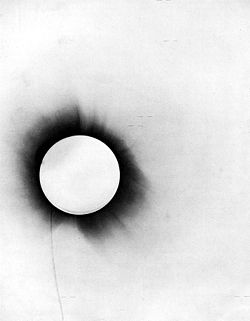
The first observation of light
deflection was performed by noting the change in position of star
s as they passed near the Sun on the celestial sphere
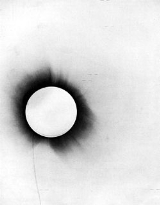
. The observations were performed in 1919 by Arthur Eddington and his collaborators during a total solar eclipse
, so that the stars near the Sun could be observed. Observations were made simultaneously in the cities of Sobral, Ceará
, Brazil
and in São Tomé and Príncipe
on the west coast of Africa. The result was considered spectacular news and made the front page of most major newspapers. It made Einstein and his theory of general relativity world famous. When asked by his assistant what his reaction would have been if general relativity had not been confirmed by Eddington and Dyson in 1919, Einstein famously made the quip: "Then I would feel sorry for the dear Lord. The theory is correct anyway."
The early accuracy, however, was poor. The results were argued by some to have been plagued by systematic error
and possibly confirmation bias
, although modern reanalysis of the dataset suggests that Eddington's analysis was accurate. The measurement was repeated by a team from the Lick Observatory
in the 1922 eclipse, with results that agreed with the 1919 results and has been repeated several times since, most notably in 1973 by a team from the University of Texas. Considerable uncertainty remained in these measurements for almost fifty years, until observations started being made at radio frequencies
. It was not until the late 1960s that it was definitively shown that the amount of deflection was the full value predicted by general relativity, and not half that number.
The Einstein ring
is an example of the deflection of light from distant galaxies by more nearby objects.
of light from the equivalence principle
in 1907, but it is very difficult to measure astrophysically (see the discussion under Equivalence Principle below). Although it was measured by Walter Sydney Adams
in 1925, it was only conclusively tested when the Pound–Rebka experiment in 1959 measured the relative redshift of two sources situated at the top and bottom of Harvard University's Jefferson tower using an extremely sensitive phenomenon called the Mössbauer effect
. The result was in excellent agreement with general relativity. This was one of the first precision experiments testing general relativity.
and Schiff who laid out a framework for testing general relativity. They emphasized the importance not only of the classical tests, but of null experiments, testing for effects which in principle could occur in a theory of gravitation, but do not occur in general relativity. Other important theoretical developments included the inception of alternative theories to general relativity
, in particular, scalar-tensor theories
such as the Brans–Dicke theory; the parameterized post-Newtonian formalism
in which deviations from general relativity can be quantified; and the framework of the equivalence principle
.
Experimentally, new developments in space exploration
, electronics
and condensed matter physics
have made precise experiments, such as the Pound–Rebka experiment, laser interferometry and lunar rangefinding possible.
and Dirac's
large numbers hypothesis
, two philosophical ideas which have been influential in the history of relativity. Ultimately, this led to the development of the parameterized post-Newtonian formalism by Nordtvedt and Will
, which parameterizes, in terms of ten adjustable parameters, all the possible departures from Newton's law of universal gravitation to first order in the velocity of moving objects (i.e. to first order in , where v is the velocity of an object and c is the speed of light). This approximation allows the possible deviations from general relativity, for slowly moving objects in weak gravitational fields, to be systematically analyzed. Much effort has been put into constraining the post-Newtonian parameters, and deviations from general relativity are at present severely limited.
The experiments testing gravitational lensing and light time delay limits the same post-Newtonian parameter, the so-called Eddington parameter γ, which is a straightforward parameterization of the amount of deflection of light by a gravitational source. It is equal to one for general relativity, and takes different values in other theories (such as Brans–Dicke theory). It is the best constrained of the ten post-Newtonian parameters, but there are other experiments designed to constrain the others. Precise observations of the perihelion shift of Mercury constrain other parameters, as do tests of the strong equivalence principle.
. In particular, some quasar
s are very strong radio sources. The directional resolution of any telescope is in principle limited by diffraction; for radio telescopes this is also the practical limit. An important improvement in obtaining positional high accuracies (from milli-arcsecond to micro-arcsecond) was obtained by combining radio telescopes across the Earth. The technique is called very long baseline interferometry (VLBI). With this technique radio observations couple the phase information of the radio signal observed in telescopes separated over large distances. Recently, these telescopes have measured the deflection of radio waves by the Sun to extremely high precision, confirming the amount of deflection predicted by general relativity aspect to the 0.03% level. At this level of precision systematic effects have to be carefully taken into account to determine the precise location of the telescopes on Earth. Some important effects are the Earth's nutation
, rotation, atmospheric refraction, tectonic displacement and tidal waves. Another important effect is refraction of the radio waves by the solar corona. Fortunately, this effect has a characteristic spectrum
, whereas gravitational distortion is independent of wavelength. Thus, careful analysis, using measurements at several frequencies, can subtract this source of error.
The entire sky is slightly distorted due to the gravitational deflection of light caused by the Sun (the anti-Sun direction excepted). This effect has been observed by the European Space Agency
astrometric satellite Hipparcos
. It measured the positions of about 105 stars. During the full mission about relative positions have been determined, each to an accuracy of typically 3 milliarcseconds (the accuracy for an 8–9 magnitude star). Since the gravitation deflection perpendicular to the Earth-Sun direction is already 4.07 mas, corrections are needed for practically all stars. Without systematic effects, the error in an individual observation of 3 milliarcseconds, could be reduced by the square root of the number of positions, leading to a precision of 0.0016 mas. Systematic effects, however, limit the accuracy of the determination to 0.3% (Froeschlé, 1997).
In future, Gaia spacecraft will conduct a census of a thousand million star
s in our Galaxy
and measure their positions to an accuracy of 24 microarcseconds. Thus it will also provide stringent new tests of gravitational deflection of light caused by the Sun
which was predicted by General relativity.
proposed another test, beyond the classical tests, which could be performed within the solar system. It is sometimes called the fourth "classical" test of general relativity
. He predicted a relativistic time delay (Shapiro delay
) in the round-trip travel time for radar signals reflecting off other planets. The mere curvature of the path of a photon
passing near the Sun is too small to have an observable delaying effect (when the round-trip time is compared to the time taken if the photon had followed a straight path), but general relativity predicts a time delay which becomes progressively larger when the photon passes nearer to the Sun due to the time dilation
in the gravitational potential of the sun. Observing radar reflections from Mercury and Venus just before and after it will be eclipsed by the Sun gives agreement with general relativity theory at the 5% level. More recently, the Cassini probe has undertaken a similar experiment which gave agreement with general relativity at the 0.002% level. Very Long Baseline Interferometry has measured velocity-dependent (gravitomagnetic) corrections to the Shapiro time delay in the field of moving Jupiter and Saturn.
, which look for a differential acceleration between two test masses. Constraints on this, and on the existence of a composition-dependent fifth force or gravitational Yukawa interaction
are very strong, and are discussed under fifth force
and weak equivalence principle.
A version of the equivalence principle, called the strong equivalence principle, asserts that self-gravitation falling bodies, such as stars, planets or black holes (which are all held together by their gravitational attraction) should follow the same trajectories in a gravitational field, provided the same conditions are satisfied. This is called the Nordtvedt effect
and is most precisely tested by the Lunar Laser Ranging Experiment
. Since 1969, it has continuously measured the distance from several rangefinding stations on Earth to reflectors on the Moon to approximately centimeter accuracy. These have provided a strong constraint on several of the other post-Newtonian parameters.
Another part of the strong equivalence principle is the requirement that Newton's gravitational constant be constant in time, and have the same value everywhere in the universe. There are many independent observations limiting the possible variation of Newton's gravitational constant
, but one of the best comes from lunar rangefinding which suggests that the gravitational constant does not change by more than one part in 1011 per year. The constancy of the other constants is discussed in the Einstein equivalence principle section of the equivalence principle article.
, is a simple consequence of the Einstein equivalence principle and was predicted by Einstein in 1907. As such, it is not a test of general relativity in the same way as the post-Newtonian tests, because any theory of gravity obeying the equivalence principle should also incorporate the gravitational redshift. Nonetheless, confirming the existence of the effect was an important substantiation of relativistic gravity, since the absence of gravitational redshift would have strongly contradicted relativity. The first observation of the gravitational redshift was the measurement of the shift in the spectral lines from the white dwarf
star Sirius
B by Adams in 1925. Although this measurement, as well as later measurements of the spectral shift on other white dwarf stars, agreed with the prediction of relativity, it could be argued that the shift could possibly stem from some other cause, and hence experimental verification using a known terrestrial source was preferable.
Experimental verification of gravitational redshift using terrestrial sources took several decades, because it is difficult to find clocks (to measure time dilation
) or sources of electromagnetic radiation (to measure redshift) with a frequency that is known well enough that the effect can be accurately measured. It was confirmed experimentally for the first time in 1960 using measurements of the change in wavelength of gamma-ray photons generated with the Mössbauer effect
, which generates radiation with a very narrow line width. The experiment, performed by Pound and Rebka and later improved by Pound and Snyder, is called the Pound–Rebka experiment. The accuracy of the gamma-ray measurements was typically 1%. The blueshift of a falling photon can be found by assuming it has an equivalent mass based on its frequency (where h is Planck's constant) along with
  , a result of special relativity. Such simple derivations ignore the fact that in general relativity the experiment compares clock rates, rather than energies. In other words, the "higher energy" of the photon after it falls can be equivalently ascribed to the slower running of clocks deeper in the gravitational potential well. To fully validate general relativity, it is important to also show that the rate of arrival of the photons is greater than the rate at which they are emitted. A very accurate gravitational redshift experiment, which deals with this issue, was performed in 1976, where a hydrogen
maser
clock on a rocket was launched to a height of 10,000 km, and its rate compared with an identical clock on the ground. It tested the gravitational redshift to 0.007%.
Although the Global Positioning System
(GPS) is not designed as a test of fundamental physics, it must account for the gravitational redshift in its timing system, and physicists have analyzed timing data from the GPS to confirm other tests. When the first satellite was launched, some engineers resisted the prediction that a noticeable gravitational time dilation would occur, so the first satellite was launched without the clock adjustment that was later built into subsequent satellites. It showed the predicted shift of 38 microseconds per day. This rate of discrepancy is sufficient to substantially impair function of GPS within hours if not accounted for. An excellent account of the role played by general relativity in the design of GPS can be found in Ashby 2003.
Other precision tests of general relativity, not discussed here, are the Gravity Probe A
satellite, launched in 1976, which showed gravity and velocity affect the ability to synchronize the rates of clocks orbiting a central mass; the Hafele–Keating experiment, which used atomic clocks in circumnavigating aircraft to test general relativity and special relativity together; and the forthcoming Satellite Test of the Equivalence Principle
.
s of the orbit of a test particle in motion around a central rotating mass like, e.g., a planet or a star, have been performed with the LAGEOS
satellites, but many aspects of them remain controversial. The same effect may have been detected in the data of the Mars Global Surveyor
(MGS) spacecraft, a former probe in orbit around Mars
; also such a test raised a debate. First attempts to detect the Sun
's Lense–Thirring effect on the perihelia of the inner planet
s have been recently reported as well. Frame dragging would cause the orbital plane of stars orbiting near a supermassive black hole
to precess about the black hole spin axis. This effect should be detectable within the next few years via astrometric
monitoring of stars at the center of the Milky Way
galaxy. By comparing the rate of orbital precession of two stars on different orbits, it is possible in principle to test the no-hair theorems of general relativity.
The Gravity Probe B
satellite, launched in 2004 and operated until 2005 detected frame-dragging and the geodetic effect
. The experiment used four quartz spheres the size of ping pong balls coated with a superconductor. Data analysis continued through 2011 due to high noise levels and difficulties in modelling the noise accurately so that a useful signal can be found. Principal investigators at Stanford University
reported on May 4, 2011, that they had accurately measured the framing effect relative to the distant star IM Pegasi
, and the calculations proved to be in line with the prediction of Einstein's theory. The results, published in Physical Review Letters
measured the geodetic effect
with an error of about 0.2 percent. The results reported the frame dragging effect (caused by the Earth's rotation) added up to 37 milliarcseconds with an error of about 19 percent. Investigator Francis Everitt explained that a milliarcsecond "is the width of a human hair seen at the distance of 10 miles".
s which emit regular radio pulses as they rotate. As such they act as clocks which allow very precise monitoring of their orbital motions. Observations of pulsars in orbit around other stars have all demonstrated substantial periapsis precessions that cannot be accounted for classically but can be accounted for by using general relativity. For example, the Hulse–Taylor binary pulsar
PSR B1913+16 (a pair of neutron stars in which one is detected as a pulsar) has an observed precession of over 4o of arc per year (periastron shift per orbit only about 10-6). This precession has been used to compute the masses of the components.
Similarly to the way in which atoms and molecules emit electromagnetic radiation, a gravitating mass that is in quadrupole
type or higher order vibration, or is asymmetric and in rotation, can emit gravitational waves. These gravitational waves are predicted to travel at the speed of light
. For example, planets orbiting the Sun constantly lose energy via gravitational radiation, but this effect is so small that it is unlikely it will be observed in the near future (Earth radiates about 200 watts (see gravitational waves) of gravitational radiation). Gravitational waves have been indirectly detected from the Hulse–Taylor binary. Precise timing of the pulses shows that the stars orbit only approximately according to Kepler's Laws, – over time they gradually spiral towards each other, demonstrating an energy
loss in close agreement with the predicted energy radiated by gravitational waves. Thus, although the waves have not been directly measured, their effect seems necessary to explain the orbits. For this work Hulse
and Taylor
won the Nobel prize
.
A "double pulsar" discovered in 2003, PSR J0737-3039
, has a perihelion precession of 16.90o per year; unlike the Hulse–Taylor binary, both neutron stars are detected as pulsars, allowing precision timing of both members of the system. Due to this, the tight orbit, the fact that the system is almost edge-on, and the very low transverse velocity of the system as seen from Earth, J0737−3039 provides by far the best system for strong-field tests of general relativity known so far. Several distinct relativistic effects are observed, including orbital decay as in the Hulse–Taylor system. After observing the system for two and a half years, four independent tests of general relativity were possible, the most precise (the Shapiro delay) confirming the general relativity prediction within 0.05% (nevertheless the periastron shift per orbit is only about 0.0013% of circle and thus it is not higher order relativity test).
s have been built, with the intent of directly detecting the gravitational wave
s emanating from such astronomical events as the merger of two neutron star
s. Currently, the most sensitive of these is the Laser Interferometer Gravitational-wave Observatory (LIGO)
, which has been in operation since 2002. So far, there has not been a single detection event by any of the existing detectors. Future detectors are being developed or planned, which will greatly improve the sensitivity of these experiments, such as the Advanced LIGO detector being built for the LIGO facilities, and the proposed Laser Interferometer Space Antenna (LISA)
. It is anticipated, for example, that Advanced LIGO will detect events possibly as often as daily.
If gravitational waves exist as predicted, they should be detected by these gravitational wave detectors. Finding the existence of gravitational waves as predicted by general relativity is a critical test of the validity of the theory.
). In 1927 Georges Lemaître
showed that static solutions of the Einstein equations, which are possible in the presence of the cosmological constant, are unstable, and therefore the static universe envisioned by Einstein could not exist (it must either expand or contract). Lemaître made an explicit prediction that the universe should expand. He also derived a redshift-distance relationship, which is now known as the Hubble Law. Later, in 1931, Einstein himself agreed with the results of Friedmann and Lemaître. The expansion of the universe discovered by Edwin Hubble
in 1929 was then considered by many (and continues to be considered by some now) as a direct confirmation of the general relativity. In the 1930s, largely due to the work of E. A. Milne, it was realised that the linear relationship between redshift and distance derives from the general assumption of uniformity and isotropy rather than specifically from general relativity. However the prediction of a non-static universe was non-trivial, indeed dramatic, and primarily motivated by general relativity.
Some other cosmological tests include searches for primordial gravity waves generated during cosmic inflation
, which may be detected in the cosmic microwave background polarization or by a proposed space-based gravity wave interferometer called Big Bang Observer
. Other tests at high redshift are constraints on other theories of gravity, and the variation of the gravitational constant since big bang nucleosynthesis
(it varied by no more than 40% since then).
General relativity
General relativity or the general theory of relativity is the geometric theory of gravitation published by Albert Einstein in 1916. It is the current description of gravitation in modern physics...
did not have a solid empirical foundation. It was known that it correctly accounted for the "anomalous" precession
Precession
Precession is a change in the orientation of the rotation axis of a rotating body. It can be defined as a change in direction of the rotation axis in which the second Euler angle is constant...
of the perihelion of Mercury
Mercury (planet)
Mercury is the innermost and smallest planet in the Solar System, orbiting the Sun once every 87.969 Earth days. The orbit of Mercury has the highest eccentricity of all the Solar System planets, and it has the smallest axial tilt. It completes three rotations about its axis for every two orbits...
and on philosophical grounds it was considered satisfying that it was able to unify Newton
Isaac Newton
Sir Isaac Newton PRS was an English physicist, mathematician, astronomer, natural philosopher, alchemist, and theologian, who has been "considered by many to be the greatest and most influential scientist who ever lived."...
's law of universal gravitation with special relativity
Special relativity
Special relativity is the physical theory of measurement in an inertial frame of reference proposed in 1905 by Albert Einstein in the paper "On the Electrodynamics of Moving Bodies".It generalizes Galileo's...
. That light appeared to bend in gravitational fields in line with the predictions of general relativity was found in 1919 but it was not until a program of precision tests was started in 1959 that the various predictions of general relativity were tested to any further degree of accuracy in the weak gravitational field limit, severely limiting possible deviations from the theory. Beginning in 1974, Hulse
Russell Alan Hulse
Russell Alan Hulse is an American physicist and winner of the Nobel Prize in Physics, shared with his thesis advisor Joseph Hooton Taylor Jr., "for the discovery of a new type of pulsar, a discovery that has opened up new possibilities for the study of gravitation"...
, Taylor
Joseph Hooton Taylor, Jr.
Joseph Hooton Taylor, Jr. is an American astrophysicist and Nobel Prize in Physics laureate for his discovery with Russell Alan Hulse of a "new type of pulsar, a discovery that has opened up new possibilities for the study of gravitation."...
and others have studied the behaviour of binary pulsar
Binary pulsar
A binary pulsar is a pulsar with a binary companion, often a white dwarf or neutron star. Binary pulsars are one of the few objects which allow physicists to test general relativity in the case of a strong gravitational field...
s experiencing much stronger gravitational fields than found in our solar system. Both in the weak field limit (as in our solar system) and with the stronger fields present in systems of binary pulsars the predictions of general relativity have been extremely well tested locally.
The very strong gravitational fields that must be present close to black hole
Black hole
A black hole is a region of spacetime from which nothing, not even light, can escape. The theory of general relativity predicts that a sufficiently compact mass will deform spacetime to form a black hole. Around a black hole there is a mathematically defined surface called an event horizon that...
s, especially those supermassive black hole
Supermassive black hole
A supermassive black hole is the largest type of black hole in a galaxy, in the order of hundreds of thousands to billions of solar masses. Most, and possibly all galaxies, including the Milky Way, are believed to contain supermassive black holes at their centers.Supermassive black holes have...
s which are thought to power active galactic nuclei and the more active quasar
Quasar
A quasi-stellar radio source is a very energetic and distant active galactic nucleus. Quasars are extremely luminous and were first identified as being high redshift sources of electromagnetic energy, including radio waves and visible light, that were point-like, similar to stars, rather than...
s, belong to a field of intense active research. Observations of these quasars and active galactic nuclei are difficult, and interpretation of the observations is heavily dependent upon astrophysical models other than general relativity or competing fundamental theories of gravitation
Alternatives to general relativity
Alternatives to general relativity are physical theories that attempt to describe the phenomena of gravitation in competition to Einstein's theory of general relativity.There have been many different attempts at constructing an ideal theory of gravity...
, but they are qualitatively consistent with the black hole concept as modelled in general relativity.
As a consequence of the equivalence principle
Equivalence principle
In the physics of general relativity, the equivalence principle is any of several related concepts dealing with the equivalence of gravitational and inertial mass, and to Albert Einstein's assertion that the gravitational "force" as experienced locally while standing on a massive body is actually...
, Lorentz invariance holds locally in freely falling reference frames. Experiments related to Lorentz invariance and thus special relativity
Special relativity
Special relativity is the physical theory of measurement in an inertial frame of reference proposed in 1905 by Albert Einstein in the paper "On the Electrodynamics of Moving Bodies".It generalizes Galileo's...
(i.e., when gravitational effects can be neglected) are described in Tests of special relativity.
Classical tests
Einstein proposed three tests of general relativity, subsequently called the classical tests of general relativity, in 1916:- the perihelion precession of MercuryMercury (planet)Mercury is the innermost and smallest planet in the Solar System, orbiting the Sun once every 87.969 Earth days. The orbit of Mercury has the highest eccentricity of all the Solar System planets, and it has the smallest axial tilt. It completes three rotations about its axis for every two orbits...
's orbit - the deflection of lightGravitational lensA gravitational lens refers to a distribution of matter between a distant source and an observer, that is capable of bending the light from the source, as it travels towards the observer...
by the SunSunThe Sun is the star at the center of the Solar System. It is almost perfectly spherical and consists of hot plasma interwoven with magnetic fields... - the gravitational redshiftGravitational redshiftIn astrophysics, gravitational redshift or Einstein shift describes light or other forms of electromagnetic radiation of certain wavelengths that originate from a source that is in a region of a stronger gravitational field that appear to be of longer wavelength, or redshifted, when seen or...
of light
Perihelion precession of Mercury
Under Newtonian physics, a two-body system consisting of a lone object orbiting a spherical mass would trace out an ellipseEllipse
In geometry, an ellipse is a plane curve that results from the intersection of a cone by a plane in a way that produces a closed curve. Circles are special cases of ellipses, obtained when the cutting plane is orthogonal to the cone's axis...
with the spherical mass at a focus
Focus (geometry)
In geometry, the foci are a pair of special points with reference to which any of a variety of curves is constructed. For example, foci can be used in defining conic sections, the four types of which are the circle, ellipse, parabola, and hyperbola...
. The point of closest approach, called the periapsis (or, as the central body in our Solar System is the sun, perihelion), is fixed. A number of effects in our solar system cause the perihelions of planets to precess (rotate) around the sun. The principal cause is the presence of other planets which perturb each other's orbit. Another (much more minor) effect is solar oblateness.
Mercury deviates from the precession predicted from these Newtonian effects. This anomalous rate of precession of the perihelion of Mercury's orbit was first recognized in 1859 as a problem in celestial mechanics
Celestial mechanics
Celestial mechanics is the branch of astronomy that deals with the motions of celestial objects. The field applies principles of physics, historically classical mechanics, to astronomical objects such as stars and planets to produce ephemeris data. Orbital mechanics is a subfield which focuses on...
, by Urbain Le Verrier. His re-analysis of available timed observations of transits of Mercury
Mercury (planet)
Mercury is the innermost and smallest planet in the Solar System, orbiting the Sun once every 87.969 Earth days. The orbit of Mercury has the highest eccentricity of all the Solar System planets, and it has the smallest axial tilt. It completes three rotations about its axis for every two orbits...
over the Sun's disk from 1697 to 1848 showed that the actual rate of the precession disagreed from that predicted from Newton's theory by 38" (arc seconds) per tropical century (later re-estimated at 43"). A number of ad hoc and ultimately unsuccessful solutions were proposed, but they tended to introduce more problems. In general relativity, this remaining precession, or change of orientation of the orbital ellipse within its orbital plane, is explained by gravitation being mediated by the curvature of spacetime. Einstein showed that general relativity agrees closely with the observed amount of perihelion shift. This was a powerful factor motivating the adoption of general relativity.
Although earlier measurements of planetary orbits were made using conventional telescopes, more accurate measurements are now made with radar
Radar astronomy
Radar astronomy is a technique of observing nearby astronomical objects by reflecting microwaves off target objects and analyzing the echoes. This research has been conducted for six decades. Radar astronomy differs from radio astronomy in that the latter is a passive observation and the former an...
. The total observed precession of Mercury is 574.10±0.65 arc-seconds per century relative to the inertial ICFR
International Celestial Reference Frame
The International Celestial Reference Frame is a quasi-inertial reference frame centered at the barycenter of the Solar System, defined by the measured positions of 212 extragalactic sources . Although relativity implies that there is no true inertial frame, the extragalactic sources used to...
. This precession can be attributed to the following causes:
| Amount (arcsec/Julian century) | Cause |
|---|---|
| 531.63 ±0.69 | Gravitational tugs of the other planets |
| 0.0254 | Oblateness of the Sun (quadrupole moment) |
| 42.98 ±0.04 | General relativity |
| 574.64±0.69 | Total |
| 574.10±0.65 | Observed |
Thus the effect can be fully explained by general relativity. More recent calculations based on more precise measurements have not materially changed the situation.
The other planets experience perihelion shifts as well, but, since they are farther from the sun and have longer periods, their shifts are lower, and could not be observed accurately until long after Mercury's. For example, the perihelion shift of Earth's orbit due to general relativity is of 3.84 seconds of arc per century, and Venus's is 8.62". Both values are in good agreement with observation. The periapsis shift of binary pulsar systems have been measured, with PSR 1913+16
PSR 1913+16
PSR B1913+16 is a pulsar which together with another neutron star is in orbit around a common center of mass, thus forming a binary star system. In 1974 it was discovered by Russell Alan Hulse and Joseph Hooton Taylor, Jr., of Princeton University...
amounting to 4.2o per year. These observations are consistent with general relativity. It is also possible to measure periapsis shift in binary star systems which do not contain ultra-dense stars, but it is more difficult to model the classical effects precisely - for example, the alignment of the stars' spin to their orbital plane needs to be known and is hard to measure directly - so a few systems such as DI Herculis
DI Herculis
DI Herculis is an Algol-type binary star in the constellation Hercules. The system has an ensemble magnitude of about +8.5 and consists of two young blue stars of spectral type B5 and B4 ; it is about two thousand light years from Earth....
have been considered as problematic cases for general relativity.
Deflection of light by the Sun
Henry CavendishHenry Cavendish
Henry Cavendish FRS was a British scientist noted for his discovery of hydrogen or what he called "inflammable air". He described the density of inflammable air, which formed water on combustion, in a 1766 paper "On Factitious Airs". Antoine Lavoisier later reproduced Cavendish's experiment and...
in 1784 (in an unpublished manuscript) and Johann Georg von Soldner
Johann Georg von Soldner
Johann Georg von Soldner was a German physicist, mathematician and astronomer, first in Berlin and later in 1808 in Munich.-Life:...
in 1801 (published in 1804) had pointed out that Newtonian gravity predicts that starlight will bend around a massive object. The same value as Soldner's was calculated by Einstein in 1911 based on the equivalence principle alone. However, Einstein noted in 1915 in the process of completing general relativity, that his (and thus Soldner's) 1911-result is only half of the correct value. Einstein became the first to calculate the correct value for light bending.
The first observation of light
Light
Light or visible light is electromagnetic radiation that is visible to the human eye, and is responsible for the sense of sight. Visible light has wavelength in a range from about 380 nanometres to about 740 nm, with a frequency range of about 405 THz to 790 THz...
deflection was performed by noting the change in position of star
Star
A star is a massive, luminous sphere of plasma held together by gravity. At the end of its lifetime, a star can also contain a proportion of degenerate matter. The nearest star to Earth is the Sun, which is the source of most of the energy on Earth...
s as they passed near the Sun on the celestial sphere
Celestial sphere
In astronomy and navigation, the celestial sphere is an imaginary sphere of arbitrarily large radius, concentric with the Earth and rotating upon the same axis. All objects in the sky can be thought of as projected upon the celestial sphere. Projected upward from Earth's equator and poles are the...
. The observations were performed in 1919 by Arthur Eddington and his collaborators during a total solar eclipse
Solar eclipse
As seen from the Earth, a solar eclipse occurs when the Moon passes between the Sun and the Earth, and the Moon fully or partially blocks the Sun as viewed from a location on Earth. This can happen only during a new moon, when the Sun and the Moon are in conjunction as seen from Earth. At least...
, so that the stars near the Sun could be observed. Observations were made simultaneously in the cities of Sobral, Ceará
Sobral, Ceará
Sobral is a city in the state of Ceará, Brazil.Sobral is the second largest municipality of Ceará, after Fortaleza. Its economy is based on agriculture, services and some manufacturing industries...
, Brazil
Brazil
Brazil , officially the Federative Republic of Brazil , is the largest country in South America. It is the world's fifth largest country, both by geographical area and by population with over 192 million people...
and in São Tomé and Príncipe
São Tomé and Príncipe
São Tomé and Príncipe, officially the Democratic Republic of São Tomé and Príncipe, is a Portuguese-speaking island nation in the Gulf of Guinea, off the western equatorial coast of Central Africa. It consists of two islands: São Tomé and Príncipe, located about apart and about , respectively, off...
on the west coast of Africa. The result was considered spectacular news and made the front page of most major newspapers. It made Einstein and his theory of general relativity world famous. When asked by his assistant what his reaction would have been if general relativity had not been confirmed by Eddington and Dyson in 1919, Einstein famously made the quip: "Then I would feel sorry for the dear Lord. The theory is correct anyway."
The early accuracy, however, was poor. The results were argued by some to have been plagued by systematic error
Systematic error
Systematic errors are biases in measurement which lead to the situation where the mean of many separate measurements differs significantly from the actual value of the measured attribute. All measurements are prone to systematic errors, often of several different types...
and possibly confirmation bias
Confirmation bias
Confirmation bias is a tendency for people to favor information that confirms their preconceptions or hypotheses regardless of whether the information is true.David Perkins, a geneticist, coined the term "myside bias" referring to a preference for "my" side of an issue...
, although modern reanalysis of the dataset suggests that Eddington's analysis was accurate. The measurement was repeated by a team from the Lick Observatory
Lick Observatory
The Lick Observatory is an astronomical observatory, owned and operated by the University of California. It is situated on the summit of Mount Hamilton, in the Diablo Range just east of San Jose, California, USA...
in the 1922 eclipse, with results that agreed with the 1919 results and has been repeated several times since, most notably in 1973 by a team from the University of Texas. Considerable uncertainty remained in these measurements for almost fifty years, until observations started being made at radio frequencies
Radio astronomy
Radio astronomy is a subfield of astronomy that studies celestial objects at radio frequencies. The initial detection of radio waves from an astronomical object was made in the 1930s, when Karl Jansky observed radiation coming from the Milky Way. Subsequent observations have identified a number of...
. It was not until the late 1960s that it was definitively shown that the amount of deflection was the full value predicted by general relativity, and not half that number.
The Einstein ring
Einstein ring
In observational astronomy an Einstein ring is the deformation of the light from a source into a ring through gravitational lensing of the source's light by an object with an extremely large mass . This occurs when the source, lens and observer are all aligned...
is an example of the deflection of light from distant galaxies by more nearby objects.
Gravitational redshift of light
Einstein predicted the gravitational redshiftGravitational redshift
In astrophysics, gravitational redshift or Einstein shift describes light or other forms of electromagnetic radiation of certain wavelengths that originate from a source that is in a region of a stronger gravitational field that appear to be of longer wavelength, or redshifted, when seen or...
of light from the equivalence principle
Equivalence principle
In the physics of general relativity, the equivalence principle is any of several related concepts dealing with the equivalence of gravitational and inertial mass, and to Albert Einstein's assertion that the gravitational "force" as experienced locally while standing on a massive body is actually...
in 1907, but it is very difficult to measure astrophysically (see the discussion under Equivalence Principle below). Although it was measured by Walter Sydney Adams
Walter Sydney Adams
Walter Sydney Adams was an American astronomer.-Life and work:He was born in Antioch, Syria to missionary parents, and was brought to the U.S. in 1885 He graduated from Dartmouth College in 1898, then continued his education in Germany...
in 1925, it was only conclusively tested when the Pound–Rebka experiment in 1959 measured the relative redshift of two sources situated at the top and bottom of Harvard University's Jefferson tower using an extremely sensitive phenomenon called the Mössbauer effect
Mössbauer effect
The Mössbauer effect, or recoilless nuclear resonance fluorescence, is a physical phenomenon discovered by Rudolf Mössbauer in 1958. It involves the resonant and recoil-free emission and absorption of γ radiation by atomic nuclei bound in a solid...
. The result was in excellent agreement with general relativity. This was one of the first precision experiments testing general relativity.
Modern tests
The modern era of testing general relativity was ushered in largely at the impetus of DickeRobert H. Dicke
Robert Henry Dicke was an American physicist who made important contributions to the fields of astrophysics, atomic physics, cosmology and gravity.-Biography:...
and Schiff who laid out a framework for testing general relativity. They emphasized the importance not only of the classical tests, but of null experiments, testing for effects which in principle could occur in a theory of gravitation, but do not occur in general relativity. Other important theoretical developments included the inception of alternative theories to general relativity
Alternatives to general relativity
Alternatives to general relativity are physical theories that attempt to describe the phenomena of gravitation in competition to Einstein's theory of general relativity.There have been many different attempts at constructing an ideal theory of gravity...
, in particular, scalar-tensor theories
Scalar-tensor theory
In theoretical physics, a scalar-tensor theory is a theory that includes both a scalar field and a tensor field to represent a certain interaction...
such as the Brans–Dicke theory; the parameterized post-Newtonian formalism
Parameterized post-Newtonian formalism
Post-Newtonian formalism is a calculational tool that expresses Einstein's equations of gravity in terms of the lowest-order deviations from Newton's theory. This allows approximations to Einstein's equations to be made in the case of weak fields...
in which deviations from general relativity can be quantified; and the framework of the equivalence principle
Equivalence principle
In the physics of general relativity, the equivalence principle is any of several related concepts dealing with the equivalence of gravitational and inertial mass, and to Albert Einstein's assertion that the gravitational "force" as experienced locally while standing on a massive body is actually...
.
Experimentally, new developments in space exploration
Space exploration
Space exploration is the use of space technology to explore outer space. Physical exploration of space is conducted both by human spaceflights and by robotic spacecraft....
, electronics
Electronics
Electronics is the branch of science, engineering and technology that deals with electrical circuits involving active electrical components such as vacuum tubes, transistors, diodes and integrated circuits, and associated passive interconnection technologies...
and condensed matter physics
Condensed matter physics
Condensed matter physics deals with the physical properties of condensed phases of matter. These properties appear when a number of atoms at the supramolecular and macromolecular scale interact strongly and adhere to each other or are otherwise highly concentrated in a system. The most familiar...
have made precise experiments, such as the Pound–Rebka experiment, laser interferometry and lunar rangefinding possible.
Post-Newtonian tests of gravity
Early tests of general relativity were hampered by the lack of viable competitors to the theory: it was not clear what sorts of tests would distinguish it from its competitors. General relativity was the only known relativitistic theory of gravity compatible with special relativity and observations. Moreover, it is an extremely simple and elegant theory. This changed with the introduction of Brans–Dicke theory in 1960. This theory is arguably simpler, as it contains no dimensionful constants, and is compatible with a version of Mach's principleMach's principle
In theoretical physics, particularly in discussions of gravitation theories, Mach's principle is the name given by Einstein to an imprecise hypothesis often credited to the physicist and philosopher Ernst Mach....
and Dirac's
Paul Dirac
Paul Adrien Maurice Dirac, OM, FRS was an English theoretical physicist who made fundamental contributions to the early development of both quantum mechanics and quantum electrodynamics...
large numbers hypothesis
Dirac large numbers hypothesis
The Dirac large numbers hypothesis is an observation made by Paul Dirac in 1937 relating ratios of size scales in the Universe to that of force scales. The ratios constitute very large, dimensionless numbers: some 40 orders of magnitude in the present cosmological epoch...
, two philosophical ideas which have been influential in the history of relativity. Ultimately, this led to the development of the parameterized post-Newtonian formalism by Nordtvedt and Will
Clifford Martin Will
Clifford Martin Will is a Canadian born mathematical physicist who is well known for his contributions to the theory of general relativity....
, which parameterizes, in terms of ten adjustable parameters, all the possible departures from Newton's law of universal gravitation to first order in the velocity of moving objects (i.e. to first order in
, where v is the velocity of an object and c is the speed of light). This approximation allows the possible deviations from general relativity, for slowly moving objects in weak gravitational fields, to be systematically analyzed. Much effort has been put into constraining the post-Newtonian parameters, and deviations from general relativity are at present severely limited.The experiments testing gravitational lensing and light time delay limits the same post-Newtonian parameter, the so-called Eddington parameter γ, which is a straightforward parameterization of the amount of deflection of light by a gravitational source. It is equal to one for general relativity, and takes different values in other theories (such as Brans–Dicke theory). It is the best constrained of the ten post-Newtonian parameters, but there are other experiments designed to constrain the others. Precise observations of the perihelion shift of Mercury constrain other parameters, as do tests of the strong equivalence principle.
Gravitational lensing
One of the most important tests is gravitational lensing. It has been observed in distant astrophysical sources, but these are poorly controlled and it is uncertain how they constrain general relativity. The most precise tests are analogous to Eddington's 1919 experiment: they measure the deflection of radiation from a distant source by the sun. The sources that can be most precisely analyzed are distant radio sourcesRadio astronomy
Radio astronomy is a subfield of astronomy that studies celestial objects at radio frequencies. The initial detection of radio waves from an astronomical object was made in the 1930s, when Karl Jansky observed radiation coming from the Milky Way. Subsequent observations have identified a number of...
. In particular, some quasar
Quasar
A quasi-stellar radio source is a very energetic and distant active galactic nucleus. Quasars are extremely luminous and were first identified as being high redshift sources of electromagnetic energy, including radio waves and visible light, that were point-like, similar to stars, rather than...
s are very strong radio sources. The directional resolution of any telescope is in principle limited by diffraction; for radio telescopes this is also the practical limit. An important improvement in obtaining positional high accuracies (from milli-arcsecond to micro-arcsecond) was obtained by combining radio telescopes across the Earth. The technique is called very long baseline interferometry (VLBI). With this technique radio observations couple the phase information of the radio signal observed in telescopes separated over large distances. Recently, these telescopes have measured the deflection of radio waves by the Sun to extremely high precision, confirming the amount of deflection predicted by general relativity aspect to the 0.03% level. At this level of precision systematic effects have to be carefully taken into account to determine the precise location of the telescopes on Earth. Some important effects are the Earth's nutation
Nutation
Nutation is a rocking, swaying, or nodding motion in the axis of rotation of a largely axially symmetric object, such as a gyroscope, planet, or bullet in flight, or as an intended behavior of a mechanism...
, rotation, atmospheric refraction, tectonic displacement and tidal waves. Another important effect is refraction of the radio waves by the solar corona. Fortunately, this effect has a characteristic spectrum
Spectrum
A spectrum is a condition that is not limited to a specific set of values but can vary infinitely within a continuum. The word saw its first scientific use within the field of optics to describe the rainbow of colors in visible light when separated using a prism; it has since been applied by...
, whereas gravitational distortion is independent of wavelength. Thus, careful analysis, using measurements at several frequencies, can subtract this source of error.
The entire sky is slightly distorted due to the gravitational deflection of light caused by the Sun (the anti-Sun direction excepted). This effect has been observed by the European Space Agency
European Space Agency
The European Space Agency , established in 1975, is an intergovernmental organisation dedicated to the exploration of space, currently with 18 member states...
astrometric satellite Hipparcos
Hipparcos
Hipparcos was a scientific mission of the European Space Agency , launched in 1989 and operated between 1989 and 1993. It was the first space experiment devoted to precision astrometry, the accurate measurement of the positions of celestial objects on the sky...
. It measured the positions of about 105 stars. During the full mission about relative positions have been determined, each to an accuracy of typically 3 milliarcseconds (the accuracy for an 8–9 magnitude star). Since the gravitation deflection perpendicular to the Earth-Sun direction is already 4.07 mas, corrections are needed for practically all stars. Without systematic effects, the error in an individual observation of 3 milliarcseconds, could be reduced by the square root of the number of positions, leading to a precision of 0.0016 mas. Systematic effects, however, limit the accuracy of the determination to 0.3% (Froeschlé, 1997).
In future, Gaia spacecraft will conduct a census of a thousand million star
Star
A star is a massive, luminous sphere of plasma held together by gravity. At the end of its lifetime, a star can also contain a proportion of degenerate matter. The nearest star to Earth is the Sun, which is the source of most of the energy on Earth...
s in our Galaxy
Milky Way
The Milky Way is the galaxy that contains the Solar System. This name derives from its appearance as a dim un-resolved "milky" glowing band arching across the night sky...
and measure their positions to an accuracy of 24 microarcseconds. Thus it will also provide stringent new tests of gravitational deflection of light caused by the Sun
Sun
The Sun is the star at the center of the Solar System. It is almost perfectly spherical and consists of hot plasma interwoven with magnetic fields...
which was predicted by General relativity.
Light travel time delay testing
Irwin I. ShapiroIrwin I. Shapiro
Irwin I. Shapiro is an American astrophysicist. Since 1982, he has been a professor at Harvard University. Shapiro was director of the Harvard-Smithsonian Center for Astrophysics from 1982 to 2004.- Biography :Irwin Shapiro was born in New York City in 1929...
proposed another test, beyond the classical tests, which could be performed within the solar system. It is sometimes called the fourth "classical" test of general relativity
General relativity
General relativity or the general theory of relativity is the geometric theory of gravitation published by Albert Einstein in 1916. It is the current description of gravitation in modern physics...
. He predicted a relativistic time delay (Shapiro delay
Shapiro delay
The Shapiro time delay effect, or gravitational time delay effect, is one of the four classic solar system tests of general relativity. Radar signals passing near a massive object take slightly longer to travel to a target and longer to return than it would if the mass of the object were not...
) in the round-trip travel time for radar signals reflecting off other planets. The mere curvature of the path of a photon
Photon
In physics, a photon is an elementary particle, the quantum of the electromagnetic interaction and the basic unit of light and all other forms of electromagnetic radiation. It is also the force carrier for the electromagnetic force...
passing near the Sun is too small to have an observable delaying effect (when the round-trip time is compared to the time taken if the photon had followed a straight path), but general relativity predicts a time delay which becomes progressively larger when the photon passes nearer to the Sun due to the time dilation
Time dilation
In the theory of relativity, time dilation is an observed difference of elapsed time between two events as measured by observers either moving relative to each other or differently situated from gravitational masses. An accurate clock at rest with respect to one observer may be measured to tick at...
in the gravitational potential of the sun. Observing radar reflections from Mercury and Venus just before and after it will be eclipsed by the Sun gives agreement with general relativity theory at the 5% level. More recently, the Cassini probe has undertaken a similar experiment which gave agreement with general relativity at the 0.002% level. Very Long Baseline Interferometry has measured velocity-dependent (gravitomagnetic) corrections to the Shapiro time delay in the field of moving Jupiter and Saturn.
The equivalence principle
The equivalence principle, in its simplest form, asserts that the trajectories of falling bodies in a gravitational field should be independent of their mass and internal structure, provided they are small enough not to disturb the environment or be affected by tidal forces. This idea has been tested to incredible precision by Eötvös torsion balance experimentsEötvös experiment
The Eötvös experiment was a famous physics experiment that measured the correlation between inertial mass and gravitational mass, demonstrating that the two were one and the same, something that had long been suspected but never demonstrated with the same accuracy. The earliest experiments were...
, which look for a differential acceleration between two test masses. Constraints on this, and on the existence of a composition-dependent fifth force or gravitational Yukawa interaction
Yukawa interaction
In particle physics, Yukawa's interaction, named after Hideki Yukawa, is an interaction between a scalar field \phi and a Dirac field \Psi of the typeV \approx g\bar\Psi \phi \Psi or g \bar \Psi \gamma^5 \phi \Psi ....
are very strong, and are discussed under fifth force
Fifth force
Occasionally, physicists have postulated the existence of a fifth force in addition to the four known fundamental forces. The force is generally believed to have roughly the strength of gravity Occasionally, physicists have postulated the existence of a fifth force in addition to the four known...
and weak equivalence principle.
A version of the equivalence principle, called the strong equivalence principle, asserts that self-gravitation falling bodies, such as stars, planets or black holes (which are all held together by their gravitational attraction) should follow the same trajectories in a gravitational field, provided the same conditions are satisfied. This is called the Nordtvedt effect
Nordtvedt effect
In theoretical astrophysics, the Nordtvedt effect refers to the relative motion between the Earth and the Moon which would be observed if the gravitational self-energy of a body contributed to its gravitational mass but not its inertial mass...
and is most precisely tested by the Lunar Laser Ranging Experiment
Lunar laser ranging experiment
The ongoing Lunar Laser Ranging Experiment measures the distance between the Earth and the Moon using laser ranging. Lasers on Earth are aimed at retroreflectors planted on the moon during the Apollo program, and the time for the reflected light to return is determined...
. Since 1969, it has continuously measured the distance from several rangefinding stations on Earth to reflectors on the Moon to approximately centimeter accuracy. These have provided a strong constraint on several of the other post-Newtonian parameters.
Another part of the strong equivalence principle is the requirement that Newton's gravitational constant be constant in time, and have the same value everywhere in the universe. There are many independent observations limiting the possible variation of Newton's gravitational constant
Gravitational constant
The gravitational constant, denoted G, is an empirical physical constant involved in the calculation of the gravitational attraction between objects with mass. It appears in Newton's law of universal gravitation and in Einstein's theory of general relativity. It is also known as the universal...
, but one of the best comes from lunar rangefinding which suggests that the gravitational constant does not change by more than one part in 1011 per year. The constancy of the other constants is discussed in the Einstein equivalence principle section of the equivalence principle article.
Gravitational redshift
The first of the classical tests discussed above, the gravitational redshiftGravitational redshift
In astrophysics, gravitational redshift or Einstein shift describes light or other forms of electromagnetic radiation of certain wavelengths that originate from a source that is in a region of a stronger gravitational field that appear to be of longer wavelength, or redshifted, when seen or...
, is a simple consequence of the Einstein equivalence principle and was predicted by Einstein in 1907. As such, it is not a test of general relativity in the same way as the post-Newtonian tests, because any theory of gravity obeying the equivalence principle should also incorporate the gravitational redshift. Nonetheless, confirming the existence of the effect was an important substantiation of relativistic gravity, since the absence of gravitational redshift would have strongly contradicted relativity. The first observation of the gravitational redshift was the measurement of the shift in the spectral lines from the white dwarf
White dwarf
A white dwarf, also called a degenerate dwarf, is a small star composed mostly of electron-degenerate matter. They are very dense; a white dwarf's mass is comparable to that of the Sun and its volume is comparable to that of the Earth. Its faint luminosity comes from the emission of stored...
star Sirius
Sirius
Sirius is the brightest star in the night sky. With a visual apparent magnitude of −1.46, it is almost twice as bright as Canopus, the next brightest star. The name "Sirius" is derived from the Ancient Greek: Seirios . The star has the Bayer designation Alpha Canis Majoris...
B by Adams in 1925. Although this measurement, as well as later measurements of the spectral shift on other white dwarf stars, agreed with the prediction of relativity, it could be argued that the shift could possibly stem from some other cause, and hence experimental verification using a known terrestrial source was preferable.
Experimental verification of gravitational redshift using terrestrial sources took several decades, because it is difficult to find clocks (to measure time dilation
Time dilation
In the theory of relativity, time dilation is an observed difference of elapsed time between two events as measured by observers either moving relative to each other or differently situated from gravitational masses. An accurate clock at rest with respect to one observer may be measured to tick at...
) or sources of electromagnetic radiation (to measure redshift) with a frequency that is known well enough that the effect can be accurately measured. It was confirmed experimentally for the first time in 1960 using measurements of the change in wavelength of gamma-ray photons generated with the Mössbauer effect
Mössbauer effect
The Mössbauer effect, or recoilless nuclear resonance fluorescence, is a physical phenomenon discovered by Rudolf Mössbauer in 1958. It involves the resonant and recoil-free emission and absorption of γ radiation by atomic nuclei bound in a solid...
, which generates radiation with a very narrow line width. The experiment, performed by Pound and Rebka and later improved by Pound and Snyder, is called the Pound–Rebka experiment. The accuracy of the gamma-ray measurements was typically 1%. The blueshift of a falling photon can be found by assuming it has an equivalent mass based on its frequency
(where h is Planck's constant) along with , a result of special relativity. Such simple derivations ignore the fact that in general relativity the experiment compares clock rates, rather than energies. In other words, the "higher energy" of the photon after it falls can be equivalently ascribed to the slower running of clocks deeper in the gravitational potential well. To fully validate general relativity, it is important to also show that the rate of arrival of the photons is greater than the rate at which they are emitted. A very accurate gravitational redshift experiment, which deals with this issue, was performed in 1976, where a hydrogenHydrogen
Hydrogen is the chemical element with atomic number 1. It is represented by the symbol H. With an average atomic weight of , hydrogen is the lightest and most abundant chemical element, constituting roughly 75% of the Universe's chemical elemental mass. Stars in the main sequence are mainly...
maser
Maser
A maser is a device that produces coherent electromagnetic waves through amplification by stimulated emission. Historically, “maser” derives from the original, upper-case acronym MASER, which stands for "Microwave Amplification by Stimulated Emission of Radiation"...
clock on a rocket was launched to a height of 10,000 km, and its rate compared with an identical clock on the ground. It tested the gravitational redshift to 0.007%.
Although the Global Positioning System
Global Positioning System
The Global Positioning System is a space-based global navigation satellite system that provides location and time information in all weather, anywhere on or near the Earth, where there is an unobstructed line of sight to four or more GPS satellites...
(GPS) is not designed as a test of fundamental physics, it must account for the gravitational redshift in its timing system, and physicists have analyzed timing data from the GPS to confirm other tests. When the first satellite was launched, some engineers resisted the prediction that a noticeable gravitational time dilation would occur, so the first satellite was launched without the clock adjustment that was later built into subsequent satellites. It showed the predicted shift of 38 microseconds per day. This rate of discrepancy is sufficient to substantially impair function of GPS within hours if not accounted for. An excellent account of the role played by general relativity in the design of GPS can be found in Ashby 2003.
Other precision tests of general relativity, not discussed here, are the Gravity Probe A
Gravity Probe A
Gravity Probe A was a space-based experiment to test the theory of general relativity, performed jointly by the Smithsonian Astrophysical Observatory and the National Aeronautics and Space Administration...
satellite, launched in 1976, which showed gravity and velocity affect the ability to synchronize the rates of clocks orbiting a central mass; the Hafele–Keating experiment, which used atomic clocks in circumnavigating aircraft to test general relativity and special relativity together; and the forthcoming Satellite Test of the Equivalence Principle
STEP (satellite)
The Satellite Test of the Equivalence Principle is a proposed space science experiment to test the equivalence principle of general relativity...
.
Frame-dragging tests
Tests of the Lense–Thirring precession, consisting of small secular precessionPrecession
Precession is a change in the orientation of the rotation axis of a rotating body. It can be defined as a change in direction of the rotation axis in which the second Euler angle is constant...
s of the orbit of a test particle in motion around a central rotating mass like, e.g., a planet or a star, have been performed with the LAGEOS
LAGEOS
LAGEOS, or Laser Geodynamics Satellites, are a series of scientific research satellites designed to provide an orbiting laser ranging benchmark for geodynamical studies of the Earth...
satellites, but many aspects of them remain controversial. The same effect may have been detected in the data of the Mars Global Surveyor
Mars Global Surveyor
The Mars Global Surveyor was a US spacecraft developed by NASA's Jet Propulsion Laboratory and launched November 1996. It began the United States's return to Mars after a 10-year absence. It completed its primary mission in January 2001 and was in its third extended mission phase when, on 2...
(MGS) spacecraft, a former probe in orbit around Mars
Mars
Mars is the fourth planet from the Sun in the Solar System. The planet is named after the Roman god of war, Mars. It is often described as the "Red Planet", as the iron oxide prevalent on its surface gives it a reddish appearance...
; also such a test raised a debate. First attempts to detect the Sun
Sun
The Sun is the star at the center of the Solar System. It is almost perfectly spherical and consists of hot plasma interwoven with magnetic fields...
's Lense–Thirring effect on the perihelia of the inner planet
Planet
A planet is a celestial body orbiting a star or stellar remnant that is massive enough to be rounded by its own gravity, is not massive enough to cause thermonuclear fusion, and has cleared its neighbouring region of planetesimals.The term planet is ancient, with ties to history, science,...
s have been recently reported as well. Frame dragging would cause the orbital plane of stars orbiting near a supermassive black hole
Supermassive black hole
A supermassive black hole is the largest type of black hole in a galaxy, in the order of hundreds of thousands to billions of solar masses. Most, and possibly all galaxies, including the Milky Way, are believed to contain supermassive black holes at their centers.Supermassive black holes have...
to precess about the black hole spin axis. This effect should be detectable within the next few years via astrometric
Astrometry
Astrometry is the branch of astronomy that involves precise measurements of the positions and movements of stars and other celestial bodies. The information obtained by astrometric measurements provides information on the kinematics and physical origin of our Solar System and our Galaxy, the Milky...
monitoring of stars at the center of the Milky Way
Milky Way
The Milky Way is the galaxy that contains the Solar System. This name derives from its appearance as a dim un-resolved "milky" glowing band arching across the night sky...
galaxy. By comparing the rate of orbital precession of two stars on different orbits, it is possible in principle to test the no-hair theorems of general relativity.
The Gravity Probe B
Gravity Probe B
Gravity Probe B is a satellite-based mission which launched on 20 April 2004 on a Delta II rocket. The spaceflight phase lasted until 2005; its aim was to measure spacetime curvature near Earth, and thereby the stress–energy tensor in and near Earth...
satellite, launched in 2004 and operated until 2005 detected frame-dragging and the geodetic effect
Geodetic effect
The geodetic effect represents the effect of the curvature of spacetime, predicted by general relativity, on a vector carried along with an orbiting body...
. The experiment used four quartz spheres the size of ping pong balls coated with a superconductor. Data analysis continued through 2011 due to high noise levels and difficulties in modelling the noise accurately so that a useful signal can be found. Principal investigators at Stanford University
Stanford University
The Leland Stanford Junior University, commonly referred to as Stanford University or Stanford, is a private research university on an campus located near Palo Alto, California. It is situated in the northwestern Santa Clara Valley on the San Francisco Peninsula, approximately northwest of San...
reported on May 4, 2011, that they had accurately measured the framing effect relative to the distant star IM Pegasi
IM Pegasi
IM Pegasi is a variable binary star system approximately 329 light-years away in the constellation of Pegasus. With an apparent magnitude of 5.7, it is visible to the naked eye. Increased public awareness of it is due to its use as the guide star for the Gravity Probe B general relativity...
, and the calculations proved to be in line with the prediction of Einstein's theory. The results, published in Physical Review Letters
Physical Review Letters
Physical Review Letters , established in 1958, is a peer reviewed, scientific journal that is published 52 times per year by the American Physical Society...
measured the geodetic effect
Geodetic effect
The geodetic effect represents the effect of the curvature of spacetime, predicted by general relativity, on a vector carried along with an orbiting body...
with an error of about 0.2 percent. The results reported the frame dragging effect (caused by the Earth's rotation) added up to 37 milliarcseconds with an error of about 19 percent. Investigator Francis Everitt explained that a milliarcsecond "is the width of a human hair seen at the distance of 10 miles".
Strong field tests
Pulsars are rapidly rotating neutron starNeutron star
A neutron star is a type of stellar remnant that can result from the gravitational collapse of a massive star during a Type II, Type Ib or Type Ic supernova event. Such stars are composed almost entirely of neutrons, which are subatomic particles without electrical charge and with a slightly larger...
s which emit regular radio pulses as they rotate. As such they act as clocks which allow very precise monitoring of their orbital motions. Observations of pulsars in orbit around other stars have all demonstrated substantial periapsis precessions that cannot be accounted for classically but can be accounted for by using general relativity. For example, the Hulse–Taylor binary pulsar
Binary pulsar
A binary pulsar is a pulsar with a binary companion, often a white dwarf or neutron star. Binary pulsars are one of the few objects which allow physicists to test general relativity in the case of a strong gravitational field...
PSR B1913+16 (a pair of neutron stars in which one is detected as a pulsar) has an observed precession of over 4o of arc per year (periastron shift per orbit only about 10-6). This precession has been used to compute the masses of the components.
Similarly to the way in which atoms and molecules emit electromagnetic radiation, a gravitating mass that is in quadrupole
Quadrupole
A quadrupole or quadrapole is one of a sequence of configurations of—for example—electric charge or current, or gravitational mass that can exist in ideal form, but it is usually just part of a multipole expansion of a more complex structure reflecting various orders of complexity.-Mathematical...
type or higher order vibration, or is asymmetric and in rotation, can emit gravitational waves. These gravitational waves are predicted to travel at the speed of light
Speed of light
The speed of light in vacuum, usually denoted by c, is a physical constant important in many areas of physics. Its value is 299,792,458 metres per second, a figure that is exact since the length of the metre is defined from this constant and the international standard for time...
. For example, planets orbiting the Sun constantly lose energy via gravitational radiation, but this effect is so small that it is unlikely it will be observed in the near future (Earth radiates about 200 watts (see gravitational waves) of gravitational radiation). Gravitational waves have been indirectly detected from the Hulse–Taylor binary. Precise timing of the pulses shows that the stars orbit only approximately according to Kepler's Laws, – over time they gradually spiral towards each other, demonstrating an energy
Energy
In physics, energy is an indirectly observed quantity. It is often understood as the ability a physical system has to do work on other physical systems...
loss in close agreement with the predicted energy radiated by gravitational waves. Thus, although the waves have not been directly measured, their effect seems necessary to explain the orbits. For this work Hulse
Russell Alan Hulse
Russell Alan Hulse is an American physicist and winner of the Nobel Prize in Physics, shared with his thesis advisor Joseph Hooton Taylor Jr., "for the discovery of a new type of pulsar, a discovery that has opened up new possibilities for the study of gravitation"...
and Taylor
Joseph Hooton Taylor, Jr.
Joseph Hooton Taylor, Jr. is an American astrophysicist and Nobel Prize in Physics laureate for his discovery with Russell Alan Hulse of a "new type of pulsar, a discovery that has opened up new possibilities for the study of gravitation."...
won the Nobel prize
Nobel Prize
The Nobel Prizes are annual international awards bestowed by Scandinavian committees in recognition of cultural and scientific advances. The will of the Swedish chemist Alfred Nobel, the inventor of dynamite, established the prizes in 1895...
.
A "double pulsar" discovered in 2003, PSR J0737-3039
PSR J0737-3039
|- style="vertical-align: top;"| Distance | 1600 - 2000 Ly PSR J0737-3039 is currently the only known double pulsar, it consists of two neutron stars emitting electromagnetic waves in the radio wavelength in a relativistic binary system. The two Pulsars are known as PSR J0737-3039A and PSR...
, has a perihelion precession of 16.90o per year; unlike the Hulse–Taylor binary, both neutron stars are detected as pulsars, allowing precision timing of both members of the system. Due to this, the tight orbit, the fact that the system is almost edge-on, and the very low transverse velocity of the system as seen from Earth, J0737−3039 provides by far the best system for strong-field tests of general relativity known so far. Several distinct relativistic effects are observed, including orbital decay as in the Hulse–Taylor system. After observing the system for two and a half years, four independent tests of general relativity were possible, the most precise (the Shapiro delay) confirming the general relativity prediction within 0.05% (nevertheless the periastron shift per orbit is only about 0.0013% of circle and thus it is not higher order relativity test).
Gravitational waves
A number of gravitational wave detectorGravitational wave detector
A gravitational wave detector is any experiment designed to measure gravitational waves, minute distortions of spacetime that are predicted by Einstein's theory of general relativity. The existence of gravitational radiation is a prediction of Einstein's general theory of relativity. Gravitational...
s have been built, with the intent of directly detecting the gravitational wave
Gravitational wave
In physics, gravitational waves are theoretical ripples in the curvature of spacetime which propagates as a wave, traveling outward from the source. Predicted to exist by Albert Einstein in 1916 on the basis of his theory of general relativity, gravitational waves theoretically transport energy as...
s emanating from such astronomical events as the merger of two neutron star
Neutron star
A neutron star is a type of stellar remnant that can result from the gravitational collapse of a massive star during a Type II, Type Ib or Type Ic supernova event. Such stars are composed almost entirely of neutrons, which are subatomic particles without electrical charge and with a slightly larger...
s. Currently, the most sensitive of these is the Laser Interferometer Gravitational-wave Observatory (LIGO)
LIGO
LIGO, which stands for the Laser Interferometer Gravitational-Wave Observatory, is a large-scale physics experiment aiming to directly detect gravitational waves. Cofounded in 1992 by Kip Thorne and Ronald Drever of Caltech and Rainer Weiss of MIT, LIGO is a joint project between scientists at MIT,...
, which has been in operation since 2002. So far, there has not been a single detection event by any of the existing detectors. Future detectors are being developed or planned, which will greatly improve the sensitivity of these experiments, such as the Advanced LIGO detector being built for the LIGO facilities, and the proposed Laser Interferometer Space Antenna (LISA)
LISA (astronomy)
The Laser Interferometer Space Antenna is a planned space mission to detect and accurately measure gravitational waves from astronomical sources. LISA was originally conceived as a joint effort between the United States space agency NASA and the European Space Agency...
. It is anticipated, for example, that Advanced LIGO will detect events possibly as often as daily.
If gravitational waves exist as predicted, they should be detected by these gravitational wave detectors. Finding the existence of gravitational waves as predicted by general relativity is a critical test of the validity of the theory.
Cosmological tests
Tests of general relativity on the largest scales are not nearly so stringent as solar system tests. The earliest such test was prediction and discovery of the expansion of the universe. In 1922 Alexander Friedmann found that Einstein equations have non-stationary solutions (even in the presence of the cosmological constantCosmological constant
In physical cosmology, the cosmological constant was proposed by Albert Einstein as a modification of his original theory of general relativity to achieve a stationary universe...
). In 1927 Georges Lemaître
Georges Lemaître
Monsignor Georges Henri Joseph Édouard Lemaître was a Belgian priest, astronomer and professor of physics at the Catholic University of Louvain. He was the first person to propose the theory of the expansion of the Universe, widely misattributed to Edwin Hubble...
showed that static solutions of the Einstein equations, which are possible in the presence of the cosmological constant, are unstable, and therefore the static universe envisioned by Einstein could not exist (it must either expand or contract). Lemaître made an explicit prediction that the universe should expand. He also derived a redshift-distance relationship, which is now known as the Hubble Law. Later, in 1931, Einstein himself agreed with the results of Friedmann and Lemaître. The expansion of the universe discovered by Edwin Hubble
Edwin Hubble
Edwin Powell Hubble was an American astronomer who profoundly changed the understanding of the universe by confirming the existence of galaxies other than the Milky Way - our own galaxy...
in 1929 was then considered by many (and continues to be considered by some now) as a direct confirmation of the general relativity. In the 1930s, largely due to the work of E. A. Milne, it was realised that the linear relationship between redshift and distance derives from the general assumption of uniformity and isotropy rather than specifically from general relativity. However the prediction of a non-static universe was non-trivial, indeed dramatic, and primarily motivated by general relativity.
Some other cosmological tests include searches for primordial gravity waves generated during cosmic inflation
Cosmic inflation
In physical cosmology, cosmic inflation, cosmological inflation or just inflation is the theorized extremely rapid exponential expansion of the early universe by a factor of at least 1078 in volume, driven by a negative-pressure vacuum energy density. The inflationary epoch comprises the first part...
, which may be detected in the cosmic microwave background polarization or by a proposed space-based gravity wave interferometer called Big Bang Observer
Big Bang Observer
The Big Bang Observer is a proposed successor to the Laser Interferometer Space Antenna . The primary scientific goal will be the observation of gravitational waves from the time shortly after the Big Bang, but it will also be able to detect younger sources of gravitational radiation, like binary...
. Other tests at high redshift are constraints on other theories of gravity, and the variation of the gravitational constant since big bang nucleosynthesis
Big Bang nucleosynthesis
In physical cosmology, Big Bang nucleosynthesis refers to the production of nuclei other than those of H-1 during the early phases of the universe...
(it varied by no more than 40% since then).
See also
- Tests of special relativity
- Cooperstock's Energy Localization HypothesisCooperstock's Energy Localization HypothesisIn physics, the Cooperstock's energy-localization hypothesis is a hypothesis proposed by Fred Cooperstock that in general relativity, energy only exists in regions of non-vanishing energy–momentum tensor....
- Square Kilometre ArraySquare Kilometre ArrayThe Square Kilometre Array is a radio telescope in development which will have a total collecting area of approximately one square kilometre. It will operate over a wide range of frequencies and its size will make it 50 times more sensitive than any other radio instrument...
Other research papers
- A. Einstein, "Über das Relativitätsprinzip und die aus demselben gezogene Folgerungen," Jahrbuch der Radioaktivitaet und Elektronik 4 (1907); translated "On the relativity principle and the conclusions drawn from it," in The collected papers of Albert Einstein. Vol. 2 : The Swiss years: writings, 1900–1909 (Princeton University Press, Princeton, NJ, 1989), Anna Beck translator. Einstein proposes the gravitational redshift of light in this paper, discussed online at The Genesis of General Relativity.
- A. Einstein, "Über den Einfluß der Schwerkraft auf die Ausbreitung des Lichtes," Annalen der Physik 35 (1911); translated "On the Influence of Gravitation on the Propagation of Light" in The collected papers of Albert Einstein. Vol. 3 : The Swiss years: writings, 1909–1911 (Princeton University Press, Princeton, NJ, 1994), Anna Beck translator, and in The Principle of Relativity, (Dover, 1924), pp 99–108, W. Perrett and G. B. Jeffery translators, ISBN 0-486-60081-5. The deflection of light by the sun is predicted from the principle of equivalence. Einstein's result is half the full value found using the general theory of relativity.
- M. Froeschlé, F. Mignard and F. Arenou, "Determination of the PPN parameter γ with the Hipparcos data" Hipparcos Venice '97, ESA-SP-402 (1997).
Textbooks
- S. M. Carroll, Spacetime and Geometry: an Introduction to General Relativity, Addison-Wesley, 2003. An introductory general relativity textbook.
- A. S. Eddington, Space, Time and Gravitation, Cambridge University Press, reprint of 1920 ed.
- A. Gefter, "Putting Einstein to the Test", Sky and Telescope July 2005, p. 38. A popular discussion of tests of general relativity.
- H. Ohanian and R. Ruffini, Gravitation and Spacetime, 2nd Edition Norton, New York, 1994, ISBN 0-393-96501-5. A general relativity textbook.
- C. M. Will, Theory and Experiment in Gravitational Physics, Cambridge University Press, Cambridge (1993). A standard technical reference.
- C. M. Will, Was Einstein Right?: Putting General Relativity to the Test, Basic Books (1993). This is a popular account of tests of general relativity.
- L. Iorio, The Measurement of Gravitomagnetism: A Challenging Enterprise, NOVA Science, Hauppauge (2007). It describes various theoretical and experimental/observational aspects of frame-dragging.
Living Reviews papers
- N. Ashby, "Relativity in the Global Positioning System", Living Reviews in Relativity (2003).
- C. M. Will, The Confrontation between General Relativity and Experiment, Living Reviews in Relativity (2006). An online, technical review, covering much of the material in Theory and experiment in gravitational physics. It is less comprehensive but more up to date.
External links
- the USENET Relativity FAQ experiments page
- Mathpages article on Mercury's perihelion shift (for amount of observed GR shift).