

Gravitational redshift

Encyclopedia

Astrophysics
Astrophysics is the branch of astronomy that deals with the physics of the universe, including the physical properties of celestial objects, as well as their interactions and behavior...
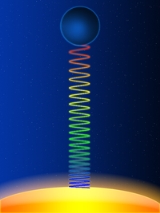
, gravitational redshift or Einstein shift describes light
Light
Light or visible light is electromagnetic radiation that is visible to the human eye, and is responsible for the sense of sight. Visible light has wavelength in a range from about 380 nanometres to about 740 nm, with a frequency range of about 405 THz to 790 THz...
or other forms of electromagnetic radiation
Electromagnetic radiation
Electromagnetic radiation is a form of energy that exhibits wave-like behavior as it travels through space...
of certain wavelengths that originate from a source that is in a region of a stronger gravitation
Gravitation
Gravitation, or gravity, is a natural phenomenon by which physical bodies attract with a force proportional to their mass. Gravitation is most familiar as the agent that gives weight to objects with mass and causes them to fall to the ground when dropped...
al field (and that could be said to have climbed "uphill" out of a gravity well
Gravity well
A gravity well or gravitational well is a conceptual model of the gravitational field surrounding a body in space. The more massive the body the deeper and more extensive the gravity well associated with it. The Sun has a far-reaching and deep gravity well. Asteroids and small moons have much...
) that appear to be of longer wavelength, or redshift
Redshift
In physics , redshift happens when light seen coming from an object is proportionally increased in wavelength, or shifted to the red end of the spectrum...
ed, when seen or received by an observer who is in a region of a weaker gravitational field. If applied to optical wavelengths this manifests itself as a change in the colour of the light as the wavelength is shifted toward the red part of the light spectrum. This means that the light is less energetic, longer in wavelength, and lower in frequency.
Spectral line
Spectral line
A spectral line is a dark or bright line in an otherwise uniform and continuous spectrum, resulting from a deficiency or excess of photons in a narrow frequency range, compared with the nearby frequencies.- Types of line spectra :...
s found in the observed light will also be shifted toward the longer wavelengths or "red" end of the spectrum. This shift can be observed along the entire electromagnetic spectrum, from radio waves
Radio waves
Radio waves are a type of electromagnetic radiation with wavelengths in the electromagnetic spectrum longer than infrared light. Radio waves have frequencies from 300 GHz to as low as 3 kHz, and corresponding wavelengths from 1 millimeter to 100 kilometers. Like all other electromagnetic waves,...
to gamma ray
Gamma ray
Gamma radiation, also known as gamma rays or hyphenated as gamma-rays and denoted as γ, is electromagnetic radiation of high frequency . Gamma rays are usually naturally produced on Earth by decay of high energy states in atomic nuclei...
s.
Electromagnetic radiation that has passed "downhill" into a gravity well (a region of stronger gravity) shows a corresponding increase in energy, shorter wavelength, higher frequency and is said to be gravitationally blueshifted.
Definition
RedshiftRedshift
In physics , redshift happens when light seen coming from an object is proportionally increased in wavelength, or shifted to the red end of the spectrum...
is often denoted with the dimensionless variable
 , defined as the fractional change of the wavelength
Where
 is the wavelength of the electromagnetic radiation
Electromagnetic radiation
Electromagnetic radiation is a form of energy that exhibits wave-like behavior as it travels through space...
(photon
Photon
In physics, a photon is an elementary particle, the quantum of the electromagnetic interaction and the basic unit of light and all other forms of electromagnetic radiation. It is also the force carrier for the electromagnetic force...
) as measured by the observer.
 is the wavelength of the electromagnetic radiation
Electromagnetic radiation
Electromagnetic radiation is a form of energy that exhibits wave-like behavior as it travels through space...
(photon
Photon
In physics, a photon is an elementary particle, the quantum of the electromagnetic interaction and the basic unit of light and all other forms of electromagnetic radiation. It is also the force carrier for the electromagnetic force...
) when measured at the source of emission.
The gravitational redshift of a photon can be calculated in the framework of General Relativity
General relativity
General relativity or the general theory of relativity is the geometric theory of gravitation published by Albert Einstein in 1916. It is the current description of gravitation in modern physics...
(using the Schwarzschild metric
Schwarzschild metric
In Einstein's theory of general relativity, the Schwarzschild solution describes the gravitational field outside a spherical, uncharged, non-rotating mass such as a star, planet, or black hole. It is also a good approximation to the gravitational field of a slowly rotating body like the Earth or...
) as

with the Schwarzschild radius
Schwarzschild radius
The Schwarzschild radius is the distance from the center of an object such that, if all the mass of the object were compressed within that sphere, the escape speed from the surface would equal the speed of light...
 ,
,where
 denotes Newton's gravitational constant
Gravitational constant
The gravitational constant, denoted G, is an empirical physical constant involved in the calculation of the gravitational attraction between objects with mass. It appears in Newton's law of universal gravitation and in Einstein's theory of general relativity. It is also known as the universal...
,
 the mass
Mass
Mass can be defined as a quantitive measure of the resistance an object has to change in its velocity.In physics, mass commonly refers to any of the following three properties of matter, which have been shown experimentally to be equivalent:...
of the gravitating body,
 the speed of light
Speed of light
The speed of light in vacuum, usually denoted by c, is a physical constant important in many areas of physics. Its value is 299,792,458 metres per second, a figure that is exact since the length of the metre is defined from this constant and the international standard for time...
, and
 the distance between the center of mass of the gravitating body and the point at which the photon is emitted.
The redshift is evaluated in at a distance in the limit going to infinity. This formula only makes sense when
 is at least as large as
  . When the photon is emitted at a distance equal to the Schwarzschild radius, the redshift will be infinitely large. When the photon is emitted at an infinitely large distance, there is no redshift. The redshift is not defined for photons emitted inside the Scharzschild radius. This is because the gravitational force is too large and the photon cannot escape.
In the Newtonian limit, i.e. when
 is sufficiently large compared to the Schwarzschild radius
  , the redshift becomes
History
The gravitational weakening of light from high-gravity stars was predicted by John MichellJohn Michell
John Michell was an English natural philosopher and geologist whose work spanned a wide range of subjects from astronomy to geology, optics, and gravitation. He was both a theorist and an experimenter....
in 1783 and Pierre-Simon Laplace
Pierre-Simon Laplace
Pierre-Simon, marquis de Laplace was a French mathematician and astronomer whose work was pivotal to the development of mathematical astronomy and statistics. He summarized and extended the work of his predecessors in his five volume Mécanique Céleste...
in 1796, using Isaac Newton
Isaac Newton
Sir Isaac Newton PRS was an English physicist, mathematician, astronomer, natural philosopher, alchemist, and theologian, who has been "considered by many to be the greatest and most influential scientist who ever lived."...
's concept of light corpuscles (see: emission theory
Emission theory
Emission theory was a competing theory for the special theory of relativity, explaining the results of the Michelson-Morley experiment...
) and who predicted that some stars would have a gravity so strong that light would not be able to escape. The effect of gravity on light was then explored by Johann Georg von Soldner
Johann Georg von Soldner
Johann Georg von Soldner was a German physicist, mathematician and astronomer, first in Berlin and later in 1808 in Munich.-Life:...
(1801), who calculated the amount of deflection of a light ray by the sun, arriving at the Newtonian answer which is half the value predicted by general relativity
General relativity
General relativity or the general theory of relativity is the geometric theory of gravitation published by Albert Einstein in 1916. It is the current description of gravitation in modern physics...
. All of this early work assumed that light could slow down and fall, which was inconsistent with the modern understanding of light waves.
Once it became accepted that light is an electromagnetic wave, it was clear that the frequency of light should not change from place to place, since waves from a source with a fixed frequency keep the same frequency everywhere. One way around this conclusion would be if time itself was altered—if clocks at different points had different rates.
This was precisely Einstein's
Albert Einstein
Albert Einstein was a German-born theoretical physicist who developed the theory of general relativity, effecting a revolution in physics. For this achievement, Einstein is often regarded as the father of modern physics and one of the most prolific intellects in human history...
conclusion in 1911. He considered an accelerating box, and noted that according to the special theory of relativity, the clock rate at the bottom of the box was slower than the clock rate at the top. Nowadays, this can be easily shown in accelerated coordinates. The metric tensor in units where the speed of light is one
Natural units
In physics, natural units are physical units of measurement based only on universal physical constants. For example the elementary charge e is a natural unit of electric charge, or the speed of light c is a natural unit of speed...
is:

and for an observer at a constant value of r, the rate at which a clock ticks, R(r), is the square root of the time coefficient, R(r)=r. The acceleration at position r is equal to the curvature of the hyperbola at fixed r, and like the curvature of the nested circles in polar coordinates, it is equal to 1/r.
So at a fixed value of g, the fractional rate of change of the clock-rate, the percentage change in the ticking at the top of an accelerating box vs at the bottom, is:

The rate is faster at larger values of R, away from the apparent direction of acceleration. The rate is zero at r=0, which is the location of the acceleration horizon
Horizon
The horizon is the apparent line that separates earth from sky, the line that divides all visible directions into two categories: those that intersect the Earth's surface, and those that do not. At many locations, the true horizon is obscured by trees, buildings, mountains, etc., and the resulting...
.
Using the principle of equivalence, Einstein concluded that the same thing holds in any gravitational field, that the rate of clocks R at different heights was altered according to the gravitational field g. When g is slowly varying, it gives the fractional rate of change of the ticking rate. If the ticking rate is everywhere almost this same, the fractional rate of change is the same as the absolute rate of change, so that:

Since the rate of clocks and the gravitational potential have the same derivative, they are the same up to a constant. The constant is chosen to make the clock rate at infinity equal to 1. Since the gravitational potential is zero at infinity:

where the speed of light has been restored to make the gravitational potential dimensionless.
The coefficient of the
 in the metric tensor
Metric tensor (general relativity)
In general relativity, the metric tensor is the fundamental object of study. It may loosely be thought of as a generalization of the gravitational field familiar from Newtonian gravitation...
is the square of the clock rate, which for small values of the potential is given by keeping only the linear term:

and the full metric tensor is:

where again the c's have been restored. This expression is correct in the full theory of general relativity, to lowest order in the gravitational field, and ignoring the variation of the space-space and space-time components of the metric tensor, which only affect fast moving objects.
Using this approximation, Einstein reproduced the incorrect Newtonian value for the deflection of light in 1909. But since a light beam is a fast moving object, the space-space components contribute too. After constructing the full theory of general relativity in 1916, Einstein solved for the space-space components in a post-Newtonian approximation, and calculated the correct amount of light deflection – double the Newtonian value. Einstein's prediction was confirmed by many experiments, starting with Arthur Eddington's 1919 solar eclipse expedition.
The changing rates of clocks allowed Einstein to conclude that light waves change frequency as they move, and the frequency/energy relationship for photons allowed him to see that this was best interpreted as the effect of the gravitational field on the mass–energy of the photon. To calculate the changes in frequency in a nearly static gravitational field, only the time component of the metric tensor is important, and the lowest order approximation is accurate enough for ordinary stars and planets, which are much bigger than their Schwartzschild radius.
Important things to stress
- The receiving end of the light transmission must be located at a higher gravitational potential in order for gravitational redshift to be observed. In other words, the observer must be standing "uphill" from the source. If the observer is at a lower gravitational potential than the source, a gravitational blueshift can be observed instead.
- Tests done by many universities continue to support the existence of gravitational redshift.
- Gravitational redshift is not only predicted by general relativityGeneral relativityGeneral relativity or the general theory of relativity is the geometric theory of gravitation published by Albert Einstein in 1916. It is the current description of gravitation in modern physics...
. Other theories of gravitation require gravitational redshift, although their detailed explanations for why it appears vary. (Any theory that includes conservation of energyConservation of energyThe nineteenth century law of conservation of energy is a law of physics. It states that the total amount of energy in an isolated system remains constant over time. The total energy is said to be conserved over time...
and mass–energy equivalence must include gravitational redshift.)
- Gravitational redshift does not assume the Schwarzschild metricSchwarzschild metricIn Einstein's theory of general relativity, the Schwarzschild solution describes the gravitational field outside a spherical, uncharged, non-rotating mass such as a star, planet, or black hole. It is also a good approximation to the gravitational field of a slowly rotating body like the Earth or...
solution to Einstein's field equation – in which the variable cannot represent the mass of any rotating or charged body.
Initial verification
A number of experimenters initially claimed to have identified the effect using astronomical measurements, and the effect was eventually considered to have been finally identified in the spectral lines of the star Sirius B by W.S. AdamsWalter Sydney Adams
Walter Sydney Adams was an American astronomer.-Life and work:He was born in Antioch, Syria to missionary parents, and was brought to the U.S. in 1885 He graduated from Dartmouth College in 1898, then continued his education in Germany...
in 1925. However, measurements of the effect before the 1960s have been critiqued by (e.g., by C.M. Will), and the effect is now considered to have been definitively verified by the experiments of Pound
Robert Pound
Robert Vivian Pound was an American physicist who helped discover nuclear magnetic resonance and who devised the famous Pound-Rebka experiment supporting general relativity .Pound was born in Ridgeway, Ontario....
, Rebka and Snider between 1959 and 1965.
The Pound–Rebka experiment of 1959 measured the gravitational redshift in spectral lines using a terrestrial 57Fe gamma source. This was documented by scientists of the Lyman Laboratory of Physics at Harvard University
Harvard University
Harvard University is a private Ivy League university located in Cambridge, Massachusetts, United States, established in 1636 by the Massachusetts legislature. Harvard is the oldest institution of higher learning in the United States and the first corporation chartered in the country...
. A commonly cited experimental verification is the Pound–Snider experiment of 1965.
More information can be seen at Tests of general relativity
Tests of general relativity
At its introduction in 1915, the general theory of relativity did not have a solid empirical foundation. It was known that it correctly accounted for the "anomalous" precession of the perihelion of Mercury and on philosophical grounds it was considered satisfying that it was able to unify Newton's...
.
Application
Gravitational redshift is studied in many areas of astrophysicalAstrophysics
Astrophysics is the branch of astronomy that deals with the physics of the universe, including the physical properties of celestial objects, as well as their interactions and behavior...
research.
Exact Solutions
A table of exact solutions of the Einstein field equationsEinstein field equations
The Einstein field equations or Einstein's equations are a set of ten equations in Albert Einstein's general theory of relativity which describe the fundamental interaction of gravitation as a result of spacetime being curved by matter and energy...
consists of the following:
| Non-rotating | Rotating | |
| Uncharged | Schwarzschild Schwarzschild metric In Einstein's theory of general relativity, the Schwarzschild solution describes the gravitational field outside a spherical, uncharged, non-rotating mass such as a star, planet, or black hole. It is also a good approximation to the gravitational field of a slowly rotating body like the Earth or... |
Kerr Kerr metric The Kerr metric describes the geometry of empty spacetime around an uncharged axially-symmetric black-hole with an event horizon which is topologically a sphere. The Kerr metric is an exact solution of the Einstein field equations of general relativity; these equations are highly non-linear, which... |
| Charged | Reissner–Nordström | Kerr–Newman |
The more often used exact equation for gravitational redshift applies to the case outside of a non-rotating, uncharged mass which is spherically symmetric. The equation is:
 , where
-
 is the gravitational constantGravitational constantThe gravitational constant, denoted G, is an empirical physical constant involved in the calculation of the gravitational attraction between objects with mass. It appears in Newton's law of universal gravitation and in Einstein's theory of general relativity. It is also known as the universal...
, -
 is the massMassMass can be defined as a quantitive measure of the resistance an object has to change in its velocity.In physics, mass commonly refers to any of the following three properties of matter, which have been shown experimentally to be equivalent:...
of the object creating the gravitational field, -
 is the radial coordinate of the point of emission (which is analogous to the classical distance from the center of the object, but is actually a Schwarzschild coordinateSchwarzschild coordinatesIn the theory of Lorentzian manifolds, spherically symmetric spacetimes admit a family of nested round spheres. In such a spacetime, a particularly important kind of coordinate chart is the Schwarzschild chart, a kind of polar spherical coordinate chart on a static and spherically symmetric...
), -
 is the radial coordinate of the observer (in the formula, this observer is at an infinitely large distance), and
 -
 is the speed of lightSpeed of lightThe speed of light in vacuum, usually denoted by c, is a physical constant important in many areas of physics. Its value is 299,792,458 metres per second, a figure that is exact since the length of the metre is defined from this constant and the international standard for time...
.
Gravitational redshift versus gravitational time dilation
When using special relativitySpecial relativity
Special relativity is the physical theory of measurement in an inertial frame of reference proposed in 1905 by Albert Einstein in the paper "On the Electrodynamics of Moving Bodies".It generalizes Galileo's...
's relativistic Doppler relationships to calculate the change in energy and frequency (assuming no complicating route-dependent effects such as those caused by the frame-dragging
Frame-dragging
Einstein's general theory of relativity predicts that non-static, stationary mass-energy distributions affect spacetime in a peculiar way giving rise to a phenomenon usually known as frame-dragging...
of rotating black hole
Rotating black hole
A rotating black hole is a black hole that possesses spin angular momentum.-Types of black holes:There are four known, exact, black hole solutions to Einstein's equations, which describe gravity in General Relativity. Two of these rotate...
s), then the Gravitational redshift and blueshift frequency ratios are the inverse of each other, suggesting that the "seen" frequency-change corresponds to the actual difference in underlying clockrate
Gravitational time dilation
Gravitational time dilation is the effect of time passing at different rates in regions of different gravitational potential; the lower the gravitational potential, the more slowly time passes...
. Route-dependence due to frame-dragging
Frame-dragging
Einstein's general theory of relativity predicts that non-static, stationary mass-energy distributions affect spacetime in a peculiar way giving rise to a phenomenon usually known as frame-dragging...
may come into play, which would invalidate this idea and complicate the process of determining globally agreed differences in underlying clock rate.
While gravitational redshift refers to what is seen, gravitational time dilation
Gravitational time dilation
Gravitational time dilation is the effect of time passing at different rates in regions of different gravitational potential; the lower the gravitational potential, the more slowly time passes...
refers to what is deduced to be "really" happening once observational effects are taken into account.
See also
- Tests of general relativityTests of general relativityAt its introduction in 1915, the general theory of relativity did not have a solid empirical foundation. It was known that it correctly accounted for the "anomalous" precession of the perihelion of Mercury and on philosophical grounds it was considered satisfying that it was able to unify Newton's...
- Equivalence principleEquivalence principleIn the physics of general relativity, the equivalence principle is any of several related concepts dealing with the equivalence of gravitational and inertial mass, and to Albert Einstein's assertion that the gravitational "force" as experienced locally while standing on a massive body is actually...
- Gravitational time dilationGravitational time dilationGravitational time dilation is the effect of time passing at different rates in regions of different gravitational potential; the lower the gravitational potential, the more slowly time passes...
- RedshiftRedshiftIn physics , redshift happens when light seen coming from an object is proportionally increased in wavelength, or shifted to the red end of the spectrum...
Primary sources
- Albert Einstein, "Relativity: the Special and General Theory." (@Project Gutenberg).
- R.V. Pound and G.A. Rebka, Jr. "Gravitational Red-Shift in Nuclear Resonance" Phys. Rev. Lett. 3 439–441 (1959)
- R.V. Pound and J.L. Snider "Effect of gravity on gamma radiation" Phys. Rev. 140 B 788–803 (1965)
- R.V. Pound, "Weighing Photons" Classical and Quantum Gravity 17 2303–2311 (2000)