


Gravity Probe B

Encyclopedia
Gravity Probe B is a satellite
-based mission which launched on 20 April 2004 on a Delta II
rocket. The spaceflight phase lasted until 2005; its aim was to measure spacetime curvature
near Earth
, and thereby the stress–energy tensor (which is related to the distribution and the motion of matter in space) in and near Earth. This provided a test of general relativity
, gravitomagnetism
and related models. The principal investigator was Francis Everitt
.
Initial results confirmed the expected geodetic effect
to an accuracy of about 1%. The expected frame-dragging
effect was similar in magnitude to the current noise
level (the noise being dominated by initially unmodeled effects). Work is continuing to model and account for these sources of unintended signal, thus permitting extraction of the frame-dragging signal if it exists at the expected level. By August 2008 the uncertainty in the frame-dragging signal had been reduced to 15%, and the December 2008 NASA report indicated that the geodetic effect was confirmed to better than 0.5%.
In an article published in the journal Physical Review Letters
in 2011, the authors reported analysis of the data from all four gyroscopes results in a geodetic drift rate of −6,601.8±18.3 mas/yr and a frame-dragging drift rate of −37.2±7.2 mas/yr, to be compared with the GR predictions of −6,606.1 mas/yr and −39.2 mas/yr, respectively.
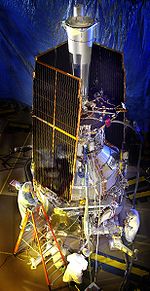 Gravity Probe B was a relativity gyroscope
experiment funded by NASA
. Efforts were led by Stanford University
physics department with Lockheed Martin
as the primary subcontractor. Mission scientists view it as the second gravity experiment in space, following the successful launch of Gravity Probe A
(GP-A) in 1976.
Some preliminary results were presented at a special session during the American Physical Society
meeting, 14–17 April 2007. NASA initially requested a proposal for extending the GP-B data analysis phase through December 2007. The data analysis phase was further extended to September 2008, and possibly later, when definitive science results on the frame-dragging
effect are expected. The mission plans were to test two unverified predictions of general relativity: frame-dragging and the geodetic effect
.
The experiment planned to check, very precisely, tiny changes in the direction of spin of four gyroscopes contained in an Earth satellite orbiting at 650 km
(400 mi) altitude, crossing directly over the poles. The gyroscopes were so free from disturbance that they provided a near-perfect space-time reference system. They were intended to measure how space and time are "warped" by the presence of the Earth, and by how much the Earth's rotation "drags" space-time around with it. This is the so-called frame-dragging effect, an example of gravitomagnetism
. It is an analog of magnetism
in classical electrodynamics, but caused by rotating masses rather than rotating electric charges.
Previously, only two analyses of the laser-ranging data obtained by the two LAGEOS
satellites, published in 1997 and 2004, claimed to have found the frame-dragging effect with an accuracy of about 20% and 10% respectively, whereas Gravity Probe B aims to measure the effect to a precision of 1%. However, subsequent analysis showed that the level of total uncertainty of the tests conducted with the two LAGEOS satellites has likely been greatly underestimated. A recent analysis of Mars Global Surveyor
data has claimed to have confirmed the effect to a precision of 0.5%, although the accuracy of this claim is disputed. Also the Lense–Thirring effect of the Sun has been recently investigated in view of a possible detection with the inner planets in the near future.
The probe has also detected the so-called geodetic effect
, a much larger effect caused by space-time being 'curved' by the mass of the Earth. A gyroscope's axis when parallel transport
ed around the Earth in one complete revolution does not end up pointing in exactly the same direction as before. The angle 'missing' may be thought of as the amount the gyroscope 'leans over' into the slope of the space-time curvature. A more precise explanation for the space curvature part of the geodetic precession is obtained by using a nearly flat cone to model the space curvature of the Earth's gravitational field. Such a cone is made by cutting out a thin 'pie-slice' from a circle and gluing the cut edges together. The spatial geodetic precession is a measure of the missing 'pie-slice' angle. Gravity Probe B should measure this effect to an accuracy of one part in 10,000, the most stringent check on general relativistic predictions to date.
The launch was planned for 19 April 2004 at Vandenberg Air Force Base
but was scrubbed within 5 minutes of the scheduled launch window due to changing winds in the upper atmosphere. An unusual feature of the mission is that it only had a one-second launch window due to the precise orbit required by the experiment. On 20 April, at 9:57:23 AM PDT
(16:57:23 UTC
) the spacecraft was launched successfully. The satellite was placed in orbit at 11:12:33 AM (18:12:33 UTC) after a cruise period over the south pole and a short second burn. The mission lasted 16 months.
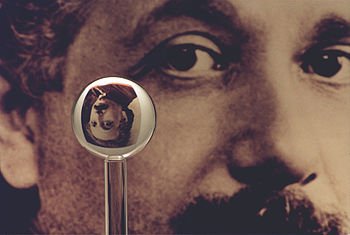 The Gravity Probe B experiment comprises four London moment gyroscopes and a reference telescope
sighted on HR8703 (also known as IM Pegasi
), a binary star
in the constellation Pegasus
. In polar orbit
, with the gyro spin directions also pointing toward HR8703, the frame-dragging and geodetic effects came out at right angles, each gyroscope measuring both.
The gyroscopes are housed in a dewar
of superfluid
helium
, maintaining a temperature of under 2 kelvins . Near-absolute zero
temperatures are required in order to minimize molecular interference, and enable the lead
and niobium
components of the gyroscope mechanisms to become superconductive
.
At the time, the gyroscopes were the most nearly spherical objects ever made. Approximately the size of ping pong balls, they are perfectly round to within forty atom
s (less than ). If one of these spheres were scaled to the size of the earth, the tallest mountains and deepest ocean trench would measure only high. They are composed of fused quartz
and coated with an extremely thin layer of niobium
. A primary concern is minimizing any influence on their spin, so the gyroscopes must never touch their containing compartment. They are held suspended with electric fields, spun up using a flow of helium gas, and their spin axes are sensed by monitoring the magnetic field of the superconductive niobium layer with SQUID
s. (A spinning superconductor generates a magnetic field precisely aligned with the rotation axis – see London moment
.)
IM Pegasi
was chosen as the guide star for multiple reasons. First, it needed to be bright enough to be usable for sightings. Then it was close to the ideal positions near at the celestial equator
of the sky coordinates
. Also important was its well understood motion in the sky, which was helped by the fact that this star emits relatively strong radio signals
. As a preparation for the setup of this mission, astronomers analyzed the radio-based position measurements with respect to far distant quasars taken over the last few years to understand its motion as precisely as needed.
research into the basic requirements and tools for the satellite.
In 1986 NASA changed plans for the shuttle
, which forced the mission team to switch from a shuttle-based launch design to one that is based on the Delta 2, and in 1995 tests planned of a prototype on a shuttle flight were cancelled as well.
Gravity Probe B marks the first time in history that a university has been in control of the development and operations of a space satellite funded by NASA.
Total cost of this project is about $750 million.
On 9 February 2007, it was announced that a number of unexpected signals had been received and that these would need to be separated out before final results could be released. In April it was announced that the spin axes of the gyroscopes were affected by torque, in a manner that varied over time, requiring further analysis to allow the results to be corrected for this source of error. Consequently, the date for the final release of data has been pushed back several times. In the data for the frame-dragging results presented at the April 2007 meeting of the American Physical Society, the random errors were much larger than the theoretical expected value and scattered on both the positive and negative sides of a null result, therefore causing skepticism on whether any useful data could be extracted in the future to test this effect.
In June 2007, a detailed update was released explaining the cause of the problem, and the solution that was being worked on. Although electrostatic patches caused by non-uniform coating of the spheres was anticipated, and was thought to have been controlled for before the experiment, it is now known that the final layer of the coating on the spheres defined two halves of slightly different potential, which gave the sphere an electrostatic axis. This created a classical dipole torque on each rotor, of a magnitude similar to the expected frame dragging effect. In addition, it dissipated energy from the polhode motion
by inducing currents in the housing electrodes, causing the motion to change with time. This meant that a simple time-average polhode model was insufficient, and a detailed orbit by orbit model was needed to remove the effect. As it was anticipated that "anything could go wrong", the final part of the flight mission was calibration, where amongst other activities, data was gathered with the spacecraft axis deliberately mis-aligned for 24 hours, to exacerbate any potential problems. This data proved invaluable for identifying the effects. With the electrostatic torque modelled as a function of axis misalignment, and the polhode motion modelled at a sufficiently fine level, it is hoped to isolate the relativity torques to the originally expected resolution.
Stanford has agreed to release the raw data to the public at an unspecified date in the future. It is likely that this data will be examined by independent scientists and independently reported to the public well after the September 2008 release. Because future interpretations of the data by scientists outside of GP-B may differ from the official results, it may take several more years for all of the data received by GP-B to be completely understood.
, that will enable the science team to continue working at least through December 2009. On 29 August 2008, the 18th meeting of the external GP-B Science Advisory Committee was held at Stanford to report progress. The ensuing SAC report to NASA states:
The Stanford-based analysis group and NASA announced on May 4, 2011 that the data from GP-B indeed confirms the two predictions of Albert Einstein's general theory of relativity. The findings were accepted for publication in the journal Physical Review Letters
.
The analysis has however drawn some criticism. Following the Physical Review Letters paper, a Nature
editorial piece (subtitled "General relativity vindicated, but was the mission worth it?") quotes Ignazio Ciufolini as saying "It may be that people repeating this analysis with another working hypothesis on the nature of the systematic errors would get another result". Science journals have expressed negative overviews, citing the $760,000,000 cost and that prior experiments had made 130-150 times more accurate measures over six years earlier.
Satellite
In the context of spaceflight, a satellite is an object which has been placed into orbit by human endeavour. Such objects are sometimes called artificial satellites to distinguish them from natural satellites such as the Moon....
-based mission which launched on 20 April 2004 on a Delta II
Delta II
Delta II was an American space launch system, originally designed and built by McDonnell Douglas. Delta II is part of the Delta rocket family and was in service from 1989 until November 1, 2011...
rocket. The spaceflight phase lasted until 2005; its aim was to measure spacetime curvature
Spacetime
In physics, spacetime is any mathematical model that combines space and time into a single continuum. Spacetime is usually interpreted with space as being three-dimensional and time playing the role of a fourth dimension that is of a different sort from the spatial dimensions...
near Earth
Earth
Earth is the third planet from the Sun, and the densest and fifth-largest of the eight planets in the Solar System. It is also the largest of the Solar System's four terrestrial planets...
, and thereby the stress–energy tensor (which is related to the distribution and the motion of matter in space) in and near Earth. This provided a test of general relativity
General relativity
General relativity or the general theory of relativity is the geometric theory of gravitation published by Albert Einstein in 1916. It is the current description of gravitation in modern physics...
, gravitomagnetism
Gravitomagnetism
Gravitomagnetism , refers to a set of formal analogies between Maxwell's field equations and an approximation, valid under certain conditions, to the Einstein field equations for general relativity. The most common version of GEM is valid only far from isolated sources, and for slowly moving test...
and related models. The principal investigator was Francis Everitt
Francis Everitt
C. W. Francis Everitt is a US-based English physicist working on experimental testing of general relativity. Everitt was educated at Imperial College London and the University of Pennsylvania in low-temperature physics...
.
Initial results confirmed the expected geodetic effect
Geodetic effect
The geodetic effect represents the effect of the curvature of spacetime, predicted by general relativity, on a vector carried along with an orbiting body...
to an accuracy of about 1%. The expected frame-dragging
Frame-dragging
Einstein's general theory of relativity predicts that non-static, stationary mass-energy distributions affect spacetime in a peculiar way giving rise to a phenomenon usually known as frame-dragging...
effect was similar in magnitude to the current noise
Noise
In common use, the word noise means any unwanted sound. In both analog and digital electronics, noise is random unwanted perturbation to a wanted signal; it is called noise as a generalisation of the acoustic noise heard when listening to a weak radio transmission with significant electrical noise...
level (the noise being dominated by initially unmodeled effects). Work is continuing to model and account for these sources of unintended signal, thus permitting extraction of the frame-dragging signal if it exists at the expected level. By August 2008 the uncertainty in the frame-dragging signal had been reduced to 15%, and the December 2008 NASA report indicated that the geodetic effect was confirmed to better than 0.5%.
In an article published in the journal Physical Review Letters
Physical Review Letters
Physical Review Letters , established in 1958, is a peer reviewed, scientific journal that is published 52 times per year by the American Physical Society...
in 2011, the authors reported analysis of the data from all four gyroscopes results in a geodetic drift rate of −6,601.8±18.3 mas/yr and a frame-dragging drift rate of −37.2±7.2 mas/yr, to be compared with the GR predictions of −6,606.1 mas/yr and −39.2 mas/yr, respectively.
Overview
Gyroscope
A gyroscope is a device for measuring or maintaining orientation, based on the principles of angular momentum. In essence, a mechanical gyroscope is a spinning wheel or disk whose axle is free to take any orientation...
experiment funded by NASA
NASA
The National Aeronautics and Space Administration is the agency of the United States government that is responsible for the nation's civilian space program and for aeronautics and aerospace research...
. Efforts were led by Stanford University
Stanford University
The Leland Stanford Junior University, commonly referred to as Stanford University or Stanford, is a private research university on an campus located near Palo Alto, California. It is situated in the northwestern Santa Clara Valley on the San Francisco Peninsula, approximately northwest of San...
physics department with Lockheed Martin
Lockheed Martin
Lockheed Martin is an American global aerospace, defense, security, and advanced technology company with worldwide interests. It was formed by the merger of Lockheed Corporation with Martin Marietta in March 1995. It is headquartered in Bethesda, Maryland, in the Washington Metropolitan Area....
as the primary subcontractor. Mission scientists view it as the second gravity experiment in space, following the successful launch of Gravity Probe A
Gravity Probe A
Gravity Probe A was a space-based experiment to test the theory of general relativity, performed jointly by the Smithsonian Astrophysical Observatory and the National Aeronautics and Space Administration...
(GP-A) in 1976.
Some preliminary results were presented at a special session during the American Physical Society
American Physical Society
The American Physical Society is the world's second largest organization of physicists, behind the Deutsche Physikalische Gesellschaft. The Society publishes more than a dozen scientific journals, including the world renowned Physical Review and Physical Review Letters, and organizes more than 20...
meeting, 14–17 April 2007. NASA initially requested a proposal for extending the GP-B data analysis phase through December 2007. The data analysis phase was further extended to September 2008, and possibly later, when definitive science results on the frame-dragging
Frame-dragging
Einstein's general theory of relativity predicts that non-static, stationary mass-energy distributions affect spacetime in a peculiar way giving rise to a phenomenon usually known as frame-dragging...
effect are expected. The mission plans were to test two unverified predictions of general relativity: frame-dragging and the geodetic effect
Geodetic effect
The geodetic effect represents the effect of the curvature of spacetime, predicted by general relativity, on a vector carried along with an orbiting body...
.
The experiment planned to check, very precisely, tiny changes in the direction of spin of four gyroscopes contained in an Earth satellite orbiting at 650 km
Kilometre
The kilometre is a unit of length in the metric system, equal to one thousand metres and is therefore exactly equal to the distance travelled by light in free space in of a second...
(400 mi) altitude, crossing directly over the poles. The gyroscopes were so free from disturbance that they provided a near-perfect space-time reference system. They were intended to measure how space and time are "warped" by the presence of the Earth, and by how much the Earth's rotation "drags" space-time around with it. This is the so-called frame-dragging effect, an example of gravitomagnetism
Gravitomagnetism
Gravitomagnetism , refers to a set of formal analogies between Maxwell's field equations and an approximation, valid under certain conditions, to the Einstein field equations for general relativity. The most common version of GEM is valid only far from isolated sources, and for slowly moving test...
. It is an analog of magnetism
Magnetism
Magnetism is a property of materials that respond at an atomic or subatomic level to an applied magnetic field. Ferromagnetism is the strongest and most familiar type of magnetism. It is responsible for the behavior of permanent magnets, which produce their own persistent magnetic fields, as well...
in classical electrodynamics, but caused by rotating masses rather than rotating electric charges.
Previously, only two analyses of the laser-ranging data obtained by the two LAGEOS
LAGEOS
LAGEOS, or Laser Geodynamics Satellites, are a series of scientific research satellites designed to provide an orbiting laser ranging benchmark for geodynamical studies of the Earth...
satellites, published in 1997 and 2004, claimed to have found the frame-dragging effect with an accuracy of about 20% and 10% respectively, whereas Gravity Probe B aims to measure the effect to a precision of 1%. However, subsequent analysis showed that the level of total uncertainty of the tests conducted with the two LAGEOS satellites has likely been greatly underestimated. A recent analysis of Mars Global Surveyor
Mars Global Surveyor
The Mars Global Surveyor was a US spacecraft developed by NASA's Jet Propulsion Laboratory and launched November 1996. It began the United States's return to Mars after a 10-year absence. It completed its primary mission in January 2001 and was in its third extended mission phase when, on 2...
data has claimed to have confirmed the effect to a precision of 0.5%, although the accuracy of this claim is disputed. Also the Lense–Thirring effect of the Sun has been recently investigated in view of a possible detection with the inner planets in the near future.
The probe has also detected the so-called geodetic effect
Geodetic effect
The geodetic effect represents the effect of the curvature of spacetime, predicted by general relativity, on a vector carried along with an orbiting body...
, a much larger effect caused by space-time being 'curved' by the mass of the Earth. A gyroscope's axis when parallel transport
Parallel transport
In geometry, parallel transport is a way of transporting geometrical data along smooth curves in a manifold. If the manifold is equipped with an affine connection , then this connection allows one to transport vectors of the manifold along curves so that they stay parallel with respect to the...
ed around the Earth in one complete revolution does not end up pointing in exactly the same direction as before. The angle 'missing' may be thought of as the amount the gyroscope 'leans over' into the slope of the space-time curvature. A more precise explanation for the space curvature part of the geodetic precession is obtained by using a nearly flat cone to model the space curvature of the Earth's gravitational field. Such a cone is made by cutting out a thin 'pie-slice' from a circle and gluing the cut edges together. The spatial geodetic precession is a measure of the missing 'pie-slice' angle. Gravity Probe B should measure this effect to an accuracy of one part in 10,000, the most stringent check on general relativistic predictions to date.
The launch was planned for 19 April 2004 at Vandenberg Air Force Base
Vandenberg Air Force Base
Vandenberg Air Force Base is a United States Air Force Base, located approximately northwest of Lompoc, California. It is under the jurisdiction of the 30th Space Wing, Air Force Space Command ....
but was scrubbed within 5 minutes of the scheduled launch window due to changing winds in the upper atmosphere. An unusual feature of the mission is that it only had a one-second launch window due to the precise orbit required by the experiment. On 20 April, at 9:57:23 AM PDT
Time zone
A time zone is a region on Earth that has a uniform standard time for legal, commercial, and social purposes. In order for the same clock time to always correspond to the same portion of the day as the Earth rotates , different places on the Earth need to have different clock times...
(16:57:23 UTC
Coordinated Universal Time
Coordinated Universal Time is the primary time standard by which the world regulates clocks and time. It is one of several closely related successors to Greenwich Mean Time. Computer servers, online services and other entities that rely on having a universally accepted time use UTC for that purpose...
) the spacecraft was launched successfully. The satellite was placed in orbit at 11:12:33 AM (18:12:33 UTC) after a cruise period over the south pole and a short second burn. The mission lasted 16 months.
Experimental setup
Telescope
A telescope is an instrument that aids in the observation of remote objects by collecting electromagnetic radiation . The first known practical telescopes were invented in the Netherlands at the beginning of the 1600s , using glass lenses...
sighted on HR8703 (also known as IM Pegasi
IM Pegasi
IM Pegasi is a variable binary star system approximately 329 light-years away in the constellation of Pegasus. With an apparent magnitude of 5.7, it is visible to the naked eye. Increased public awareness of it is due to its use as the guide star for the Gravity Probe B general relativity...
), a binary star
Binary star
A binary star is a star system consisting of two stars orbiting around their common center of mass. The brighter star is called the primary and the other is its companion star, comes, or secondary...
in the constellation Pegasus
Pegasus (constellation)
Pegasus is a constellation in the northern sky, named after the winged horse Pegasus in Greek mythology. It was one of the 48 constellations listed by the 2nd century astronomer Ptolemy, and remains one of the 88 modern constellations.-Stars:...
. In polar orbit
Polar orbit
A polar orbit is an orbit in which a satellite passes above or nearly above both poles of the body being orbited on each revolution. It therefore has an inclination of 90 degrees to the equator...
, with the gyro spin directions also pointing toward HR8703, the frame-dragging and geodetic effects came out at right angles, each gyroscope measuring both.
The gyroscopes are housed in a dewar
Dewar flask
A Dewar flask is a vessel designed to provide very good thermal insulation. For instance, when filled with a hot liquid, the vessel will not allow the heat to easily escape, and the liquid will stay hot for far longer than in a typical container...
of superfluid
Superfluid
Superfluidity is a state of matter in which the matter behaves like a fluid without viscosity and with extremely high thermal conductivity. The substance, which appears to be a normal liquid, will flow without friction past any surface, which allows it to continue to circulate over obstructions and...
helium
Helium
Helium is the chemical element with atomic number 2 and an atomic weight of 4.002602, which is represented by the symbol He. It is a colorless, odorless, tasteless, non-toxic, inert, monatomic gas that heads the noble gas group in the periodic table...
, maintaining a temperature of under 2 kelvins . Near-absolute zero
Absolute zero
Absolute zero is the theoretical temperature at which entropy reaches its minimum value. The laws of thermodynamics state that absolute zero cannot be reached using only thermodynamic means....
temperatures are required in order to minimize molecular interference, and enable the lead
Lead
Lead is a main-group element in the carbon group with the symbol Pb and atomic number 82. Lead is a soft, malleable poor metal. It is also counted as one of the heavy metals. Metallic lead has a bluish-white color after being freshly cut, but it soon tarnishes to a dull grayish color when exposed...
and niobium
Niobium
Niobium or columbium , is a chemical element with the symbol Nb and atomic number 41. It's a soft, grey, ductile transition metal, which is often found in the pyrochlore mineral, the main commercial source for niobium, and columbite...
components of the gyroscope mechanisms to become superconductive
Superconductivity
Superconductivity is a phenomenon of exactly zero electrical resistance occurring in certain materials below a characteristic temperature. It was discovered by Heike Kamerlingh Onnes on April 8, 1911 in Leiden. Like ferromagnetism and atomic spectral lines, superconductivity is a quantum...
.
At the time, the gyroscopes were the most nearly spherical objects ever made. Approximately the size of ping pong balls, they are perfectly round to within forty atom
Atom
The atom is a basic unit of matter that consists of a dense central nucleus surrounded by a cloud of negatively charged electrons. The atomic nucleus contains a mix of positively charged protons and electrically neutral neutrons...
s (less than ). If one of these spheres were scaled to the size of the earth, the tallest mountains and deepest ocean trench would measure only high. They are composed of fused quartz
Fused quartz
Fused quartz and fused silica are types of glass containing primarily silica in amorphous form. They are manufactured using several different processes...
and coated with an extremely thin layer of niobium
Niobium
Niobium or columbium , is a chemical element with the symbol Nb and atomic number 41. It's a soft, grey, ductile transition metal, which is often found in the pyrochlore mineral, the main commercial source for niobium, and columbite...
. A primary concern is minimizing any influence on their spin, so the gyroscopes must never touch their containing compartment. They are held suspended with electric fields, spun up using a flow of helium gas, and their spin axes are sensed by monitoring the magnetic field of the superconductive niobium layer with SQUID
SQUID
A SQUID is a very sensitive magnetometer used to measure extremely weak magnetic fields, based on superconducting loops containing Josephson junctions....
s. (A spinning superconductor generates a magnetic field precisely aligned with the rotation axis – see London moment
London moment
The 'London moment' is a quantum-mechanical phenomenon whereby a spinning superconductor generates a magnetic field whose axis lines up exactly with the spin axis....
.)
IM Pegasi
IM Pegasi
IM Pegasi is a variable binary star system approximately 329 light-years away in the constellation of Pegasus. With an apparent magnitude of 5.7, it is visible to the naked eye. Increased public awareness of it is due to its use as the guide star for the Gravity Probe B general relativity...
was chosen as the guide star for multiple reasons. First, it needed to be bright enough to be usable for sightings. Then it was close to the ideal positions near at the celestial equator
Celestial equator
The celestial equator is a great circle on the imaginary celestial sphere, in the same plane as the Earth's equator. In other words, it is a projection of the terrestrial equator out into space...
of the sky coordinates
Equatorial coordinate system
The equatorial coordinate system is a widely-used method of mapping celestial objects. It functions by projecting the Earth's geographic poles and equator onto the celestial sphere. The projection of the Earth's equator onto the celestial sphere is called the celestial equator...
. Also important was its well understood motion in the sky, which was helped by the fact that this star emits relatively strong radio signals
Radio astronomy
Radio astronomy is a subfield of astronomy that studies celestial objects at radio frequencies. The initial detection of radio waves from an astronomical object was made in the 1930s, when Karl Jansky observed radiation coming from the Milky Way. Subsequent observations have identified a number of...
. As a preparation for the setup of this mission, astronomers analyzed the radio-based position measurements with respect to far distant quasars taken over the last few years to understand its motion as precisely as needed.
History
The conceptual design for this mission was first proposed by an MIT professor, George Pugh, who was working with the U.S. Department of Defense in 1959 and later discussed by Leonard Schiff (Stanford) in 1960 at Pugh's suggestion, based partly on a theoretical paper about detecting frame dragging that Schiff had written in 1957. It was proposed to NASA in 1961, and they supported the project with funds in 1964. This grant ended in 1977 after a long phase of engineeringEngineering
Engineering is the discipline, art, skill and profession of acquiring and applying scientific, mathematical, economic, social, and practical knowledge, in order to design and build structures, machines, devices, systems, materials and processes that safely realize improvements to the lives of...
research into the basic requirements and tools for the satellite.
In 1986 NASA changed plans for the shuttle
Space Shuttle
The Space Shuttle was a manned orbital rocket and spacecraft system operated by NASA on 135 missions from 1981 to 2011. The system combined rocket launch, orbital spacecraft, and re-entry spaceplane with modular add-ons...
, which forced the mission team to switch from a shuttle-based launch design to one that is based on the Delta 2, and in 1995 tests planned of a prototype on a shuttle flight were cancelled as well.
Gravity Probe B marks the first time in history that a university has been in control of the development and operations of a space satellite funded by NASA.
Total cost of this project is about $750 million.
Mission timeline
This is a list of major events for the GP-B experiment.- 20 April 2004: Launch of GP-B from Vandenberg AFB and successful insertion into polar orbit.
- 27 August 2004: GP-B entered its science phase. On mission day 129 all systems were configured to be ready for data collection, with the only exception being gyro 4, which needed further spin axis alignment.
- 15 August 2005: The science phase of the mission ended and the spacecraft instruments transitioned to the final calibration mode.
- 26 September 2005: The calibration phase ended with liquid helium still in the dewar. The spacecraft was returned to science mode pending the depletion of the last of the liquid helium.
- February 2006: Phase I of data analysis complete
- September 2006: Analysis team realised that more error analysis, particularly around the polhode motionPolhodeThe details of a spinning body may impose restrictions on the motion of its angular velocity vector, ω. The curve produced by the angular velocity vector on the inertia ellipsoid, is known as the polhode, coined from Greek meaning "path of the pole"...
of the gyros, was necessary than could be done in the time to April 2007, and applied to NASA for an extension of funding to the end of 2007. - December 2006: Completion of Phase III of data analysis
- 14 April 2007: Announcement of best results obtained to date. Francis Everitt gave a plenary talk at the meeting of the American Physical SocietyAmerican Physical SocietyThe American Physical Society is the world's second largest organization of physicists, behind the Deutsche Physikalische Gesellschaft. The Society publishes more than a dozen scientific journals, including the world renowned Physical Review and Physical Review Letters, and organizes more than 20...
announcing initial results: "The data from the GP-B gyroscopes clearly confirm Einstein's predicted geodetic effect to a precision of better than 1 percent. However, the frame-dragging effect is 170 times smaller than the geodetic effect, and Stanford scientists are still extracting its signature from the spacecraft data." — Gravity Probe B website - 8 December 2010: GP-B spacecraft decommissioned, left in its 642 km (400 mi) polar orbit.
- 4 May 2011: GP-B Final experimental results were announced. In a public press and media event at NASA Headquarters, GP-B Principal Investigator, Francis Everitt announced the final results of Gravity Probe B.
On 9 February 2007, it was announced that a number of unexpected signals had been received and that these would need to be separated out before final results could be released. In April it was announced that the spin axes of the gyroscopes were affected by torque, in a manner that varied over time, requiring further analysis to allow the results to be corrected for this source of error. Consequently, the date for the final release of data has been pushed back several times. In the data for the frame-dragging results presented at the April 2007 meeting of the American Physical Society, the random errors were much larger than the theoretical expected value and scattered on both the positive and negative sides of a null result, therefore causing skepticism on whether any useful data could be extracted in the future to test this effect.
In June 2007, a detailed update was released explaining the cause of the problem, and the solution that was being worked on. Although electrostatic patches caused by non-uniform coating of the spheres was anticipated, and was thought to have been controlled for before the experiment, it is now known that the final layer of the coating on the spheres defined two halves of slightly different potential, which gave the sphere an electrostatic axis. This created a classical dipole torque on each rotor, of a magnitude similar to the expected frame dragging effect. In addition, it dissipated energy from the polhode motion
Polhode
The details of a spinning body may impose restrictions on the motion of its angular velocity vector, ω. The curve produced by the angular velocity vector on the inertia ellipsoid, is known as the polhode, coined from Greek meaning "path of the pole"...
by inducing currents in the housing electrodes, causing the motion to change with time. This meant that a simple time-average polhode model was insufficient, and a detailed orbit by orbit model was needed to remove the effect. As it was anticipated that "anything could go wrong", the final part of the flight mission was calibration, where amongst other activities, data was gathered with the spacecraft axis deliberately mis-aligned for 24 hours, to exacerbate any potential problems. This data proved invaluable for identifying the effects. With the electrostatic torque modelled as a function of axis misalignment, and the polhode motion modelled at a sufficiently fine level, it is hoped to isolate the relativity torques to the originally expected resolution.
Stanford has agreed to release the raw data to the public at an unspecified date in the future. It is likely that this data will be examined by independent scientists and independently reported to the public well after the September 2008 release. Because future interpretations of the data by scientists outside of GP-B may differ from the official results, it may take several more years for all of the data received by GP-B to be completely understood.
NASA review
A review by a panel of 15 experts commissioned by NASA has recommended against extending the data analysis phase beyond 2008. They warn that the required reduction in noise level (due to classical torques and breaks in data collection due to solar flares) "is so large that any effect ultimately detected by this experiment will have to overcome considerable (and in our opinion, well justified) skepticism in the scientific community".Data Analysis after NASA
NASA funding and sponsorship of the program ended on 30 September 2008, but GP-B has secured alternative funding from King Abdulaziz City of Science and Technology KACST in Saudi ArabiaSaudi Arabia
The Kingdom of Saudi Arabia , commonly known in British English as Saudi Arabia and in Arabic as as-Sa‘ūdiyyah , is the largest state in Western Asia by land area, constituting the bulk of the Arabian Peninsula, and the second-largest in the Arab World...
, that will enable the science team to continue working at least through December 2009. On 29 August 2008, the 18th meeting of the external GP-B Science Advisory Committee was held at Stanford to report progress. The ensuing SAC report to NASA states:
The Stanford-based analysis group and NASA announced on May 4, 2011 that the data from GP-B indeed confirms the two predictions of Albert Einstein's general theory of relativity. The findings were accepted for publication in the journal Physical Review Letters
Physical Review Letters
Physical Review Letters , established in 1958, is a peer reviewed, scientific journal that is published 52 times per year by the American Physical Society...
.
The analysis has however drawn some criticism. Following the Physical Review Letters paper, a Nature
Nature (journal)
Nature, first published on 4 November 1869, is ranked the world's most cited interdisciplinary scientific journal by the Science Edition of the 2010 Journal Citation Reports...
editorial piece (subtitled "General relativity vindicated, but was the mission worth it?") quotes Ignazio Ciufolini as saying "It may be that people repeating this analysis with another working hypothesis on the nature of the systematic errors would get another result". Science journals have expressed negative overviews, citing the $760,000,000 cost and that prior experiments had made 130-150 times more accurate measures over six years earlier.
See also
- Frame-draggingFrame-draggingEinstein's general theory of relativity predicts that non-static, stationary mass-energy distributions affect spacetime in a peculiar way giving rise to a phenomenon usually known as frame-dragging...
- Gravity
- Gravity Probe AGravity Probe AGravity Probe A was a space-based experiment to test the theory of general relativity, performed jointly by the Smithsonian Astrophysical Observatory and the National Aeronautics and Space Administration...
- GravitomagnetismGravitomagnetismGravitomagnetism , refers to a set of formal analogies between Maxwell's field equations and an approximation, valid under certain conditions, to the Einstein field equations for general relativity. The most common version of GEM is valid only far from isolated sources, and for slowly moving test...
- Tests of general relativityTests of general relativityAt its introduction in 1915, the general theory of relativity did not have a solid empirical foundation. It was known that it correctly accounted for the "anomalous" precession of the perihelion of Mercury and on philosophical grounds it was considered satisfying that it was able to unify Newton's...
- Timeline of gravitational physics and relativityTimeline of gravitational physics and relativityTimeline of gravitational physics and general relativity* 3rd century BC - Aristarchus of Samos proposes heliocentric model, measures the distance to the moon and its size...