
A
gravitational wave detector is any experiment designed to measure gravitational waves, minute distortions of
spacetimeIn physics, spacetime is any mathematical model that combines space and time into a single continuum. Spacetime is usually interpreted with space as being three-dimensional and time playing the role of a fourth dimension that is of a different sort from the spatial dimensions...
that are predicted by
EinsteinAlbert Einstein was a German-born theoretical physicist who developed the theory of general relativity, effecting a revolution in physics. For this achievement, Einstein is often regarded as the father of modern physics and one of the most prolific intellects in human history...
's theory of
general relativityGeneral relativity or the general theory of relativity is the geometric theory of gravitation published by Albert Einstein in 1916. It is the current description of gravitation in modern physics...
. The existence of gravitational radiation is a prediction of Einstein's general theory of relativity. Gravitational waves are perturbations in the curvature of spacetime caused by accelerated masses. Since the 1960s gravitational wave detectors have been built and constantly improved. The present-day generation of resonant mass antennas and laser interferometers has reached the necessary sensitivity to detect gravitational waves from sources in the
Milky WayThe Milky Way is the galaxy that contains the Solar System. This name derives from its appearance as a dim un-resolved "milky" glowing band arching across the night sky...
.
Complications
The direct detection of gravitational waves is complicated by the
extraordinarily small effect the waves would produce on a detector. The amplitude of a spherical wave will fall off as the inverse square of the distance from the source. Thus, even waves from extreme systems like merging binary black holes die out to very small amplitude by the time they reach the Earth. Astrophysicists expect that some gravitational waves passing the Earth may be as large as

, but generally no bigger.
Weber bars
A simple device to detect the expected wave motion is called a
Weber barA Weber bar is a device used in the detection of gravitational waves first devised and constructed by physicist Joseph Weber at the University of Maryland...
— a large, solid bar of metal isolated from outside vibrations. This type of instrument was the first type of gravitational wave detector. Strains in space due to an incident gravitational wave excite the bar's resonant frequency and could thus be amplified to detectable levels. Conceivably, a nearby supernova might be strong enough to be seen without resonant amplification. Modern forms of the Weber bar are still operated, cryogenically cooled, with
superconducting quantum interference devicesA SQUID is a very sensitive magnetometer used to measure extremely weak magnetic fields, based on superconducting loops containing Josephson junctions....
to detect vibration (see for example,
ALLEGROALLEGRO was a ground-based, cryogenic resonant Weber bar, gravitational wave detector run by Warren Johnson, et. al at Louisiana State University in Baton Rouge, Louisiana. The detector was commissioned in the early 90's, and was decommissioned in 2008....
). Weber bars are not sensitive enough to detect anything but extremely powerful gravitational waves.
MiniGRAILMiniGRAIL is an instrument that is designed to detect gravitational waves. The MiniGRAIL is the first such detector to use a spherical design. It is located at Leiden University in the Netherlands. The project is being managed by the Kamerlingh Onnes Laboratory...
is a spherical gravitational wave antenna using this principle. It is based at
Leiden UniversityLeiden University , located in the city of Leiden, is the oldest university in the Netherlands. The university was founded in 1575 by William, Prince of Orange, leader of the Dutch Revolt in the Eighty Years' War. The royal Dutch House of Orange-Nassau and Leiden University still have a close...
, consisting of an exactingly machined 1150 kg sphere cryogenically cooled to 20 mK. The spherical configuration allows for equal sensitivity in all directions, and is somewhat experimentally simpler than larger linear devices requiring high vacuum. Events are detected by measuring
deformation of the detector sphereIn mathematics, especially as applied to physics, multipole moments are the coefficients of a series expansion of a potential due to continuous or discrete sources . A multipole moment usually involves powers of the distance to the origin, as well as some angular dependence...
. MiniGRAIL is highly sensitive in the 2–4 kHz range, suitable for detecting gravitational waves from rotating neutron star instabilities or small black hole mergers.
Interferometers
A more sensitive detector uses laser
interferometryInterferometry refers to a family of techniques in which electromagnetic waves are superimposed in order to extract information about the waves. An instrument used to interfere waves is called an interferometer. Interferometry is an important investigative technique in the fields of astronomy,...
to measure gravitational-wave induced motion between separated 'free' masses. This allows the masses to be separated by large distances (increasing the signal size); a further advantage is that it is sensitive to a wide range of frequencies (not just those near a resonance as is the case for Weber bars). Ground-based interferometers are now operational. Currently, the most sensitive is
LIGOLIGO, which stands for the Laser Interferometer Gravitational-Wave Observatory, is a large-scale physics experiment aiming to directly detect gravitational waves. Cofounded in 1992 by Kip Thorne and Ronald Drever of Caltech and Rainer Weiss of MIT, LIGO is a joint project between scientists at MIT,...
— the Laser Interferometer Gravitational Wave Observatory. LIGO has three detectors: one in
Livingston, LouisianaLivingston is a town in and the parish seat of Livingston Parish, Louisiana, United States. The population was 1,342 at the 2000 census. It is part of the Baton Rouge Metropolitan Statistical Area....
; the other two (in the same vacuum tubes) at the
Hanford siteThe Hanford Site is a mostly decommissioned nuclear production complex on the Columbia River in the U.S. state of Washington, operated by the United States federal government. The site has been known by many names, including Hanford Works, Hanford Engineer Works or HEW, Hanford Nuclear Reservation...
in
Richland, WashingtonRichland is a city in Benton County in the southeastern part of the U.S. state of Washington, at the confluence of the Yakima and the Columbia Rivers. As of the 2010 census, the city population was 48,058. April 1, 2011 estimates from the Washington State Office of Financial Management put the...
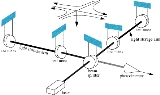
. Each consists of two light storage arms which are 2 to 4 kilometers in length. These are at 90 degree angles to each other, with the light passing through 1m diameter vacuum tubes running the entire 4 kilometers. A passing gravitational wave will slightly stretch one arm as it shortens the other. This is precisely the motion to which an interferometer is most sensitive.
Even with such long arms, the strongest gravitational waves will only change the distance between the ends of the arms by at most roughly 10
−18 meters. LIGO should be able to detect gravitational waves as small as

. Upgrades to LIGO and other detectors such as
VIRGO-Astronomy:* Virgo Cluster, a cluster of galaxies in the constellation Virgo* Virgo , a constellation* Virgo Stellar Stream, remains of a dwarf galaxy* Virgo Supercluster, a galactic supercluster-Surname:* Virgo...
,
GEO 600GEO 600 is a gravitational wave detector located near Sarstedt, Germany. This instrument, and its sister interferometric detectors, when operational, are some of the most sensitive gravitational wave detectors ever designed...
, and
TAMA 300TAMA 300 is a gravitational wave detector located at the Mitaka campus of the National Astronomical Observatory of Japan. It is a project of the gravitational wave studies group at the Institute for Cosmic Ray Research of the University of Tokyo...
should increase the sensitivity still further; the next generation of instruments (Advanced LIGO and Advanced Virgo) will be more than ten times more sensitive. Another highly sensitive interferometer (
LCGTThe Large Scale Cryogenic Gravitational Wave Telescope is a future project of the gravitational wave studies group at the Institute for Cosmic Ray Research of the University of Tokyo. The ICRR was established in 1976 for cosmic ray studies, and is currently working on TAMA 300...
) is currently in the design phase. A key point is that a ten-times increase in sensitivity (radius of "reach") increases the volume of space accessible to the instrument by one thousand. This increases the rate at which detectable signals should be seen from one per tens of years of observation, to tens per year.
Interferometric detectors are limited at high frequencies by
shot noiseShot noise is a type of electronic noise that may be dominant when the finite number of particles that carry energy is sufficiently small so that uncertainties due to the Poisson distribution, which describes the occurrence of independent random events, are of significance...
, which occurs because the lasers produce photons randomly; one analogy is to rainfall — the rate of rainfall, like the laser intensity, is measurable, but the raindrops, like photons, fall at random times, causing fluctuations around the average value. This leads to noise at the output of the detector, much like radio static. In addition, for sufficiently high laser power, the random momentum transferred to the test masses by the laser photons shakes the mirrors, masking signals at low frequencies. Thermal noise (e.g.,
Brownian motionBrownian motion or pedesis is the presumably random drifting of particles suspended in a fluid or the mathematical model used to describe such random movements, which is often called a particle theory.The mathematical model of Brownian motion has several real-world applications...
) is another limit to sensitivity. In addition to these "stationary" (constant) noise sources, all ground-based detectors are also limited at low frequencies by seismic noise and other forms of environmental vibration, and other "non-stationary" noise sources; creaks in mechanical structures, lightning or other large electrical disturbances, etc. may also create noise masking an event or may even imitate an event. All these must be taken into account and excluded by analysis before a detection may be considered a true gravitational wave event.
Space-based interferometers, such as
LISAThe Laser Interferometer Space Antenna is a planned space mission to detect and accurately measure gravitational waves from astronomical sources. LISA was originally conceived as a joint effort between the United States space agency NASA and the European Space Agency...
and DECIGO, are also being developed. LISA's design calls for three test masses forming an equilateral triangle, with lasers from each spacecraft to each other spacecraft forming two independent interferometers. LISA is planned to occupy a solar orbit trailing the Earth, with each arm of the triangle being five million kilometers. This puts the detector in an
excellent vacuumThe interplanetary medium is the material which fills the solar system and through which all the larger solar system bodies such as planets, asteroids and comets move.-Composition and physical characteristics:...
far from Earth-based sources of noise, though it will still be susceptible to shot noise, as well as artifacts caused by
cosmic rayCosmic rays are energetic charged subatomic particles, originating from outer space. They may produce secondary particles that penetrate the Earth's atmosphere and surface. The term ray is historical as cosmic rays were thought to be electromagnetic radiation...
s and
solar windThe solar wind is a stream of charged particles ejected from the upper atmosphere of the Sun. It mostly consists of electrons and protons with energies usually between 1.5 and 10 keV. The stream of particles varies in temperature and speed over time...
.
High frequency detectors
There are currently two detectors focusing on detections at the higher end of the gravitational wave spectrum (10
−7 to 10
5 Hz): one at
University of BirminghamThe University of Birmingham is a British Redbrick university located in the city of Birmingham, England. It received its royal charter in 1900 as a successor to Birmingham Medical School and Mason Science College . Birmingham was the first Redbrick university to gain a charter and thus...
, England, and the other at
INFNThe Istituto Nazionale di Fisica Nucleare is the coordinating institution for nuclear, particle and astroparticle physics in Italy. It was founded on the 8th of August 1951, to further the nuclear physics research tradition initiated by Enrico Fermi in Rome, in the 1930s...
Genoa, Italy. A third is under development at
Chongqing UniversityChongqing University is a comprehensive national university in the Shapingba District of Chongqing municipality, China. It is a member of the Project 211 and Project 985 which aims to transform Chinese universities into better research institutions.-History:...
, China. The Birmingham detector measures changes in the polarization state of a
microwaveMicrowaves, a subset of radio waves, have wavelengths ranging from as long as one meter to as short as one millimeter, or equivalently, with frequencies between 300 MHz and 300 GHz. This broad definition includes both UHF and EHF , and various sources use different boundaries...
beam circulating in a closed loop about one meter across. Two have been fabricated and they are currently expected to be sensitive to periodic spacetime strains of

, given as an
amplitude spectral densityIn statistical signal processing and physics, the spectral density, power spectral density , or energy spectral density , is a positive real function of a frequency variable associated with a stationary stochastic process, or a deterministic function of time, which has dimensions of power per hertz...
. The INFN Genoa detector is a resonant antenna consisting of two coupled spherical superconducting harmonic oscillators a few centimeters in diameter. The oscillators are designed to have (when uncoupled) almost equal resonant frequencies. The system is currently expected to have a sensitivity to periodic spacetime strains of

, with an expectation to reach a sensitivity of

. The Chongqing University detector is planned to detect relic high-frequency gravitational waves with the predicted typical parameters ?
g ~ 10
10 Hz (10 GHz) and
h ~ 10
−30–10
−31.
Pulsar timing arrays
A different approach to detecting gravitational waves is used by
pulsar timing arrayA pulsar timing array is a set of millisecond pulsars that can be used to detect and analyse gravitational waves. Such a detection would result from a detailed investigation of the arrival times of pulses emitted by these millisecond pulsars....
s, such as the
European Pulsar Timing ArrayThe European Pulsar Timing Array is a European collaboration to combine five 100-m class radio-telescopes to observe an array of pulsars with the specific goal of detecting gravitational waves...
, the
North American Nanohertz Observatory for Gravitational WavesThe North American Nanohertz Observatory for Gravitational Waves is a consortium of astronomers who share a common goal of detecting gravitational waves via regular observations of an ensemble of millisecond pulsars using with the Green Bank and Arecibo radio telescopes...
, and the Parkes Pulsar Timing Array. These projects propose to detect gravitational waves by looking at the effect these waves have on the incoming signals from an array of 20–50 well-known millisecond pulsars. As a gravitational wave passing through the Earth contracts space in one direction and expands space in another, the times of arrival of pulsar signals from those directions are shifted correspondingly. By studying a fixed set of pulsars across the sky, these arrays should be able to detect gravitational waves in the nanohertz range. Such signals are expected to be emitted by pairs of merging supermassive black holes.
Einstein@Home
In some sense, the easiest signals to detect should be constant sources. Supernovae and neutron star or black hole mergers should have larger amplitudes and be more interesting, but the waves generated will be more complicated. The waves given off by a spinning, bumpy neutron star would be "monochromatic" — like a
pure toneA pure tone is a tone with a sinusoidal waveshape.A sine wave is characterized by its frequency, the number of cycles per second—or its wavelength, the distance the waveform travels through its medium within a period—and the amplitude, the size of each cycle...
in
acousticsAcoustics is the interdisciplinary science that deals with the study of all mechanical waves in gases, liquids, and solids including vibration, sound, ultrasound and infrasound. A scientist who works in the field of acoustics is an acoustician while someone working in the field of acoustics...
. It would not change very much in amplitude or frequency.
The
Einstein@HomeEinstein@Home is a volunteer distributed computing project hosted by the University of Wisconsin–Milwaukee and the Max Planck Institute for Gravitational Physics . The project is directed by Bruce Allen...
project is a
distributed computingDistributed computing is a field of computer science that studies distributed systems. A distributed system consists of multiple autonomous computers that communicate through a computer network. The computers interact with each other in order to achieve a common goal...
project similar to
SETI@home SETI@home is an Internet-based public volunteer computing project employing the BOINC software platform, hosted by the Space Sciences Laboratory, at the University of California, Berkeley, in the United States. SETI is an acronym for the Search for Extra-Terrestrial Intelligence...
intended to detect this type of simple gravitational wave. By taking data from LIGO and GEO, and sending it out in little pieces to thousands of volunteers for parallel analysis on their home computers, Einstein@Home can sift through the data far more quickly than would be possible otherwise.
Specific operational gravitational wave detectors
- CLIO
CLIO is the Cryogenic Laser Interferometer Observatory, a prototype detector for gravitational waves. It is testing cryogenic mirror technologies for the future Large Cryogenic Gravity Telescope ....
- GEO 600
GEO 600 is a gravitational wave detector located near Sarstedt, Germany. This instrument, and its sister interferometric detectors, when operational, are some of the most sensitive gravitational wave detectors ever designed...
- LCGT
The Large Scale Cryogenic Gravitational Wave Telescope is a future project of the gravitational wave studies group at the Institute for Cosmic Ray Research of the University of Tokyo. The ICRR was established in 1976 for cosmic ray studies, and is currently working on TAMA 300...
- LIGO
LIGO, which stands for the Laser Interferometer Gravitational-Wave Observatory, is a large-scale physics experiment aiming to directly detect gravitational waves. Cofounded in 1992 by Kip Thorne and Ronald Drever of Caltech and Rainer Weiss of MIT, LIGO is a joint project between scientists at MIT,...
- LISA
The Laser Interferometer Space Antenna is a planned space mission to detect and accurately measure gravitational waves from astronomical sources. LISA was originally conceived as a joint effort between the United States space agency NASA and the European Space Agency...
- MiniGrail
MiniGRAIL is an instrument that is designed to detect gravitational waves. The MiniGRAIL is the first such detector to use a spherical design. It is located at Leiden University in the Netherlands. The project is being managed by the Kamerlingh Onnes Laboratory...
- Pulsar Timing Arrays
A pulsar timing array is a set of millisecond pulsars that can be used to detect and analyse gravitational waves. Such a detection would result from a detailed investigation of the arrival times of pulses emitted by these millisecond pulsars....
- TAMA 300
TAMA 300 is a gravitational wave detector located at the Mitaka campus of the National Astronomical Observatory of Japan. It is a project of the gravitational wave studies group at the Institute for Cosmic Ray Research of the University of Tokyo...
- VIRGO
The Virgo is a gravitational wave detector in Italy, which commenced operations in 2007. It is one of a handful of the world's major experiments working towards the observation of gravitational waves....