

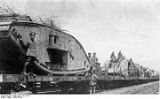
Tanks in World War I

Encyclopedia
_tank.jpg)
Trench warfare
Trench warfare is a form of occupied fighting lines, consisting largely of trenches, in which troops are largely immune to the enemy's small arms fire and are substantially sheltered from artillery...
had brought to the western front
Western Front (World War I)
Following the outbreak of World War I in 1914, the German Army opened the Western Front by first invading Luxembourg and Belgium, then gaining military control of important industrial regions in France. The tide of the advance was dramatically turned with the Battle of the Marne...
. The first prototype of the Mark I tank
Mark I tank
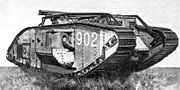
The British Mark I was a tracked vehicle developed by the British Army during the First World War and the world's first combat tank. The Mark I entered service in August 1916, and was first used in action on the morning of 15 September 1916 during the Battle of Flers-Courcelette, of the Somme...
was tested for the British Army
British Army
The British Army is the land warfare branch of Her Majesty's Armed Forces in the United Kingdom. It came into being with the unification of the Kingdom of England and Scotland into the Kingdom of Great Britain in 1707. The new British Army incorporated Regiments that had already existed in England...
on September 8th 1915. Although initially termed "land ships" by the British Army, initial vehicles were referred to as "water-carriers" (then shortened to "tanks") to preserve secrecy.
While the British took the lead in tank
Tank
A tank is a tracked, armoured fighting vehicle designed for front-line combat which combines operational mobility, tactical offensive, and defensive capabilities...
development, the French
France
The French Republic , The French Republic , The French Republic , (commonly known as France , is a unitary semi-presidential republic in Western Europe with several overseas territories and islands located on other continents and in the Indian, Pacific, and Atlantic oceans. Metropolitan France...
were not far behind and fielded their first tanks in 1917. The Germans
German Empire
The German Empire refers to Germany during the "Second Reich" period from the unification of Germany and proclamation of Wilhelm I as German Emperor on 18 January 1871, to 1918, when it became a federal republic after defeat in World War I and the abdication of the Emperor, Wilhelm II.The German...
, on the other hand, were slower to develop tanks, concentrating on anti-tank
Anti-tank warfare
Anti-tank warfare was created by the need to seek technology and tactics to destroy tanks and their supporting infantry during the First World War...
weapons.
Initial results were mixed with reliability. There were problems that caused considerable attrition rates during combat
Armoured warfare
Armoured warfare or tank warfare is the use of armoured fighting vehicles in modern warfare. It is a major component of modern methods of war....
deployment and transit. The heavily bombed-out terrain was impassable to conventional vehicles, and only highly mobile tanks such as the Mark and FTs performed reasonably well. The Mark I's rhomboid
Rhomboid
Traditionally, in two-dimensional geometry, a rhomboid is a parallelogram in which adjacent sides are of unequal lengths and angles are oblique.A parallelogram with sides of equal length is a rhombus but not a rhomboid....
shape meant it could navigate larger obstacles, especially long trenches, better than many armoured fighting vehicle
Armoured fighting vehicle
An armoured fighting vehicle is a combat vehicle, protected by strong armour and armed with weapons. AFVs can be wheeled or tracked....
s.
Along with the tank, the first self-propelled gun
Self-propelled gun
A self-propelled gun is form of self-propelled artillery, and in modern use is usually used to refer to artillery pieces such as howitzers....
and the first armoured personnel carrier
Armoured personnel carrier
An armoured personnel carrier is an armoured fighting vehicle designed to transport infantry to the battlefield.APCs are usually armed with only a machine gun although variants carry recoilless rifles, anti-tank guided missiles , or mortars...
were also introduced in World War I (the Mark V* tank was built with space inside for a small squad of infantry
Infantry
Infantrymen are soldiers who are specifically trained for the role of fighting on foot to engage the enemy face to face and have historically borne the brunt of the casualties of combat in wars. As the oldest branch of combat arms, they are the backbone of armies...
).
Conceptual roots of the tank
Leonardo da Vinci
Leonardo di ser Piero da Vinci was an Italian Renaissance polymath: painter, sculptor, architect, musician, scientist, mathematician, engineer, inventor, anatomist, geologist, cartographer, botanist and writer whose genius, perhaps more than that of any other figure, epitomized the Renaissance...
marked the first attempt at workable concept but was never brought beyond paper drawings. Whether it influenced anything later is unknown. With the coming of the Industrial Revolution
Industrial Revolution
The Industrial Revolution was a period from the 18th to the 19th century where major changes in agriculture, manufacturing, mining, transportation, and technology had a profound effect on the social, economic and cultural conditions of the times...
and the demonstrable power of steam, it was not too long before James Cowan presented his proposal for a Steam Powered Land Ram in 1855, towards the end of the Crimean War
Crimean War
The Crimean War was a conflict fought between the Russian Empire and an alliance of the French Empire, the British Empire, the Ottoman Empire, and the Kingdom of Sardinia. The war was part of a long-running contest between the major European powers for influence over territories of the declining...
. Looking like a helmet on 'footed' Boydell wheels, early forerunners of the Pedrail wheel
Pedrail wheel
The pedrail wheel is a type of wheel developed in the early 20th century for all-terrain locomotion. It was used in agricultural machinery and was considered as a possible technique for the development of the tank in World War I, but was ultimately replaced by the more robust continuous track...
and caterpillar track
Caterpillar track
Continuous tracks or caterpillar tracks are a system of vehicle propulsion in which modular metal plates linked into a continuous band are driven by two or more wheels...
, it was essentially an armoured steam tractor equipped with cannon
Cannon
A cannon is any piece of artillery that uses gunpowder or other usually explosive-based propellents to launch a projectile. Cannon vary in caliber, range, mobility, rate of fire, angle of fire, and firepower; different forms of cannon combine and balance these attributes in varying degrees,...
and (shades of Boudica
Boudica
Boudica , also known as Boadicea and known in Welsh as "Buddug" was queen of the British Iceni tribe who led an uprising against the occupying forces of the Roman Empire....
) rotating scythe
Scythe
A scythe is an agricultural hand tool for mowing grass, or reaping crops. It was largely replaced by horse-drawn and then tractor machinery, but is still used in some areas of Europe and Asia. The Grim Reaper is often depicted carrying or wielding a scythe...
s sprouting from the sides. Lord Palmerston
Henry Temple, 3rd Viscount Palmerston
Henry John Temple, 3rd Viscount Palmerston, KG, GCB, PC , known popularly as Lord Palmerston, was a British statesman who served twice as Prime Minister in the mid-19th century...
is said to have dismissed it as 'barbaric', but in truth looks, it was mechanically impractical.
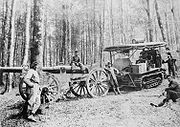
Grantham
Grantham is a market town within the South Kesteven district of Lincolnshire, England. It bestrides the East Coast Main Line railway , the historic A1 main north-south road, and the River Witham. Grantham is located approximately south of the city of Lincoln, and approximately east of Nottingham...
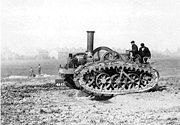
, built a series of tractor
Tractor
A tractor is a vehicle specifically designed to deliver a high tractive effort at slow speeds, for the purposes of hauling a trailer or machinery used in agriculture or construction...
s using his patented 'chain-track' which were put through their paces by the British Army
British Army
The British Army is the land warfare branch of Her Majesty's Armed Forces in the United Kingdom. It came into being with the unification of the Kingdom of England and Scotland into the Kingdom of Great Britain in 1707. The new British Army incorporated Regiments that had already existed in England...
, a (small) section of which wanted to evaluate artillery tractor
Artillery tractor
Artillery tractor is a kind of tractor, also referred to as a gun tractor, a vehicle used to tow artillery pieces of varying weights.-Traction:...
s. At one point, in 1908, a perceptive officer remarked to Roberts that he should design a new machine with armour, capable of carrying its own gun. But, disheartened by years of ultimately fruitless tinkering for the Army, Roberts failed to take up the idea.
An Engineer in the Austro-Hungarian Army, Leutnant Gunther Burstyn
Günther Burstyn
Gunther Burstyn was an inventor, technician, and officer of the Austro-Hungarian Army....
, inspired by Holt tractors, designed a tracked armoured vehicle in 1911 carrying a light gun in a rotating turret; equipped also with hinged 'arms', two in front and two at the rear, carrying wheels on the ends to assist with obstacles and trenches, it was a very forward-looking design, if rather small. The Austrian government
Austria-Hungary
Austria-Hungary , more formally known as the Kingdoms and Lands Represented in the Imperial Council and the Lands of the Holy Hungarian Crown of Saint Stephen, was a constitutional monarchic union between the crowns of the Austrian Empire and the Kingdom of Hungary in...
said it would be interested in evaluating it if Burstyn could secure commercial backing to produce a prototype. Lacking the requisite contacts, he let it drop. An approach to the German government was similarly fruitless.
In 1912, A South Australia
South Australia
South Australia is a state of Australia in the southern central part of the country. It covers some of the most arid parts of the continent; with a total land area of , it is the fourth largest of Australia's six states and two territories.South Australia shares borders with all of the mainland...
n, Lancelot De Mole
Lancelot De Mole
Lancelot Eldin De Mole CBE, was an Australian engineer and inventor. He suggested the idea of what would become the tank to the British authorities before the First World War but his idea was not taken up at the time and the tank was brought to fruition later by others.-Life:De Mole was born in...
, submitted a proposal to the British War Office
War Office
The War Office was a department of the British Government, responsible for the administration of the British Army between the 17th century and 1964, when its functions were transferred to the Ministry of Defence...
for a "chain-rail vehicle which could be easily steered and carry heavy loads over rough ground and trenches". De Mole made several more proposals to the War Office after 1912, in 1914 and 1916, with a culminating proposal in late 1917, accompanied by a huge one-eighth scale model, yet all fell on substantially deaf ears. De Mole's proposal already had the climbing face, so typical of the later World War I British tanks, but it is unknown whether there was some connection. Inquiries from the government of Australia
Australia
Australia , officially the Commonwealth of Australia, is a country in the Southern Hemisphere comprising the mainland of the Australian continent, the island of Tasmania, and numerous smaller islands in the Indian and Pacific Oceans. It is the world's sixth-largest country by total area...
, after the war, yielded polite responses that Mr. De Mole's ideas had unfortunately been too advanced for the time to be properly recognised at their just value. The Commission on Awards to Inventors in 1919, which adjudicated all the competing claims to the development of the tank, recognised the brilliance of De Mole's design, even considering that it was superior to the machines actually developed, but due to its narrow remit, could only make a payment of £987 to De Mole to cover his expenses. As an aside, De Mole noted in 1919 that he was urged by friends before the war to approach the Germans with his design, but declined to do so for patriotic reasons.
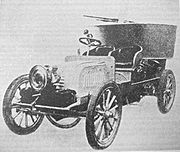
World War I
World War I , which was predominantly called the World War or the Great War from its occurrence until 1939, and the First World War or World War I thereafter, was a major war centred in Europe that began on 28 July 1914 and lasted until 11 November 1918...
, motorized vehicles were still relatively uncommon, and their use on the battlefield was initially limited, especially of heavier vehicles. Armoured cars soon became more commonplace with most belligerents, especially in more open terrain. In fact, on August 23, 1914, the French Colonel Estienne
Jean-Baptiste Eugène Estienne
Jean Baptiste Eugène EstienneEstienne's forenames are frequently incorrectly given as Jean-Baptiste Eugène. He was christened with the three names Jean, Baptiste, and Eugène, but disliked the name Baptiste, and preferred to be addressed as Eugène. He usually signed himself J.E. Estienne. See...
, later a major proponent of tanks, declared: Messieurs, la victoire appartiendra dans cette guerre à celui des deux belligérants qui parviendra le premier à placer un canon de 75 sur une voiture capable de se mouvoir en tout terrain ("Gentlemen, the victory will belong, in this war, to the one of the two belligerents who will be the first to succeed in mounting a 75 mm gun on a vehicle capable of moving in all types of terrain").
Armored cars did indeed prove useful in open land such as in deserts, but were not very good at crossing obstacles (e.g. trenches, barriers) or in more challenging terrain. The other issue was that it was very hard to add much protection or armament.
The main limitation was the wheels, which gave a high ground pressure
Ground pressure
Ground pressure is the pressure exerted on the ground by the tires or tracks of a motorized vehicle, and is one measure of its potential mobility, especially over soft ground. Ground pressure is measured in pascals which corresponds to the EES unit of pounds per square inch...
for the vehicle's weight. This could be solved by adding more wheels, but unless they also were driven, the effect was to reduce traction on the powered wheels. Driving extra wheels meant more drive train weight, in turn requiring a larger and heavier engine to maintain performance. Even worse, none of this extra weight was put into an improvement of armor or armament carried, and the vehicles were still incapable of crossing very rough terrain.
The adoption of caterpillar track
Caterpillar track
Continuous tracks or caterpillar tracks are a system of vehicle propulsion in which modular metal plates linked into a continuous band are driven by two or more wheels...
s offered a new solution to the problem. The tracks spread the weight of the vehicles over a much greater area, which was all used for traction to move the vehicle. The limitation on armor and firepower was no longer ground pressure but the power and weight of the power-plant.
The remaining issue was how to utilise and configure a vehicle, which would be figured out first by the Landship Committee and Inventions Committee. A variety of other concepts would be combined, such as special steel for armor, a climbing face for the tracks, and weapons mounted in rotating turrets.
But before this could happen some individual would have to set the entire process into motion. This person was to be Major Ernest Dunlop Swinton
Ernest Dunlop Swinton
Major General Sir Ernest Dunlop Swinton, KBE, CB, DSO, RE was a military writer and British Army officer. Swinton is credited with influencing the development and adoption of the tank by the British during the First World War. He is also known for popularising the term "no-mans land".-Early life...
RE
Royal Engineers
The Corps of Royal Engineers, usually just called the Royal Engineers , and commonly known as the Sappers, is one of the corps of the British Army....
, British official war correspondent serving in France in 1914. Swinton recounts in his book Eyewitness how he first got the sudden idea to build a tank on October 19, 1914, while driving a car in northern France. It is known however that he in July 1914 received a letter from a friend, the South-African engineer Hugh Merriot, asking his attention for the fact that armoured tractors might be very useful in warfare. November 1914 Swinton suggested the idea of an armoured tracked vehicle to the military authorities, by sending a proposal to Lieutenant-Colonel Maurice Hankey. Hankey in turn tried to interest Lord Kitchener
Herbert Kitchener, 1st Earl Kitchener
Field Marshal Horatio Herbert Kitchener, 1st Earl Kitchener KG, KP, GCB, OM, GCSI, GCMG, GCIE, ADC, PC , was an Irish-born British Field Marshal and proconsul who won fame for his imperial campaigns and later played a central role in the early part of the First World War, although he died halfway...
in the idea; when this failed he sent in December a memorandum to the Committee of Imperial Defence
Committee of Imperial Defence
The Committee of Imperial Defence was an important ad hoc part of the government of the United Kingdom and the British Empire from just after the Second Boer War until the start of World War II...
, of which he was himself the secretary; First Lord of the Admiralty Winston Churchill
Winston Churchill
Sir Winston Leonard Spencer-Churchill, was a predominantly Conservative British politician and statesman known for his leadership of the United Kingdom during the Second World War. He is widely regarded as one of the greatest wartime leaders of the century and served as Prime Minister twice...
was one of the members. Hankey proposed to build a gigantic steel roller, pushed by tracked tractors, to shield the advancing infantry. Churchill in turn on January 5 wrote a note to Prime Minister Herbert Asquith, in which he warned that the Germans might any moment introduce a comparable system. A worried Asquith now ordered Kitchener to form the Inventions Committee headed by General Scott-Moncrieff to study the development of armoured vehicles; this committee concluded however in February 1915 that such vehicles were wholly impractical and advised not to develop any.
The Landships Committee
Winston Churchill however decided that if the Army wouldn't take up the idea, the NavyRoyal Navy
The Royal Navy is the naval warfare service branch of the British Armed Forces. Founded in the 16th century, it is the oldest service branch and is known as the Senior Service...
should proceed independently, even if it were to exceed the limits of his authority. He created a Landships Committee
Landships Committee
The Landships Committee was a small British war cabinet committee established in February 1915 to deal with the design and construction of what would turn out to be tanks during the First World War...
in February 1915, initially to investigate designs for a massive troop transporter. As a truer picture of front-line conditions was developed the aims of the investigation changed. Together with the older Inventions Committee a requirement was formulated for an armoured vehicle capable of 4 mph (6 km/h), climbing a 5 feet (1.5 m) high parapet, crossing an 8 feet (2.4 m) wide gap, and armed with machine guns and a light artillery
Artillery
Originally applied to any group of infantry primarily armed with projectile weapons, artillery has over time become limited in meaning to refer only to those engines of war that operate by projection of munitions far beyond the range of effect of personal weapons...
piece. A similar proposal was working its way through the Army GHQ in France and in June the Landship Committee was made a joint service venture between the War Office and the Admiralty. The Naval involvement in AFV design had originally come about through the Royal Naval Air Service
Royal Naval Air Service
The Royal Naval Air Service or RNAS was the air arm of the Royal Navy until near the end of the First World War, when it merged with the British Army's Royal Flying Corps to form a new service , the Royal Air Force...
Armoured Car Division, the only British unit fielding AFVs in 1914; surprisingly until the end of the war most experimentation on heavy land vehicles would be done by Naval air service unit N°20.
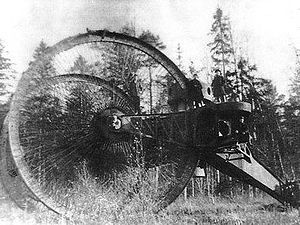
Russian Empire
The Russian Empire was a state that existed from 1721 until the Russian Revolution of 1917. It was the successor to the Tsardom of Russia and the predecessor of the Soviet Union...
Czar tank of 1915 were soon understood to be impractical. However, adapting the existing Holt Company caterpillar designs — the only robust tracked tractors available in 1915 — into a fighting machine, as France, Germany and the United States
United States
The United States of America is a federal constitutional republic comprising fifty states and a federal district...
did, was decided against as Holt indicated to be unable to deliver a sufficient number for extended mass production. While armour and weapon systems were easy to acquire, other existing caterpillar and suspension units were too weak and existing engines were notably underpowered for the armoured behemoths that the designers had in mind. The Killen-Strait tractor with three tracks was used for the first experiments in June but was much too small to be developed further. The large British Pedrail monotrack vehicle proved to be unsuitable. Trials to couple two small American Bullock tractors failed. There also were considerable differences of opinion between the several committee members. Col R.E.B. Crompton, a veteran military engineer and electrical pioneer, drafted numerous designs with Lucien Legros for armoured troop carrying vehicles and gun-armed vehicles, to have used either Bullock tracks or variants of the Pedrail. At the same time, Lt Robert Macfie, of the RNAS, and Albert Nesfield, an Ealing
Ealing
Ealing is a suburban area of west London, England and the administrative centre of the London Borough of Ealing. It is located west of Charing Cross and around from the City of London. It is one of the major metropolitan centres identified in the London Plan. It was historically a rural village...
-based engineer, devised a number of armoured tracked vehicles, which incorporated an angled front 'climbing face' to the tracks. The two men were to fall out bitterly as their plans came to nought, Macfie in particular pursuing a vendetta against the other members of the Landships Committee after the war.
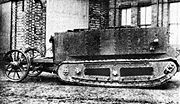
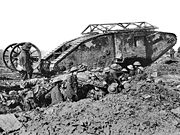
William Foster & Co.
William Foster & Co Ltd was an agricultural machinery company based in Lincoln, Lincolnshire, England and usually just called "Fosters of Lincoln." The company can be traced back to 1846, when William Foster purchased a flour mill in Lincoln. William Foster then proceeded to start small scale...
built the 14 ton "Little Willie
Little Willie
Little Willie was a prototype in the development of the British Mark I tank. Constructed in the summer of 1915 through a close cooperation of the military and industry of the United Kingdom, it was the first completed tank prototype in history...
", which first ran on 8 September. Powered by a 105 hp (78 kW) Daimler engine, the 10 feet (3 m) armoured box was initially fitted with a low Bullock caterpillar. A rotating top turret
Gun turret
A gun turret is a weapon mount that protects the crew or mechanism of a projectile-firing weapon and at the same time lets the weapon be aimed and fired in many directions.The turret is also a rotating weapon platform...
was planned with a 40 mm gun but abandoned due to weight problems, leaving the final vehicle unarmed and little more than a test-bed for the difficult track system. Difficulties with the commercial tracks supplied led to Tritton designing a completely new track system different from, and vastly more robust than, any other system then in use. The next design by Lieutenant Walter Gordon Wilson
Walter Gordon Wilson
Major Walter Gordon Wilson was an engineer and member of the British Royal Naval Air Service. He was credited by the 1919 Royal Commission on Awards to Inventors as the co-inventor of the tank, along with Sir William Tritton....
RNAS, a pre-war motor engineer, added a larger track frame to the hull of "Little Willie". In order to achieve the demanded gap clearance a rhomboidal shape was chosen—stretching the form to improve the track footprint and climbing capacity. To keep a low centre of gravity the rotating turret design was dropped in favour of sponson
Sponson
Sponsons are projections from the sides of a watercraft, for protection, stability, or the mounting of equipment such as armaments or lifeboats, etc...
s on the sides of the hull fitted with naval 6-pounder (57 mm) guns. A final specification was agreed on in late September for trials in early 1916, and the resulting 30 ton "Big Willie" (later called "Mother") together with "Little Willie" underwent trials at Hatfield Park on 29 January and 2 February. Attendees at the second trial included Lord Kitchener
Herbert Kitchener, 1st Earl Kitchener
Field Marshal Horatio Herbert Kitchener, 1st Earl Kitchener KG, KP, GCB, OM, GCSI, GCMG, GCIE, ADC, PC , was an Irish-born British Field Marshal and proconsul who won fame for his imperial campaigns and later played a central role in the early part of the First World War, although he died halfway...
, Lloyd George
David Lloyd George
David Lloyd George, 1st Earl Lloyd-George of Dwyfor OM, PC was a British Liberal politician and statesman...
, Reginald McKenna
Reginald McKenna
Reginald McKenna was a British banker and Liberal politician. He notably served as Home Secretary and Chancellor of the Exchequer during the premiership of H. H. Asquith.-Background and education:...
and other political luminaries. On 12 February an initial order for 100 "Mother" type vehicles was made, later expanded to 150.
Although landship was a natural term coming from an Admiralty committee, it was considered too descriptive and could give away British intentions. The committee therefore looked for an appropriate code term for the vehicles. Factory workers assembling the vehicles had been told they were producing "mobile water tanks" for desert warfare in Mesopotamia
Mesopotamia
Mesopotamia is a toponym for the area of the Tigris–Euphrates river system, largely corresponding to modern-day Iraq, northeastern Syria, southeastern Turkey and southwestern Iran.Widely considered to be the cradle of civilization, Bronze Age Mesopotamia included Sumer and the...
. Water Container was therefore considered but rejected because the committee would inevitably be known as the WC Committee (WC meaning water closet was a common British term for a toilet
Flush toilet
A flush toilet is a toilet that disposes of human waste by using water to flush it through a drainpipe to another location. Flushing mechanisms are found more often on western toilets , but many squat toilets also are made for automated flushing...
). The term tank, as in water tank, was in December 1915 finally accepted as its official designation. From then on, the term "tank" was established among British and also German soldiers, but rejected by the French. While in German Tank specifically refers to the World War I type (as opposed to modern Panzer), in English, Russian and other languages the name even for contemporary armoured vehicles is still based on the word tank.
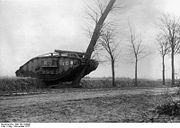
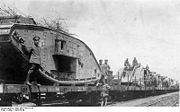
The first fifty had been delivered to France on 30 August. They were 'male' or 'female', depending upon whether their armament was the 57 mm gun or only multiple smaller Hotchkiss
Hotchkiss M1909 Benet-Mercie machine gun
The Hotchkiss M1909 machine gun was a French designed light machine gun of the early 20th century, developed and built by Hotchkiss et Cie. It was also known as the Hotchkiss Mark I and M1909 Benet-Mercie....
or Vickers machine gun
Vickers machine gun
Not to be confused with the Vickers light machine gunThe Vickers machine gun or Vickers gun is a name primarily used to refer to the water-cooled .303 inch machine gun produced by Vickers Limited, originally for the British Army...
s. The crew was eight, four of whom were needed to handle the steering and drive gears. The tanks were capable of 6 km/h (4 mph), matching the speed of marching infantry
Infantry
Infantrymen are soldiers who are specifically trained for the role of fighting on foot to engage the enemy face to face and have historically borne the brunt of the casualties of combat in wars. As the oldest branch of combat arms, they are the backbone of armies...
with whom they were to be integrated to aid in the destruction of enemy machine guns.
After the war, The Royal Commission on Awards to Inventors decided that the inventors of the Tank were Sir William Tritton, managing director of Fosters and Major Walter Gordon Wilson.
Trial by fire
_tank.jpg)
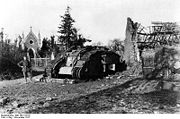
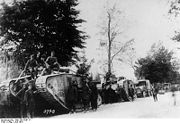
The first use of tanks on the battlefield was the use of 49 British Mk.I tanks at the Battle of the Somme (1916)
Battle of the Somme (1916)
The Battle of the Somme , also known as the Somme Offensive, took place during the First World War between 1 July and 14 November 1916 in the Somme department of France, on both banks of the river of the same name...
on 15 September 1916, with mixed, but still impressive results as many broke down but nearly a third succeeded in breaking through. Of the forty-nine tanks shipped to the Somme, only thirty-two were able to begin the first attack in which they were used, and nine made it across "no man's land" to the German lines. The tanks had been rushed into combat before the design was mature enough (against Churchill's wishes ), and the number was small, but their use gave important feedback on how to design newer tanks, the soundness of the concept, and their potential to affect the course of the war. On the other hand, the French Army was critical of the British employment of small numbers of tanks at this battle. They felt the British had sacrificed the secrecy of the weapon while employing it in numbers too small to be decisive. One of the 2 tanks that broke the German lines on September 15 had fired on the 9th Norfolks, thinking them Germans.
The Mark I's were capable of performing on the real battlefield of World War I, one of the most difficult battlefield terrains ever. They did have reliability problems, but when they were working they could cross trenches or craters of 9 feet (2.7 m) and drive right through barbed wire. It was still common for them to get stuck, especially in larger bomb craters, but overall the rhomboid shape allowed for extreme terrain mobility.
.jpg)
Carbon monoxide
Carbon monoxide , also called carbonous oxide, is a colorless, odorless, and tasteless gas that is slightly lighter than air. It is highly toxic to humans and animals in higher quantities, although it is also produced in normal animal metabolism in low quantities, and is thought to have some normal...
, fuel and oil vapours from the engine and cordite
Cordite
Cordite is a family of smokeless propellants developed and produced in the United Kingdom from 1889 to replace gunpowder as a military propellant. Like gunpowder, cordite is classified as a low explosive because of its slow burning rates and consequently low brisance...
fumes from the weapons as ventilation was inadequate. Temperatures inside could reach 50°C
Celsius
Celsius is a scale and unit of measurement for temperature. It is named after the Swedish astronomer Anders Celsius , who developed a similar temperature scale two years before his death...
(122°F
Fahrenheit
Fahrenheit is the temperature scale proposed in 1724 by, and named after, the German physicist Daniel Gabriel Fahrenheit . Within this scale, the freezing of water into ice is defined at 32 degrees, while the boiling point of water is defined to be 212 degrees...
). Entire crews lost consciousness or became violently sick when again exposed to fresh air.
To counter the fumes inside and the danger of bullet splash or fragments and rivet
Rivet
A rivet is a permanent mechanical fastener. Before being installed a rivet consists of a smooth cylindrical shaft with a head on one end. The end opposite the head is called the buck-tail. On installation the rivet is placed in a punched or pre-drilled hole, and the tail is upset, or bucked A rivet...
s knocked off the inside of the hull, the crew wore helmets with goggles and chainmail masks. Gas masks were also standard issue, as they were to all soldiers at this point in the war (see chemical warfare
Chemical warfare
Chemical warfare involves using the toxic properties of chemical substances as weapons. This type of warfare is distinct from Nuclear warfare and Biological warfare, which together make up NBC, the military acronym for Nuclear, Biological, and Chemical...
). The side armour of 8 mm initially made them largely immune to small arms fire, but could be penetrated by the recently developed armour-piercing K bullet
K bullet
Also: Patrone SmK 8x57mm ISThe K bullet is a 8x57mm IS armor-piercing bullet which has a tool steel core and which was designed to be fired from a standard Mauser rifle. It was used by the German infantry against the first British tanks in World War I...
s. There was also the danger of being overrun by infantry and attacked with grenades. The next generation had thicker armour, making them nearly immune to the K bullets. In response, the Germans developed a larger purpose-made anti-tank rifle, and also a Geballte Ladung ("Bunched Charge")—several regular stick grenades bundled together for a much bigger explosion.
Engine power was a primary limitation on the tanks; the roughly one hundred horsepower engines gave a power-to-weight ratio of 3.3 hp/ton (2.5 kW/ton). By the end of the 20th century, power-to-weight ratios exceeded 20 hp/ton (15 kW/ton).
Many feel that because the British Commander Field Marshal
Field Marshal
Field Marshal is a military rank. Traditionally, it is the highest military rank in an army.-Etymology:The origin of the rank of field marshal dates to the early Middle Ages, originally meaning the keeper of the king's horses , from the time of the early Frankish kings.-Usage and hierarchical...
Douglas Haig
Douglas Haig, 1st Earl Haig
Field Marshal Douglas Haig, 1st Earl Haig, KT, GCB, OM, GCVO, KCIE, ADC, was a British senior officer during World War I. He commanded the British Expeditionary Force from 1915 to the end of the War...
was himself a horse cavalryman, his command failed to appreciate the value of tanks. In fact, horse cavalry
Cavalry
Cavalry or horsemen were soldiers or warriors who fought mounted on horseback. Cavalry were historically the third oldest and the most mobile of the combat arms...
doctrine in World War I was to "follow up a breakthrough with harassing attacks in the rear", but there were no breakthroughs on the Western Front until the tanks came along. Despite these supposed views of Haig, he made an order for 1,000 tanks shortly after the failure at the Somme and always remained firmly in favour of further production.
In 1919, Major General Sir Louis Jackson said: "The tank was a freak. The circumstances which called it into existence were exceptional and not likely to recur. If they do, they can be dealt with by other means."
French developments
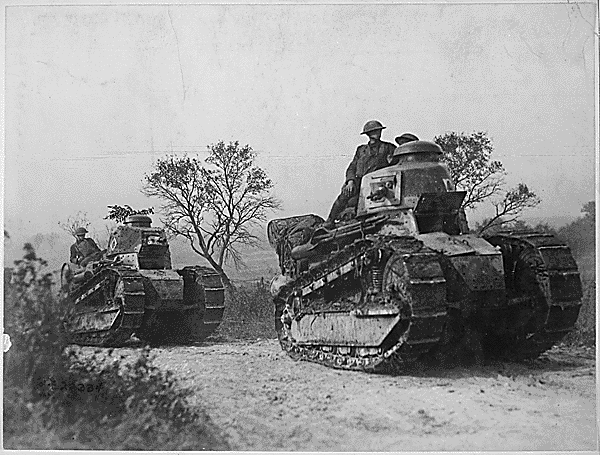
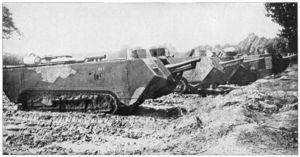
Schneider CA1
The Schneider CA1 was the first French tank. It was inspired by the need to overcome the stalemate of the trench warfare of the Great War.-Caterpillar development:...
equipped with a short 75 mm howitzer, had poor mobility due to a short track length combined with a hull that overhung front and rear. It was unreliable as well; a maximum of only about 130 of the 400 built were ever operational at the same time. Then industrial rivalry began to play a detrimental role: it created the heavy Char St Chamond
St Chamond (tank)
The Saint-Chamond was the second French heavy tank of the First World War.Overall an inadequate design born of commercial rivalry, the war ended before it was replaced by British heavy tanks.-Development:...
, a parallel development not ordered by the Army but approved by government through industrial lobby, which mounted much more impressive weaponry — its 75 mm was the most powerful gun fielded by any operational tank up till 1941 — but also combined many of the Schneider CA's faults with an even larger overhanging body. Its innovative petro-electrical transmission, while allowing for easy steering, was insufficiently developed and led to a large number of breakdowns.
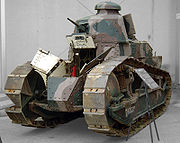
Renault
Renault S.A. is a French automaker producing cars, vans, and in the past, autorail vehicles, trucks, tractors, vans and also buses/coaches. Its alliance with Nissan makes it the world's third largest automaker...
's excellent small tank design, the FT, incorporating a proper climbing face for the tracks, that was the first tank to incorporate a top-mounted turret with a full rotation. In fact the FT was in many respects the first truly 'modern' tank having a layout that has been followed by almost all designs ever since: driver at the front; main armament in a fully rotating turret on top; engine at the rear. Previous models had been "box tanks", with a single crowded space combining the role of engine room, fighting compartment, ammunition stock and driver's cabin. (A very similar Peugeot prototype, with a fixed casemate mounting a short 75mm cannon, was trialled in 1918 but the idea was not pursued) The FT would have the largest production run of any tank of the war, with over 3700 built, more numerous than all British tanks combined. That this would happen was at first far from certain; some in the French army lobbied for the alternative mass production of super-heavy tanks. Much design effort was put in this line of development resulting in the gigantic Char 2C
Char 2C
The Char 2C was a French super-heavy tank developed, although never deployed, during World War I. It was the largest operational tank ever.-Development:...
, the most complex and technologically advanced tank of its day. Its very complexity ensured it being produced too late to participate in World War I and in the very small number of just ten, but it would be the first tank with a three-man turret; the heaviest to enter service until late in World War II and still the largest ever operational.
French production at first lagged behind the British. After August 1916 however, British tank manufacture was temporarily halted to wait for better designs, allowing the French to overtake their allies in numbers. When the French used tanks for the first time on 16 April 1917, during the Nivelle Offensive
Nivelle offensive
The Nivelle Offensive was a 1917 French attack on the Western Front in the First World War. Promised as the assault that would end the war within 48 hours, with casualties expected of around 10,000 men, it failed on both counts. It was a three-stage plan:...
, they had four times more tanks available. But that would not last long as the offensive was a major failure; the Schneiders were badly deployed and suffered 50% losses from German long-range artillery. The Saint-Chamond tanks, first deployed on 5 May, proved to be so badly designed that they were unable to cross the first line of German trenches.
Battle of Cambrai
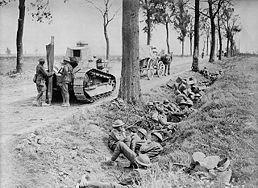
J.F.C. Fuller
Major-General John Frederick Charles Fuller, CB, CBE, DSO was a British Army officer, military historian and strategist, notable as an early theorist of modern armoured warfare, including categorising principles of warfare...
, chief of staff of the Tank Corps
Royal Tank Regiment
The Royal Tank Regiment is an armoured regiment of the British Army. It was formerly known as the Tank Corps and the Royal Tank Corps. It is part of the Royal Armoured Corps and is made up of two operational regiments, the 1st Royal Tank Regiment and the 2nd Royal Tank Regiment...
, was responsible for the tanks' role in the battle. They made an unprecedented breakthrough but, as ever on the Western front, the opportunity was not exploited. Ironically, it was the soon-to-be-supplanted horse cavalry that had been assigned the task of following up the motorised tank attack.
Tanks became more effective as the lesson of the early tanks was absorbed. The British produced the Mark IV in 1917. Similar to the early Marks in appearance, its construction was considered to produce a more reliable machine, the long-barrelled naval guns were shortened (the barrels of the earlier, longer, guns, being prone to digging in the mud when negotiating obstacles) and armour was increased just enough to defeat the standard German armour-piercing bullet.
The continued need for five men to drive the tank was solved with the Mark V which used Wilson's epicyclic gearing in 1918. Also in 1918 the French produced the Renault
Renault
Renault S.A. is a French automaker producing cars, vans, and in the past, autorail vehicles, trucks, tractors, vans and also buses/coaches. Its alliance with Nissan makes it the world's third largest automaker...
FT, the result of a co-operation between Estienne and Louis Renault. As mentioned before, it had the innovative turret position, and was operated by two men. At just 8 tons it was half the weight of the Medium A Whippet but the version with the cannon had more firepower. It was conceived for mass production, and the FT would become the most produced tank of World War I by a wide margin, with over 3,000 delivered to the French Army. Large numbers were used by the Americans and several were also loaned to the British.
In July 1918, the French used 480 tanks (mostly FTs) in 1918 at the Battle of Soissons
Battle of Soissons (1918)
The Battle of Soissons was a World War I battle, waged during 18 July to 22 July 1918, between the French and the German armies....
, and there were even larger assaults planned for 1919. The Entente
Triple Entente
The Triple Entente was the name given to the alliance among Britain, France and Russia after the signing of the Anglo-Russian Entente in 1907....
had hoped to commit over 30,000 tanks to battle in that year.
Villers-Bretonneux: tank against tank
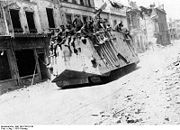
A7V
The A7V was a tank introduced by Germany in 1918, near the end of World War I. One hundred vehicles were ordered during the spring of 1918, but only 21 were delivered. It was nicknamed "The Moving Fortress" by the British because of the shape of the hull...
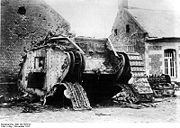
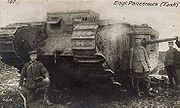
, although only fifteen A7Vs were built. The majority of the roughly hundred or so tanks fielded by Germany were captured British and French vehicles. A7Vs were captured by the Allies, but they were not used, and most ended up being scrapped.
The first tank-versus-tank battles took place 24 April 1918. It was an unexpected engagement between three German 7Vs and three British Mk. IVs at Villers-Bretonneux.
Fuller
J.F.C. Fuller
Major-General John Frederick Charles Fuller, CB, CBE, DSO was a British Army officer, military historian and strategist, notable as an early theorist of modern armoured warfare, including categorising principles of warfare...
's Plan 1919
Plan 1919
Plan 1919 was a military strategy drawn up by J.F.C. Fuller in 1918 during World War I. His plan criticised the practice of physically destroying the enemy, and instead suggested a lightning thrust toward the command center of the German army...
involving massive use of tanks for an offensive, was never used because the blockade
Blockade
A blockade is an effort to cut off food, supplies, war material or communications from a particular area by force, either in part or totally. A blockade should not be confused with an embargo or sanctions, which are legal barriers to trade, and is distinct from a siege in that a blockade is usually...
of Germany and the entry of the US brought an end to the war. The plan itself would become the inspiration for German
Nazi Germany
Nazi Germany , also known as the Third Reich , but officially called German Reich from 1933 to 1943 and Greater German Reich from 26 June 1943 onward, is the name commonly used to refer to the state of Germany from 1933 to 1945, when it was a totalitarian dictatorship ruled by...
blitzkrieg
Blitzkrieg
For other uses of the word, see: Blitzkrieg Blitzkrieg is an anglicized word describing all-motorised force concentration of tanks, infantry, artillery, combat engineers and air power, concentrating overwhelming force at high speed to break through enemy lines, and, once the lines are broken,...
tactics in World War II
World War II
World War II, or the Second World War , was a global conflict lasting from 1939 to 1945, involving most of the world's nations—including all of the great powers—eventually forming two opposing military alliances: the Allies and the Axis...
. As a military planner and later journalist, Fuller continued to develop his doctrine of using tanks supported by infantry to break through enemy lines to attack communications in the rear.
Finally, in a preview of later developments, the British developed the Whippet. This tank was specifically designed to exploit breaches in the enemy front. The Whippet was faster than most other tanks, although it carried only machinegun armament. Postwar tank designs would reflect this trend towards greater tactical mobility.
By 1918, the Germans had learned to deal with tanks. At the Battle of Amiens (1918) 72% of the Allied Tank Corps was destroyed in the first 4 days. 41.4% of all British tanks had been destroyed by the 64th day. On November 5th, there were only 8 tanks left in the British tank corps.