

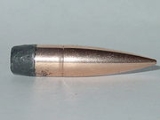
K bullet

Encyclopedia
Also: Patrone SmK 8x57mm IS

.jpg) The K bullet is a 8x57mm IS armor-piercing
The K bullet is a 8x57mm IS armor-piercing
bullet
which has a tool steel
core and which was designed to be fired from a standard Mauser
rifle. It was used by the German infantry against the first British tank
s in World War I
. The K bullet had a probability of approximately one-third to penetrate armor 12-13 mm thick up to a distance of 100 meters.
The K round was in use by the battle of Messines Ridge in June 1917 which was the first use by the British of the Mark IV tank
which had more armour and was resistant.
and World War II
, including:
Armor-piercing shot and shell
An armor-piercing shell is a type of ammunition designed to penetrate armor. From the 1860s to 1950s, a major application of armor-piercing projectiles was to defeat the thick armor carried on many warships. From the 1920s onwards, armor-piercing weapons were required for anti-tank missions...
bullet
Bullet
A bullet is a projectile propelled by a firearm, sling, or air gun. Bullets do not normally contain explosives, but damage the intended target by impact and penetration...
which has a tool steel
Tool steel
Tool steel refers to a variety of carbon and alloy steels that are particularly well-suited to be made into tools. Their suitability comes from their distinctive hardness, resistance to abrasion, their ability to hold a cutting edge, and/or their resistance to deformation at elevated temperatures...
core and which was designed to be fired from a standard Mauser
Mauser
Mauser was a German arms manufacturer of a line of bolt-action rifles and pistols from the 1870s to 1995. Mauser designs were built for the German armed forces...
rifle. It was used by the German infantry against the first British tank
Mark I tank
The British Mark I was a tracked vehicle developed by the British Army during the First World War and the world's first combat tank. The Mark I entered service in August 1916, and was first used in action on the morning of 15 September 1916 during the Battle of Flers-Courcelette, of the Somme...
s in World War I
World War I
World War I , which was predominantly called the World War or the Great War from its occurrence until 1939, and the First World War or World War I thereafter, was a major war centred in Europe that began on 28 July 1914 and lasted until 11 November 1918...
. The K bullet had a probability of approximately one-third to penetrate armor 12-13 mm thick up to a distance of 100 meters.
The K round was in use by the battle of Messines Ridge in June 1917 which was the first use by the British of the Mark IV tank
Mark IV tank
The British Mark IV tank was a British tank of the First World War. Introduced in 1917, it benefitted from significant developments on the first British tank the intervening designs being small batches used for training...
which had more armour and was resistant.
Variants
The Germans made several versions of the K bullet during World War IWorld War I
World War I , which was predominantly called the World War or the Great War from its occurrence until 1939, and the First World War or World War I thereafter, was a major war centred in Europe that began on 28 July 1914 and lasted until 11 November 1918...
and World War II
World War II
World War II, or the Second World War , was a global conflict lasting from 1939 to 1945, involving most of the world's nations—including all of the great powers—eventually forming two opposing military alliances: the Allies and the Axis...
, including:
| Designation | Full Name | Description |
|---|---|---|
| S.m.K.H. | Spitzgeschoss mit Kern, Hart | Replaced the tool steel core with a tungsten carbide Tungsten carbide Tungsten carbide is an inorganic chemical compound containing equal parts of tungsten and carbon atoms. Colloquially, tungsten carbide is often simply called carbide. In its most basic form, it is a fine gray powder, but it can be pressed and formed into shapes for use in industrial machinery,... core. |
| S.m.K. L'spur | Spitzgeschoss mit Kern, Leuchtspur | Has a shorter steel core, and includes a tracer Tracer ammunition Tracer ammunition are bullets that are built with a small pyrotechnic charge in their base. Ignited by the burning powder, the phosphorus tail burns very brightly, making the projectile visible to the naked eye... composition. May include color designation such as (gelb) which means "yellow". |
| S.m.K. Ub.m.Zerl. | Spitzgeschoss mit Kern Übungsmunition mit Zerleger | A very rare practice bullet which self destructs after a certain distance. |