
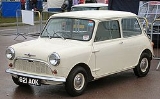
The
Mini is a small car that was made by the
British Motor CorporationThe British Motor Corporation, or commonly known as BMC was a vehicle manufacturer from United Kingdom, formed by the merger of the Austin Motor Company and the Nuffield Organisation in 1952...
(BMC) and its successors from 1959 until 2000. The original is considered a British icon of the 1960s, and its space-saving front-wheel-drive layout (which allowed 80% of the area of the car's
floorpanThe floorpan is a large sheet metal stamping that often incorporates several smaller welded stampings to form the floor of a large vehicle and the position of its external and structural panels....
to be used for passengers and luggage) influenced a generation of car-makers. The vehicle is in some ways considered the British equivalent to its German contemporary, the
Volkswagen BeetleThe Volkswagen Type 1, widely known as the Volkswagen Beetle or Volkswagen Bug, is an economy car produced by the German auto maker Volkswagen from 1938 until 2003...
, which enjoyed similar popularity in North America. In 1999 the Mini was voted the second most influential
car of the 20th centuryThe Car of the Century was an international award given to the world's most influential car of the 20th century. The election process was overseen by the Global Automotive Elections Foundation...
, behind the
Ford Model TThe Ford Model T is an automobile that was produced by Henry Ford's Ford Motor Company from September 1908 to May 1927...
.
This distinctive two-door car was designed for BMC by Sir Alec Issigonis. It was manufactured at the
LongbridgeThe Longbridge plant is an industrial complex situated in the Longbridge area of Birmingham, United Kingdom. It is currently owned by SAIC Group and is a manufacturing and research and development facility for its MG Motor subsidiary....
and Cowley plants in England, the Victoria Park / Zetland
British Motor Corporation (Australia)British Motor Corporation was a motor manufacturing company formed in Australia in 1954 by the merger of the Austin Motor Company and Nuffield Pty Ltd. This followed the merger in 1952 of the Austin Motor Company and the Nuffield Group in the United Kingdom to form the British Motor Corporation...
factory in Sydney, Australia, and later also in Spain (
AuthiThe Authi car company of Pamplona, Spain, was founded in 1965 as a result of a collaboration between BMC and NMQ ....
), Belgium, Chile, Italy (
InnocentiInnocenti was an Italian machinery works originally established by Ferdinando Innocenti in 1920.After World War II, the company was famous for many years for Lambretta scooters models such as LI125, LI150, TV175, TV200, SX125, SX150, SX200, GP125, GP150 and GP200.From 1961 to 1976 Innocenti built...
), Malta, Portugal, South Africa, Uruguay, Venezuela and Yugoslavia. The Mini Mark I had three major UK updates: the Mark II, the Clubman and the Mark III. Within these was a series of variations including an estate car, a
pick-up truck"Pick-Up Truck" is a song written and recorded by Belgian acid house musician Praga Khan. It is the third single from Praga's eighth studio album, Soundscraper....
, a van and the
Mini MokeThe Mini Moke is a vehicle based on the Mini and designed for the British Motor Corporation by Sir Alec Issigonis. The name comes from "Mini"—the car with which the Moke shares many parts—and "Moke", which is an archaic dialect term for donkey...
—a
jeepJeep is an automobile marque of Chrysler . The first Willys Jeeps were produced in 1941 with the first civilian models in 1945, making it the oldest off-road vehicle and sport utility vehicle brand. It inspired a number of other light utility vehicles, such as the Land Rover which is the second...
-like buggy. The Mini Cooper and Cooper "S" were sportier versions that were successful as rally cars, winning the Monte Carlo Rally four times from 1964 through to 1967, although in 1966 the Mini was disqualified after the finish, along with six other British entrants, which included the first four cars to finish, under a questionable ruling that the cars had used an illegal combination of headlamps and spotlights.
Initially Minis were marketed under the
AustinThe Austin Motor Company was a British manufacturer of automobiles. The company was founded in 1905 and merged in 1952 into the British Motor Corporation Ltd. The marque Austin was used until 1987...
and
MorrisThe Morris Motor Company was a British car manufacturing company. After the incorporation of the company into larger corporations, the Morris name remained in use as a marque until 1984 when British Leyland's Austin Rover Group decided to concentrate on the more popular Austin marque...
names, as the Austin Seven and Morris Mini Minor, until Mini became a marque in its own right in 1969. The Mini was again marketed under the Austin name in the 1980s.
Design and development
Designed as project ADO15 (
AustinThe Austin Motor Company was a British manufacturer of automobiles. The company was founded in 1905 and merged in 1952 into the British Motor Corporation Ltd. The marque Austin was used until 1987...
Drawing
Office project number
15), the Mini came about because of a fuel shortage caused by the 1956
Suez CrisisThe Suez Crisis, also referred to as the Tripartite Aggression, Suez War was an offensive war fought by France, the United Kingdom, and Israel against Egypt beginning on 29 October 1956. Less than a day after Israel invaded Egypt, Britain and France issued a joint ultimatum to Egypt and Israel,...
. Petrol was once again rationed in the UK, sales of large cars slumped, the market for German
bubble carBubble car is a subjective term used for some small, economical automobiles, usually produced in the 1950s and 1960s.- Varieties :The Messerschmitt KR175 and KR200, and the FMR Tg500, had aircraft-style bubble canopies, giving rise to the term bubble car to refer to all these post-war microcars...
s boomed.
Leonard LordLeonard Percy Lord, 1st Baron Lambury KBE was a captain of the British motor industry.-Background and education:...
, the somewhat autocratic head of BMC, reportedly detested these cars so much that he vowed to rid the streets of them and design a 'proper miniature car'. He laid down some basic design requirements: the car should be contained within a box that measured 10 × 4 × 4 ft (3 × 1.2 × 1.2 m); and the passenger accommodation should occupy 6 ft (1.8 m) of the 10 ft (3 m) length; and the engine, for reasons of cost, should be an existing unit. Issigonis, who had been working for
AlvisAlvis Car and Engineering Company Ltd was a British manufacturing company that existed in Coventry, England from 19191967. In addition to automobiles designed for the civilian market, the company also produced racing cars, aircraft engines, armoured cars and other armoured fighting vehicles, the...
, had been recruited back to BMC in 1955 and, with his skills in designing small cars, was a natural for the task. The team that designed the Mini was remarkably small: as well as Issigonis, there was Jack Daniels (who had worked with him on the
Morris MinorThe Morris Minor was a British economy car that debuted at the Earls Court Motor Show, London, on 20 September 1948. Designed under the leadership of Alec Issigonis, more than 1.3 million were manufactured between 1948 and 1971...
), Chris Kingham (who had been with him at Alvis), two engineering students and four draughtsmen. Together, by October 1957, they had designed and built the original prototype, which was affectionately named "The Orange Box" because of its colour.
The ADO15 used a conventional
BMC A-SeriesAustin Motor Company's small straight-4 automobile engine, the A-Series, is one of the most common in the world. Launched in 1951 with the Austin A30, production lasted until 2000 in the Mini. It used a cast-iron block and cylinder head, and a steel crankshaft with 3 main bearings...
four-cylinderThe inline-four engine or straight-four engine is an internal combustion engine with all four cylinders mounted in a straight line, or plane along the crankcase. The single bank of cylinders may be oriented in either a vertical or an inclined plane with all the pistons driving a common crankshaft....
water-cooled engine, but departed from tradition by mounting it
transverselyA transverse engine is an engine mounted in a vehicle so that the engine's crankshaft axis is perpendicular to the long axis of the vehicle. Many modern front wheel drive vehicles use this engine mounting configuration...
, with the engine-oil-lubricated, four-speed transmission in the
sumpA sump is a low space that collects any often-undesirable liquids such as water or chemicals. A sump can also be an infiltration basin used to manage surface runoff water and recharge underground aquifers....
, and by employing
front-wheel driveFront-wheel drive is a form of engine/transmission layout used in motor vehicles, where the engine drives the front wheels only. Most modern front-wheel drive vehicles feature a transverse engine, rather than the conventional longitudinal engine arrangement generally found in rear-wheel drive and...
. Almost all small front-wheel-drive cars developed since have used a similar configuration, except with the transmission usually separately enclosed rather than using the engine oil. The radiator was mounted at the left side of the car so that the engine-mounted fan could be retained, but with reversed pitch so that it blew air into the natural low pressure area under the front wing. This location saved precious vehicle length, but had the disadvantage of feeding the radiator with air that had been heated by passing over the engine. It also exposed the entire ignition system to the direct ingress of rainwater through the grille.
The
suspensionSuspension is the term given to the system of springs, shock absorbers and linkages that connects a vehicle to its wheels. Suspension systems serve a dual purpose — contributing to the car's roadholding/handling and braking for good active safety and driving pleasure, and keeping vehicle occupants...
system, designed by Issigonis's friend
Dr. Alex MoultonDr. Alexander Eric Moulton CBE is an English engineer and inventor, specialising in suspension design.Moulton is the great-grandson of the rubber pioneer Stephen Moulton, the founder of the family business George Spencer Moulton & Co...
at
Moulton Developments LimitedMoulton Developments Limited is a British company formed by Alex Moulton in the late 1950s to work on the design and development of the suspension system for Alec Issigonis's BMC Mini project, and other projects....
, used compact rubber cones instead of conventional springs. This ingenious space-saving design also featured rising progressive-rate springing of the cones, and provided some natural damping, in addition to the normal dampers. Built into the subframes, the rubber cone system gave a raw and bumpy ride which was accentuated by the woven-webbing seats, but the rigidity of the rubber cones, together with the wheels being pushed out to the corners of the car, gave the Mini go kart-like handling that would become famous.
Initially an interconnected fluid system was planned—similar to the one that Alec Issigonis and Alex Moulton were working on in the mid-1950s at Alvis. They had assessed the mechanically interconnected
Citroën 2CVThe Citroën 2CV |tax horsepower]]”) was an economy car produced by the French automaker Citroën between 1948 and 1990. It was technologically advanced and innovative, but with uncompromisingly utilitarian unconventional looks, and deceptively simple Bauhaus inspired bodywork, that belied the sheer...
suspension at that time (according to an interview by Moulton with
Car MagazineCar Magazine is a British automotive enthusiast magazine published monthly by Bauer Automotive. International editions are published by Bauer Automotive in Brazil, China, Greece, India, Mexico, the Middle East, Poland , Romania, Russia, South Africa , Spain, Thailand and Turkey...
in the late 1990s), which inspired the design of the Hydrolastic suspension system for the Mini and Morris/Austin 1100, to try to keep the benefits of the 2CV system (ride comfort, body levelling, keeping the roadwheel under good control and the tyre in contact with the road), but with added roll stiffness that the 2CV was very much lacking. The short development time of the car meant this was not ready in time for the Mini's launch. The system intended for the Mini was further developed and the
hydrolasticHydrolastic is a type of space-efficient automotive suspension system used in many cars produced by British Motor Corporation and its successor companies....
system was first used on the Morris 1100, launched in 1962; the Mini gained the system later in 1964. Ten-inch (254 mm) wheels were specified, so new tyres had to be developed, the initial contract going to
DunlopDunlop Rubber was a company based in the United Kingdom which manufactured tyres and other rubber products for most of the 20th century. It was acquired by BTR plc in 1985. Since then, ownership of the Dunlop trade-names has been fragmented.-Early history:...
. Issigonis went to Dunlop stating that he wanted even smaller, 8 in (203 mm) wheels (even though
he had already settled on ten-inch). An agreement was made on the ten-inch (254 mm) size, after Dunlop choked on the eight-inch (203 mm) proposition.
Sliding windows allowed storage pockets in the hollow doors; reportedly Issigonis sized them to fit a bottle of
Gordon's GinGordon's is a brand of London Dry gin produced in the United Kingdom and under licence in New Zealand, Canada and several other former British territories. The top markets for Gordon's are the UK, US, Greece and Africa...
. The
bootThe trunk or boot of an automobile or car is the vehicle's main storage, luggage, or cargo compartment. Trunk is used in North American English and Jamaican English; boot is used elsewhere in the English speaking world. Trunk is also primarily used in many non-English speaking regions, such as...
lid was hinged at the bottom so that the car could be driven with it open to increase luggage space. On early cars the
number plateA vehicle registration plate is a metal or plastic plate attached to a motor vehicle or trailer for official identification purposes. The registration identifier is a numeric or alphanumeric code that uniquely identifies the vehicle within the issuing region's database...
was hinged at the top so that it could swing down to remain visible when the boot lid was open. This feature was later discontinued after it was discovered that exhaust gases could leak into the cockpit when the boot was open.
The Mini was designed as a
monocoqueMonocoque is a construction technique that supports structural load by using an object's external skin, as opposed to using an internal frame or truss that is then covered with a non-load-bearing skin or coachwork...
shell with welded seams visible on the outside of the car running down the A and C pillars, and between the body and the floor pan. Those that ran from the base of the A-pillar to the wheel well were described as 'everted' (lit., 'turned outward') to provide more room for the front seat occupants. To further simplify construction, the hinges for the doors and boot lid were mounted externally.
Production models differed from the prototypes by the addition of front and rear subframes to the
unibodyMonocoque is a construction technique that supports structural load by using an object's external skin, as opposed to using an internal frame or truss that is then covered with a non-load-bearing skin or coachwork...
to take the suspension loads, and by having the engine mounted the other way round, with the carburettor at the back rather than at the front. This layout required an extra gear between engine and
transmissionA machine consists of a power source and a power transmission system, which provides controlled application of the power. Merriam-Webster defines transmission as: an assembly of parts including the speed-changing gears and the propeller shaft by which the power is transmitted from an engine to a...
to reverse the direction of rotation at the input to the transmission. Having the carburettor behind the engine reduced
carburettor icingCarburetor, or carb icing, is an icing condition which can affect any carburetor under certain atmospheric conditions. Carburetor icing occurs when there is humid air, and the temperature drop in the venturi causes the water vapor to freeze. The ice will form on the surfaces of the carburetor...
, but the distributor was then exposed to water coming in through the grille. The engine size was reduced from 948 cc to 848 cc; this, in conjunction with a small increase in the car's width, cut the top speed from 90 mph (145 km/h) to a more reasonable (for the time) 72 mph (116 km/h).
Despite its utilitarian origins, the classic Mini shape had become so well known that by the 1990s,
Rover GroupThe Rover Group plc was the name given in 1986 to the British state-owned vehicle manufacturer previously known as British Leyland or BL. Owned by British Aerospace from 1988 to 1994, when it was sold to BMW, the Group was broken up in 2000 with the Rover and MG marques being acquired by the MG...
—the heirs to BMC—were able to register its design as a trade mark in its own right.
Mark I Mini: 1959–1967
The production version of the Mini was demonstrated to the press in April 1959, and by August several thousand cars had been produced ready for the first sales. The first Mini rolled off the production line on 26 August 1959.
The name
Mini did not appear by itself immediately—the first models being marketed under two of BMC's brand names,
Austin and
Morris. The name
Austin Seven (sometimes written as
SE7EN in early publicity material) recalled the popular small
Austin 7The Austin 7 was a car produced from 1922 through to 1939 in the United Kingdom by the Austin Motor Company. Nicknamed the "Baby Austin", it was one of the most popular cars ever produced for the British market, and sold well abroad...
of the 1920s and 1930s. The other name used until 1967 in the United Kingdom (and in Commonwealth countries such as Australia),
Morris Mini-Minor, seems to have been a play on words. The Morris Minor was a well known and successful car, with the word
minor being Latin for "lesser"; so an abbreviation of the Latin word for "least"—
minimus—was used for the new even smaller car. It was originally going to be called the Austin Newmarket.
One of the very first examples from 1959 is now on display at the
National Motor MuseumThe National Motor Museum is a museum in the village of Beaulieu, set in the heart of the New Forest, in the English county of Hampshire.- History :...
in Hampshire. The very first example, with the now iconic registration plate "621 AOK", is on display at the
Heritage Motor CentreThe Heritage Motor Centre is a British motor museum and research centre, located adjacent to the Jaguar Land Rover Gaydon Centre near Gaydon in Warwickshire, England. The centre is open to the public, and houses a collection of important vehicles, celebrating Britain's motoring heritage...
in Warwickshire.
Until 1962, the cars appeared as the
Austin 850 and
Morris 850 in North America and France, and in Denmark as the
Austin Partner (until 1964) and
Morris Mascot (until 1981). The name
Mini was first used domestically by BMC for Austin's version in 1961, when the
Austin Seven was rebranded as the
Austin Mini, somewhat to the surprise of the
Sharps CommercialsBond Cars Ltd was a British car maker. Initially called Sharps Commercials Ltd, it changed its name to Bond Cars Ltd in 1963. The company was taken over by the Reliant Motor Co Ltd of Tamworth, Staffs in 1970 who quickly closed the Preston factory, transferring the spare parts business for the...
car company (later known as
Bond Cars LtdBond Cars Ltd was a British car maker. Initially called Sharps Commercials Ltd, it changed its name to Bond Cars Ltd in 1963. The company was taken over by the Reliant Motor Co Ltd of Tamworth, Staffs in 1970 who quickly closed the Preston factory, transferring the spare parts business for the...
) who had been using the name
MinicarMinicar or mini car may refer to:*City car, a European car classification*Kei car, a Japanese car classification*Obvio!, is a Brazilian car*The Mini, a popular British small car made from 1959 to 2000...
for their three-wheeled vehicles since 1949. However, legal action was somehow averted, and BMC used the name
Mini thereafter.
In 1964, the suspension of the cars was replaced by another Moulton design, the
hydrolasticHydrolastic is a type of space-efficient automotive suspension system used in many cars produced by British Motor Corporation and its successor companies....
system. The new suspension gave a softer ride but it also increased weight and production cost and, in the minds of many enthusiasts, spoiled the handling characteristics for which the Mini was so famous. In 1971, the original rubber suspension reappeared and was retained for the remaining life of the Mini.
From October 1965 the option of an
Automotive ProductsAutomotive Products, commonly abbreviated to AP, was an automotive industry components company set up in 1920 by Edward Boughton, Willie Emmott and Denis Brock, to import and sell American-made components to service the fleet of ex-military trucks left behind in Europe after World War I.In 1928,...
(AP) designed four-speed
automatic transmissionAn automatic transmission is one type of motor vehicle transmission that can automatically change gear ratios as the vehicle moves, freeing the driver from having to shift gears manually...
became available. Cars fitted with this became the Mini-Matic
Slow at the outset, Mark I sales strengthened across most of the model lines in the 1960s, and production totalled 1,190,000. Sold at almost below cost, the basic Mini made very little money for its owners. However, it still did make a small profit. Ford once took a Mini away and completely dismantled it, possibly to see if they could offer an alternative. It was their opinion though, that they could not sell it at BMC's price. Ford determined that the BMC must have been losing around 30 pounds per car, and so decided to produce a larger car – the
CortinaAs the 1960s dawned, BMC were revelling in the success of their new Mini – the first successful true minicar to be built in Britain in the postwar era...
, launched in 1962 – as its competitor in the budget market.
BMC insisted that the way company overheads were shared out, the Mini always made money. Larger profits came from the popular
De Luxe models and from optional extras such as seat belts, door mirrors, a heater and a radio, which would be considered necessities on modern cars, as well as the various "Cooper" and "Cooper S" models.
The Mini etched its place into popular culture in the 1960s with well-publicised purchases by film and music stars.
Mark II Mini: 1967–1970
The Mark II Mini featured a redesigned grille which remained with the car from that point on. Also, a larger rear window and numerous cosmetic changes were introduced. 429,000 Mark II Minis were made.
A bewildering variety of Mini types were made in
PamplonaPamplona is the historial capital city of Navarre, in Spain, and of the former kingdom of Navarre.The city is famous worldwide for the San Fermín festival, from July 6 to 14, in which the running of the bulls is one of the main attractions...
, Spain, by the
AuthiThe Authi car company of Pamplona, Spain, was founded in 1965 as a result of a collaboration between BMC and NMQ ....
company from 1968 onwards, mostly under the Morris name.
The Mini was arguably the star of the 1969 film
The Italian JobThe Italian Job is a 1969 British caper film, written by Troy Kennedy Martin, produced by Michael Deeley and directed by Peter Collinson. Subsequent television showings and releases on video have established it as an institution in the United Kingdom....
, which features a car chase in which a gang of thieves drive three Minis down staircases, through storm drains, over buildings and finally into the back of a moving bus. This film was
remade in 2003The Italian Job is a 2003 heist film directed by F. Gary Gray. The film stars Mark Wahlberg, Charlize Theron, Edward Norton, Seth Green, Jason Statham, Mos Def, and Donald Sutherland. It is an American remake of a 1969 British film of the same name, and is about a team of thieves who plan to steal...
using the
new MINIMini is a British automotive marque owned by BMW which specialises in small cars.Mini originated as a specific vehicle, a small car originally known as the Morris Mini-Minor and the Austin Seven, launched by the British Motor Corporation in 1959, and developed into a brand encompassing a range of...
.
Variants
The popularity of the original Mini spawned many models that targeted different markets.
Wolseley Hornet and Riley Elf (1961–1969)
Built as more luxurious versions of the Mini, both the
WolseleyThe Wolseley Motor Company was a British automobile manufacturer founded in 1901. After 1935 it was incorporated into larger companies but the Wolseley name remained as an upmarket marque until 1975.-History:...
Hornet and the
RileyRiley was a British motorcar and bicycle manufacturer from 1890. The company became part of the Nuffield Organisation in 1938 and was later merged into British Leyland: late in 1969 British Leyland announced their discontinuance of Riley production, although 1969 was a difficult year for the UK...
Elf had longer, slightly finned rear wings and larger boots that gave the cars a more traditional
three-box designThree-box design is a broad automotive styling term describing a coupé, sedan, notchback or hatchback where — when viewed in profile — principal volumes are articulated into three separate compartments or boxes: engine, passenger and cargo....
. Front-end treatment, which incorporated each marque's traditional upright grille design, also contributed to a less utilitarian appearance. The cars had larger-diameter chrome hubcaps than the Austin and Morris Minis, and additional chrome accents, bumper overriders and wood-veneer dashboards. The Riley was the more expensive of the two cars. The name "Wolseley Hornet" was first used on a
1930s sports carthumb|right|275px|1932 Wolseley Hornet EW SpecialThe Wolseley Hornet was a lightweight saloon car produced by the Wolseley Motor Company from 1930 to 1936...
, while the name "Elf" recalled the
Riley Spritethumb|250px|Riley Nine Kestrel Saloon 1933The Riley Nine was one of the most successful light cars produced by the British motor industry in the inter war period. It was made by the Riley company of Coventry, England with a wide range of body styles between 1926 and 1938.The car was largely...
and Imp sports cars, also of the 1930s. The full-width dashboard was a differentiator between the Elf and Hornet. This better dashboard was the idea of Christopher Milner the Sales Manager for Riley.
Both cars went through three versions. Initially, they used the 848 cc engine, changing to a single carburettor version of the Cooper's 998 cc power unit in the Mark II in 1963. The MKIII facelift of 1966 brought wind-up windows and fresh-air fascia vents; also concealed door hinges two years before these were seen on the mainstream Mini. 30,912 Riley Elfs and 28,455 Wolseley Hornets were built.
Morris Mini Traveller and Austin Mini Countryman (1961–1969)
Two-door estate cars with double "barn"-style rear doors. Both were built on a slightly longer chassis of 84 inch (2.14 m) compared to 80.25 inch (2.04 m) for the saloon.
The luxury models had decorative, non-structural wood inserts in the rear body which gave the car a similar appearance to the larger Morris Minor estate which had some of the look of an American-style 1950s
WoodieA woodie is a car body style, especially a station wagon, where the rear bodywork is constructed of wood framework with infill panels of wood or painted metal....
. Approximately 108,000 Austin Mini Countrymen and 99,000 Morris Mini Travellers were built.
Mini Van (1960–1982)
A commercial panel van rated at ¼-ton load capacity. Built on the longer Traveller chassis but without side windows, it proved popular in 1960s Britain as a cheaper alternative to the car: it was classed as a commercial vehicle and as such carried no sales tax. A set of simple stamped steel slots served in place of a more costly chrome grille. The Mini Van was renamed as the Mini 95 in 1978, the number representing the gross vehicle weight of 0.95 tons. 521,494 were built. Despite this renaming, the motoring public continued to call it the Mini Van, as a result of which the class of vehicles known as
minivanMinivan is a type of van designed for personal use. Minivans are typically either two-box or one box designs for maximum interior volume – and are taller than a sedan, hatchback, or a station wagon....
s in other countries are referred to in Britain as MPVs.
Mini Moke (1964–1989)
A utility vehicle intended for the British Army, for whom a few twin-engined 4-wheel-drive versions were also built. Although the 4WD Moke could climb a 1:2 gradient, it lacked enough ground clearance for military use. The single-engined front-wheel-drive Moke enjoyed some popularity in civilian production. About 50,000 were made in total, from 1964 to 1968 in the UK, 1966 to 1982 in Australia and 1983 to 1989 in Portugal. The car featured in the cult 1967 TV series
The PrisonerThe Prisoner is a 17-episode British television series first broadcast in the UK from 29 September 1967 to 1 February 1968. Starring and co-created by Patrick McGoohan, it combined spy fiction with elements of science fiction, allegory and psychological drama.The series follows a British former...
, and is popular in holiday locations such as Barbados and Macau, where Mokes were used as police cars. Mokes were also available to rent there as recently as March 2006. "Moke" is archaic British slang for a donkey.
Mini Pick-up (1961–1982)
A pick-up truck, 11 ft (3.4 m) from nose to tail, built on the longer Mini Van platform, with an open-top rear cargo area and a tailgate. The factory specified the weight of the Pickup as less than 1500 lb (680.4 kg) with a full 6 imp gal (27 l; 7 US gal) of fuel.
As with the Van, the Pickup did not have a costly chrome grille. Instead, a simple set of stamped metal slots allowed airflow into the engine compartment. The Pickup was spartan in basic form, although the factory brochure informed prospective buyers that "[a] fully equipped Mini Pick-up is also available which includes a recirculatory heater." Passenger-side sun visor, seat belts, laminated windscreen, tilt tubes and cover were available at extra cost. Like the van, the Pickup was renamed as the Mini 95 in 1978.
A total of 58,179 Mini Pickups were built.
Morris Mini K (March 1969 – August 1971, Australia only)
Built in the Australian British Motor Corporation factory at
Zetland, New South WalesZetland is an inner-city suburb of Sydney, New South Wales, Australia. Zetland is located 4 kilometres south of the Sydney central business district, in the local government area of the City of Sydney....
, using 80% local content, the Morris Mini K was advertised as the "great leap forward". The Mini K ('K' standing for Kangaroo) had a 1098 cc engine and was the last round-nose model to be produced in Australia, originally priced at
A$The Australian dollar is the currency of the Commonwealth of Australia, including Christmas Island, Cocos Islands, and Norfolk Island, as well as the independent Pacific Island states of Kiribati, Nauru and Tuvalu...
1780. The Mini K was offered in 2 door sedan and 2 door van body styles.
Mini Cooper and Cooper S: 1961–2000
Issigonis' friend
John CooperJohn Newton Cooper was a co-founder, with his father Charles Cooper, of the Cooper Car Company. Born in Surbiton, Surrey, England, UK he became an auto racing legend with his rear-engined chassis design that would eventually change the face of the sport at its highest levels, from Formula One to...
, owner of the
Cooper Car CompanyThe Cooper Car Company was founded in 1946 by Charles Cooper and his son John Cooper. Together with John's boyhood friend, Eric Brandon, they began by building racing cars in Charles' small garage in Surbiton, Surrey, England in 1946...
and designer and builder of
Formula OneFormula One, also known as Formula 1 or F1 and referred to officially as the FIA Formula One World Championship, is the highest class of single seater auto racing sanctioned by the Fédération Internationale de l'Automobile . The "formula" designation in the name refers to a set of rules with which...
and rally cars, saw the potential of the Mini for competition. Issigonis was initially reluctant to see the Mini in the role of a performance car, but after John Cooper appealed to BMC management, the two men collaborated to create the
Mini Cooper, a nimble, economical and inexpensive car. The Austin Mini Cooper and Morris Mini Cooper debuted in 1961.
The original 848 cc engine from the Morris Mini-Minor was given a longer stroke to increase capacity to 997 cc, boosting power from 34
bhpHorsepower is the name of several units of measurement of power. The most common definitions equal between 735.5 and 750 watts.Horsepower was originally defined to compare the output of steam engines with the power of draft horses in continuous operation. The unit was widely adopted to measure the...
to 55 bhp (25 to 41
kWThe watt is a derived unit of power in the International System of Units , named after the Scottish engineer James Watt . The unit, defined as one joule per second, measures the rate of energy conversion.-Definition:...
). The car featured a racing-tuned engine, twin SU carburettors, a closer-ratio gearbox and front
disc brakeThe disc brake or disk brake is a device for slowing or stopping the rotation of a wheel while it is in motion.A brake disc is usually made of cast iron, but may in some cases be made of composites such as reinforced carbon–carbon or ceramic matrix composites. This is connected to the wheel and/or...
s, uncommon at the time in a small car. One thousand units of this version were commissioned by management, intended for and designed to meet the
homologationHomologation is a technical term, derived from the Greek homologeo for "to agree", which is generally used in English to signify the granting of approval by an official authority...
rules of
Group 2In relation to motorsport governed by the FIA, Group A referred to a set of regulations providing production-derived vehicles for outright competition. In contrast to the short-lived Group B and Group C, the Group A referred to production-derived vehicles limited in terms of power, weight, allowed...
rally racing. The 997 cc engine was replaced by a shorter stroke 998 cc unit in 1964.
A more powerful Mini Cooper, dubbed the "S", was developed in tandem and released in 1963. Featuring a 1071 cc engine with a 70.61 mm bore and nitrided steel crankshaft and strengthened bottom end to allow further tuning; and larger
servo-assistedA vacuum servo is a component used on motor vehicles in their braking system, to provide assistance to the driver by decreasing the braking effort. In the USA it is commonly called a brake booster.-Background:...
disc brakes, 4,030 Cooper S cars were produced and sold until the model was updated in August 1964. Cooper also produced two S models specifically for circuit racing in the under 1000cc and under 1300cc classes respectively, rated at 970 cc and a 1275 cc, both with the 70.61mm bore and both of which were also offered to the public. The smaller-engine model was not well received, and only 963 had been built when the model was discontinued in 1965. The 1275 cc Cooper S models continued in production until 1971.
Sales of the Mini Cooper were as follows: 64,000 Mark I Coopers with 997 cc or 998 cc engines; 19,000 Mark I Cooper S with 970 cc, 1071 cc or 1275 cc engines; 16,000 Mark II Coopers with 998 cc engines; 6,300 Mark II Cooper S with 1275 cc engines. There were no Mark III Coopers and just 1,570 Mark III Cooper S's.
The Mini Cooper S earned acclaim with Monte Carlo Rally victories in 1964, 1965 and 1967. Minis were initially placed first, second and third in the 1966 rally as well, but were disqualified after a controversial decision by the French judges. The disqualification related to the use of a variable resistance headlamp dimming circuit in place of a dual-filament lamp. It should be noted that the
Citroën DSThe Citroën DS is an executive car produced by the French manufacturer Citroën between 1955 and 1975. Styled by Italian sculptor and industrial designer Flaminio Bertoni and the French aeronautical engineer André Lefèbvre, the DS was known for its aerodynamic futuristic body design and innovative...
that was eventually awarded first place had illegal white headlamps but escaped disqualification. The driver of the Citroën,
Pauli ToivonenPauli Toivonen was a Finnish rally car driver. He drove for Citroën, Lancia and Porsche and had many successes to his credit...
, was reluctant to accept the trophy and vowed that he would never race for Citroën again. BMC probably received more publicity from the disqualification than they would have gained from a victory.

Monte Carlo Rally Results for Mini.
| Year | Driver | Co-driver | Result |
| 1962 |
Pat Moss Pat Moss, after her marriage Pat Moss-Carlsson, was one of the most successful female auto rally drivers of all time, scoring 3 outright wins and 7 Podium Finishes in international rallies. She was crowned European Ladies' Rally Champion five times... |
Ann Wisdom |
Ladies' Award |
| 1963 |
Rauno AaltonenRauno August Aaltonen , also known as "The Rally Professor", is a Finnish former professional rally driver who competed in the World Rally Championship throughout the 1970s. Before WRC was established Aaltonen competed in the European Rally Championship. He won the championship in 1965, with Tony... |
Tony Ambrose John Anthony Ambrose was a British rally driver who, as co-driver, twice won the RAC Rally, in 1956 and 1965.-Early life and Oxford University:... |
3rd |
| 1964 |
Paddy Hopkirk Patrick Barron "Paddy" Hopkirk is a former rally driver from Northern Ireland.He was born in Belfast and educated at Clongowes Wood College in County Kildare from 1945 – 1949 before attending Trinity College, Dublin until 1953. He started his winning career in professional racing and rally driving... |
Henry Liddon |
Winner |
| Timo Mäkinen Timo Mäkinen was one of the original "Flying Finns" of motor rallying. He is most famous for his hat-tricks of wins in the RAC Rally and the 1000 Lakes Rally-Career:... |
Patrick Vanson |
4th |
| 1965 |
Timo Mäkinen Timo Mäkinen was one of the original "Flying Finns" of motor rallying. He is most famous for his hat-tricks of wins in the RAC Rally and the 1000 Lakes Rally-Career:... |
Paul Easter |
Winner |
| 1966 |
Timo Mäkinen Timo Mäkinen was one of the original "Flying Finns" of motor rallying. He is most famous for his hat-tricks of wins in the RAC Rally and the 1000 Lakes Rally-Career:... |
Paul Easter |
(disqualified) |
Rauno AaltonenRauno August Aaltonen , also known as "The Rally Professor", is a Finnish former professional rally driver who competed in the World Rally Championship throughout the 1970s. Before WRC was established Aaltonen competed in the European Rally Championship. He won the championship in 1965, with Tony... |
Tony Ambrose John Anthony Ambrose was a British rally driver who, as co-driver, twice won the RAC Rally, in 1956 and 1965.-Early life and Oxford University:... |
(disqualified) |
| Paddy Hopkirk Patrick Barron "Paddy" Hopkirk is a former rally driver from Northern Ireland.He was born in Belfast and educated at Clongowes Wood College in County Kildare from 1945 – 1949 before attending Trinity College, Dublin until 1953. He started his winning career in professional racing and rally driving... |
Henry Liddon |
(disqualified) |
| 1967 |
Rauno AaltonenRauno August Aaltonen , also known as "The Rally Professor", is a Finnish former professional rally driver who competed in the World Rally Championship throughout the 1970s. Before WRC was established Aaltonen competed in the European Rally Championship. He won the championship in 1965, with Tony... |
Henry Liddon |
Winner |
| 1968 |
Rauno AaltonenRauno August Aaltonen , also known as "The Rally Professor", is a Finnish former professional rally driver who competed in the World Rally Championship throughout the 1970s. Before WRC was established Aaltonen competed in the European Rally Championship. He won the championship in 1965, with Tony... |
Henry Liddon |
3rd |
| Tony Fall Richard Anthony Fall was a British rally driver. He was born in Bradford. He began his rallying career as a club rally driver in a Mini. He was considerably better than his peers, however, and was soon spotted by the BMC team; this led to a drive in their works team alongside Paddy Hopkirk, Timo... |
Mike Wood |
4th |
| Paddy Hopkirk Patrick Barron "Paddy" Hopkirk is a former rally driver from Northern Ireland.He was born in Belfast and educated at Clongowes Wood College in County Kildare from 1945 – 1949 before attending Trinity College, Dublin until 1953. He started his winning career in professional racing and rally driving... |
Ron Crellin |
5th |
In 1971, the Mini Cooper design was licensed in Italy by
InnocentiInnocenti was an Italian machinery works originally established by Ferdinando Innocenti in 1920.After World War II, the company was famous for many years for Lambretta scooters models such as LI125, LI150, TV175, TV200, SX125, SX150, SX200, GP125, GP150 and GP200.From 1961 to 1976 Innocenti built...
and in 1973 to Spain by Authi (Automoviles de Turismo Hispano-Ingleses), which began to produce the Innocenti Mini Cooper 1300 and the Authi Mini Cooper 1300, respectively. The Cooper name disappeared from the UK Mini range at this time, as British Leyland (as it was by then) supposedly did not want to pay John Cooper royalties for the use of his name, so it was not seen again on Minis for nearly 20 years.
A new Mini Cooper named the RSP (Rover Special Products) was briefly relaunched in 1990–1991, with slightly lower performance than the 1960s Cooper. It proved so popular that the new Cooper-marked Mini went into full production in late 1991. From 1992, Coopers were fitted with a
fuel-injectedFuel injection is a system for admitting fuel into an internal combustion engine. It has become the primary fuel delivery system used in automotive petrol engines, having almost completely replaced carburetors in the late 1980s....
version of the 1275 cc engine, and in 1997 a multi-point fuel injected engine was introduced, along with a front-mounted radiator and various safety improvements.
Mini Clubman and 1275GT: 1969–1980
In 1969, under the ownership of British Leyland, the Mini was given a facelift by stylist
Roy HaynesRoy D. Haynes was a British automobile designer. Haynes worked for Ford where he was responsible for the design of the 1966 Cortina MkII. In 1967 he moved to BMC where he created the 1969 Mini Clubman facelift for the Mini, and where he designed the 1971 Morris Marina.Haynes was replaced as...
, who had previously worked for
FordFord Motor Company is an American multinational automaker based in Dearborn, Michigan, a suburb of Detroit. The automaker was founded by Henry Ford and incorporated on June 16, 1903. In addition to the Ford and Lincoln brands, Ford also owns a small stake in Mazda in Japan and Aston Martin in the UK...
. The restyled version was called the Mini Clubman, and has a squarer frontal look, using the same indicator/sidelight assembly as the
Austin MaxiThe Austin Maxi was a medium sized 5-door hatchback car from British Leyland for the 1970s. It was the first British five speed five-door hatchback.-History:...
. The Mini Clubman was intended to replace the upmarket Riley and Wolseley versions. A new model, dubbed the 1275GT, was slated as the replacement for the 998 cc Mini Cooper (the 1275 cc Mini Cooper S continued alongside the 1275GT for two years until 1971). The Clubman Estate took over where the Countryman and Traveller left off.
However, British Leyland continued to produce the classic 1959 "round-front" design, alongside the newer Clubman and 1275GT models (which were replaced in 1980 by the new hatchback Austin Metro, while production of the original "round-front" Mini design continued for another 20 years.)
Production of the Clubman and 1275GT got off to a slow start because the cars incorporated "lots of production changes" including the relocation of tooling from the manufacturer's
CowleyCowley in Oxford, England, is a residential and industrial area that forms a small conurbation within greater Oxford. Cowley's neighbours are central Oxford to the northwest, Rose Hill and Blackbird Leys to the south, New Headington to the north and the villages of Horspath and Garsington across...
plant to the
LongbridgeLongbridge is an area of Birmingham, England. For local government purposes it is a ward within the district of Northfield.Since 1905, the area has been dominated by the Longbridge plant, which produced Austin, Nash Metropolitan, Morris, British Leyland, and most recently MG Rover cars...
plant: very few cars were handed over to customers before the early months of 1970.
Early domestic market Clubmans were still delivered on cross-ply tyres despite the fact that by 1970
radialsA radial tire is a particular design of automotive tire . In this design, the cord plies are arranged at 90 degrees to the direction of travel, or radially ....
had become the norm for the car's mainstream competitors. By 1973 new Minis were, by default, being shipped with radial tyres, though cross-plies could be specified by special order, giving British buyers a price saving of £8.
The 1275GT is often incorrectly described as the "Mini Clubman 1275GT". The official name was always just the "Mini 1275GT", and it was a separate, distinct model from the Clubman (although it shared the same frontal treatment as the Mini Clubman, and was launched at the same time).
In 1971, the 1275 cc Mini Cooper S was discontinued in the UK, leaving the Mini 1275GT as the only sporting Mini on sale for the rest of the decade. Innocenti in Italy, however, continued making their own version of the Mini Cooper for some time. While the UK built 1275GT was not nearly as quick as a 1275 Mini Cooper S, it was cheaper to buy, run, and insure. It was the first Mini to be equipped with a
tachometerA tachometer is an instrument measuring the rotation speed of a shaft or disk, as in a motor or other machine. The device usually displays the revolutions per minute on a calibrated analogue dial, but digital displays are increasingly common...
. It also featured a standard-fit close-ratio gearbox. Performance of the 1275GT was lively for the time, achieving 0–60 mph (26.8 m/s) in 12.9 seconds, and the excellent midrange torque offered a 30 – time in top gear of only nine seconds. The bluff front, however, meant that the model struggled to reach 90 mi/h. The 1275 cc A-series engine could be cheaply and easily tuned, though the cheap purchase price and prominent "sidewinder" door stripes meant that this model developed a reputation as something of a "boy-racer special" during the 1970s and into the 1980s.
The Mini Clubman and 1275GT were responsible for two motoring "firsts": they were the first vehicles to use a flexi printed-circuit board behind the dash instruments (universal nowadays, but technically advanced for 1969). Secondly, the 1275GT was the first vehicle to be offered with run-flat tyres; from 1974 this model could be ordered with optional Dunlop Denovo tyres on 12 inches (304.8 mm) diameter rims. In the event of a puncture, the Dunlop Denovo tyre would not burst and quickly deflate, but could continue to be used safely at speeds of up to 50 mi/h. This was a useful safety feature, although the increased road noise and relatively poor grip of this tyre meant that many 1275GT buyers ignored this option.
Throughout the 1970s, British Leyland continued to produce the classic 1959 "round-front" design, alongside the newer Clubman and 1275GT models. The long-nose Clubman and 1275GT offered better crash safety, were better equipped, and had vastly better under-bonnet access, but they were more expensive and aerodynamically inferior to the original 1959 design. The Mini Clubman and 1275GT were replaced in 1980 by the new hatchback Austin Metro, while production of the original "round-front" Mini design continued for another 20 years. At the end of Clubman and 1275GT production, 275,583 Clubman saloons, 197,606 Clubman Estates and 110,673 1275GTs had been made.
The Clubman in Australia
For the Australian market, all Minis including the Van gained the Clubman front in 1971 although the car was still basically a Mk I behind the A-Pillar. The Australian van thus became the only Clubman Van produced anywhere in the world. From mid 1971 to the end of 1972, a Clubman GT version of the sedan was produced. This was essentially a Cooper S in Clubman body, equipped with the same 7.5 inches (190.5 mm) disc brakes, twin fuel tanks, and twin-carb Cooper S 1275 cc engine. Australian Clubman sedans were marketed under the
Morris Mini Clubman name when introduced in August 1971, and as the
Leyland Mini, without the Clubman name, from February 1973.
To end Mini production in Australia, a limited edition runout model was produced − the 1275LS. Originally created as a top end model, when the decision was made to end production, it became the runout model. Fitted with a pollution control 1275cc engine sourced from Europe, the LS had a single 1.5 inches (38.1 mm) carburettor and 8.4 inches (213.4 mm) disk brakes. It was available in Nugget Gold and Hi-Ho Silver only with interior trim to match. Production of this model commenced in July 1978 and concluded in October 1978 with an approximate total of 800 vehicles produced.
Mark III and onwards: 1969–2000
The Mark III Mini had a modified bodyshell with enough alterations to see the factory code change from ADO15 to ADO20 (which it shared with the Clubman). The most obvious changes were larger doors with concealed hinges. Customer demand led to the sliding windows being replaced with winding windows—although some Australian-manufactured Mark I Minis had adopted this feature in 1965 (with opening quarterlight windows). The suspension reverted from
HydrolasticHydrolastic is a type of space-efficient automotive suspension system used in many cars produced by British Motor Corporation and its successor companies....
to rubber cones as a cost-saving measure. (The 1275 GT and Clubman would retain the hydrolastic system until June 1971 when they, too, switched to the rubber cone suspension of the original Minis.)
Production at the Cowley plant was ended, and the simple name
Mini completely replaced the separate Austin and Morris brands.
In the late 1970s, Innocenti introduced the
Innocenti 90 and 120The Innocenti Mini is an automobile introduced by Leyland Innocenti in 1974. The vehicle was a rebodied, 3-door hatchback version of the Mini, styled by Bertone....
, Bertone-designed hatchbacks based on the Mini platform. Bertone also created a Mini Cooper equivalent, christened the
Innocenti De TomasoThe Innocenti De Tomaso was an automobile produced by Nuova Innocenti from 1976 to 1992.The 4-cylinder version was produced between 1976 and 1982, the 3-cylinder version Turbo was produced between 1983 and 1989....
, that sported a 1275 cc engine similar to the MG Metro engine but with a 11 stud head, a special inlet manifold and used the "A" clutch instead of the "Verto" type. The most important feature was the utilisation of homokinetic shafts, avoiding the rubber couplings.
By this stage, the Mini was still hugely popular in Britain, but it was looking increasingly outdated in the face of newer and more practical rivals including the
Ford FiestaThe Ford Fiesta is a front wheel drive supermini/subcompact manufactured and marketed by Ford Motor Company and built in Europe, Brazil, Argentina, Mexico, Venezuela, China, India, Thailand and South Africa...
,
Vauxhall ChevetteThe Chevette was a supermini model of car manufactured by Vauxhall in the UK from 1975 to 1984. It was Vauxhall's version of the family of small "T-Cars" from Vauxhall's parent General Motors ; the family included the Opel Kadett in Germany, the Isuzu Gemini in Japan, the Holden Gemini in...
,
Chrysler SunbeamThe Chrysler Sunbeam is a small supermini 3-door hatchback manufactured by Chrysler Europe at the former Rootes Group factory in Linwood in Scotland. The Sunbeam's development was funded by a British government grant with the aim to keep the Linwood plant running, and the small car was based on the...
,
Fiat 127The Fiat 127 is a supermini produced by the Italian automaker Fiat between 1971 and 1983. It was introduced in 1971 as the replacement for the Fiat 850...
,
Volkswagen PoloThe Volkswagen Polo is a supermini car manufactured by Volkswagen. It is sold in Europe and other markets worldwide in hatchback, saloon, coupé and estate variants....
and
Peugeot 104The Peugeot 104 is a supermini motor car designed by Paolo Martin and produced by the French car manufacturer Peugeot between 1972 and 1988.- Production history :Saloon launch 1972...
. Since the late 1960s, plans had been in place for a newer and more practical supermini to replace it, though the Mini was still the only car of this size built by British Leyland for the home market.
Reports of the Mini's imminent demise surfaced again in 1980 with the launch of the Austin Mini-Metro (badging with the word
mini in all lowercase). In New Zealand in 1981, the Mini starred in a road trip movie directed by
Geoff MurphyGeoff Murphy is a successful New Zealand filmmaker best known for his work during the renaissance of New Zealand cinema that began in the last half of the 1970s....
called
Goodbye Pork PieGoodbye Pork Pie is a 1981 New Zealand film directed by Geoff Murphy and written by Geoff Murphy and Ian Mune. The film is considered to be one of New Zealand's most popular films, and has been described as Easy Rider meets the Keystone Kops....
. The Mini was beginning to fall out of favour in many export markets, with the South African, Australian, and New Zealand markets all stopping production around this time.
Although the Mini continued after the Metro's launch, production volumes were reduced as British Leyland and successor combine Rover Group concentrated on the Metro as its key supermini. Indeed, 1981 was the Mini's last year in the top ten of Britain's top selling cars, as it came ninth and the Metro was fifth.
- Mark III (introduced in November 1969) had wind up windows with internal door hinges except for the van and pick-up models. The boot lid lost the original hinged number plate and its recess shape and a large rear colour coded lamp was fitted in its place, along with larger rear side windows.
- Mark IV (introduced in 1976) had a front rubber mounted subframe with single tower bolts and the rear frame had some larger bushes introduced. Twin stalk indicators were introduced with larger foot pedals. From 1977 onwards, the rear indicator lamps had the reverse lights incorporated in them.
- Mark V (from 1984): all cars had 8.4 inches (213.4 mm) brake discs and plastic wheel arches (mini special arches) but retained the same Mark IV body shell shape.
- Mark VI (from 1990): the engine mounting points were moved forward to take 1275 cc power units, and includes the HIF
HIF can refer to:*The ISO 639-3 language code for Fiji Hindi* High Intensity Fluorescent lighting fixture*Horizontal Integration Facility*Hypoxia-inducible factor a transcription factor that helps regulate cellular response to oxygen levels....
carb version, plus the single point fuel injected car which came out in 1991. The 998 cc power units were discontinued. Internal bonnet release were fitted from 1992.
- Mark VII (from 1996): was the final version, twin point injection with front mounted radiator. Full-width dashboard replaces the original shelf, internal bonnet release. Introduction of airbag
An Airbag is a vehicle safety device. It is an occupant restraint consisting of a flexible envelope designed to inflate rapidly during an automobile collision, to prevent occupants from striking interior objects such as the steering wheel or a window...
on driver's side.
End of production
Throughout the 1980s and 1990s the British market enjoyed numerous "special editions" of the Mini, which shifted the car from a mass-market item into a fashionable icon. It was this image that perhaps helped the Mini become such an asset for
BMWBayerische Motoren Werke AG is a German automobile, motorcycle and engine manufacturing company founded in 1916. It also owns and produces the Mini marque, and is the parent company of Rolls-Royce Motor Cars. BMW produces motorcycles under BMW Motorrad and Husqvarna brands...
, which later bought the remnants of BMC as the
Rover GroupMG Rover was the last domestically owned mass-production car manufacturer in the British motor industry. The company was formed when BMW sold the car-making and engine manufacturing assets of the original Rover Group to the Phoenix Consortium in 2000....
. It was even more popular in Japan, where it was seen as a retro-cool icon, and inspired many imitators. The
ERA Mini TurboThe E.R.A. Mini Turbo was conceived as a 1980s replacement for the Mini Cooper S by installing a Metro turbo engine into a modified Mini City bodyshell. The first cars were made in 1989....
was particularly popular with Japanese buyers.
In 1994, under
Bernd PischetsriederDr. Bernd Peter Pischetsrieder is a German automobile engineer and manager.He was born in Munich, Bavaria, and studied Mechanical Engineering at the Technical University of Munich from 1968 to 1972. He earned the degree of "Diplom-Ingenieur", and began his career at BMW in 1973 as a Production...
, a first cousin once removed of Issigonis, BMW took control of the Rover Group, which included the Mini, fitting an
airbagAn Airbag is a vehicle safety device. It is an occupant restraint consisting of a flexible envelope designed to inflate rapidly during an automobile collision, to prevent occupants from striking interior objects such as the steering wheel or a window...
to comply with European legislation.
By March 2000, Rover was still suffering massive losses, and BMW decided to dispose of most of the companies. The sell-off was completed in May that year.
MGThe MG Car Company is a former British sports car manufacturer founded in the 1920s by Cecil Kimber. Best known for its two-seat open sports cars, MG also produced saloons and coupés....
and Rover went to
PhoenixPhoenix Venture Holdings , also known as the Phoenix Consortium, is a British company formed by four businessmen...
, a new British consortium; and
Land RoverLand Rover is a British car manufacturer with its headquarters in Gaydon, Warwickshire, United Kingdom which specialises in four-wheel-drive vehicles. It is owned by the Indian company Tata Motors, forming part of their Jaguar Land Rover group...
was sold to
Ford Motor CompanyFord Motor Company is an American multinational automaker based in Dearborn, Michigan, a suburb of Detroit. The automaker was founded by Henry Ford and incorporated on June 16, 1903. In addition to the Ford and Lincoln brands, Ford also owns a small stake in Mazda in Japan and Aston Martin in the UK...
. BMW retained the Mini name and the planned new model, granting Rover temporary rights to the brand and allowing it to manufacture and sell the run-out model of the old Mini. By April 2000, the range consisted of four versions: the Mini Classic Seven, the Mini Classic Cooper, the Mini Classic Cooper Sport and—for overseas European markets—the Mini Knightsbridge. The last Mini (a red Cooper Sport) was built on 4 October 2000 and presented to the British Motor Industry Heritage Trust in December of that year. A total of 5,387,862 cars had been manufactured.
After the last of the Mini production had been sold, the 'Mini' name reverted to BMW ownership. The new
'BMW' MINIMini is a British automotive marque owned by BMW which specialises in small cars.Mini originated as a specific vehicle, a small car originally known as the Morris Mini-Minor and the Austin Seven, launched by the British Motor Corporation in 1959, and developed into a brand encompassing a range of...
is technically unrelated to the old car but retains the classic transverse 4-cylinder, front-wheel-drive configuration and iconic "bulldog" stance of the original.
Timeline
- August 1959: Introduction of the Austin Seven, Morris Mini-Minor and Morris Mini-Minor DL 2-door saloons, all with transversely mounted 848 cc engine and 4-speed manual
A manual transmission, also known as a manual gearbox or standard transmission is a type of transmission used in motor vehicle applications...
gearbox.
- 1960: Introduction of the Austin Seven Countryman and Morris Mini-Minor Traveller 3-door estates, both with 848 cc engine from the saloon models. 116,667 cars built in the first full year of production.
- 1961: Introduction of the Austin Seven Super and Morris Mini-Minor Super 2-door saloons.
- 1961: Introduction of the Austin Mini Cooper and Morris Mini Cooper 2-door saloon, both with larger 997 cc 55 bhp engine.
- January 1962: All former Austin Seven models now officially called Austin Mini.
- March 1962: pvc seat covers replaced cloth upholstery on entry level model ("basic Mini").
- 1962: "De Luxe" and "Super" designations discontinued. "Super de Luxe" designation introduced. Modified instrument panel now included oil pressure and water temperature gauges.
- March 1963: Introduction of the Austin Mini Cooper 1071 S and Morris Mini Cooper 1071 S 2-door saloons, both with larger 1071 cc 70 bhp engine.
- 1964: Introduction of the Mini Moke.
- April 1964: Introduction of the Austin and Morris Mini-Cooper 998, Mini-Cooper 970 S and Mini-Cooper 1275 S. 1275 S models have 1275 cc 76 bhp engine. Automatic transmission available as an option for the 998 cc Austin Mini-Cooper 998 and 1275 S. Previous Mini-Cooper 997 and 1071 S models dropped.
- 1965: Mini Cooper 970 S discontinued.
- October 1965: Automatic transmission now available as an option on standard Austin/Morris Mini and Morris Mini SDL.
- October 1967: Mark 2 range launched with facelift and upgraded equipment. Austin Mini range as follows: 850, 1000, Cooper 998 and Cooper 1275 S 2-door saloons and 1000 Countryman 3-door estate. Morris Mini range as follows: 850, 850 SDL, 1000 SDL, Cooper 998 and Cooper 1275 S 2-door saloons and 1000 Traveller 3-door estate. Optional automatic transmission available on all Austin models (except 850) and Morris Mini 1000 SDL saloon.
- September 1968: Manual four speed gear box with synchromesh on all four forward ratios introduced.
- March 1969: Launch of the Morris Mini K an Australian-only model manufactured in the Australian British Motor Corporation factory at Zetland NSW using 80% local content
- October 1969: Separate Austin and Morris badging now merged into Mini 850/Mini 1000 badging. Range reduced to: 850, 1000, Clubman, Cooper S and 1275 GT 2-door coupe
A coupé or coupe is a closed car body style , the precise definition of which varies from manufacturer to manufacturer, and over time...
s and Clubman 3-door estateA station wagon is a body style variant of a sedan/saloon with its roof extended rearward over a shared passenger/cargo volume with access at the back via a third or fifth door , instead of a trunk lid...
. Optional automatic transmissionAn automatic transmission is one type of motor vehicle transmission that can automatically change gear ratios as the vehicle moves, freeing the driver from having to shift gears manually...
available on all except 1275 GT.
- April 1974: A heater became standard equipment on the entry level Mini 850 (having now already been included in the standard specification of the other models for some time).
Limited editions
From the Mark IV onward, many special limited-production editions of the Mini were offered. These included models that were created to commemorate racing victories or to celebrate an anniversary of the Mini marque. Limited editions generally came equipped with a unique combination of interior and exterior trim and special decals. Examples include Mini 1100 Special, Mini Rio, Mini Mayfair, Mini Park Lane, Mini Italian Job, Mini Cooper RSP, Mini Flame, Mini Racing and the Mini Monza.
Concepts and unproduced prototypes
From 1967 to 1979, Issigonis had been designing a replacement for the Mini in the form of an experimental model called the 9X. It was longer and more powerful than the Mini, but due to politicking inside British Leyland (which had now been formed by the merger of BMC's parent company
British Motor HoldingsBritish Motor Holdings Limited was a British motor company known until 14 December 1966 as British Motor Corporation Limited .-History:...
and the Leyland Motor Corporation), the car did not reach production. It was an intriguing "might-have-been"; the car was technologically advanced, and many believe it would have been competitive up until the 1980s.
A number of prototypes produced for vehicles based on the Mini but which never saw production are held and sometimes displayed at the British
Heritage Motor CentreThe Heritage Motor Centre is a British motor museum and research centre, located adjacent to the Jaguar Land Rover Gaydon Centre near Gaydon in Warwickshire, England. The centre is open to the public, and houses a collection of important vehicles, celebrating Britain's motoring heritage...
museum at
GaydonGaydon is a parish and village in Warwickshire, England, close to Leamington Spa. In the 2001 census, the parish had a population of 376.The village is at the junction of the B4100 and B4451 roads, a mile from Junction 12 of the M40 motorway, and is two miles north-east of Kineton.-Motor...
, Warwickshire. These included the Twini, a re-engineered four-wheel-drive Moke with two engines—one at the front and another at the back; the Austin Ant, a second attempt to produce a four-wheel-drive vehicle, this time using a
transfer caseA transfer case is a part of a four-wheel-drive system found in four-wheel-drive and all-wheel-drive vehicles. The transfer case is connected to the transmission and also to the front and rear axles by means of drive shafts...
; and a two-seater convertible MG edition of the Mini, cancelled due to it being perceived as competition for the
MG MidgetThe MG Midget is a small two-seater sports car produced by the MG division of the British Motor Corporation from 1961 to 1979. It revived a famous name used on earlier models such as the MG M-type, MG D-type, MG J-type and MG T-type.-MG Midget MkI :...
.
In 1992, a project considering possible improvements to the Mini was started. Codenamed
Minki ("Mini" plus K-Series engine), it included a redesigned dashboard, a two-piece
tailgateTailgate is an American English word denoting the door or 'gate' at the back of a wagon, pickup truck, SUV or other similar type of vehicle that is hinged at the bottom and can be opened for the convenience in loading cargo into the rear of the vehicle...
instead of a boot, fold down rear seats, Hydragas suspension and a 3-cylinder version of the K-Series engine with a 5-speed gearbox.
However, the project was cancelled by management within Rover, who decided that the cost of engineering the changes, and achieving compliance with modern crash testing standards, was too great for the production volumes that could be expected of an updated Mini.
In 1995 the idea to update the Mini again surfaced but this time with BMW management. As part of the process of deciding how to replace the Mini, a vehicle representing what the current Mini could have become, if it had been developed further over its production history, was commissioned.
This resulted in the
Minki-II, designed to house the 1.4L MPI K-Series engine with an extensive redesign inside, but without the original Minki's tailgate. The car had to be widened by 50mm and lengthened by 50mm to accommodate the new engine and gearbox, with Hydragas suspension and dashboard from a
Rover 100The Metro is a supermini car that was produced by the Austin Rover Group division of British Leyland and its successors. It was launched in 1980 as the Austin miniMetro. It was intended to complement the Mini, and was developed under the codename LC8....
. The Minki-II was used for Hydragas development work, this suspension being considered at the time for the R59 project, later to become the BMW MINI.
Exotic Minis and celebrities
The Mini was a cultural icon and shows up in movies such as
The Italian JobThe Italian Job is a 1969 British caper film, written by Troy Kennedy Martin, produced by Michael Deeley and directed by Peter Collinson. Subsequent television showings and releases on video have established it as an institution in the United Kingdom....
(1969), in which three Mark I Austin Mini Cooper S cars are used in a gold bullion robbery; in
The Bourne IdentityThe Bourne Identity is a 2002 American spy film loosely based on Robert Ludlum's novel of the same name. It stars Matt Damon as Jason Bourne, an amnesiac attempting to discover his true identity amidst a clandestine conspiracy within the Central Intelligence Agency . The film also stars Franka...
(2002) as a beat-up but surprisingly capable vehicle for a car chase;
Goodbye Pork PieGoodbye Pork Pie is a 1981 New Zealand film directed by Geoff Murphy and written by Geoff Murphy and Ian Mune. The film is considered to be one of New Zealand's most popular films, and has been described as Easy Rider meets the Keystone Kops....
(1981) where a yellow Mini 1000 is used to travel the length of New Zealand, or in
Lara Croft: Tomb RaiderLara Croft: Tomb Raider is a 2001 adventure thriller film adapted from the Tomb Raider video game series. Directed by Simon West and starring Angelina Jolie as Lara Croft, it was released in U.S. theaters on June 15, 2001. The film was a commercial success...
(2001) as a collectible fashion icon garaged alongside other classic sports cars. It has also featured in television shows such as
Mr. BeanMr. Bean is a British comedy television programme series of 14 half-hour episodes written by and starring Rowan Atkinson as the title character. Different episodes were also written by Robin Driscoll, Richard Curtis and one by Ben Elton. The pilot episode was broadcast on ITV on 1 January 1990,...
and (as the
Mini MokeThe Mini Moke is a vehicle based on the Mini and designed for the British Motor Corporation by Sir Alec Issigonis. The name comes from "Mini"—the car with which the Moke shares many parts—and "Moke", which is an archaic dialect term for donkey...
) in
The PrisonerThe Prisoner is a 17-episode British television series first broadcast in the UK from 29 September 1967 to 1 February 1968. Starring and co-created by Patrick McGoohan, it combined spy fiction with elements of science fiction, allegory and psychological drama.The series follows a British former...
. Madeline Zimmer, in Jean-Luc Godard's Masculin féminin (1966), said she hoped her new single would be a big hit so she can buy a Morris Cooper.
In the 1960s and 1970s, the Mini also became a veritable "fashion statement". Many celebrities of that era drove Minis that had been customised by famous British
coachbuilderA coachbuilder is a manufacturer of bodies for carriages or automobiles.The trade dates back several centuries. Rippon was active in the time of Queen Elizabeth I, Barker founded in 1710 by an officer in Queen Anne's Guards, Brewster a relative newcomer , formed in 1810. Others in Britain included...
s. Examples include
Peter SellersRichard Henry Sellers, CBE , known as Peter Sellers, was a British comedian and actor. Perhaps best known as Chief Inspector Clouseau in The Pink Panther film series, he is also notable for playing three different characters in Dr...
'
wickerWicker is hard woven fiber formed into a rigid material, usually used for baskets or furniture. Wicker is often made of material of plant origin, but plastic fibers are also used....
side-panelled Mini built by
HooperHooper was a British coachbuilding company based in London.-Founding:The company was founded as Adams and Hooper in 1805 and held a royal warrant from 1830, building elegant horse drawn carriages, supplying them to King William IV, Queen Victoria and King Edward VII. The first royal car, a Hooper...
(the
Rolls-RoyceRolls-Royce Limited was a renowned British car and, from 1914 on, aero-engine manufacturing company founded by Charles Stewart Rolls and Henry Royce on 15 March 1906 as the result of a partnership formed in 1904....
coachbuilder) which appeared in his movie
A Shot in the DarkA Shot in the Dark is a 1964 comedy film directed by Blake Edwards and is the second installment in the Pink Panther series. Peter Sellers is featured again as Inspector Jacques Clouseau of the French Sûreté...
.
Ringo StarrRichard Starkey, MBE better known by his stage name Ringo Starr, is an English musician and actor who gained worldwide fame as the drummer for The Beatles. When the band formed in 1960, Starr was a member of another Liverpool band, Rory Storm and the Hurricanes. He became The Beatles' drummer in...
's hatchback designed by Radford, who also built a Mini de Ville for
Britt EklandBritt-Marie Ekland is a Swedish actress and singer, and a long time resident of the United Kingdom. She is best known for her roles as a Bond girl in The Man with the Golden Gun, and in the British cult horror film The Wicker Man, as well as her marriage to actor Peter Sellers, and her...
, Peter Sellers' wife, with a special rear estate wagon door.
Radford-Places:England* Radford, Coventry* Radford, Nottingham* Radford, Oxfordshire* Radford, Somerset* Radford Semele, WarwickshireAustralia* Radford College, CanberraUSA* Radford, Virginia* Radford University, Virginia...
also built Mini de Villes for
John LennonJohn Winston Lennon, MBE was an English musician and singer-songwriter who rose to worldwide fame as one of the founding members of The Beatles, one of the most commercially successful and critically acclaimed acts in the history of popular music...
,
Marianne FaithfullMarianne Evelyn Faithfull is an award-winning English singer, songwriter and actress whose career has spanned five decades....
and a
psychedelicThe term psychedelic is derived from the Greek words ψυχή and δηλοῦν , translating to "soul-manifesting". A psychedelic experience is characterized by the striking perception of aspects of one's mind previously unknown, or by the creative exuberance of the mind liberated from its ostensibly...
version that appeared in
The BeatlesThe Beatles were an English rock band, active throughout the 1960s and one of the most commercially successful and critically acclaimed acts in the history of popular music. Formed in Liverpool, by 1962 the group consisted of John Lennon , Paul McCartney , George Harrison and Ringo Starr...
movie
Magical Mystery TourMagical Mystery Tour is an hour-long British television film starring The Beatles that originally aired on BBC1 on 26 December 1967...
owned by
George HarrisonGeorge Harrison, MBE was an English musician, guitarist, singer-songwriter, actor and film producer who achieved international fame as lead guitarist of The Beatles. Often referred to as "the quiet Beatle", Harrison became over time an admirer of Indian mysticism, and introduced it to the other...
who maintained it through the years and had it restored, including the art, prior to making an appearance with it at
GoodwoodThe Goodwood Festival of Speed, commonly abbreviated as FoS and referred within the United Kingdom as simply the Festival of Speed, is an annual hill climb featuring historic motor racing vehicles that is held in the grounds of Goodwood House, West Sussex, England.Typically held in late June or...
as late as June 1998. Marianne Faithfull drove her duo-tone de Ville to the
Law CourtsThe Royal Courts of Justice, commonly called the Law Courts, is the building in London which houses the Court of Appeal of England and Wales and the High Court of Justice of England and Wales...
to hear
Mick JaggerSir Michael Philip "Mick" Jagger is an English musician, singer and songwriter, best known as the lead vocalist and a founding member of The Rolling Stones....
's appeal of his drug conviction in 1967. The same year John Lennon drove his de Ville hatchback to
Apple studiosApple Records is a record label founded by The Beatles in 1968, as a division of Apple Corps Ltd. It was initially intended as a creative outlet for the Beatles, both as a group and individually, plus a selection of other artists including Mary Hopkin, James Taylor, Badfinger, and Billy Preston...
after hearing of
Brian EpsteinBrian Samuel Epstein , was an English music entrepreneur, and is best known for being the manager of The Beatles up until his death. He also managed several other musical artists such as Gerry & the Pacemakers, Billy J. Kramer and the Dakotas, Cilla Black, The Remo Four & The Cyrkle...
's death. At around the same time, Radford also extensively customised a 1275 Mini-Cooper S for
MonkeeThe Monkees are an American pop rock group. Assembled in Los Angeles in 1966 by Robert "Bob" Rafelson and Bert Schneider for the American television series The Monkees, which aired from 1966 to 1968, the musical acting quartet was composed of Americans Micky Dolenz, Michael Nesmith and Peter Tork,...
Michael NesmithRobert Michael Nesmith is an American musician, songwriter, actor, producer, novelist, businessman, and philanthropist, best known as a member of the musical group The Monkees and star of the TV series of the same name...
which gave dramatically improved performance combined with luxury and silence. Coachbuilders Wood & Pickett also made special versions called the Margrave and Margrave SE, sold by
MayfairMayfair is an area of central London, within the City of Westminster.-History:Mayfair is named after the annual fortnight-long May Fair that took place on the site that is Shepherd Market today...
dealerships in mod London and elsewhere. Marc Bolan famously died when the Mini 1275GT in which he was a passenger hit a Tree in Barnes, London on 16 September 1977. The site is now Officially Recognised by the English Tourist Board as
Bolan's Rock ShrineMarc Bolan's Rock Shrine is the memorial to Marc Bolan where he died when the car in which he was a passenger hit a sycamore tree on Queen's Ride in Barnes, London on September 16, 1977.-Origins:...
Other tuned Mini specials were built by various specialists, such as the British Automobile Company M-30, of which only three were produced in 1989 to celebrate the Mini's 30th birthday. They featured a supercharged 115 bhp, 1275 cc engine,
RecaroRECARO GmbH & Co. KG, commonly known as Recaro, is a German company based in Kirchheim unter Teck in the vicinity of Stuttgart, known for their automobile bucket seats...
seats and a custom dashboard. One BAC M-30 was notably owned by
Bernie EcclestoneBernard Charles "Bernie" Ecclestone is an English business magnate, as president and CEO of Formula One Management and Formula One Administration and through his part-ownership of Alpha Prema, the parent company of the Formula One Group of companies. As such, he is generally considered the primary...
and auctioned in 2007.
Kit cars and customisation
The cheapness, simplicity and easy availability of used Minis make it an ideal candidate for body replacement.
There are over 120 Mini-based
kit carA kit car, also known as a "component car", is an automobile that is available as a set of parts that a manufacturer sells and the buyer then either assembles into a car themselves, or retains a third party to do part or all of the work on their behalf...
s from various small companies and individual enthusiasts. There are also numerous dramatically modified Minis such as a set of three street-legal cars made up to look like giant oranges as a promotion for the Outspan company (one of which is on display at the National Motor Museum), a Mini that was made to look like a half-timbered cottage, complete with thatched roof and windows with curtains. Some enthusiasts have drastically shortened or lowered their cars to make them yet smaller. There is also a "sprint shell" which has a lower roof and a small body chop, which dramatically reduces drag. Others make small versions of
stretched limosA limousine is a luxury sedan or saloon car, especially one with a lengthened wheelbase or driven by a chauffeur. The chassis of a limousine may have been extended by the manufacturer or by an independent coachbuilder. These are called "stretch" limousines and are traditionally black or white....
,
double-decker busA double-decker bus is a bus that has two storeys or 'decks'. Global usage of this type of bus is more common in outer touring than in its intra-urban transportion role. Double-decker buses are also commonly found in certain parts of Europe, Asia, and former British colonies and protectorates...
es,
monster truckA monster truck is a pickup truck, typically styled after pickup trucks' bodies, modified or purposely built with extremely large wheels and suspension...
s, motor homes and many other kinds of vehicles from used Minis.
Years after the Mini finally ended its production run, there are still ample third-party parts—both spares for restoration and performance parts for race tuning.
Given the low weight and good handling of the Mini it is also popular to do an
engine swapAn engine swap is the process of removing a car's engine and replacing it with another. This is done either because of failure, or to install a different engine, usually one that is more powerful or more modern and maintainable....
putting in a modern, high performance engine like the Rover K Series, a Honda VTEC B16A2, a Suzuki Swift GTi, a rear mounted Yamaha R1 motorbike engine, or the Vauxhall 16v 2 litre c20 XE "red top" engine, amongst various alternatives.
Awards
The Mini has won many awards over the years, perhaps the most notable include: "Car of the Century" (
AutocarAutocar is a weekly British automobile magazine published by Haymarket Motoring Publications Ltd. It refers to itself as "The World's oldest car magazine".-History:...
magazine 1995), "Number One Classic Car of All Time" (
Classic & Sports CarClassic & Sports Car is the market-leading magazine for enthusiasts buying, maintaining, restoring or dreaming about classic cars.Launched in 1982 Classic and Sports Car is a British monthly magazine published by Haymarket Magazines providing coverage of all types of classic cars, from mainstream...
magazine 1996) and "European Car of the Century" in a worldwide Internet poll run by the prestigious Global Automotive Elections Foundation in 1999. The Mini managed second place (behind the Model T Ford) for "Global Car of the Century" in that same poll.
In the end 5.3 million Minis were sold, making it by far the most popular British car ever made. Thousands of these are still on the road, with the remaining pre-1980s versions being firmly established as collectors' items.
Minis in the United States
Between 1960 and 1967, BMC exported approximately 10,000 left-hand drive BMC Minis to the United States. Sales were discontinued when stricter federal safety standards were imposed in 1968; the Mini's wheelbase was too short to comply. The
A-SeriesAustin Motor Company's small straight-4 automobile engine, the A-Series, is one of the most common in the world. Launched in 1951 with the Austin A30, production lasted until 2000 in the Mini. It used a cast-iron block and cylinder head, and a steel crankshaft with 3 main bearings...
engine, contrary to popular belief, was fully compliant with federal and state emissions standards, as shown by the Austin America which was sold in the United States until 1972. As this was a larger car, the minimum wheelbase legislation did not affect its saleability.
Minis that were originally sold in the US are becoming hard to find, so most of the restored Minis now running in the US have been imported by individual enthusiasts—typically from Australia or New Zealand where the climate has limited the amount of rust formation and cars are available for relatively low prices. There is increasing difficulty in finding cars that are old enough to meet the 25 year emissions exemption and yet are still in a reasonable condition. This has led some importers to place the
vehicle identification numberA Vehicle Identification Number, commonly abbreviated to VIN, is a unique serial number used by the automotive industry to identify individual motor vehicles. VINs were first used in 1954...
(VIN) plates from older cars onto Minis that are less than 25 years old—claiming that the car was "repaired" by replacing every single part with the exception of the VIN plate. Such vehicles are termed "re-VINs" and are surprisingly common. This may leave such importers open to accusations of a "
Ship of TheseusThe Ship of Theseus, also known as Theseus' paradox, or various variants, notably grandfather's axe and Trigger's Broom is a paradox that raises the question of whether an object which has had all its component parts replaced remains fundamentally the same object.The paradox is most notably...
" fraud such as befell the late
Boyd CoddingtonBoyd Leon Coddington was an American hot rod designer, the owner of the Boyd Coddington Hot Rod Shop and star of American Hot Rod on TLC.-Early life, education and early career :...
from the state of California.
Popularity
At its peak, the Mini was a strong seller in most of the countries where it was sold, with the United Kingdom inevitably receiving the highest volumes.
It was a huge seller in the mini-car market, which it virtually monopolised until the arrival of the
Hillman ImpThe Hillman Imp is a compact, rear-engined saloon car that was manufactured under the Hillman marque by the Rootes Group from 1963 to 1976...
in 1963. It comprehensively outsold the Imp, and it was 16 years before the Mini received a serious threat to its sales success. This threat came in the shape of the much more modern and practical
Vauxhall ChevetteThe Chevette was a supermini model of car manufactured by Vauxhall in the UK from 1975 to 1984. It was Vauxhall's version of the family of small "T-Cars" from Vauxhall's parent General Motors ; the family included the Opel Kadett in Germany, the Isuzu Gemini in Japan, the Holden Gemini in...
of 1975, but the Mini continued to sell in huge volumes and was still very popular when its "replacement"—the Metro—arrived in 1980. By this time, the Mini's design had been overtaken by numerous more modern and practical efforts, but it still offered sheer driving fun that was almost unbeatable in this size of car.
Although the Metro never actually replaced the Mini, production figures for the Mini dipped during the 1980s, and interest in the now-iconic design was not revived until the re-introduction of the famous Mini Cooper in 1989. This helped the car retain its desirability and driver appeal throughout the 1990s, right up to the end of production on 4 October 2000.
Nearly a decade after its demise, the Mini is still a common sight on Britain's roads, and the many surviving pre-1980s models in particular are now widely regarded as collector's items.
A total of 1,581,887 Minis were sold in Britain after its launch in 1959. The last new one to be registered was sold in 2004, some four years after the end of production.
Safety
Issigonis designed the Mini with an emphasis on active safety. Asked about the crash worthiness of the Mini he said
"I make my cars with such good brakes, such good steering, that if people get into a crash it´s their own fault". and
"I don’t design my cars to have accidents". It is generally acknowledged that the Mini was designed with excellent handling characteristics.
In July 1965
BMCThe British Motor Corporation, or commonly known as BMC was a vehicle manufacturer from United Kingdom, formed by the merger of the Austin Motor Company and the Nuffield Organisation in 1952...
announced that following "comments by safety experts" about the Mini's external doorhandles, these would be modified on new cars so that the gap between the handle and the door panel would be effectively closed.
Nicholas Faith states in his book that Murray Mackay, one of the UK's leading motor vehicle crash and safety researchers, was critical of the pre-1967 Mini's passive safety features, including the protruding filler cap, the door latch, and the vulnerability of the passenger space to engine intrusion.
The Mini was withdrawn from the American market because it could not meet the 1968 U.S. safety regulations but was sold in Canada until 1979 and more intense
emission standardEmission standards are requirements that set specific limits to the amount of pollutants that can be released into the environment. Many emissions standards focus on regulating pollutants released by automobiles and other powered vehicles but they can also regulate emissions from industry, power...
s, and was never updated to comply with those regulations.
Throughout its life, the Mini was modified in various ways to improve its safety. In 1974 a prototype Mini experimental safety vehicle was built (Mini Clubman SRV4) which featured a longer
crumple zoneThe crumple zone is a structural feature mainly of automobiles. Crumple zones have also been incorporated into railcars in recent years.They are designed to absorb the energy from the impact during an accident by controlled deformation. This energy is much higher than is commonly recognized...
, a "pedestrian friendly" front-end, run-flat tyres, strengthened door sills, extra internal padding and recessed door handles.
Jack DanielsWilliam John 'Jack' Daniels was a British car engineer.Born in New Marston, England, he worked alongside Sir Alec Issigonis on his two most noteworthy projects - the Mini and the Morris Minor....
, one of the original Issigonis team, is stated to have been working on further safety improvements for the Mini when he retired in 1977. Several times it was thought that safety regulations would stop Mini production Safety improved in 1996, with the introduction of
airbagAn Airbag is a vehicle safety device. It is an occupant restraint consisting of a flexible envelope designed to inflate rapidly during an automobile collision, to prevent occupants from striking interior objects such as the steering wheel or a window...
s and side impact bars. The Mini, challenged by increasingly demanding European safety and pollution standards, was planned by
British AerospaceBritish Aerospace plc was a UK aircraft, munitions and defence-systems manufacturer. Its head office was in the Warwick House in the Farnborough Aerospace Centre in Farnborough, Hampshire...
to be taken out of production in 1996, but BMW chose to invest to keep the Mini legal until the launch of the BMW MINI.
In January 2007, the
Which? magazineWhich? is a product-testing and consumer campaigning charity with a magazine, website and various other services run by Which? Ltd ....
listed the
Mini City in its "Ten worst cars for safety (since 1983)" list, alongside other economical, lightweight, fuel efficient cars like the
Hyundai Pony 1.2LThe Hyundai Pony , was a small rear-wheel drive automobile produced by the Hyundai Motor Company from 1975 to 1988 .-Background:...
,
Fiat Panda 900 SuperThe Fiat Panda is a city car from the Italian automobile manufacturer Fiat. The first Fiat Panda was introduced in 1980, and was produced until 2003 with only a few changes. It is now sometimes referred to as the "old Panda". The second model, launched in 2003, is sometimes referred to "New Panda"...
,
Suzuki Alto GLThe Suzuki Alto is a small car designed by Suzuki. Its selling points include low price and good fuel economy. The model was introduced in 1979 and has been built in many countries worldwide.-1st generation :...
, Daihatsu Domino,
Citroën AX 11 REThe Citroën AX is a supermini built by the French manufacturer Citroën from 1986 to 1998. The AX was launched at the 1986 Paris Motor Show to replace the Citroën Visa and Citroën LNA.-Overview:...
,
Yugo 45 and 55The Zastava Koral , also known simply as the Yugo, was a subcompact car built by the Zastava corporation. The first Yugo 45 was handmade on 2 October 1978....
,
Peugeot 205 GLThe Peugeot 205 is a supermini produced by the French car manufacturer Peugeot between 1983 and 1998. It was declared 'Car of the Decade' by CAR magazine in 1990. The 205 won 1984 What Car? car of the year.-History:...
, and the
Citroën 2CVThe Citroën 2CV |tax horsepower]]”) was an economy car produced by the French automaker Citroën between 1948 and 1990. It was technologically advanced and innovative, but with uncompromisingly utilitarian unconventional looks, and deceptively simple Bauhaus inspired bodywork, that belied the sheer...
6.
A UK Department for Transport statistics publication, presenting estimates of the risk of driver injury in two car injury collisions, based on reported road accident data, estimated that the 1990–2000 Mini was one of two small cars (the other being the
Hyundai AtozThe Hyundai Atos is a city car produced by Hyundai. The original Atos was introduced in 1997. In 1999, it was joined by the less controversially styled Atos Prime. It uses the G4HC Epsilon straight-4 engine. The second generation Atos Prime was launched in 2004...
), which, with an estimated 84% of drivers likely to be injured, presented the greatest risk of driver injury. The average risk for the small car category was 76%.
50th Anniversary
Several key events marked the 50th Anniversary of the Mini in 2009.
On 13 January 2009, The
Royal MailRoyal Mail is the government-owned postal service in the United Kingdom. Royal Mail Holdings plc owns Royal Mail Group Limited, which in turn operates the brands Royal Mail and Parcelforce Worldwide...
released a limited edition of stamps entitled ‘British Design Classics’ that featured an original, Egg-Shell Blue, MK1 Mini, registration XAA 274.
On 25 May 2009, 10,000 Minis and 25,000 people attended an anniversary party at
Silverstone CircuitSilverstone Circuit is an English motor racing circuit next to the Northamptonshire villages of Silverstone and Whittlebury. The circuit straddles the Northamptonshire and Buckinghamshire border, with the current main circuit entry on the Buckinghamshire side...
in
NorthamptonshireNorthamptonshire is a landlocked county in the English East Midlands, with a population of 629,676 as at the 2001 census. It has boundaries with the ceremonial counties of Warwickshire to the west, Leicestershire and Rutland to the north, Cambridgeshire to the east, Bedfordshire to the south-east,...
.
Between 7th-10th august 2009 approximately 4000 minis from around the world congregated at Longbridge Birmingham to celebrate the 50th Birthday of the Mini
Finally, on 26 August 2009, smallcarBIGCITY, launched in London to provide sightseeing tours of the capital in a fleet of restored Mini Coopers.
New Mini
When production of the classic Mini ceased in 2000, BMW (the new owner of the brand) announced the successor to the Mini. The brand name for the new car is MINI (written in capital letters), and it is commonly called the "New Mini".
The new Mini is much larger than the original Mini. It is around 58 centimetres (22.8 in) longer, 50 centimetres (19.7 in) wider, 7 centimetres (2.8 in) higher, and weighs around 1144 kg (2,522 lb) rather than 650 kg (1,433 lb). It is now classified as
compact carA compact car , or small family car , is a classification of cars which are larger than a supermini but smaller than or equal to a mid-size car...
rather than
city carA city car is a small car intended for use primarily in an urban area.City cars are sold worldwide and most automotive industry manufacturers have one or two in their line-up. In North-America city cars are often referred to simply as "subcompacts" alongside the superminis. These kind of cars...
.
On 3 April 2007, the one millionth Mini rolled out of the Oxford Plant after six years of production, just one month longer than it took the classic Mini to reach the same total in March 1965.
See also
External links