

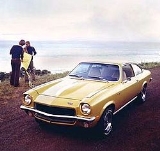
Chevrolet Vega

Encyclopedia
The Chevrolet Vega is a subcompact
, two-door automobile that was produced by the Chevrolet
division of General Motors
for the 1971-1977 model year
s. Named after the star Vega
, the car was powered by a lightweight aluminum-block inline four-cylinder engine. The Vega was produced in hatchback
, notchback
, wagon
, and panel delivery
body styles.
Initially well-received by buyers and the motoring press, from whom it received numerous awards, the Vega sold well against domestic subcompacts such as the AMC Gremlin
, Ford Pinto
, and imports from Toyota, Datsun
and Volkswagen
. By 1974 the Vega was among the top 10 best-selling American cars.
A limited-production model, the Cosworth Vega
was introduced in March 1975 with a reduced displacement
, but more powerful all-aluminum inline four-cylinder engine, sold the same year as several new GM subcompacts: the rebadged Pontiac Astre
, the Vega-based, upscale Chevrolet Monza
with variants from Buick and Oldsmobile, and the less expensive Chevrolet Chevette
.
Developed quickly, early examples of the Vega suffered engine problems, poor build quality, and corrosion, which caused long-term harm to GM's reputation. The faults were remedied by recalls
and design upgrades. A three-year decline in sales culminated in the car's cancellation at the end of the 1977 model year
divisions were working separately on small cars in the early and mid 1960s. Ed Cole
, GM's executive vice-president of operating staffs was working on his own small-car project using the corporate engineering and design staffs. He presented the program to GM's president in 1967. When the corporation started seriously talking about a mini-car, Cole's version was chosen with the proposals from Chevy and Pontiac rejected, and Cole's new mini-car was given to Chevrolet to sell. Not only did corporate management make the decision to enter the mini-car market, it also decided to develop the car itself. It was a corporate car, not a divisional one.
In 1968 GM chairman James Roche
announced that General Motors would produce the new mini-car in the U.S. in two years. Ed Cole was the chief engineer and Bill Mitchell, the vice-president of the design staff, was the chief stylist. Cole wanted a world-beater, and he wanted it in showrooms in 24 months. This was an extremely short time to design and engineer a new car, especially one that borrowed almost nothing from any other. Ed Cole formed a GM corporate design team exclusively for the Vega headed by James G. Musser, Jr. who had played major roles in helping develop the Chevy II
, the Camaro, the 350-and 400-cu in V8's and the Turbo-Hydramatic
transmission. Musser said, "This was the first vehicle where one person was in charge and, under him — that is me — a group of guys did the entire vehicle." The Vega, like the Corvair
, has long been referred to as Ed Cole's baby. It was as GM president that Cole oversaw the genesis of the Chevrolet Vega — ultimately meeting the projected schedule. Early spy reports called the Vega "Gemini" and "GMini," although Motor Trend
and other publications used the correct internal designation, XP-887. Chevrolet "teaser" ads began in May 1970, not announcing its name, stating-You'll see.
engine block technology. The first sand cast aluminum blocks were actually produced a full two years prior to the corporate decision to build the Vega.
The decision was made to go with a relatively large displacement engine with good low speed torque
. Economy would be achieved through the use of low numerical gear ratios, which would keep engine rpm low. The Vega engine itself went through 6,000,000 driving miles of testing. The earliest, or pre-test, version of the engine was tested in a Fiat 124
sedan. This car was used for development of the aluminum block, while several 1968 Opel sedans were used for drive train development
Chevrolet instituted a totally new management program: the car line management technique. In placing a single individual, the chief vehicle engineer
, in charge of the entire program and having the entire car – including engine, suspension, and brakes – designed by engineers specifically assigned to the Vega. A total of 50 engineers were assigned to the Vega engineering team broken down into body, power train, and chassis design groups; the product assurance group, and the pleasability group. Fisher Body
engineers and draftsmen were also moved in with the Vega personnel. It is generally acknowledged that this organizational arrangement made it possible to put out a totally new car in such a short time. The pleasabilty group would check continuously on the vehicles on the assembly line. As part of another program, computers would monitor quality control of every vehicle built.
In October 1968, there was only one body style – the "11" style notchback sedan, one engine, one transmission
– the MB1 Torque-Drive manually shifted two-speed automatic, no headliner, one base trim level, a bench seat
, molded rubber floor covering, no glove box, no air-conditioning option, ventilation only through the upper dash direct from the wiper plenum, and exterior paint on the interior. As the program progressed into development, the market changed, and so did the product.
December 1968 – Hatchback, wagon, and panel delivery styles added. floor-level ventilation added. optional performance engine ("L-11" two-barrel) added; predicted production rate was 20%; actually ran at 75%. Bucket seats replaced bench seat as standard equipment. Carpeting and headliners added for hatchback and station wagon. Air conditioning option added; predicted production was 10%, actually ran at 45%.
February 1969 – Opel
three- and four-speed transmissions added (three-speed standard, others optional), Powerglide
added (now four transmissions), mechanical fuel pump replaced by in-tank electric pump, power steering option added, base "11" style Notchback trim upgraded to match Hatchback and Wagon (carpet and headliner).
April 1969 – Gauge-pack cluster option added, HD suspension
and wide tire
option added, adjustable seat back option added; ran at 45% production, bumpers restyled, lower valance panels added, swing-out quarter window option added; ran at 10% production.
July 1969 – Electrically heated backlite option added; ran at 10% production, "GT" package option added at $325.00; ran at 35% production, bright window-frame and roof drip moldings added to the Hatchback and Wagon.
This is essentially how the car launched as a 1971 model. Production began on June 26, 1970. After the National GM strike (9/70-11/70) ended, bright roof drip moldings were added to base "11" notchback; moldings were sent to dealers to update units already in the field in December. The car still had no glove box.
Chevrolet paid a price for its rush to introduce the car with other 1971 models. Tests which should have been at the proving grounds were performed by customers, necessitating numerous piecemeal "fixes" by dealers. Chevrolet's "bright star", received an enduring black eye despite a continuing development program which eventually alleviated most of these initial shortcomings.
and a 65.4 inches (1,661.2 mm) width. The 1971 and 1972 models have a 169.7 inches (4,310.4 mm) overall length or just over 14 feet (4.3 m). 1973 models are 3 inches (76.2 mm) longer due to the front 5 mph bumper. 1974 to 1977 models have front and rear 5 mph bumpers and are 5.7 inches (144.8 mm) longer than the 1971 and 1972 models. In a size comparison with a 1970 Nova, the Vega has 14 inches (355.6 mm) shorter wheelbase, 7 inches (177.8 mm) narrower width, 2 inches (50.8 mm) lower height, and (1971 and 1972 models) have 20 inches (508 mm) less overall length.
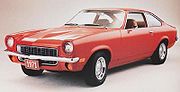
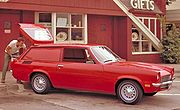
The Hatchback Coupe, with its lower lower roofline and a fold-down rear seat accounted for nearly half of all Vegas sold. The Sedan, later named Notchback is the only model with an enclosed trunk, has more rear seat headroom than the hatchback, and offered the lowest base price. The wagon, named Kammback has a lower cargo liftover height, a swing-up liftgate, and of course, more carring space. Wagon rear-side windows are permanently in place. A one-passenger panel delivery, named Panel Express is based on the wagon with steel panels in place of the rear side glass, an enclosed storage area and an optional auxiliary front passenger seat. The Panel Express used Chevy Van seats lacking headrests required for passenger vehicle classification.
The aluminum block inline-four engine was a joint effort from General Motors, Reynolds Metals
, and Sealed Power Corp
. The engine and its die-cast block technology was developed by GM engineering staff, before the program was handed off to Chevrolet to finalize and bring to production. Ed Cole, who had been personally involved with the design of the 1955 Chevrolet V8 as chief engineer at Chevrolet, was equally involved with the Vega engine as GM president, and was a frequent visitor on Saturdays to the engineering staff engine drafting room, reviewing the design and giving direction for changes. Chevrolet engineers and manufacturing personnel weren't pleased, especially since they knew Ed Cole wanted the job done quickly. As the engine development progressed at Chevrolet, it became known (in closed offices) as "The world's tallest, smallest engine" due to the tall cylinder head. Plagued by vibration and noisy operation and prone to overheating, the engine definitely did not live up to the Vega's potential.
By 1974, the overheating was gone, the vibration was a thing of the past and the noise had been reduced to an acceptable level.
 GM's German subsidiary Opel
was commissioned to tool up a new three-speed derivative of their production four-speed manual transmission
. Opel had a four-speed available that was in high-volume production, but the GM finance department insisted that the base transmission be a low-cost three-speed, with the traditional profit-generating four-speed as an extra-cost option. Opel tooled up a new three-speed unit exclusively for the Vega, unusual only because it had shift linkages on both sides. Its final cost was higher than the optional four-speed due to the tooling investment and production volume. Both transmissions were shipped from Germany, 100 transmissions to a crate, and arrived in shipments of thousands of transmissions at a time. Initially Powerglide
automatic and Torque-Drive semi-automatic transmissions were optional. The two-speed Torque drive required a manual upshift but had no clutch pedal. The US-built Saginaw three- and four-speed manual and an air-cooled version of the Turbo-Hydramatic
automatic later replaced the Opel-built manual transmissions, the Torque-Drive, and Powerglide. The Vega's front-engine, rear-wheel drive layout
is the traditional one where the engine is located at the front of the vehicle and driven wheels are located at the rear. Axle ratios ran from a low 2.53 for economy, to a 2.92 for better acceleration with a slight fall-off in economy to a 3.36 performance ratio. Positraction
was also available.
Its suspension and live rear axle
design, near ideal weight distribution
, low center of gravity
and neutral steering
give the Vega world-class handling characteristics. Lateral acceleration capacity is 0.90 g for the standard suspension, and 0.93 g for the RPO F-41 suspension. Weight distribution is quoted at 53.2% front and 46.8% rear. The steering box and linkage are located ahead of the front wheel centerline. The shaft is a cushioned two-piece unit. The overall ratio is 22.5:1 and the curb to curb turning circle is 33 feet (10.1 m). The overall chassis suspension was to be tuned to a new A78 × 13 tire that was being developed concurrently with the vehicle. The front suspension is classic General Motors short and long-arm. The lower control arm bushings were actually larger than those of the 1970 Camaro. The four-link rear suspension copied that of the 1970 Chevelle, and coil spring
s are used throughout. This was a significant departure from the leaf spring
suspension used in the Camaro and Chevy II Nova.
The engineers in charge of chassis development were seeking a package that would provide full-size domestic car ride qualities with handling equal to that of European cars. A torque-arm rear suspension was later adopted, replacing the four-link design, thus eliminating the panic-braking induced rear wheel-hop. The Vega's front disc and rear drum brake system copied an excellent Opel design including 10-inch diameter single-piston solid rotors designed especially for the Vega and 9-inch diameter drum rear brakes, utilizing the leading-trailing design. The system is balanced to give braking distribution of 70/30 front and rear with no proportioning valve, and exhibiting nearly linear pedal effort.
All four Vega models share the same hood, fenders, floor pan, door lower panels, rocker panels, engine compartment, and front end. The roof panel is a double layer, with a drilled inner panel to cut noise. The hood is hinged at the front and features a inside locking mechanism. Due to its "Modular Construction Design", a Vega sedan with 578 body parts had 418 fewer parts than its full-size Chevrolet counterpart. Modular
Construction Design reduced the number of joints and sealing operations resulting in stronger, tighter bodies, effectively contributed to vehicle quality and made possible a very high rate of production. The Vega's body surface was the first accomplished completely through use of computers. Body surface information recorded on tape derived from the clay
styling model, allowed computers to improve the body surface mathematically. Computer-developed tapes were also used to control drafting machines in producing master surface plates which were extremely accurate. Computers were also utilized in making the hundreds of necessary engineering calculations including, vision angle, field of view
, rear compartment lid and door counterbalance geometries, structural stresses, deflection
calculations and tolerance studies.
The Vega's styling was judged conservative, clean-lined and timeless. The GM styling studio's main influence was the 1967 to 1969 Fiat 124 Sport Coupe AC. The Chevrolet Camaro/Corvette studio under Henry "Hank" Haga was doing the 1970 Camaro at the time. With direction from Bill Mitchell, Haga's group took a clay model and redid the engineering version of the Vega, grafting a miniaturized Camaro front end and egg-crate grille and capped the rear of the sedan and hatchback models with recognizable Chevrolet tail lamps. The coupe has hints of everything from Camaro to Ferrari in its styling. Three years later the front end would be redesigned to accommodate the revised 1974 pendulum
-test, 5 mph bumper standard. The sloped front-end was generally well-received although many Vega enthusiasts preferred the older design. The seats are covered in vinyl and foam-padded with built-in head restraints. All interior panels are single-piece molded units and flooring is rubber on sedan and delivery; Carpet on the other two models with additional sound insulation added. An optional Decor package for the sedan included the carpeting, the additional insulation and an adjustment for the passenger seat. A custom interior option for all models (except delivery) added upgraded upholstery, woodgrain accents and cargo area load floor carpeting in the hatchback and wagon.
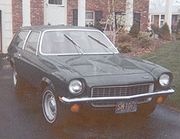
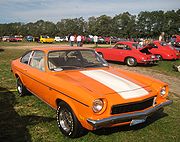
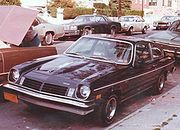
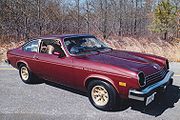 In mid-1971 an optional GT package for Hatchback and Kammback models was introduced including the L-11 two-barrel 140 engine, the F-41 handling suspension option (H.D.springs and shock absorbers, front and rear stabilizer bars, 6-inch-wide wheels and 70-series raised white-letter tires), GT fender emblems, black-finished grill and lower body sills, clear parking lamp lenses, chrome belt and lower moldings, full instrumentation, four-spoke sport steering wheel, adjustable driver's seat back, a passenger-assist handle and a wood-grain dash
. Satin-finished GT wheels with trim rings and chrome center caps replaced the argent wheels and stainless hub caps, and a hood/deck sport stripe in black or white was optional. Yenko Chevrolet
marketed the Yenko Stinger II through 1973 — based on the Vega GT, its 140 cu in L-11 engine featured high-compression pistons and a turbocharger
producing 155 hp. Included were front and rear spoiler
s and side striping with "Yenko Stinger II" identification.
1972 models were essentially carried over from 1971 with a few refinements and additions. Vibration and noise levels were reduced by a revised exhaust system
and better driveline damping and the rear shock absorbers were revised. The Turbo-hydramatic three-speed automatic transmission and a custom cloth interior were new options and a glove box was added.
The 1973 Vega had over 300 changes, including new exterior and interior colors and new standard interior trim. The front and rear script nameplates — "Chevrolet Vega 2300" were changed to block letters — "VEGA by Chevrolet". The front bumper, on stronger brackets was extended 3 inches with a steel body-color filler panel — to meet the 1973 5 mph front bumper standards. US-built Saginaw manual transmissions and a new shift linkage replaced the Opel-built units. The L-11 engine featured a new Holley staged two-barrel carburetor. New options included BR70-13 white stripe steel belted radial tires, full wheel covers and body side molding with black rubber insert. Two new models were introduced mid-year — the Estate Kammback Wagon with wood grain sides and rear trim, and the LX Notchback including a vinyl roof
. On May 17, 1973 the millionth Vega was produced at the Lordstown assembly plant — a bright orange GT Hatchback with white sport stripes, power steering, a neutral custom vinyl interior with exclusive vinyl door panels, accent-color orange carpeting and millionth Vega door handle accents. A limited edition "Millionth Vega" was introduced replicating the milestone car. 6500 were built May 1 to July 1.
The 1974 model year brought the only major exterior design changes, due to the revised front and rear 5 mph bumper standards. The redesigned front end featured a slanted header panel and recessed headlamp bezels with a louvered steel grille replacing the egg-crate plastic grille. Front and rear aluminum bumpers with inner steel spring (resembling the 1974 Camaro) replaced the chrome bumpers, and front and rear license plate mountings were relocated. A revised rear panel on Notchback and Hatchback models had larger single unit taillights and ventilation grills were eliminated on trunk and hatch lids. Overall length was increased six inches (152 mm) compared to 1971-72 models. A 16 gallon fuel tank replaced the 11 gallon tank. The GT sport stripes option was changed — side striping replaced the painted hood/deck stripes. The custom interior's wood-trimmed molded door panels were replaced with vinyl door panels matching the seat trim. In January plastic front fender liners were added after thousands of sets of fenders were replaced under warranty
on 1971-1974 models. In February the "Spirit of America" limited edition hatchback was introduced featuring a white exterior, white vinyl roof, blue and red striping on body-sides, hood and rear-end panel, emblems on front fenders and rear panel, white "GT" wheels, A70-13 raised white-letter tires, a white custom vinyl interior and red accent color carpeting. 7500 were built through May. Sales peaked for the 1974 model year with 460,374 produced.
The 1975 Vega had 264 changes including H.E.I.
(High-energy) electronic ignition and catalytic converter
. New options included power brakes, tilt steering wheel, BR78-13B GM-spec steel belted wsw radial tires, and a special custom cloth interior option for the Hatchback and Kammback. In March the Cosworth Vega was introduced featuring an all-aluminum twin-cam inline-4 engine and the first use of electronic fuel injection on a Chevrolet passenger car. All 2,061 1975 models were black with gold accent striping, gold-colored aluminum wheels and black custom vinyl, black custom cloth, or white custom vinyl interiors with a gold "engine turned" dash bezel and gold-plated plaque with Cosworth ID and build number. The Panel Express was discontinued at the end of the model year. Never a big seller, Panel Express sales peaked the Vega's first year at 7,800 units. After leveling off to an average of 4,000 per year, only 1,525 1975 models were sold. Total sales fell to 206,239.
1976 models had 300 changes. A facelift included a revised header panel with Chevy bowtie emblem, a wider grill, revised headlamp bezels —all made of corrosion resistant material, and new tri-color taillights for the Notchback and Hatchback. The 2.3-liter engine, named Dura-built 140, received improved cooling and durability refinements. The chassis received the Monza's upgraded components including the box-section front cross-member, larger rear brakes, and torque-arm rear suspension which replaced the four-link design. The body received extensive anti-rust improvements including galvanized fenders and rocker panels. New models introduced were the GT Estate wagon, the Cabriolet Notchback with a half vinyl roof with opera window
s, similar to the Monza Towne Coupe, and a limited edition Nomad Wagon featuring restyled side windows. New options included a Borg Warner five-speed manual overdrive
transmission and a houndstooth
type seat trim named "sport cloth" for an additional charge of $18. In January, a "Sky-Roof" with tinted reflectorized sliding glass and 8-track tape player options were added. The Cosworth was offered in eight additional exterior and two additional interior colors mid-year, but was canceled in July after only 1,446 1976 models.
1977 models were carried over from 1976 with a few revisions and additions. The Notchback was renamed Coupe. The Dura-built 140 engine received a pulse-air system to meet the more strict 1977 Federal emission standards. A similar system secured the Cosworth engine EPA certificate in 1975. The one-barrel version of the engine was dropped, as was the three-speed manual transmission. A full console was a new option and GTs received blacked-out trim and a revised side striping option.
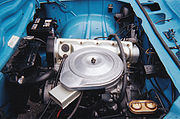 The Vega 140 CID engine
is a 2287 cc inline-four featuring a die-cast aluminum cylinder and case assembly and a cast-iron cylinder head with a single overhead camshaft (SOHC) The cylinder block
is an open deck design with siamesed free-standing cylinder bores. Outer case walls form the water jacket and are sealed off by the head and the head gasket. The block has cast iron main caps and a cast iron crankshaft
. The cast iron cylinder head
was chosen for low cost and structural integrity. The overhead valvetrain is a direct acting design of extreme simplicity. Only three components activate the valve rather than the usual seven of a typical push rod system. The camshaft
is supported by five conventional pressed-in bearings. The camshaft is driven from the crankshaft by an externally mounted continuous cogged belt and sprocket
system. Six v-grooves on the outside of the belt drive the water pump
and fan.
The large-bore-and-long-stroke design provides good torque
and lower rpm operation for reduced wear. Compression ratio
for the standard and optional engine is 8.0:1, as the engine was designed to operate on low-lead and no-lead fuels. A single-barrel carburetor
version produces 90 hp. The two-barrel version (RPO
L11) produces 110 hp. From 1972 on, ratings were listed as SAE net. The relatively large (for an inline-4) engine is naturally prone to vibration and is subdued by large rubber engine mounts. The 1972 Rochester
DualJet two-barrel carburetor required an air pump for emission certification and was replaced in 1973 with a Holley-built 5210C staged two-barrel carb. Emission control revisions made in 1973 reduced power output on the optional engine by 5 bhp, although the engine's cruising noise levels were reduced.H.E.I.
ignition was introduced on 1975 engines.
See: Criticism - 140 engine
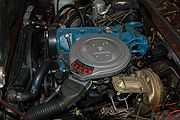 The 140 cu in engine was named Dura-Built 140 in 1976. It featured improved coolant pathways for the aluminum-block, a redesigned cylinder head incorporating quieter hydraulic valve lifters, longer life valve stem seals (which reduced oil consumption by 50%), and a redesigned water pump, head gasket
, and thermostat
. Warranty on the engine was five years/60000 miles (96,560.4 km).
"August 1, 1975. 8 a.m. Outside the southern edge of Las Vegas, Nevada
. Three medium orange Vegas start their engines. They won't be turning them off much during the next 58 days except for rest and food stops, refueling and maintenance. They have a job to do." Chevrolet conducted an advertised 60,000 miles in 60 days Durability Run of the 1976 Vega and its Dura-Built 140 engine.
Three new Vega hatchback coupes equipped with manual transmissions and air conditioning were driven non-stop for 60000 miles (96,560.4 km) in 60 days through the deserts of California and Nevada (Death Valley
) using three pre-production models of the subcompact and nine non-professional drivers.
All three 1976 Vegas completed a total of 180000 miles (289,681.2 km) with only one "reliability" incident — a broken timing belt
. This fact prompted Vega project engineer Bernie Ernest to say, "The Vega has reliability in excess of 60,000 miles, and therefore the corporation feels very comfortable with the warranty."
Motor Trend in their February 1976 report The 60,000-mile Vega, said, "Chevrolet chose the 349-mile Southwestern desert route in order to show the severely criticized engine and cooling system had been improved in the 1976 model. During the 60-day test which was certified and supervised by the United States Auto Club, the three cars were subjected to ambient temperatures never lower than 99 °F (37.2 °C) and often reaching as high as 122 °F (50 °C). The nine drivers were instructed to treat the cars as they would their own and use the air conditioning as desired. Yet, in more than 180,000 miles of total driving, the cars used only 24 ounces of coolant, an amount attributed to normal evaporation under severe desert conditions. Furthermore, fuel economy for the three test Vegas averaged 28.9 mpg over the duration of the run, while oil was used at the rate of only one quart every 3400 miles. Translated into actual driving expenses, the three Vegas averaged a per-mile cost of 2.17 cents." One of the cars went on display at the 1976 New York Auto Show
. The 1976 Vega was marketed as a durable and reliable car. The 1977 Dura-Built 140 engine added a pulse-air system to meet the more-strict 1977 U.S. exhaust emission regulations
. The engine paint color (as used on all Chevy engines) changed from orange on 1976 engines, to blue on 1977 engines.
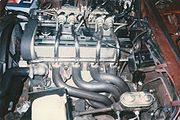 The Cosworth Vega
122 CID engine is a 1994 cc inline-four featuring a die cast aluminum alloy cylinder and case assembly and a Type 356 aluminum alloy, 16-valve cylinder head with double overhead camshafts (DOHC), designed in conjunction with English engineering company Cosworth
. The camshafts are held in a removable cam-carrier which also serves as a guide for the valve lifters. Each camshaft is supported by five bearings and is turned by individual cam gears on the front end. The two overhead camshafts are driven, along with the water pump
and fan, by a fiberglass cord reinforced neoprene rubber belt, much like the Vega 140 cu in engine. Below the cam carrier is a 16-valve cylinder head constructed of an aluminum alloy using sintered iron valve seats and iron cast valve seats. Sturdy forged
aluminum piston
s and heat-treated forged steel crankshaft and connecting rods reveal racing ancestry; assure high-performance durability.
The engine features a stainless steel
exhaust header and electronic fuel injection (EFI) – a Bendix system with pulse-time manifold injection, four injector valves, an electronic control unit (ECU), five independent sensors and two fuel pumps. Each engine was hand-built and includes a cam cover sticker with the engine builder's signature. The Cosworth Vega engine is some 60 lb (27.2 kg) lighter than the SOHC Vega engine. The engine develops its maximum power at 5,600 rpm and is redlined at 6,500 rpm where the SOHC Vega engine peaks at 4,400 rpm and all is done at 5,000 rpm. Final rating is 110 hp.
The planned 1974 launch of the Cosworth variant was delayed when burned exhaust valves were found at 40000 miles (64,373.6 km) during a 50000 miles (80,467 km) emissions certification run. This resulted in a major redesign of the fuel system and ignition system, plus the addition of fresh air injection into the exhaust to reduce pollutants.
With only 3,508 of the 5,000 engines used, GM disassembled about 500; the remaining engines were scrapped.
alloy called A-390, composed of 77 percent aluminum, 17 percent silicon
, 4 percent copper
, 1 percent iron
, and traces of phosphorus
, zinc
, manganese
, and titanium
— suitable for faster production diecasting, making the Vega block less expensive to manufacture than other aluminum engines. Sealed Power Corp. developed chrome-plated piston rings that were blunted to prevent cylinder bore scuffing. Basic work had been done under Eudell Jackobson of GM engineering. Then suddenly, Chevrolet got handed the job of putting this sleeveless
aluminum block into production. The Vega blocks were cast in Massena, New York
at the same factory that had produced the Corvair engine
. The casting process provided a uniform distribution of fine primary silicon particles approximately 0.001 inches (25 µm) in size. The blocks were aged eight hours at 450 °F (232.2 °C) to achieve dimensional stability, then inpregnated with sodium silicate
to help eliminate porosity. From Massena, the cast engine blocks were shipped to GM's engine plant in Tonawanda, New York
where they underwent the etch and machining operations. The cylinder bores were rough and finish-honed conventionally to a 7-microinch (180 nm) finish then etched removing approximately 0.00015-inch (3.8 µm) of aluminum, leaving the pure silicon particles prominent to form the bore surface. A four-layer plating process was necessary for the piston skirts, putting a hard iron surface opposite the silicon of the block. From Tonawanda, the engines went to the Chevrolet assembly plant in Lordstown, Ohio
. The technical breakthroughs of the block lay in the die-casting method used to produce it, and in the silicon alloying which provided a compatible bore surface without liners. With a finished weight of 36 pounds (16.3 kg), the block weighs 51 pounds (23.1 kg) less than the cast-iron block of the 153 cubic inch inline-four used in the Chevy II Nova.
notes:
1972–1977 hp/torque ratings are SAE Net
L-11 engine standard on 1977 models
arrangement and side-flow "Heron" combustion chamber design. They deisgned a "crossflow" aluminum cylinder head with a single centrally mounted overhead camshaft (OHC) and roller rocker arms operating intake valves on one side and exhaust valves on the other, similar to the Ferrari
V12 cylinder head design of that period; it was about 4" lower than the Vega production head, was lighter and had true "hemi
" chambers with big valves. Numerous prototype
s were built, and manufacturing tooling was started in anticipation of approval for production. Ultimately the design was not approved. Had it gone to production, it would not have had the differential expansion
head gasket problems of the iron-head engine and would have provided higher performance than the optional L-11 engine.
, and GM President Ed Cole projected its release in three years, initially targeted for an October 1973 introduction as a 1974 Vega option. The General Motors Rotary Combustion Engine
(GMRCE) had two rotors displacing 206 cubic inch, twin distributors and coils, and an aluminum housing. RC2-206 Wankels were installed in 1973 Vegas for cold weather testing in Canada.
Motor Trend, in a 1973 article "The '75 Vega Rotary" said: "GM saw the rotary engine's future as probably much greater than they do today...mileage will be in the 16-18 mpg range. Compared to the normal piston (engine) Vega's 20 to 26 mpg, the whole rotary deal begins to look just a little less attractive, with what the price of gasoline skyrocketing, but that's another matter."
Unwilling to face fuel efficiency
criticism that Mazda
withstood, GM felt it could meet 1975 emissions standards with the engine tuned to provide better mileage. Other refinements improved mileage to 20 mpgU.S. (8.5 km/L), but with the fuel breakthrough came related side-effect problems — apex seal failures, as well as a rotor tip-seal problem. By December 1973, it was clear the Wankel, now planned for the Monza 2+2
, would not be ready for either production or emissions certification in time for the start of the 1975 model year, and after paying another $10 million against its rotary licence fees, the company announced the first postponement. Motor Trend in April 1974 predicted the final outcome – on September 24, 1974, Ed Cole postponed the Wankel engine ostensibly due to emissions difficulties. He retired the same month. GM admitted fuel economy for the rotary was sub-standard and postponed production in favor of further development. Pete Estes
succeeded Ed Cole as GM President and never showed any special interest in the Wankel or in the perpetuation of Cole's ideas.
were carried out automatically by industrial robot
s called Unimate
s. Engine and rear axle assemblies positioned by hydraulic lifts with bodies overhead were synchronized to move along the line at 30 feet per minute. Sub-assembly areas, conveyor belts and quality control were all computer directed.
The Lordstown worker had only 36 seconds to do his job instead of the normal minute. With 25 percent more line workers than needed, the speed of assembly did not bother most workers at first, organizing themselves into groups of three, so the fourth could rest while the others worked. The Vegas that came off the line in those early months were well built. They still had mechanical flaws but the quality of assembly — things like fit-and-finish — was not a problem. The car was good, so good, in fact, and so well received that it earned Motor Trend's Car of the Year award for 1971. Then in October 1971, General Motors ordered Chevrolet and Fisher Body to turn over Lordstown to the General Motors Assembly Division (GMAD). One of its missions was to cut costs and it did this by letting go that fourth "extra" worker and the line speed didn't slow. GMAD ran a much tighter ship and discipline became more rigorous. The United Auto Workers
(UAW) claimed that 800 workers were laid off at Lordstown within the first year of GMAD's arrival. The division put the figure at 370. Feelings got worse with management accusing workers of intentionally slowing the line and sabotaging cars by leaving parts off and doing shoddy work. The workers countered that GMAD sped up the line and cut staffing. Whatever the truth, quality did suffer and In March 1972, the plant's 7,700 workers called a wildcat strike that lasted a month and cost GM 150 million dollars. Vega production jumped by well more than 100,000 units for 1972, but would have been even more robust without the contentious strike. 1975 was a "rolling model change" at 100 cars per hour with no downtime.
had no effective means to reach full production targets, so they called DuPont
(lacquer paint supplier); using two mobile paint laboratories, they developed a new paint chemistry and application specifics over a weekend — Non-Aqueous Dispersion Lacquer (NAD). There were production paint colors to that new formulation within a week, which enabled them to continue the production ramp-up successfully to 106 per hour in the paint shop. John Hinkley, GMAD-Lordstown Coordinator said: "Masking, painting, and demasking the GT's optional sport stripes was something to see at 106 per hour."
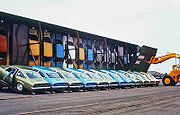 The Vega was designed to be shipped vertically, nose down. Railroad car
s named Vert-A-Pac were designed jointly by General Motors and Southern Pacific — each holding 30 Vegas versus 18 in normal tri-level autorack
s. Each car was fitted with four removable cast-steel sockets in the undercarriage. Plastic spacers were wedged beside the powertrain to prevent damage to engine and transmission mount, and were removed during unloading. The rail car ramp/doors were opened and closed via forklift.
Chevrolet conducted vibration
and low-speed crash tests to ensure the suspended, nose-down cars would not shift or incur damage in railroad collisions. Chevrolet's goal was to deliver cars topped with fluids and ready to drive to the dealership. To do this, engineers had to design an engine oil
baffle to prevent oil from entering the No. 1 cylinder; Batteries
had filler caps located high up on the rear edge of the battery case to prevent acid spilling; the carburetor float bowl had a tube that drained gasoline
into the vapor canister during shipment, and the windshield washer bottle stood at a 45-degree angle.
magazines. DeLorean also authorized the Cosworth Vega prototype, later requesting initiation of production. His 1979 book, On A Clear Day You Can See General Motors, included a chapter on the Vega program.
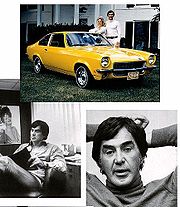 In Motor Trends August 1970 issue, DeLorean discussed the upcoming car, touting its quality of assembly and its handling capabilities. DeLorean said,
On A Clear Day You Can See General Motors -John Z. DeLorean's Look Inside The Automotive Giant by J. Patrick Wright was written in 1974, a year following DeLorean's resignation from GM, and finally published in 1979. In "The Vega" chapter, DeLorean was critical of the corporate control of the Vega program and discussed his decisions in regards to launching the car. DeLorean said,
by six months and preceded the Ford Pinto
by one day. Time magazine in September 1970 said the Vega was slightly more expensive than the Pinto. Motor Trend in February 1971 said conservative estimates had placed the cost of bringing the Vega (XP-887) from drawing board to production reality at a staggering $200 million compared to about $5 million for the AMC Gremlin. The Vega competed directly with its domestic rivals and Japanese imports from Toyota and Datsun
as well as the successful, but aging VW Beetle.
Five months prior to the Vega's public introduction, Chevrolet invited six publications to participate in a test run from Denver, Colorado
to Phoenix, Arizona
. Six cars were provided, driven out to Denver from the GM Proving Grounds in Milford, Michigan
. Three Vegas - a sedan, coupe, and wagon, VW Beetle, Toyota Corona, and Ford Maverick. In September 1970 Car Life magazine reported on the two-day test run: "The motoring press took an 890-mile trip in three Vegas and three competitors. The Vegas won." "The most impressive part of the trip was the cornering power of the three Vegas. None of the other cars could begin to keep up." Michael Lamm said, "We all agreed that the three Vegas were well put together, that they were comfortable, roomy, reasonably quiet, and fun to drive." John Bond, publisher of Road and Track and Car Life, who'd never been overly fond of American automobiles said he thought the Vega handled better than any economy car he'd ever driven. The highest speed attained on a level road was 105 mph (46.9 m/s) at 5,250 rpm by the Vega coupe with the L-11 performance option. The highest fuel mileage recorded was the Vega sedan at 25.5 mpg. The best 0-60 time was the L-11 Vega coupe at 13.5 seconds.
Motor Trend
in a 1971 VW-Pinto-Vega comparison said, "The engine in the Vega is the strongest of the three...its drag strip performance will blow the doors off both the Pinto
and the VW. The Vega, while enjoyable to drive, is a more serious car. It's faster, more comfortable, quieter and better riding than either the Pinto or VW while still delivering respectable fuel economy."
Car and Driver
in 1971 awarded top pick to the Vega above the Ford Pinto, AMC Gremlin
, VW Beetle, Toyota Corolla and Chrysler Simca
. C&D said: "The Vega was the most expensive car in the test by almost $300 but the Vega's virtues are nicely in proportion to its price and it was the unanimous favorite." "The Vega pulls down the number one position because of its particular suitability to American driving conditions. In general the Vega is quick and nimble without the sports car harshness most American car drivers find objectionable." "The Vega's tall 2.53:1 axle ratio allowed a low 3,000 rpm at 80 mph (130 km/h)." "It was the quickest of the cars tested, taking 12.2 seconds to reach 60 mi/h." C&D credited the Vega "an excellent combination of performance and economy."
Motor Trend in a 1972 comparison test A Back Door To Economy chose the Vega GT best car over the Ford Pinto Runabout and Gremlin X saying, "Chevy has had it all along." "Even extended trips do not induce excessive driver fatigue and that is one reason why it was the Car of the Year in 1971.
Car and Driver in a 6-Car Comparison Test Super Coupes in 1972 rated the Vega GT's styling over Pinto Runabout, Opel 1900 Rallye
, Mazda RX-2
, Capri 2000
, and Toyota Celica
, saying: "...If looks alone determined the best Super coupe, the Vega GT would win hands down without ever turning a wheel."
Road Test magazine in the 1976 Super Coupe Shootout — Alfa vs. Mazda vs. Lancia
vs. Saab
vs. Cosworth Vega, RT said: "The results are in Figure 2. Read 'em and weep, all you foreign-is-better nuts, because right there at the top, and by a long way at that, is the Cosworth Vega. It had the fastest 0-60 time, the fastest quarter-mile time, and tied with the Saab for the shortest braking distance". "The Cosworth is American, and a collector's item, and it came close, damn close to winning the whole thing."
Motor Trend Classic magazine in a 2010 Loving Look Back comparison — 1973 Vega GT, 1972 Pinto Runabout and 1971 Gremlin X — closes the article saying, "Emotionally, Jim Brokaw summed it up in January 1972: Gremlin has power, but Pinto has the price, and a much quieter ride. Which car is best? Vega."
, Car and Driver
and the American Iron and Steel Institute
. Chevrolet's early Vega advertising included ads promoting awards won by the car. Frank Markus, Technical Director of Motor Trend wrote in the Motor Trend Classic Fall 2010 issue, "Chevrolet spun the Vega as a more American, upscale car. And let's face it, the car looked hot. So can you blame us for falling hook, line, and sinker for the Vega and naming it 1971's Car of the Year?"
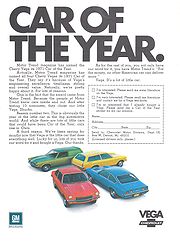 Motor Trend awarded the Vega 1971 Car of the Year.
American Iron and Steel Institute awarded the Vega in 1971 for–Excellence in design in transportation equipment.
Motor Trend awarded the Vega GT 1973 Car of the Year in the Economy Class.
Car and Driver readers voted the Vega Best Economy Sedan in 1971, 1972 and 1973 in C&D's Annual Reader's Choice Poll. In 1971, the Vega's first year on the market, it managed to unseat the incumbent import, breaking its eight-year winning streak.
Car and Driver selected the Cosworth Vega one of the 10 Best Collectable Cars in its fourth annual Ten Best issue, saying: "We're talking about historical significance here."
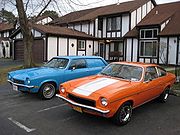
note: 1973 model breakdown N/A
variants. 1973–1977 Pontiac Astre
s used all Vega bodies (and Vega engines through 1976). 1978–1979 Chevrolet Monza
and Pontiac Sunbird wagons used the Vega Kammback wagon body with engines supplied by Pontiac
and Buick
. Chevy also offered the Monza 'S' for 1978 as a Monza price leader, using the Vega hatchback body.
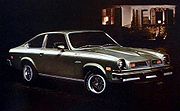
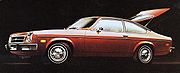
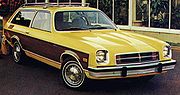
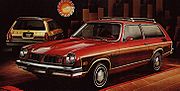 The Pontiac Astre was introduced in the U.S. for the 1975 model year, giving Pontiac dealers a needed fuel-efficient subcompact. Pontiac's trademark split grill and front emblem, Astre nameplates, an upgraded interior trim and a Pontiac steering wheel with emblem helped to differentiate itself from the Vega. The SJ Hatchback and SJ Safari Wagon models feature soft nylon
upholstery, cut pile carpeting, padded and cloth covered door panels, and a fabric headliner, plus rally instruments, the higher-output two-barrel engine, four-speed (over a three-speed manual) gearbox or automatic and radial tires. A GT package option for the hatchback and Safari wagon combined the lower-line interior with the SJ's performance and handling features. 3,000 1975 "Lil Wide Track" packages were sold. 1977 models featured a new vertical design grill and aluminum wheels were a new option. The Astre Formula was introduced which included the handling package, chrome valve cover, three-piece spoiler, Formula T/A steering wheel and special decals. The Astre used the Vega 140 cu in (2.3 l) engine through 1976. The Pontiac 151 cu in (2.5 L) OHV Iron-Duke
inline-four engine was used for the final 1977 model year. Transmissions are the three- and four-speed manual, five-speed manual with overdrive (1976–1977 option) and the three-speed automatic.
The Chevrolet Monza 'S' produced for the 1978 model year used the Vega hatchback body style. With the Vega nameplate canceled, the Monza 'S' was marketed as a price leader for the Chevy Monza line. The rebadged hatchback had the new Monza front end header panel and grill with Chevy bowtie emblem, steel front and rear bumpers replaced the Vega's aluminum bumpers. Monza front fender nameplates, and a two-spoke color keyed steering wheel with Monza emblem. White-wall tires and full wheel covers were standard as were bumper rub strips. In addition, there was an expanded engine availability. Pontiac's 151 cu in (2.5 l) OHV 'Iron-Duke' in-line 4 was standard. A choice of two V6 engines were available. Buick's 196 cu in (3.2 l) 90 hp V6 and 231 cu in (3.8 l) 105 hp V6. The four-speed manual was standard with all engines. The five-speed manual with overdrive and three-speed automatic transmissions were optional.
The Chevrolet Monza Wagon produced for the 1978–1979 model years used the Vega wagon body style. The rebadged wagon had the new Monza front end and grill and front and rear steel bumpers, front fender namplates and the Monza steering wheel with emblem. White-wall tires, full wheel covers and bumper rub strips were standard equipment. The Monza Estate, like the Vega Estate wagon it replaced, features wood grain sides and rear trim with outline moldings and the custom interior. Monza wagon models included, as standard, the 151 cu in I-4. The 196 cu in (3.2 l) and 231 cu in (3.8 l) V6 engines were optional. The four-speed manual was standard with all engines. The five-speed manual with overdrive, and three-speed automatic transmissions optional.
The Pontiac Sunbird Safari Wagon produced for the 1978–1979 model years used the Vega wagon body style. It replaced the discontinued Pontiac Astre Safari wagon which was essentially carried over with Sunbird badging. The Sunbird wagon retained the Vega/Astre aluminum bumpers, unlike the Monza wagon, which featured a new front end and steel bumpers, but the 1979 model featured a revised horizontal styled grill. Standard powertrain was Pontiac's 151 cubic inch inline-four with a four-speed manual transmission. Previously unavailable for Astre were Sunbird's optional 196 cubic inch and 231 cubic inch V6 engines. Five-speed manual and three-speed automatic were transmission options.
note: 1973–1974 Pontiac Astre (GM of Canada) N/A
es." Further development and upgrades continued throughout the car's seven-year production run, addressing its engine and cost-related issues.
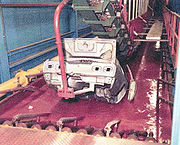 Fisher Body Division was very proud of its Elpo primering process, which should have prevented rust
, but didn't. The Elpo process (electrophoretic deposition of polymers) pioneered by Fisher, followed a seven stage zinc phosphate initial treatment and itself involved submerging the assembled Vega body in a vat containing reddish-brown paint-primer particles in 65000 US gal (246,052 l; 54,124 imp gal) of water. The metal bodies received a positive electrical charge, the primer particles carried a negative charge, and by leaving the body in the vat for two minutes even the most remote recesses get coated, theoretically. The body was then dried, wet-sanded, sealer-coated and finally sprayed with acrylic lacquer and baked in a 300 °F (148.9 °C) degree oven. In practice however, the Elpo dip did not flow to every recess or reach every surface. Vega expert Gary Derian was interviewed by Collectable Automobile in 2000. He said:
Chevrolet installed stopgap plastic deflectors in late 1973 and full plastic inner fenders in 1974. The original design provided for the full inner fender liners from the beginning. But at a cost review meeting the finance department cancelled the liners, as they would have added $1.14 per side, or $2.28 per car to the product cost. One of the program objectives was to produce a 2,000-pound car to sell for $2,000.00, and every penny was watched. Five years later, after GM had spent millions to replace thousands of sets of rusted-out Vega fenders in the field, the plastic fender liners were reinstated as a mid-model change during the 1974 model year. But
rust damage also affected the rocker panels, the door bottoms, the area beneath the windshield, and the primary body structure above the rockers. Darian added. "The front suspension cam bolts would sometimes rust solidly in place, which prevented alignment adjustments. To remove the cam bolts required lots of careful work with a cutting torch and all new parts."
Starting in 1976, extensive anti-rust improvements on Vega's body included galvanized steel fenders and rocker panels and "four layer" fender protection with zinc coated and primed inner fenders and wheelwell protective mastic, zinc-rich pre-prime coating on inner doors, expandable sealer installed between rear quarter panel and wheel housing panel, and corrosion resistant grill and headlamp housings.
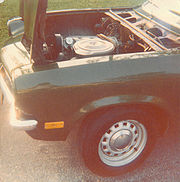 The Vega was subject to two recalls early in its production run involving its 140 cubic inch engine. 130,000 cars fitted with L-11 option addressed a concern over backfiring caused by the two-barrel carburetor. The second recall, in the early summer of 1972, involved 350,000 cars with the standard engine driven by a perceived risk that a component in the emission control system might fall into the throttle linkage, jamming it open. Eudell Jackobson from GM engineering confirmed the problems involving the early two-barrel Rochester carburetor and engine valve-stem seals. Jackobson said,
The Vega's cooling system held only 6 quarts (5.7 l) and had a tiny two-tube, 1 sq ft (0.09290304 m²) radiator
, when topped off the Vega cooling system was adequate. But most owners tended not to check the coolant level often enough, and in combination with leaking valve-stem seals the engine would often be low on oil and coolant simultaneously. This caused overheating which distorted the open deck block allowing antifreeze to seep past the head gasket, causing piston scuffing inside the cylinders.
In response, Chevrolet added a coolant overflow bottle and an electronic low-coolant indicator in 1974 that could be retrofitted to earlier models at no cost. Under a revised 50000 mi (80,467 km) engine warranty for 1971–1975 Vegas, an owner with a damaged engine had a choice to have the short block replaced with a brand new unit or a rebuilt steel-sleeved unit. This proved costly for Chevrolet. GM engineer Fred Kneisler maintaines that too much emphasis had been put on overheating problems versus the real culprits: brittle valve stem seals and too-thin piston plating. Regardless of the cause, damaged cylinder walls were common.
Collectible Automobile said, "Kneisler feels Chevrolet could have anticipated some of the Vega's problems had there been time to run what he call's "granny tests", more formally known as failure mode analysis — involves treating a car the way a "typical" grandmother would; i.e. ignoring coolant and oil levels, and rarely servicing anything. The granny test would have taken time, which the Vega's development engineers didn't really have. But apparently no one thought to run granny tests anyway." Kneisler confessed,
1976-1977 Dura-Built 140 engines had improved engine block coolant pathways, a redesigned head gasket, water pump, and thermostat, and had a five-year/60000 mi (96,560.4 km) warranty. Ironically, despite its lack of success with the Vega, the liner-less aluminum/silicon engine technology that GM and Reynolds developed turned out to be sound. Mercedes-Benz
and Porsche
both use sleeveless aluminum engines today. The metallurgy and finishing processes are slightly different, but the basic principles are those developed for the Vega engine.
The 2300 engine's simplicity was praised, as were the handling package and brakes of a Vega with the 110 hp engine. Other magazines said the car was well matched to the tastes and needs of the 1970s, that it was "very good", and in December 1970 Motor Trend included the Vega as one of the "Ten Best Cars of 1971".
Road and Track's editor, John R. Bond said, "As a final observation, I think the Vega is beyond a doubt the best handling passenger car ever built in the U.S. It has many other good qualities, but the roadholding impressed and surprised me most of all."
In 1971, Car and Driver favorably compared the basic Vega with the Ford Pinto, and described the Vega as one of the world's best-looking compact sedans. The turbocharged Yenko Stinger II version was called a sports car. The following year, Hot Rod magazine
voted the GT "Best Buy" of the 1972 Chevrolet line. Also in 1972, the Vega was voted "Easiest to service, least mechanical problems and best overall in its class" in a magazine survey of independent auto service personnel. Car and Driver chose a GT model in 1972 and a Cosworth in 1974 for tire tests because of their handling balance.
In 1973 and 1974, improvements were noted in the engine, traction, and gearshift. The GT was commended for its performance, economy, cornering, brakes, air conditioning, interior, "sense of balance that you rarely find in a sedan", steering that felt quite accurate, and the interior's high-quality carpets, door panels and seat coverings.
In a 1975 road test the Cosworth Vega's performance and handling received positive reviews, as did the car's balance, roll-stiffness distribution and mild understeer.
In 1976 the Cosworth Vega was complimented for its engine's smoothness and responsiveness, and for "very good" handling. The car was rated "a nice balance between performance and economy".
In April 2000, Collectible Automobile magazine said that the Vega's engine was "the most extraordinary part of the car", adding that although by 1976 the Vega was "fairly decent", the introduction of the even less expensive Chevette in 1976 "put the handwriting on the wall."
In 2010, Motor Trend Technical Director Frank Markus test drove a 6k-miles 1973 Vega GT. He reported, "After a few gentle miles, I begin to understand how this car won its awards and comparison tests, and said that "well-maintained examples are great looking, nice-driving, economical classics."
. A letter from its founder Ralph Nader
to GM Chairman Richard Gerstenberg contained a list of safety allegations. It also said that the car was a "sloppily crafted, unreliable and unsafe automobile" and that it "hardly set a good example in small car production for American industry".
In 1979, Popular Science
said the cost of free repairs to the Vega in the 1970s ran into tens of millions, and that repairs were often free of charge up to two years after the warranty ran out.
A 1990 Time
article said the Vega was "a poorly engineered car notorious for rust and breakdowns."
In 1991, Newsweek
magazine called the Vega costlier and more troublesome than its rivals.
Joe Sherman's 1993 book In the Rings of Saturn said that "by its third recall, ninety-five percent of all Vegas manufactured before May 1972 had critical safety flaws", and that the model's "checkered history only reinforced the belief that GM made inferior small cars. This legacy would prove far more important than any direct impact the Vega would have on GM's profits."
Motor Trend said in its September 1999 50th Anniversary Issue: "The Vega seemed well placed to set the standard for subcompacts in the 70s, but it was troubled by one of the most vulnerable Achilles heels in modern automotive history; an alloy four-cylinder engine block that self destructed all too easily, and all too often. Once the word got out the damage was done, even though the engine had been revamped."
The April 2000 issue of Collectible Automobile magazine summed up with: "The Chevy Vega has become a symbol of all the problems Detroit faced in the 70's" and ". . . little by little, everything that could go wrong, did. Had its big engineering and manufacturing plans succeeded, the last laugh might have belonged to Chevy . . . The greatest toll came in the damage it did to Chevrolet's and GM's reputation. The other effect the Vega had on GM was to help make the corporation conservative, and dull its will to lead."
Robert Freeland's 2005 book The Struggle for Control of the Modern Corporation said "poor planning and perfunctory implementation . . . led to an extremely poor quality automobile beset by mechanical problems," In his 2010 book Generation Busted, author Alan Zemek said, "Chevrolet's answer to the Japanese car, left it with a black eye."
In 2008, Popular Mechanics
editor John Pearley Huffman's web article, 10 Cars that Damaged General Motors, said the Vega's sales success meant there were "just that many more people disappointed" by it. "Throw in haphazard build quality and sheetmetal that you could practically hear rusting away, and the Vega truly rates as one of GM's great debacles."
The 1971 Vega placed third in Car and Driver 's 2009 article, Dishonorable Mention: The 10 Most Embarrassing Award Winners in Automotive History. The editors addressed Motor Trends Car of the Year award: "That’s not to say the choice of the Vega as 1971 Car of the Year didn’t make sense in context..compared with Ford’s Pinto, the Vega at least seemed better. The Vega’s aluminum engine block even seemed like a technological leap forward. However, the aluminum block’s unlined cylinder bores scored easily, and the (usually misaligned) iron cylinder head let oil pour into them."
In 2010, John Pearley Huffman of Popular Mechanics referred to the Vega as "the car that nearly destroyed GM."
is a front engine, rear wheel drive design based on the Chevrolet Vega using many of its components including the aluminum-block 140 cubic inch inline-four engine. The vehicle had a 90 inches (2,286 mm) wheelbase with an overall length of 166 inches (4,216.4 mm). This two-seater sports coupe offered a unique look at alternative engineering approaches to future techniques in design and manufacturing.
The vehicle was built with a frameless fiberglass
foam sandwich body and chassis. The entire body consisted of four lightweight fiberglass outer body panels, the floor pan, firewall, upper front, and upper rear with a rigid urethane
foam filling the designed clearance between the panels. The structure and appearance of the car were designed so that the body could be assembled using four lightweight molded outer skin sections. With the outer skin panels placed in a foaming mold, liquid urethane was injected between the panels where it expanded and bonded the body into a single, rigid sandwich structure. The result was a vehicle body virtually free of squeaks, rattles, and vibrations. Once the urethane hardened (which took about fifteen minutes), the suspension, drive train, hood and doors were bolted to reinforcing plates, which were bonded to the fiberglass panels.
A key consideration in the engineering design of the XP-898 was the advantage of improved crash worthiness of the sandwich construction technique. The energy absorption characteristics of the vehicle enabled engineers to simulate crash conditions for the vehicle at speeds up to 50 mph (22.4 m/s) without catastrophic failure to the structure.
.jpg) Chevy Vegas are often modified due to their front engine-rear drive (FR)
Chevy Vegas are often modified due to their front engine-rear drive (FR)
design, light weight and low cost. A small-block Chevrolet V8 engine
fits in the engine compartment; and a big-block V8 will fit with minor chassis modifications. The Vega was not offered with a factory V8 option, although the Vega-based Monza, Sunbird and Starfire were.
Motion Performance and Scuncio Chevrolet sold new, converted
small and big block V8 Vegas. Heavy duty engine mounts and front springs were fitted to support the increased engine weight, a large radiator and modified driveshaft were required. For engines over 300 hp, or with a manual transmission, a narrowed 12-bolt differential was required, replacing the stock Vega unit.
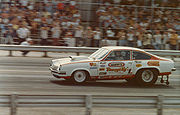 Drag racer Bill "Grumpy" Jenkins in the 1972 season, won six of eight National Pro-Stock division events with his Pro Stock
, 331 cu in (5.4 l)-powered 1972 Vega, Grumpy's Toy X. In its first event, the untested Vega made 9.6 second passes and won the 1972 Winternationals. Jenkins' 1974 Vega, Grumpy's Toy XI, was the first full-bodied Pro Stock drag racer
with a full tube chassis, as well as the first with MacPherson strut
suspension and dry sump oiling. Jenkins' 1974 Vega sold for $550,000 in 2007.
In July 1972, Hot Rod tested a Chevrolet-built prototype Vega featuring an all-aluminum V8. The special 283 cu in (4.6 l) engine was used in a 1950s special lightweight Corvette program, and later installed in the Chevrolet Engineering Research Vehicle (CERV), an open-wheel rear engine prototype. One of the last engines was bored out to 302 cu in (5 l) for the Vega application. With 11:1 compression pistons, a "097 Duntov" mechanical camshaft and cast-iron four-barrel intake manifold with a Quadrajet carburetor, the car recorded a stopwatch quarter-mile standing-start time of 13.97 seconds. The prototype had a stock Turbo Hydramatic, stock Vega rearend and street tires.
(SCCA) sanctioned, showroom stock sedan races at Lime Rock Park
in Lime Rock, Connecticut
-The Car and Driver SS/Sedan Challenge. With Bruce Cargill-representing the readers-having won Challenge I in 1972 in a Dodge Colt
, and Patrick Bedard
-C&D's executive writer-the victor of Challenge II in 1973 in an Opel 1900 sedan, Challenge III would be the tie-breaker event.
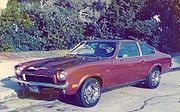 On October 12, 1974 C&D's Bedard piloted their 1973 Vega GT #0 in Car and Driver's SS/Sedan Challenge III and had just edged out an Opel to win the race. "The lone Vega outran every single Opel, Colt, Pinto, Datsun, Toyota and Subaru on the starting grid. From the summit of the winner's platform the car was in the impound area, a metallic bronze coupe with a big yellow zero on its battle-scared flank. It was driven it there after the victory lap, the tech inspectors had pushed it off the scales probing under the hood, looking for the secrets of its speed. It had done the job-this Vega GT faced off against 31 other well-driven showroom stocks and it had finished first.
After purchasing the year-old Vega in California for $1,900, Bedard contacted Doug Roe, a former Chevrolet engineer with a reputation as a Vega specialist mentioning the showroom stocker. Roe replied: "Better overfill it about a quart. When you run them over 5,000 rpm, all the oil stays up in the head and you'll wipe the bearings. And something has to be done with the crankcase vents. If you don't it'll pump all that oil into the intake." Bedard said,
Subcompact car
Subcompact car is a North American term used to describe automobiles whose class size is smaller than that of a compact car, usually not exceeding in length, but larger than a microcar...
, two-door automobile that was produced by the Chevrolet
Chevrolet
Chevrolet , also known as Chevy , is a brand of vehicle produced by General Motors Company . Founded by Louis Chevrolet and ousted GM founder William C. Durant on November 3, 1911, General Motors acquired Chevrolet in 1918...
division of General Motors
General Motors
General Motors Company , commonly known as GM, formerly incorporated as General Motors Corporation, is an American multinational automotive corporation headquartered in Detroit, Michigan and the world's second-largest automaker in 2010...
for the 1971-1977 model year
Model year
The model year of a product is a number used worldwide, but with a high level of prominence in North America, to describe approximately when a product was produced, and indicates the coinciding base specification of that product....
s. Named after the star Vega
Vega
Vega is the brightest star in the constellation Lyra, the fifth brightest star in the night sky and the second brightest star in the northern celestial hemisphere, after Arcturus...
, the car was powered by a lightweight aluminum-block inline four-cylinder engine. The Vega was produced in hatchback
Hatchback
A Hatchback is a car body style incorporating a shared passenger and cargo volume, with rearmost accessibility via a rear third or fifth door, typically a top-hinged liftgate—and features such as fold-down rear seats to enable flexibility within the shared passenger/cargo volume. As a two-box...
, notchback
Notchback
Notchback is a styling term describing a car body style, a variation of three-box styling where the third distinct volume or "box" is less pronounced — especially where the rear deck is short or where the rear window is upright...
, wagon
Station wagon
A station wagon is a body style variant of a sedan/saloon with its roof extended rearward over a shared passenger/cargo volume with access at the back via a third or fifth door , instead of a trunk lid...
, and panel delivery
Sedan delivery
A sedan delivery, commonly called a delivery in American English and a car derived van in British English, is a two-door station wagon with a driver or driver and front passenger seats, and steel sheet-metal panels in place of rear side windows...
body styles.
Initially well-received by buyers and the motoring press, from whom it received numerous awards, the Vega sold well against domestic subcompacts such as the AMC Gremlin
AMC Gremlin
The AMC Gremlin is a two-door subcompact car produced in the United States and Canada by the American Motors Corporation between 1970 and 1978. AMC reduced its development and manufacturing costs by adapting a shortened Hornet platform with a Kammback-type tail...
, Ford Pinto
Ford Pinto
The Ford Pinto is a subcompact car produced by the Ford Motor Company for the model years 1971–1980. The car's name derives from the Pinto horse. Initially offered as a two-door sedan, Ford offered "Runabout" hatchback and wagon models the following year, competing in the U.S. market with the AMC...
, and imports from Toyota, Datsun
Datsun
Datsun was an automobile marque. The name was created in 1931 by the DAT Motorcar Co. for a new car model, spelling it as "Datson" to indicate its smaller size when compared to the existing, larger DAT car. Later, in 1933 after Nissan Motor Co., Ltd...
and Volkswagen
Volkswagen
Volkswagen is a German automobile manufacturer and is the original and biggest-selling marque of the Volkswagen Group, which now also owns the Audi, Bentley, Bugatti, Lamborghini, SEAT, and Škoda marques and the truck manufacturer Scania.Volkswagen means "people's car" in German, where it is...
. By 1974 the Vega was among the top 10 best-selling American cars.
A limited-production model, the Cosworth Vega
Chevrolet Cosworth Vega
The Chevrolet Cosworth Vega is a subcompact four-passenger automobile produced by the Chevrolet division of General Motors for the 1975 and 1976 model years. The Cosworth Twin-Cam is a limited production, performance version of the Vega...
was introduced in March 1975 with a reduced displacement
Engine displacement
Engine displacement is the volume swept by all the pistons inside the cylinders of an internal combustion engine in a single movement from top dead centre to bottom dead centre . It is commonly specified in cubic centimeters , litres , or cubic inches...
, but more powerful all-aluminum inline four-cylinder engine, sold the same year as several new GM subcompacts: the rebadged Pontiac Astre
Pontiac Astre
The Pontiac Astre is a subcompact automobile that was produced by the Pontiac division of General Motors. Essentially a rebadged Chevrolet Vega, it was introduced in Canada for the 1973 model year and sold there exclusively through 1974. It debuted in the U.S...
, the Vega-based, upscale Chevrolet Monza
Chevrolet Monza
The Chevrolet Monza is a subcompact, four-passenger automobile produced by the Chevrolet division of General Motors for the 1975–1980 model years. The Monza is based on the Chevrolet Vega, sharing its wheelbase, width and 140 CID inline-4 engine...
with variants from Buick and Oldsmobile, and the less expensive Chevrolet Chevette
Chevrolet Chevette
The Chevrolet Chevette was introduced in September, 1975 and manufactured for model years 1976-1987 based on GM's worldwide T platform and superseding the Vega as Chevrolet's entry-level subcompact...
.
Developed quickly, early examples of the Vega suffered engine problems, poor build quality, and corrosion, which caused long-term harm to GM's reputation. The faults were remedied by recalls
Product recall
A product recall is a request to return to the maker a batch or an entire production run of a product, usually due to the discovery of safety issues. The recall is an effort to limit liability for corporate negligence and to improve or avoid damage to publicity...
and design upgrades. A three-year decline in sales culminated in the car's cancellation at the end of the 1977 model year
Origin
Chevrolet and PontiacPontiac
Pontiac was an automobile brand that was established in 1926 as a companion make for General Motors' Oakland. Quickly overtaking its parent in popularity, it supplanted the Oakland brand entirely by 1933 and, for most of its life, became a companion make for Chevrolet. Pontiac was sold in the...
divisions were working separately on small cars in the early and mid 1960s. Ed Cole
Ed Cole
Edward Nicholas Cole was an American automotive executive for General Motors.- Career :Cole was the son of a dairy farmer. In his youth, he designed, built, and sold homemade radio sets, and as a teenager became a field representative for a tractor manufacturer...
, GM's executive vice-president of operating staffs was working on his own small-car project using the corporate engineering and design staffs. He presented the program to GM's president in 1967. When the corporation started seriously talking about a mini-car, Cole's version was chosen with the proposals from Chevy and Pontiac rejected, and Cole's new mini-car was given to Chevrolet to sell. Not only did corporate management make the decision to enter the mini-car market, it also decided to develop the car itself. It was a corporate car, not a divisional one.
In 1968 GM chairman James Roche
James Roche (General Motors)
James M. Roche was an American statistician who served as the Chief Executive Officer and Chairman of the Board at General Motors Corporation. He is credited for promoting racial equality within General Motors ....
announced that General Motors would produce the new mini-car in the U.S. in two years. Ed Cole was the chief engineer and Bill Mitchell, the vice-president of the design staff, was the chief stylist. Cole wanted a world-beater, and he wanted it in showrooms in 24 months. This was an extremely short time to design and engineer a new car, especially one that borrowed almost nothing from any other. Ed Cole formed a GM corporate design team exclusively for the Vega headed by James G. Musser, Jr. who had played major roles in helping develop the Chevy II
Chevrolet Nova
The Chevrolet Chevy II/Nova is a compact automobile manufactured by the Chevrolet division of General Motors produced in four generations for the 1962 through 1979 model years. Nova was the top model in the Chevy II lineup through 1968. The Chevy II nameplate was dropped, Nova becoming the...
, the Camaro, the 350-and 400-cu in V8's and the Turbo-Hydramatic
Turbo-Hydramatic
Turbo-Hydramatic is the registered tradename of a family of automatic transmissions developed and produced by General Motors. These transmissions mate a three-element torque converter to a Simpson planetary geartrain, providing three forward speeds plus reverse.The Turbo-Hydramatic series was...
transmission. Musser said, "This was the first vehicle where one person was in charge and, under him — that is me — a group of guys did the entire vehicle." The Vega, like the Corvair
Chevrolet Corvair
-First generation :The 1960 Corvair 500 and 700 series four-door sedans were conceived as economy cars offering few amenities in order to keep the price competitive, with the 500 selling for under $2,000...
, has long been referred to as Ed Cole's baby. It was as GM president that Cole oversaw the genesis of the Chevrolet Vega — ultimately meeting the projected schedule. Early spy reports called the Vega "Gemini" and "GMini," although Motor Trend
Motor Trend
Motor Trend is an American automobile magazine. It first appeared in September 1949, issued by Petersen Publishing Company in Los Angeles, and bearing the tag line "The Magazine for a Motoring World". Petersen Publishing was sold to British publisher EMAP in 1998, who sold the former Petersen...
and other publications used the correct internal designation, XP-887. Chevrolet "teaser" ads began in May 1970, not announcing its name, stating-You'll see.
Development 1968–1970
The Chevy Vega was conceived in 1968 to utilize the newly developed all-aluminum die-castDie casting
Die casting is a metal casting process that is characterized by forcing molten metal under high pressure into a mold cavity. The mold cavity is created using two hardened tool steel dies which have been machined into shape and work similarly to an injection mold during the process...
engine block technology. The first sand cast aluminum blocks were actually produced a full two years prior to the corporate decision to build the Vega.
The decision was made to go with a relatively large displacement engine with good low speed torque
Torque
Torque, moment or moment of force , is the tendency of a force to rotate an object about an axis, fulcrum, or pivot. Just as a force is a push or a pull, a torque can be thought of as a twist....
. Economy would be achieved through the use of low numerical gear ratios, which would keep engine rpm low. The Vega engine itself went through 6,000,000 driving miles of testing. The earliest, or pre-test, version of the engine was tested in a Fiat 124
Fiat 124
The Fiat 124 is a mid-sized family car produced by the Italian manufacturer Fiat between 1966 and 1974. It was the replacement of the Fiat 1300 and Fiat 1500...
sedan. This car was used for development of the aluminum block, while several 1968 Opel sedans were used for drive train development
Chevrolet instituted a totally new management program: the car line management technique. In placing a single individual, the chief vehicle engineer
Engineer
An engineer is a professional practitioner of engineering, concerned with applying scientific knowledge, mathematics and ingenuity to develop solutions for technical problems. Engineers design materials, structures, machines and systems while considering the limitations imposed by practicality,...
, in charge of the entire program and having the entire car – including engine, suspension, and brakes – designed by engineers specifically assigned to the Vega. A total of 50 engineers were assigned to the Vega engineering team broken down into body, power train, and chassis design groups; the product assurance group, and the pleasability group. Fisher Body
Fisher Body
Fisher Body is an automobile coachbuilder founded by the Fisher brothers in 1908 in Detroit, Michigan; it is now an operating division of General Motors Company...
engineers and draftsmen were also moved in with the Vega personnel. It is generally acknowledged that this organizational arrangement made it possible to put out a totally new car in such a short time. The pleasabilty group would check continuously on the vehicles on the assembly line. As part of another program, computers would monitor quality control of every vehicle built.
In October 1968, there was only one body style – the "11" style notchback sedan, one engine, one transmission
Transmission (mechanics)
A machine consists of a power source and a power transmission system, which provides controlled application of the power. Merriam-Webster defines transmission as: an assembly of parts including the speed-changing gears and the propeller shaft by which the power is transmitted from an engine to a...
– the MB1 Torque-Drive manually shifted two-speed automatic, no headliner, one base trim level, a bench seat
Bench seat
The bench seat was the traditional seat installed in American automobiles. This seat featured a continuous pad running the full width of the cabin...
, molded rubber floor covering, no glove box, no air-conditioning option, ventilation only through the upper dash direct from the wiper plenum, and exterior paint on the interior. As the program progressed into development, the market changed, and so did the product.
December 1968 – Hatchback, wagon, and panel delivery styles added. floor-level ventilation added. optional performance engine ("L-11" two-barrel) added; predicted production rate was 20%; actually ran at 75%. Bucket seats replaced bench seat as standard equipment. Carpeting and headliners added for hatchback and station wagon. Air conditioning option added; predicted production was 10%, actually ran at 45%.
February 1969 – Opel
Opel
Adam Opel AG, generally shortened to Opel, is a German automobile company founded by Adam Opel in 1862. Opel has been building automobiles since 1899, and became an Aktiengesellschaft in 1929...
three- and four-speed transmissions added (three-speed standard, others optional), Powerglide
Powerglide
The Powerglide is a two-speed automatic transmission designed by General Motors. It was available primarily on Chevrolet from January, 1950 through 1973, although some Pontiac models also used this automatic transmission, extensively on models produced for the Canadian market with Chevrolet...
added (now four transmissions), mechanical fuel pump replaced by in-tank electric pump, power steering option added, base "11" style Notchback trim upgraded to match Hatchback and Wagon (carpet and headliner).
April 1969 – Gauge-pack cluster option added, HD suspension
Suspension (vehicle)
Suspension is the term given to the system of springs, shock absorbers and linkages that connects a vehicle to its wheels. Suspension systems serve a dual purpose — contributing to the car's roadholding/handling and braking for good active safety and driving pleasure, and keeping vehicle occupants...
and wide tire
Tire
A tire or tyre is a ring-shaped covering that fits around a wheel rim to protect it and enable better vehicle performance by providing a flexible cushion that absorbs shock while keeping the wheel in close contact with the ground...
option added, adjustable seat back option added; ran at 45% production, bumpers restyled, lower valance panels added, swing-out quarter window option added; ran at 10% production.
July 1969 – Electrically heated backlite option added; ran at 10% production, "GT" package option added at $325.00; ran at 35% production, bright window-frame and roof drip moldings added to the Hatchback and Wagon.
This is essentially how the car launched as a 1971 model. Production began on June 26, 1970. After the National GM strike (9/70-11/70) ended, bright roof drip moldings were added to base "11" notchback; moldings were sent to dealers to update units already in the field in December. The car still had no glove box.
Chevrolet paid a price for its rush to introduce the car with other 1971 models. Tests which should have been at the proving grounds were performed by customers, necessitating numerous piecemeal "fixes" by dealers. Chevrolet's "bright star", received an enduring black eye despite a continuing development program which eventually alleviated most of these initial shortcomings.
Design and engineering
All Vega models have a 97 inches (2,463.8 mm) wheelbaseWheelbase
In both road and rail vehicles, the wheelbase is the distance between the centers of the front and rear wheels.- Road :In automobiles, the wheelbase is the horizontal distance between the center of the front wheel and the center of the rear wheel...
and a 65.4 inches (1,661.2 mm) width. The 1971 and 1972 models have a 169.7 inches (4,310.4 mm) overall length or just over 14 feet (4.3 m). 1973 models are 3 inches (76.2 mm) longer due to the front 5 mph bumper. 1974 to 1977 models have front and rear 5 mph bumpers and are 5.7 inches (144.8 mm) longer than the 1971 and 1972 models. In a size comparison with a 1970 Nova, the Vega has 14 inches (355.6 mm) shorter wheelbase, 7 inches (177.8 mm) narrower width, 2 inches (50.8 mm) lower height, and (1971 and 1972 models) have 20 inches (508 mm) less overall length.
The Hatchback Coupe, with its lower lower roofline and a fold-down rear seat accounted for nearly half of all Vegas sold. The Sedan, later named Notchback is the only model with an enclosed trunk, has more rear seat headroom than the hatchback, and offered the lowest base price. The wagon, named Kammback has a lower cargo liftover height, a swing-up liftgate, and of course, more carring space. Wagon rear-side windows are permanently in place. A one-passenger panel delivery, named Panel Express is based on the wagon with steel panels in place of the rear side glass, an enclosed storage area and an optional auxiliary front passenger seat. The Panel Express used Chevy Van seats lacking headrests required for passenger vehicle classification.
The aluminum block inline-four engine was a joint effort from General Motors, Reynolds Metals
Reynolds Metals
Reynolds Group Holdings is an American packaging company with its roots in the Reynolds Metals Company, was the second largest aluminum company in the United States, and the third largest in the world...
, and Sealed Power Corp
SPX Corporation
SPX Corporation is a Fortune 500 multi-industry manufacturing firm. SPX's business segments serve developing and emerging end markets, such as global infrastructure, process equipment, and diagnostic tool industries. With corporate headquarters in Charlotte, North Carolina, they have operations in...
. The engine and its die-cast block technology was developed by GM engineering staff, before the program was handed off to Chevrolet to finalize and bring to production. Ed Cole, who had been personally involved with the design of the 1955 Chevrolet V8 as chief engineer at Chevrolet, was equally involved with the Vega engine as GM president, and was a frequent visitor on Saturdays to the engineering staff engine drafting room, reviewing the design and giving direction for changes. Chevrolet engineers and manufacturing personnel weren't pleased, especially since they knew Ed Cole wanted the job done quickly. As the engine development progressed at Chevrolet, it became known (in closed offices) as "The world's tallest, smallest engine" due to the tall cylinder head. Plagued by vibration and noisy operation and prone to overheating, the engine definitely did not live up to the Vega's potential.
By 1974, the overheating was gone, the vibration was a thing of the past and the noise had been reduced to an acceptable level.
Opel
Adam Opel AG, generally shortened to Opel, is a German automobile company founded by Adam Opel in 1862. Opel has been building automobiles since 1899, and became an Aktiengesellschaft in 1929...
was commissioned to tool up a new three-speed derivative of their production four-speed manual transmission
Manual transmission
A manual transmission, also known as a manual gearbox or standard transmission is a type of transmission used in motor vehicle applications...
. Opel had a four-speed available that was in high-volume production, but the GM finance department insisted that the base transmission be a low-cost three-speed, with the traditional profit-generating four-speed as an extra-cost option. Opel tooled up a new three-speed unit exclusively for the Vega, unusual only because it had shift linkages on both sides. Its final cost was higher than the optional four-speed due to the tooling investment and production volume. Both transmissions were shipped from Germany, 100 transmissions to a crate, and arrived in shipments of thousands of transmissions at a time. Initially Powerglide
Powerglide
The Powerglide is a two-speed automatic transmission designed by General Motors. It was available primarily on Chevrolet from January, 1950 through 1973, although some Pontiac models also used this automatic transmission, extensively on models produced for the Canadian market with Chevrolet...
automatic and Torque-Drive semi-automatic transmissions were optional. The two-speed Torque drive required a manual upshift but had no clutch pedal. The US-built Saginaw three- and four-speed manual and an air-cooled version of the Turbo-Hydramatic
Turbo-Hydramatic
Turbo-Hydramatic is the registered tradename of a family of automatic transmissions developed and produced by General Motors. These transmissions mate a three-element torque converter to a Simpson planetary geartrain, providing three forward speeds plus reverse.The Turbo-Hydramatic series was...
automatic later replaced the Opel-built manual transmissions, the Torque-Drive, and Powerglide. The Vega's front-engine, rear-wheel drive layout
Front-engine, rear-wheel drive layout
In automotive design, an FR, or Front-engine, Rear-wheel drive layout is one where the engine is located at the front of the vehicle and driven wheels are located at the rear. This was the traditional automobile layout for most of the 20th century....
is the traditional one where the engine is located at the front of the vehicle and driven wheels are located at the rear. Axle ratios ran from a low 2.53 for economy, to a 2.92 for better acceleration with a slight fall-off in economy to a 3.36 performance ratio. Positraction
Positraction
Positraction was the last album released by New York band Live Skull. It was released by Caroline Records in 1988.-Track listing:All songs written by Live Skull, unless otherwise noted.# "Circular Saw" 2:06# "Richie's House" 3:39# "Mr...
was also available.
Its suspension and live rear axle
Live axle
A live axle, sometimes called a solid axle, is a type of beam axle suspension system that uses the driveshafts that transmit power to the wheels to connect the wheels laterally so that they move together as a unit....
design, near ideal weight distribution
Weight distribution
Weight distribution is the apportioning of weight within a vehicle, especially cars, airplanes, and trains.In a vehicle which relies on gravity in some way, weight distribution directly affects a variety of vehicle characteristics, including handling, acceleration, traction, and component life...
, low center of gravity
Center of gravity
In physics, a center of gravity of a material body is a point that may be used for a summary description of gravitational interactions. In a uniform gravitational field, the center of mass serves as the center of gravity...
and neutral steering
Recirculating ball
Recirculating ball, also known as recirculating ball and nut or worm and sector, is a steering mechanism commonly found in older automobiles, and some trucks...
give the Vega world-class handling characteristics. Lateral acceleration capacity is 0.90 g for the standard suspension, and 0.93 g for the RPO F-41 suspension. Weight distribution is quoted at 53.2% front and 46.8% rear. The steering box and linkage are located ahead of the front wheel centerline. The shaft is a cushioned two-piece unit. The overall ratio is 22.5:1 and the curb to curb turning circle is 33 feet (10.1 m). The overall chassis suspension was to be tuned to a new A78 × 13 tire that was being developed concurrently with the vehicle. The front suspension is classic General Motors short and long-arm. The lower control arm bushings were actually larger than those of the 1970 Camaro. The four-link rear suspension copied that of the 1970 Chevelle, and coil spring
Coil spring
A Coil spring, also known as a helical spring, is a mechanical device, which is typically used to store energy and subsequently release it, to absorb shock, or to maintain a force between contacting surfaces...
s are used throughout. This was a significant departure from the leaf spring
Leaf spring
Originally called laminated or carriage spring, a leaf spring is a simple form of spring, commonly used for the suspension in wheeled vehicles...
suspension used in the Camaro and Chevy II Nova.
The engineers in charge of chassis development were seeking a package that would provide full-size domestic car ride qualities with handling equal to that of European cars. A torque-arm rear suspension was later adopted, replacing the four-link design, thus eliminating the panic-braking induced rear wheel-hop. The Vega's front disc and rear drum brake system copied an excellent Opel design including 10-inch diameter single-piston solid rotors designed especially for the Vega and 9-inch diameter drum rear brakes, utilizing the leading-trailing design. The system is balanced to give braking distribution of 70/30 front and rear with no proportioning valve, and exhibiting nearly linear pedal effort.
All four Vega models share the same hood, fenders, floor pan, door lower panels, rocker panels, engine compartment, and front end. The roof panel is a double layer, with a drilled inner panel to cut noise. The hood is hinged at the front and features a inside locking mechanism. Due to its "Modular Construction Design", a Vega sedan with 578 body parts had 418 fewer parts than its full-size Chevrolet counterpart. Modular
Modular design
Modular design, or "modularity in design" is an approach that subdivides a system into smaller parts that can be independently created and then used in different systems to drive multiple functionalities...
Construction Design reduced the number of joints and sealing operations resulting in stronger, tighter bodies, effectively contributed to vehicle quality and made possible a very high rate of production. The Vega's body surface was the first accomplished completely through use of computers. Body surface information recorded on tape derived from the clay
Clay (industrial plasticine)
Industrial plasticine is a modeling material which is mainly used by automotive design studios. It was developed as an industrial version of plasticine or hobby clay....
styling model, allowed computers to improve the body surface mathematically. Computer-developed tapes were also used to control drafting machines in producing master surface plates which were extremely accurate. Computers were also utilized in making the hundreds of necessary engineering calculations including, vision angle, field of view
Field of view
The field of view is the extent of the observable world that is seen at any given moment....
, rear compartment lid and door counterbalance geometries, structural stresses, deflection
Deflection (engineering)
In engineering, deflection is the degree to which a structural element is displaced under a load. It may refer to an angle or a distance.The deflection distance of a member under a load is directly related to the slope of the deflected shape of the member under that load and can be calculated by...
calculations and tolerance studies.
The Vega's styling was judged conservative, clean-lined and timeless. The GM styling studio's main influence was the 1967 to 1969 Fiat 124 Sport Coupe AC. The Chevrolet Camaro/Corvette studio under Henry "Hank" Haga was doing the 1970 Camaro at the time. With direction from Bill Mitchell, Haga's group took a clay model and redid the engineering version of the Vega, grafting a miniaturized Camaro front end and egg-crate grille and capped the rear of the sedan and hatchback models with recognizable Chevrolet tail lamps. The coupe has hints of everything from Camaro to Ferrari in its styling. Three years later the front end would be redesigned to accommodate the revised 1974 pendulum
Pendulum
A pendulum is a weight suspended from a pivot so that it can swing freely. When a pendulum is displaced from its resting equilibrium position, it is subject to a restoring force due to gravity that will accelerate it back toward the equilibrium position...
-test, 5 mph bumper standard. The sloped front-end was generally well-received although many Vega enthusiasts preferred the older design. The seats are covered in vinyl and foam-padded with built-in head restraints. All interior panels are single-piece molded units and flooring is rubber on sedan and delivery; Carpet on the other two models with additional sound insulation added. An optional Decor package for the sedan included the carpeting, the additional insulation and an adjustment for the passenger seat. A custom interior option for all models (except delivery) added upgraded upholstery, woodgrain accents and cargo area load floor carpeting in the hatchback and wagon.
Model year changes
Dashboard
A dashboard is a control panel placed in front of the driver of an automobile, housing instrumentation and controls for operation of the vehicle....
. Satin-finished GT wheels with trim rings and chrome center caps replaced the argent wheels and stainless hub caps, and a hood/deck sport stripe in black or white was optional. Yenko Chevrolet
Yenko Chevrolet
Yenko Chevrolet, located in Canonsburg, Pennsylvania, was one of largest custom muscle car shops of the late 1960s and early 1970s. Don Yenko, son of the dealership founder, first sold specially ordered and equipped Corvairs in 1965 through 1967 as the Yenko Stinger.-History:In 1966, Don Yenko was...
marketed the Yenko Stinger II through 1973 — based on the Vega GT, its 140 cu in L-11 engine featured high-compression pistons and a turbocharger
Turbocharger
A turbocharger, or turbo , from the Greek "τύρβη" is a centrifugal compressor powered by a turbine that is driven by an engine's exhaust gases. Its benefit lies with the compressor increasing the mass of air entering the engine , thereby resulting in greater performance...
producing 155 hp. Included were front and rear spoiler
Spoiler (automotive)
A spoiler is an automotive aerodynamic device whose intended design function is to 'spoil' unfavorable air movement across a body of a vehicle in motion. Spoilers on the front of a vehicle are often called air dams, because in addition to directing air flow they also reduce the amount of air...
s and side striping with "Yenko Stinger II" identification.
1972 models were essentially carried over from 1971 with a few refinements and additions. Vibration and noise levels were reduced by a revised exhaust system
Exhaust system
An exhaust system is usually tubing used to guide reaction exhaust gases away from a controlled combustion inside an engine or stove. The entire system conveys burnt gases from the engine and includes one or more exhaust pipes...
and better driveline damping and the rear shock absorbers were revised. The Turbo-hydramatic three-speed automatic transmission and a custom cloth interior were new options and a glove box was added.
The 1973 Vega had over 300 changes, including new exterior and interior colors and new standard interior trim. The front and rear script nameplates — "Chevrolet Vega 2300" were changed to block letters — "VEGA by Chevrolet". The front bumper, on stronger brackets was extended 3 inches with a steel body-color filler panel — to meet the 1973 5 mph front bumper standards. US-built Saginaw manual transmissions and a new shift linkage replaced the Opel-built units. The L-11 engine featured a new Holley staged two-barrel carburetor. New options included BR70-13 white stripe steel belted radial tires, full wheel covers and body side molding with black rubber insert. Two new models were introduced mid-year — the Estate Kammback Wagon with wood grain sides and rear trim, and the LX Notchback including a vinyl roof
Vinyl roof
Vinyl roof refers to a vinyl covering for an automobile's top. This covering was originally designed to give the appearance of a convertible to models with a fixed roof, but eventually it evolved into a styling statement in its own right. Vinyl roofs were most popular in the American market, and...
. On May 17, 1973 the millionth Vega was produced at the Lordstown assembly plant — a bright orange GT Hatchback with white sport stripes, power steering, a neutral custom vinyl interior with exclusive vinyl door panels, accent-color orange carpeting and millionth Vega door handle accents. A limited edition "Millionth Vega" was introduced replicating the milestone car. 6500 were built May 1 to July 1.
The 1974 model year brought the only major exterior design changes, due to the revised front and rear 5 mph bumper standards. The redesigned front end featured a slanted header panel and recessed headlamp bezels with a louvered steel grille replacing the egg-crate plastic grille. Front and rear aluminum bumpers with inner steel spring (resembling the 1974 Camaro) replaced the chrome bumpers, and front and rear license plate mountings were relocated. A revised rear panel on Notchback and Hatchback models had larger single unit taillights and ventilation grills were eliminated on trunk and hatch lids. Overall length was increased six inches (152 mm) compared to 1971-72 models. A 16 gallon fuel tank replaced the 11 gallon tank. The GT sport stripes option was changed — side striping replaced the painted hood/deck stripes. The custom interior's wood-trimmed molded door panels were replaced with vinyl door panels matching the seat trim. In January plastic front fender liners were added after thousands of sets of fenders were replaced under warranty
Warranty
In business and legal transactions, a warranty is an assurance by one party to the other party that specific facts or conditions are true or will happen; the other party is permitted to rely on that assurance and seek some type of remedy if it is not true or followed.In real estate transactions, a...
on 1971-1974 models. In February the "Spirit of America" limited edition hatchback was introduced featuring a white exterior, white vinyl roof, blue and red striping on body-sides, hood and rear-end panel, emblems on front fenders and rear panel, white "GT" wheels, A70-13 raised white-letter tires, a white custom vinyl interior and red accent color carpeting. 7500 were built through May. Sales peaked for the 1974 model year with 460,374 produced.
The 1975 Vega had 264 changes including H.E.I.
H.E.I.
High energy ignition, also known as H.E.I, is an electronic ignition system introduced by General Motors in 1971 and used through the mid 1980s. It is characterised by the incorporation of the ignition coil into the distributor cap, eliminating the need for a coil wire and adjusting them. The coil...
(High-energy) electronic ignition and catalytic converter
Catalytic converter
A catalytic converter is a device used to convert toxic exhaust emissions from an internal combustion engine into non-toxic substances. Inside a catalytic converter, a catalyst stimulates a chemical reaction in which noxious byproducts of combustion are converted to less toxic substances by dint...
. New options included power brakes, tilt steering wheel, BR78-13B GM-spec steel belted wsw radial tires, and a special custom cloth interior option for the Hatchback and Kammback. In March the Cosworth Vega was introduced featuring an all-aluminum twin-cam inline-4 engine and the first use of electronic fuel injection on a Chevrolet passenger car. All 2,061 1975 models were black with gold accent striping, gold-colored aluminum wheels and black custom vinyl, black custom cloth, or white custom vinyl interiors with a gold "engine turned" dash bezel and gold-plated plaque with Cosworth ID and build number. The Panel Express was discontinued at the end of the model year. Never a big seller, Panel Express sales peaked the Vega's first year at 7,800 units. After leveling off to an average of 4,000 per year, only 1,525 1975 models were sold. Total sales fell to 206,239.
1976 models had 300 changes. A facelift included a revised header panel with Chevy bowtie emblem, a wider grill, revised headlamp bezels —all made of corrosion resistant material, and new tri-color taillights for the Notchback and Hatchback. The 2.3-liter engine, named Dura-built 140, received improved cooling and durability refinements. The chassis received the Monza's upgraded components including the box-section front cross-member, larger rear brakes, and torque-arm rear suspension which replaced the four-link design. The body received extensive anti-rust improvements including galvanized fenders and rocker panels. New models introduced were the GT Estate wagon, the Cabriolet Notchback with a half vinyl roof with opera window
Opera window
Opera Windows are small porthole sized side windows in the C-pillar of some cars. Typically offered in unison with a vinyl roof, they were a very common design feature of American automobiles during the 1970s. The design was new at the time, "... and would prove to be very popular, indicated by its...
s, similar to the Monza Towne Coupe, and a limited edition Nomad Wagon featuring restyled side windows. New options included a Borg Warner five-speed manual overdrive
Overdrive (mechanics)
Overdrive is a term used to describe a mechanism that allows an automobile to cruise at sustained speed with reduced engine RPM, leading to better fuel economy, lower noise and lower wear...
transmission and a houndstooth
Houndstooth
Houndstooth, houndstooth check or hound's tooth , also known as dogstooth, dogtooth or dog's tooth, is a duotone textile pattern characterized by broken checks or abstract four-pointed shapes, often in black and white, although other colours are used...
type seat trim named "sport cloth" for an additional charge of $18. In January, a "Sky-Roof" with tinted reflectorized sliding glass and 8-track tape player options were added. The Cosworth was offered in eight additional exterior and two additional interior colors mid-year, but was canceled in July after only 1,446 1976 models.
1977 models were carried over from 1976 with a few revisions and additions. The Notchback was renamed Coupe. The Dura-built 140 engine received a pulse-air system to meet the more strict 1977 Federal emission standards. A similar system secured the Cosworth engine EPA certificate in 1975. The one-barrel version of the engine was dropped, as was the three-speed manual transmission. A full console was a new option and GTs received blacked-out trim and a revised side striping option.
140 CID OHC
Engine
An engine or motor is a machine designed to convert energy into useful mechanical motion. Heat engines, including internal combustion engines and external combustion engines burn a fuel to create heat which is then used to create motion...
is a 2287 cc inline-four featuring a die-cast aluminum cylinder and case assembly and a cast-iron cylinder head with a single overhead camshaft (SOHC) The cylinder block
Cylinder block
A cylinder block is an integrated structure comprising the cylinder of a reciprocating engine and often some or all of their associated surrounding structures...
is an open deck design with siamesed free-standing cylinder bores. Outer case walls form the water jacket and are sealed off by the head and the head gasket. The block has cast iron main caps and a cast iron crankshaft
Crankshaft
The crankshaft, sometimes casually abbreviated to crank, is the part of an engine which translates reciprocating linear piston motion into rotation...
. The cast iron cylinder head
Cylinder head
In an internal combustion engine, the cylinder head sits above the cylinders on top of the cylinder block. It closes in the top of the cylinder, forming the combustion chamber. This joint is sealed by a head gasket...
was chosen for low cost and structural integrity. The overhead valvetrain is a direct acting design of extreme simplicity. Only three components activate the valve rather than the usual seven of a typical push rod system. The camshaft
Camshaft
A camshaft is a shaft to which a cam is fastened or of which a cam forms an integral part.-History:An early cam was built into Hellenistic water-driven automata from the 3rd century BC. The camshaft was later described in Iraq by Al-Jazari in 1206. He employed it as part of his automata,...
is supported by five conventional pressed-in bearings. The camshaft is driven from the crankshaft by an externally mounted continuous cogged belt and sprocket
Sprocket
A sprocket or sprocket-wheel is a profiled wheel with teeth, cogs, or even sprockets that mesh with a chain, track or other perforated or indented material. The name 'sprocket' applies generally to any wheel upon which are radial projections that engage a chain passing over it...
system. Six v-grooves on the outside of the belt drive the water pump
Water Pump
Water Pump is one of the neighbourhoods of Gulberg Town in Karachi, Sindh, Pakistan. It is near main Water Pump that supplies fresh water to the city of Karachi....
and fan.
The large-bore-and-long-stroke design provides good torque
Torque
Torque, moment or moment of force , is the tendency of a force to rotate an object about an axis, fulcrum, or pivot. Just as a force is a push or a pull, a torque can be thought of as a twist....
and lower rpm operation for reduced wear. Compression ratio
Compression ratio
The 'compression ratio' of an internal-combustion engine or external combustion engine is a value that represents the ratio of the volume of its combustion chamber from its largest capacity to its smallest capacity...
for the standard and optional engine is 8.0:1, as the engine was designed to operate on low-lead and no-lead fuels. A single-barrel carburetor
Carburetor
A carburetor , carburettor, or carburetter is a device that blends air and fuel for an internal combustion engine. It is sometimes shortened to carb in North America and the United Kingdom....
version produces 90 hp. The two-barrel version (RPO
Regular Production Option
A Regular Production Option is a General Motors standard coding for vehicle configuration options. These codes are a combination of 3 alphanumeric characters and refer to a specific option or modification to the vehicle...
L11) produces 110 hp. From 1972 on, ratings were listed as SAE net. The relatively large (for an inline-4) engine is naturally prone to vibration and is subdued by large rubber engine mounts. The 1972 Rochester
Rochester Products Division
Rochester Products Division was a division of General Motors that manufactured carburetors, and related components including emissions control devices and cruise control systems in Rochester, New York...
DualJet two-barrel carburetor required an air pump for emission certification and was replaced in 1973 with a Holley-built 5210C staged two-barrel carb. Emission control revisions made in 1973 reduced power output on the optional engine by 5 bhp, although the engine's cruising noise levels were reduced.H.E.I.
H.E.I.
High energy ignition, also known as H.E.I, is an electronic ignition system introduced by General Motors in 1971 and used through the mid 1980s. It is characterised by the incorporation of the ignition coil into the distributor cap, eliminating the need for a coil wire and adjusting them. The coil...
ignition was introduced on 1975 engines.
See: Criticism - 140 engine
Dura-Built 140
Head gasket
A head gasket is a gasket that sits between the engine block and cylinder head in an internal combustion engine. Its purpose is to seal the cylinders to ensure maximum compression and avoid leakage of coolant or engine oil into the cylinders; as such, it is the most critical sealing application in...
, and thermostat
Thermostat
A thermostat is the component of a control system which regulates the temperature of a system so that the system's temperature is maintained near a desired setpoint temperature. The thermostat does this by switching heating or cooling devices on or off, or regulating the flow of a heat transfer...
. Warranty on the engine was five years/60000 miles (96,560.4 km).
"August 1, 1975. 8 a.m. Outside the southern edge of Las Vegas, Nevada
Las Vegas, Nevada
Las Vegas is the most populous city in the U.S. state of Nevada and is also the county seat of Clark County, Nevada. Las Vegas is an internationally renowned major resort city for gambling, shopping, and fine dining. The city bills itself as The Entertainment Capital of the World, and is famous...
. Three medium orange Vegas start their engines. They won't be turning them off much during the next 58 days except for rest and food stops, refueling and maintenance. They have a job to do." Chevrolet conducted an advertised 60,000 miles in 60 days Durability Run of the 1976 Vega and its Dura-Built 140 engine.
Three new Vega hatchback coupes equipped with manual transmissions and air conditioning were driven non-stop for 60000 miles (96,560.4 km) in 60 days through the deserts of California and Nevada (Death Valley
Death Valley
Death Valley is a desert valley located in Eastern California. Situated within the Mojave Desert, it features the lowest, driest, and hottest locations in North America. Badwater, a basin located in Death Valley, is the specific location of the lowest elevation in North America at 282 feet below...
) using three pre-production models of the subcompact and nine non-professional drivers.
All three 1976 Vegas completed a total of 180000 miles (289,681.2 km) with only one "reliability" incident — a broken timing belt
Timing belt
A timing belt, or cam belt , is a part of an internal combustion engine that controls the timing of the engine's valves. Some engines, such as the flat-4 Volkswagen air-cooled engine, and the straight-6 Toyota F engine use timing gears...
. This fact prompted Vega project engineer Bernie Ernest to say, "The Vega has reliability in excess of 60,000 miles, and therefore the corporation feels very comfortable with the warranty."
Motor Trend in their February 1976 report The 60,000-mile Vega, said, "Chevrolet chose the 349-mile Southwestern desert route in order to show the severely criticized engine and cooling system had been improved in the 1976 model. During the 60-day test which was certified and supervised by the United States Auto Club, the three cars were subjected to ambient temperatures never lower than 99 °F (37.2 °C) and often reaching as high as 122 °F (50 °C). The nine drivers were instructed to treat the cars as they would their own and use the air conditioning as desired. Yet, in more than 180,000 miles of total driving, the cars used only 24 ounces of coolant, an amount attributed to normal evaporation under severe desert conditions. Furthermore, fuel economy for the three test Vegas averaged 28.9 mpg over the duration of the run, while oil was used at the rate of only one quart every 3400 miles. Translated into actual driving expenses, the three Vegas averaged a per-mile cost of 2.17 cents." One of the cars went on display at the 1976 New York Auto Show
New York International Auto Show
The New York International Auto Show is an annual auto show held in New York City in late March or early April. It is usually held at the Jacob Javits Convention Center. It usually opens on or just before Easter weekend and closes on the first Sunday after Easter...
. The 1976 Vega was marketed as a durable and reliable car. The 1977 Dura-Built 140 engine added a pulse-air system to meet the more-strict 1977 U.S. exhaust emission regulations
Automobile emissions control
Vehicle emissions control is the study and practice of reducing the motor vehicle emissions -- emissions produced by motor vehicles, especially internal combustion engines....
. The engine paint color (as used on all Chevy engines) changed from orange on 1976 engines, to blue on 1977 engines.
122 CID DOHC
Chevrolet Cosworth Vega
The Chevrolet Cosworth Vega is a subcompact four-passenger automobile produced by the Chevrolet division of General Motors for the 1975 and 1976 model years. The Cosworth Twin-Cam is a limited production, performance version of the Vega...
122 CID engine is a 1994 cc inline-four featuring a die cast aluminum alloy cylinder and case assembly and a Type 356 aluminum alloy, 16-valve cylinder head with double overhead camshafts (DOHC), designed in conjunction with English engineering company Cosworth
Cosworth
Cosworth is a high performance engineering company founded in London in 1958, specialising in engines and electronics for automobile racing , mainstream automotive and defence industries...
. The camshafts are held in a removable cam-carrier which also serves as a guide for the valve lifters. Each camshaft is supported by five bearings and is turned by individual cam gears on the front end. The two overhead camshafts are driven, along with the water pump
Water Pump
Water Pump is one of the neighbourhoods of Gulberg Town in Karachi, Sindh, Pakistan. It is near main Water Pump that supplies fresh water to the city of Karachi....
and fan, by a fiberglass cord reinforced neoprene rubber belt, much like the Vega 140 cu in engine. Below the cam carrier is a 16-valve cylinder head constructed of an aluminum alloy using sintered iron valve seats and iron cast valve seats. Sturdy forged
Forging
Forging is a manufacturing process involving the shaping of metal using localized compressive forces. Forging is often classified according to the temperature at which it is performed: '"cold," "warm," or "hot" forging. Forged parts can range in weight from less than a kilogram to 580 metric tons...
aluminum piston
Piston
A piston is a component of reciprocating engines, reciprocating pumps, gas compressors and pneumatic cylinders, among other similar mechanisms. It is the moving component that is contained by a cylinder and is made gas-tight by piston rings. In an engine, its purpose is to transfer force from...
s and heat-treated forged steel crankshaft and connecting rods reveal racing ancestry; assure high-performance durability.
The engine features a stainless steel
Stainless steel
In metallurgy, stainless steel, also known as inox steel or inox from French "inoxydable", is defined as a steel alloy with a minimum of 10.5 or 11% chromium content by mass....
exhaust header and electronic fuel injection (EFI) – a Bendix system with pulse-time manifold injection, four injector valves, an electronic control unit (ECU), five independent sensors and two fuel pumps. Each engine was hand-built and includes a cam cover sticker with the engine builder's signature. The Cosworth Vega engine is some 60 lb (27.2 kg) lighter than the SOHC Vega engine. The engine develops its maximum power at 5,600 rpm and is redlined at 6,500 rpm where the SOHC Vega engine peaks at 4,400 rpm and all is done at 5,000 rpm. Final rating is 110 hp.
The planned 1974 launch of the Cosworth variant was delayed when burned exhaust valves were found at 40000 miles (64,373.6 km) during a 50000 miles (80,467 km) emissions certification run. This resulted in a major redesign of the fuel system and ignition system, plus the addition of fresh air injection into the exhaust to reduce pollutants.
With only 3,508 of the 5,000 engines used, GM disassembled about 500; the remaining engines were scrapped.
Aluminum engine block
GM Research Labs had been working on a sleeveless aluminum block since the late 1950s. The incentive was cost. Engineering out the four-cylinder block liners would save $8 per unit. Reynolds Metal Co. developed an eutecticEutectic system
A eutectic system is a mixture of chemical compounds or elements that has a single chemical composition that solidifies at a lower temperature than any other composition. This composition is known as the eutectic composition and the temperature is known as the eutectic temperature...
alloy called A-390, composed of 77 percent aluminum, 17 percent silicon
Silicon
Silicon is a chemical element with the symbol Si and atomic number 14. A tetravalent metalloid, it is less reactive than its chemical analog carbon, the nonmetal directly above it in the periodic table, but more reactive than germanium, the metalloid directly below it in the table...
, 4 percent copper
Copper
Copper is a chemical element with the symbol Cu and atomic number 29. It is a ductile metal with very high thermal and electrical conductivity. Pure copper is soft and malleable; an exposed surface has a reddish-orange tarnish...
, 1 percent iron
Iron
Iron is a chemical element with the symbol Fe and atomic number 26. It is a metal in the first transition series. It is the most common element forming the planet Earth as a whole, forming much of Earth's outer and inner core. It is the fourth most common element in the Earth's crust...
, and traces of phosphorus
Phosphorus
Phosphorus is the chemical element that has the symbol P and atomic number 15. A multivalent nonmetal of the nitrogen group, phosphorus as a mineral is almost always present in its maximally oxidized state, as inorganic phosphate rocks...
, zinc
Zinc
Zinc , or spelter , is a metallic chemical element; it has the symbol Zn and atomic number 30. It is the first element in group 12 of the periodic table. Zinc is, in some respects, chemically similar to magnesium, because its ion is of similar size and its only common oxidation state is +2...
, manganese
Manganese
Manganese is a chemical element, designated by the symbol Mn. It has the atomic number 25. It is found as a free element in nature , and in many minerals...
, and titanium
Titanium
Titanium is a chemical element with the symbol Ti and atomic number 22. It has a low density and is a strong, lustrous, corrosion-resistant transition metal with a silver color....
— suitable for faster production diecasting, making the Vega block less expensive to manufacture than other aluminum engines. Sealed Power Corp. developed chrome-plated piston rings that were blunted to prevent cylinder bore scuffing. Basic work had been done under Eudell Jackobson of GM engineering. Then suddenly, Chevrolet got handed the job of putting this sleeveless
Cylinder (engine)
A cylinder is the central working part of a reciprocating engine or pump, the space in which a piston travels. Multiple cylinders are commonly arranged side by side in a bank, or engine block, which is typically cast from aluminum or cast iron before receiving precision machine work...
aluminum block into production. The Vega blocks were cast in Massena, New York
Massena (town), New York
Massena is a town in St. Lawrence County, New York, United States. The town is on the northern border of the county and is nicknamed "The Gateway to the Fourth Coast". The population was 13,121 at the 2000 census. The town of Massena contains a village also called Massena...
at the same factory that had produced the Corvair engine
Chevrolet Corvair engine
The Chevrolet Corvair engine was a flat-6 piston engine used exclusively in the 1960s Chevrolet Corvair automobile. It was a highly unusual engine for General Motors: It was air-cooled, used a flat design, with aluminum heads and crankcase, with individual iron cylinder barrels...
. The casting process provided a uniform distribution of fine primary silicon particles approximately 0.001 inches (25 µm) in size. The blocks were aged eight hours at 450 °F (232.2 °C) to achieve dimensional stability, then inpregnated with sodium silicate
Sodium silicate
Sodium silicate is the common name for a compound sodium metasilicate, Na2SiO3, also known as water glass or liquid glass. It is available in aqueous solution and in solid form and is used in cements, passive fire protection, refractories, textile and lumber processing, and automobiles...
to help eliminate porosity. From Massena, the cast engine blocks were shipped to GM's engine plant in Tonawanda, New York
Tonawanda (town), New York
Tonawanda is a town in Erie County, New York, United States. As of the 2000 census, the town had a population of 78,155. The town is at the north border of the county and is the northern suburb of Buffalo...
where they underwent the etch and machining operations. The cylinder bores were rough and finish-honed conventionally to a 7-microinch (180 nm) finish then etched removing approximately 0.00015-inch (3.8 µm) of aluminum, leaving the pure silicon particles prominent to form the bore surface. A four-layer plating process was necessary for the piston skirts, putting a hard iron surface opposite the silicon of the block. From Tonawanda, the engines went to the Chevrolet assembly plant in Lordstown, Ohio
Lordstown, Ohio
Lordstown is a village in Trumbull County, Ohio, United States. It is part of the Youngstown-Warren-Boardman, OH-PA Metropolitan Statistical Area...
. The technical breakthroughs of the block lay in the die-casting method used to produce it, and in the silicon alloying which provided a compatible bore surface without liners. With a finished weight of 36 pounds (16.3 kg), the block weighs 51 pounds (23.1 kg) less than the cast-iron block of the 153 cubic inch inline-four used in the Chevy II Nova.
Engine output summary
| Year | Standard Engine | Optional L-11 Engine & GT (Z29) | Cosworth Twin-Cam (ZO9) |
|---|---|---|---|
| 1971 | 90 hp @ 4,400 rpm 136 lbft @ 2,400 rpm |
110 hp @ 4,800 rpm 138 lbft @ 3,200 rpm |
|
| 1972 | 80 hp @ 4,400 rpm 121 lbft @ 2,400 rpm |
90 hp @ 4,800 rpm 121 lbft @ 2,800 rpm |
|
| 1973 | 72 hp @ 4,400 rpm 100 lbft @ 2,000 rpm |
85 hp @ 4,800 rpm 115 lbft @ 2,400 rpm |
|
| 1974 | 75 hp @ 4,400 rpm 115 lbft @ 2,400 rpm |
85 hp @ 4,400 rpm 122 lbft @ 2,400 rpm |
|
| 1975 | 78 hp @ 4,200 rpm 120 lbft @ 2,000 rpm |
87 hp @ 4,400 rpm 122 lbft @ 2,800 rpm |
110 hp @ 5,600 rpm 107 lbft @ 4,800 rpm |
| 1976 | 70 hp @ 4,200 rpm 120 lbft @ 2,000 rpm |
84 hp @ 4,400 rpm 122 lbft @ 2,800 rpm |
110 hp @ 5,600 rpm 107 lbft @ 4,800 rpm |
| 1977 | 84 hp @ 4,400 rpm 122 lbft @ 2,800 rpm |
notes:
1972–1977 hp/torque ratings are SAE Net
L-11 engine standard on 1977 models
OHC L-10
Although the optional L-11 engine became a integral to the Vega development program in December 1968, the Chevrolet engine group disliked the tall iron cylinder head with its unusual tappetTappet
A tappet is the noise made by a worn cam follower, however the term is widely used to represent the cam follower itself. In mechanical engineering it is a projection which imparts a linear motion to some other component within an assembly...
arrangement and side-flow "Heron" combustion chamber design. They deisgned a "crossflow" aluminum cylinder head with a single centrally mounted overhead camshaft (OHC) and roller rocker arms operating intake valves on one side and exhaust valves on the other, similar to the Ferrari
Ferrari
Ferrari S.p.A. is an Italian sports car manufacturer based in Maranello, Italy. Founded by Enzo Ferrari in 1929, as Scuderia Ferrari, the company sponsored drivers and manufactured race cars before moving into production of street-legal vehicles as Ferrari S.p.A. in 1947...
V12 cylinder head design of that period; it was about 4" lower than the Vega production head, was lighter and had true "hemi
Hemi engine
A Hemi engine is an internal combustion engine in which the roof of each cylinder's combustion chambers is of hemispherical form.- History :...
" chambers with big valves. Numerous prototype
Prototype
A prototype is an early sample or model built to test a concept or process or to act as a thing to be replicated or learned from.The word prototype derives from the Greek πρωτότυπον , "primitive form", neutral of πρωτότυπος , "original, primitive", from πρῶτος , "first" and τύπος ,...
s were built, and manufacturing tooling was started in anticipation of approval for production. Ultimately the design was not approved. Had it gone to production, it would not have had the differential expansion
Thermal expansion
Thermal expansion is the tendency of matter to change in volume in response to a change in temperature.When a substance is heated, its particles begin moving more and thus usually maintain a greater average separation. Materials which contract with increasing temperature are rare; this effect is...
head gasket problems of the iron-head engine and would have provided higher performance than the optional L-11 engine.
RC2-206 Wankel
In November 1970, GM paid $50 million for initial licenses to produce the Wankel rotary engineWankel engine
The Wankel engine is a type of internal combustion engine using an eccentric rotary design to convert pressure into a rotating motion instead of using reciprocating pistons. Its four-stroke cycle takes place in a space between the inside of an oval-like epitrochoid-shaped housing and a rotor that...
, and GM President Ed Cole projected its release in three years, initially targeted for an October 1973 introduction as a 1974 Vega option. The General Motors Rotary Combustion Engine
General Motors Rotary Combustion Engine
The General Motors Rotary Combustion Engine is an internal combustion Wankel engine which uses a rotary design to convert pressure into a rotating motion instead of using reciprocating pistons. In November 1970, GM paid $50 million for initial licenses to produce their version of the Wankel rotary...
(GMRCE) had two rotors displacing 206 cubic inch, twin distributors and coils, and an aluminum housing. RC2-206 Wankels were installed in 1973 Vegas for cold weather testing in Canada.
Motor Trend, in a 1973 article "The '75 Vega Rotary" said: "GM saw the rotary engine's future as probably much greater than they do today...mileage will be in the 16-18 mpg range. Compared to the normal piston (engine) Vega's 20 to 26 mpg, the whole rotary deal begins to look just a little less attractive, with what the price of gasoline skyrocketing, but that's another matter."
Unwilling to face fuel efficiency
Fuel efficiency
Fuel efficiency is a form of thermal efficiency, meaning the efficiency of a process that converts chemical potential energy contained in a carrier fuel into kinetic energy or work. Overall fuel efficiency may vary per device, which in turn may vary per application, and this spectrum of variance is...
criticism that Mazda
Mazda
is a Japanese automotive manufacturer based in Fuchū, Aki District, Hiroshima Prefecture, Japan.In 2007, Mazda produced almost 1.3 million vehicles for global sales...
withstood, GM felt it could meet 1975 emissions standards with the engine tuned to provide better mileage. Other refinements improved mileage to 20 mpgU.S. (8.5 km/L), but with the fuel breakthrough came related side-effect problems — apex seal failures, as well as a rotor tip-seal problem. By December 1973, it was clear the Wankel, now planned for the Monza 2+2
Chevrolet Monza
The Chevrolet Monza is a subcompact, four-passenger automobile produced by the Chevrolet division of General Motors for the 1975–1980 model years. The Monza is based on the Chevrolet Vega, sharing its wheelbase, width and 140 CID inline-4 engine...
, would not be ready for either production or emissions certification in time for the start of the 1975 model year, and after paying another $10 million against its rotary licence fees, the company announced the first postponement. Motor Trend in April 1974 predicted the final outcome – on September 24, 1974, Ed Cole postponed the Wankel engine ostensibly due to emissions difficulties. He retired the same month. GM admitted fuel economy for the rotary was sub-standard and postponed production in favor of further development. Pete Estes
Pete Estes
Elliot Marantette "Pete" Estes was an American automotive engineer and executive, most known as being the fifteenth president of General Motors, from 1974 to 1981...
succeeded Ed Cole as GM President and never showed any special interest in the Wankel or in the perpetuation of Cole's ideas.
Lordstown Assembly
GM built a $75 million plant, Lordstown Assembly in Lordstown, Ohio, to produce the Vega. When completed, Lordstown was the world's most automated auto plant. Approximately 95 percent of each Vega body's 3900 weldsWelding
Welding is a fabrication or sculptural process that joins materials, usually metals or thermoplastics, by causing coalescence. This is often done by melting the workpieces and adding a filler material to form a pool of molten material that cools to become a strong joint, with pressure sometimes...
were carried out automatically by industrial robot
Industrial robot
An industrial robot is defined by ISO as an automatically controlled, reprogrammable, multipurpose manipulator programmable in three or more axes...
s called Unimate
Unimate
Unimate was the first industrial robot,which worked on a General Motors assembly line at the Inland Fisher Guide Plant in Ewing Township, New Jersey, in 1961.It was created by George Devol in the 1950s using his original patents...
s. Engine and rear axle assemblies positioned by hydraulic lifts with bodies overhead were synchronized to move along the line at 30 feet per minute. Sub-assembly areas, conveyor belts and quality control were all computer directed.
Production speed
Vega production at Lordstown was projected at 100 cars an hour from the beginning: one vehicle every 36 seconds. This was nearly twice the normal volume and by far was the fastest rate in the world. Most GM auto plants turned cars out at the rate of 55 an hour. Within months Lordstown was producing 73.5 Vegas an hour.The Lordstown worker had only 36 seconds to do his job instead of the normal minute. With 25 percent more line workers than needed, the speed of assembly did not bother most workers at first, organizing themselves into groups of three, so the fourth could rest while the others worked. The Vegas that came off the line in those early months were well built. They still had mechanical flaws but the quality of assembly — things like fit-and-finish — was not a problem. The car was good, so good, in fact, and so well received that it earned Motor Trend's Car of the Year award for 1971. Then in October 1971, General Motors ordered Chevrolet and Fisher Body to turn over Lordstown to the General Motors Assembly Division (GMAD). One of its missions was to cut costs and it did this by letting go that fourth "extra" worker and the line speed didn't slow. GMAD ran a much tighter ship and discipline became more rigorous. The United Auto Workers
United Auto Workers
The International Union, United Automobile, Aerospace and Agricultural Implement Workers of America, better known as the United Auto Workers , is a labor union which represents workers in the United States and Puerto Rico, and formerly in Canada. Founded as part of the Congress of Industrial...
(UAW) claimed that 800 workers were laid off at Lordstown within the first year of GMAD's arrival. The division put the figure at 370. Feelings got worse with management accusing workers of intentionally slowing the line and sabotaging cars by leaving parts off and doing shoddy work. The workers countered that GMAD sped up the line and cut staffing. Whatever the truth, quality did suffer and In March 1972, the plant's 7,700 workers called a wildcat strike that lasted a month and cost GM 150 million dollars. Vega production jumped by well more than 100,000 units for 1972, but would have been even more robust without the contentious strike. 1975 was a "rolling model change" at 100 cars per hour with no downtime.
New paint chemistry
As initial production ramped up to the goal of 100 vehicles per hour, a major problem developed in the paint shop. At 85 units per hour, the incidence of deficient paint application had risen to where nearly 100% of the units required repair. They simply could not lay the paint on fast enough with conventional pressures and tips, and when they increased pressures and opened up tips, they got runs and sags everywhere. Fisher BodyFisher Body
Fisher Body is an automobile coachbuilder founded by the Fisher brothers in 1908 in Detroit, Michigan; it is now an operating division of General Motors Company...
had no effective means to reach full production targets, so they called DuPont
DuPont
E. I. du Pont de Nemours and Company , commonly referred to as DuPont, is an American chemical company that was founded in July 1802 as a gunpowder mill by Eleuthère Irénée du Pont. DuPont was the world's third largest chemical company based on market capitalization and ninth based on revenue in 2009...
(lacquer paint supplier); using two mobile paint laboratories, they developed a new paint chemistry and application specifics over a weekend — Non-Aqueous Dispersion Lacquer (NAD). There were production paint colors to that new formulation within a week, which enabled them to continue the production ramp-up successfully to 106 per hour in the paint shop. John Hinkley, GMAD-Lordstown Coordinator said: "Masking, painting, and demasking the GT's optional sport stripes was something to see at 106 per hour."
Vertical rail transport
Railroad car
A railroad car or railway vehicle , also known as a bogie in Indian English, is a vehicle on a rail transport system that is used for the carrying of cargo or passengers. Cars can be coupled together into a train and hauled by one or more locomotives...
s named Vert-A-Pac were designed jointly by General Motors and Southern Pacific — each holding 30 Vegas versus 18 in normal tri-level autorack
Autorack
An autorack, also known as an auto carrier, is a specialized piece of railroad rolling stock used to transport automobiles and light trucks, generally from factories to automotive distributors...
s. Each car was fitted with four removable cast-steel sockets in the undercarriage. Plastic spacers were wedged beside the powertrain to prevent damage to engine and transmission mount, and were removed during unloading. The rail car ramp/doors were opened and closed via forklift.
Chevrolet conducted vibration
Vibration
Vibration refers to mechanical oscillations about an equilibrium point. The oscillations may be periodic such as the motion of a pendulum or random such as the movement of a tire on a gravel road.Vibration is occasionally "desirable"...
and low-speed crash tests to ensure the suspended, nose-down cars would not shift or incur damage in railroad collisions. Chevrolet's goal was to deliver cars topped with fluids and ready to drive to the dealership. To do this, engineers had to design an engine oil
Oil
An oil is any substance that is liquid at ambient temperatures and does not mix with water but may mix with other oils and organic solvents. This general definition includes vegetable oils, volatile essential oils, petrochemical oils, and synthetic oils....
baffle to prevent oil from entering the No. 1 cylinder; Batteries
Car battery
An automotive battery is a type of rechargeable battery that supplies electric energy to an automobile. Usually this refers to an SLI battery to power the starter motor, the lights, and the ignition system of a vehicle’s engine...
had filler caps located high up on the rear edge of the battery case to prevent acid spilling; the carburetor float bowl had a tube that drained gasoline
Gasoline
Gasoline , or petrol , is a toxic, translucent, petroleum-derived liquid that is primarily used as a fuel in internal combustion engines. It consists mostly of organic compounds obtained by the fractional distillation of petroleum, enhanced with a variety of additives. Some gasolines also contain...
into the vapor canister during shipment, and the windshield washer bottle stood at a 45-degree angle.
DeLorean influence
GM Vice President John Z. DeLorean was appointed general manager of Chevrolet in 1969, a year prior to the Vega's introduction. DeLorean oversaw the Vega launch – directing the Chevrolet division and the Lordstown Assembly plant. He promoted the car in Motor Trend and LookLook (American magazine)
Look was a bi-weekly, general-interest magazine published in Des Moines, Iowa from 1937 to 1971, with more of an emphasis on photographs than articles...
magazines. DeLorean also authorized the Cosworth Vega prototype, later requesting initiation of production. His 1979 book, On A Clear Day You Can See General Motors, included a chapter on the Vega program.
"Our design concept was we wanted to build a car that does everything well, and if you drive the car you really will be very impressed. It has far and away the best handling of anything in its class. In fact it handles better than many sports cars. The performance is excellent. There is nothing that comes within a mile of the Vega for performance and handling. It out-performs any car in its price class in accelerating. This car will out-handle almost any sports car built in Europe. Not just little cars, but sports cars too. This is quite an automobile...The Vega is going to be built at a quality level that has never been attained before in a manufacturing operation in this country, and probably in the world. We have automatic inspection of virtually every single engine part and so we know it is going to be right.. I think the ride and handling of some of the imports is quite mediocre. But some of them are extremely well put together. The Vega has good craftsmanship, without the faults of the imports."
On A Clear Day You Can See General Motors -John Z. DeLorean's Look Inside The Automotive Giant by J. Patrick Wright was written in 1974, a year following DeLorean's resignation from GM, and finally published in 1979. In "The Vega" chapter, DeLorean was critical of the corporate control of the Vega program and discussed his decisions in regards to launching the car. DeLorean said,
"This program produced a hostile relationship between the corporate staffs, which essentially designed and engineered the car, and Chevrolet Division which was to sell it. From the first day I stepped into Chevrolet, the Vega was in trouble. Engineers are a very proud group. They take interest and pride in their designs, but this was not their car and they did not want to work on it. My most important problem was to motivate the division to get the car into as good shape as we could before introduction. So we made the Vega the first project of the new Planning Committee and gave it top priority with the revised marketing department. As the Lordstown, Ohio assembly plant was converted to Vega production, I initiated an intense program for quality control with the target of making the first cars off the assembly line the best quality cars, from a manufacturing standpoint, ever built. As the starting date approached, we put tens of additional inspectors and workers on the line and introduced a computerized quality control program in which each car was inspected as it came off the line and, if necessary, repaired." "While I was convinced that we were doing our best with the car that was given to us, I was called upon by the corporation to tout the car far beyond my personal convictions about it." "I said with a clear conscience that it was a quality car, and I believed it was because the first 2,000 cars were road tested off the assembly line with a sizable proportion thereafter, and millions of dollars was spent to reinspect and repair each vehicle." "In naming the car one name stood out - Gemini. When pronounced it almost said "G-M-ini. Marketing studies notwithstanding, Ed Cole liked the name Vega and so did top corporate management, who disregarded our test results."
Vega versus competitors
As domestic automakers entered the subcompact class, Chevrolet's introduction of the Vega on September 10, 1970 followed the AMC GremlinAMC Gremlin
The AMC Gremlin is a two-door subcompact car produced in the United States and Canada by the American Motors Corporation between 1970 and 1978. AMC reduced its development and manufacturing costs by adapting a shortened Hornet platform with a Kammback-type tail...
by six months and preceded the Ford Pinto
Ford Pinto
The Ford Pinto is a subcompact car produced by the Ford Motor Company for the model years 1971–1980. The car's name derives from the Pinto horse. Initially offered as a two-door sedan, Ford offered "Runabout" hatchback and wagon models the following year, competing in the U.S. market with the AMC...
by one day. Time magazine in September 1970 said the Vega was slightly more expensive than the Pinto. Motor Trend in February 1971 said conservative estimates had placed the cost of bringing the Vega (XP-887) from drawing board to production reality at a staggering $200 million compared to about $5 million for the AMC Gremlin. The Vega competed directly with its domestic rivals and Japanese imports from Toyota and Datsun
Datsun 510
The Datsun 510 was a series of the Datsun Bluebird sold from 1968 to 1974, and offered outside the U.S. and Canada as the Datsun 1600. According to AutoWeek's G.D...
as well as the successful, but aging VW Beetle.
Five months prior to the Vega's public introduction, Chevrolet invited six publications to participate in a test run from Denver, Colorado
Denver, Colorado
The City and County of Denver is the capital and the most populous city of the U.S. state of Colorado. Denver is a consolidated city-county, located in the South Platte River Valley on the western edge of the High Plains just east of the Front Range of the Rocky Mountains...
to Phoenix, Arizona
Phoenix, Arizona
Phoenix is the capital, and largest city, of the U.S. state of Arizona, as well as the sixth most populated city in the United States. Phoenix is home to 1,445,632 people according to the official 2010 U.S. Census Bureau data...
. Six cars were provided, driven out to Denver from the GM Proving Grounds in Milford, Michigan
Milford, Michigan
Milford is a village in Oakland County in the U.S. state of Michigan. The population was 6,175 at the 2010 census. The village is located within Milford Township.- Geography :...
. Three Vegas - a sedan, coupe, and wagon, VW Beetle, Toyota Corona, and Ford Maverick. In September 1970 Car Life magazine reported on the two-day test run: "The motoring press took an 890-mile trip in three Vegas and three competitors. The Vegas won." "The most impressive part of the trip was the cornering power of the three Vegas. None of the other cars could begin to keep up." Michael Lamm said, "We all agreed that the three Vegas were well put together, that they were comfortable, roomy, reasonably quiet, and fun to drive." John Bond, publisher of Road and Track and Car Life, who'd never been overly fond of American automobiles said he thought the Vega handled better than any economy car he'd ever driven. The highest speed attained on a level road was 105 mph (46.9 m/s) at 5,250 rpm by the Vega coupe with the L-11 performance option. The highest fuel mileage recorded was the Vega sedan at 25.5 mpg. The best 0-60 time was the L-11 Vega coupe at 13.5 seconds.
Motor Trend
Motor Trend
Motor Trend is an American automobile magazine. It first appeared in September 1949, issued by Petersen Publishing Company in Los Angeles, and bearing the tag line "The Magazine for a Motoring World". Petersen Publishing was sold to British publisher EMAP in 1998, who sold the former Petersen...
in a 1971 VW-Pinto-Vega comparison said, "The engine in the Vega is the strongest of the three...its drag strip performance will blow the doors off both the Pinto
Ford Pinto
The Ford Pinto is a subcompact car produced by the Ford Motor Company for the model years 1971–1980. The car's name derives from the Pinto horse. Initially offered as a two-door sedan, Ford offered "Runabout" hatchback and wagon models the following year, competing in the U.S. market with the AMC...
and the VW. The Vega, while enjoyable to drive, is a more serious car. It's faster, more comfortable, quieter and better riding than either the Pinto or VW while still delivering respectable fuel economy."
Car and Driver
Car and Driver
Car and Driver is an American automotive enthusiast magazine. Its total circulation is 1.31 million. It is owned by Hearst Magazines, who purchased prior owner Hachette Filipacchi Media U.S. in 2011...
in 1971 awarded top pick to the Vega above the Ford Pinto, AMC Gremlin
AMC Gremlin
The AMC Gremlin is a two-door subcompact car produced in the United States and Canada by the American Motors Corporation between 1970 and 1978. AMC reduced its development and manufacturing costs by adapting a shortened Hornet platform with a Kammback-type tail...
, VW Beetle, Toyota Corolla and Chrysler Simca
Simca 1100
The Simca 1100 is an automobile built from 1967 to 1982 by Chrysler Europe's division Simca. It was replaced by the Talbot Horizon.The 1100 was the result of "Project 928", started in 1962, finalized by engineers Philippe Grundeler and Charles Scales...
. C&D said: "The Vega was the most expensive car in the test by almost $300 but the Vega's virtues are nicely in proportion to its price and it was the unanimous favorite." "The Vega pulls down the number one position because of its particular suitability to American driving conditions. In general the Vega is quick and nimble without the sports car harshness most American car drivers find objectionable." "The Vega's tall 2.53:1 axle ratio allowed a low 3,000 rpm at 80 mph (130 km/h)." "It was the quickest of the cars tested, taking 12.2 seconds to reach 60 mi/h." C&D credited the Vega "an excellent combination of performance and economy."
Motor Trend in a 1972 comparison test A Back Door To Economy chose the Vega GT best car over the Ford Pinto Runabout and Gremlin X saying, "Chevy has had it all along." "Even extended trips do not induce excessive driver fatigue and that is one reason why it was the Car of the Year in 1971.
Car and Driver in a 6-Car Comparison Test Super Coupes in 1972 rated the Vega GT's styling over Pinto Runabout, Opel 1900 Rallye
Opel Manta
The Opel Manta was a rear-wheel-drive sports coupé motor vehicle built by Opel, from 1970 to 1988.-1970–75: Opel Manta A:The Manta A was released in September 1970, two months ahead of the then new Opel Ascona on which it was based...
, Mazda RX-2
Mazda RX-2
The Mazda RX-2 was a midsize car introduced in 1970 and sold through 1978. It used a rotary engine and shared a chassis with the piston-engined Mazda Capella/616/618....
, Capri 2000
Mercury Capri
-First Generation :See also Ford CapriThe Mercury Capri was built in Cologne, Germany, and was sold through Lincoln-Mercury dealers in North America. The European Capri was first sold in the US in April 1970 and carried the Mercury marque identification as Ford already had a Mustang for the same...
, and Toyota Celica
Toyota Celica
The Toyota Celica name has been applied to a series of coupes made by the Japanese company Toyota. The name is ultimately derived from the Latin word coelica meaning "heavenly" or "celestial"....
, saying: "...If looks alone determined the best Super coupe, the Vega GT would win hands down without ever turning a wheel."
Road Test magazine in the 1976 Super Coupe Shootout — Alfa vs. Mazda vs. Lancia
Lancia Beta
The Lancia Beta is a car produced by Lancia. It was the first new model introduced by Lancia after it had been taken over by Fiat in 1969.-Berlina:...
vs. Saab
Saab 99
- Development :On April 2, 1965, Gudmund's day in Sweden, after several years of planning, the Saab board started Project Gudmund. This was a project to develop a new and larger car to take the manufacturer beyond the market for the smaller Saab 96...
vs. Cosworth Vega, RT said: "The results are in Figure 2. Read 'em and weep, all you foreign-is-better nuts, because right there at the top, and by a long way at that, is the Cosworth Vega. It had the fastest 0-60 time, the fastest quarter-mile time, and tied with the Saab for the shortest braking distance". "The Cosworth is American, and a collector's item, and it came close, damn close to winning the whole thing."
Motor Trend Classic magazine in a 2010 Loving Look Back comparison — 1973 Vega GT, 1972 Pinto Runabout and 1971 Gremlin X — closes the article saying, "Emotionally, Jim Brokaw summed it up in January 1972: Gremlin has power, but Pinto has the price, and a much quieter ride. Which car is best? Vega."
Awards
The Vega received awards from Motor TrendMotor Trend
Motor Trend is an American automobile magazine. It first appeared in September 1949, issued by Petersen Publishing Company in Los Angeles, and bearing the tag line "The Magazine for a Motoring World". Petersen Publishing was sold to British publisher EMAP in 1998, who sold the former Petersen...
, Car and Driver
Car and Driver
Car and Driver is an American automotive enthusiast magazine. Its total circulation is 1.31 million. It is owned by Hearst Magazines, who purchased prior owner Hachette Filipacchi Media U.S. in 2011...
and the American Iron and Steel Institute
American Iron and Steel Institute
The American Iron and Steel Institute is an association of North American steel producers. Its predecessor organizations date back to 1855 making it one of the oldest trade associations in the United States. AISI assumed its present form in 1908, with Elbert H...
. Chevrolet's early Vega advertising included ads promoting awards won by the car. Frank Markus, Technical Director of Motor Trend wrote in the Motor Trend Classic Fall 2010 issue, "Chevrolet spun the Vega as a more American, upscale car. And let's face it, the car looked hot. So can you blame us for falling hook, line, and sinker for the Vega and naming it 1971's Car of the Year?"
MT: "The base Vega is a magnificent automobile without any options at all."
"...It is appropriate that the final choice was a car that reflects Detroit's timely response to the people's needs instead of a copy writer's idea of what they should need. So, the Chevrolet Vega 2300 is Motor Trend's 1971 Car of the Year by way of engineering excellence, packaging, styling and timeliness. As such, we are saying that for the money, no other American car can deliver more."
American Iron and Steel Institute awarded the Vega in 1971 for–Excellence in design in transportation equipment.
Motor Trend awarded the Vega GT 1973 Car of the Year in the Economy Class.
MT: "The best version of the Vega came out on top matched against the best versions of its competition."..."The Vega was judged solid, warm and comfortable, with a good finish." Pleasing the American car buyer is a delicate task. Economy really means economy with an illusion of luxury. This time Chevrolet won the guessing game."
Car and Driver readers voted the Vega Best Economy Sedan in 1971, 1972 and 1973 in C&D's Annual Reader's Choice Poll. In 1971, the Vega's first year on the market, it managed to unseat the incumbent import, breaking its eight-year winning streak.
Car and Driver selected the Cosworth Vega one of the 10 Best Collectable Cars in its fourth annual Ten Best issue, saying: "We're talking about historical significance here."
Production
Total Vega production was 1,966,157 including 3,508 Cosworth Vegas. At its peak, total Vega production was 2,400 units per day. The majority were built in the United States at Lordstown Assembly in Lordstown, Ohio. In 1973–1974, Vegas were also built at the GM of Canada plant Sainte-Thérèse Assembly in Quebec. Collectible Automobile said, "One thing that helped the Vega sell was its timing. It debuted in 1971. Then in late 1973, the first big international fuel crunch hit, with small, thrifty, American-made cars suddenly in great demand. The 1973-74 oil embargo, perhaps more than any other factor, boosted the Vega's fortunes."| Year | Notchback | Hatchback | Kammback | Panel Del. | Cosworth | Total |
|---|---|---|---|---|---|---|
| 1971 | 58,800 | 168,300 | 42,800 | 7,800 | — | 277,700 |
| 1972 | 55,800 | 262,700 | 72,000 | 4,114 | — | 394,592 |
| 1973 | n/a | n/a | n/a | n/a | — | 395,792 |
| 1974 | 63,591 | 271,682 | 113,326 | 4,287 | — | 452,886 |
| 1975 | 35,143 | 112,912 | 56,133 | 1,525 | 2,061 | 206,239 |
| 1976 | 27,619 | 77,409 | 46,114 | — | 1,446 | 160,523 |
| 1977 | 12,365 | 37,395 | 25,181 | — | — | 78,402 |
| 1,966,157 |
note: 1973 model breakdown N/A
Rebadged variants
Vega body styles were used to produce several badge engineeredBadge engineering
Badge engineering is an ironic term that describes the rebadging of one product as another...
variants. 1973–1977 Pontiac Astre
Pontiac Astre
The Pontiac Astre is a subcompact automobile that was produced by the Pontiac division of General Motors. Essentially a rebadged Chevrolet Vega, it was introduced in Canada for the 1973 model year and sold there exclusively through 1974. It debuted in the U.S...
s used all Vega bodies (and Vega engines through 1976). 1978–1979 Chevrolet Monza
Chevrolet Monza
The Chevrolet Monza is a subcompact, four-passenger automobile produced by the Chevrolet division of General Motors for the 1975–1980 model years. The Monza is based on the Chevrolet Vega, sharing its wheelbase, width and 140 CID inline-4 engine...
and Pontiac Sunbird wagons used the Vega Kammback wagon body with engines supplied by Pontiac
Pontiac
Pontiac was an automobile brand that was established in 1926 as a companion make for General Motors' Oakland. Quickly overtaking its parent in popularity, it supplanted the Oakland brand entirely by 1933 and, for most of its life, became a companion make for Chevrolet. Pontiac was sold in the...
and Buick
Buick
Buick is a premium brand of General Motors . Buick models are sold in the United States, Canada, Mexico, China, Taiwan, and Israel, with China being its largest market. Buick holds the distinction as the oldest active American make...
. Chevy also offered the Monza 'S' for 1978 as a Monza price leader, using the Vega hatchback body.
Nylon
Nylon is a generic designation for a family of synthetic polymers known generically as polyamides, first produced on February 28, 1935, by Wallace Carothers at DuPont's research facility at the DuPont Experimental Station...
upholstery, cut pile carpeting, padded and cloth covered door panels, and a fabric headliner, plus rally instruments, the higher-output two-barrel engine, four-speed (over a three-speed manual) gearbox or automatic and radial tires. A GT package option for the hatchback and Safari wagon combined the lower-line interior with the SJ's performance and handling features. 3,000 1975 "Lil Wide Track" packages were sold. 1977 models featured a new vertical design grill and aluminum wheels were a new option. The Astre Formula was introduced which included the handling package, chrome valve cover, three-piece spoiler, Formula T/A steering wheel and special decals. The Astre used the Vega 140 cu in (2.3 l) engine through 1976. The Pontiac 151 cu in (2.5 L) OHV Iron-Duke
GM Iron Duke engine
Iron Dukes were fitted with fuel injection in 1982. This version was christened the Tech IV, though Car and Driver later ridiculed it as the low-Tech IV. Power output remained at ....
inline-four engine was used for the final 1977 model year. Transmissions are the three- and four-speed manual, five-speed manual with overdrive (1976–1977 option) and the three-speed automatic.
The Chevrolet Monza 'S' produced for the 1978 model year used the Vega hatchback body style. With the Vega nameplate canceled, the Monza 'S' was marketed as a price leader for the Chevy Monza line. The rebadged hatchback had the new Monza front end header panel and grill with Chevy bowtie emblem, steel front and rear bumpers replaced the Vega's aluminum bumpers. Monza front fender nameplates, and a two-spoke color keyed steering wheel with Monza emblem. White-wall tires and full wheel covers were standard as were bumper rub strips. In addition, there was an expanded engine availability. Pontiac's 151 cu in (2.5 l) OHV 'Iron-Duke' in-line 4 was standard. A choice of two V6 engines were available. Buick's 196 cu in (3.2 l) 90 hp V6 and 231 cu in (3.8 l) 105 hp V6. The four-speed manual was standard with all engines. The five-speed manual with overdrive and three-speed automatic transmissions were optional.
The Chevrolet Monza Wagon produced for the 1978–1979 model years used the Vega wagon body style. The rebadged wagon had the new Monza front end and grill and front and rear steel bumpers, front fender namplates and the Monza steering wheel with emblem. White-wall tires, full wheel covers and bumper rub strips were standard equipment. The Monza Estate, like the Vega Estate wagon it replaced, features wood grain sides and rear trim with outline moldings and the custom interior. Monza wagon models included, as standard, the 151 cu in I-4. The 196 cu in (3.2 l) and 231 cu in (3.8 l) V6 engines were optional. The four-speed manual was standard with all engines. The five-speed manual with overdrive, and three-speed automatic transmissions optional.
The Pontiac Sunbird Safari Wagon produced for the 1978–1979 model years used the Vega wagon body style. It replaced the discontinued Pontiac Astre Safari wagon which was essentially carried over with Sunbird badging. The Sunbird wagon retained the Vega/Astre aluminum bumpers, unlike the Monza wagon, which featured a new front end and steel bumpers, but the 1979 model featured a revised horizontal styled grill. Standard powertrain was Pontiac's 151 cubic inch inline-four with a four-speed manual transmission. Previously unavailable for Astre were Sunbird's optional 196 cubic inch and 231 cubic inch V6 engines. Five-speed manual and three-speed automatic were transmission options.
| Rebadged variant | Production |
|---|---|
| 1975–1977 Pontiac Astre | 147,773 |
| 1978 Chevrolet Monza 'S' Hatchback | 2,326 |
| 1978–1979 Chevrolet Monza Wagon | 41,023 |
| 1978–1979 Pontiac Sunbird Wagon | 11,336 |
| Total | 192,458 |
note: 1973–1974 Pontiac Astre (GM of Canada) N/A
Problems
Collectible Automobile said, "Although the Vega sold well from the beginning, the buying public soon started to question the car's quality. It had every right to; It came out prematurely and still had a lot of glitchGlitch
A glitch is a short-lived fault in a system. It is often used to describe a transient fault that corrects itself, and is therefore difficult to troubleshoot...
es." Further development and upgrades continued throughout the car's seven-year production run, addressing its engine and cost-related issues.
Fisher Body
Rust
Rust is a general term for a series of iron oxides. In colloquial usage, the term is applied to red oxides, formed by the reaction of iron and oxygen in the presence of water or air moisture...
, but didn't. The Elpo process (electrophoretic deposition of polymers) pioneered by Fisher, followed a seven stage zinc phosphate initial treatment and itself involved submerging the assembled Vega body in a vat containing reddish-brown paint-primer particles in 65000 US gal (246,052 l; 54,124 imp gal) of water. The metal bodies received a positive electrical charge, the primer particles carried a negative charge, and by leaving the body in the vat for two minutes even the most remote recesses get coated, theoretically. The body was then dried, wet-sanded, sealer-coated and finally sprayed with acrylic lacquer and baked in a 300 °F (148.9 °C) degree oven. In practice however, the Elpo dip did not flow to every recess or reach every surface. Vega expert Gary Derian was interviewed by Collectable Automobile in 2000. He said:
"The design of the front end caused air to be trapped at the tops of the fenders, so they never got coated. Early cars had no inner fender liners, so the tops of the front fenders got blasted by sand and salt thrown up by the tires, and they quickly rusted." Derion pointed out, too, that a rust-prone gap existed between the front fenders and the cowl vent. "Moist debris and salt would pack into this area rusting through the metal in a few years."
Chevrolet installed stopgap plastic deflectors in late 1973 and full plastic inner fenders in 1974. The original design provided for the full inner fender liners from the beginning. But at a cost review meeting the finance department cancelled the liners, as they would have added $1.14 per side, or $2.28 per car to the product cost. One of the program objectives was to produce a 2,000-pound car to sell for $2,000.00, and every penny was watched. Five years later, after GM had spent millions to replace thousands of sets of rusted-out Vega fenders in the field, the plastic fender liners were reinstated as a mid-model change during the 1974 model year. But
rust damage also affected the rocker panels, the door bottoms, the area beneath the windshield, and the primary body structure above the rockers. Darian added. "The front suspension cam bolts would sometimes rust solidly in place, which prevented alignment adjustments. To remove the cam bolts required lots of careful work with a cutting torch and all new parts."
Starting in 1976, extensive anti-rust improvements on Vega's body included galvanized steel fenders and rocker panels and "four layer" fender protection with zinc coated and primed inner fenders and wheelwell protective mastic, zinc-rich pre-prime coating on inner doors, expandable sealer installed between rear quarter panel and wheel housing panel, and corrosion resistant grill and headlamp housings.
140 CID engine
"Because of the inherent second order unbalance of the four-cylinder engine, relatively soft engine mounts were required. Due to the soft mounts, the Vega engine sometimes shook to the extent that it would loosen the screws holding the top cover to the carburetorCarburetorA carburetor , carburettor, or carburetter is a device that blends air and fuel for an internal combustion engine. It is sometimes shortened to carb in North America and the United Kingdom....
body. The top cover would then jump up and down, which activated the accelerator pump, which shot raw gasoline through the cylinders and into the exhaust system. Fuel would puddle inside the mufflerMufflerA muffler is a device for reducing the amount of noise emitted by the exhaust of an internal combustion engine. A US Patent for an Exhaust muffler for engines was granted to Milton and Marshall Reeves in 1897....
and eventually explode; backfire. The early mufflers would blow out towards the fuel tank, so later ones were engineered so they'd blow away from the tank. We also started using Loc-TiteThread-locking fluidThread-locking fluid is a thin, single-component adhesive, applied to the threads of fasteners such as screws and bolts to prevent loosening, leakage, and corrosion. Typically, thread-locking fluids are methacrylate-based, and cure anaerobically...
on the carburetor bolts." In 1973 the Rochester two-barrel carburetor was replaced with a Holley-Weber design.
"After the engine had been in production for a while, customers would go back to the dealer complaining about oilMotor oilMotor oil or engine oil is an oil used for lubrication of various internal combustion engines. The main function is to lubricate moving parts; it also cleans, inhibits corrosion, improves sealing, and cools the engine by carrying heat away from moving parts.Motor oils are derived from...
consumption... the mechanic would peer down the bore scope and observe cylinder scuffing. We eventually found out that the problem had never been the scuffing of the (cylinder) bore. The real problem was the valve stem seals. They'd harden, split, fall off, and oil would leak down past the valves and into the combustion chamberCombustion chamberA combustion chamber is the part of an engine in which fuel is burned.-Internal combustion engine:The hot gases produced by the combustion occupy a far greater volume than the original fuel, thus creating an increase in pressure within the limited volume of the chamber...
. So we did some experiments. When we got an oil burner, we simply replaced the valve-stem seals, and that cured it." 1976-77 Dura-built engines had redesigned seals that reduced oil consumption by fifty percent.
The Vega's cooling system held only 6 quarts (5.7 l) and had a tiny two-tube, 1 sq ft (0.09290304 m²) radiator
Radiator (engine cooling)
Radiators are used for cooling internal combustion engines, mainly in automobiles but also in piston-engined aircraft, railway locomotives, motorcycles, stationary generating plant or any similar use of such an engine....
, when topped off the Vega cooling system was adequate. But most owners tended not to check the coolant level often enough, and in combination with leaking valve-stem seals the engine would often be low on oil and coolant simultaneously. This caused overheating which distorted the open deck block allowing antifreeze to seep past the head gasket, causing piston scuffing inside the cylinders.
In response, Chevrolet added a coolant overflow bottle and an electronic low-coolant indicator in 1974 that could be retrofitted to earlier models at no cost. Under a revised 50000 mi (80,467 km) engine warranty for 1971–1975 Vegas, an owner with a damaged engine had a choice to have the short block replaced with a brand new unit or a rebuilt steel-sleeved unit. This proved costly for Chevrolet. GM engineer Fred Kneisler maintaines that too much emphasis had been put on overheating problems versus the real culprits: brittle valve stem seals and too-thin piston plating. Regardless of the cause, damaged cylinder walls were common.
Collectible Automobile said, "Kneisler feels Chevrolet could have anticipated some of the Vega's problems had there been time to run what he call's "granny tests", more formally known as failure mode analysis — involves treating a car the way a "typical" grandmother would; i.e. ignoring coolant and oil levels, and rarely servicing anything. The granny test would have taken time, which the Vega's development engineers didn't really have. But apparently no one thought to run granny tests anyway." Kneisler confessed,
"It astonishes me that not one of us thought about seeing what would happen if we ran out of water. Let's just see what happens. After the fact, it certainly seems reasonable, but it never occurred to us. And the test system back then didn't let things fail. If a test driver at the proving grounds didn't ever check one of those engines and let it run out of coolant...if it burned up, he'd get fired. The drivers were checking coolant every day, checking the oil, checking everything every shift."
1976-1977 Dura-Built 140 engines had improved engine block coolant pathways, a redesigned head gasket, water pump, and thermostat, and had a five-year/60000 mi (96,560.4 km) warranty. Ironically, despite its lack of success with the Vega, the liner-less aluminum/silicon engine technology that GM and Reynolds developed turned out to be sound. Mercedes-Benz
Mercedes-Benz
Mercedes-Benz is a German manufacturer of automobiles, buses, coaches, and trucks. Mercedes-Benz is a division of its parent company, Daimler AG...
and Porsche
Porsche
Porsche Automobil Holding SE, usually shortened to Porsche SE a Societas Europaea or European Public Company, is a German based holding company with investments in the automotive industry....
both use sleeveless aluminum engines today. The metallurgy and finishing processes are slightly different, but the basic principles are those developed for the Vega engine.
Praise
In 1970, the American automotive press variously described the Vega as enjoyable, functional, comfortable and innovative, with good handling, ride, visibility, freeway cruising and economy.The 2300 engine's simplicity was praised, as were the handling package and brakes of a Vega with the 110 hp engine. Other magazines said the car was well matched to the tastes and needs of the 1970s, that it was "very good", and in December 1970 Motor Trend included the Vega as one of the "Ten Best Cars of 1971".
Road and Track's editor, John R. Bond said, "As a final observation, I think the Vega is beyond a doubt the best handling passenger car ever built in the U.S. It has many other good qualities, but the roadholding impressed and surprised me most of all."
In 1971, Car and Driver favorably compared the basic Vega with the Ford Pinto, and described the Vega as one of the world's best-looking compact sedans. The turbocharged Yenko Stinger II version was called a sports car. The following year, Hot Rod magazine
Hot Rod Magazine
Hot Rod is an American monthly magazine devoted to hot rodding, —modifying automobiles for performance and appearance.-History:Hot Rod is the oldest magazine devoted to hot rodding having been published since 1948. Robert E. Petersen founded the magazine and his Petersen Publishing Company...
voted the GT "Best Buy" of the 1972 Chevrolet line. Also in 1972, the Vega was voted "Easiest to service, least mechanical problems and best overall in its class" in a magazine survey of independent auto service personnel. Car and Driver chose a GT model in 1972 and a Cosworth in 1974 for tire tests because of their handling balance.
In 1973 and 1974, improvements were noted in the engine, traction, and gearshift. The GT was commended for its performance, economy, cornering, brakes, air conditioning, interior, "sense of balance that you rarely find in a sedan", steering that felt quite accurate, and the interior's high-quality carpets, door panels and seat coverings.
In a 1975 road test the Cosworth Vega's performance and handling received positive reviews, as did the car's balance, roll-stiffness distribution and mild understeer.
In 1976 the Cosworth Vega was complimented for its engine's smoothness and responsiveness, and for "very good" handling. The car was rated "a nice balance between performance and economy".
In April 2000, Collectible Automobile magazine said that the Vega's engine was "the most extraordinary part of the car", adding that although by 1976 the Vega was "fairly decent", the introduction of the even less expensive Chevette in 1976 "put the handwriting on the wall."
In 2010, Motor Trend Technical Director Frank Markus test drove a 6k-miles 1973 Vega GT. He reported, "After a few gentle miles, I begin to understand how this car won its awards and comparison tests, and said that "well-maintained examples are great looking, nice-driving, economical classics."
Criticism
Early criticism of the Vega came from the Center for Auto SafetyCenter for Auto Safety
The Center for Auto Safety was founded in 1970 by Consumers Union and Ralph Nader as a Washington, D.C.-based lobbying group focused on the United States automotive industry.- Accomplishments :...
. A letter from its founder Ralph Nader
Ralph Nader
Ralph Nader is an American political activist, as well as an author, lecturer, and attorney. Areas of particular concern to Nader include consumer protection, humanitarianism, environmentalism, and democratic government....
to GM Chairman Richard Gerstenberg contained a list of safety allegations. It also said that the car was a "sloppily crafted, unreliable and unsafe automobile" and that it "hardly set a good example in small car production for American industry".
In 1979, Popular Science
Popular Science
Popular Science is an American monthly magazine founded in 1872 carrying articles for the general reader on science and technology subjects. Popular Science has won over 58 awards, including the ASME awards for its journalistic excellence in both 2003 and 2004...
said the cost of free repairs to the Vega in the 1970s ran into tens of millions, and that repairs were often free of charge up to two years after the warranty ran out.
A 1990 Time
Time (magazine)
Time is an American news magazine. A European edition is published from London. Time Europe covers the Middle East, Africa and, since 2003, Latin America. An Asian edition is based in Hong Kong...
article said the Vega was "a poorly engineered car notorious for rust and breakdowns."
In 1991, Newsweek
Newsweek
Newsweek is an American weekly news magazine published in New York City. It is distributed throughout the United States and internationally. It is the second-largest news weekly magazine in the U.S., having trailed Time in circulation and advertising revenue for most of its existence...
magazine called the Vega costlier and more troublesome than its rivals.
Joe Sherman's 1993 book In the Rings of Saturn said that "by its third recall, ninety-five percent of all Vegas manufactured before May 1972 had critical safety flaws", and that the model's "checkered history only reinforced the belief that GM made inferior small cars. This legacy would prove far more important than any direct impact the Vega would have on GM's profits."
Motor Trend said in its September 1999 50th Anniversary Issue: "The Vega seemed well placed to set the standard for subcompacts in the 70s, but it was troubled by one of the most vulnerable Achilles heels in modern automotive history; an alloy four-cylinder engine block that self destructed all too easily, and all too often. Once the word got out the damage was done, even though the engine had been revamped."
The April 2000 issue of Collectible Automobile magazine summed up with: "The Chevy Vega has become a symbol of all the problems Detroit faced in the 70's" and ". . . little by little, everything that could go wrong, did. Had its big engineering and manufacturing plans succeeded, the last laugh might have belonged to Chevy . . . The greatest toll came in the damage it did to Chevrolet's and GM's reputation. The other effect the Vega had on GM was to help make the corporation conservative, and dull its will to lead."
Robert Freeland's 2005 book The Struggle for Control of the Modern Corporation said "poor planning and perfunctory implementation . . . led to an extremely poor quality automobile beset by mechanical problems," In his 2010 book Generation Busted, author Alan Zemek said, "Chevrolet's answer to the Japanese car, left it with a black eye."
In 2008, Popular Mechanics
Popular Mechanics
Popular Mechanics is an American magazine first published January 11, 1902 by H. H. Windsor, and has been owned since 1958 by the Hearst Corporation...
editor John Pearley Huffman's web article, 10 Cars that Damaged General Motors, said the Vega's sales success meant there were "just that many more people disappointed" by it. "Throw in haphazard build quality and sheetmetal that you could practically hear rusting away, and the Vega truly rates as one of GM's great debacles."
The 1971 Vega placed third in Car and Driver 's 2009 article, Dishonorable Mention: The 10 Most Embarrassing Award Winners in Automotive History. The editors addressed Motor Trends Car of the Year award: "That’s not to say the choice of the Vega as 1971 Car of the Year didn’t make sense in context..compared with Ford’s Pinto, the Vega at least seemed better. The Vega’s aluminum engine block even seemed like a technological leap forward. However, the aluminum block’s unlined cylinder bores scored easily, and the (usually misaligned) iron cylinder head let oil pour into them."
In 2010, John Pearley Huffman of Popular Mechanics referred to the Vega as "the car that nearly destroyed GM."
Concept car
The 1973 Chevrolet XP-898 concept carConcept car
A concept vehicle or show vehicle is a car made to showcase new styling and or new technology. They are often shown at motor shows to gauge customer reaction to new and radical designs which may or may not have a chance of being produced....
is a front engine, rear wheel drive design based on the Chevrolet Vega using many of its components including the aluminum-block 140 cubic inch inline-four engine. The vehicle had a 90 inches (2,286 mm) wheelbase with an overall length of 166 inches (4,216.4 mm). This two-seater sports coupe offered a unique look at alternative engineering approaches to future techniques in design and manufacturing.
The vehicle was built with a frameless fiberglass
Fiberglass
Glass fiber is a material consisting of numerous extremely fine fibers of glass.Glassmakers throughout history have experimented with glass fibers, but mass manufacture of glass fiber was only made possible with the invention of finer machine tooling...
foam sandwich body and chassis. The entire body consisted of four lightweight fiberglass outer body panels, the floor pan, firewall, upper front, and upper rear with a rigid urethane
Polyurethane
A polyurethane is any polymer composed of a chain of organic units joined by carbamate links. Polyurethane polymers are formed through step-growth polymerization, by reacting a monomer with another monomer in the presence of a catalyst.Polyurethanes are...
foam filling the designed clearance between the panels. The structure and appearance of the car were designed so that the body could be assembled using four lightweight molded outer skin sections. With the outer skin panels placed in a foaming mold, liquid urethane was injected between the panels where it expanded and bonded the body into a single, rigid sandwich structure. The result was a vehicle body virtually free of squeaks, rattles, and vibrations. Once the urethane hardened (which took about fifteen minutes), the suspension, drive train, hood and doors were bolted to reinforcing plates, which were bonded to the fiberglass panels.
A key consideration in the engineering design of the XP-898 was the advantage of improved crash worthiness of the sandwich construction technique. The energy absorption characteristics of the vehicle enabled engineers to simulate crash conditions for the vehicle at speeds up to 50 mph (22.4 m/s) without catastrophic failure to the structure.
V8 Vegas
Front-engine, rear-wheel drive layout
In automotive design, an FR, or Front-engine, Rear-wheel drive layout is one where the engine is located at the front of the vehicle and driven wheels are located at the rear. This was the traditional automobile layout for most of the 20th century....
design, light weight and low cost. A small-block Chevrolet V8 engine
V8 engine
A V8 engine is a V engine with eight cylinders mounted on the crankcase in two banks of four cylinders, in most cases set at a right angle to each other but sometimes at a narrower angle, with all eight pistons driving a common crankshaft....
fits in the engine compartment; and a big-block V8 will fit with minor chassis modifications. The Vega was not offered with a factory V8 option, although the Vega-based Monza, Sunbird and Starfire were.
Motion Performance and Scuncio Chevrolet sold new, converted
Engine swap
An engine swap is the process of removing a car's engine and replacing it with another. This is done either because of failure, or to install a different engine, usually one that is more powerful or more modern and maintainable....
small and big block V8 Vegas. Heavy duty engine mounts and front springs were fitted to support the increased engine weight, a large radiator and modified driveshaft were required. For engines over 300 hp, or with a manual transmission, a narrowed 12-bolt differential was required, replacing the stock Vega unit.
Pro Stock
Pro Stock Drag Racing is a class of drag racing featuring 'Factory Hot-Rods'. The class can be known as "all motor," as the cars cannot use artificial induction such as turbocharging, supercharging, or nitrous oxide, and there are very strict rules governing the modifications allowed to the...
, 331 cu in (5.4 l)-powered 1972 Vega, Grumpy's Toy X. In its first event, the untested Vega made 9.6 second passes and won the 1972 Winternationals. Jenkins' 1974 Vega, Grumpy's Toy XI, was the first full-bodied Pro Stock drag racer
Drag racing
Drag racing is a competition in which specially prepared automobiles or motorcycles compete two at a time to be the first to cross a set finish line, from a standing start, in a straight line, over a measured distance, most commonly a ¼-mile straight track....
with a full tube chassis, as well as the first with MacPherson strut
MacPherson strut
The MacPherson strut is a type of car suspension system which uses the axis of a telescopic damper as the upper steering pivot. It is widely used in modern vehicles and named after Earle S. MacPherson, who developed the design.-History:...
suspension and dry sump oiling. Jenkins' 1974 Vega sold for $550,000 in 2007.
In July 1972, Hot Rod tested a Chevrolet-built prototype Vega featuring an all-aluminum V8. The special 283 cu in (4.6 l) engine was used in a 1950s special lightweight Corvette program, and later installed in the Chevrolet Engineering Research Vehicle (CERV), an open-wheel rear engine prototype. One of the last engines was bored out to 302 cu in (5 l) for the Vega application. With 11:1 compression pistons, a "097 Duntov" mechanical camshaft and cast-iron four-barrel intake manifold with a Quadrajet carburetor, the car recorded a stopwatch quarter-mile standing-start time of 13.97 seconds. The prototype had a stock Turbo Hydramatic, stock Vega rearend and street tires.
Car and Driver's Showroom Stock #0
In the 1970s Car and Driver challenged its readers to a series of Sports Car Club of AmericaSports Car Club of America
The Sports Car Club of America is a club and sanctioning body supporting road racing, rallying, and autocross in the United States. Formed in 1944, it runs many programs for both amateur and professional racers.-History:...
(SCCA) sanctioned, showroom stock sedan races at Lime Rock Park
Lime Rock Park
Lime Rock Park is a natural-terrain motorsport road racing venue located in Lime Rock, Connecticut, United States, a hamlet in the village of Lakeville, Connecticut, in the state’s northwest corner...
in Lime Rock, Connecticut
Connecticut
Connecticut is a state in the New England region of the northeastern United States. It is bordered by Rhode Island to the east, Massachusetts to the north, and the state of New York to the west and the south .Connecticut is named for the Connecticut River, the major U.S. river that approximately...
-The Car and Driver SS/Sedan Challenge. With Bruce Cargill-representing the readers-having won Challenge I in 1972 in a Dodge Colt
Dodge Colt
The Dodge Colt and the similar Plymouth Champ and Plymouth Colt, were subcompact cars sold by Dodge and Plymouth from 1970 to 1994. They were captive imports from Mitsubishi Motors, initially twins of the rear-wheel drive Galant and Lancer families before shifting to the smaller front-wheel drive...
, and Patrick Bedard
Patrick Bedard
Patrick Bedard , is an American automobile racing driver and journalist.In the 70's, Car and Driver magazine challenged its readers to series of Sports Car Club of America sanctioned, 25-lap Showroom Stock Sedan races. In the Car and Driver SS/Sedan Challenge II, Bedard finished first driving...
-C&D's executive writer-the victor of Challenge II in 1973 in an Opel 1900 sedan, Challenge III would be the tie-breaker event.
After purchasing the year-old Vega in California for $1,900, Bedard contacted Doug Roe, a former Chevrolet engineer with a reputation as a Vega specialist mentioning the showroom stocker. Roe replied: "Better overfill it about a quart. When you run them over 5,000 rpm, all the oil stays up in the head and you'll wipe the bearings. And something has to be done with the crankcase vents. If you don't it'll pump all that oil into the intake." Bedard said,
"On its very first lap around Lime Rock the Vega blew its air cleaner full of oil. And it also ran 215 °F (101.7 °C) on the water temperature gauge. When I called Roe about the overheating he said all Vegas run at 215 degrees on the water temp gauge. It would be ok to about 230 degrees. Then it would probably start to detonate. I wasn't even convinced that it could finish. And I didn't even know all of its bad habits yet. Five laps from the end I discovered that once the tank drops below a quarter full, the fuel wouldn't pick up in the right turns. Twice per lap the carburetor would momentarily run dry. And if that wasn't bad enough, the temperature gauge read exactly 230 degrees and a white Opel was on my tail as unshakably as a heat-seeking missile. But it was also clear that no matter how good a driver Don Knowles was and no matter how quick his Opel, he wasn't going to get by if the Vega simply stayed alive. Which it did. You have to admire a car like that. If it wins, it must be the best, never mind all of the horror stories you hear, some of them from me."