
All Topics  
Ford Pinto

 
Ford Pinto

   Email Print
   Bookmark   Link


Ford Pinto


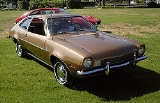
The Ford Pinto was a subcompact
Subcompact car

File:1973 Vega GT.jpgFile:Bluepinto.jpgA subcompact car is an automobile in a North American vehicle size class, encompassing vehicles smaller than compact cars....
 manufactured by the Ford Motor Company
Ford Motor Company

The Ford Motor Company is an United States multinational corporation and the world's List of automobile manufacturers#World Motor Vehicle Production by Manufacturer based on worldwide vehicle sales, following Toyota, General Motors, and Volkswagen Group....
 for the North America
North America

North America is the northern continent of the Americas, situated in the Earth's northern hemisphere and almost totally in the western hemisphere....
n market, first introduced on September 11, 1970, and built through the 1980 model year
Model year

The model year of a product is a number used in North America to describe approximately when a product was produced.The model year and the actual calendar year of production do not always coincide....
. The rebadged
Badge engineering

Badge engineering is a term that describes the badge of one product as another. Due to the high cost of designing and engineering a totally new model, or establishing a new brand , it is often more cost-effective to rebadge a single product multiple times....
 Lincoln-Mercury
Lincoln-Mercury

Lincoln-Mercury is a collective name for the Lincoln and Mercury divisions of the Ford Motor Company, whose vehicles are typically sold side-by-side in a single Car dealership....
 version, the Mercury Bobcat debuted in Canada
Canada

Canada is a country occupying most of northern North America, extending from the Atlantic Ocean in the east to the Pacific Ocean in the west and northward into the Arctic Ocean....
 in 1974, and subsequently in the U.S. in 1975.

The AMC Gremlin
AMC Gremlin

The AMC Gremlin is a subcompact car that was made by the American Motors Corporation for nine model years. During its manufacturing run from April 1970 through 1978, a total of 671,475 Gremlins were built in the United States and Canada....
 arrived on the market on April 1, 1970, six months before the Pinto. As with the Pinto, which derived heavily from the Ford Maverick
Ford Maverick (North America)

The Ford Maverick was compact car manufactured from April 1969-1977 in the USA, Canada, Mexico and from 1973 to 1979 in Brazil — employing a rear wheel drive automobile platform dating to the original 1960 Falcon....
, the Gremlin derived from the AMC Hornet
AMC Hornet

The AMC Hornet is a compact automobile made by the American Motors beginning with the 1970 model year and continuing through the 1977 model year....
.

A team of stylists at Ford was assigned to design the Pinto's exterior and interior.


Discussion
Ask a question about 'Ford Pinto'
Start a new discussion about 'Ford Pinto'
Answer questions from other users
Full Discussion Forum


Encyclopedia


The Ford Pinto was a subcompact
Subcompact car

File:1973 Vega GT.jpgFile:Bluepinto.jpgA subcompact car is an automobile in a North American vehicle size class, encompassing vehicles smaller than compact cars....
 manufactured by the Ford Motor Company
Ford Motor Company

The Ford Motor Company is an United States multinational corporation and the world's List of automobile manufacturers#World Motor Vehicle Production by Manufacturer based on worldwide vehicle sales, following Toyota, General Motors, and Volkswagen Group....
 for the North America
North America

North America is the northern continent of the Americas, situated in the Earth's northern hemisphere and almost totally in the western hemisphere....
n market, first introduced on September 11, 1970, and built through the 1980 model year
Model year

The model year of a product is a number used in North America to describe approximately when a product was produced.The model year and the actual calendar year of production do not always coincide....
. The rebadged
Badge engineering

Badge engineering is a term that describes the badge of one product as another. Due to the high cost of designing and engineering a totally new model, or establishing a new brand , it is often more cost-effective to rebadge a single product multiple times....
 Lincoln-Mercury
Lincoln-Mercury

Lincoln-Mercury is a collective name for the Lincoln and Mercury divisions of the Ford Motor Company, whose vehicles are typically sold side-by-side in a single Car dealership....
 version, the Mercury Bobcat debuted in Canada
Canada

Canada is a country occupying most of northern North America, extending from the Atlantic Ocean in the east to the Pacific Ocean in the west and northward into the Arctic Ocean....
 in 1974, and subsequently in the U.S. in 1975.

The AMC Gremlin
AMC Gremlin

The AMC Gremlin is a subcompact car that was made by the American Motors Corporation for nine model years. During its manufacturing run from April 1970 through 1978, a total of 671,475 Gremlins were built in the United States and Canada....
 arrived on the market on April 1, 1970, six months before the Pinto. As with the Pinto, which derived heavily from the Ford Maverick
Ford Maverick (North America)

The Ford Maverick was compact car manufactured from April 1969-1977 in the USA, Canada, Mexico and from 1973 to 1979 in Brazil — employing a rear wheel drive automobile platform dating to the original 1960 Falcon....
, the Gremlin derived from the AMC Hornet
AMC Hornet

The AMC Hornet is a compact automobile made by the American Motors beginning with the 1970 model year and continuing through the 1977 model year....
.

A team of stylists at Ford was assigned to design the Pinto's exterior and interior. However, Robert Eidschun's design of the exterior was eventually chosen, in its entirety. This was unusual, as most cars consist of several elements, each designed by a different stylist. The clay models of the Pinto were finalized in December 1968, which is when Eidschun left Ford to join Chrysler, where he went on to design elements of the successful Dodge Charger
Dodge Charger (B-body)

The Dodge Charger was a car model of car produced by Dodge. The 1966 to 1974 Chargers were sporty models based on the Chrysler B platform that could be ordered with high-performance options....
 and Plymouth Duster
Plymouth Duster

The first Plymouth Duster was a semi-fastback version of the Plymouth Valiant automobile, produced in the United States from 1970 to 1976....
.

While the previously introduced Ford Maverick offered either straight-6
Straight-6

The straight-6 or inline-6 engine is a six cylinder internal combustion engine with all six cylinder mounted in a straight line along the crankcase....
 or V8 engine
V8 engine

A V8 engine is a V engine with eight cylinder s mounted on the crankcase in two banks of four cylinders, in most cases set at a right angle to each other but sometimes at a narrower angle, with all eight pistons driving a common crankshaft....
 and twin bench seats, the Pinto offered a straight-4
Straight-4

The straight-4 or inline-4 engine is a four cylinder internal combustion engine with all four cylinder mounted in a straight line along the crankcase....
 engine and bucket seat
Bucket seat

A bucket seat is a seat contoured to hold one person, distinct from bench seats which are flat platforms designed to seat multiple people. Bucket seats are standard in fast cars to keep riders in place when making sharp or quick turns....
s — more in keeping with small imports such as the Volkswagen Beetle
Volkswagen Beetle

The Volkswagen Type 1 is an economy car produced by the Germany auto maker Volkswagen from 1938 until 2003. The car was originally known as K?fer, the German language word for "beetle," from which the popular English nickname originates....
 and Toyota Corolla
Toyota Corolla

The Corolla is a line of subcompact car/compact cars produced by the Japanese automaker Toyota, which has become very popular throughout the world since the nameplate was first introduced in 1966....
. Pintos were manufactured in St. Thomas, Ontario
St. Thomas, Ontario

St. Thomas is a city in southwestern Ontario, Canada. It is the seat for Elgin County, Ontario and gained its city charter on March 4, 1881....
; Edison, New Jersey
Edison, New Jersey

Edison Township is a Township in Middlesex County, New Jersey, United States. As of the United States 2000 Census, the township had a total population of 97,687, making it at the time the List of municipalities in New Jersey ....
; and in Richmond, California
Richmond, California

Richmond is a city in western Contra Costa County, California, California, United States. The city was incorporated on August 7, 1905., El Cerrito Historical Society, June 2007, retrieved August 15, 2007 It is located in the East Bay , part of the San Francisco Bay Area....
.

History

For many years, Ford sold many small models from its British line as captive imports, including the Ford Cortina
Ford Cortina

The Ford Cortina is a mid-sized family car built by Ford of Britain in various guises from 1962 to 1982.The Cortina was Ford's mass-market mid-sized car and sold in enormous numbers, making it common on British roads....
. The Pinto would be later complemented by the imported, but even smaller front wheel drive Ford Fiesta
Ford Fiesta

The Ford Fiesta is a small front wheel drive supermini car designed by the Ford Motor Company and built in Europe, Brazil, Argentina, Mexico, Venezuela, China, India and South Africa....
, and formally replaced by the more modern Escort
Ford Escort (North American)

The Ford Escort is a compact car that was manufactured by the Ford Motor Company. The North American Escort adopted both the badge and the general design of a redesigned European model, and the name has been applied to several different designs in North America since its introduction as Ford's first successful world car....
, patterned after the front wheel drive Volkswagen Rabbit, for the 1981 model year.

Compared with imports, seating was very low to the floor. Styling somewhat resembled the larger Ford Maverick
Ford Maverick (North America)

The Ford Maverick was compact car manufactured from April 1969-1977 in the USA, Canada, Mexico and from 1973 to 1979 in Brazil — employing a rear wheel drive automobile platform dating to the original 1960 Falcon....
 in grille and tail light themes, but had a smooth fastback profile. Body styles included a two-door coupé
Coupé

A coup? or coupe is a closed car body style, the precise definition of which varies from manufacturer to manufacturer, and over time. Coup?s are often hardtopped sports cars or sporty variants of sedan body styles, with doors commonly reduced from 4 to 2, and a Close-coupled sedan interior offering either two seats or 2+2 seating ....
 with a conventional trunk, a three-door hatchback
Hatchback

Hatchback is a term designating an automobile design, containing a passenger cabin with an integrated cargo space, accessed from behind the vehicle by a single, top-hinged tailgate or large flip-up window....
 called the Runabout, a two-door station wagon
Station wagon

A station wagon in American English, Australian English, Canadian English and New Zealand English usage and an estate car in British English usage, is a passenger automobile with a car body style similar to a sedan but with the roofline following the full, sometimes extended rear cargo area, i.e. ending with a more vertical door...
, and the Ford Pinto Cruising Wagon, produced from 1977 to 1980 and styled to resemble a small conversion van
Conversion van

A Conversion van Is a full-size cargo van that is sent to third-party companies to be outfitted with various luxuries for road trips and camping....
 (very much the trend in the late 1970s) complete with a round "bubble window" in the side panels. There was even a top of the line Pinto Squire, which had faux wood sides like the flagship Ford Country Squire
Ford Country Squire

The Ford Country Squire was a full-size station wagon built by the Ford Motor Company from 1950 until 1991; it was based on the Ford full-size car line available in each year....
. There were appearance packages, but never a factory performance package similar to the Cosworth Vega
Chevrolet Vega

File:71 Vega Panel Express.jpgThe Chevrolet Vega is a four passenger subcompact car that was introduced September 10, 1970 and produced for the 1971 through 1977 model years....
 or the 304 V8 Gremlin X.

The car's mechanical design was conventional, with unibody construction, a longitudinally-mounted engine in front driving the rear wheels through either a manual
Manual transmission

A manual transmission is a type of Transmission used in automotive applications. It generally utilizes a driver-operated clutch operated by a pedal or lever, for regulating torque transfer from the engine to the transmission, and a gear-shift either operated by hand or by foot ....
 or automatic transmission
Automatic transmission

An automatic transmission is an automobile gearbox that can change gear ratios automatically as the vehicle moves, freeing the driver from having to shift gears manual transmission....
 and live axle
Live axle

A live axle, sometimes called a solid axle, is a type of beam axle suspension that uses the driveshafts that transmit power to the wheels to connect the wheels laterally so that they move together as a unit....
 rear end. Suspension was by unequal length control arm
Control arm

In Suspension , a control arm is a nearly flat and roughly triangular member , that pivots in two places. The broad end of the triangle attaches at the frame and pivots on a bushing....
s with coil spring
Coil spring

A Coil spring, also known as a helical spring, is a mechanical device, which is typically used to store energy and subsequently release it, to absorb shock, or to maintain a force between contacting surfaces....
s at the front and the live axle rear was suspended on leaf spring
Leaf spring

Originally called laminated or carriage spring, a leaf spring is a simple form of spring , commonly used for the suspension in wheeled vehicles....
s. The rack and pinion
Rack and pinion

A rack and pinion is a pair of gears which convert rotational motion into linear motion. The circular pinion engages teeth on a flat bar - the rack....
 steering had optional power assist
Power steering

Power steering is a system for reducing the steering effort on vehicles by using an external power source to assist in turning the wheel.The earliest known patent related to power steering was filed on August 30, 1932, by Francis W....
, as did the brakes.

Road & Track
Road & Track

Road & Track is an automobile enthusiast magazine in the United States, founded by two friends in 1947. It is owned by Hachette Filipacchi M?dias and is published monthly....
 faulted the suspension and standard drum brake
Drum brake

A drum brake is a brake in which the friction is caused by a set of Brake shoe or Brake pad that press against the Brake lining of a rotating drum....
s, calling the latter a "serious deficiency". But they praised the proven 1.6 L Kent
Ford Kent engine

The Ford Kent is an internal combustion engine from Ford Motor Company. Originally developed in 1959 for the Ford Anglia, it is an straight-4 overhead valve type engine with a cast iron cylinder head and block....
 engine, adapted from European Fords. The much larger 2300
GM 2300 engine

The 2300 was a 2.3 L/140 cu in straight-4 automobile engine produced by General Motors Corporation from 1971 through 1977. The Chevrolet Vega engine, as it became known, was unusual for the time with an aluminum block and cast iron SOHC head....
 found in arch-rival Chevrolet Vega
Chevrolet Vega

File:71 Vega Panel Express.jpgThe Chevrolet Vega is a four passenger subcompact car that was introduced September 10, 1970 and produced for the 1971 through 1977 model years....
 was an innovative brand new design using an aluminum block and iron head. This engine needed more development work as initially released. Consumer Reports
Consumer Reports

Consumer Reports is an United States magazine published monthly by Consumers Union. It publishes reviews and comparisons of consumer products and services based on reporting and results from its in-house testing laboratory....
 rated the 1971 Pinto below the Vega but above the Gremlin.

Though the cars were thoroughly forgotten for some time, the Pinto seems to be enjoying success as an amateur-level vintage racing car, owing to its light weight, rear-wheel drive (RWD) layout, willing and durable Ford of Europe engines, and good car and parts availability.

Engines

Except for 1973 and 1980, the Pinto was available with two engines. The first was always the smallest and least powerful of the two and was the standard engine offered. The second was always a larger, more powerful engine available at an extra cost. For the first five years of production, only four cylinder inline engines were offered. As can be seen in the following breakout of available engines, Ford changed the power ratings almost every year.

Of particular note is the introduction in 1974 of the OHC
Ford Pinto engine

The Ford Pinto engine is the unofficial but generic nickname for a straight-4 internal combustion engine built by the Ford Europe. In Ford sales literature it was referred to as the EAO or OHC engine, it is also sometimes called the "Metric engine" since it was designed using the metric system....
 I4 engine. This engine would be updated and modified several times allowing it to remain in production into 1997. Among other Ford vehicles, a turbocharged version of this engine would later power the performance based Thunderbird Turbo Coupe
Ford Thunderbird

The Thunderbird, often abbreviated as T-Bird, was an automobile manufactured by the Ford Motor Company in the United States from 1955 through 2005 — through thirteen generations and various body types....
, Mustang SVO
Ford Mustang SVO

The Mustang SVO was a limited-production version of the Ford Mustang sold from 1984 to 1986, during which time it was the fastest, most expensive version of the Mustang available....
, and the European-built Merkur XR4Ti
Merkur XR4Ti

The Merkur XR4Ti was a short-lived United States and Canada-market version of the European Ford Sierra. It was the brainchild of then Ford Vice President Bob Lutz....
.

Initial Pinto deliveries in the early years used the English and German engines tuned for performance (see below). The 2,000 cc engine used a two barrel carburetor where just one bore was bigger than that used on the Maverick. With the low weight (not much above ) and the SOHC engine it rated a 10.8 second 0-60 time. With the advent of emission control requirements, Ford moved from the European sourced to domestically sourced engines, using new or modified designs. New safety legislation impacted bumpers and other parts adding to the weight of the car, reducing performance.

One major change to hit the industry in 1972 was in the method used to measure horsepower. Using a net figure based on engine power received at the rear wheels rather than the gross number generated untethered on a test stand, the rating of Pinto's engine dropped to for 1972, while the bigger four went from in 1971 to in '72.

1971
  • 1.6 L (98 CID) Kent
    Ford Kent engine

    The Ford Kent is an internal combustion engine from Ford Motor Company. Originally developed in 1959 for the Ford Anglia, it is an straight-4 overhead valve type engine with a cast iron cylinder head and block....
     OHV
    Overhead valve

    An overhead valve engine, also called pushrod engine or I-head engine is a type of piston engine that places the camshaft in the cylinder block and uses pushrods or rods to actuate rocker arm above the cylinder head to actuate the poppet valve....
     I4 - and
  • 2.0 L (122 CID) EAO
    Ford Pinto engine

    The Ford Pinto engine is the unofficial but generic nickname for a straight-4 internal combustion engine built by the Ford Europe. In Ford sales literature it was referred to as the EAO or OHC engine, it is also sometimes called the "Metric engine" since it was designed using the metric system....
     SOHC I4 -
1972
  • 1.6 L Kent -
  • 2.0 L EAO -
1973
  • 2.0 L EAO -
1974
  • 2.0 L EAO -
  • 2.3 L (140 CID) OHC -
1975
  • 2.3 L OHC -
  • 2.8 L (170 CID) Cologne
    Ford Cologne V6 engine

    The original Ford Cologne V6, also known as the Ford Taunus V6, 640L, was a 60? cast iron block V6 internal combustion engine built by the Ford Motor Company in Cologne, Germany, hence the name....
     V6 -
1976
  • 2.3 L OHC - and
  • 2.8 L Cologne - and
1977
  • 2.3 L OHC - and
  • 2.8 L Cologne - and
1978
  • 2.3 L OHC - and
  • 2.8 L Cologne - and
1979
  • 2.3 L OHC - and
  • 2.8 L Cologne - and
1980
  • 2.3 L OHC - and


Safety problems and scandal

Through early production of the model, it became a focus of a major scandal
Scandal

A scandal is a widely publicized incident that involves allegations of Malfeasance in office, disgrace, or Morality outrage. A scandal may be based on reality, the product of false allegations, or a mixture of both....
 when it was alleged that the car's design allowed its fuel tank to be easily damaged in the event of a rear-end collision
Rear-end collision

A rear-end collision is a traffic accident wherein a vehicle crashes into the vehicle in front of it, so called because it hits its rear. It may also be a classification of railway accidents wherein a train runs into the rear of a preceding train....
 which sometimes resulted in deadly fires and explosions. Critics argued that the vehicle's lack of a true rear bumper as well as any reinforcing structure between the rear panel and the tank, meant that in certain collisions, the tank would be thrust forward into the differential
Differential (mechanics)

A differential is a device, usually but not necessarily employing gears, capable of transmitting torque and rotation through three shafts, almost always used in one of two ways....
, which had a number of protruding bolts that could puncture the tank. This, and the fact that the doors could potentially jam during an accident (due to poor reinforcing) made the car a potential deathtrap.

Ford was aware of this design flaw but allegedly refused to pay what was characterized as the minimal expense of a redesign. Instead, it was argued, Ford decided it would be cheaper to pay off possible lawsuits for resulting deaths. Mother Jones magazine obtained the cost-benefit analysis
Cost-benefit analysis

Cost-benefit analysis is a term that refers both to:* a formal discipline used to help appraise, or assess, the case for a project or proposal, which itself is a process known as project appraisal; and...
 that it said Ford had used to compare the cost of an $11 ($ today, allowing for inflation) repair against the cost of paying off potential law suits, in what became known as the Ford Pinto memo. The characterization of Ford's design decision as gross disregard for human lives in favor of profits led to significant lawsuits. While Ford was acquitted of criminal charges, it lost several million dollars and gained a reputation for manufacturing "the barbecue that seats four." Nevertheless, as a result of this identified problem, Ford initiated a callback which provided a dealer installable "safety kit" that installed some plastic protective material over the offending sharp objects, negating the risk of tank puncture."

The most famous Ford Pinto product liability
Product liability

Product liability is the area of law in which manufacturers, distributors, suppliers, retailers, and others who make products available to the public are held responsible for the injuries those products cause....
 case resulted in a judicial opinion
Opinion

An opinion is a belief that may or may not be backed up with evidence, but which cannot be proved with that evidence. An opinion is normally a subjective statement and may be the result of an emotion or an interpretation of facts; people may draw opposing opinions from the same facts....
 that is a staple of remedies courses in American law school
Law school

A law school is an institution specializing in legal education....
s. In 1981 in Grimshaw v. Ford Motor Co., the California Court of Appeal for the Fourth Appellate District reviewed Ford's conduct, and upheld compensatory damages
Damages

In law, damages refer to the money paid or awarded to a claimant , pursuer or plaintiff following a successful claim in a lawsuit....
 of $2.5 million ($ today) and punitive damages
Punitive damages

Punitive damages are damages not awarded in order to compensate the plaintiff, but in order to reform or deter the defendant and similar persons from pursuing a course of action such as that which damaged the plaintiff....
 of $3.5 million ($ today) against Ford. It also upheld the judge's reduction of the punitive damages from the jury's original verdict of $125 million ($ today). Of the two plaintiffs, one was killed in the collision that caused her Pinto to explode, and her passenger, 13-year old Richard Grimshaw, was badly burned and scarred for life.

However, a 1991 law review paper by Gary Schwartz argued that the case against the Pinto was less clear-cut than commonly supposed. Twenty-seven people died in Pinto fires. Given the Pinto's production figures (over 2 million built), this was no worse than typical for the time. Schwartz argued that the car was no more fire-prone than other cars of the time, that its fatality rates were lower than comparably sized imported automobiles, and that the supposed "smoking gun" document that plaintiffs claimed showed Ford's callousness in designing the Pinto was actually a document based on National Highway Traffic Safety Administration
National Highway Traffic Safety Administration

The National Highway Traffic Safety Administration is an agency of the Executive Branch of the United States Government, part of the United States Department of Transportation....
 regulations about the value of a human life rather than a document containing an assessment of Ford's potential tort liability.

Due to the alleged engineering, safety, and reliability problems, Time magazine
Time (magazine)

Time is a weekly United States newsmagazine, similar to Newsweek and U.S. News & World Report. A European edition is published from London....
 included the Pinto on its list of the fifty worst cars of all time.

Pinto Pangra

Pinto Pangra
The Pinto Pangra is a modified sporting Pinto produced in limited numbers by a Ford dealer, FOULGER Ford in Arcadia, California
Arcadia, California

Arcadia is a United States city in Los Angeles County, California that is located about northeast of downtown Los Angeles in the San Gabriel Valley, at the base of the San Gabriel Mountains....
. Approximately 55 were sold during 1973 and (to a limited degree) 1974, and in addition the components were sold in kit form. A Pangra cost approximately $5,000 ($ today).

The most visible modification was a slanted fiberglass nose with pop-up headlights. Internally, the stock 2 liter engine was fitted with an AK Miller turbocharger; a "Can-Am" suspension package with Koni dampers lowered the car and improved the handling; aluminum wheels with wider tires were fitted, as were Recaro seats, a revised dash with a new center console, full instrumentation, and a digital tachometer.

See also

  • Ford Pinto engine
    Ford Pinto engine

    The Ford Pinto engine is the unofficial but generic nickname for a straight-4 internal combustion engine built by the Ford Europe. In Ford sales literature it was referred to as the EAO or OHC engine, it is also sometimes called the "Metric engine" since it was designed using the metric system....
     - Used in many other cars as well
  • AVE Mizar
    AVE Mizar

    The Advanced Vehicle Engineers Mizar was a flying car built between 1971 in aviation and 1973 in aviation by Advanced Vehicle Engineers of Oxnard, California, California....
     - A flying Pinto


External links

  • - year by year specifications and magazine articles.
  • includes full 1973 brochure in JPG format