
All Topics  
Chevrolet Chevelle

 
Chevrolet Chevelle

   Email Print
   Bookmark   Link


Chevrolet Chevelle


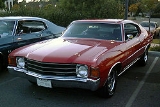
The Chevrolet Chevelle (pronounced "shev-el") is a mid-sized automobile
Automobile

An automobile or motor car is a wheeled motor vehicle for transportation passengers, which also carries its own car engine or motor. Most definitions of the term specify that automobiles are designed to run primarily on roads, to have seating for one to eight people, to typically have four wheels, and to be constructed principally f...
 from Chevrolet
Chevrolet

Chevrolet is a brand of automobile, produced by General Motors . It is the top selling GM marque, with "Chevrolet" or "Chevy" being at times synonymous with GM....
 debuting in 1964. It was produced from 1964 through 1977 and was one of General Motors
General Motors

General Motors Corporation , founded in 1908, is the world's second-largest automaker after Toyota, ranked by 2008 global unit sales. GM was the global sales leader for 77 consecutive calendar years from 1931 to 2008....
' most successful cars. Chevelle models ranged from economical family cars to powerful coupe
Coupé

A coup? or coupe is a closed car body style, the precise definition of which varies from manufacturer to manufacturer, and over time. Coup?s are often hardtopped sports cars or sporty variants of sedan body styles, with doors commonly reduced from 4 to 2, and a Close-coupled sedan interior offering either two seats or 2+2 seating ....
s and convertible
Convertible

A convertible is a type of automobile in which the roof can retract and fold away, converting it from an enclosed to an open-air vehicle. Many different car body styles are manufactured and marketed in convertible form....
s. The Malibu
Chevrolet Malibu

The Chevrolet Malibu is a mid-size car produced in the United States by General Motors. It is marketed in the United States, Canada, Mexico and Middle East....
, at first the top trim level in the Chevelle line, replaced the Chevelle name entirely after 1977. The Chevelle chassis (based on the reengineered GM A platform
GM A platform

The General Motors Corporation A platform was a mid-size car automobile platform. The A-bodies evolved from rear wheel drive compact cars to front wheel drive mid-size cars over the course of 32 years....
) provided the platform for the Chevrolet Monte Carlo
Chevrolet Monte Carlo

The Chevrolet Monte Carlo was an American-made automobile. Originally introduced by Chevrolet for the 1970 model year , it has gone through six generations as of 2007....
, a very successful model itself.

The Chevelle was intended to compete with the similarly sized Ford Fairlane, and to return to the Chevrolet lineup a model similar in size and concept to the popular 1955-57 models.


Discussion
Ask a question about 'Chevrolet Chevelle'
Start a new discussion about 'Chevrolet Chevelle'
Answer questions from other users
Full Discussion Forum


Encyclopedia


The Chevrolet Chevelle (pronounced "shev-el") is a mid-sized automobile
Automobile

An automobile or motor car is a wheeled motor vehicle for transportation passengers, which also carries its own car engine or motor. Most definitions of the term specify that automobiles are designed to run primarily on roads, to have seating for one to eight people, to typically have four wheels, and to be constructed principally f...
 from Chevrolet
Chevrolet

Chevrolet is a brand of automobile, produced by General Motors . It is the top selling GM marque, with "Chevrolet" or "Chevy" being at times synonymous with GM....
 debuting in 1964. It was produced from 1964 through 1977 and was one of General Motors
General Motors

General Motors Corporation , founded in 1908, is the world's second-largest automaker after Toyota, ranked by 2008 global unit sales. GM was the global sales leader for 77 consecutive calendar years from 1931 to 2008....
' most successful cars. Chevelle models ranged from economical family cars to powerful coupe
Coupé

A coup? or coupe is a closed car body style, the precise definition of which varies from manufacturer to manufacturer, and over time. Coup?s are often hardtopped sports cars or sporty variants of sedan body styles, with doors commonly reduced from 4 to 2, and a Close-coupled sedan interior offering either two seats or 2+2 seating ....
s and convertible
Convertible

A convertible is a type of automobile in which the roof can retract and fold away, converting it from an enclosed to an open-air vehicle. Many different car body styles are manufactured and marketed in convertible form....
s. The Malibu
Chevrolet Malibu

The Chevrolet Malibu is a mid-size car produced in the United States by General Motors. It is marketed in the United States, Canada, Mexico and Middle East....
, at first the top trim level in the Chevelle line, replaced the Chevelle name entirely after 1977. The Chevelle chassis (based on the reengineered GM A platform
GM A platform

The General Motors Corporation A platform was a mid-size car automobile platform. The A-bodies evolved from rear wheel drive compact cars to front wheel drive mid-size cars over the course of 32 years....
) provided the platform for the Chevrolet Monte Carlo
Chevrolet Monte Carlo

The Chevrolet Monte Carlo was an American-made automobile. Originally introduced by Chevrolet for the 1970 model year , it has gone through six generations as of 2007....
, a very successful model itself.

The Chevelle was intended to compete with the similarly sized Ford Fairlane, and to return to the Chevrolet lineup a model similar in size and concept to the popular 1955-57 models. Early design photos show what would eventually be the Chevelle wearing Nova
Chevrolet Nova

The Chevrolet Nova is an automobile produced in the United States from 1962 to 1979 by the Chevrolet division of General Motors and from 1985 to 1988 by the NUMMI, a joint venture between General Motors and Toyota....
 nameplates, the name then being used for the top trim level in the smaller Chevy II series. The Chevelle was the basis for the Beaumont
Beaumont (automobile)

Beaumont was a make of mid-size automobile produced by General Motors of Canada from 1966 to 1969....
, a re-trimmed model sold only in Canada
Canada

Canada is a country occupying most of northern North America, extending from the Atlantic Ocean in the east to the Pacific Ocean in the west and northward into the Arctic Ocean....
 by Pontiac
Pontiac

Pontiac is a brand of automobiles, produced by General Motors Corporation that has been sold in the United States, Canada and Mexico since 1926....
 dealers.

Four-door hardtop sedans, dubbed Sport Sedans, were available from 1966 though 1972. A two-door station wagon
Station wagon

A station wagon in American English, Australian English, Canadian English and New Zealand English usage and an estate car in British English usage, is a passenger automobile with a car body style similar to a sedan but with the roofline following the full, sometimes extended rear cargo area, i.e. ending with a more vertical door...
 was available in 1964 and 1965 in the bottom-line Chevelle 300 series. Two-door hardtop
Hardtop

A hardtop is a term for a rigid, rather than canvas, automobile roof. It has been used in several contexts: detachable hardtops, retractable hardtop roofs, and the so-called pillarless hardtop body style....
 coupe
Coupé

A coup? or coupe is a closed car body style, the precise definition of which varies from manufacturer to manufacturer, and over time. Coup?s are often hardtopped sports cars or sporty variants of sedan body styles, with doors commonly reduced from 4 to 2, and a Close-coupled sedan interior offering either two seats or 2+2 seating ....
s and convertible
Convertible

A convertible is a type of automobile in which the roof can retract and fold away, converting it from an enclosed to an open-air vehicle. Many different car body styles are manufactured and marketed in convertible form....
s were produced from 1964 to 1972, while four-door sedans and four-door wagons were offered throughout the entire run. Various models of wagons were sold with exclusive nameplates: Nomad
Chevrolet Nomad

The Chevrolet Nomad was a station wagon model produced by the Chevrolet Division of General Motors. The Nomad is best remembered in its two-door 1955-57 form, and was considered a halo vehicle during its three-year production as a two-door station wagon....
, Nomad Custom (1968), Greenbrier, Concours, and Concours Estate. In line with other Chevrolet series, the two-door hardtops were called Sport Coupes.

A utility pickup, the El Camino
Chevrolet El Camino

The Chevrolet El Camino was a coupe utility vehicle / muscle car built by Chevrolet in the United States from 1959 to 1960, with production resuming in 1964 and continuing through 1987....
, was part of the lineup and, depending on the year, was available in 300/300 Deluxe trim level, Malibu trim level and the one-year only SS396. The El Camino outlived its passenger car counterpart until its demise in 1987.

Chevelle SS

The Chevelle SS
Super Sport

Super Sport, or SS, is an option package offered by Chevrolet on many of its vehicle lines since 1961. Some of the better-known models to bear the SS badge include the Chevrolet Camaro, Chevrolet Chevelle, Chevrolet El Camino, Chevrolet Impala, and Chevrolet Nova....
 represented Chevrolet's entry into the muscle car
Muscle car

Muscle car is a term used to refer to a variety of high performance automobiles. At its most widely accepted the term refers to American 2-door rear wheel drive mid-size cars of the late 1960s and early 1970s equipped with large, powerful V8 engines and sold at an affordable price for street use and automobile racing, formally and informal...
 battle. Early 1964 and 1965 Chevelles had a Malibu SS badge on the rear quarter panel (the sought-after Z16 option had the emblem on the front fender, where 201 Malibu SS396s were produced); after 1965, the Malibu SS badging disappeared except for those sold in Canada. The Chevelle SS, which became a regular series of its own in 1966 called the SS396, was the high performance version and had its own line of engines and performance equipment. The performance engines available included 396 CID
Cubic inch

A cubic inch is a non-International System of Units Units of measurement of volume, equal to the volume of a cube with sides of one inch.Cubic inches are still sometimes used as a unit of measurement in the United States and Canada, although SI is continuing to gradually displace non-SI usage....
 V8s - rated at 325, 350 and respectively (the mid horsepower 396 was rated at for 1966 only and thereafter). The SS396 series only lasted three years from 1966 through 1968 before being relegated to an option status just like air conditioning or a radio. The 1966 and 1967 model years also saw the limited run of the 'strut back' 2-dr sport coupe with its own model number, 17, as opposed to model number 37 used on previous and later 2-dr sport coupes. The 1968 model year was the first and only year of the SS396 El Camino with its own series/model identification of 13880. Almost all the goodies (big block engine, suspension, transmission options, etc.) of the SS396 could be ordered on the 1966 and 1967 El Camino but, sadly, the SS396 series El Camino was not available until (and only in) the 1968 model year. As with the 300 Deluxe and Malibu in 1969 and only the Malibu from 1970 to 1972, the SS option could be ordered in the El Camino as well.

Two prototype Z16 Chevelles were built at the Baltimore plant and all regular production Z16 Chevelles were built at the Kansas City plant. Whether these 2 prototypes and the 1 reported convertible are included in this 201 figure isn't known. The 1 convertible was reportedly special built for Chevy General Manager Semon "Bunkie" Knudsen but is commonly called the 201st Z16 Chevelle. The original Z16 convertible has yet to surface and it is suspected the car has long since been destroyed.

The Z-16 option included a convertible boxed frame (even on the hardtop Sport Coupe), a shortened rear axle and brake assembly from the contemporary Impala, heavy-duty suspension, plus virtually all Chevelle comfort and convenience options. The Z-16 standard big-block 396 Turbo-Jet V8 came only with the Muncie close-ratio four-speed manual transmission. The rear of the Z-16 had a unique black and chrome trim panel which framed untrimmed Chevelle 300-style taillights (Malibu and Malibu SS models had bright metal trim attached to the lenses).

For Chevelle enthusiasts who wanted a high-performance mid-sized car but with a hot small-block V8, all Chevelle models (not including the Z16 of course) in 1965 were available with a 350-horsepower 327 cubic-inch V8 (option code L79) in 1965. That same engine was also offered in downrated form at , in all 1967 and 1968 models not including of course the SS396 which was tied solely to the 396 engines.

For the 1969 model year, the SS396 series (138xx) was dropped and the Super Sport became a performance option. In 1969 the SS option could be ordered on the 300 Deluxe 2-dr Sport Coupe (13437) and 2-dr sedan (13427) as well as the Malibu 2-dr Sport Coupe (13637), convertible (13667), and El Camino (13680). In 1970 the SS option was limited to the Malibu series (2-dr Sport Coupe, convertible, and El Camino). In both 1969 and 1970 the SS option included the 396/402 as the base engine keeping the option alive as a performance-oriented choice. This changed in 1971 when the SS option could be ordered with any optional V8 and became more of a dress-up option than a performance option.

Prior to 1970, GM had a restriction stating that no mid-size car
Mid-size car

A mid-size car is the North American and Australian term for an automobile with a size between that of a Compact car and a full-size car. In Europe, cars of a similar size are often referred to as large family cars, or executive cars....
 could have an engine with a displacement over 400 CID, though some inventive people figured out ways around this through the dealership; 1968 and 1969 were the times of the COPO (Central Office Production Order), in which a car was ordered by the dealer with a larger than allowed engine in it for racing purposes.

In 1970 GM dropped the displacement rule, and that was when the bigger engines were available as regular production options, resulting the addition of an SS454 line option to the existing SS396 option. The first change was that the 396 engine was bored out to 402 CID , but the car kept the 396 badging as so much advertising had been put into the 396 namesake that they didn't want to change it. Most notable was the 454 CID LS5 V8
V8 engine

A V8 engine is a V engine with eight cylinder s mounted on the crankcase in two banks of four cylinders, in most cases set at a right angle to each other but sometimes at a narrower angle, with all eight pistons driving a common crankshaft....
 rated at and the LS6 at . It was the 454 that made the Chevelle a legend. The LS6, with and of torque, would rocket the Chevelle through the 1/4 mile in low to mid-13 second times at 105 to . In fact, the stock LS6 at produced more power than any other stock production engine offered by any manufacturer during the golden age of muscle cars (which most people consider to be from 1965 to 1972).

Typical 1970 Fisher Body plate breakdown

Do not confuse the Fisher Body Number plate information with that found on the Vehicle Identification Number (VIN) plate. The series depiction on the Fisher Body Number plate does NOT have the meaning as the VIN plate.

Some assembly plants have more information on their plates than others and some have information on different lines. Please check the individual assembly plants for specifics.

Line 1: Production date of vehicle. A typical production date is 06C

This production date of 06C decodes to June (06) in the third week (C). Unfortunately, nobody can define what dates are associated with a week letter.

01 - January 07 - July 02 - February 08 - August 03 - March 09 - September 04 - April 10 - October 05 - May 11 - November 06 - June 12 - December

A - First Week B - Second Week C - Third Week D - Fourth Week E - Fifth Week

Line 2: The first two-digit number on line two is the year of production followed by division/series/body style, assembly plant, and the Fisher Body unit number used for production purposes.

SERIES/MODEL IDENTIFICATION (for trim level purposes only, not for engine type identification)

NOMAD SERIES 131-13236 STATION WAGON MODEL 131-13236 ~ NOMAD 4-DOOR STATION WAGON*

CHEVELLE STANDARD SERIES 133-13400 MODEL 133-13437 ~ 2-DOOR SPORT COUPE, 5-PASSENGER MODEL 133-13469 ~ 4-DOOR SEDAN, 6-PASSENGER MODEL 133-13480 ~ 2-DOOR SEDAN PICKUP, 5-PASSENGER

GREENBRIER SERIES 133-13400 STATION WAGON MODEL 133-13436 ~ GREENBRIER 4-DOOR STATION WAGON, 2-SEAT* MODEL 13446 ~ GREENBRIER 4-DOOR STATION WAGON, 3-SEAT

MALIBU SERIES 135-13600 MODEL 135-13637 ~ 2-DOOR SPORT COUPE, 5-PASSENGER MODEL 135-13639 ~ 4-DOOR SPORT SEDAN, 6-PASSENGER MODEL 135-13667 ~ 2-DOOR CONVERTIBLE, 5-PASSENGER MODEL 135-13669 ~ 4-DOOR SEDAN, 6-PASSENGER MODEL 135-13680 ~ 2-DOOR SEDAN PICKUP, 5-PASSENGER

CONCOURS SERIES 135-136-13800 STATION WAGON MODEL 135-13636 ~ CONCOURS 4-DOOR STATION WAGON, 2-SEAT MODEL 13646 ~ CONCOURS 4-DOOR STATION WAGON, 3-SEAT MODEL 13836 ~ CONCOURS ESTATE 4-DOOR STATION WAGON, 2-SEAT MODEL 13846 ~ CONCOURS ESTATE 4-DOOR STATION WAGON, 3-SEAT

MONTE CARLO SERIES 13857** MODEL 13857 ~ MONTE CARLO, 2-DOOR SPORT COUPE, 5-PASSENGER

  • Conventional tailgate; dual action tailgate standard for all other Chevelle Station Wagons.
    • The Monte Carlo was introduced in 1970 and was only available in one series. Many do not consider the Monte Carlo when talking about Chevelles but carries the Chevelle 13xxx series and was built along side the Chevelle using the same vehicle sequencing numbers.


Line 3: Interior trim and lower/upper paint codes.

For 1971, GM mandated that all divisions design their engines to run on lower-octane regular, low-lead or unleaded gasoline due to tightening emission requirements and in anticipation of the catalytic converter that would be used on 1975 and later models, necessitating the use of unleaded fuel. To permit usage of the lower-octane fuels, all engines featured low compression ratios (9 to 1 and lower; well below the 10.25-11.25 to 1 range on high performance engines of 1970 and earlier). This move reduced horsepower ratings on the big-block engines to 300 for the 402 cubic-inch V8 but surprisingly, the LS-5 454 option got an "advertised" five-horsepower increase to 365. The LS-6 454 option, which was originally announced as a regular production option on the Chevelle SS for 1971, was dropped early in the model year and no official records indicate that any 1971 Chevelles were assembled with the LS-6 engine.

In the face of declining musclecar sales following the "insurance surcharge" wrath of 1970, the Chevelle SS - at least in base form - changed from a specific performance car to a trim package, much like the original Chevelle SS models that pre-dated the introduction of the SS396 in 1966. For 1971, the base Chevelle SS engine was a two-barrel 350 cubic-inch V8 rated at 245 gross (165 net) horsepower and optionally available was a four-barrel carbureted version of the 350 V8 rated at 275 gross (200 net) horsepower. The big block engines
Internal combustion engine

The internal combustion engine is an engine in which the combustion of a fuel occurs in a combustion chamber inside and integral to the engine. In an internal combustion engine it is always the expansion of the high temperature and pressure gases that are produced by the combustion which apply force to the movable component of the engine, such as...
 of previous years were now extra-cost options including the 402 V8 rated at 300 gross/270 net horsepower; and LS-5 454 V8 with 365 gross and 285 net horsepower. Chevrolet specifications for 1971 included both "gross" and "net" horsepower figures for all engines to ease the transition to 1972 and later years, when Chevy and other manufacturers only listed the "net" horsepower ratings.

The 1972 Chevelle SS had a top engine rated at 270 net hp (201 kW) conforming with GM's decree that all engines were to be rated at their net engine ratings. Despite the lower rating there was no evidence that power had actually changed on production cars of that year. All other engines on the SS roster were unchanged from 1971.

In mid-1971 and continued through 1972, the base Chevelle Sport Coupe was offered as the "Heavy Chevy" model featuring special striping and other appearance items. The "Heavy Chevy" was available with any V8 engine offered in the Chevelle roster ranging from the 307 two-barrel to the 402 four-barrel. However, the 454 big-block was only offered with the "SS" package and not available with the "Heavy Chevy" option.

Many customers, however, chose the Chevelle as an economical family car that, while not as expensive to operate as larger models (including the Chevrolet Impala
Chevrolet Impala

The Chevrolet Impala is a Full-size car automobile built by General Motors for their Chevrolet division. Ed Cole, Chevrolet's chief engineer in the late 1950s, defined the Impala as a "prestige car within the reach of the average American citizen."...
), had enough room to seat a family of five in reasonable comfort. Popular convenience items ranged from power steering
Power steering

Power steering is a system for reducing the steering effort on vehicles by using an external power source to assist in turning the wheel.The earliest known patent related to power steering was filed on August 30, 1932, by Francis W....
, power brake
Brake

A brake is a device for applying a force against the friction of the road, slowing or stopping the motion of a machine or vehicle, or alternatively a device to restrain it from starting to move again....
s, automatic transmission
Automatic transmission

An automatic transmission is an automobile gearbox that can change gear ratios automatically as the vehicle moves, freeing the driver from having to shift gears manual transmission....
, air conditioning
Air conditioning

An air conditioner is an appliance, system, or Mechanism designed to extract heat from an area via a refrigeration cycle. In construction, a complete system of heating, Ventilation , and air conditioning is referred to as "HVAC." Its purpose, in a building or an automobile, is to provide comfort during either hot or cold...
 and stereo
Stereophonic sound

Stereophonic sound, commonly called stereo, is the reproduction of sound, using two or more independent Sound recording and reproduction channels, through a symmetrical configuration of loudspeakers, in such a way as to create a pleasant and natural impression of sound heard from various directions, as in natural hearing....
 radio; plus appearance items including vinyl top, full wheel covers and whitewall tires.

The Yenko Chevelles

Retired race car driver Don Yenko, (at the time making a living as a Chevrolet dealer), developed his own line of signature Chevelles, along with his own models of Camaro
Chevrolet Camaro

The Chevrolet Camaro is a pony car manufactured by the Chevrolet division of General Motors. It went on sale on September 29, 1966 for the 1967 model year and was designed as a competing model to the Ford Mustang....
s and Nova
Chevrolet Nova

The Chevrolet Nova is an automobile produced in the United States from 1962 to 1979 by the Chevrolet division of General Motors and from 1985 to 1988 by the NUMMI, a joint venture between General Motors and Toyota....
s, which became the Yenko Super Cars. At the time, the largest engine being installed in Chevelle SS's was the 396 cid V8. Yenko decided to equip his acquired models with the Chevrolet 427 cid V8. While being an extremely limited edition of Chevelles, they nonetheless proved very popular among Chevy lovers across the country. Today at auction, the Yenko Super Cars can bring as much as $2.2 million.

1973-1977


The Chevelle underwent a redesign for the 1973 model year. The so-called "colonnade hardtop" styling featured frameless door glass and fixed "B" pillars. Rear windows on coupes no longer could be opened, no doubt encouragement from GM to purchase the increasingly popular optional air conditioning. Front suspension was based on the Camaro/Firebird which greatly enhanced handling. Engine choices ranged from the 250 I6 to the venerable 454 V8. Hardened engine valve seats and hydraulic camshafts made these engines reliable for many miles, and allowed them to accept the increasingly popular unleaded regular gasoline. Crossflow radiators and coolant reservoirs that prevented air from entering the system prevented overheating. Swivel bucket seats and center console for automatic and manual shift cars were offered in every model as was the instrument gauge cluster. Power front disc and rear drum brakes were standard. Power accessories, air conditioning and AM/FM tape stereo were more prevalent these years and provided a pleasing drive. A power moonroof was an option in 73-75.

The station wagon, available in 6 or 9 passenger seating, featured a rear hatchback door which allowed for easier entry and loading. The Chevrolet El Camino and GMC Sprint were based on the Chevelle. Yearly design changes to the front and rear mark the aesthetic differences as in previous years. The Chevelles were top sellers for GM as was the Oldsmobile Cutlass, which used the same corporate A-body platform.

1973 model offerings started with the top luxury Laguna series with its distinct urethane nose, followed by Malibu and then Deluxe models. An SS package was available for Malibu coupes and for the only time, station wagons. The SS option included a black front grille, SS badging on the interior and exterior, body side striping, rally wheels with white letter tires, F41 sport suspension with front and rear sway bars, and a 350 or 454 V8. A 4 speed Muncie transmission was available with 350 or 454 equipped cars on any model.

For 1974 the Laguna S3 coupe replaced the "SS" as the sporty/performance option on the Chevelle. The nomenclature S3 referred to sport and 3rd generation Chevelle. It sported a special urethane nose, body side striping, Laguna S3 badging, rally wheels, 4 spoke steering wheel and F41 sport suspension with front and rear sway bars. Radial tires on 15" wheels and radial tuned suspension provided road grip and retractable 3 point seat belts were introduced and still used in new cars today. A 400 engine was new this year. The 454 was the top engine and available with the Turbo Hydra-Matic automatic
Automatic transmission

An automatic transmission is an automobile gearbox that can change gear ratios automatically as the vehicle moves, freeing the driver from having to shift gears manual transmission....
 400 or Muncie 4 speed manual transmission
Manual transmission

A manual transmission is a type of Transmission used in automotive applications. It generally utilizes a driver-operated clutch operated by a pedal or lever, for regulating torque transfer from the engine to the transmission, and a gear-shift either operated by hand or by foot ....
s.

With the Laguna nameplate now bearing the sporty model in the Chevelle line, the top-line series for 1974 became the Malibu Classic, offered in sedan, coupe and station wagon models. Unlike the '73 Laguna, the Malibu Classic used the same grillework as lesser Chevelle models but added a spring-loaded hood ornament. Inside, Malibu Classic featured luxurious interiors with notchback bench seats (or optional Strato bucket seats) upholstered in cloth or vinyl, carpeted door panels and woodgrain instrument panel trim, and vertical opera windows on coupes or exterior wood trim on station wagons. Also for 1974, the base Chevelle Deluxe series was dropped, leaving the plain Malibu as the low-end series.

The 1975 Laguna S-3 debuted as a 1/2 year model in February and sported a new sloped front nose designed for Nascar. H.E.I. or High Energy Ignition provided spark to the spark plugs with minimal maintenance and increased power. The larger distributor cap also provided better high RPM performance by decreasing the likelihood of the spark conducting to the wrong terminal. The 454 and Turbo Hydra-Matic 400 transmission was available for the first half of the model year and then the 400 was the top engine choice.

For 1976, Chevelle was available with the new 5.0 liter 305 V8 the 350 and the 400.

1977 offered the Malibu Classic as the top model and the 350 was the top engine. A Chevelle S.E. or special edition was available and provided front and rear spoilers, rally wheels, special graphics and sport suspension. Only 50 or so were built.

NASCAR The 73-77 Chevelle was the top car in the Nascar circuit in the 1970s. The car was so popular and successful on the track that Chevrolet developed a new front nose in 1975 that lead to the aerodynamic cars of today. The car dominated the field so much that Nascar imposed a carburetor restrictor plate for all Lagunas. Drivers that raced 73-77 Chevelles include: Darrell Waltrip, Junior Johnson, Benny Parsons, Cale Yarborough, Bobby and Donnie Allison, Bobby Isaac, Lennie Pond, A.J. Foyt, Ricky Rudd, Dale Earnhardt and female racer Janet Guthrie.

When GM downsized its intermediate models for 1978, the Chevelle name was dropped and all models took the Chevrolet Malibu
Chevrolet Malibu

The Chevrolet Malibu is a mid-size car produced in the United States by General Motors. It is marketed in the United States, Canada, Mexico and Middle East....
 name.

External links

  • - ChevelleStuff.com
  • - MuscleCarClub.com
  • - MuscleCarDrive.com
  • - 1964-1972 Chevelle Parts from Ground Up