


Subaru

Encyclopedia
subaɽu; ˈsuːbəruː is the automobile manufacturing division
of Japanese transportation conglomerate
Fuji Heavy Industries
(FHI).
Subaru is internationally known for their use of the boxer engine
layout popularized in cars by the Volkswagen Beetle
and Porsche 911
, in most of their vehicles above 1500 cc as well as their use of the all wheel drive
drivetrain layout, first introduced in 1972, that became standard equipment for mid-size and smaller cars in most international markets as of 1996, and is now standard in all Subaru vehicles. They also offer many turbocharged versions of their passenger cars, such as the sporty Impreza WRX.
Fuji Heavy Industries
, the parent company of Subaru, is currently in a partial partnership with Toyota Motor Corporation, which owns 16.5% of FHI.
Subaru is the Japanese name for the Pleiades
star cluster, which in turn inspires the Subaru logo and alludes to the six companies that merged to create FHI.
, Ltd and soon became the primary manufacturer of aircraft
for Japan during World War II. At the end of the Second World War Nakajima Aircraft was again reorganized, this time as Fuji Sangyo Co, Ltd. In 1946, the company created the Fuji Rabbit
motor scooter with spare aircraft parts from the war. In 1950, Fuji Sangyo was divided into 12 smaller corporations according to the Japanese Government's 1950 Corporate Credit Rearrangement Act, anti-zaibatsu
legislation, but between 1953 and 1955, four of these corporations and a newly formed corporation Fuji Kogyo, a scooter manufacturer; coachbuilders
Fuji Jidosha; engine manufacturers Omiya Fuji Kogyo; chassis
builders Utsunomiya Sharyo and the Tokyo Fuji Dangyo trading company
decided to merge together to form the Fuji Heavy Industries known today.
 Kenji Kita, the CEO of Fuji Heavy Industries
at the time, wanted the new company to be involved in car manufacturing and soon began plans for building a car with the development code-name P-1. Mr. Kita canvassed the Company for suggestions about naming the P1, but none of the proposals were appealing enough. In the end, he gave the car a Japanese name that he had "been cherishing in his heart": Subaru, which is the name of the Pleiades
star cluster in Japanese. The first Subaru car was named the Subaru 1500
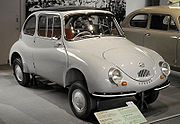
. Only twenty P1s were manufactured owing to multiple supply issues. From 1954 to 2008, the company designed and manufactured dozens of vehicles including the 1500 (1954), the tiny air-cooled 360
(1958), the Sambar
(1961), the 1000
(which saw the introduction of the Subaru boxer engine in 1965), the R-2
(1969), the Rex
and the Leone
(1971), the BRAT
(1978), Alcyone (1985), the Legacy
(1989), the Impreza
(1993), the Forester
(1997), the Tribeca
(2005), and the Exiga
(2008).
Eisaku Sato
. Nissan would utilize FHI's bus manufacturing capability and expertise for their Nissan Diesel line of buses. In turn, many Subaru vehicles, even today, use parts from the Nissan manufacturing keiretsu
. The Subaru automatic transmission, known as the 4EAT, is also used in the first generation Nissan Pathfinder
. Speculation has suggested that it was Subaru that introduced Renault
to Nissan, when Renault asked for assistance in all-wheel drive (AWD) technology, and when FHI told Renault to discuss their plans with Nissan, the discussions may have been a contributing factor to the currently successful Renault-Nissan alliance. Upon Nissan's acquisition by Renault
, its 20% stake was sold to General Motors.
On October 5, 2005 Toyota Motor Corporation
purchased 8.7% of FHI shares from General Motors who had owned 20.1% of FHI since 1999. GM later divested its remaining 11.4% stake, selling its shares on the open market to sever all ties with FHI. FHI previously stated that there might have been 27 million shares (3.4%) acquired before the start of trading by an unknown party on October 6, 2005, and speculation suggested that a bank or perhaps another automaker was involved. After the purchase, Toyota announced a contract with Subaru on March 13, 2006 to use the underutilized Subaru manufacturing facility in Lafayette, Indiana
, and Toyota announced plans to hire up to 1,000 workers and set aside an assembly line for the Camry model, beginning in the second quarter of 2007.
During the brief General Motors period, a "badge engineered" Impreza
was sold in the United States as the Saab 9-2X
. An SUV (Subaru Tribeca
/ SAAB 9-6X) was also planned but the SAAB version did not proceed.
and associates. It relocated to Pennsauken, New Jersey shortly thereafter and moved to its current headquarters in Cherry Hill, New Jersey
in 1986 when Fuji Heavy Industries acquired full ownership.
In 1989, Subaru and then-partner Isuzu opened a joint factory in Lafayette, Indiana
called Subaru-Isuzu Automotive, Inc., or SIA, which initially manufactured the Subaru Legacy
and Isuzu Rodeo. In 2001, Isuzu sold their stake in the plant to FHI for $1 due to flagging sales and it was renamed Subaru of Indiana Automotive Inc. SIA has been designated a backyard wildlife Habitat
by the National Wildlife Federation
and has achieved a zero-landfill production designation.
Here is a commercial introducing Subaru to North America
. In 1989, the privately owned SACL was purchased by the Toronto-based Subaru Canada, Inc., who, under the guidance of parent company Fuji Heavy Industries
, began an expansion process that would eventually see over 100 Subaru Dealers in operation across the country.
Subaru Canada, Inc. is a wholly owned subsidiary of Fuji Heavy Industries
of Japan. Headquartered in Mississauga, Ontario
, the company markets and distributes Subaru vehicles, parts and accessories through a network of 88 authorized dealers throughout Canada.
class vehicles like the Rex
and Sambar
and begin to develop larger, mainstream passenger cars like the Leone
, and when Subaru continued in their efforts, and introduced the Legacy
in 1989, it was a sales success and a new direction for the company. Subaru decided to offer more products due to the Plaza Accord
agreement of 1985 which made the value of the yen stronger in exchange rates to the dollar, which had an effect on Subaru sales in the USA. The creation of the Legacy was influenced by Subaru's desire to compete with successful Japanese carmakers Toyota, Nissan and Honda, and the Legacy was targeted against the Camry, Stanza, and Accord. The Legacy was considered mainstream in its appearance and a departure from previous vehicles, which had earned a reputation of being "quirky". It was perceived by some as Subaru's attempt to compete with new luxury brands Lexus, Infiniti and Acura, as Japanese vehicles were increasing in popularity, particularly in the USA. Subaru continued their new direction with the controversially styled Alcyone XT
(1985), the GT
six-cylinder SVX
(1992), and the Impreza
(1993).
From 1995 to 2000, Subaru ran a series of advertisements for the newly developed Subaru Outback
which starred Paul Hogan
, well known for his "Crocodile Dundee
" film character. The advertisements were intended to highlight Subaru's All wheel drive, and depicted the Outback in a number of rugged Australian locations. The tagline "the world's first sport utility wagon" was successfully used by Subaru, though the AMC Eagle
had tried much the same idea, with less success in the 1980s.
 Before the Outback was introduced, Subaru sold a badge engineered Isuzu Trooper
in Japan as the Subaru Bighorn.
Some of the advertising slogans Subaru has used in the past include, "Inexpensive, and built to stay that way", "The World's Favorite Four Wheel Drive" (in the U.K.), "Plus on y pense, plus on a le gout de la conduire" (The more one thinks, the more one has the taste of driving it) in French Quebec, "We built our reputation by building a better car", "What to Drive", "The Beauty of All wheel drive", "Think, Feel, Drive", and currently "Love. It's what makes a Subaru, a Subaru" in North America, "All 4 The Driver" in Australia, and "Uncommon Engineering, Uncommon Stability, Uncommon Roadholding, Uncommon Sense" in the UK.
As a result of this refocused advertising campaign, Subaru products began to attract a following among the young and educated, who saw the car as a practical alternative to the SUV craze. Subaru was among the first automotive companies to market to gays and lesbians in the US. Subaru has historically been popular in the Northeastern United States, as well as the Pacific Northwest
. According to Automotive Lease Guide, Subaru ranked second place in vehicles that have the highest overall predicted resale values among all industry and all luxury vehicles for MY 2009. The awards are derived after carefully studying segment competition, historical vehicle performance and industry trends. According to a study done by J.D. Power and Associates
, for the 2008 Customer Retention Study, Subaru ranked at 50.5%, which was above the national average of 48%. Harman Kardon
is currently the audio supplier for Subaru products worldwide.
Fight Mediocrity!
Subaru has recently created the 2011 Mediocrity car and campaign to illustrate the difference between the current, "boring mid-sized sedan segment" and the "thrilling experience of driving the new 2011 Subaru Legacy". Complete with its own website, Facebook, Twitter, and YouTube page, the Mediocrity campaign has been a comedic hit with many viewers.
Hōkago no Pleiades (Original net animation)
Subaru launched an animation series developed jointly with Gainax
. The 4-part mini episode series was released on YouTube
on February 1, 2011. It featured a magical girl
plot with Subaru as a leading protagonist.
 Subaru Rally Team Japan led by Noriyuki Koseki (founder of Subaru Tecnica International
STI
) ran Subaru Leone
coupé, sedan DL, RX
(SRX)
and RX Turbo
in the World Rally Championship between 1980 and 1989. Drivers for individual rallies included Ari Vatanen
, Per Eklund
, Shekhar Mehta
, Mike Kirkland, Possum Bourne and Harald Demut. Mike Kirkland finished 6th overall and won the A Group at the 1986 Safari Rally
. That year Subaru was one of the only manufacturers combining 4WD and turbo after Audi's successful quattro system had been introduced in 1980, but Audi withdrew from the WRC after safety concerns and Ford's serious accident early in the 1986 season. Subaru changed the rally model to Legacy RS for the 1990–1992 period and took part in the first complete season in the World Rally Championship with the same model in 1993.
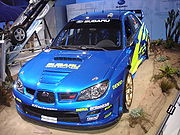
Modified versions of the Impreza WRX
and WRX STi
have been competing successfully in rallying
; drivers Colin McRae
(1995), Richard Burns
(2001) and Petter Solberg
(2003) have won World Rally Championship
drivers' titles with the Subaru World Rally Team
, and Subaru took the manufacturers' title three years in a row from 1995 to 1997. Subaru's World Rally Championship cars are prepared and run by Prodrive
, the highly successful British motorsport team. Several endurance records were set in the early and mid-nineties by the Subaru Legacy
.
Subaru was briefly involved in Formula One
circuit racing when it bought a controlling interest in the tiny Italian Coloni team
for the 1990 season
. The Coloni 3B's 12-cylinder engine was badged as a Subaru and shared the boxer layout with the company's own engines, but was an existing design built by Italian firm Motori Moderni
. The cars were overweight and underpowered and the partnership broke down before the season finished. With the rise of rally racing, and the Import scene
in the US, the introduction of the highly anticipated Subaru Impreza WRX
in 2001 was successful in bringing high-performance, AWD compact cars into the sports car mainstream. Subaru supplies a factory-backed team for Rally America
, and has won the driver's title in each of the series' five seasons.
On 16 December 2008, it was announced that Subaru would no longer be competing in the World Rally Championships, due to the issues with the current global economic crisis, combined with the prospect of a car which still needed development for the 2009 season and a change in regulations for the 2010 season.
Starting in 2006, Subaru of America (SOA), as the official distributor of Subaru vehicles in the United States, participates in the Subaru Road Racing Team (SRRT) with a Subaru Legacy
2.5 GT Spec-B in the Grand-Am Street Tuner class. In 2010, SRRT campaigns a Subaru Impreza WRX STI
in the Grand Sport class. In 2011, SRRT switched from the hatchback to a 2011 Subaru Impreza WRX STI sedan.
, water-cooled, common rail
, turbodiesel
, using a variable geometry turbocharger
called the Subaru EE engine, the first of its type to be fitted to a passenger car. Volkswagen had previously experimented with this idea during the 1950s, and made two air-cooled boxer prototype
diesel engines that were not turbocharged, and installed one engine in a Type 1
and another in a Type 2
.
The Subaru engine was rated at 110 kW and 350 N·m (258.1 ft·lbf) with a displacement of 2.0 litres. In March 2008, Subaru offered the Legacy sedan and wagon and the Outback wagon with the 2.0 litre turbodiesel in the EU with a 5-speed manual transmission only.
In September 2008, Subaru announced that the diesel Forester and diesel Impreza will be introduced at the 2008 Paris Motor Show, with Forester sales to begin October 2008 and diesel Impreza sales to start January 2009. The Forester and Impreza will have a 6-speed manual transmission only, whereas the Legacy and Outback have 5-speed manual transmissions only.
United States Environmental Protection Agency
fuel economy estimated is:
City Ranges
Highway Ranges
The fuel economy ratings listed are comparable to the Smart ForTwo
.
According to the Subaru Owners on-line newsletter dated March 2008, Subaru is "currently making modifications to the diesel so it meets the more stringent US standards. Subaru diesel models should be domestically available in two to three years."
.jpg) Subaru claims to have implemented advanced policies which include recycling, reducing harmful emissions, and educating their employees; continuing their efforts have helped them in their environmental initiatives. The Subaru plant in Lafayette, Indiana (SIA) was the first auto assembly plant to achieve zero landfill status; nothing from the manufacturing process goes into a landfill. The company has also developed a recycling plan for the "end-of-life" of their cars. Most of their modern products use aluminium
Subaru claims to have implemented advanced policies which include recycling, reducing harmful emissions, and educating their employees; continuing their efforts have helped them in their environmental initiatives. The Subaru plant in Lafayette, Indiana (SIA) was the first auto assembly plant to achieve zero landfill status; nothing from the manufacturing process goes into a landfill. The company has also developed a recycling plan for the "end-of-life" of their cars. Most of their modern products use aluminium
throughout the vehicle, in the engine, transmission, suspension and elsewhere in each vehicle, that can be recycled when the vehicle is no longer serviceable.
An excerpt from the Subaru website stated "In 2006, SIA was awarded the United States Environmental Protection Agency´s Gold Achievement Award as a top achiever in the agency's WasteWise program to reduce waste and improve recycling." The website also stated that "It also became the first U.S. automotive assembly plant to be designated a wildlife habitat."
Subaru currently offers a Partial Zero Emissions Vehicle (PZEV) certified Legacy, Outback, and Forester models which are available for sale anywhere in the U.S. Other car makers limit vehicles certified as PZEV in states that have adopted California emission standards. Subaru PZEV vehicles meet California's Super-Ultra-Low-Emission Vehicle exhaust emission standard. All other models have been certified LEV2
.
Plug-in electric vehicle
, which is a kei car
equipped with a lithium-ion battery pack. The vehicle has a short range of 56 miles (90.1 km) but it actually costs more than the Mitsubishi iMiEV, at ¥
4,725,000 ($48,200 US), including Japanese Government consumption tax
es. It will qualify for a rebate from the Japanese Government of up to $14,100 US, bringing the price down to $34,100 US. The vehicle is much like the i-MiEV, with a 47-kilowatt motor and a quick-charge capability, but the two-door mini-car has a boxy shape. FHI plans to start delivery in late July and plans to sell 170 vehicles by March 2010.
In Japan, Subaru is also currently testing two electric vehicles called the Subaru G4e
and the Subaru R1e
.
Subaru Hybrid Tourer Concept, is a four-seat vehicle with gull-wing door
s that combines a 2-liter, turbocharged, direct-injection gasoline engine with a continuously variable transmission and two axle-mounted motors. A lithium-ion battery pack provides energy storage for the vehicle.
The following models are sold in Asia and Europe. In Japan, they are in the Kei car
class, with either front or all wheel drive, and a straight engine
:
An article posted by Autoblog
on April 16, 2008 stated that due to the corporate investment by Toyota, all kei cars built by Subaru will be replaced by Daihatsu models beginning in 2010.
December 4, 2007 saw an article claiming that Subaru was considering building a motorcycle, called the Subaru HS500, with a single-cylinder 500 cc engine producing 50 hp.
Subaru HS500
together, to be released around 2011.
Automaker
The automotive industry designs, develops, manufactures, markets, and sells motor vehicles, and is one of the world's most important economic sectors by revenue....
of Japanese transportation conglomerate
Conglomerate (company)
A conglomerate is a combination of two or more corporations engaged in entirely different businesses that fall under one corporate structure , usually involving a parent company and several subsidiaries. Often, a conglomerate is a multi-industry company...
Fuji Heavy Industries
Fuji Heavy Industries
, or FHI, is a Japanese transportation conglomerate most known for being the manufacturer of Subaru automobiles. It traces its roots to the Nakajima Aircraft Company, a leading supplier of airplanes to the Japanese government during World War II...
(FHI).
Subaru is internationally known for their use of the boxer engine
Flat engine
A flat engine is an internal combustion engine with multiple pistons that move in a horizontal plane. Typically, the layout has cylinders arranged in two banks on either side of a single crankshaft and is sometimes known as the boxer, or horizontally opposed engine. The concept was patented in 1896...
layout popularized in cars by the Volkswagen Beetle
Volkswagen Beetle
The Volkswagen Type 1, widely known as the Volkswagen Beetle or Volkswagen Bug, is an economy car produced by the German auto maker Volkswagen from 1938 until 2003...
and Porsche 911
Porsche 911
The Porsche 911 is a luxury 2-door sports coupe made by Porsche AG of Stuttgart, Germany. It has a distinctive design, rear-engined and with independent rear suspension, an evolution of the swing axle on the Porsche 356. The engine was also air-cooled until the introduction of the Type 996 in 1998...
, in most of their vehicles above 1500 cc as well as their use of the all wheel drive
Four-wheel drive
Four-wheel drive, 4WD, or 4×4 is a four-wheeled vehicle with a drivetrain that allows all four wheels to receive torque from the engine simultaneously...
drivetrain layout, first introduced in 1972, that became standard equipment for mid-size and smaller cars in most international markets as of 1996, and is now standard in all Subaru vehicles. They also offer many turbocharged versions of their passenger cars, such as the sporty Impreza WRX.
Fuji Heavy Industries
Fuji Heavy Industries
, or FHI, is a Japanese transportation conglomerate most known for being the manufacturer of Subaru automobiles. It traces its roots to the Nakajima Aircraft Company, a leading supplier of airplanes to the Japanese government during World War II...
, the parent company of Subaru, is currently in a partial partnership with Toyota Motor Corporation, which owns 16.5% of FHI.
Subaru is the Japanese name for the Pleiades
Pleiades (star cluster)
In astronomy, the Pleiades, or Seven Sisters , is an open star cluster containing middle-aged hot B-type stars located in the constellation of Taurus. It is among the nearest star clusters to Earth and is the cluster most obvious to the naked eye in the night sky...
star cluster, which in turn inspires the Subaru logo and alludes to the six companies that merged to create FHI.
History
FHI started out as The Aircraft Research Laboratory in 1915 headed by Chikuhei Nakajima. In 1932, the company was reorganized as Nakajima Aircraft CompanyNakajima Aircraft Company
The Nakajima Aircraft Company was a prominent Japanese aircraft manufacturer throughout World War II.-History:...
, Ltd and soon became the primary manufacturer of aircraft
Fixed-wing aircraft
A fixed-wing aircraft is an aircraft capable of flight using wings that generate lift due to the vehicle's forward airspeed. Fixed-wing aircraft are distinct from rotary-wing aircraft in which wings rotate about a fixed mast and ornithopters in which lift is generated by flapping wings.A powered...
for Japan during World War II. At the end of the Second World War Nakajima Aircraft was again reorganized, this time as Fuji Sangyo Co, Ltd. In 1946, the company created the Fuji Rabbit
Fuji Rabbit
The Fuji Rabbit was a motor scooter produced in Japan by Fuji Heavy Industries from 1946 through 1968.Production of the initial model, the S-1 began in 1946, some six months before the Vespa went into production and was largely inspired by scooters used by American servicemen during and after World...
motor scooter with spare aircraft parts from the war. In 1950, Fuji Sangyo was divided into 12 smaller corporations according to the Japanese Government's 1950 Corporate Credit Rearrangement Act, anti-zaibatsu
Zaibatsu
is a Japanese term referring to industrial and financial business conglomerates in the Empire of Japan, whose influence and size allowed for control over significant parts of the Japanese economy from the Meiji period until the end of World War II.-Terminology:...
legislation, but between 1953 and 1955, four of these corporations and a newly formed corporation Fuji Kogyo, a scooter manufacturer; coachbuilders
Coach (vehicle)
A coach is a large motor vehicle, a type of bus, used for conveying passengers on excursions and on longer distance express coach scheduled transport between cities - or even between countries...
Fuji Jidosha; engine manufacturers Omiya Fuji Kogyo; chassis
Chassis
A chassis consists of an internal framework that supports a man-made object. It is analogous to an animal's skeleton. An example of a chassis is the underpart of a motor vehicle, consisting of the frame with the wheels and machinery.- Vehicles :In the case of vehicles, the term chassis means the...
builders Utsunomiya Sharyo and the Tokyo Fuji Dangyo trading company
Trading company
Trading companies are businesses working with different kinds of products which are sold for consumer, business or government purposes. Trading companies buy a specialized range of products, maintain a stock or a shop, and deliver products to customers....
decided to merge together to form the Fuji Heavy Industries known today.
Fuji Heavy Industries
, or FHI, is a Japanese transportation conglomerate most known for being the manufacturer of Subaru automobiles. It traces its roots to the Nakajima Aircraft Company, a leading supplier of airplanes to the Japanese government during World War II...
at the time, wanted the new company to be involved in car manufacturing and soon began plans for building a car with the development code-name P-1. Mr. Kita canvassed the Company for suggestions about naming the P1, but none of the proposals were appealing enough. In the end, he gave the car a Japanese name that he had "been cherishing in his heart": Subaru, which is the name of the Pleiades
Pleiades
Pleiades can refer to:Astronomy and science*Pleiades , an open cluster of stars in the constellation Taurus**Pleiades in folklore and literature, interpretations and traditional meanings of the star cluster among various human cultures...
star cluster in Japanese. The first Subaru car was named the Subaru 1500
Subaru 1500
The first vehicle built by the automotive division of Fuji Heavy Industries was called the Subaru 1500, with the development code-name of P1. The prototype used a monocoque body structure, with an independent front wishbone suspension and a rear leaf spring suspension with three plates and a live...
. Only twenty P1s were manufactured owing to multiple supply issues. From 1954 to 2008, the company designed and manufactured dozens of vehicles including the 1500 (1954), the tiny air-cooled 360
Subaru 360
The Subaru 360 was the first automobile mass-produced by Fuji Heavy Industries' Subaru division. A number of innovative features were used to design a very small and inexpensive car to address government plans to produce a small "people's car" with an engine no larger than 360 cc when most in...
(1958), the Sambar
Subaru Sambar
The Subaru Sambar is an automobile built by automaker Subaru for the Japanese market. It is Japan's first Keitora , shorthand for "kei class truck" and is still in production. The Sambar is available in both microvan and Kei truck to fulfill the Kei car guidelines...
(1961), the 1000
Subaru 1000
The ' was a compact car and introduced in Japan July 10, 1970, replacing the FF-1 Star. It was a front wheel drive vehicle with a typical Subaru EA61 or EA62 flat-4 engine. A fully independent torsion bar suspension and rack and pinion steering were impressive for the time. The inboard front...
(which saw the introduction of the Subaru boxer engine in 1965), the R-2
Subaru R-2
The Subaru R-2 was a kei car manufactured by Subaru from 1969 to 1972. The R-2 was a full model change of the popular Subaru 360, but with an updated appearance and increased interior space...
(1969), the Rex
Subaru Rex
The Subaru Rex, also known as Ace, Viki, Sherpa, 500/600/700, Mini Jumbo or M60/M70/M80 in various export markets, is a kei class automobile produced from 1972 to 1992 mainly for sale in Japan by Subaru, although it was also sold in Europe, South America, and the Caribbean...
and the Leone
Subaru Leone
The Subaru Leone was a compact car produced by the Japanese car manufacturer Fuji Heavy Industries from 1971 to 1994. The word "leone" is Italian for lion....
(1971), the BRAT
Subaru BRAT
The Subaru BRAT was the coupe utility version of the Subaru Leone from the 1970s...
(1978), Alcyone (1985), the Legacy
Subaru Legacy
The Subaru Legacy is a mid-size car built by the Japanese company Fuji Heavy Industries, and manufactured by its division Subaru since 1989, and is available as a sedan or wagon. Part of the original design goals for the Legacy model was to provide Subaru a vehicle in which they could compete in...
(1989), the Impreza
Subaru Impreza
Introduced in November 1993, the Impreza was offered in either front-wheel drive or all-wheel drive versions and as a four-door sedan/saloon or five-door station wagon/estate. According to a Motor Trend article written March 1992 on page 26, the name of Subaru's new compact was, initially, to be...
(1993), the Forester
Subaru Forester
The Subaru Forester is an all-wheel drive crossover wagon manufactured since 1997 by Fuji Heavy Industries and sold under the Subaru brand...
(1997), the Tribeca
Subaru Tribeca
The Subaru Tribeca is a mid-size crossover SUV sold since 2005 by Subaru, the automobile manufacturing division of Japanese transportation conglomerate Fuji Heavy Industries . Released in some markets as the Subaru B9 Tribeca, the name "Tribeca" derives from the TriBeCa neighborhood of New York City...
(2005), and the Exiga
Subaru Exiga
The Subaru Exiga is a new medium MPV that debuted as a concept car during the 2007 Tokyo Motor Show. According to the Japanese Subaru press introduction materials, the name "Exiga" is a neologism combination of the words "exciting" and "active"....
(2008).
Major shareholders
Nissan had acquired a 20% stake in 1968 during a period of government-ordered merging of the Japanese auto industry in order to improve competitiveness under the administration of Prime MinisterPrime Minister of Japan
The is the head of government of Japan. He is appointed by the Emperor of Japan after being designated by the Diet from among its members, and must enjoy the confidence of the House of Representatives to remain in office...
Eisaku Sato
Eisaku Sato
This article is about the Prime Minister of Japan. For the governor of Fukushima Prefecture of Japan of the same name, see Eisaku Satō ....
. Nissan would utilize FHI's bus manufacturing capability and expertise for their Nissan Diesel line of buses. In turn, many Subaru vehicles, even today, use parts from the Nissan manufacturing keiretsu
Keiretsu
A is a set of companies with interlocking business relationships and shareholdings. It is a type of business group. The keiretsu has maintained dominance over the Japanese economy for the greater half of the twentieth century....
. The Subaru automatic transmission, known as the 4EAT, is also used in the first generation Nissan Pathfinder
Nissan Pathfinder
The Nissan Pathfinder is a SUV manufactured by Nissan Motors since 1986, derived from Nissan's compact pickup truck platform. The Pathfinder is slotted in size between the Murano and Armada or Patrol, but in price between the Xterra and Murano...
. Speculation has suggested that it was Subaru that introduced Renault
Renault
Renault S.A. is a French automaker producing cars, vans, and in the past, autorail vehicles, trucks, tractors, vans and also buses/coaches. Its alliance with Nissan makes it the world's third largest automaker...
to Nissan, when Renault asked for assistance in all-wheel drive (AWD) technology, and when FHI told Renault to discuss their plans with Nissan, the discussions may have been a contributing factor to the currently successful Renault-Nissan alliance. Upon Nissan's acquisition by Renault
Renault
Renault S.A. is a French automaker producing cars, vans, and in the past, autorail vehicles, trucks, tractors, vans and also buses/coaches. Its alliance with Nissan makes it the world's third largest automaker...
, its 20% stake was sold to General Motors.
On October 5, 2005 Toyota Motor Corporation
Toyota Motor Corporation
, , , commonly known simply as Toyota and abbreviated as TMC, is a multinational automaker headquartered in Toyota, Aichi, Japan. In 2010, Toyota Motor Corporation employed 317,734 people worldwide, and was the world's largest automobile manufacturer by production.The company was founded by...
purchased 8.7% of FHI shares from General Motors who had owned 20.1% of FHI since 1999. GM later divested its remaining 11.4% stake, selling its shares on the open market to sever all ties with FHI. FHI previously stated that there might have been 27 million shares (3.4%) acquired before the start of trading by an unknown party on October 6, 2005, and speculation suggested that a bank or perhaps another automaker was involved. After the purchase, Toyota announced a contract with Subaru on March 13, 2006 to use the underutilized Subaru manufacturing facility in Lafayette, Indiana
Lafayette, Indiana
Lafayette is a city in and the county seat of Tippecanoe County, Indiana, United States, northwest of Indianapolis. As of the 2010 census, the city had a total population of 67,140. West Lafayette, on the other side of the Wabash River, is home to Purdue University, which has a large impact on...
, and Toyota announced plans to hire up to 1,000 workers and set aside an assembly line for the Camry model, beginning in the second quarter of 2007.
During the brief General Motors period, a "badge engineered" Impreza
Subaru Impreza
Introduced in November 1993, the Impreza was offered in either front-wheel drive or all-wheel drive versions and as a four-door sedan/saloon or five-door station wagon/estate. According to a Motor Trend article written March 1992 on page 26, the name of Subaru's new compact was, initially, to be...
was sold in the United States as the Saab 9-2X
Saab 9-2X
The Saab 9-2X is a station wagon automobile that was sold by Saab only in North America as a 2005 and 2006 model year car. It was built in Japan by Fuji Heavy Industries’ Gunma Yajima Plant Ōta, Gunma....
. An SUV (Subaru Tribeca
Subaru Tribeca
The Subaru Tribeca is a mid-size crossover SUV sold since 2005 by Subaru, the automobile manufacturing division of Japanese transportation conglomerate Fuji Heavy Industries . Released in some markets as the Subaru B9 Tribeca, the name "Tribeca" derives from the TriBeCa neighborhood of New York City...
/ SAAB 9-6X) was also planned but the SAAB version did not proceed.
Subaru in the United States
Subaru of America was established in 1968 in Philadelphia by Malcolm BricklinMalcolm Bricklin
Malcolm Bricklin born in Philadelphia, Pennsylvania is an automotive entrepreneur. He is best known for his self-named automobile company, and for being one of the few Americans who has successfully introduced foreign cars in bulk to the American public from firms such as Subaru, Fiat and...
and associates. It relocated to Pennsauken, New Jersey shortly thereafter and moved to its current headquarters in Cherry Hill, New Jersey
Cherry Hill, New Jersey
Cherry Hill is a township in Camden County, New Jersey, in the United States. As of the 2010 United States Census, the township had a population of 71,045, representing an increase of 1,080 from the 69,965 residents enumerated during the 2000 Census...
in 1986 when Fuji Heavy Industries acquired full ownership.
In 1989, Subaru and then-partner Isuzu opened a joint factory in Lafayette, Indiana
Lafayette, Indiana
Lafayette is a city in and the county seat of Tippecanoe County, Indiana, United States, northwest of Indianapolis. As of the 2010 census, the city had a total population of 67,140. West Lafayette, on the other side of the Wabash River, is home to Purdue University, which has a large impact on...
called Subaru-Isuzu Automotive, Inc., or SIA, which initially manufactured the Subaru Legacy
Subaru Legacy
The Subaru Legacy is a mid-size car built by the Japanese company Fuji Heavy Industries, and manufactured by its division Subaru since 1989, and is available as a sedan or wagon. Part of the original design goals for the Legacy model was to provide Subaru a vehicle in which they could compete in...
and Isuzu Rodeo. In 2001, Isuzu sold their stake in the plant to FHI for $1 due to flagging sales and it was renamed Subaru of Indiana Automotive Inc. SIA has been designated a backyard wildlife Habitat
Habitat
* Habitat , a place where a species lives and grows*Human habitat, a place where humans live, work or play** Space habitat, a space station intended as a permanent settlement...
by the National Wildlife Federation
National Wildlife Federation
The National Wildlife Federation is the United States' largest private, nonprofit conservation education and advocacy organization, with over four million members and supporters, and 48 state and territorial affiliated organizations...
and has achieved a zero-landfill production designation.
Here is a commercial introducing Subaru to North America
Subaru in Canada
In 1976, Canadians got their first exposure to Subaru vehicles when Subaru Auto Canada Limited (SACL) began offering the Subaru LeoneSubaru Leone
The Subaru Leone was a compact car produced by the Japanese car manufacturer Fuji Heavy Industries from 1971 to 1994. The word "leone" is Italian for lion....
. In 1989, the privately owned SACL was purchased by the Toronto-based Subaru Canada, Inc., who, under the guidance of parent company Fuji Heavy Industries
Fuji Heavy Industries
, or FHI, is a Japanese transportation conglomerate most known for being the manufacturer of Subaru automobiles. It traces its roots to the Nakajima Aircraft Company, a leading supplier of airplanes to the Japanese government during World War II...
, began an expansion process that would eventually see over 100 Subaru Dealers in operation across the country.
Subaru Canada, Inc. is a wholly owned subsidiary of Fuji Heavy Industries
Fuji Heavy Industries
, or FHI, is a Japanese transportation conglomerate most known for being the manufacturer of Subaru automobiles. It traces its roots to the Nakajima Aircraft Company, a leading supplier of airplanes to the Japanese government during World War II...
of Japan. Headquartered in Mississauga, Ontario
Mississauga, Ontario
Mississauga is a city in Southern Ontario located in the Regional Municipality of Peel, and in the western part of the Greater Toronto Area. With an estimated population of 734,000, it is Canada's sixth-most populous municipality, and has almost doubled in population in each of the last two decades...
, the company markets and distributes Subaru vehicles, parts and accessories through a network of 88 authorized dealers throughout Canada.
Marketing efforts
In the 1970s, the company decided to expand its model range from small keiKei car
Kei cars, K-cars, or , are a Japanese category of small vehicles, including passenger cars, vans, and pickup trucks. They are designed to comply with Japanese government tax and insurance regulations, and in most rural areas are exempted from the requirement to certify that adequate parking is...
class vehicles like the Rex
Subaru Rex
The Subaru Rex, also known as Ace, Viki, Sherpa, 500/600/700, Mini Jumbo or M60/M70/M80 in various export markets, is a kei class automobile produced from 1972 to 1992 mainly for sale in Japan by Subaru, although it was also sold in Europe, South America, and the Caribbean...
and Sambar
Subaru Sambar
The Subaru Sambar is an automobile built by automaker Subaru for the Japanese market. It is Japan's first Keitora , shorthand for "kei class truck" and is still in production. The Sambar is available in both microvan and Kei truck to fulfill the Kei car guidelines...
and begin to develop larger, mainstream passenger cars like the Leone
Subaru Leone
The Subaru Leone was a compact car produced by the Japanese car manufacturer Fuji Heavy Industries from 1971 to 1994. The word "leone" is Italian for lion....
, and when Subaru continued in their efforts, and introduced the Legacy
Subaru Legacy
The Subaru Legacy is a mid-size car built by the Japanese company Fuji Heavy Industries, and manufactured by its division Subaru since 1989, and is available as a sedan or wagon. Part of the original design goals for the Legacy model was to provide Subaru a vehicle in which they could compete in...
in 1989, it was a sales success and a new direction for the company. Subaru decided to offer more products due to the Plaza Accord
Plaza Accord
The Plaza Accord or Plaza Agreement was an agreement between the governments of France, West Germany, Japan, the United States, and the United Kingdom, to depreciate the U.S. dollar in relation to the Japanese yen and German Deutsche Mark by intervening in currency markets...
agreement of 1985 which made the value of the yen stronger in exchange rates to the dollar, which had an effect on Subaru sales in the USA. The creation of the Legacy was influenced by Subaru's desire to compete with successful Japanese carmakers Toyota, Nissan and Honda, and the Legacy was targeted against the Camry, Stanza, and Accord. The Legacy was considered mainstream in its appearance and a departure from previous vehicles, which had earned a reputation of being "quirky". It was perceived by some as Subaru's attempt to compete with new luxury brands Lexus, Infiniti and Acura, as Japanese vehicles were increasing in popularity, particularly in the USA. Subaru continued their new direction with the controversially styled Alcyone XT
Subaru XT
The Subaru XT, XT6, Vortex, and Alcyone is a 2-door coupé that sold from 1985 to 1991. The name Alcyone was used in Japan, the Vortex name was used in Australia and New Zealand, and the name XT or XT6 , was sold in North America and Europe...
(1985), the GT
Grand tourer
A grand tourer is a high-performance luxury automobile designed for long-distance driving. The most common format is a two-door coupé with either a two-seat or a 2+2 arrangement....
six-cylinder SVX
Subaru Alcyone SVX
The Subaru Alcyone SVX, also known outside of its home market Japan as the Subaru SVX, is a two-door grand tourer coupé that was sold by Subaru, the automobile manufacturing division of Japanese transportation conglomerate Fuji Heavy Industries . Produced from 1991 to 1997, it was FHI's first...
(1992), and the Impreza
Subaru Impreza
Introduced in November 1993, the Impreza was offered in either front-wheel drive or all-wheel drive versions and as a four-door sedan/saloon or five-door station wagon/estate. According to a Motor Trend article written March 1992 on page 26, the name of Subaru's new compact was, initially, to be...
(1993).
From 1995 to 2000, Subaru ran a series of advertisements for the newly developed Subaru Outback
Subaru Outback
The Subaru Outback is a station wagon manufactured by Fuji Heavy Industries since 1995. Its original concept originated with Subaru of America, which was suffering from slumping sales in the mid-1990s partly due to a lack of an entry in the then-burgeoning sport utility vehicle market...
which starred Paul Hogan
Paul Hogan
Paul Hogan, AM is an Australian actor best known for his role as Michael "Crocodile" Dundee from the Crocodile Dundee film series, for which he won a Golden Globe award.-Early life and career:...
, well known for his "Crocodile Dundee
Crocodile Dundee
"Crocodile" Dundee is a 1986 Australian comedy film set in the Australian Outback and in New York City. It stars Paul Hogan as the weathered Mick Dundee and Linda Kozlowski as Sue Charlton....
" film character. The advertisements were intended to highlight Subaru's All wheel drive, and depicted the Outback in a number of rugged Australian locations. The tagline "the world's first sport utility wagon" was successfully used by Subaru, though the AMC Eagle
AMC Eagle
The AMC Eagle is a compact-sized four-wheel drive passenger vehicle that was produced by American Motors Corporation . The AMC Eagle line of vehicles inaugurated a new product category of "sport-utility" or crossover SUV....
had tried much the same idea, with less success in the 1980s.
Isuzu Trooper
The Isuzu Trooper was a mid-size SUV produced by the Japanese automaker Isuzu between 1981 and 2005. It was exported worldwide as the Isuzu Bighorn, Isuzu Trooper, Isuzu Trooper II , Caribe 442, Acura SLX, Chevrolet Trooper, Subaru Bighorn, Honda Horizon, Opel/Vauxhall Monterey, Holden Jackaroo,...
in Japan as the Subaru Bighorn.
Some of the advertising slogans Subaru has used in the past include, "Inexpensive, and built to stay that way", "The World's Favorite Four Wheel Drive" (in the U.K.), "Plus on y pense, plus on a le gout de la conduire" (The more one thinks, the more one has the taste of driving it) in French Quebec, "We built our reputation by building a better car", "What to Drive", "The Beauty of All wheel drive", "Think, Feel, Drive", and currently "Love. It's what makes a Subaru, a Subaru" in North America, "All 4 The Driver" in Australia, and "Uncommon Engineering, Uncommon Stability, Uncommon Roadholding, Uncommon Sense" in the UK.
As a result of this refocused advertising campaign, Subaru products began to attract a following among the young and educated, who saw the car as a practical alternative to the SUV craze. Subaru was among the first automotive companies to market to gays and lesbians in the US. Subaru has historically been popular in the Northeastern United States, as well as the Pacific Northwest
Pacific Northwest
The Pacific Northwest is a region in northwestern North America, bounded by the Pacific Ocean to the west and, loosely, by the Rocky Mountains on the east. Definitions of the region vary and there is no commonly agreed upon boundary, even among Pacific Northwesterners. A common concept of the...
. According to Automotive Lease Guide, Subaru ranked second place in vehicles that have the highest overall predicted resale values among all industry and all luxury vehicles for MY 2009. The awards are derived after carefully studying segment competition, historical vehicle performance and industry trends. According to a study done by J.D. Power and Associates
J.D. Power and Associates
J.D. Power and Associates is a global marketing information services firm founded in 1968 by James David Power III. The firm conducts surveys of customer satisfaction, product quality, and buyer behavior for industries ranging from cars to marketing and advertising firms. The firm is best known for...
, for the 2008 Customer Retention Study, Subaru ranked at 50.5%, which was above the national average of 48%. Harman Kardon
Harman Kardon
harman/kardon is a division of Harman International Industries and manufactures home and car audio equipment.Founded in 1953 by Dr. Sidney Harman and Bernard Kardon — two men with a deep interest in music and the arts — the company helped create the high-fidelity audio industry. Their first product...
is currently the audio supplier for Subaru products worldwide.
Fight Mediocrity!
Subaru has recently created the 2011 Mediocrity car and campaign to illustrate the difference between the current, "boring mid-sized sedan segment" and the "thrilling experience of driving the new 2011 Subaru Legacy". Complete with its own website, Facebook, Twitter, and YouTube page, the Mediocrity campaign has been a comedic hit with many viewers.
Hōkago no Pleiades (Original net animation)
Subaru launched an animation series developed jointly with Gainax
Gainax
is a Japanese anime studio famous for productions such as Gunbuster, The Wings of Honneamise, Nadia: The Secret of Blue Water, Neon Genesis Evangelion, FLCL and Tengen Toppa Gurren Lagann which have gone on to critical acclaim and commercial success, as well as for their association with...
. The 4-part mini episode series was released on YouTube
YouTube
YouTube is a video-sharing website, created by three former PayPal employees in February 2005, on which users can upload, view and share videos....
on February 1, 2011. It featured a magical girl
Magical girl
belong to a sub-genre of Japanese fantasy anime and manga. Magical girl stories feature young girls with superhuman abilities, forced to fight evil and to protect the Earth. They often possess a secret identity, although the name can just refer to young girls who follow a plotline involving magic...
plot with Subaru as a leading protagonist.
Motorsports
Subaru Tecnica International
, or STi, is Fuji Heavy Industries' motorsports division. STi, along with Prodrive of the UK specializes in the preparation of a variety of vehicles for the Subaru World Rally Team which competed in the World Rally Championship...
STI
STI
-Institutes:*Sega Technical Institute*Semantic Technology Institute International, a scientific and research network; also some of its members call themselves STI*Southern Technical Institute—a university in Marietta, Georgia, USA...
) ran Subaru Leone
Subaru Leone
The Subaru Leone was a compact car produced by the Japanese car manufacturer Fuji Heavy Industries from 1971 to 1994. The word "leone" is Italian for lion....
coupé, sedan DL, RX
Subaru Leone
The Subaru Leone was a compact car produced by the Japanese car manufacturer Fuji Heavy Industries from 1971 to 1994. The word "leone" is Italian for lion....
(SRX)
Subaru Leone
The Subaru Leone was a compact car produced by the Japanese car manufacturer Fuji Heavy Industries from 1971 to 1994. The word "leone" is Italian for lion....
and RX Turbo
Subaru Leone
The Subaru Leone was a compact car produced by the Japanese car manufacturer Fuji Heavy Industries from 1971 to 1994. The word "leone" is Italian for lion....
in the World Rally Championship between 1980 and 1989. Drivers for individual rallies included Ari Vatanen
Ari Vatanen
Ari Pieti Uolevi Vatanen is a Finnish rally driver turned politician and Member of the European Parliament 1999–2009. Vatanen won the World Rally Championship drivers' title in 1981 and the Paris Dakar Rally four times....
, Per Eklund
Per Eklund
Per Eklund, born on June 26, 1946 in Skönnerud , Eda Municipality of Värmland in Sweden, is a Rally and Rallycross driver who lives in Arvika. His nickname is "Pekka". In rallying he never made it to the very top but he has been very successful in his later rallycross career.- Saab works...
, Shekhar Mehta
Shekhar Mehta
Chandrashekhar "Shekhar" Mehta was a Ugandan-born Kenyan rally driver. He won the Safari Rally a record five times , including four consecutively, and in 1981 finished fifth in the World Rally Championship...
, Mike Kirkland, Possum Bourne and Harald Demut. Mike Kirkland finished 6th overall and won the A Group at the 1986 Safari Rally
Safari Rally
The Safari Rally is considered by many to be the world's toughest rally. It was first held from 27 May to 1 June 1953 as the East African Coronation Safari in Kenya, Uganda and Tanganyika, as a celebration of the coronation of Queen Elizabeth II...
. That year Subaru was one of the only manufacturers combining 4WD and turbo after Audi's successful quattro system had been introduced in 1980, but Audi withdrew from the WRC after safety concerns and Ford's serious accident early in the 1986 season. Subaru changed the rally model to Legacy RS for the 1990–1992 period and took part in the first complete season in the World Rally Championship with the same model in 1993.
Modified versions of the Impreza WRX
Subaru Impreza WRX
The Subaru Impreza WRX is a turbocharged version of the Subaru Impreza, an all-wheel drive, four-door passenger vehicle. It is available as a sedan or wagon....
and WRX STi
Subaru Impreza WRX STI
The Subaru Impreza WRX STI, has the highest trim in the Subaru Impreza compact car line, produced by Japanese automaker Subaru.In the late 1980s, Subaru created the Subaru Tecnica International division to coordinate development for the FIA World Rally Championship and other motorsports activities...
have been competing successfully in rallying
Rallying
Rallying, also known as rally racing, is a form of auto racing that takes place on public or private roads with modified production or specially built road-legal cars...
; drivers Colin McRae
Colin McRae
Colin Steele McRae, MBE was a Scottish rally driver born in Lanark.The son of five-time British Rally Champion Jimmy McRae and brother of rally driver Alister McRae, Colin McRae was the 1991 and 1992 British Rally Champion and, in 1995, became the first British person and the youngest to win the...
(1995), Richard Burns
Richard Burns
Richard Alexander Burns was an English rally driver. He was born in Reading, Berkshire. He was the 2001 World Rally Champion, having previously finished runner-up in the series in 1999 and 2000. He also helped Mitsubishi to the world manufacturers' title in 1998, and Peugeot in 2002...
(2001) and Petter Solberg
Petter Solberg
Petter "Hollywood" Solberg , from Spydeberg in Østfold, Norway, is a professional rally driver. He debuted in the World Rally Championship in 1998 and was signed by the Ford factory team in 1999...
(2003) have won World Rally Championship
World Rally Championship
The World Rally Championship is a rallying series organised by the FIA, culminating with a champion driver and manufacturer. The driver's world championship and manufacturer's world championship are separate championships, but based on the same point system. The series currently consists of 13...
drivers' titles with the Subaru World Rally Team
Subaru World Rally Team
The Subaru World Rally Team was Subaru's World Rally Championship team. It used a distinctive blue with yellow color scheme that is a throwback to the sponsorship deal with State Express 555, a BAT cigarette brand popular in Asia. 555 logos were found on Subaru cars from 1993 to 2003...
, and Subaru took the manufacturers' title three years in a row from 1995 to 1997. Subaru's World Rally Championship cars are prepared and run by Prodrive
Prodrive
Prodrive is a British motorsport and automotive engineering group based in Banbury, Oxfordshire, England. It designs, constructs and races cars for companies and teams such as Subaru, Aston Martin and Ford...
, the highly successful British motorsport team. Several endurance records were set in the early and mid-nineties by the Subaru Legacy
Subaru Legacy
The Subaru Legacy is a mid-size car built by the Japanese company Fuji Heavy Industries, and manufactured by its division Subaru since 1989, and is available as a sedan or wagon. Part of the original design goals for the Legacy model was to provide Subaru a vehicle in which they could compete in...
.
Subaru was briefly involved in Formula One
Formula One
Formula One, also known as Formula 1 or F1 and referred to officially as the FIA Formula One World Championship, is the highest class of single seater auto racing sanctioned by the Fédération Internationale de l'Automobile . The "formula" designation in the name refers to a set of rules with which...
circuit racing when it bought a controlling interest in the tiny Italian Coloni team
Enzo Coloni Racing Car Systems
Enzo Coloni Racing Car Systems, commonly referred to simply as Coloni, is an Italian motor racing team and former Formula One racing car constructor. While it has been successful in Formula Three and Formula 3000, the team was one of the least successful in Formula One history...
for the 1990 season
1990 Formula One season
The 1990 Formula One season was the 41st season of FIA Formula One motor racing. It featured the 1990 FIA Formula One World Championship which commenced on March 11, 1990 and ended on November 4 after sixteen races...
. The Coloni 3B's 12-cylinder engine was badged as a Subaru and shared the boxer layout with the company's own engines, but was an existing design built by Italian firm Motori Moderni
Motori Moderni
Motori Moderni was a Formula One engine manufacturer from 1985 through 1987. It was established by the experienced Italian engine designer Carlo Chiti....
. The cars were overweight and underpowered and the partnership broke down before the season finished. With the rise of rally racing, and the Import scene
Import scene
The Import Scene or Import Racing Scene or Tuner Scene refers to the subculture that revolves around modifying imported brand cars , especially those of Japanese brands, for street racing.-History:...
in the US, the introduction of the highly anticipated Subaru Impreza WRX
Subaru Impreza WRX
The Subaru Impreza WRX is a turbocharged version of the Subaru Impreza, an all-wheel drive, four-door passenger vehicle. It is available as a sedan or wagon....
in 2001 was successful in bringing high-performance, AWD compact cars into the sports car mainstream. Subaru supplies a factory-backed team for Rally America
Rally America
The Rally America National Championship is the national championship of rallying events in the United States. The inaugural season was in 2005. Rally America was also the name given to the organization that sanctioned the championship, was briefly rebranded to RallyCar in July 2010, then reverted...
, and has won the driver's title in each of the series' five seasons.
On 16 December 2008, it was announced that Subaru would no longer be competing in the World Rally Championships, due to the issues with the current global economic crisis, combined with the prospect of a car which still needed development for the 2009 season and a change in regulations for the 2010 season.
Starting in 2006, Subaru of America (SOA), as the official distributor of Subaru vehicles in the United States, participates in the Subaru Road Racing Team (SRRT) with a Subaru Legacy
Subaru Legacy
The Subaru Legacy is a mid-size car built by the Japanese company Fuji Heavy Industries, and manufactured by its division Subaru since 1989, and is available as a sedan or wagon. Part of the original design goals for the Legacy model was to provide Subaru a vehicle in which they could compete in...
2.5 GT Spec-B in the Grand-Am Street Tuner class. In 2010, SRRT campaigns a Subaru Impreza WRX STI
Subaru Impreza WRX STI
The Subaru Impreza WRX STI, has the highest trim in the Subaru Impreza compact car line, produced by Japanese automaker Subaru.In the late 1980s, Subaru created the Subaru Tecnica International division to coordinate development for the FIA World Rally Championship and other motorsports activities...
in the Grand Sport class. In 2011, SRRT switched from the hatchback to a 2011 Subaru Impreza WRX STI sedan.
Diesel
The 2007 Frankfurt International Motor Show saw Subaru introduce a horizontally opposedFlat engine
A flat engine is an internal combustion engine with multiple pistons that move in a horizontal plane. Typically, the layout has cylinders arranged in two banks on either side of a single crankshaft and is sometimes known as the boxer, or horizontally opposed engine. The concept was patented in 1896...
, water-cooled, common rail
Common rail
Common rail direct fuel injection is a modern variant of direct fuel injection system for petrol and diesel engines.On diesel engines, it features a high-pressure fuel rail feeding individual solenoid valves, as opposed to low-pressure fuel pump feeding unit injectors...
, turbodiesel
Turbodiesel
Turbodiesel refers to any diesel engine with a turbocharger. Turbocharging is the norm rather than the exception in modern car and truck diesel engines...
, using a variable geometry turbocharger
Variable geometry turbocharger
Variable-geometry turbochargers are a family of turbochargers, usually designed to allow the effective aspect ratio of the turbo to be altered as conditions change. This is done because optimum aspect ratio at low engine speeds is very different from that at high engine speeds...
called the Subaru EE engine, the first of its type to be fitted to a passenger car. Volkswagen had previously experimented with this idea during the 1950s, and made two air-cooled boxer prototype
Prototype
A prototype is an early sample or model built to test a concept or process or to act as a thing to be replicated or learned from.The word prototype derives from the Greek πρωτότυπον , "primitive form", neutral of πρωτότυπος , "original, primitive", from πρῶτος , "first" and τύπος ,...
diesel engines that were not turbocharged, and installed one engine in a Type 1
Volkswagen Beetle
The Volkswagen Type 1, widely known as the Volkswagen Beetle or Volkswagen Bug, is an economy car produced by the German auto maker Volkswagen from 1938 until 2003...
and another in a Type 2
Volkswagen Type 2
The Volkswagen Type 2, officially known as the Transporter or Kombi informally as Bus or Camper , was a panel van introduced in 1950 by German automaker Volkswagen as its second car model – following and initially deriving from Volkswagen's first model, the Type 1 , it was given the factory...
.
The Subaru engine was rated at 110 kW and 350 N·m (258.1 ft·lbf) with a displacement of 2.0 litres. In March 2008, Subaru offered the Legacy sedan and wagon and the Outback wagon with the 2.0 litre turbodiesel in the EU with a 5-speed manual transmission only.
In September 2008, Subaru announced that the diesel Forester and diesel Impreza will be introduced at the 2008 Paris Motor Show, with Forester sales to begin October 2008 and diesel Impreza sales to start January 2009. The Forester and Impreza will have a 6-speed manual transmission only, whereas the Legacy and Outback have 5-speed manual transmissions only.
United States Environmental Protection Agency
United States Environmental Protection Agency
The U.S. Environmental Protection Agency is an agency of the federal government of the United States charged with protecting human health and the environment, by writing and enforcing regulations based on laws passed by Congress...
fuel economy estimated is:
City Ranges
- 32.7 miles per US gallon
- 33.6 miles per US gallon
Highway Ranges
- 45.2 miles per US gallon
- 49 miles per US gallon
The fuel economy ratings listed are comparable to the Smart ForTwo
Smart Fortwo
The Smart Fortwo is a rear-engined two-seater city car manufactured by Smart GmbH, introduced at the 1998 Paris Motor Show as the Smart City Coupé, and currently in its second generation...
.
According to the Subaru Owners on-line newsletter dated March 2008, Subaru is "currently making modifications to the diesel so it meets the more stringent US standards. Subaru diesel models should be domestically available in two to three years."
New technology
Since the 2005 model year, Subaru has adopted the Controller–area network (CAN) bus technology for the USA and Canada markets. Starting in the 2007 model year, all Subaru vehicles use the CAN technology. Typically, two CAN-buses are used on vehicles: a high-speed CAN running at 500 kbit/s for powertrain communication, and a low-speed CAN running at 125 kbit/s for body control functions and instrument panels. A body-integrated unit (BIU) is used between these two networks.Historic cars
- 360Subaru 360The Subaru 360 was the first automobile mass-produced by Fuji Heavy Industries' Subaru division. A number of innovative features were used to design a very small and inexpensive car to address government plans to produce a small "people's car" with an engine no larger than 360 cc when most in...
- 1500Subaru 1500The first vehicle built by the automotive division of Fuji Heavy Industries was called the Subaru 1500, with the development code-name of P1. The prototype used a monocoque body structure, with an independent front wishbone suspension and a rear leaf spring suspension with three plates and a live...
- 1000Subaru 1000The ' was a compact car and introduced in Japan July 10, 1970, replacing the FF-1 Star. It was a front wheel drive vehicle with a typical Subaru EA61 or EA62 flat-4 engine. A fully independent torsion bar suspension and rack and pinion steering were impressive for the time. The inboard front...
- R-2Subaru R-2The Subaru R-2 was a kei car manufactured by Subaru from 1969 to 1972. The R-2 was a full model change of the popular Subaru 360, but with an updated appearance and increased interior space...
(1969–1972) - Alcyone XT
- Alcyone SVXSubaru Alcyone SVXThe Subaru Alcyone SVX, also known outside of its home market Japan as the Subaru SVX, is a two-door grand tourer coupé that was sold by Subaru, the automobile manufacturing division of Japanese transportation conglomerate Fuji Heavy Industries . Produced from 1991 to 1997, it was FHI's first...
- BajaSubaru BajaThe Subaru Baja is a light-utility, all-wheel-drive, four passenger, four-door, open-bed vehicle manufactured from 2003-2006 by Subaru. The Baja combines the handling and passenger carrying characteristics of a car with the open-bed versatility, and to a lesser degree, load capacity of a pickup...
- BRATSubaru BRATThe Subaru BRAT was the coupe utility version of the Subaru Leone from the 1970s...
- FF-1 GSubaru GThe Subaru FF-1 G was a compact car from the 1970s, replacing the FF-1 Star. It was a front wheel drive vehicle with a typical Subaru EA61 or EA62 flat-4 engine. A fully independent torsion bar suspension and rack and pinion steering were impressive for the time. The inboard front drum brakes...
- FF-1 StarSubaru FF-1 StarThe Subaru FF-1 Star was a development of the original front wheel drive Subaru, the 1000. The FF-1 was marketed as the Star in the United States in 1970 and 1971 model years, and was replaced by the FF-1 G in 1972 but remained in production in some markets until 1973. There were coupe, sedan, and...
- Justy / TuttoSubaru JustyThe Subaru Justy is a subcompact hatchback that has been sold by Japanese automobile manufacturer Subaru since 1984. From 1984–1994 Subaru manufactured the Justy itself; since then it has sold a rebadged version of other vehicles under the Justy nameplate...
- LeoneSubaru LeoneThe Subaru Leone was a compact car produced by the Japanese car manufacturer Fuji Heavy Industries from 1971 to 1994. The word "leone" is Italian for lion....
- SumoSubaru SumoThe Subaru Sumo, known as the Libero in European markets apart from the UK, Norway, and Sweden, and as the Domingo in the Japanese market, was a microvan produced from 1983 to 1998. In Sweden, it was known as the Columbuss, and in Taiwan the latter generation was marketed as the Estratto...
- RexSubaru RexThe Subaru Rex, also known as Ace, Viki, Sherpa, 500/600/700, Mini Jumbo or M60/M70/M80 in various export markets, is a kei class automobile produced from 1972 to 1992 mainly for sale in Japan by Subaru, although it was also sold in Europe, South America, and the Caribbean...
- Traviq
- VivioSubaru VivioThe Subaru Vivio is a kei car that was introduced in March 1992, and manufactured by Subaru until October 1998. It has a 658 cc multi-point fuel-injected four-cylinder engine , which is small enough to place it in the light car class, giving its owners large tax breaks in Japan...
- Libero
Environmental record
Aluminium
Aluminium or aluminum is a silvery white member of the boron group of chemical elements. It has the symbol Al, and its atomic number is 13. It is not soluble in water under normal circumstances....
throughout the vehicle, in the engine, transmission, suspension and elsewhere in each vehicle, that can be recycled when the vehicle is no longer serviceable.
An excerpt from the Subaru website stated "In 2006, SIA was awarded the United States Environmental Protection Agency´s Gold Achievement Award as a top achiever in the agency's WasteWise program to reduce waste and improve recycling." The website also stated that "It also became the first U.S. automotive assembly plant to be designated a wildlife habitat."
Subaru currently offers a Partial Zero Emissions Vehicle (PZEV) certified Legacy, Outback, and Forester models which are available for sale anywhere in the U.S. Other car makers limit vehicles certified as PZEV in states that have adopted California emission standards. Subaru PZEV vehicles meet California's Super-Ultra-Low-Emission Vehicle exhaust emission standard. All other models have been certified LEV2
Low emission vehicle
A low-emission vehicle is a motor vehicle that emits relatively low levels of motor vehicle emissions. The term may be used in a general sense, but in some countries it is defined in air quality statues....
.
Electric vehicles
In June 2006, Fuji Heavy Industries, Inc. (FHI) launched its Subaru StellaSubaru Stella
The Subaru Stella is a Japanese automobile produced by Subaru starting June 2006. The Stella is based on the same architecture as the Subaru R2...
Plug-in electric vehicle
Electric vehicle
An electric vehicle , also referred to as an electric drive vehicle, uses one or more electric motors or traction motors for propulsion...
, which is a kei car
Kei car
Kei cars, K-cars, or , are a Japanese category of small vehicles, including passenger cars, vans, and pickup trucks. They are designed to comply with Japanese government tax and insurance regulations, and in most rural areas are exempted from the requirement to certify that adequate parking is...
equipped with a lithium-ion battery pack. The vehicle has a short range of 56 miles (90.1 km) but it actually costs more than the Mitsubishi iMiEV, at ¥
Japanese yen
The is the official currency of Japan. It is the third most traded currency in the foreign exchange market after the United States dollar and the euro. It is also widely used as a reserve currency after the U.S. dollar, the euro and the pound sterling...
4,725,000 ($48,200 US), including Japanese Government consumption tax
Consumption tax
A consumption tax is a tax on spending on goods and services. The tax base of such a tax is the money spent on consumption. Consumption taxes are usually indirect, such as a sales tax or a value added tax...
es. It will qualify for a rebate from the Japanese Government of up to $14,100 US, bringing the price down to $34,100 US. The vehicle is much like the i-MiEV, with a 47-kilowatt motor and a quick-charge capability, but the two-door mini-car has a boxy shape. FHI plans to start delivery in late July and plans to sell 170 vehicles by March 2010.
In Japan, Subaru is also currently testing two electric vehicles called the Subaru G4e
Subaru G4e
The Subaru G4e is an electric car undergoing development and testing by Japanese automaker Subaru. It was unveiled at the 2007 Tokyo Motor Show. The car seats five in a functional, accessible interior and has a wedge design with a low 0.276 drag coefficient. It has a range of and can be fully...
and the Subaru R1e
Subaru R1e
The Subaru R1e is a battery-electric microcar undergoing development and testing. The car was jointly developed with Tokyo Electric Power, the giant Japanese utility company. Currently 10 prototypes have been built and are undergoing testing by Tokyo Electric Power, which plans to eventually...
.
Subaru Hybrid Tourer Concept, is a four-seat vehicle with gull-wing door
Gull-wing door
Gull-wing door is an automotive industry term describing car doors that are hinged at the roof rather than the side, as pioneered by the 1952 Mercedes-Benz 300SL race car and its road-legal version introduced in 1954....
s that combines a 2-liter, turbocharged, direct-injection gasoline engine with a continuously variable transmission and two axle-mounted motors. A lithium-ion battery pack provides energy storage for the vehicle.
Current models
North America/Europe/Oceania/Middle East/Asia/Japan Subaru models- ExigaSubaru ExigaThe Subaru Exiga is a new medium MPV that debuted as a concept car during the 2007 Tokyo Motor Show. According to the Japanese Subaru press introduction materials, the name "Exiga" is a neologism combination of the words "exciting" and "active"....
- ForesterSubaru ForesterThe Subaru Forester is an all-wheel drive crossover wagon manufactured since 1997 by Fuji Heavy Industries and sold under the Subaru brand...
- ImprezaSubaru ImprezaIntroduced in November 1993, the Impreza was offered in either front-wheel drive or all-wheel drive versions and as a four-door sedan/saloon or five-door station wagon/estate. According to a Motor Trend article written March 1992 on page 26, the name of Subaru's new compact was, initially, to be...
- WRXSubaru Impreza WRXThe Subaru Impreza WRX is a turbocharged version of the Subaru Impreza, an all-wheel drive, four-door passenger vehicle. It is available as a sedan or wagon....
& WRX STISubaru Impreza WRX STIThe Subaru Impreza WRX STI, has the highest trim in the Subaru Impreza compact car line, produced by Japanese automaker Subaru.In the late 1980s, Subaru created the Subaru Tecnica International division to coordinate development for the FIA World Rally Championship and other motorsports activities... - Outback Sport / Gravel Express / RV
- WRX
- JustySubaru JustyThe Subaru Justy is a subcompact hatchback that has been sold by Japanese automobile manufacturer Subaru since 1984. From 1984–1994 Subaru manufactured the Justy itself; since then it has sold a rebadged version of other vehicles under the Justy nameplate...
- Legacy / LibertySubaru LegacyThe Subaru Legacy is a mid-size car built by the Japanese company Fuji Heavy Industries, and manufactured by its division Subaru since 1989, and is available as a sedan or wagon. Part of the original design goals for the Legacy model was to provide Subaru a vehicle in which they could compete in...
- Outback / Grand Wagon / LancasterSubaru OutbackThe Subaru Outback is a station wagon manufactured by Fuji Heavy Industries since 1995. Its original concept originated with Subaru of America, which was suffering from slumping sales in the mid-1990s partly due to a lack of an entry in the then-burgeoning sport utility vehicle market...
- Outback / Grand Wagon / Lancaster
- Tribeca
- DexToyota bB-First Generation :It is based on the Toyota Vitz.While the box-shaped car was initially targeted towards Japanese men in their twenties, it is also popular with women buyers.-Open deck :...
The following models are sold in Asia and Europe. In Japan, they are in the Kei car
Kei car
Kei cars, K-cars, or , are a Japanese category of small vehicles, including passenger cars, vans, and pickup trucks. They are designed to comply with Japanese government tax and insurance regulations, and in most rural areas are exempted from the requirement to certify that adequate parking is...
class, with either front or all wheel drive, and a straight engine
Straight engine
Usually found in four- and six-cylinder configurations, the straight engine, or inline engine is an internal-combustion engine with all cylinders aligned in one row, with no offset...
:
- PleoSubaru PleoThe second-generation Pleo first went on sale in Japan on April 20, 2010. Due to Subaru's corporate investment by Toyota, this second generation is manufactured by Daihatsu instead of Subaru, and is a rebadged Daihatsu Mira.-External links:*...
- R1Subaru R1The Subaru R1 was introduced by the Japanese carmaker Subaru on January 4, 2005. It was designed to fit within the Japanese kei car tax bracket.The R1 is a two-door version of the Subaru R2, but with a shorter body and wheelbase...
- R2Subaru R2For the late 1960s Subaru R-2, please see Subaru R-2The Subaru R2 was announced in Japan on December 8, 2003, and the R2 name was inspired by the Subaru R-2, the kei car model that was produced between 1969 and 1972....
- SambarSubaru SambarThe Subaru Sambar is an automobile built by automaker Subaru for the Japanese market. It is Japan's first Keitora , shorthand for "kei class truck" and is still in production. The Sambar is available in both microvan and Kei truck to fulfill the Kei car guidelines...
- StellaSubaru StellaThe Subaru Stella is a Japanese automobile produced by Subaru starting June 2006. The Stella is based on the same architecture as the Subaru R2...
An article posted by Autoblog
Autoblog
Autoblog is a neologism and misnomer used to describe a particular type of website which uses software designed to automatically add content in a blog format. The owner of an autoblog is generally referred to as an autoblogger. Engaging in this practice is called autoblogging.Autoblogging does...
on April 16, 2008 stated that due to the corporate investment by Toyota, all kei cars built by Subaru will be replaced by Daihatsu models beginning in 2010.
Concept cars
- Subaru SRD-1Subaru SRD-1The Subaru SRD-1 was, according to the double sided color placard, "An innovative dream wagon concept for the '90s and beyond". It was a luxury sports wagon concept car that wasn't put into production...
(Experimental design study introduced in 1990) - 1996 Subaru Exiga
- Subaru B9 ScramblerSubaru B9 ScramblerSubaru B9 Scrambler is an automobile from Subaru. It's a classic, open sports car. It's a long two seater powered by a hybrid engine. The design is done by Andreas Zapatinas....
- Subaru B11s
- Subaru B5 TPH (Turbo Parallel Hybrid) (Japanese: Subaru B5-TPH)
December 4, 2007 saw an article claiming that Subaru was considering building a motorcycle, called the Subaru HS500, with a single-cylinder 500 cc engine producing 50 hp.
Subaru HS500
Toyota-Subaru Coupé (FT-86)
After Toyota approximately doubled its stake in FHI to 16.5%, on April 10, 2008, it was announced that Toyota and Subaru are working on a 2-door coupéCoupé
A coupé or coupe is a closed car body style , the precise definition of which varies from manufacturer to manufacturer, and over time...
together, to be released around 2011.
See also
- ProdriveProdriveProdrive is a British motorsport and automotive engineering group based in Banbury, Oxfordshire, England. It designs, constructs and races cars for companies and teams such as Subaru, Aston Martin and Ford...
Motorsport team selected by Subaru to run their World Rally Team - Subaru Tecnica InternationalSubaru Tecnica International, or STi, is Fuji Heavy Industries' motorsports division. STi, along with Prodrive of the UK specializes in the preparation of a variety of vehicles for the Subaru World Rally Team which competed in the World Rally Championship...
(also known as STI) - List of Subaru engines
- List of Subaru transmissions
- Subaru EA engineSubaru EA engineThe Subaru EA engine is a series of automobile internal combustion engines manufactured by Subaru, a division of Fuji Heavy Industries. All EA series engines are of a flat-4 design....
series - Subaru EF engineSubaru EF engineThe EF is an automotive engine made by Subaru, introduced in 1984 for the Subaru Justy.It is a water-cooled straight-3 four-stroke engine with a belt-driven single overhead camshaft, and a chain-driven balance shaft...
series - Subaru EJ engineSubaru EJ engineThe Subaru EJ engine is a series of automotive engines manufactured by Subaru and introduced in 1989, intended to succeed the previous Subaru EA engine. The EJ series is the mainstay of Subaru's engine line, with all engines of this series being 16-valve flat-4 horizontal, with configurations...
series