
|
|
|
|
Volkswagen Polo
|
| |
|
| |
The Volkswagen Polo is a supermini car manufactured by Volkswagen. It is sold in Europe and other markets worldwide in hatchback, saloon, coupé and estate variants.
f 2008, there have been four separate generations of the Polo, usually identifed by a "Series" or "Mark" number.

Discussion
Ask a question about 'Volkswagen Polo'
Start a new discussion about 'Volkswagen Polo'
Answer questions from other users
|
Encyclopedia
The Volkswagen Polo is a supermini car manufactured by Volkswagen. It is sold in Europe and other markets worldwide in hatchback, saloon, coupé and estate variants.
History
As of 2008, there have been four separate generations of the Polo, usually identifed by a "Series" or "Mark" number. Some generations were facelifted mid way through production, with the updated versions known unofficially by an addition of the letter F to the mark number, e.g. Mark IIF. Some press and enthusiasts consider the facelifts to be separate models and hence have used the unofficial designations Polo Mark 1 to Mark 7. Each model of Polo is also identified by a two- or three-character Volkswagen Group Typ number. Official VW Polo history describes Mark I to Mark IV using either Roman numerals or Arabic numerals, with facelifted variants known as "Phase II" models.
The body style has been varied through the life of the car, most widely as a hatchback which derived from the Audi 50. A saloon version was marketed as the Volkswagen Derby.
Volkswagen vehicles built off different platforms have carried the Polo name plate. For example the Volkswagen Polo Playa hatchback sold in Southern Africa in the late 1990s was a rebadged SEAT Ibiza which has a different body shell from the Mark III Polo sold in Europe at the same time. The current saloon is only available in China, Latin America and South Africa and other Southern Africa countries.
Position in the Volkswagen range
On its introduction in 1975, the Polo was Volkswagen's second front wheel drive hatchback model, fitting into the range beneath the Golf, which had been launched the previous year. It remained the smallest model in the Volkswagen range until 1998, when the Volkswagen Lupo was introduced. The Polo is still Volkswagen's second smallest model, larger than the Fox and smaller than the Golf. (In North America, the Golf – now sold there as the Rabbit – is the smallest Volkswagen available, the Polo never having been sold in this territory.)
Over the generations, as with many other long-lived car brands, the Polo's size has increased, and the latest incarnation of the Polo is actually larger than the original Golf Mark I.
The current version is mechanically very similar to the SEAT Ibiza and Škoda Fabia, being based on a standard Volkswagen Group platform used for a large number of models.
Performance versions and motorsport
Volkswagen pioneered the so-called hot hatch genre of high performance hatchbacks with the Golf GTI in 1975, and has produced a number of performance versions of the Polo. The first of these was the Polo GT version of the Mark 1F.
The Mark II and IIF were available as supercharged G40 models. The GT G40 with its 1.3-litre 85 kW (115 bhp) could reach 100 km/h (62 mph) in 8.1 s from standstill and had a maximum speed of 196 km/h (122 mph). It was used by Volkswagen to set a number of world endurance speed records, such as the 1.3-litre class records for speed over 24 hours and speed over a distance of 5000 km.
The fastest version of the Mark III on the UK market was the 16-valve h model. A 120 PS (88 kW) GTI model was also produced, but only in a limited edition in Germany, and this was the first time the GTI label had been used for a Polo. A GTI version of the Mark IIIF Polo, with a 125 bhp (92 kW) 1.6-litre petrol engine was also produced.
In 2004 Volkswagen Individual, a specialist division of Volkswagen, produced a limited number of (Mark IV Polo) Club Sports with a 1.8T 180 hp/132 kW engine. Available only in Germany, this was based on the one-make racing series Polo Cup Racer hatchback. The Club Sport came with a roll cage inside the vehicle and Recaro racing seats as standard.
A GTI version of the Polo Mark IVF was launched in 2006. This features styling similar to that of the contemporary Golf GTI and a turbocharged 20-valve 150 bhp 1.8-litre petrol engine. It has a 0-60 mph time of 8.2 s and a top speed of .
Volkswagen Individual have also engineered an even faster Polo called the Polo GTI Cup Edition. Available with the same 1.8T engine, albeit with 180 bhp (130 kW), its claimed 0-100 km/h (0-62 mph) is 7.5 s and it has a claimed top speed of .
Volkswagen Racing in South Africa rallied a four-wheel drive Mark IVF Polo which shared some components with its sister World Rally Championship (WRC) Škoda Fabia; the S2000 has a 2.0 L 191 kW (260 bhp) engine.
Mark IV Polos have been entered into the Junior World Rally Championship (JWRC).
There have been a number of one make race series for the Polo, starting with the Volkswagen Polo G40 Cup for Mark II and Mark IIF G40 versions. The current Polo Cup championship for cars is a support race at rounds of the Deutsche Tourenwagen Masters.
Related models
The first Polo was effectively a rebadged version of the Audi 50 hatchback launched in August 1974.
The Audi 50 was discontinued in 1978 as Audi concentrated on larger luxury models. The Mark I and Mark II versions of the Polo were then standalone models in the Volkswagen range.
With the expansion of the Volkswagen Group in the 1990s, SEAT and Škoda were acquired, and the platform used for the Polo was shared with other models.
The Mk III Polo shared its platform with the SEAT Ibiza Mark II. The Ibiza was actually launched before the Polo, and shared essentially all its mechanicals, the dashboard and other interior components, although there were no body panels shared between the two cars. The saloon and estate versions of the Mark III Polo were actually re-badged SEAT Córdoba models, and had no body panels in common with the Polo hatchback. The SEAT Inca and Volkswagen Caddy vans were also based on this model. The Volkswagen Lupo and SEAT Arosa were also based on a shortened version of the Mark III Polo platform.
The Mark IV Polo continued this trend of platform sharing, with the Škoda Fabia and SEAT Ibiza Mark III, both being developed on the same platform and featuring several of the same engines.
Bodystyles
The first Polos were hatchbacks, with the saloon being marketed as the Volkswagen Derby.
On the arrival of the Mark II model, the saloon was renamed the Volkswagen Polo Classic and the hatchback style was renamed as a coupé, the Volkswagen Polo Coupé. Unusually, the Polo that was marketed as a hatchback was closer in concept to an estate. This version was the most popular in virtually every country where the Polo was sold.
From the Mark III onwards, the range was more straightforwardly conventional, including unambiguous saloon, hatchback and estate models.
Body style summary
- 3-door hatchback (all versions) - the Mark II and Mark IIF were available in two separate 3-door hatchback styles, one of which was badged as a coupé
- 2-door saloon (Mark I, Mark IF, Mark II, Mark IIF)
- 4-door saloon (Mark III, Mark IIIF)
- 5-door hatchback (Mark III, Mark IIIF, Mark IV, Mark IVF)
- 5-door estate (Mark III, Mark IIIF)
- 5-door crossover SUV-style (2WD) hatchback (Mark IV, Mark IVF)
Mechanical layout
The Polo is a compact car, with a traditional transversely mounted engine and front-wheel drive. Mark I Polos only came with four-cylinder petrol engines, but for the Mark II, a diesel engine was offered for the first time, although only in certain markets, others having to wait until the launch of the Mark III. The current range includes a variety of three- and four-cylinder petrol and diesel engines.
Early versions used four speed manual transmission, whilst the current car is available with either five-speed manual or four-speed automatic transmission. The suspension system on all models uses a fully independent MacPherson strut front suspension, and a Twist-beam rear suspension. Most models use disc brakes at the front and rear drum brakes, although some recent models have all round disc brakes.
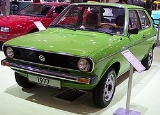
Polo Mark I (Typ 86, 1975–81) The first-generation Polo, a rebadged version of the Audi 50, was introduced in 1975 and was produced until October 1981. By 1979, 500,000 Polos were produced worldwide. It shared the internal designation Typ 86 with the Audi 50.
The differences between the Audi and Volkswagen models were minor, with the Polo being cheaper and much more basic. The two cars were initially sold alongside each other, but the Audi 50 never sold as well, and was withdrawn in 1978. The Polo was manufactured at the Volkswagen plant in Wolfsburg.
In 1977, the Derby saloon was released, which was simply a Polo, identical to the hatchback from the C-pillar forward, with a large boot attached (an Audi proposal which was never sold by them).
The Mark I Polo was available with the following engines:
- 895 cc, straight-4 petrol (hatchback only)
- 1093 cc straight-4 petrol, 50 PS (37 kW)
- 1272 cc, straight-4 petrol, (Polo GT, Derby sedan models, Audi 50 only)
Different levels of compression were used on each size to achieve different power outputs, and the variations are numerous, often differing depending on the country of sale, ranging from 35 to 60 PS (26 to 44 kW).
Polo Mark I facelift (1979–81)
The Mark I Polo and Derby were facelifted in 1979. Sometimes referred to as the Mark IF, the facelifted model featured plastic bumpers, a different front grille and a revised dashboard. The round headlights of the Derby were replaced with square ones, bringing it into line with the similar (but larger) Golf-based Jetta saloon.
Polo Mark II (Typ 86C, 1981–95)
The Polo Mark II (or Typ 86C) was introduced in October 1981, with the major change being the introduction of a third body style with a steep (almost vertical) rear window, in addition to a version resembling the original Mark I shape with a diagonal rear window. These two body styles were called the Wagon (in some markets) and Coupé respectively, although in fact both were three-door hatchbacks, and in some markets the Wagon designation was not used, with that car being simply the "Volkswagen Polo" without a suffix. The sedan version was now called the Polo Classic, and the Derby name became extinct. Production was expanded to Spain in the mid-1980s following Volkswagen's takeover of SEAT. By 1983, the millionth Polo was produced. The second million were produced by 1986..
Although it was still marketed as a supermini to compete with the likes of the Austin Metro, Ford Fiesta and Renault 5, the Polo was larger than most – if not all – of its competitors, and was almost as large as small family cars like the Ford Escort and Vauxhall Astra/Opel Kadett. Its price, comfort and specification were also more comparable with these larger cars.
The Mark II Polo was used extensively by Volkswagen to develop future innovations, for example supercharging in the GT G40 version. A G-supercharger would later be used on the larger and more technically challenging G60 engine used in the Golf and Corrado.
A fuel efficient two-cylinder diesel was prototyped in the mid 1980s with a G40 supercharger to overcome its small capacity, although this did not make it to production. A high fuel efficiency model which did make production was the Formel E (E for Economy), introduced in 1983. This used a high compression 1272 cc engine, taller gear ratios and an early stop-start ignition system (called "SSA") which would cut the engine when idle for more than two seconds to save fuel whilst temporarily stopped in traffic, and re-start the engine on moving the gear lever to the left in neutral. Similar systems were later used on the Volkswagen Golf Mk3 and various systems from other car manufacturers.
It was a popular import in the UK, competing with the likes of the Peugeot 205, Fiat Uno and Nissan Micra. Its reliability and build quality were among the best to be found on a small car of this era, and numerous examples are still on Britain's roads as of 2008 - 18 years after the car's demise. Its durability ensured that its longevity was more impressive than several other notable cars of this era, namely the Austin Metro, Fiat Uno and Renault 5.
The Mark II was available with the following engines:
- 1093 cc straight-4 petrol (1981–83)
- 1272 cc straight-4 petrol (1981–)
- 1043 cc straight-4 petrol (1983–)
- 1272 cc straight-4 petrol with fuel injection and equipped with a catalytic converter. (1983–) GT
- 1272 cc straight-4 supercharged petrol with 113 PS (83 kW) ( G40 version 1987 only)
- 1.3 L straight-4 diesel (1986–)
- 1.4 L 4straight-4 diesel (1990–)
Polo Mark II facelift (1990–95)
A comprehensive facelift in 1990 (sometimes referred to as the Mark IIF, also unofficially known as the "Mark 3") saw square headlights, enlarged and reshaped tail-lights, bigger bumpers and a new interior (dashboard and door trim). The three different body styles were maintained. As well as the cosmetic differences, under the skin the car received modifications to the chassis, suspension and brakes. The new Polo still had the 4-cylinder engine but now as well as the carburettor 1.0 L, a fuel injection model was available with single-point injection and all engines came standard with a catalytic converter to combat tightening European laws on car emissions. The saloon was only produced in Spain, and production of it ceased in 1992.
A clever feature on this version of the Polo was a stereo/cassette player unit which could be completely removed. This feature caught on well with buyers, who were able to remove it from the car as a security measure.
At the time of launch of the Mark IIF Polo, the highest performance model was the Polo GT. This featured a multi-point fuel injected version of the 1272 cc engine. This produced and had a quoted top speed of . 0-60 figures from stand still stood at 11.1 seconds. Defining features of the GT include red piping in the bumpers, black overhead cloth, a rev counter and a red "GT" badge in the grille. This was succeeded by the launch of the G40 in May 1991, displacing the GT as the most powerful Polo at the time. The GT squareback was discontinued in 1992 due to poor sales in comparison with the coupé version.
Soon after the launch of the Mark IIF, another sporting model was added to the range — a new version of the supercharged G40, now as a full production model in all markets rather than the limited batch of Mark II G40s. As with the previous model, Volkswagen Motorsport modified G40 Cup cars were sold for racing in a one-make series, the Volkswagen Polo G40 Cup. Features that define the G40 from other Polo models at the time (on top of the GT) include a bee-sting aerial, BBS cross-spoke alloy wheels, Le Mans interior trim and front and rear red "G40" badges.
Although this version of the Polo was based on a nine-year-old design when it was launched, it sold well in most of Western Europe and was a popular choice in the UK, where a large percentage of examples are still running 13 years after the last one was sold. It is a more frequent sight on Britain's roads than several other popular small cars of that era, notably the Rover Metro and Fiat Uno both of which had rust problems.
Polo Mark III (Typ 6N, 1995–2002)
The Mark III Polo (or Typ 6N, sometimes referred to as the "Mark 4") appeared in 1995, and was a completely new model (on a new chassis), available as 3- and 5-door hatchback versions. It shared its platform with the SEAT Ibiza Mark 2. This platform actually used the floorpan of the Volkswagen Golf MkIII (a multitude of mechanical parts and all of the suspension components were interchangeable among the three models). Although the dashboard and a number of mechanical components, including engines, were shared with the Ibiza, outwardly the two cars were different, with no shared body panels.
The saloon and estate versions of the Mark III were essentially rebadged SEAT Córdobas, which were launched a year earlier. They were referred to internally by Volkswagen as the Typ 6KV, and shared body panels with the SEAT model rather than the Polo hatchback models, with some cosmetic alterations such as new rear and front bumpers and headlights. The Volkswagen Caddy 9K van also shares the same platform and front-end styling as the 6KV models.
The Volkswagen Lupo and SEAT Arosa city cars were based on a shortened version of the Typ 6N platform, and shared many components.
The car was available with the following engines:
- 1043 cc straight-4 petrol 45 PS (33 kW) (1995–97)
- 1272 cc straight-4 petrol 55 PS (40 kW) (1995–96)
- 1.6 L straight-4 petrol
- 1.4 L straight-4 16 valve petrol (AFH 100 bhp)
- 1.4 L straight-4 petrol 60 PS (44 kW) (1996–)
- 999 cc straight-4 petrol 50 PS (37 kW) — all-new aluminium block multi-point injection (1997–)
- 1.6 L straight-4 petrol 100 PS (74 kW) (6K saloon and estate models only)
- 1.6 L straight-4 petrol 75 PS (55 kW) (6K saloon and estate models only)
- 1.9 L straight-4 diesel 64 PS (47 kW)
Polo Mark III Phase II (Typ 6N2, 2000–02)
The facelifted Mark III Phase II (or Typ 6N2; sometimes referred to as the Mark IIIF or "Mark 5") was released in 2000. The hatchback models featured updated styling including new headlights and bumpers and an all new interior based on that of the Lupo. Although the car was similar in appearance to the Mark III, Volkswagen claimed that 70% of the components were new. The bodyshell was fully galvanised and stiffened but not fully redesigned, although some panels were changed. Power steering, anti-lock brakes and twin airbags were made standard. The saloon and estate versions received the new interior, but not the full exterior facelift. Also, the 3-cylinder 1.4 TDI engine was introduced for the 3 and 5-door hatchbacks. The Mark IIIF Polo Classic is still sold in Mexico and Argentina. In Mexico is known as the Derby.
Both versions of the Mark III Polo were strong sellers in the UK, never quite a match for market leaders such as the Ford Fiesta and Vauxhall Corsa, but a strong competitor for the likes of the Fiat Punto and Nissan Micra. At the time of its launch, it was arguably the best small car on sale in Britain in terms of build quality and "upmarket" feel, something that was noticeably absent from the likes of the Citroen Saxo and Peugeot 106. By the time of the Mark III's demise however, many of its competitors had matched and even exceeded its standards. The 1.4 TDI was considered the best in the range due to its reliability, fuel consumption, and relative power, for a small engine.
Awards
- 1999 Used Car Buyer "Greatest Used Car Buy Awards" – Best Economy Car
- 1998 Top Gear Magazine "Top Cars" – Best Supermini
- 1997 Auto Express "New Car Honours" – Best Supermini
- 1997 "Complete Car of the Year Awards" – Best Supermini
- 1995 Which? Magazine "Best Buys" – Best Supermini
Polo Playa (1996–2002)
The Volkswagen Polo Playa was a model for the South African market. It was sold instead of the European Polo Mark III from 1996 until 2002, and was effectively a rebadged SEAT Ibiza Mark II. In 2002, the Mark IV Polo was adopted in South Africa, and the separate Polo Playa model was dropped.
Polo Mark IV (Typ 9N, 2002–2009)
Unveiled in September 2001, the all-new Mark IV (or Typ 9N, sometimes also referred to as the "Mark 6") model was put on sale in early 2002. It shares its platform with the SEAT Ibiza Mark 3 and Škoda Fabia. The car is all new compared to the Mark III/F, and bears more structural resemblance to the Typ 6KV than the Typ 6N; outwardly the most recognisable change is the use of quad round headlights similar to the Lupo's.
The car was available with the following engines:
- 1.2 L straight-3 6-valve petrol, 55 PS (40 kW)
- 1.2 L straight-3 12-valve petrol, 65 PS (47 kW)
- 1.4 L straight-4 16-valve petrol, 75 PS (55 kW)
- 1.4 L straight-4 16-valve petrol Fuel Stratified Injection, 86 PS (62 kW) (FSI-badged model)
- 1.4 L straight-4 16-valve petrol, 100 PS (74 kW) (16V-badged model).
- 1.4 L straight-3 TDI, 75 PS (55 kW).
- 1.9 L straight-4 SDI, 64 PS (47 kW)
- 1.9 L straight-4 TDI, 100 PS (74 kW)
- 1.9 L straight-4 TDI, 130 PS (96 kW).
- 1.6 L straight-4, 8 valve petrol, , cast iron block, very short manual gearbox (Brazilian market)
- 2.0 L straight-4, 8 valve petrol, , cast iron block, very short manual gearbox (Brazilian market)
Dimensions:
- Length: 3897
- Width: 1650
- Height: 1465
- Wheelbase: 2460
There was also a Crossover SUV version of the Polo (similar to the Rover Streetwise) with "off-road" styling, named Polo Fun (Polo Dune in the United Kingdom), but despite its appearance the car was never available with four wheel drive. A saloon version, called Polo Classic, was produced in Brazil, South Africa and China, and exported to the rest of Latin America and to Australia.
The Chinese-built Polo Classic for the Australian market has the distinction of being the first Chinese built car to be exported to a right hand drive developed country.
Volkswagen Racing rallyed a Polo S1600 in the 2003 Junior World Rally Championships, winning the Turkish round. The Super 1600 developed 165 kW/215 to its front wheels.
This version of the Polo was a mixed success in the UK. It sold reasonably well (though not as well as some earlier Polos) but several customer satisfaction surveys by high profile motoring magazines such as Top Gear gave the Polo a very low rating. Top Gear's 2005 survey rated the Polo as the third least satisfying supermini to own, with only the Fiat Punto and Rover 25 receiving a worse rating. It fell behind most of its crucial rivals, namely the Ford Fiesta, Vauxhall Corsa, Renault Clio and Peugeot 206.
Polo Mark IV Phase II (Typ 9N3, 2005–2009) In 2005, the Mark IV was face-lifted with new Volkswagen Passat-style one piece headlights and tail lights, and a different hatch. This facelifted model is officially known as the Mark IV Phase II or Typ 9N3, and sometime referred to as the Mark IVF or "Mark 7". Designed by Walter de'Silva, in the UK, the Mark IVF is available in seven different trim levels, ranging from the basic "E" model to the "GTI". The engine range is as for the Mark IV, with the addition of the following engine:
- 1781 cc, turbocharged straight-4, 20V petrol, 150 PS (GTI models only)-Special GTI CUP EDITION with 180 PS
- 1422 cc, straight-3, 70 and 80 PS (51 and 59 kW) TDI
- 1896 cc, straight-4, 100 and 130 PS (74 and 96 kW) TDI
- 1984 cc, straight-4, 8 valve petrol, 116 PS (85 kW) (South African market)
- 1.6 L straight-4, 8 valve flexfuel, 101 PS (petrol) / 103 PS (ethanol), cast iron block, very short manual gearbox (Brazilian market)
- 2.0 L straight-4, 8 valve petrol, , cast iron block, very short manual gearbox (Brazilian market)
Dimension:
- Length: 3926
- Width: 1650
- Height: 1465
- Wheelbase: 2460
A mini SUV-styled (but still two wheel drive) CrossPolo version of the Mark IVF was also produced as a successor to the Mark IV-based Polo Fun. In 2007, Volkswagen premiered its BlueMotion range with the emphasis of lower emissions and high fuel economy. Volkswagen's first car under the BlueMotion range is a modified 1.4 litre VW Polo TDI with longer gear ratios, aerodynamic changes and lightweight alloys with low rolling resistant tyres. The end result is a car capable of producing less than 100g/km of CO2 with a stated fuel economy of 74.3mpg on a combined cycle. Volkswagen plan to use the platform set by the Polo on expanding their BlueMotion ranges which includes the Volkswagen Golf and the Volkswagen Passat.
Polo Mark V (2009-) Volkswagen launched the fifth generation Polo at the Geneva Motor Show in March 2009. Production for the UK market is scheduled to start in summer 2009, with first deliveries in October 2009.
Official images released show the new Polo follows styling cues from the Golf VI.
The Polo Mark V is 36 mm longer and 32 mm wider and sits 13 mm lower to the road than the previous generation Polo. Boot capacity is increased by 10 litres to 280 litres of storage space with 952 litres with the seats folded down. The car is 7.5% lighter than its predecessor. The Polo has thorax airbags and is expected to achieve a five-star EuroNCAP crash impact rating. Engines are quoted as:
- 1.2L, 3 cylinder petrol, 44 kW or 50 kW, Efficiency: 5.5L/100 km (claimed)
- 1.2L TSI, turbocharged 4 cylinder petrol, 1.2 77 kW
- 1.4L, 4 cylinder petrol, 62 kW Efficiency: 5.9 L/100 km (claimed) - Suitable for low grade petrol, optional 7-speed DSG
- 1.6L TDI, turbocharged 4 cylinder common rail diesel, 55 kW, Efficiency: 4.2L/100 km (claimed) - Emits 109g/km of CO2
- 1.6L TDI, turbocharged 4 cylinder common rail diesel, 66 kW, Efficiency: 3.8L/100 km (claimed) - Bluemotion package
- 1.6L TDI, turbocharged 4 cylinder common rail diesel, 77 kW
The next generation Polo may also become available in North America as soon as 2010, as Volkswagen was looking to add a subcompact vehicle to its lineup there. It is confirmed that the Polo will be sold in North America, but it is uncertain whether it will be the current generation version or its successor.
Trivia
- The Polo name has been a source of speculation. Some people believed it was a reference to polar winds, in keeping with Volkswagen's penchant for naming its watercooled cars after winds and currents, but many fans insist that it is in fact a pun on the Golf's name, because "golf" and "polo" are both words (in both English and German) for upper-class sports. The fact that the Polo's original saloon derivative was named the Derby gives more credence to the latter theory, since derby, like polo, refers to an equestrian sport.
- It should be noted that in 1989-1991 the small displacement Polo engine (1043cc) and trans-axle were used in an attempt to revive the East German Trabant replacing the 600cc 2 cylinder two-stroke and awkward column shift transmission. Both two-stroke and Polo versions were produced side by side but Trabant production soon fell after the collapse of the Berlin wall, November 9, 1989, because people could now own other cars. Many new Trabants were unsold and sent back to the factory in Zwickau. Trabant production ended in 1991.
- Some Polo models from the 1970s and 1980s used the emblem of the city of Wolfsburg on the steering wheel hub rather than the normal Volkswagen logo seen today. This was typical of older Volkswagens, such as the Beetle.
- In 2004, a viral video advertisement was widely circulated on the internet. In it, a suicide bomber drives a Polo to his target; the bomb is detonated but the car remains completely intact, to the extent that the event goes unnoticed by bystanders. The ad finally displays the Polo's established tagline, Small but tough. The ad was created by the secretive, London based, freelance advertising partnership, Lee and Dan, who claimed it was not intended to be viewed by the public. Despite legal action against the partnership by Volkswagen in 2005, there are rumours the ad was secretly commissioned by the company as a form of Viral marketing.
Fuel Economy
Fuel consumption for the South African Polo Classic model:
| Model | Fuel economy (L/100 km / US mpg) |
|---|
| 1.4 diesel |
- 4.7 / 50.0 (motorway)
- 8.5 / 33.2 (urban)
| | 1.4 petrol | 6.5 / 36.2 (motorway)11 / 21.4 (urban) | | 1.4 petrol manual | 5.3 / 44.4 (motorway)9.2 / 25.6 (urban)6.9 / 34.1 (combined) | | 1.6 petrol manual | 5.3 / 44.4 (motorway)9.2 / 25.6 (urban)7.0 / 33.6 (combined) | | 1.6 petrol auto | 5.9 / 39.9 (motorway)10.0 / 23.5 (urban)7.4 / 31.8 (combined) | | 2.0 petrol manual | 5.9 / 39.9 (motorway)10.4 / 22.6 (urban)7.6 / 30.9 (combined) | | 1.9 turbodiesel 74 kW | 4.0 / 58.8 (motorway)6.4 / 36.7 (urban)4.9 / 48.0 (combined) | | 1.9 turbodiesel 96 kW | 4.3 / 54.7 (motorway)6.8 / 34.6 (urban)5.2 / 45.2 (combined) |
External links
|
| |
|
|