
All Topics  
Hardtop

 
Hardtop

   Email Print
   Bookmark   Link


Hardtop


A hardtop is a term for a rigid, rather than canvas, automobile
Automobile

An automobile or motor car is a wheeled motor vehicle for transportation passengers, which also carries its own car engine or motor. Most definitions of the term specify that automobiles are designed to run primarily on roads, to have seating for one to eight people, to typically have four wheels, and to be constructed principally f...
 roof. It has been used in several contexts: detachable hardtops, retractable hardtop roofs, and the so-called pillarless hardtop body style.

Detachable hardtops
Before the mid-1920s 90% of automobiles had open tops, with rudimentary (if any) weather protection provided by a convertible
Convertible

A convertible is a type of automobile in which the roof can retract and fold away, converting it from an enclosed to an open-air vehicle. Many different car body styles are manufactured and marketed in convertible form....
-type canvas top and celluloid
Celluloid

Celluloid is the name of a class of Chemical compound created from nitrocellulose and camphor, plus dyes and other agents. Generally regarded to be the first thermoplastic, it was first created as Parkesine in 1856 and as Xylonite in 1869 before being registered as Celluloid in 1870....
 or isinglass
Muscovite

Muscovite is a Silicate minerals mineral of aluminium and potassium with formula potassiumaluminum22, or 236....
 side curtains.


Discussion
Ask a question about 'Hardtop'
Start a new discussion about 'Hardtop'
Answer questions from other users
Full Discussion Forum


Recent Posts


Encyclopedia


A hardtop is a term for a rigid, rather than canvas, automobile
Automobile

An automobile or motor car is a wheeled motor vehicle for transportation passengers, which also carries its own car engine or motor. Most definitions of the term specify that automobiles are designed to run primarily on roads, to have seating for one to eight people, to typically have four wheels, and to be constructed principally f...
 roof. It has been used in several contexts: detachable hardtops, retractable hardtop roofs, and the so-called pillarless hardtop body style.

Detachable hardtops


Before the mid-1920s 90% of automobiles had open tops, with rudimentary (if any) weather protection provided by a convertible
Convertible

A convertible is a type of automobile in which the roof can retract and fold away, converting it from an enclosed to an open-air vehicle. Many different car body styles are manufactured and marketed in convertible form....
-type canvas top and celluloid
Celluloid

Celluloid is the name of a class of Chemical compound created from nitrocellulose and camphor, plus dyes and other agents. Generally regarded to be the first thermoplastic, it was first created as Parkesine in 1856 and as Xylonite in 1869 before being registered as Celluloid in 1870....
 or isinglass
Muscovite

Muscovite is a Silicate minerals mineral of aluminium and potassium with formula potassiumaluminum22, or 236....
 side curtains. Some automobile bodies had roofs that could be removed during the summer and reattached during the winter, although it was a cumbersome and laborious job. By the time of World War I
World War I

World War I, or the First World War , was a global military conflict which involved the Great powers, organized into two opposing military alliances: the Allies of World War I and the Central Powers....
 some automakers offered a lift-off roof, typically with a wood frame, canvas or leather
Leather

Leather is a material created through the tanning of rawhides and skins of animals, primarily cattlehide. The tanning process converts the putrescible skin into a durable, long-lasting and versatile natural material for various uses....
 covering, and glass windows. These removable roofs, sometimes called a California top, were the forerunners of the detachable hardtop, offering security and weather protection comparable to a fixed-roof model when installed.

Following the ascendancy of steel tops for closed bodies in the 1930s, detachable hardtops with metal roofs began to appear. After World War II
World War II

World War II, or the Second World War , was a global military conflict which involved a Participants in World War II, including all of the great powers, organised into two opposing military alliances: the Allies of World War II and the Axis powers....
, the availability of new types of plastic
Plastic

Plastic is the general common term for a wide range of synthetic or semisynthetic organic chemistry solid materials suitable for the manufacture of industrial products....
 and fiberglass
Fiberglass

Fiberglass, , is material made from extremely fine fibers of glass. It is used as a reinforcing agent for many polymer products; the resulting composite material, properly known as fiber-reinforced polymer or glass-reinforced plastic , is called "fiberglass" in popular usage....
 allowed lighter, easier to handle hardtops with much of the strength of a metal top.

In the 1950s and 1960s detachable hardtops were offered for various convertible
Convertible

A convertible is a type of automobile in which the roof can retract and fold away, converting it from an enclosed to an open-air vehicle. Many different car body styles are manufactured and marketed in convertible form....
 sports car
Sports car

A sports car is a term used to describe a class of automobile. The exact definition varies, but generally it is used to refer to a low to ground, light weight vehicle with a powerful engine....
s and roadster
Roadster

A roadster, also known as a spyder or spider, is a two-seater car, traditionally without a roof and no side or rear windows. Modern day two-seaters commonly have windows and feature retractable roofs ....
s, including the 1955-1957 Ford Thunderbird
Ford Thunderbird

The Thunderbird, often abbreviated as T-Bird, was an automobile manufactured by the Ford Motor Company in the United States from 1955 through 2005 — through thirteen generations and various body types....
 and the Chevrolet Corvette
Chevrolet Corvette

The Chevrolet Corvette is a sports car that has been manufactured by General Motors since 1953. The car was originally designed by Harley Earl, and named by Myron Scott after the fast corvette....
. Because the convertible top mechanism is itself expensive, the hardtop is customarily offered as an additional, extra-cost option. On early Thunderbirds (and Corvettes through 1967), buyers could choose between a detachable hardtop and a folding canvas top at no additional cost, but paid extra for both.

Improvements in canvas tops have rendered the detachable hardtop less common in recent years, in part because the top cannot be stored in the vehicle when not in use, requiring a garage or other storage facility. Nonetheless, some open cars continue to offer it as an option. Around 10% of Mazda MX-5
Mazda MX-5

The Mazda MX-5, also known as Miata in North America and Roadster in Japan, is a two-seater roadster sports car built by Mazda in Hiroshima, Japan – introduced in 1989 and now in its third generation....
s are believed to have been delivered with an accessory hardtop, which is compulsory for some auto racing series.

Retractable hardtops

See main article: under convertibles: retractable hardtop
Convertible

A convertible is a type of automobile in which the roof can retract and fold away, converting it from an enclosed to an open-air vehicle. Many different car body styles are manufactured and marketed in convertible form....


A retractable hardtop (also known as coupé convertible or coupé cabriolet) is a type of convertible that forgoes a folding textile roof in favor of an automatically operated, multi-part, self-storing roof where the rigid roof sections are opaque, translucent, or independently operable.

Pillarless hardtops

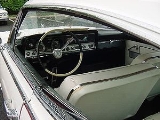
The other automotive usage of the term "hardtop" is a body style known as the hardtop convertible. A hardtop convertible is a fixed-roof model designed to look like a convertible with the top raised. While some early models retained side window frames and B-pillars, by the 1950s most were pillarless hardtops, omitting the B-pillar (the roof support behind the front doors) and configuring the window frames, if any, to retract with the glass when lowered. Some hardtops took the convertible look even further, including such details as simulating a convertible-top framework in the interior headliner and shaping the roof to resemble a raised canvas top. By the late 1960s such modifications were often superseded by a simple vinyl roof
Vinyl roof

Vinyl roof refers to a vinyl covering for an automobile's top. This covering was originally designed to give the appearance of a convertible to models with a fixed roof, but eventually it evolved into a styling statement in its own right....
.

A pillarless hardtop is inherently less rigid than a pillared body, requiring extra underbody strength to prevent shake. Production hardtops commonly shared the frame
Chassis

A chassis consists of a Frame that supports an inanimate object, analogous to an animal's skeleton, for example in a motor vehicle or a firearm....
 or reinforced body structure of the contemporary convertible model, which was already reinforced to compensate for the lack of a fixed roof. With such a reinforced frame, a hardtop was stronger and stiffer than a convertible, but both weaker and (because of the reinforcements) heavier than a pillared body.

There were a variety of hardtop-like body styles dating back to at least the 1920s. Chrysler Corporation showed a pillarless Town and Country hardtop coupe as a concept vehicle in 1946, but the car never went into production. The trend-setter for mass-production hardtops was General Motors, which launched two-door, pillarless hardtops in 1949 as the Buick Roadmaster
Buick Roadmaster

The Roadmaster was an automobile built by the Buick division of General Motors. Buick first used the Roadmaster name between 1936 and 1958. In 1991, Buick again applied the Roadmaster name to its full-size rear-wheel drive sedan and station wagon models as a replacement for the Buick Estate....
 Riviera, Oldsmobile 98
Oldsmobile 98

The Oldsmobile 98 was a full-size car automobile, as well as the List of flagship vehicles by manufacturer of the Oldsmobile division of General Motors in the United States....
 Holiday, and Cadillac Coupe de Ville
Cadillac Coupe de Ville

The Coupe deVille was a model of Cadillac from 1949 through 1993. The name has become famous through pop culture, with references in pop music, Film, and other media....
. They were purportedly inspired by the wife of a Buick executive who always drove convertibles, but never lowered the top. The hardtop became extremely popular in the 1950s, and by 1956 every major U.S. automaker offered hardtop coupé
Coupé

A coup? or coupe is a closed car body style, the precise definition of which varies from manufacturer to manufacturer, and over time. Coup?s are often hardtopped sports cars or sporty variants of sedan body styles, with doors commonly reduced from 4 to 2, and a Close-coupled sedan interior offering either two seats or 2+2 seating ....
s and four-door sedans in a particular model lineup. In 1955, Buick and Oldsmobile introduced the first 4 door hardtop sedans and Chevy and Pontiac even introduced "hardtop" (six pillar) two door wagons (the Nomad
Chevrolet Nomad

The Chevrolet Nomad was a station wagon model produced by the Chevrolet Division of General Motors. The Nomad is best remembered in its two-door 1955-57 form, and was considered a halo vehicle during its three-year production as a two-door station wagon....
 and Safari
Pontiac Safari

Safari was a name first applied to Pontiac's version of the 2-door Nomad station wagon. The body style, originally exhibited as a 1954 Chevrolet Corvette Motorama concept car, was shifted to Chevrolet and Pontiac full-size 1955 production vehicles because of the perceived greater sales potential....
, respectively), and in 1956 the first four-door hardtop station wagon
Station wagon

A station wagon in American English, Australian English, Canadian English and New Zealand English usage and an estate car in British English usage, is a passenger automobile with a car body style similar to a sedan but with the roofline following the full, sometimes extended rear cargo area, i.e. ending with a more vertical door...
 was introduced by Rambler
Rambler Six

The Rambler Six is an Mid-size car automobile that was built and sold by American Motors Corporation . The Rambler was sold under the Nash and Hudson brand names....
. In 1957, Mercury offered both two- and four-door hardtop wagons, the only brand to ever to do so. The type didn't didn't catch on, though, as most buyers considered wagons too boxy to benefit from the sporty look (or expensive enough to begin with). All disappeared from the market after 1964. The Facel Vega Excellence
Facel Vega Excellence

The Facel Vega Excellence was a luxury sedan produced by Facel Vega of Paris, France, from 1958 until the company ceased production in 1964, by when 152 had been built....
 is a notable French example of a four door hardtop from this period, noted for the huge opening with both doors on one side open and for sagging if all the doors were left open. The doors were designed for locking to the floor and not each other.

Throughout the 1960s the two-door pillarless hardtop was by far the most popular body style in most lines where such a model was offered. Even on family vehicles like the Chevrolet Impala
Chevrolet Impala

The Chevrolet Impala is a Full-size car automobile built by General Motors for their Chevrolet division. Ed Cole, Chevrolet's chief engineer in the late 1950s, defined the Impala as a "prestige car within the reach of the average American citizen."...
, the two-door hardtop regularly outsold four-door sedans.

The hardtop began to disappear along with convertibles in the mid-1970s, partly out of a concern that U.S. federal safety regulations would be difficult for pillarless models to pass. The ascendancy of monocoque
Monocoque

Monocoque, from Greek language for single and French for shell , is a construction technique that supports structural load by using an object's external skin as opposed to using an internal frame or truss that is then covered with a non-load-bearing skin....
 construction also made the pillarless design less practical. Some models adopted modified roof styling, placing the B pillars behind tinted side window glass and painting or molding the outer side of each pillar in black to make them less visible, creating a hardtop look without actually omitting the pillar. Some mid to late 1970s models continued their previous two-door hardtop bodies, but with fixed rear windows or a variety of vinyl roof and opera window
Opera window

Opera Windows are small porthole sized side windows in the C-pillar of some cars. Typically offered in unison with a vinyl roof, they were a very common design feature of USA automobiles during the 1970s....
 treatments. The U.S. industry's last true two-door and four-door hardtops were in the 1978 Chrysler Newport
Chrysler Newport

The Newport was a name used by the Chrysler division of the Chrysler Corporation used as both a hardtop body designation and also for its entry level model between 1961 and 1981....
 and New Yorker
Chrysler New Yorker

The Chrysler New Yorker was a premium automobile built by the Chrysler Corporation from 1939 to 1996, serving for several years as the brand's flagship vehicles model....
 lines.

Since then, no U.S. manufacturer has offered a true hardtop in regular production, although some German manufacturers, including BMW
BMW

, is an independent German automotive industry founded in 1916. It also produces BMW Motorrad, is the owner of the MINI brand and is the parent company of Rolls-Royce Motor Cars....
 and Mercedes-Benz
Mercedes-Benz

Mercedes-Benz is a German manufacturer of automobiles, buses, coach es, and trucks. It is currently a division of the parent company, Daimler AG , after previously being owned by Daimler-Benz....
 have offered upscale pillarless hardtops. Renault produced a three door hard top between 2001 and 2003 in the form of the Avantime
Renault Avantime

The Renault Avantime was a coup? automobile marketed by the France manufacturer Renault between 2001 and 2003. The car, which had a radical and unique design, suffered from very poor sales and was discontinued after only two years of production....
. Many Japanese domestic cars, particularly from Toyota and Nissan, are offered in hardtop form. British luxury carmaker Bentley
Bentley

Bentley Motors Limited is an English manufacturer of automobiles founded on 18 January 1919 by Walter Owen Bentley . Mr. Bentley had been previously known for his range of Rotary engine aircraft engines in World War I, the most famous being the Bentley BR1 as used in later versions of the Sopwith Camel....
 (owned by Volkswagen Group
Volkswagen Group

Volkswagen Group, or Volkswagen Aktiengesellschaft , is a German automotive industry group, currently the automotive industry#World's largest vehicle manufacturing groups , and the largest in Europe....
) sells two true hardtop coupes, the Continental GT fastback, and the new Brooklands
Brooklands

Brooklands was a 2.75 miles Auto racing circuit and airfield built near Weybridge in Surrey, England. It opened in 1907, and was the world's first purpose-built motorsport venue....
 coupe (2008). Other British pillarless hardtops included the attractive Sunbeam Rapier
Sunbeam Rapier

The Sunbeam Car Company Rapier was the first of the "Rootes Audax" range of light cars produced by the Rootes Group. Announced at a motor show in October 1955, it preceded its Hillman Minx and Singer Gazelle counterparts by several months....
 and the glitzy Ford Consul Capri (355)
Ford Capri

Ford Capri was a name used by the Ford Motor Company for three separate automobile models:* The Ford Consul Capri coupe, produced by Ford of Great Britain between 1961 and 1964...
 which, unlike America, sold fewer cars than their saloon cousins. The body style was thought to be making a comeback, as concept versions of the Dodge Challenger
Dodge Challenger

Dodge Challenger is the name of three different automobile models marketed by the Dodge division of Chrysler LLC since 1970....
 and Chevrolet Camaro
Chevrolet Camaro

The Chevrolet Camaro is a pony car manufactured by the Chevrolet division of General Motors. It went on sale on September 29, 1966 for the 1967 model year and was designed as a competing model to the Ford Mustang....
 shown in 2006 were both two-door hardtops, though both companies have stated that production versions will contain a B Pillar to keep the prices low. Another pillar-less design was featured in the 2007 model concept for the Chrysler 300C
Chrysler 300C

The Chrysler Corporation has used the designation Chrysler 300C to refer to two different vehicles, which are described in separate articles.* The 1957 Chrysler 300C, that year's version of the Chrysler 300 letter series; a large, high-performance luxury coupe sold in very limited numbers....
.

See also

  • Car body style
    Car body style

    Automobile can come in a large variety of different body styles. Some are still in production, while others are of historical interest only. These styles are largely independent of a car classification in terms of price, size and intended broad market; the same car model might be available in multiple body styles ....