

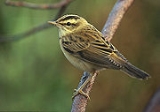
Sedge Warbler

Encyclopedia
The Sedge Warbler is an Old World warbler
in the genus Acrocephalus
. It is a medium-sized warbler with a brown, streaked back and wings and a distinct pale supercilium
. Sedge Warblers are migratory
, crossing the Sahara
to get from their Europe
an and Asia
n breeding grounds to spend winter in Africa
. The male's song is composed of random chattering phrases and can include mimicry of other species. The Sedge Warbler is mostly insectivorous
.
, the crown is streaked with black, and the bill is strong and pointed. The legs are greyish.
The plumage
of the sexes is identical, although they can be told apart when caught for ringing
by the presence of a brood patch
or cloacal protuberance
. Juvenile birds have dark spots on the breast. They can be easier to confuse with Aquatic Warbler
s due to an apparent pale central crown stripe contrasting with the darker edges. Other similar species include Moustached Warbler
s and Pallas's Grasshopper-warblers. The oldest recorded Sedge Warbler was a bird ringed in Finland
which reached the age of 10 years, 1 month. The typical lifespan is 2 years.
in his Systema naturae in 1758 (British ornithologists did not distinguish the species from the Eurasian Reed Warbler until the 18th Century). Its scientific name is derived from the Greek
akros, meaning 'pointed', and kephale ('head'), skhoiniklos ('reed') and baino ('to walk'). It is monotypic.
. Data analysis by the British Trust for Ornithology
has shown that fluctuations in the Sedge Warbler population stem from the adult survival rate, due to changes in rainfall on the birds' wintering grounds. Global changes in population have not been measured, but the Sedge Warbler's status is designated 'of Least Concern' by BirdLife International
.
It breeds across Europe
and western and central Asia
and is migratory
. After feeding up post-breeding, they migrate quickly across southern Europe and the Sahara from August to September. Studies in Nigeria
and Uganda
suggest that Sedge Warblers return to spend winter at the same sites, year after year.
All Sedge Warblers spend winter in sub-Sahara
n Africa, from Senegal
in the west to Ethiopia
in the east, and as far south as the eastern Cape Province
of South Africa
and northern Namibia
. The route taken on the southward migration, and eventual wintering grounds, correspond to the birds' breeding grounds. Birds ringed in the United Kingdom
and Netherlands
are later found from south-west Iberia
to Italy
; birds from Sweden
are recovered in central Europe and Italy; while Finnish
birds are found in north-east Italy and Malta
east to the Aegean
region. Sedge Warblers from the former Soviet Union
take routes via the eastern Mediterranean Sea
and Middle East
.
Loss of wetland areas for feeding on migration, and the expansion of the Sahara desert, pose threats to the Sedge Warbler's breeding population. Birds begin leaving Africa in late February, fatten up at wetlands before and probably after crossing the Sahara, and arrive in Europe
from March onwards.
Unlike other members of the Acrocephalus
genus, the Sedge Warbler's range stretches from the Arctic to mid-latitudes. It is adapted to cool, cloudy and moist conditions. Though it is often found in wetlands, it can breed 500 metres or more away from water. During the breeding season, this is a species found in reedbeds, often with scrub, ditches and habitats away from water including hedgerows, patches of Stinging Nettle
s, and arable crops. On the African wintering grounds, habitats such as reeds at wetlands, papyrus, grass, sedge and reedmace and tall elephant grass are used. It can be found at altitudes of 1,800–2,400 metres above sea level in Ethiopia.
Male Sedge Warblers commence singing only a few hours after arriving on their breeding territory. The song is given from a bare perch such as a reed stem or bush, or from cover and during routine flights within their territory. Song-flights are also performed: while singing, the bird takes off, rises to a height of around 2–5 metres and then after a short circling flight, makes a slow, 'parachuting' descent, often with the wings held up in a 'v' shape. The song has the function of attracting a mate, rather than keeping other males away, and is stopped as soon as a mate is found. Contact calls are described as 'chirr' or 'kerr'; these calls are repeated quickly to form a rattling alarm call.
Studies have found that male Sedge Warblers are often faithful to their breeding sites, but females are less so. A study in Nottinghamshire
, England
, showed that a third of males which returned bred within 50 m or less of their previous breeding site, and only 14% bred further than 400 m away. Pairs are usually monogamous, but not strictly so. Males occasionally practice bigamy and promiscuity. If eggs or chicks are predated, the female will often leave the male, who then resumes singing and pairs with another female. Hybridisation with the Eurasian Reed Warbler has been recorded.
The male defends a territory of around 0.1 to 0.2 hectares; in a study at Zaanstad
, Netherlands
, 68 territories were studied, with an average size of 1064 metres square one year, and 904 m sq the next. The nest, built by the female, is in vegetation on the ground or up to a height of 50 cm. The cup-shaped structure has an outer layer of grass, stems and leaves, plus spiders' webs, with a thick, finer layer inside including reed flowers, animal hair and plant down. It is woven around vertical plant stems. Between 3-5 greenish-yellow and brown-mottled egg
s are laid, measuring 18 x 13 mm and weighing 1.6 g each. They are incubated by the female for 14 days; the chicks are altricial
and naked. Both male and female care for the chicks, which fledge after 13–14 days. After leaving the nest, young Sedge Warblers continue begging for food from their parents for between 1–2 weeks after learning to fly.
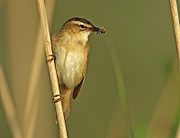 Prey taken by Sedge Warblers includes mayflies, dragonflies and damselflies
, grasshoppers
, bugs
, lacewings
, moths
, beetles
and flies
. Vegetable material includes elderberries and blackberries
. On their wintering grounds food includes non-biting midges
and flowers and berries from the Toothbrush Tree
.
In late July, prior to migration, it appears that Sedge Warblers seek out sites with large numbers of Plum-reed Aphids
and stay longer there than at other places; ringing studies show that birds may move considerable distances (e.g. from southern England
to northern France
) in search of food before beginning their actual migration. In Portugal
, the aphid supply dries up too early for Sedge Warblers to utilise it, so many birds do not stop off there and are already heavy with fat when they pass through. Birds with the heaviest fat reserves built up before migration are capable of non-stop flights from Africa to southern Britain, or from Uganda
to Iraq
, for example. Some double their normal weight when 'fuelling' for migration. Lighter birds are forced to make the journey in several shorter parts.
Sedge Warblers feed in low, thick vegetation, especially reeds and rushes, but also in arable fields and around bushes. A study at Attenborough, Nottinghamshire
in England
, found that the habitats used for foraging during the breeding season were 47% marshland, mostly Glyceria
grasses, 26% shrub, 21% field vegetation and 6% woodland. Feeding techniques include 'picking' insects from vegetation while perched or sometimes hovering, and 'leap-catching', when the bird grabs flying insects as it flies between perches. Sedge Warblers tend to hop between plant stems and pick insects from underneath leaves; they take advantage of the low temperatures around dusk and dawn which make their prey less mobile.
Old World warbler
The "Old World Warblers" is the name used to describe a large group of birds formerly grouped together in the bird family Sylviidae. The family held over 400 species in over 70 genera, and were the source of much taxonomic confusion. Two families were split out initially, the cisticolas into...
in the genus Acrocephalus
Acrocephalus
The Acrocephalus warblers are small, insectivorous passerine birds belonging to the genus Acrocephalus. Formerly in the paraphyletic Old World warbler assemblage, they are now separated as the namesake of the marsh- and tree-warbler family Acrocephalidae...
. It is a medium-sized warbler with a brown, streaked back and wings and a distinct pale supercilium
Supercilium
The supercilium is a plumage feature found on the heads of some bird species. It is a stripe which runs from the base of the bird's beak above its eye, finishing somewhere towards the rear of the bird's head. Also known as an "eyebrow", it is distinct from the eyestripe, which is a line which runs...
. Sedge Warblers are migratory
Bird migration
Bird migration is the regular seasonal journey undertaken by many species of birds. Bird movements include those made in response to changes in food availability, habitat or weather. Sometimes, journeys are not termed "true migration" because they are irregular or in only one direction...
, crossing the Sahara
Sahara
The Sahara is the world's second largest desert, after Antarctica. At over , it covers most of Northern Africa, making it almost as large as Europe or the United States. The Sahara stretches from the Red Sea, including parts of the Mediterranean coasts, to the outskirts of the Atlantic Ocean...
to get from their Europe
Europe
Europe is, by convention, one of the world's seven continents. Comprising the westernmost peninsula of Eurasia, Europe is generally 'divided' from Asia to its east by the watershed divides of the Ural and Caucasus Mountains, the Ural River, the Caspian and Black Seas, and the waterways connecting...
an and Asia
Asia
Asia is the world's largest and most populous continent, located primarily in the eastern and northern hemispheres. It covers 8.7% of the Earth's total surface area and with approximately 3.879 billion people, it hosts 60% of the world's current human population...
n breeding grounds to spend winter in Africa
Africa
Africa is the world's second largest and second most populous continent, after Asia. At about 30.2 million km² including adjacent islands, it covers 6% of the Earth's total surface area and 20.4% of the total land area...
. The male's song is composed of random chattering phrases and can include mimicry of other species. The Sedge Warbler is mostly insectivorous
Insectivore
An insectivore is a type of carnivore with a diet that consists chiefly of insects and similar small creatures. An alternate term is entomophage, which also refers to the human practice of eating insects....
.
Description
This is a medium-sized warbler, long and weighing around 12 g. It has a streaked brown back and wings, and pale underparts. The rump is warm brown and unstreaked, contrasting with the duller wings. The forehead is flattened, there is a prominent whitish superciliumSupercilium
The supercilium is a plumage feature found on the heads of some bird species. It is a stripe which runs from the base of the bird's beak above its eye, finishing somewhere towards the rear of the bird's head. Also known as an "eyebrow", it is distinct from the eyestripe, which is a line which runs...
, the crown is streaked with black, and the bill is strong and pointed. The legs are greyish.
The plumage
Plumage
Plumage refers both to the layer of feathers that cover a bird and the pattern, colour, and arrangement of those feathers. The pattern and colours of plumage vary between species and subspecies and can also vary between different age classes, sexes, and season. Within species there can also be a...
of the sexes is identical, although they can be told apart when caught for ringing
Bird ringing
Bird ringing or bird banding is a technique used in the study of wild birds, by attaching a small, individually numbered, metal or plastic tag to their legs or wings, so that various aspects of the bird's life can be studied by the ability to re-find the same individual later...
by the presence of a brood patch
Brood patch
thumb|250px|Brood patch of [[Sand Martin]]A brood patch is a patch of featherless skin that is visible on the underside of birds during the nesting season. This patch of skin is well supplied with blood vessels at the surface making it possible for the birds to transfer heat to their eggs when...
or cloacal protuberance
Cloaca
In zoological anatomy, a cloaca is the posterior opening that serves as the only such opening for the intestinal, reproductive, and urinary tracts of certain animal species...
. Juvenile birds have dark spots on the breast. They can be easier to confuse with Aquatic Warbler
Aquatic Warbler
The Aquatic Warbler, Acrocephalus paludicola, is an Old World warbler in the genus Acrocephalus. It breeds in temperate eastern Europe and western Asia, with an estimated population of 15,000 pairs. It is migratory, wintering in west Africa...
s due to an apparent pale central crown stripe contrasting with the darker edges. Other similar species include Moustached Warbler
Moustached Warbler
The Moustached Warbler, Acrocephalus melanopogon, is an Old World warbler in the genus Acrocephalus. It breeds in southern Europe and southern temperate Asia with a few in north-west Africa. It is partially migratory...
s and Pallas's Grasshopper-warblers. The oldest recorded Sedge Warbler was a bird ringed in Finland
Finland
Finland , officially the Republic of Finland, is a Nordic country situated in the Fennoscandian region of Northern Europe. It is bordered by Sweden in the west, Norway in the north and Russia in the east, while Estonia lies to its south across the Gulf of Finland.Around 5.4 million people reside...
which reached the age of 10 years, 1 month. The typical lifespan is 2 years.
Taxonomy
The Sedge Warbler was first described by Carolus LinnaeusCarolus Linnaeus
Carl Linnaeus , also known after his ennoblement as , was a Swedish botanist, physician, and zoologist, who laid the foundations for the modern scheme of binomial nomenclature. He is known as the father of modern taxonomy, and is also considered one of the fathers of modern ecology...
in his Systema naturae in 1758 (British ornithologists did not distinguish the species from the Eurasian Reed Warbler until the 18th Century). Its scientific name is derived from the Greek
Greek language
Greek is an independent branch of the Indo-European family of languages. Native to the southern Balkans, it has the longest documented history of any Indo-European language, spanning 34 centuries of written records. Its writing system has been the Greek alphabet for the majority of its history;...
akros, meaning 'pointed', and kephale ('head'), skhoiniklos ('reed') and baino ('to walk'). It is monotypic.
Distribution and habitat
The Sedge Warbler has a large range and an estimated Global Extent of Occurrence of 10 million square kilometres, with a large global population including between 8.8 million and 15 million birds in EuropeEurope
Europe is, by convention, one of the world's seven continents. Comprising the westernmost peninsula of Eurasia, Europe is generally 'divided' from Asia to its east by the watershed divides of the Ural and Caucasus Mountains, the Ural River, the Caspian and Black Seas, and the waterways connecting...
. Data analysis by the British Trust for Ornithology
British Trust for Ornithology
The British Trust for Ornithology is an organisation founded in 1932 for the study of birds in the British Isles.-Activities:The BTO carries out research into the lives of birds, chiefly by conducting population and breeding surveys and by bird ringing, largely carried out by a large number of...
has shown that fluctuations in the Sedge Warbler population stem from the adult survival rate, due to changes in rainfall on the birds' wintering grounds. Global changes in population have not been measured, but the Sedge Warbler's status is designated 'of Least Concern' by BirdLife International
BirdLife International
BirdLife International is a global Partnership of conservation organisations that strives to conserve birds, their habitats and global biodiversity, working with people towards sustainability in the use of natural resources...
.
It breeds across Europe
Europe
Europe is, by convention, one of the world's seven continents. Comprising the westernmost peninsula of Eurasia, Europe is generally 'divided' from Asia to its east by the watershed divides of the Ural and Caucasus Mountains, the Ural River, the Caspian and Black Seas, and the waterways connecting...
and western and central Asia
Asia
Asia is the world's largest and most populous continent, located primarily in the eastern and northern hemispheres. It covers 8.7% of the Earth's total surface area and with approximately 3.879 billion people, it hosts 60% of the world's current human population...
and is migratory
Bird migration
Bird migration is the regular seasonal journey undertaken by many species of birds. Bird movements include those made in response to changes in food availability, habitat or weather. Sometimes, journeys are not termed "true migration" because they are irregular or in only one direction...
. After feeding up post-breeding, they migrate quickly across southern Europe and the Sahara from August to September. Studies in Nigeria
Nigeria
Nigeria , officially the Federal Republic of Nigeria, is a federal constitutional republic comprising 36 states and its Federal Capital Territory, Abuja. The country is located in West Africa and shares land borders with the Republic of Benin in the west, Chad and Cameroon in the east, and Niger in...
and Uganda
Uganda
Uganda , officially the Republic of Uganda, is a landlocked country in East Africa. Uganda is also known as the "Pearl of Africa". It is bordered on the east by Kenya, on the north by South Sudan, on the west by the Democratic Republic of the Congo, on the southwest by Rwanda, and on the south by...
suggest that Sedge Warblers return to spend winter at the same sites, year after year.
All Sedge Warblers spend winter in sub-Sahara
Sahara
The Sahara is the world's second largest desert, after Antarctica. At over , it covers most of Northern Africa, making it almost as large as Europe or the United States. The Sahara stretches from the Red Sea, including parts of the Mediterranean coasts, to the outskirts of the Atlantic Ocean...
n Africa, from Senegal
Senegal
Senegal , officially the Republic of Senegal , is a country in western Africa. It owes its name to the Sénégal River that borders it to the east and north...
in the west to Ethiopia
Ethiopia
Ethiopia , officially known as the Federal Democratic Republic of Ethiopia, is a country located in the Horn of Africa. It is the second-most populous nation in Africa, with over 82 million inhabitants, and the tenth-largest by area, occupying 1,100,000 km2...
in the east, and as far south as the eastern Cape Province
Cape Province
The Province of the Cape of Good Hope was a province in the Union of South Africa and subsequently the Republic of South Africa...
of South Africa
South Africa
The Republic of South Africa is a country in southern Africa. Located at the southern tip of Africa, it is divided into nine provinces, with of coastline on the Atlantic and Indian oceans...
and northern Namibia
Namibia
Namibia, officially the Republic of Namibia , is a country in southern Africa whose western border is the Atlantic Ocean. It shares land borders with Angola and Zambia to the north, Botswana to the east and South Africa to the south and east. It gained independence from South Africa on 21 March...
. The route taken on the southward migration, and eventual wintering grounds, correspond to the birds' breeding grounds. Birds ringed in the United Kingdom
United Kingdom
The United Kingdom of Great Britain and Northern IrelandIn the United Kingdom and Dependencies, other languages have been officially recognised as legitimate autochthonous languages under the European Charter for Regional or Minority Languages...
and Netherlands
Netherlands
The Netherlands is a constituent country of the Kingdom of the Netherlands, located mainly in North-West Europe and with several islands in the Caribbean. Mainland Netherlands borders the North Sea to the north and west, Belgium to the south, and Germany to the east, and shares maritime borders...
are later found from south-west Iberia
Iberian Peninsula
The Iberian Peninsula , sometimes called Iberia, is located in the extreme southwest of Europe and includes the modern-day sovereign states of Spain, Portugal and Andorra, as well as the British Overseas Territory of Gibraltar...
to Italy
Italy
Italy , officially the Italian Republic languages]] under the European Charter for Regional or Minority Languages. In each of these, Italy's official name is as follows:;;;;;;;;), is a unitary parliamentary republic in South-Central Europe. To the north it borders France, Switzerland, Austria and...
; birds from Sweden
Sweden
Sweden , officially the Kingdom of Sweden , is a Nordic country on the Scandinavian Peninsula in Northern Europe. Sweden borders with Norway and Finland and is connected to Denmark by a bridge-tunnel across the Öresund....
are recovered in central Europe and Italy; while Finnish
Finland
Finland , officially the Republic of Finland, is a Nordic country situated in the Fennoscandian region of Northern Europe. It is bordered by Sweden in the west, Norway in the north and Russia in the east, while Estonia lies to its south across the Gulf of Finland.Around 5.4 million people reside...
birds are found in north-east Italy and Malta
Malta
Malta , officially known as the Republic of Malta , is a Southern European country consisting of an archipelago situated in the centre of the Mediterranean, south of Sicily, east of Tunisia and north of Libya, with Gibraltar to the west and Alexandria to the east.Malta covers just over in...
east to the Aegean
Aegean Sea
The Aegean Sea[p] is an elongated embayment of the Mediterranean Sea located between the southern Balkan and Anatolian peninsulas, i.e., between the mainlands of Greece and Turkey. In the north, it is connected to the Marmara Sea and Black Sea by the Dardanelles and Bosporus...
region. Sedge Warblers from the former Soviet Union
Soviet Union
The Soviet Union , officially the Union of Soviet Socialist Republics , was a constitutionally socialist state that existed in Eurasia between 1922 and 1991....
take routes via the eastern Mediterranean Sea
Mediterranean Sea
The Mediterranean Sea is a sea connected to the Atlantic Ocean surrounded by the Mediterranean region and almost completely enclosed by land: on the north by Anatolia and Europe, on the south by North Africa, and on the east by the Levant...
and Middle East
Middle East
The Middle East is a region that encompasses Western Asia and Northern Africa. It is often used as a synonym for Near East, in opposition to Far East...
.
Loss of wetland areas for feeding on migration, and the expansion of the Sahara desert, pose threats to the Sedge Warbler's breeding population. Birds begin leaving Africa in late February, fatten up at wetlands before and probably after crossing the Sahara, and arrive in Europe
Europe
Europe is, by convention, one of the world's seven continents. Comprising the westernmost peninsula of Eurasia, Europe is generally 'divided' from Asia to its east by the watershed divides of the Ural and Caucasus Mountains, the Ural River, the Caspian and Black Seas, and the waterways connecting...
from March onwards.
Unlike other members of the Acrocephalus
Acrocephalus
The Acrocephalus warblers are small, insectivorous passerine birds belonging to the genus Acrocephalus. Formerly in the paraphyletic Old World warbler assemblage, they are now separated as the namesake of the marsh- and tree-warbler family Acrocephalidae...
genus, the Sedge Warbler's range stretches from the Arctic to mid-latitudes. It is adapted to cool, cloudy and moist conditions. Though it is often found in wetlands, it can breed 500 metres or more away from water. During the breeding season, this is a species found in reedbeds, often with scrub, ditches and habitats away from water including hedgerows, patches of Stinging Nettle
Stinging nettle
Stinging nettle or common nettle, Urtica dioica, is a herbaceous perennial flowering plant, native to Europe, Asia, northern Africa, and North America, and is the best-known member of the nettle genus Urtica...
s, and arable crops. On the African wintering grounds, habitats such as reeds at wetlands, papyrus, grass, sedge and reedmace and tall elephant grass are used. It can be found at altitudes of 1,800–2,400 metres above sea level in Ethiopia.
Breeding
The song is varied, rushed and chattering, with sweeter phrases and some mimicry, typical of the Acrocephalus warblers. It is composed of phrases in random order, so that it is never the same. Male Sedge Warblers which have the widest repertoire mate with the largest number of females.Male Sedge Warblers commence singing only a few hours after arriving on their breeding territory. The song is given from a bare perch such as a reed stem or bush, or from cover and during routine flights within their territory. Song-flights are also performed: while singing, the bird takes off, rises to a height of around 2–5 metres and then after a short circling flight, makes a slow, 'parachuting' descent, often with the wings held up in a 'v' shape. The song has the function of attracting a mate, rather than keeping other males away, and is stopped as soon as a mate is found. Contact calls are described as 'chirr' or 'kerr'; these calls are repeated quickly to form a rattling alarm call.
Studies have found that male Sedge Warblers are often faithful to their breeding sites, but females are less so. A study in Nottinghamshire
Nottinghamshire
Nottinghamshire is a county in the East Midlands of England, bordering South Yorkshire to the north-west, Lincolnshire to the east, Leicestershire to the south, and Derbyshire to the west...
, England
England
England is a country that is part of the United Kingdom. It shares land borders with Scotland to the north and Wales to the west; the Irish Sea is to the north west, the Celtic Sea to the south west, with the North Sea to the east and the English Channel to the south separating it from continental...
, showed that a third of males which returned bred within 50 m or less of their previous breeding site, and only 14% bred further than 400 m away. Pairs are usually monogamous, but not strictly so. Males occasionally practice bigamy and promiscuity. If eggs or chicks are predated, the female will often leave the male, who then resumes singing and pairs with another female. Hybridisation with the Eurasian Reed Warbler has been recorded.
The male defends a territory of around 0.1 to 0.2 hectares; in a study at Zaanstad
Zaanstad
Zaanstad is a municipality in the Netherlands, in the province of North Holland. Its main town is Zaandam. It is part of the metropolitan area of Amsterdam.-Population centres:...
, Netherlands
Netherlands
The Netherlands is a constituent country of the Kingdom of the Netherlands, located mainly in North-West Europe and with several islands in the Caribbean. Mainland Netherlands borders the North Sea to the north and west, Belgium to the south, and Germany to the east, and shares maritime borders...
, 68 territories were studied, with an average size of 1064 metres square one year, and 904 m sq the next. The nest, built by the female, is in vegetation on the ground or up to a height of 50 cm. The cup-shaped structure has an outer layer of grass, stems and leaves, plus spiders' webs, with a thick, finer layer inside including reed flowers, animal hair and plant down. It is woven around vertical plant stems. Between 3-5 greenish-yellow and brown-mottled egg
Egg (biology)
An egg is an organic vessel in which an embryo first begins to develop. In most birds, reptiles, insects, molluscs, fish, and monotremes, an egg is the zygote, resulting from fertilization of the ovum, which is expelled from the body and permitted to develop outside the body until the developing...
s are laid, measuring 18 x 13 mm and weighing 1.6 g each. They are incubated by the female for 14 days; the chicks are altricial
Altricial
Altricial, meaning "requiring nourishment", refers to a pattern of growth and development in organisms which are incapable of moving around on their own soon after hatching or being born...
and naked. Both male and female care for the chicks, which fledge after 13–14 days. After leaving the nest, young Sedge Warblers continue begging for food from their parents for between 1–2 weeks after learning to fly.
Food and feeding
Odonata
Odonata is an order of insects, encompassing dragonflies and damselflies . The word dragonfly is also sometimes used to refer to all Odonata, but the back-formation odonate is a more correct English name for the group as a whole...
, grasshoppers
Orthoptera
Orthoptera is an order of insects with paurometabolous or incomplete metamorphosis, including the grasshoppers, crickets and locusts.Many insects in this order produce sound by rubbing their wings against each other or their legs, the wings or legs containing rows of corrugated bumps...
, bugs
Hemiptera
Hemiptera is an order of insects most often known as the true bugs , comprising around 50,000–80,000 species of cicadas, aphids, planthoppers, leafhoppers, shield bugs, and others...
, lacewings
Neuroptera
The insect order Neuroptera, or net-winged insects, includes the lacewings, mantidflies, antlions, and their relatives. The order contains some 6,010 species...
, moths
Lepidoptera
Lepidoptera is a large order of insects that includes moths and butterflies . It is one of the most widespread and widely recognizable insect orders in the world, encompassing moths and the three superfamilies of butterflies, skipper butterflies, and moth-butterflies...
, beetles
Coleopter
A coleopter is a type of Vertical Take-Off and Landing aircraft design that uses a ducted fan as the primary fuselage of the entire aircraft. Generally they appear to be a large barrel-like extension at the rear, with a small cockpit area suspended above it. Like most ducted fan designs, coleopters...
and flies
Hymenoptera
Hymenoptera is one of the largest orders of insects, comprising the sawflies, wasps, bees and ants. There are over 130,000 recognized species, with many more remaining to be described. The name refers to the heavy wings of the insects, and is derived from the Ancient Greek ὑμήν : membrane and...
. Vegetable material includes elderberries and blackberries
Rubus
Rubus is a large genus of flowering plants in the rose family, Rosaceae, subfamily Rosoideae. Raspberries, blackberries, and dewberries are common, widely distributed members of the genus. Most of these plants have woody stems with prickles like roses; spines, bristles, and gland-tipped hairs are...
. On their wintering grounds food includes non-biting midges
Chironomidae
Chironomidae are a family of nematoceran flies with a global distribution. They are closely related to the Ceratopogonidae, Simuliidae, and Thaumaleidae...
and flowers and berries from the Toothbrush Tree
Salvadora persica
Salvadora persica , is a species of Salvadora....
.
In late July, prior to migration, it appears that Sedge Warblers seek out sites with large numbers of Plum-reed Aphids
Aphididae
Aphididae is a very large insect family in the aphid superfamily , of the order Hemiptera. There are several thousand species in this family, many of which are well known for being serious plant pests...
and stay longer there than at other places; ringing studies show that birds may move considerable distances (e.g. from southern England
England
England is a country that is part of the United Kingdom. It shares land borders with Scotland to the north and Wales to the west; the Irish Sea is to the north west, the Celtic Sea to the south west, with the North Sea to the east and the English Channel to the south separating it from continental...
to northern France
France
The French Republic , The French Republic , The French Republic , (commonly known as France , is a unitary semi-presidential republic in Western Europe with several overseas territories and islands located on other continents and in the Indian, Pacific, and Atlantic oceans. Metropolitan France...
) in search of food before beginning their actual migration. In Portugal
Portugal
Portugal , officially the Portuguese Republic is a country situated in southwestern Europe on the Iberian Peninsula. Portugal is the westernmost country of Europe, and is bordered by the Atlantic Ocean to the West and South and by Spain to the North and East. The Atlantic archipelagos of the...
, the aphid supply dries up too early for Sedge Warblers to utilise it, so many birds do not stop off there and are already heavy with fat when they pass through. Birds with the heaviest fat reserves built up before migration are capable of non-stop flights from Africa to southern Britain, or from Uganda
Uganda
Uganda , officially the Republic of Uganda, is a landlocked country in East Africa. Uganda is also known as the "Pearl of Africa". It is bordered on the east by Kenya, on the north by South Sudan, on the west by the Democratic Republic of the Congo, on the southwest by Rwanda, and on the south by...
to Iraq
Iraq
Iraq ; officially the Republic of Iraq is a country in Western Asia spanning most of the northwestern end of the Zagros mountain range, the eastern part of the Syrian Desert and the northern part of the Arabian Desert....
, for example. Some double their normal weight when 'fuelling' for migration. Lighter birds are forced to make the journey in several shorter parts.
Sedge Warblers feed in low, thick vegetation, especially reeds and rushes, but also in arable fields and around bushes. A study at Attenborough, Nottinghamshire
Attenborough, Nottinghamshire
Attenborough is a village and a suburb in the Broxtowe borough of Nottinghamshire. It forms part of Greater Nottingham, and is to the southwest of Nottingham, between Long Eaton and Beeston...
in England
England
England is a country that is part of the United Kingdom. It shares land borders with Scotland to the north and Wales to the west; the Irish Sea is to the north west, the Celtic Sea to the south west, with the North Sea to the east and the English Channel to the south separating it from continental...
, found that the habitats used for foraging during the breeding season were 47% marshland, mostly Glyceria
Glyceria
Glyceria is a genus of grasses known commonly as mannagrass or, as referred to in the UK, sweet-grass. These are perennial rhizomatous grasses found in wet areas in temperate regions worldwide. The base of the grass grows along the ground and may root at several places. Then it grows erect and...
grasses, 26% shrub, 21% field vegetation and 6% woodland. Feeding techniques include 'picking' insects from vegetation while perched or sometimes hovering, and 'leap-catching', when the bird grabs flying insects as it flies between perches. Sedge Warblers tend to hop between plant stems and pick insects from underneath leaves; they take advantage of the low temperatures around dusk and dawn which make their prey less mobile.
Further reading
- Ageing and sexing (PDF) by Javier Blasco-Zumeta
- The RSPB: Sedge warbler page with sound file and images