

Neuroptera

Encyclopedia
The insect
order
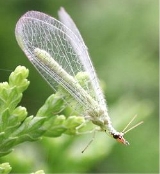
Neuroptera, or net-winged insects, includes the lacewings, mantidflies, antlion
s, and their relatives. The order contains some 6,010 species
. Traditionally, the group that was once known as Planipennia, with the Neuroptera at that time also including alderflies
, fishflies
, dobsonflies
and snakeflies
, but these are now generally considered to be separate orders (the Megaloptera
and Raphidioptera). Sometimes the name Neuropterida
is used to refer to these three orders as a group. This is either placed at superorder rank, with the Endopterygota
becoming an unranked clade
above it, or the Endopterygota are maintained as a superorder, with an unranked Neuropterida being a part of them. Within the endopterygotes, the closest living relatives of the neuropteridan clade are the beetle
s. The common name lacewings is often used for the most widely known net-winged insects - the green lacewings (Chrysopidae) - but actually most members of the Neuroptera are referred to as some sort of "lacewing".
The adults of this order possess four membranous wings, with the forewings and hindwings about the same size, and with many vein
s. They have chewing mouthparts, and undergo complete metamorphosis.
Neuropterans first appeared during the Permian
Period, and continued to diversify through the Mesozoic Era. During this time several unusually large forms evolved, especially in the extinct family
Kalligrammatidae, often referred to as "the butterflies of the Jurassic
" due to their large, patterned wings.
suitable for chewing, and lack the various adaptations found in most other endopterygote
insect groups.
They have four wings, which are usually similar in size and shape, have a generalised pattern of veins. Some Neuropterans have specialised sense organs in their wings, or have bristles or other structures to link their wings together during flight.
The larvae are specialised predators, with elongated mandibles adapted for piercing and sucking. The larval body form varies between different families, depending on the nature of their prey. In general, however, they have three pairs of thoracic legs, each ending in two claws. The abdomen
often has adhesive discs on the last two segments.
The larvae of most families are predators. Many chrysopids
eat aphids and other pest insects, and have been used for biological control (either from commercial distributors but also abundant and widespread in nature). Larvae in various families cover themselves in debris (sometimes including dead prey insects) as camouflage
, taken to an extreme in the ant lions, which bury themselves completely out of sight and ambush prey from "pits" in the soil. Larvae of some Ithonidae
are root feeders, and larvae of Sisyridae
are aquatic, and feed on freshwater
sponges. A few mantispids are parasites of spider
egg sacs.
As in other holometabolic
orders, there is a pupa
l stage, generally enclosed in some form of cocoon composed of silk and soil or other debris. The pupa eventually cuts its way out of the cocoon with its mandibles, and may even move about for a short while before undergoing the moult
to the adult form.
Adults of many groups are also predatory, but some do not feed, or consume only nectar.
record. In 1995, for example, it was simply known that the Megaloptera
and Raphidioptera were not part of the Neuroptera in the strict sense, and the Mantispoidea and part of the Myrmeleontoidea were the only groups that could be confirmed by cladistic analysis. Though the relationships of some families
remain to be fully understood, most major lineages of Neuropterida can nowadays be robustly placed in an evolution
ary context.
Apart from a few groups that are quite basal or of uncertain position, the net-winged insects can be divided into two suborders, the Myrmeleontiformia and the Hemerobiiformia. The primitive Nevrorthidae
, the most ancient group of living neuropterans, are sometimes considered a third suborder Nevrorthiformia or included in the Hemerobiiformia and more specifically in the Osmyloidea. But actually they are better considered a very basal lineage.
Basal and unresolved forms
Suborder Hemerobiiformia
Suborder Myrmeleontiformia
Insect
Insects are a class of living creatures within the arthropods that have a chitinous exoskeleton, a three-part body , three pairs of jointed legs, compound eyes, and two antennae...
order
Order (biology)
In scientific classification used in biology, the order is# a taxonomic rank used in the classification of organisms. Other well-known ranks are life, domain, kingdom, phylum, class, family, genus, and species, with order fitting in between class and family...
Neuroptera, or net-winged insects, includes the lacewings, mantidflies, antlion
Antlion
Antlions are a group of insects in the family Myrmeleontidae . The most well-known genus is Myrmeleo. There are about 2,000 species...
s, and their relatives. The order contains some 6,010 species
Species
In biology, a species is one of the basic units of biological classification and a taxonomic rank. A species is often defined as a group of organisms capable of interbreeding and producing fertile offspring. While in many cases this definition is adequate, more precise or differing measures are...
. Traditionally, the group that was once known as Planipennia, with the Neuroptera at that time also including alderflies
Alderfly
Alderflies are megalopteran insects of the family Sialidae. They are closely related to the dobsonflies and fishflies as well as to the prehistoric Euchauliodidae. All living alderflies - about 66 species altogether - are part of the subfamily Sialinae, which contains between one and seven extant...
, fishflies
Fishfly
Fishflies are the members of the subfamily Chauliodinae, belonging to the megalopteran family Corydalidae. They are most easily distinguished from their closest relatives, dobsonflies, by the jaws and antennae...
, dobsonflies
Dobsonfly
A Dobsonfly is any insect of the subfamily Corydalinae, part of the megalopteran family Corydalidae. There are over 220 species of dobsonflies. Dobsonflies are found throughout the Americas and Asia, as well as South Africa...
and snakeflies
Snakefly
Snakeflies are a group of insects in the order Raphidioptera, consisting of about 210 extant species. Together with the Megaloptera they were formerly placed within the Neuroptera, but now these two are generally regarded as separate orders....
, but these are now generally considered to be separate orders (the Megaloptera
Megaloptera
Megaloptera is an order of insects. It contains the alderflies, dobsonflies and fishflies, and there are about 300 known species.The Megaloptera were formerly considered part of a group then called Neuroptera, together with lacewings and snakeflies, but these are now generally considered to be...
and Raphidioptera). Sometimes the name Neuropterida
Neuropterida
The Neuropterida are a clade of holometabolous insects. Well-known members are the lacewings, antlions and dobsonflies.Historically, they were known as Neuroptera, but this name nowadays refers to lacewings and their relatives only, which formerly were known as Planipennia...
is used to refer to these three orders as a group. This is either placed at superorder rank, with the Endopterygota
Endopterygota
The Endopterygota, also known as Holometabola, are insects of the subclass Pterygota which go through distinctive larval, pupal, and adult stages. They undergo a radical metamorphosis, with the larval and adult stages differing considerably in their structure and behaviour...
becoming an unranked clade
Clade
A clade is a group consisting of a species and all its descendants. In the terms of biological systematics, a clade is a single "branch" on the "tree of life". The idea that such a "natural group" of organisms should be grouped together and given a taxonomic name is central to biological...
above it, or the Endopterygota are maintained as a superorder, with an unranked Neuropterida being a part of them. Within the endopterygotes, the closest living relatives of the neuropteridan clade are the beetle
Beetle
Coleoptera is an order of insects commonly called beetles. The word "coleoptera" is from the Greek , koleos, "sheath"; and , pteron, "wing", thus "sheathed wing". Coleoptera contains more species than any other order, constituting almost 25% of all known life-forms...
s. The common name lacewings is often used for the most widely known net-winged insects - the green lacewings (Chrysopidae) - but actually most members of the Neuroptera are referred to as some sort of "lacewing".
The adults of this order possess four membranous wings, with the forewings and hindwings about the same size, and with many vein
Vein
In the circulatory system, veins are blood vessels that carry blood towards the heart. Most veins carry deoxygenated blood from the tissues back to the heart; exceptions are the pulmonary and umbilical veins, both of which carry oxygenated blood to the heart...
s. They have chewing mouthparts, and undergo complete metamorphosis.
Neuropterans first appeared during the Permian
Permian
The PermianThe term "Permian" was introduced into geology in 1841 by Sir Sir R. I. Murchison, president of the Geological Society of London, who identified typical strata in extensive Russian explorations undertaken with Edouard de Verneuil; Murchison asserted in 1841 that he named his "Permian...
Period, and continued to diversify through the Mesozoic Era. During this time several unusually large forms evolved, especially in the extinct family
Family (biology)
In biological classification, family is* a taxonomic rank. Other well-known ranks are life, domain, kingdom, phylum, class, order, genus, and species, with family fitting between order and genus. As for the other well-known ranks, there is the option of an immediately lower rank, indicated by the...
Kalligrammatidae, often referred to as "the butterflies of the Jurassic
Jurassic
The Jurassic is a geologic period and system that extends from about Mya to Mya, that is, from the end of the Triassic to the beginning of the Cretaceous. The Jurassic constitutes the middle period of the Mesozoic era, also known as the age of reptiles. The start of the period is marked by...
" due to their large, patterned wings.
Anatomy and biology
Neuropterans are soft-bodied insects with relatively few specialised features. They have large lateral compound eyes, and may or may not also have ocelli. Their mouthparts have strong mandiblesMandible (arthropod)
thumb|250px|The mandibles of a [[Bull ant]]The mandible of an arthropod is either of a pair of mouthparts used for biting, cutting and holding food. Mandibles are often simply referred to as jaws. Mandibles are present in the extant subphyla Myriapoda , Crustacea and Hexapoda...
suitable for chewing, and lack the various adaptations found in most other endopterygote
Endopterygota
The Endopterygota, also known as Holometabola, are insects of the subclass Pterygota which go through distinctive larval, pupal, and adult stages. They undergo a radical metamorphosis, with the larval and adult stages differing considerably in their structure and behaviour...
insect groups.
They have four wings, which are usually similar in size and shape, have a generalised pattern of veins. Some Neuropterans have specialised sense organs in their wings, or have bristles or other structures to link their wings together during flight.
The larvae are specialised predators, with elongated mandibles adapted for piercing and sucking. The larval body form varies between different families, depending on the nature of their prey. In general, however, they have three pairs of thoracic legs, each ending in two claws. The abdomen
Abdomen
In vertebrates such as mammals the abdomen constitutes the part of the body between the thorax and pelvis. The region enclosed by the abdomen is termed the abdominal cavity...
often has adhesive discs on the last two segments.
Life cycle and ecology
 |
|
The larvae of most families are predators. Many chrysopids
Chrysopidae
Green lacewings are insects in the large family Chrysopidae of the order Neuroptera. There are about 85 genera and 1,300–2,000 species in this widespread group...
eat aphids and other pest insects, and have been used for biological control (either from commercial distributors but also abundant and widespread in nature). Larvae in various families cover themselves in debris (sometimes including dead prey insects) as camouflage
Camouflage
Camouflage is a method of concealment that allows an otherwise visible animal, military vehicle, or other object to remain unnoticed, by blending with its environment. Examples include a leopard's spotted coat, the battledress of a modern soldier and a leaf-mimic butterfly...
, taken to an extreme in the ant lions, which bury themselves completely out of sight and ambush prey from "pits" in the soil. Larvae of some Ithonidae
Ithonidae
The Ithonidae or moth lacewings are a small family of winged insects of the insect order Neuroptera. This family contains a total of nine genera, seven living and two extinct. The modern moth lacewings have a notably disjunct distribution while the extinct genera had a more global range. The family...
are root feeders, and larvae of Sisyridae
Sisyridae
The Sisyridae, commonly known as spongeflies or spongillaflies, is a family of winged insects of the order Neuroptera. Approximately 60 living species are known.-Description:...
are aquatic, and feed on freshwater
Freshwater
Fresh water is naturally occurring water on the Earth's surface in ice sheets, ice caps, glaciers, bogs, ponds, lakes, rivers and streams, and underground as groundwater in aquifers and underground streams. Fresh water is generally characterized by having low concentrations of dissolved salts and...
sponges. A few mantispids are parasites of spider
Spider
Spiders are air-breathing arthropods that have eight legs, and chelicerae with fangs that inject venom. They are the largest order of arachnids and rank seventh in total species diversity among all other groups of organisms...
egg sacs.
As in other holometabolic
Holometabolism
Holometabolism, also called complete metamorphism, is a term applied to insect groups to describe the specific kind of insect development which includes four life stages - as an embryo or egg, a larva, a pupa and an imago or adult. Holometabolism is a monophyletic trait that all insects in the...
orders, there is a pupa
Pupa
A pupa is the life stage of some insects undergoing transformation. The pupal stage is found only in holometabolous insects, those that undergo a complete metamorphosis, going through four life stages; embryo, larva, pupa and imago...
l stage, generally enclosed in some form of cocoon composed of silk and soil or other debris. The pupa eventually cuts its way out of the cocoon with its mandibles, and may even move about for a short while before undergoing the moult
Ecdysis
Ecdysis is the moulting of the cuticula in many invertebrates. This process of moulting is the defining feature of the clade Ecdysozoa, comprising the arthropods, nematodes, velvet worms, horsehair worms, rotifers, tardigrades and Cephalorhyncha...
to the adult form.
Adults of many groups are also predatory, but some do not feed, or consume only nectar.
Taxonomy and systematics
The understanding of neuropteran phylogeny has vastly improved since the mid-1990s, not the least courtesy of the ever-growing fossilFossil
Fossils are the preserved remains or traces of animals , plants, and other organisms from the remote past...
record. In 1995, for example, it was simply known that the Megaloptera
Megaloptera
Megaloptera is an order of insects. It contains the alderflies, dobsonflies and fishflies, and there are about 300 known species.The Megaloptera were formerly considered part of a group then called Neuroptera, together with lacewings and snakeflies, but these are now generally considered to be...
and Raphidioptera were not part of the Neuroptera in the strict sense, and the Mantispoidea and part of the Myrmeleontoidea were the only groups that could be confirmed by cladistic analysis. Though the relationships of some families
Family (biology)
In biological classification, family is* a taxonomic rank. Other well-known ranks are life, domain, kingdom, phylum, class, order, genus, and species, with family fitting between order and genus. As for the other well-known ranks, there is the option of an immediately lower rank, indicated by the...
remain to be fully understood, most major lineages of Neuropterida can nowadays be robustly placed in an evolution
Evolution
Evolution is any change across successive generations in the heritable characteristics of biological populations. Evolutionary processes give rise to diversity at every level of biological organisation, including species, individual organisms and molecules such as DNA and proteins.Life on Earth...
ary context.
Apart from a few groups that are quite basal or of uncertain position, the net-winged insects can be divided into two suborders, the Myrmeleontiformia and the Hemerobiiformia. The primitive Nevrorthidae
Nevrorthidae
The Nevrorthidae - often incorrectly spelled "Neurorthidae" - are a small family of winged insects of the order Neuroptera. They are a living fossil....
, the most ancient group of living neuropterans, are sometimes considered a third suborder Nevrorthiformia or included in the Hemerobiiformia and more specifically in the Osmyloidea. But actually they are better considered a very basal lineage.
Basal and unresolved forms
- Genus Mantispidiptera Grimaldi, 2000 (Late Cretaceous; New Jersey; formerly Mantispidae)
- Genus Mesohemerobius Ping, 1928(Late Jurassic/Early Cretaceous; China)
- Family Permithonidae (fossil, probably paraphyletic)
- Family Prohemerobiidae (fossil, probably paraphyletic)
- Family NevrorthidaeNevrorthidaeThe Nevrorthidae - often incorrectly spelled "Neurorthidae" - are a small family of winged insects of the order Neuroptera. They are a living fossil....
- Family Grammosmylidae (fossil)
Suborder Hemerobiiformia
- Incertae sedisIncertae sedis, is a term used to define a taxonomic group where its broader relationships are unknown or undefined. Uncertainty at specific taxonomic levels is attributed by , , and similar terms.-Examples:*The fossil plant Paradinandra suecica could not be assigned to any...
- Family Osmylitidae (fossil, probably paraphyletic)
- Superfamily Ithonioidea
- Family IthonidaeIthonidaeThe Ithonidae or moth lacewings are a small family of winged insects of the insect order Neuroptera. This family contains a total of nine genera, seven living and two extinct. The modern moth lacewings have a notably disjunct distribution while the extinct genera had a more global range. The family...
: moth lacewings (includes Rapismatidae) - Family PolystoechotidaePolystoechotidaeThe Polystoechotidae or giant lacewings are a small family of winged insects of the insect order Neuroptera. This family contains three living and seven extinct genera. The modern giant lacewings have a notably disjunct distribution while the extinct genera had a more global range. The family is...
: giant lacewings (formerly in Hemerobioidea)
- Family Ithonidae
- Superfamily Osmyloidea
- Family OsmylidaeOsmylidaeOsmylidae are a small family of winged insects of the net-winged insect order Neuroptera. The osmylids are found all over the world except in North America. A common species through most of Europe is Osmylus fulvicephalus.-Description and ecology:...
: osmylids
- Family Osmylidae
- Superfamily Chrysopoidea
- Family Ascalochrysidae (fossil)
- Family Mesochrysopidae (fossil)
- Family ChrysopidaeChrysopidaeGreen lacewings are insects in the large family Chrysopidae of the order Neuroptera. There are about 85 genera and 1,300–2,000 species in this widespread group...
: green lacewings, stinkflies (formerly in Hemerobioidea)
- Superfamily Hemerobioidea
- Family HemerobiidaeHemerobiidaeHemerobiidae is a family of Neuropteran insects commonly known as brown lacewings. These insects differ from the somewhat similar Chrysopidae not only by the usual colouring but by the wing venation: hemerobiids having numerous long veins lacking in chrysopids. Some of the costal cross veins are...
: brown lacewings
- Family Hemerobiidae
- Superfamily Coniopterygoidea
- Family ConiopterygidaeConiopterygidaeThe dustywings, Coniopterygidae, are a family of Pterygota of the net-winged insect order . About 460 living species are known...
: dustywings - Family SisyridaeSisyridaeThe Sisyridae, commonly known as spongeflies or spongillaflies, is a family of winged insects of the order Neuroptera. Approximately 60 living species are known.-Description:...
: spongillaflies (formerly in Osmyloidea, tentatively placed here)
- Family Coniopterygidae
- Superfamily Mantispoidea
- Family DilaridaeDilaridaeThe pleasing lacewings, Dilaridae, are a family of winged insects of the order Neuroptera.They were formerly placed in the superfamily Hemerobioidea...
: pleasing lacewings (formerly in Hemerobioidea) - Family Mantispidae: mantidflies
- Family Mesithonidae (fossil, probably paraphyletic)
- Family RhachiberothidaeRhachiberothidaeThe thorny lacewings, Rhachiberothidae, are a family of winged insects of the order Neuroptera.Long included in the Berothidae , they are usually considered a separate family by current authors...
: thorny lacewings - Family BerothidaeBerothidaeThe beaded lacewings, Berothidae, are a family of winged insects of the order Neuroptera. The family was first named by Anton Handlirsch in 1906....
: beaded lacewings
- Family Dilaridae
Suborder Myrmeleontiformia
- Superfamily Nemopteroidea
- Family Kalligrammatidae (fossil)
- Family PsychopsidaePsychopsidaeThe Psychopsidae are a family of winged insects of the order Neuroptera. They are commonly called silky lacewings.The silky lacewings are distinguishable in their adult stage by their attractively patterned and pubescent wings known as vena triplica.They were formerly placed in the superfamily...
: silky lacewings (formerly in Hemerobioidea) - Family NemopteridaeNemopteridaeSpoonwings or Nemopteridae are a family of neuropteran insects. They are also called Thread-winged Antlions. Their flight is delicate and they have a circling flight to avoid walls when they are trapped indoors...
: spoonwings, spoon-winged laceflies, thread-winged laceflies (formerly in Myrmeleontoidea)
- Superfamily Myrmeleontoidea
- Family Osmylopsychopidae (fossil)
- Family Nymphitidae (fossil)
- Family Solenoptilidae (fossil, probably paraphyletic)
- Family Brogniartiellidae (fossil)
- Family NymphidaeNymphidaeThe split-footed lacewings, Nymphidae, are a family of winged insects of the order Neuroptera.Split-footed lacewings stand somewhat apart from other living Myrmeleontoidea...
: split-footed lacewings (includes Myiodactylidae) - Family Babinskaiidae (fossil)
- Family Myrmeleontidae: antlions (includes Palaeoleontidae)
- Family Ascalaphidae: owlflies, ascalaphids
External links
- Illustrated database of Neuroptera (insects)
- Bibliography of the Neuropterida A database of Neuroptera related scientific literature
- Brown lacewings of Florida on the University of FloridaUniversity of FloridaThe University of Florida is an American public land-grant, sea-grant, and space-grant research university located on a campus in Gainesville, Florida. The university traces its historical origins to 1853, and has operated continuously on its present Gainesville campus since September 1906...
/ Institute of Food and Agricultural SciencesInstitute of Food and Agricultural SciencesThe University of Florida’s Institute of Food and Agricultural Sciences is a federal-state-county partnership dedicated to developing knowledge in agriculture, human and natural resources, and the life sciences, and enhancing and sustaining the quality of human life by making that information...
Featured Creatures website