

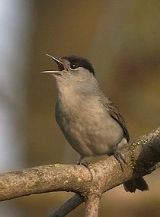
Old World warbler

Encyclopedia
The "Old World Warblers" is the name used to describe a large group of birds formerly grouped together in the bird family Sylviidae. The family held over 400 species in over 70 genera, and were the source of much taxonomic confusion. Two families were split out initially, the cisticolas into Cisticolidae
and the kinglets into Regulidae. In the past ten years they have been the subject of much research and many species are now placed into other families, including the Acrocephalidae
, Cettiidae
, Phylloscopidae
, and Megaluridae
. In addition some species have been moved into existing families or have not yet had their placement fully resolved. A smaller family of warblers, together with some babblers formerly placed in the family Timaliidae and the parrotbill
s, are retained in a much smaller family Sylviidae
.
, although some will also eat fruit, nectar, or tiny seeds.
The majority of species are monogamous and build simple, cup-shaped nests in dense vegetation. They lay between two and six eggs per clutch, depending on species. Both parents typically help in raising the young, which are able to fly at around two weeks of age.
in nearly 50 genera
. They had themselves been split out of the Muscicapidae. The latter family had for most of its existence served as perhaps the ultimate wastebin taxon
on the history of ornithology
. By the early 20th century, about every insectivorous Old World
"songster" known to science had at one point been placed therein, and most continued to be so.
Only after the mid-20th century did the dismantling of the "pan-Muscicapidae" begin in earnest. However, the Sylviidae remained a huge family, with few clear patterns of relationships recognisable. Though by no means as diverse as the Timaliidae (Old World babblers) (another "wastebin taxon" containing more thrush-like forms), the frontiers between the former "pan-Muscicapidae" were much blurred. The largely southern warbler family Cisticolidae
was traditionally included in the Sylviidae. The kinglet
s, a small genus in a monotypic
family Regulidae, were also frequently placed in this family. The American Ornithologists' Union
includes the gnatcatcher
s, as subfamily Polioptilinae, in the Sylviidae.
Sibley & Ahlquist (1990) united the "Old World warblers" with the babblers and other taxa in a superfamily
Sylvioidea
as a result of DNA-DNA hybridisation
studies. This demonstrated that the Muscicapidae as initially defined were a form taxon
which collected entirely unrelated songbirds. Consequently, the monophyly
of the individual "songster" lineages themselves was increasingly being questioned.
More recently, analysis of DNA sequence
data has provided information on the Sylvioidea. Usually, the scope of the clade was vastly underestimated and only one or two specimens were sampled for each presumed "family". Minor or little-known groups such as the parrotbill
s were left out entirely (e.g. Ericson & Johansson 2003, Barker et al. 2004). These could only confirm that the Cisticolidae were indeed distinct, and suggested that bulbul
s (Pycnonotidae) were apparently the closest relatives of a group containing Sylviidae, Timaliidae, cisticolids and white-eyes.
In 2003, a study of Timaliidae relationships (Cibois 2003a) using mtDNA cytochrome b
and 12S/16S rRNA
data indicated that the Sylviidae and Old World babblers were not reciprocally monophyletic to each other. Moreover, Sylvia, the type genus
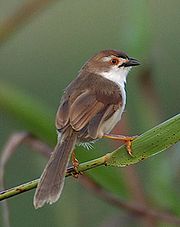
of the Sylvidae, turned out to be closer to taxa such as the Yellow-eyed Babbler
(Chrysomma sinense) (traditionally held to be an atypical timaliid) and the Wrentit
(Chamaea fasciata), an enigmatic species generally held to be the only American
Old World babbler. The parrotbills, formerly considered a family Paradoxornithidae (roughly, "puzzling birds") of unclear affiliations also were part of what apparently was a well distinctive clade
.
Cibois suggested that the Sylviidae should officially be suppressed by the ICZN
as a taxon and the genus Sylvia merged into the Timaliidae (Cibois 2003b), but doubts remained. Clearly, the sheer extent of the groups concerned made it necessary to study a wide range of taxa. This was begun by Beresford et al. (2005) and Alström et al. (2006). They determined that the late-20th-century Sylviidae united at least 4, but probably as many as 7 major distinct lineages. The authors propose the creation of several new families (Phylloscopidae
, Cettiidae
, Acrocephalidae
, Megaluridae
) to better reflect the evolution
ary history of the sylvioid group.
The Sylviidae, in turn, receive several taxa from other families. Nonetheless, the now-monophyletic family has shrunk by nearly 80% for the time being, now containing 55 species in 10 genera at least. It is entirely likely however that with further research, other taxa from those still incertae sedis
among its former contents, the Timaliidae, the Cisticolinae, or even the Muscicapidae will be moved into this group.
genus on west coast of North America
.
Parisoma superspecies
Layard's Warbler
, Parisoma layardi
Rufous-vented Warbler
, Parisoma subcaeruleum
curruca clade
Yemen Warbler, Sylvia buryi - sometimes placed in Parisoma
Red Sea Warbler
, Sylvia leucomelaena
(Western) Orphean Warbler
, Sylvia hortensis
Lesser Whitethroat
, Sylvia curruca
Hume's Whitethroat
, Sylvia althaea
Small Whitethroat
, Sylvia minula
communis-melanocephala assemblage
Asian Desert Warbler
, Sylvia nana
African Desert Warbler
, Sylvia deserti
Whitethroat
, Sylvia communis
Spectacled Warbler
, Sylvia conspicillata
Tristram's Warbler
, Sylvia deserticola
Dartford Warbler
, Sylvia undata
Marmora's Warbler
, Sylvia sarda
Rüppell's Warbler
, Sylvia rueppelli
Cyprus Warbler
, Sylvia melanothorax
(Western) Subalpine Warbler
, Sylvia cantillans
Moltoni's Warbler, Sylvia (cantillans) moltonii
Sardinian Warbler
, Sylvia melanocephala
Fayyum Warbler, Sylvia melanocephala/momus norissae - doubtfully distinct, extinct (c.1940)
Menetries' Warbler, Sylvia mystacea
Moved to family Cisticolidae
Genus Sceptomycter
- sometimes merged into Bathmocercus. Cisticolidae?
Genus Poliolais - Cisticolidae or more basal like bulbul
s?
Two to 14 of the 15 tailorbird
s
Moved to family Acrocephalidae
 Marsh- and tree warblers or acrocephalid warblers. Usually rather large "warblers", most are olivaceous brown above with much yellow to beige below. Usually in open woodland, reedbeds or tall grass. Mainly southern Asia to western Europe and surroundings ranging far into Pacific, some in Africa. The genus limits are seriously in need of revision; either most species are moved into Acrocephalus, or the latter is split up though there is presently insufficient knowledge as to how.
- marsh-warblers (about 35 species) Genus Hippolais - tree warblers (8 species)
Genus Chloropeta
- yellow warblers (3 species)
Genus Nesillas
- brush warblers (4 living species, 1 recently extinct)
Moved to Malagasy warbler
See Cibois et al. (2001)
Genus Cryptosylvicola
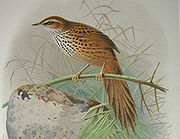 Grass warblers and allies . Mid-sized and usually long-tailed species; sometimes strongly patterned but generally very drab in overall coloration. Often forage on the ground. Old World and into Australian region, centred around Indian Ocean
; possibly also one species in South America
. A not too robustly supported clade that requires further study.
The Black-capped Donacobius
Donacobius atricapillus, which was long considered an aberrant wren
or mockingbird
is apparently quite closely related, and might possibly be considered the only American species of this family.
Moved to family Cettiidae
Typical bush warblers and relatives or cettiid warblers. Another group of generally very drab species, tend to be smaller and shorter-tailed than Megaluridae. Usually frequent shrubland and undergrowth. Continental Asia, and surrounding regions, ranging into Africa and southern Europe.
Genus Hylia - tentatively placed here
Genus Abroscopus
- Abroscopus warblers
Yellow-bellied Warbler
Abroscopus superciliaris
Black-faced Warbler
Abroscopus schisticeps
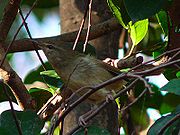
Bornean Stubtail
Urosphena whiteheadi
Asian Stubtail
Urosphena squameiceps
Genus Tesia
- tesias
Genus Cettia
- typical bush-warblers (some 15 species). Polyphyletic.
Genus Tickellia
Genus Phyllergates
Rufous-headed Tailorbird
Phyllergates heterolaemus
Moved to family Phylloscopidae
Leaf-warblers or phylloscopid warblers. A group very variable in size, often vivid green coloration above and yellow below, or more subdued with greyish-green to greyish-brown plumage. Catch food on the wing fairly often. Eurasia, ranging into Wallacea and Africa.
Moved to family Macrosphenidae
African warblers. Also "Sphenoeacus group". An assemblage of usually species-poor and apparently rather ancient "odd warblers" from Africa. Ecomorphologically
quite variable. Monophyly requires confirmation.
Northern Crombec
Sylvietta brachyura
Short-billed Crombec
Sylvietta philippae
Red-capped Crombec
Sylvietta ruficapilla
Red-faced Crombec
Sylvietta whytii
Somali Crombec
Sylvietta isabellina
Cape Crombec
Sylvietta rufescens
Genus Melocichla
Genus Achaetops
Genus Sphenoeacus
Genus Cryptillas. - formerly Bradypterus (now Locustellidae)
Genus Macrosphenus
- longbill
s
Yellow Longbill
Macrosphenus flavicans
Grey Longbill
Macrosphenus concolor
Pulitzer's Longbill
Macrosphenus pulitzeri
Kretschmer's Longbill
Macrosphenus kretschmeri
families listed above. Those in the Australian-Pacific region are probably Megaluridae
. These taxa are listed in the sequence used in recent years.
Not in Sylvioidea
Entirely unrelated songbirds hitherto placed in Sylviidae
Genus Stenostira - Together with some "odd flycatchers", they form the new family Stenostiridae
. They are closely related to Paridae (Beresford et al. 2005)
Genus Hyliota
- hyliotas. Basal Passerida
with no known relatives, perhaps somewhat closer to Promeropidae (sugarbirds)
Southern Hyliota
Hyliota australis
Usambara Hyliota
Hyliota usambarae
Violet-backed Hyliota
Hyliota violacea
Genus Newtonia
- newtonias. Now in Vangidae (vangas); possibly polyphyletic (Yamagishi et al. 2001)
[still use obsolete taxomony. EoL has Panurus picture, which is as wrong as it can be!]
Cisticolidae
The Cisticolidae family of small passerine birds is a group of about 110 warblers found mainly in warmer southern regions of the Old World. They are often included within the Old World warbler family Sylviidae....
and the kinglets into Regulidae. In the past ten years they have been the subject of much research and many species are now placed into other families, including the Acrocephalidae
Acrocephalidae
Acrocephalidae is a family of oscine passerine birds, in the superfamily Sylvioidea....
, Cettiidae
Cettiidae
Cettiidae is a newly validated family of small insectivorous songbirds , formerly placed in the Old World warbler "wastebin" assemblage. It contains the typical bush-warblers and their relatives. As common name, cettiid warblers is usually used.Its members occur mainly in Asia and Africa, ranging...
, Phylloscopidae
Phylloscopidae
Phylloscopidae is a newly described family of small insectivorous birds formerly placed in the Old World warbler family. Its members occur in Eurasia, ranging into Wallacea and Africa...
, and Megaluridae
Megaluridae
Locustellidae is a newly recognized family of small insectivorous songbirds , formerly placed in the Old World warbler "wastebin" family. It contains the grass-warblers, grassbirds, and the Bradypterus "bush-warblers". These birds occur mainly in Eurasia, Africa, and the Australian region...
. In addition some species have been moved into existing families or have not yet had their placement fully resolved. A smaller family of warblers, together with some babblers formerly placed in the family Timaliidae and the parrotbill
Parrotbill
The parrotbills are a group of peculiar birds native to East and Southeast Asia, though feral populations are known from elsewhere. They are generally small, long-tailed birds which inhabit reedbeds and similar habitat. They feed mainly on seeds, e.g. of grasses, to which their bill, as the name...
s, are retained in a much smaller family Sylviidae
Sylviidae
Sylviidae is a family of passerine birds that was part of an assemblage known as the Old World warblers. The family was formerly a wastebin taxon with over 400 species of bird in over 70 genera. The family was poorly defined with many characteristics shared with other families...
.
Characteristics
Most Old World Warblers are of generally undistinguished appearance, though some Asian species are boldly marked. The sexes are often identical, but may be clearly distinct, notably in the genus Sylvia. They are of small to medium size, varying from 9 to 16 centimetres in length, with a small, finely pointed bill. Almost all species are primarily insectivorousInsectivore
An insectivore is a type of carnivore with a diet that consists chiefly of insects and similar small creatures. An alternate term is entomophage, which also refers to the human practice of eating insects....
, although some will also eat fruit, nectar, or tiny seeds.
The majority of species are monogamous and build simple, cup-shaped nests in dense vegetation. They lay between two and six eggs per clutch, depending on species. Both parents typically help in raising the young, which are able to fly at around two weeks of age.
Systematics
In the late 20th century, the Sylviidae were thought to unite nearly 300 small insectivorous bird speciesSpecies
In biology, a species is one of the basic units of biological classification and a taxonomic rank. A species is often defined as a group of organisms capable of interbreeding and producing fertile offspring. While in many cases this definition is adequate, more precise or differing measures are...
in nearly 50 genera
Genus
In biology, a genus is a low-level taxonomic rank used in the biological classification of living and fossil organisms, which is an example of definition by genus and differentia...
. They had themselves been split out of the Muscicapidae. The latter family had for most of its existence served as perhaps the ultimate wastebin taxon
Wastebin taxon
Wastebasket taxon is a term used in some taxonomic circles to refer to a taxon that has the sole purpose of classifying organisms that do not fit anywhere else. They are typically defined by their lack of one or more distinct character states or by their not belonging to one or more other taxa...
on the history of ornithology
Ornithology
Ornithology is a branch of zoology that concerns the study of birds. Several aspects of ornithology differ from related disciplines, due partly to the high visibility and the aesthetic appeal of birds...
. By the early 20th century, about every insectivorous Old World
Old World
The Old World consists of those parts of the world known to classical antiquity and the European Middle Ages. It is used in the context of, and contrast with, the "New World" ....
"songster" known to science had at one point been placed therein, and most continued to be so.
Only after the mid-20th century did the dismantling of the "pan-Muscicapidae" begin in earnest. However, the Sylviidae remained a huge family, with few clear patterns of relationships recognisable. Though by no means as diverse as the Timaliidae (Old World babblers) (another "wastebin taxon" containing more thrush-like forms), the frontiers between the former "pan-Muscicapidae" were much blurred. The largely southern warbler family Cisticolidae
Cisticolidae
The Cisticolidae family of small passerine birds is a group of about 110 warblers found mainly in warmer southern regions of the Old World. They are often included within the Old World warbler family Sylviidae....
was traditionally included in the Sylviidae. The kinglet
Kinglet
The kinglets or crests are a small group of birds sometimes included in the Old World warblers, but are frequently given family status because they also resemble the titmice. The scientific name Regulidae is derived from the Latin word regulus for "petty king" or prince, and comes from the...
s, a small genus in a monotypic
Monotypic
In biology, a monotypic taxon is a taxonomic group with only one biological type. The term's usage differs slightly between botany and zoology. The term monotypic has a separate use in conservation biology, monotypic habitat, regarding species habitat conversion eliminating biodiversity and...
family Regulidae, were also frequently placed in this family. The American Ornithologists' Union
American Ornithologists' Union
The American Ornithologists' Union is an ornithological organization in the USA. Unlike the National Audubon Society, its members are primarily professional ornithologists rather than amateur birders...
includes the gnatcatcher
Gnatcatcher
The 15-20 species of small passerine birds in the gnatcatcher family occur in North and South America . Most species of this mainly tropical and subtropical group are resident, but the Blue-gray Gnatcatcher of the USA and southern Canada migrates south in winter...
s, as subfamily Polioptilinae, in the Sylviidae.
Sibley & Ahlquist (1990) united the "Old World warblers" with the babblers and other taxa in a superfamily
Taxonomic rank
In biological classification, rank is the level in a taxonomic hierarchy. Examples of taxonomic ranks are species, genus, family, and class. Each rank subsumes under it a number of less general categories...
Sylvioidea
Sylvioidea
Sylvioidea is a superfamily of passerine birds. It is one of at least three major clades within the Passerida along with the Muscicapoidea and Passeroidea. It contains about 1300 species including the Old World warblers, Old World babblers, swallows, larks, bulbuls and perhaps the tits...
as a result of DNA-DNA hybridisation
DNA-DNA hybridisation
DNA-DNA hybridization generally refers to a molecular biology technique that measures the degree of genetic similarity between pools of DNA sequences. It is usually used to determine the genetic distance between two species...
studies. This demonstrated that the Muscicapidae as initially defined were a form taxon
Form taxon
Form classification is the classification of organisms based on their morphology, which does not necessarily reflect their biological relationships...
which collected entirely unrelated songbirds. Consequently, the monophyly
Monophyly
In common cladistic usage, a monophyletic group is a taxon which forms a clade, meaning that it contains all the descendants of the possibly hypothetical closest common ancestor of the members of the group. The term is synonymous with the uncommon term holophyly...
of the individual "songster" lineages themselves was increasingly being questioned.
More recently, analysis of DNA sequence
DNA sequence
The sequence or primary structure of a nucleic acid is the composition of atoms that make up the nucleic acid and the chemical bonds that bond those atoms. Because nucleic acids, such as DNA and RNA, are unbranched polymers, this specification is equivalent to specifying the sequence of...
data has provided information on the Sylvioidea. Usually, the scope of the clade was vastly underestimated and only one or two specimens were sampled for each presumed "family". Minor or little-known groups such as the parrotbill
Parrotbill
The parrotbills are a group of peculiar birds native to East and Southeast Asia, though feral populations are known from elsewhere. They are generally small, long-tailed birds which inhabit reedbeds and similar habitat. They feed mainly on seeds, e.g. of grasses, to which their bill, as the name...
s were left out entirely (e.g. Ericson & Johansson 2003, Barker et al. 2004). These could only confirm that the Cisticolidae were indeed distinct, and suggested that bulbul
Bulbul
Bulbuls are a family, Pycnonotidae, of medium-sized passerine songbirds. Many forest species are known as greenbuls. The family is distributed across most of Africa and into the Middle East, tropical Asia to Indonesia, and north as far as Japan. A few insular species occur on the tropical islands...
s (Pycnonotidae) were apparently the closest relatives of a group containing Sylviidae, Timaliidae, cisticolids and white-eyes.
In 2003, a study of Timaliidae relationships (Cibois 2003a) using mtDNA cytochrome b
Cytochrome b
Cytochrome b/b6 is the main subunit of transmembrane cytochrome bc1 and b6f complexes. In addition, it commonly refers to a region of mtDNA used for population genetics and phylogenetics.- Function :...
and 12S/16S rRNA
16S ribosomal RNA
16S ribosomal RNA is a component of the 30S subunit of prokaryotic ribosomes. It is approximately 1.5kb in length...
data indicated that the Sylviidae and Old World babblers were not reciprocally monophyletic to each other. Moreover, Sylvia, the type genus
Type genus
In biological classification, a type genus is a representative genus, as with regard to a biological family. The term and concept is used much more often and much more formally in zoology than it is in botany, and the definition is dependent on the nomenclatural Code that applies:* In zoological...
of the Sylvidae, turned out to be closer to taxa such as the Yellow-eyed Babbler
Yellow-eyed Babbler
The Yellow-eyed Babbler Chrysomma sinense is a passerine bird species found in open grass and scrub in south Asia. Its common name refers to its traditional placement with the Old World babbler family Timaliidae...
(Chrysomma sinense) (traditionally held to be an atypical timaliid) and the Wrentit
Wrentit
The Wrentit is a small bird that lives in chaparral and bushland. It is the only species in the genus Chamaea....
(Chamaea fasciata), an enigmatic species generally held to be the only American
Americas
The Americas, or America , are lands in the Western hemisphere, also known as the New World. In English, the plural form the Americas is often used to refer to the landmasses of North America and South America with their associated islands and regions, while the singular form America is primarily...
Old World babbler. The parrotbills, formerly considered a family Paradoxornithidae (roughly, "puzzling birds") of unclear affiliations also were part of what apparently was a well distinctive clade
Clade
A clade is a group consisting of a species and all its descendants. In the terms of biological systematics, a clade is a single "branch" on the "tree of life". The idea that such a "natural group" of organisms should be grouped together and given a taxonomic name is central to biological...
.
Cibois suggested that the Sylviidae should officially be suppressed by the ICZN
International Commission on Zoological Nomenclature
The International Commission on Zoological Nomenclature is an organization dedicated to "achieving stability and sense in the scientific naming of animals". Founded in 1895, it currently comprises 28 members from 20 countries, mainly practicing zoological taxonomists...
as a taxon and the genus Sylvia merged into the Timaliidae (Cibois 2003b), but doubts remained. Clearly, the sheer extent of the groups concerned made it necessary to study a wide range of taxa. This was begun by Beresford et al. (2005) and Alström et al. (2006). They determined that the late-20th-century Sylviidae united at least 4, but probably as many as 7 major distinct lineages. The authors propose the creation of several new families (Phylloscopidae
Phylloscopidae
Phylloscopidae is a newly described family of small insectivorous birds formerly placed in the Old World warbler family. Its members occur in Eurasia, ranging into Wallacea and Africa...
, Cettiidae
Cettiidae
Cettiidae is a newly validated family of small insectivorous songbirds , formerly placed in the Old World warbler "wastebin" assemblage. It contains the typical bush-warblers and their relatives. As common name, cettiid warblers is usually used.Its members occur mainly in Asia and Africa, ranging...
, Acrocephalidae
Acrocephalidae
Acrocephalidae is a family of oscine passerine birds, in the superfamily Sylvioidea....
, Megaluridae
Megaluridae
Locustellidae is a newly recognized family of small insectivorous songbirds , formerly placed in the Old World warbler "wastebin" family. It contains the grass-warblers, grassbirds, and the Bradypterus "bush-warblers". These birds occur mainly in Eurasia, Africa, and the Australian region...
) to better reflect the evolution
Evolution
Evolution is any change across successive generations in the heritable characteristics of biological populations. Evolutionary processes give rise to diversity at every level of biological organisation, including species, individual organisms and molecules such as DNA and proteins.Life on Earth...
ary history of the sylvioid group.
The Sylviidae, in turn, receive several taxa from other families. Nonetheless, the now-monophyletic family has shrunk by nearly 80% for the time being, now containing 55 species in 10 genera at least. It is entirely likely however that with further research, other taxa from those still incertae sedis
Incertae sedis
, is a term used to define a taxonomic group where its broader relationships are unknown or undefined. Uncertainty at specific taxonomic levels is attributed by , , and similar terms.-Examples:*The fossil plant Paradinandra suecica could not be assigned to any...
among its former contents, the Timaliidae, the Cisticolinae, or even the Muscicapidae will be moved into this group.
Family Sylviidae sensu stricto
True warblers (or sylviid warblers) and parrotbills. A fairly diverse group of smallish taxa with longish tails. Mostly in Asia, to a lesser extent in Africa. A few range into Europe; one monotypicMonotypic
In biology, a monotypic taxon is a taxonomic group with only one biological type. The term's usage differs slightly between botany and zoology. The term monotypic has a separate use in conservation biology, monotypic habitat, regarding species habitat conversion eliminating biodiversity and...
genus on west coast of North America
North America
North America is a continent wholly within the Northern Hemisphere and almost wholly within the Western Hemisphere. It is also considered a northern subcontinent of the Americas...
.
- Genus Sylvia - typical warblers (c.20 species). Paraphyletic or contains Parisoma
- Temperate Eurasian superspecies ("
- BlackcapBlackcapThe Blackcap is a common and widespread sylviid warbler which breeds throughout temperate Europe, western Asia and northwestern Africa, and winters from northwestern Europe south to tropical Africa...
,
- Garden WarblerGarden WarblerThe Garden Warbler, Sylvia borin, is a common and widespread typical warbler which breeds throughout northern and temperate Europe into western Asia. This small passerine bird is strongly migratory, and winters in central and southern Africa...
, Sylvia borin
- Banded WarblerBanded WarblerThe Banded Parisoma, Banded Tit Warbler, or Banded Warbler is a species of Old World warbler in the Sylviidae family.It is found in Ethiopia, Kenya, Somalia, and Tanzania.Its natural habitat is dry savanna.Length:...
,
Layard's Warbler
The Layard's Warbler or Layard's Tit-Babbler is a species of Old World warbler in the Sylviidae family. It is found in Lesotho, Namibia, and South Africa. Its natural habitat is subtropical or tropical dry shrubland....
, Parisoma layardi
Rufous-vented Warbler
The Chestnut-vented Warbler , Parisoma subcaeruleum, is an Old World warbler...
, Parisoma subcaeruleum
- Brown WarblerBrown WarblerThe Brown Parisoma or Brown Warbler is a typical warbler found in Africa....
,
Red Sea Warbler
The Arabian Warbler or Red Sea Warbler is a species of Old World warbler in the Sylviidae family.It is found in Djibouti, Egypt, Eritrea, Israel, Jordan, Oman, Saudi Arabia, Somalia, Sudan, and Yemen....
, Sylvia leucomelaena
Orphean Warbler
The Orphean Warbler, Sylvia hortensis, is a typical warbler of the genus Sylvia. This species occurs in summer around the Mediterranean, through Turkey and the Caucasus and extending into Central Asia. It is migratory, wintering in sub-Saharan Africa...
, Sylvia hortensis
- Eastern Orphean WarblerEastern Orphean WarblerThe Eastern Orphean Warbler, Sylvia hortensis crassirostris, is a typical warbler of the genus Sylvia. This species occurs in summer around the Mediterranean, through the Balkans via Turkey, the Caucasus and surrounding regions to Central Asia. It is migratory, wintering in sub-Saharan Africa...
,
Lesser Whitethroat
The Lesser Whitethroat is a common and widespread typical warbler which breeds in temperate Europe, except the southwest, and in western and central Asia. This small passerine bird is strongly migratory, wintering in Africa just south of the Sahara, Arabia and India.Unlike many typical warblers,...
, Sylvia curruca
Hume's Whitethroat
Hume's Whitethroat Sylvia althaea is a species of typical warbler. Until recently, it was considered conspecific with the Lesser Whitethroat; today these are seen as members of a superspecies which also includes the Desert Whitethroat...
, Sylvia althaea
Small Whitethroat
The Desert Whitethroat is a typical warbler. Until recently, it was considered conspecific with the Lesser Whitethroat; today these are seen as members of a superspecies...
, Sylvia minula
- Margelanic Whitethroat,
- Barred WarblerBarred WarblerThe Barred Warbler is a typical warbler which breeds across temperate regions of central and eastern Europe and western and central Asia. This passerine bird is strongly migratory, and winters in tropical eastern Africa....
,
Asian Desert Warbler
The Asian Desert Warbler Sylvia nana is a typical warbler which breeds in the deserts of central and western Asia and the extreme east of Europe , and migrating to similar habitats in southwestern Asia and the far northeast of Africa in winter...
, Sylvia nana
African Desert Warbler
The African Desert Warbler Sylvia deserti is a typical warbler which breeds in the deserts of northwestern Africa south of the Atlas Mountains from southern Morocco east to western Libya and south to Mali and Niger. It winters in the same area, and does not migrate other than short distances...
, Sylvia deserti
Whitethroat
The Common Whitethroat, Sylvia communis, is a common and widespread typical warbler which breeds throughout Europe and across much of temperate western Asia. This small passerine bird is strongly migratory, and winters in tropical Africa, Arabia and Pakistan.This is one of several Sylvia species...
, Sylvia communis
Spectacled Warbler
The Spectacled Warbler is a species in the typical warbler genus Sylvia. It breeds in north west Africa, southwest Europe from Iberia to Italy, and then further east on the eastern Mediterranean islands and coastal regions. It is mainly resident in Africa, but other populations migrate to winter...
, Sylvia conspicillata
Tristram's Warbler
The Tristram's Warbler is a species of Old World warbler in the Sylviidae family.It is found in Algeria, Libya, Mauritania, Morocco, Tunisia, and Western Sahara.Its natural habitat is subtropical dry shrubland.-References:...
, Sylvia deserticola
Dartford Warbler
The Dartford Warbler, Sylvia undata, is a typical warbler from the warmer parts of western Europe, and northwestern Africa. Its breeding range lies west of a line from southern England to the heel of Italy...
, Sylvia undata
Marmora's Warbler
Marmora's Warbler, Sylvia sarda, is a typical warbler, genus Sylvia. It breeds on Mediterranean islands, typically including Corsica and Sardinia. The smaller Balearic Islands subspecies is increasingly given specific status as Balearic Warbler, Sylvia balearica...
, Sylvia sarda
- Balearic Warbler,
Rüppell's Warbler
The Rüppell's Warbler is a typical warbler of the genus Sylvia. It breeds in Greece, Turkey and neighbouring islands. It is migratory, wintering in north east Africa. This is a rare vagrant to western Europe. The name is occasionally cited as "Rueppell's Warbler".It is a typical "sylvia" warbler,...
, Sylvia rueppelli
Cyprus Warbler
The Cyprus Warbler, Sylvia melanothorax, is a typical warbler which breeds on Cyprus. This small passerine bird is a short-distance migrant, and winters in Israel, Jordan and Egypt....
, Sylvia melanothorax
Subalpine Warbler
The Subalpine Warbler, Sylvia cantillans, is a small typical warbler which breeds in the southernmost areas of Europe and northwest Africa. This small passerine bird is migratory, and winters along the southern edge of the Sahara...
, Sylvia cantillans
- Eastern Subalpine Warbler,
Sardinian Warbler
The Sardinian Warbler, Sylvia melanocephala, is a common and widespread typical warbler from the Mediterranean region.-Description:...
, Sylvia melanocephala
- Genus Pseudoalcippe - African Hillbabbler. Formerly in Illadopsis (Timaliidae)
- Genus Rhopophilus - White-browed Chinese Warbler. Formerly in Cisticolidae
- Genus Lioparus - Golden-breasted Fulvetta. Formerly in Alcippe (Timaliidae)
- Genus Paradoxornis - typical parrotbills (18 species). Formerly in Paradoxornithidae; polyphyletic
- Genus Conostoma - Great Parrotbill. Formerly in Paradoxornithidae; tentatively placed here
- Genus FulvettaFulvettaFulvetta is a songbird genus. Originally proposed in 1877, it was recently reestablished for the typical fulvettas, which were long included with their presumed relatives in the Timaliidae genus Alcippe...
- typical fulvettas (7 species). Formerly in Alcippe (Timaliidae) - Genus ChrysommaChrysommaChrysomma is a songbird genus. Long believed to be Timaliidae , they are actually quite closely related to the typical warblers and even closer to the parrotbills, and therefore a member of the family Sylviidae.Species are:...
- 3 species. Formerly in Timaliidae - Genus Chamaea - Wrentit
Moved to family Timaliidae
- Genus Graminicola
- Rufous-rumped GrassbirdRufous-rumped GrassbirdThe Rufous-Rumped Grassbird is a species of babbler in a monotypic genus in the Timaliidae family. It was formerly placed in the Old World Warbler family Sylviidae.-Distribution and habitat:...
("-babbler") Graminicola bengalensis
- Rufous-rumped Grassbird
Moved to family CisticolidaeCisticolidaeThe Cisticolidae family of small passerine birds is a group of about 110 warblers found mainly in warmer southern regions of the Old World. They are often included within the Old World warbler family Sylviidae....
- Genus BathmocercusBathmocercusBathmocercus is a genus of bird in the Cisticolidae family.It contains the following species:* Black-capped Rufous Warbler * Black-faced Rufous Warbler...
- rufous-warblers- Black-capped Rufous-warblerBlack-capped Rufous-warblerThe Black-headed Rufous Warbler , also known as the Black-Capped Rufous Warbler, is a species of bird in the Cisticolidae family. It is found in Ivory Coast, Ghana, Guinea, Liberia, and Sierra Leone. Its natural habitats are subtropical or tropical moist lowland forests, subtropical or tropical...
- Black-capped Rufous-warbler
- Black-faced Rufous-warblerBlack-faced Rufous-warblerThe Black-Faced Rufous Warbler is a species of bird in the Cisticolidae family.It is found in Cameroon, Central African Republic, Republic of the Congo, Democratic Republic of the Congo, Equatorial Guinea, Gabon, Kenya, Rwanda, Sudan, Tanzania, and Uganda.Its natural habitats are subtropical or...
Bathmocercus rufus
Sceptomycter
Scepomycter is a genus of threatened birds in the Cisticolidae family. The two species are endemic to highland forests in the Eastern Arc Mountains of Tanzania. They are small, mainly grey birds with a reddish-orange head.-Taxonomy:...
- sometimes merged into Bathmocercus. Cisticolidae?
- Mrs Moreau's WarblerMrs Moreau's WarblerWinifred's Warbler , also known as Mrs Moreau's Warbler, is a species of bird in the Cisticolidae family. The genus Scepomycter has traditionally been considered monotypic, but in 2009 a closely related new species was described, the Rubeho Warbler. Alternatively, the Winifred’s Warbler is...
Sceptomycter winifredae
Bulbul
Bulbuls are a family, Pycnonotidae, of medium-sized passerine songbirds. Many forest species are known as greenbuls. The family is distributed across most of Africa and into the Middle East, tropical Asia to Indonesia, and north as far as Japan. A few insular species occur on the tropical islands...
s?
- White-tailed WarblerWhite-tailed WarblerThe White-tailed Warbler is a species of bird in the Cisticolidae family, the only of its genus Poliolais. It is found in Cameroon, Equatorial Guinea, and Nigeria....
Tailorbird
Tailorbirds are small birds belonging to the genus Orthotomus often placed in the Old World warbler family Sylviidae. However, recent research suggests they more likely belong in the Cisticolidae and they are treated as such in Del Hoyo et al....
s
Moved to family AcrocephalidaeAcrocephalidaeAcrocephalidae is a family of oscine passerine birds, in the superfamily Sylvioidea....
- Genus
Acrocephalus
The Acrocephalus warblers are small, insectivorous passerine birds belonging to the genus Acrocephalus. Formerly in the paraphyletic Old World warbler assemblage, they are now separated as the namesake of the marsh- and tree-warbler family Acrocephalidae...
- marsh-warblers (about 35 species)
Chloropeta
Chloropeta is a genus of Acrocephalidae warblers; formerly, they were placed in the paraphyletic "Old World warblers".It contains the following species:* Papyrus Yellow Warbler...
- yellow warblers (3 species)
Nesillas
Nesillas is a genus of Old World warbler in the Acrocephalidae family.It contains the following species:* Grand Comoro Brush-Warbler * Lantz's Brush-Warbler...
- brush warblers (4 living species, 1 recently extinct)
Moved to Malagasy warblerMalagasy warblerThe Malagasy warblers are a newly validated clade of songbirds. They were formally named Bernieridae in 2010. The family consists of ten species of small forest birds and is endemic to Madagascar....
s
See Cibois et al. (2001)
- Genus
- Thamnornis Thamnornis chloropetoides
- Cryptic WarblerCryptic WarblerThe Cryptic Warbler is a species of Malagasy warbler in the Bernieriidae family. It was formerly placed in the Old world warbler family Sylviidae. It is endemic to Madagascar.-References:...
Moved to family Locustellidae
Indian Ocean
The Indian Ocean is the third largest of the world's oceanic divisions, covering approximately 20% of the water on the Earth's surface. It is bounded on the north by the Indian Subcontinent and Arabian Peninsula ; on the west by eastern Africa; on the east by Indochina, the Sunda Islands, and...
; possibly also one species in South America
South America
South America is a continent situated in the Western Hemisphere, mostly in the Southern Hemisphere, with a relatively small portion in the Northern Hemisphere. The continent is also considered a subcontinent of the Americas. It is bordered on the west by the Pacific Ocean and on the north and east...
. A not too robustly supported clade that requires further study.
- Genus BradypterusBradypterusBradypterus is a genus of small insectivorous songbirds in the newly recognized grass warbler family . They were formerly placed in the Sylviidae, which at that time was a wastebin taxon for the warbler-like Sylvioidea...
- Megalurid bush-warblers (more than 20 species). Paraphyletic with at least one species ("B." victorini) not belonging into this family. - Genus Locustella - grass warblers (9 species)
- Genus MegalurusMegalurusMegalurus is a genus of passerine bird in the family Locustellidae. The genus was once placed in the Old World warbler "wastebin" family Sylviidae. The genus contains six species also known as the typical grassbirds...
- typical grassbirds. Probably polyphyletic- Marsh GrassbirdMarsh GrassbirdThe Marsh Grassbird , also known as the Japanese Swamp Warbler, is a species of Old World warbler in the Locustellidae family. It is found in China, Japan, South Korea, Mongolia, and Russia....
Megalurus pryeri - Tawny GrassbirdTawny GrassbirdThe Tawny Grassbird is a songbird species of the grass- and bush-warbler family . It was formerly placed in the "Old World warbler" assemblage....
Megalurus timoriensis - Little GrassbirdLittle GrassbirdThe Little Grassbird is a species of Old World warbler in the Locustellidae family. It is found in Australia and in West Papua, Indonesia.-References:* BirdLife International 2004. . Downloaded on 10 July 2007....
Megalurus gramineus - Striated GrassbirdStriated GrassbirdThe Striated Grassbird is an "Old World warbler" species in the family Locustellidae. It was formerly placed in the Sylviidae....
Megalurus palustris - Fly River GrassbirdFly River GrassbirdThe Fly River Grassbird is a species of Old World warbler in the Locustellidae family.It is found in Indonesia and Papua New Guinea.Its natural habitats are freshwater lakes and freshwater marshes....
Megalurus albolimbatus
- Marsh Grassbird
The Black-capped Donacobius
Black-capped Donacobius
The Black-capped Donacobius is a conspicuous, vocal South American bird. It is found in tropical swamps and wetlands in Argentina, Bolivia, Brazil, Colombia, Ecuador, French Guiana, Guyana, Paraguay, Peru, Suriname, and Venezuela; also Panama of Central America.-Taxonomy:The Black-capped...
Donacobius atricapillus, which was long considered an aberrant wren
Wren
The wrens are passerine birds in the mainly New World family Troglodytidae. There are approximately 80 species of true wrens in approximately 20 genera....
or mockingbird
Mockingbird
Mockingbirds are a group of New World passerine birds from the Mimidae family. They are best known for the habit of some species mimicking the songs of other birds and the sounds of insects and amphibians, often loudly and in rapid succession. There are about 17 species in three genera...
is apparently quite closely related, and might possibly be considered the only American species of this family.
Moved to family CettiidaeCettiidaeCettiidae is a newly validated family of small insectivorous songbirds , formerly placed in the Old World warbler "wastebin" assemblage. It contains the typical bush-warblers and their relatives. As common name, cettiid warblers is usually used.Its members occur mainly in Asia and Africa, ranging...
Typical bush warblers and relatives or cettiid warblers. Another group of generally very drab species, tend to be smaller and shorter-tailed than Megaluridae. Usually frequent shrubland and undergrowth. Continental Asia, and surrounding regions, ranging into Africa and southern Europe.- Genus Pholidornis - formerly in Remizidae; tentatively placed here
- Tit-hyliaTit-hyliaThe Tit Hylia is a species of bird in the Remizidae family. It is monotypic within the genus Pholidornis....
- Tit-hylia
- Green HyliaGreen HyliaThe Green Hylia is a songbird species traditionally included in the "Old World warbler" assemblage, but probably belonging to the bush-warbler family...
Hylia prasina
Abroscopus
Abroscopus is a small genus of "warbler" in the family Cettiidae, formerly included in the Sylviidae.It contains the following three species:* Rufous-faced Warbler Abroscopus albogularis* Black-faced Warbler Abroscopus schisticeps...
- Abroscopus warblers
- Rufous-faced WarblerRufous-faced WarblerThe Rufous-faced Warbler is a species of bush warbler . It was formerly included in the "Old World warbler" assemblage....
Yellow-bellied Warbler
The Yellow-bellied Warbler is a species of bush warbler . It was formerly included in the "Old World warbler" assemblage....
Abroscopus superciliaris
Black-faced Warbler
The Black-faced Warbler is a species of bush warbler . It was formerly included in the "Old World warbler" assemblage....
Abroscopus schisticeps
- Genus ErythrocercusErythrocercusErythrocercus is a genus of bird in the Monarchidae family found in Africa.It contains the following species:* Yellow Flycatcher * Livingstone's Flycatcher...
- monarch-warblers. Formerly MonarchinaeMonarchinaeThe Monarch Flycatchers comprise a family of passerine birds which includes boatbills, shrikebills, paradise-flycatchers, and magpie-larks....
.- Chestnut-capped FlycatcherChestnut-capped FlycatcherThe Chestnut-capped Flycatcher is a species of bird in the Monarchidae family.-Distribution and habitat:It is found in Angola, Cameroon, Central African Republic, Republic of the Congo, Democratic Republic of the Congo, Ivory Coast, Equatorial Guinea, Gabon, Ghana, Guinea, Liberia, Mali, Nigeria,...
Erythrocercus mccallii - Yellow FlycatcherYellow FlycatcherThe Yellow Flycatcher is a species of bird in the Monarchidae family.It is found in Kenya, Somalia, and Tanzania....
Erythrocercus holochlorus - Livingstone's FlycatcherLivingstone's FlycatcherThe Livingstone's Flycatcher is a species of bird in the Monarchidae family.It is found in Malawi, Mozambique, Tanzania, Zambia, and Zimbabwe....
Erythrocercus livingstonei
- Chestnut-capped Flycatcher
- Genus UrosphenaUrosphenaUrosphena is a genus of Old World warbler in the Sylviidae family.It contains the following species:* Asian Stubtail * Timor Stubtail * Bornean Stubtail...
- stubtails- Timor StubtailTimor StubtailThe Timor Stubtail is a species of Old World warbler in the Sylviidae family.It is found in Indonesia and East Timor.-References:* BirdLife International 2004. . Downloaded on 10 July 2007....
- Babar Stubtail
- Timor Stubtail
Bornean Stubtail
The Bornean Stubtail is a species of Old World warbler in the Sylviidae family.It is found in Indonesia and Malaysia. The population is suspected to be stable in the absence of evidence for any declines or substantial threats. The species is reported to be a common bird above 2,000 m.-References:*...
Urosphena whiteheadi
Asian Stubtail
The Asian Stubtail is a species of Old World warbler in the Sylviidae family.It is found in China, Japan, North Korea, South Korea, Laos, Myanmar, Nepal, the Philippines, Russia, Taiwan, Thailand, and Vietnam....
Urosphena squameiceps
Tesia
The tesias are a genus, Tesia, of Old World warbler. The genus was once included in the large family Sylviidae but recent research placed it within the new family Cettiidae. The genus has a discontinuous distribution in East and South East Asia...
- tesias
- Chestnut-headed TesiaChestnut-headed TesiaThe Chestnut-headed Tesia is a songbird species formerly in the "Old World warbler" but nowadays placed in the bush warbler family ....
Tesia castaneocoronata - Javan TesiaJavan TesiaThe Javan Tesia is a species of Old World warbler in the Cettiidae family.It is endemic to Java in Indonesia. The Javan Tesia is a small tesia with long legs and almost no tail. It feeds on insects in the undergrowth of broadleaf forests.-References:* BirdLife International 2004. . Downloaded...
Tesia superciliaris - Slaty-bellied TesiaSlaty-bellied TesiaThe Slaty-Bellied Tesia is a species of warbler in the Cettiidae family.It is found in Bhutan, China, India, Laos, Myanmar, Nepal, Thailand, and Vietnam. Its natural habitats are subtropical or tropical moist lowland forests and subtropical or tropical moist montane forests.-References:* BirdLife...
Tesia olivea - Grey-bellied TesiaGrey-bellied TesiaThe Grey-bellied Tesia is a species of warbler in the Cettiidae family.It is found in Bangladesh, Bhutan, Cambodia, China, India, Laos, Myanmar, Nepal, Thailand, and Vietnam. Its natural habitat is subtropical or tropical moist montane forests.-References:* BirdLife International 2004. . ...
Tesia cyaniventer - Russet-capped TesiaRusset-capped TesiaThe Russet-Capped Tesia is a species of Old World warbler in the Cettiidae family. The scientific name commemorates British colonial administrator and zoological collector Alfred Hart Everett.-References:...
Tesia everetti
Cettia
Cettia is a genus of small insectivorous songbirds which make up the core of the newly recognized family Cettiidae. They were formerly placed in the Sylviidae, which at that time was a wastebin taxon for the warbler-like Sylvioidea. The range of this genus extends from Europe to the western Pacific...
- typical bush-warblers (some 15 species). Polyphyletic.
- Broad-billed WarblerBroad-billed WarblerThe Broad-billed Warbler is a species of bush warbler . It was formerly included in the "Old World warbler" assemblage, and belongs to the monotypic genus Tickellia....
Tickellia hodgsoni
- Mountain TailorbirdMountain TailorbirdThe Mountain Tailorbird is a songbird species formerly placed in the "Old World warbler" assemblage with the other tailorbirds, but it actually seems to be one of the "pseudo-tailorbirds" which should be considered a genus Phyllergates in the family Cettiidae.It is found in Bangladesh, Bhutan,...
Rufous-headed Tailorbird
The Rufous-Headed Tailorbird is a species of Old World warbler in the Sylviidae family.It is found only in the Philippines....
Phyllergates heterolaemus
Moved to Family Aegithalidae
- Genus LeptopoecileLeptopoecileLeptopoecile is a genus of bird in the long-tailed tit family Aegithalidae. The genus was once placed in the large family Sylviidae, but analysis of mitochondrial DNA placed it with the long-tailed tits.It contains the following species:...
- tit-warblers. Tentatively placed there.- White-browed Tit-warblerWhite-browed Tit-warblerThe White-browed Tit-warbler is a species of bird in the Aegithalidae family. It is found in China, India, Kazakhstan, Nepal, Pakistan, Russia, Tajikistan, and Turkmenistan.Its natural habitat is boreal forests....
Leptopoecile sophiae - Crested Tit-warblerCrested Tit-warblerThe Crested Tit-warbler is a species of bird in the Aegithalidae family.It is found in China and possibly India.Its natural habitat is boreal forests.-References:...
Leptopoecile elegans
- White-browed Tit-warbler
Moved to family PhylloscopidaePhylloscopidaePhylloscopidae is a newly described family of small insectivorous birds formerly placed in the Old World warbler family. Its members occur in Eurasia, ranging into Wallacea and Africa...
Leaf-warblers or phylloscopid warblers. A group very variable in size, often vivid green coloration above and yellow below, or more subdued with greyish-green to greyish-brown plumage. Catch food on the wing fairly often. Eurasia, ranging into Wallacea and Africa.- Genus Phylloscopus - leaf-warblers (c.55 species). Polyphyletic.
- Genus SeicercusSeicercusSeicercus is a genus of Old World warbler formerly in the Sylviidae family but now placed in Phylloscopidae. The genus is distributed in eastern and southern Asia from northern China to Timor in the Lesser Sundas...
- polyphyletic- Golden-spectacled Warbler Seicercus burkii
- Grey-crowned Warbler Seicercus (burkii) tephrocephalus
- Whistler's Warbler Seicercus (burkii) whistleri
- Bianchi's Warbler Seicercus (burkii) valentini
- Emei Shan Warbler Seicercus omeiensis
- Plain-tailed WarblerPlain-tailed WarblerThe Plain-tailed Warbler, or Alström' Warbler is a species of Old World warbler in the Phylloscopidae family...
Seicercus soror - White-spectacled WarblerWhite-spectacled WarblerThe White-spectacled Warbler is a species of leaf warbler . It was formerly included in the "Old World warbler" assemblage.It is found in Bangladesh, Bhutan, China, India, Laos, Myanmar, Nepal, and Vietnam...
Seicercus affinis - paraphyletic- Bar-winged White-spectacled Warbler Seicercus (affinis) intermedius
- Grey-cheeked WarblerGrey-cheeked WarblerThe Grey-cheeked Warbler is a species of leaf warbler . It was formerly included in the "Old World warbler" assemblage....
Seicercus poliogenys - Grey-hooded WarblerGrey-hooded WarblerThe Grey-hooded Warbler is a species of leaf warbler . It was formerly included in the "Old World warbler" assemblage....
Seicercus xanthoschistos - Chestnut-crowned WarblerChestnut-crowned WarblerThe Chestnut-crowned Warbler is a species of leaf warbler . It was formerly included in the "Old World warbler" assemblage....
Seicercus castaniceps - Yellow-breasted WarblerYellow-breasted WarblerThe Yellow-breasted Warbler is a species of Old World warbler in the Phylloscopidae family.It is found in Indonesia, Malaysia, and the Philippines....
Seicercus montis - Sunda WarblerSunda WarblerThe Sunda Warbler is a species of Old World warbler in the Phylloscopidae family.It is found only in Indonesia.-References:* BirdLife International 2004. . Downloaded on 10 July 2007....
Seicercus grammiceps
- Golden-spectacled Warbler Seicercus burkii
Moved to family MacrosphenidaeMacrosphenidaeThe African warblers are a newly erected family, Macrosphenidae, of songbirds. Most of the species were formerly placed in the Old World warbler family Sylviidae, although one species, the Rockrunner, was placed in the babbler family Timaliidae...
African warblers. Also "Sphenoeacus group". An assemblage of usually species-poor and apparently rather ancient "odd warblers" from Africa. EcomorphologicallyEcomorphology
Ecomorphology or Ecological Morphology is studying relationships between morphological and ecological variation. There is modern emphasis on linking the two aspects of variation by measuring the performance of traits associated behaviors, and fitness outcomes of the relationships...
quite variable. Monophyly requires confirmation.
- Genus Sylvietta - crombecCrombecSylvietta, the crombecs, is a genus of African warblers. Formerly placed in the massively paraphyletic Sylviidae, it is now considered to belong to a newly-recognized family found only in Africa, Macrosphenidae.It contains the following species:...
s- Green CrombecGreen CrombecThe Green Crombec is a species of African warbler, formerly placed in the family Sylviidae.It is found in Angola, Benin, Cameroon, Central African Republic, Republic of the Congo, Democratic Republic of the Congo, Ivory Coast, Equatorial Guinea, Gabon, Gambia, Ghana, Guinea, Kenya, Liberia, Mali,...
- Green Crombec
- Lemon-bellied CrombecLemon-bellied CrombecThe Lemon-bellied Crombec is a species of African warbler, formerly placed in the family Sylviidae.It is found in Angola, Cameroon, Central African Republic, Republic of the Congo, Democratic Republic of the Congo, Ivory Coast, Equatorial Guinea, Gabon, Gambia, Ghana, Guinea, Liberia, Nigeria,...
Sylvietta denti - White-browed CrombecWhite-browed CrombecThe White-browed Crombec is a species of African warbler, formerly placed in the family Sylviidae. The enigmatic Chapin's Crombec might be a distinct species, or a subspecies Sylvietta leucophrys chapini of the present species.The White-browed Crombec is found in Burundi, Democratic Republic of...
Sylvietta leucophrys- Chapin's Crombec
Northern Crombec
The Northern Crombec is a species of African warbler, formerly placed in the family Sylviidae.It is found in Benin, Burkina Faso, Cameroon, Central African Republic, Chad, Democratic Republic of the Congo, Ivory Coast, Djibouti, Eritrea, Ethiopia, Gambia, Ghana, Guinea, Guinea-Bissau, Kenya, Mali,...
Sylvietta brachyura
Short-billed Crombec
Philippa's Crombec , also known as the Short-billed Crombec, is a species of African warbler, formerly placed in the family Sylviidae. It is found in Ethiopia and Somalia. Its natural habitat is dry savanna.-References:...
Sylvietta philippae
Red-capped Crombec
The Red-capped Crombec is a species of African warbler, formerly placed in the family Sylviidae.It is found in Angola, Republic of the Congo, Democratic Republic of the Congo, Malawi, Mozambique, Tanzania, Zambia, Zimbabwe, and possibly Botswana.Its natural habitats are subtropical or tropical dry...
Sylvietta ruficapilla
Red-faced Crombec
The Red-faced Crombec is a species of African warbler, formerly placed in the family Sylviidae.It is found in Burundi, Ethiopia, Kenya, Malawi, Mozambique, Namibia, Rwanda, Sudan, Tanzania, Uganda, and Zimbabwe....
Sylvietta whytii
Somali Crombec
The Somali Crombec is a species of African warbler, formerly placed in the family Sylviidae.It is found in Ethiopia, Kenya, Somalia, and Tanzania.Its natural habitat is subtropical or tropical dry shrubland.-References:...
Sylvietta isabellina
Cape Crombec
The Cape Crombec or Long-billed Crombec, Sylvietta rufescens, is an African warbler.The Cape Crombec breeds in southern Africa from the Democratic Republic of the Congo, Zambia and Tanzania southwards to South Africa....
Sylvietta rufescens
- Moustached Grass-warblerMoustached Grass-warblerThe Moustached Grass-Warbler is a species of African Warbler, formerly placed in the Sylviidae family.It is found in Angola, Benin, Burkina Faso, Burundi, Cameroon, Central African Republic, Chad, Republic of the Congo, Democratic Republic of the Congo, Ivory Coast, Ethiopia, Gabon, Ghana, Guinea,...
Melocichla mentalis
- Damara Rock-jumperDamara Rock-jumperThe Rockrunner , also known as the Damara Rock-jumper, is a species of African warbler, formerly placed in the Sylviidae family.It is found in Angola and Namibia....
Cape Grassbird
The Cape Grassbird or Cape Grass Warbler is an African warbler found in southern Africa.-Taxonomy:It was formerly placed in the Sylviidae family and is the only member of the genus Sphenoeacus...
- Cape GrassbirdCape GrassbirdThe Cape Grassbird or Cape Grass Warbler is an African warbler found in southern Africa.-Taxonomy:It was formerly placed in the Sylviidae family and is the only member of the genus Sphenoeacus...
Sphenoeacus afer
- Victorin's Scrub-warblerVictorin's Scrub-warblerThe Victorin's Warbler , or Victorin's Scrub-warbler is a species of African Warbler, formerly placed in the Sylviidae family...
Cryptillas victorini
Macrosphenus
Macrosphenus is a genus of African warblers, formerly placed in the Sylviidae family. The genus is one of two in that family known as longbills.It contains the following species:* Grey Longbill...
- longbill
Macrosphenus
Macrosphenus is a genus of African warblers, formerly placed in the Sylviidae family. The genus is one of two in that family known as longbills.It contains the following species:* Grey Longbill...
s
- Kemp's LongbillKemp's LongbillThe Kemp's Longbill is a species of Old World warbler in the Macrosphenidae family.It is found in Cameroon, Ivory Coast, Ghana, Guinea, Liberia, Nigeria, and Sierra Leone....
Yellow Longbill
The Yellow Longbill is a species of Old World warbler in the Macrosphenidae family.It is found in Angola, Cameroon, Central African Republic, Republic of the Congo, Democratic Republic of the Congo, Equatorial Guinea, Gabon, Nigeria, Sudan, Tanzania, and Uganda.Its natural habitats are subtropical...
Macrosphenus flavicans
Grey Longbill
The Grey Longbill is a species of Old World warbler in the Macrosphenidae family.It is found in Angola, Benin, Cameroon, Central African Republic, Republic of the Congo, Democratic Republic of the Congo, Ivory Coast, Equatorial Guinea, Gabon, Ghana, Guinea, Liberia, Nigeria, Sierra Leone,...
Macrosphenus concolor
Pulitzer's Longbill
Pulitzer's Longbill is a species of bird. Formerly considered an "Old World warbler" and placed in the family Sylviidae, it is now considered to belong to an group of enigmatic African warblers in the family Macrosphenidae. It is found only in Angola.Its natural habitat is subtropical or tropical...
Macrosphenus pulitzeri
Kretschmer's Longbill
The Kretschmer's Longbill is a species of Old World warbler in the Macrosphenidae family.It is found in Kenya, Mozambique, and Tanzania....
Macrosphenus kretschmeri
"Sylviidae" incertae sedis
Taxa that have not been studied. Most are likely to belong to one of SylvioideaSylvioidea
Sylvioidea is a superfamily of passerine birds. It is one of at least three major clades within the Passerida along with the Muscicapoidea and Passeroidea. It contains about 1300 species including the Old World warblers, Old World babblers, swallows, larks, bulbuls and perhaps the tits...
families listed above. Those in the Australian-Pacific region are probably Megaluridae
Megaluridae
Locustellidae is a newly recognized family of small insectivorous songbirds , formerly placed in the Old World warbler "wastebin" family. It contains the grass-warblers, grassbirds, and the Bradypterus "bush-warblers". These birds occur mainly in Eurasia, Africa, and the Australian region...
. These taxa are listed in the sequence used in recent years.
- Genus Dromaeocercus - emu-tails. Megaluridae?
- Brown Emu-tailBrown Emu-tailThe Brown Emu-Tail is a species of Old World warbler in the Megaluridae family.It is found only in Madagascar.Its natural habitat is subtropical or tropical moist montanes.It is threatened by habitat loss.-References:...
- Brown Emu-tail
- Grey Emu-tailGrey Emu-tailThe Grey Emu-Tail , also known as the Madagascan Grassbird or Feather-tailed Warbler, is a species of Old World warbler in the Sylviidae family.It is found only in Madagascar....
Dromaeocercus seebohmi - sometimes separated in Amphilais
- Genus Phyllolais - Cisticolidae?
- Buff-bellied WarblerBuff-bellied WarblerThe Buff-bellied Warbler is a species of bird in the Cisticolidae family. It is monotypic within the genus Phyllolais....
Phyllolais pulchella
- Buff-bellied Warbler
- Genus Graueria
- Grauer's WarblerGrauer's WarblerGrauer's Warbler is a species of Old World warbler in the Sylviidae family.It is found in Burundi, the Democratic Republic of the Congo, Rwanda, and Uganda.Its natural habitat is subtropical or tropical moist montane forests....
- Grauer's Warbler
- Genus EremomelaEremomelaThe eremomelas are a genus, Eremomela, of passerines in the cisticola family Cisticolidae. The genus was previously placed with the larger Old World warbler family Sylviidae prior to that genus being broken up into several families. The genus contains ten to eleven species, all of which are found...
- eremomelas. Cettiidae?- Salvadori's Eremomela Eremomela salvadorii
- Yellow-vented EremomelaYellow-vented EremomelaThe Yellow-Vented Eremomela, Eremomela flavicrissalis, is a species of Old World warbler in the Sylviidae family. It is found in dry savannas in Ethiopia, Kenya, Somalia, Tanzania, and Uganda....
Eremomela flavicrissalis - Yellow-bellied EremomelaYellow-bellied EremomelaThe Yellow-bellied Eremomela is an Old World warbler. However, the taxonomy of the "African warblers", an assemblage of usually species-poor and apparently rather ancient "odd warblers" from Africa is currently in a state of flux.The Yellow-bellied Eremomela is a common breeding species in Africa...
Eremomela icteropygialis - Senegal EremomelaSenegal EremomelaThe Senegal Eremomela, Eremomela pusilla, is a warbler.These 10.5 cm long warblers have olive upperparts and yellow underparts. The throat is white. The sexes are similar in appearance.Like most warblers, the Green-backed Eremomela is insectivorous...
Eremomela canescens - Green-backed EremomelaGreen-backed EremomelaThe Green-backed Eremomela, Eremomela canescens, is a small warbler. This bird is a common resident breeder in tropical Africa from Kenya to The Green-backed Eremomela, Eremomela canescens, is a small [[Old World warbler|warbler]]...
Eremomela pusilla - Greencap EremomelaGreencap EremomelaThe Greencap Eremomela is a species of Old World warbler in the Sylviidae family.It is found in Angola, Botswana, Burundi, Republic of the Congo, Democratic Republic of the Congo, Gabon, Kenya, Malawi, Mozambique, Namibia, Rwanda, South Africa, Swaziland, Tanzania, Uganda, Zambia, and Zimbabwe.Its...
Eremomela scotops - Yellow-rumped EremomelaYellow-rumped EremomelaThe Yellow-rumped Eremomela , also known as the Karoo Eremomela, is a species of Old World warbler in the Sylviidae family.It is found in Namibia and South Africa....
Eremomela gregalis - Rufous-crowned EremomelaRufous-crowned EremomelaThe Rufous-Crowned Eremomela is a species of Old World warbler in the Sylviidae family.It is found in Angola, Benin, Cameroon, Central African Republic, Republic of the Congo, Democratic Republic of the Congo, Ivory Coast, Equatorial Guinea, Gabon, Ghana, Guinea, Liberia, Nigeria, Sierra Leone,...
Eremomela badiceps - Turner's EremomelaTurner's EremomelaThe Turner's Eremomela is a species of Old World warbler in the Sylviidae family.It is found in Democratic Republic of the Congo, Kenya, and Uganda....
Eremomela turneri- Western Turner's Eremomela Eremomela turneri kalindei - probably extinct (early 1980s?)
- Black-necked EremomelaBlack-necked EremomelaThe Black-Necked Eremomela is a species of Old World warbler in the Sylviidae family.It is found in Angola, Democratic Republic of the Congo, and Zambia....
Eremomela atricollis - Burnt-neck EremomelaBurnt-neck EremomelaThe Burnt-necked Eremomela is a species of Old World warbler in the Sylviidae family. It is found in Angola, Botswana, Malawi, Mozambique, Namibia, South Africa, Swaziland, Zambia, and Zimbabwe. Its natural habitats are subtropical or tropical dry forests, dry savanna, and subtropical or tropical...
Eremomela usticollis
- Genus RandiaRandiaRandia can refer to:*Rand's Warbler , a bird species*Randia , a genus of plants in the Rubiaceae...
- Malagasy warblers?- Rand's WarblerRand's WarblerThe Rand's Warbler is a species of Old World warbler in the Sylviidae family. It is found only in Madagascar.Its natural habitat is subtropical or tropical moist lowland forests. It is threatened by habitat loss....
- Rand's Warbler
- Genus Hemitesia
- Neumann's WarblerNeumann's WarblerThe Neumann's Warbler is a species of Old World warbler in the Sylviidae family.It is found in Burundi, Democratic Republic of the Congo, Rwanda, and Uganda.Its natural habitat is subtropical or tropical moist montanes....
Hemitesia neumanni
- Neumann's Warbler
- Genus Bowdleria - fernbirds. Sometimes merged into Megalurus. Megaluridae?
- FernbirdFernbirdThe Fernbird is an insectivorous bird endemic to New Zealand. The Māori names are Kōtātā or Mātātā. It is a rich brown above and white below, with brown spots on both the throat and breast. Early settlers called it the "Swamp Sparrow" no doubt because of its colouration. The tail feathers are...
- Fernbird
- Chatham Islands FernbirdChatham Islands FernbirdThe Chatham Islands Fernbird is an extinct bird species endemic to Pitt Island and Mangere Island . Its next living relatives are the Snares Fernbird and the New Zealand Fernbird or Matata...
Bowdleria rufescens - extinct (c.1900)
- Genus Chaetornis - Bristled Grassbird. Megaluridae?
- Genus SchoenicolaSchoenicolaSchoenicola is a genus of Old World warbler in the Locustellidae family. There are two species, one from Africa and one from peninsular India. The genus has been placed in the subfamily Megalurinae.It contains the following species:...
- grassbirds. Basal Megaluridae?- Broad-tailed GrassbirdBroad-tailed GrassbirdThe Broad-tailed Grassbird is a species of Old World warbler in the Locustellidae family. It is endemic to the Western Ghats of India with the possibility of occurrence in Sri Lanka. A small, mostly brown bird, it has a broad rounded and graduated tail...
- Broad-tailed Grassbird
- Fan-tailed GrassbirdFan-tailed GrassbirdThe Fan-tailed Grassbird or Broad-tailed Warbler is a species of Old World warbler in the Locustellidae family....
Schoenicola brevirostris
- Genus Cincloramphus - songlarkSonglarkThe Songlarks are a genus of birds in the Old World Warbler family Megaluridae.There are two species:* Brown Songlark * Rufous Songlark Both are endemic to Australia....
s. Basal Megaluridae?- Brown SonglarkBrown SonglarkThe Brown Songlark , also Australian Songlark, is a small passerine bird found throughout much of Australia. A member of the Old World Warbler family, the species is notable for sexual size dimorphism, among the most pronounced in any bird...
Cincloramphus cruralis - Rufous SonglarkRufous SonglarkThe Rufous Songlark is a species of Old World warbler endemic to Australia.-Taxonomy:It is a species of Megaluridae, the Old World Warblers, a successful passerine family. It shares the genus Cincloramphus with the Brown Songlark, another species endemic to Australia.The Rufous Songlark was...
Cincloramphus mathewsi
- Brown Songlark
- Genus Eremiornis - probably Megaluridae
- Spinifex-birdSpinifex-birdThe Spinifexbird has a rich brown cap, golden brown streaked wings, and a long tail. Both sexes are alike. Its diet comprises a variety of insects and seeds collected in porcupine grass. This species flies weakly, with its tail drooping. It tends to be solitary, and therefore is not migratory...
- Spinifex-bird
- Genus Buettikoferella - probably Megaluridae
- Buff-banded BushbirdBuff-banded BushbirdThe Buff-banded Thicketbird or Buff-banded Bushbird is a species of Old World warbler in the Megaluridae family.It is found in Indonesia and East Timor.-References:...
Buettikoferella bivittata
- Buff-banded Bushbird
- Genus MegalurulusMegalurulusMegalurulus, the thicketbirds, are a genus of songbirds. Previously placed in the "Old World Warbler" family Sylviidae, they does not seem to be a close relative of the typical warblers...
- thicketbirds. Probably Megaluridae- New Caledonian Grassbird
- Bismarck ThicketbirdBismarck ThicketbirdThe Bismarck Thicketbird is a bird species. Previously placed in the "Old World Warbler" family Sylviidae, it does not seem to be a close relative of the typical warblers; probably it belongs in the newly-recognized grass-warbler family Megaluridae...
Megalurulus grosvenori - Bougainville ThicketbirdBougainville ThicketbirdThe Bougainville Thicketbird is a bird species. Previously placed in the "Old World Warbler" family Sylviidae, it does not seem to be a close relative of the typical warblers; probably it belongs in the newly-recognized grass-warbler family Megaluridae. It is found only in Papua New Guinea...
Megalurulus llaneae - Guadalcanal ThicketbirdGuadalcanal ThicketbirdThe Guadalcanal Thicketbird is a bird species. Previously placed in the "Old World Warbler" family Sylviidae, it does not seem to be a close relative of the typical warblers; probably it belongs in the newly-recognized grass-warbler family Megaluridae...
Megalurulus whitneyi - Rusty ThicketbirdRusty ThicketbirdThe Rusty Thicketbird is a bird species. Previously placed in the "Old World Warbler" family Sylviidae, it does not seem to be a close relative of the typical warblers; probably it belongs in the newly-recognized grass-warbler family Megaluridae. It is found only in Papua New Guinea.-References:*...
Megalurulus rubiginosus
- Genus Trichocichla - Long-legged Warbler
Not in SylvioideaSylvioideaSylvioidea is a superfamily of passerine birds. It is one of at least three major clades within the Passerida along with the Muscicapoidea and Passeroidea. It contains about 1300 species including the Old World warblers, Old World babblers, swallows, larks, bulbuls and perhaps the tits...
Entirely unrelated songbirds hitherto placed in Sylviidae- Genus Amaurocichla - Apparently a Passeroidea; very close to, or part of the MotacillidaeMotacillidaeThe Motacillidae are a family of small passerine birds with medium to long tails. There are around 65 species in 6 genera and they include the wagtails, longclaws and pipits. The longclaws are entirely restricted to the Afrotropics, and the wagtails are predominately found in Europe, Africa and...
- Bocage's LongbillBocage's LongbillThe São Tomé Shorttail , also known as Bocage's Longbill, is a species of passerine bird in the superfamily Passeroidea. It is the only member of the genus Amaurocichla. Formerly placed in the family Sylviidae, appears to be close to the Motacillidae, though its relationships currently are unclear...
or São Tomé Short-tail
- Bocage's Longbill
Stenostiridae
Stenostiridae, or the Fairy Flycatchers, is a family of small passerine birds proposed as a result of recent discoveries in molecular systematics . They are commonly referred to as stenostirid warblers....
. They are closely related to Paridae (Beresford et al. 2005)
- Fairy WarblerFairy WarblerThe Fairy Warbler or Fairy Flycatcher is a small passerine bird. Formerly placed in the Old World flycatcher family, Muscicapidae, it is now separated with some other "odd flycatchers" as the new family Stenostiridae...
Stenostira scita
Hyliota
Hyliota is a genus of passerine bird. The taxonomic position of the genus has been a long standing mystery. They have been formerly regarded as Old World warblers in the Sylviidae family, or related to the batises and wattle-eyes in the family Platysteiridae, bush-shrikes in the family...
- hyliotas. Basal Passerida
Passerida
Passerida is under the Sibley-Ahlquist taxonomy, one of two "parvorders" contained within the suborder Passeri...
with no known relatives, perhaps somewhat closer to Promeropidae (sugarbirds)
- Yellow-bellied HyliotaYellow-bellied HyliotaThe Yellow-Bellied Hyliota is a species of Old World warbler in the Sylviidae family.It is found in Angola, Burkina Faso, Burundi, Cameroon, Central African Republic, Republic of the Congo, Democratic Republic of the Congo, Ivory Coast, Ethiopia, Gabon, Gambia, Ghana, Guinea, Guinea-Bissau, Kenya,...
Southern Hyliota
The Southern Hyliota is a species of Old World warbler in the Sylviidae family.It is found in Angola, Cameroon, Democratic Republic of the Congo, Kenya, Malawi, Mozambique, South Africa, Tanzania, Uganda, Zambia, and Zimbabwe....
Hyliota australis
Usambara Hyliota
The Usambara Hyliota is a species of Old World warbler in the Sylviidae family.It is found only in Tanzania.Its natural habitats are subtropical or tropical moist lowland forests, subtropical or tropical moist montanes, and plantations.It is threatened by habitat loss.-References:* BirdLife...
Hyliota usambarae
Violet-backed Hyliota
The Violet-Backed Hyliota is a species of Old World warbler in the Sylviidae family.It is found in Benin, Cameroon, Central African Republic, Republic of the Congo, Democratic Republic of the Congo, Ivory Coast, Equatorial Guinea, Gabon, Ghana, Guinea, Liberia, Nigeria, Rwanda, Sierra Leone, and...
Hyliota violacea
Newtonia (bird)
Newtonia is a genus of passerine birds containing four species. They were formerly classified in the Old World warbler family Sylviidae or Old World flycatcher family Muscicapidae but have recently been shown to belong to the vanga family Vangidae....
- newtonias. Now in Vangidae (vangas); possibly polyphyletic (Yamagishi et al. 2001)
- Dark NewtoniaDark NewtoniaThe Dark Newtonia is a species of bird in the Vangidae family.It is endemic to Madagascar.Its natural habitat is subtropical or tropical moist lowland forests.-References:...
Newtonia amphichroa - Common NewtoniaCommon NewtoniaThe Common Newtonia is a species of bird in the Vangidae family.It is endemic to Madagascar.Its natural habitats are subtropical or tropical dry forests and subtropical or tropical moist lowland forests....
Newtonia brunneicauda - Archbold's NewtoniaArchbold's NewtoniaThe Archbold's Newtonia is a species of bird in the Vangidae family.It is endemic to Madagascar.Its natural habitats are subtropical or tropical dry forests and subtropical or tropical dry shrubland.-References:...
Newtonia archboldi - Red-tailed NewtoniaRed-tailed NewtoniaThe Red-tailed Newtonia is a species of bird in the Vangidae family.It is endemic to Madagascar.Its natural habitat is subtropical or tropical moist lowland forests.It is threatened by habitat loss.-References:...
Newtonia fanovanae - tentatively placed here
External links
- Old World warblers videos on the Internet Bird Collection
[still use obsolete taxomony. EoL has Panurus picture, which is as wrong as it can be!]