


Rape of Belgium

Encyclopedia
German war crimes
The government of Germany ordered, organized and condoned several war crimes in both World War I and World War II. The most notable of these is the Holocaust in which millions of people were murdered or died from abuse and neglect, 60% of them Jews...
in the opening months of the War (4 August through September 1914).
The neutrality of Belgium
Belgium
Belgium , officially the Kingdom of Belgium, is a federal state in Western Europe. It is a founding member of the European Union and hosts the EU's headquarters, and those of several other major international organisations such as NATO.Belgium is also a member of, or affiliated to, many...
had been guaranteed by the Treaty of London (1839) which had been signed by Prussia
Prussia
Prussia was a German kingdom and historic state originating out of the Duchy of Prussia and the Margraviate of Brandenburg. For centuries, the House of Hohenzollern ruled Prussia, successfully expanding its size by way of an unusually well-organized and effective army. Prussia shaped the history...
. The Treaty of London was confirmed in 1871 and at the Hague Conference
Hague Conventions (1899 and 1907)
The Hague Conventions were two international treaties negotiated at international peace conferences at The Hague in the Netherlands: The First Hague Conference in 1899 and the Second Hague Conference in 1907...
in 1907 by the German Empire
German Empire
The German Empire refers to Germany during the "Second Reich" period from the unification of Germany and proclamation of Wilhelm I as German Emperor on 18 January 1871, to 1918, when it became a federal republic after defeat in World War I and the abdication of the Emperor, Wilhelm II.The German...
, which largely inherited and reaffirmed Prussia's diplomatic obligations.
However the German Schlieffen Plan
Schlieffen Plan
The Schlieffen Plan was the German General Staff's early 20th century overall strategic plan for victory in a possible future war in which the German Empire might find itself fighting on two fronts: France to the west and Russia to the east...
required that German armed forces violate Belgium's neutrality in order to outflank the French Army, concentrated in eastern France
France
The French Republic , The French Republic , The French Republic , (commonly known as France , is a unitary semi-presidential republic in Western Europe with several overseas territories and islands located on other continents and in the Indian, Pacific, and Atlantic oceans. Metropolitan France...
. The German Chancellor Theobald von Bethmann Hollweg dismissed the treaty of 1839 as a "scrap of paper". Throughout the beginning of the war the German army engaged in numerous atrocities against the civilian population of Belgium, and destruction of civilian property; 6,000 Belgians were killed, 25,000 homes and other buildings in 837 communities destroyed. 1,500,000 Belgians fled from the invading German army (20% of the entire Belgian population)..
War crimes
In some places, particularly LiègeLiège
Liège is a major city and municipality of Belgium located in the province of Liège, of which it is the economic capital, in Wallonia, the French-speaking region of Belgium....
, Andenne
Andenne
Andenne is a Belgian municipality located in the Walloon province of Namur. On January 1, 2006 Andenne had a total population of 25,240. The total area is 86.17 km² which gives a population density of 292 inhabitants per km². The city extends on both sides of the river Meuse...
and Leuven
Leuven
Leuven is the capital of the province of Flemish Brabant in the Flemish Region, Belgium...
, but firstly Dinant
Dinant
Dinant is a Walloon city and municipality located on the River Meuse in the Belgian province of Namur, Belgium. The Dinant municipality includes the old communes of Anseremme, Bouvignes-sur-Meuse, Dréhance, Falmagne, Falmignoul, Foy-Notre-Dame, Furfooz, Lisogne, Sorinnes, and Thynes.-Origins to...
, there is evidence that the violence against civilians was premeditated. But in Dinant the German army believed sincerely that the inhabitants were as dangerous as the French soldiers themselves.
German troops, afraid of Belgian guerrilla fighters, or francs-tireurs
Francs-tireurs
Francs-tireurs – literally "free shooters" – was used to describe irregular military formations deployed by France during the early stages of the Franco-Prussian War...
, burned homes and executed civilians throughout eastern and central Belgium, including Aarschot
Aarschot
Aarschot is a city and municipality in the province of Flemish Brabant, in Flanders, one of the three regions of Belgium. The municipality comprises the city of Aarschot proper and the towns of Gelrode, Langdorp and Rillaar. On January 1, 2006 Aarschot had a total population of 27,864...
(156 dead), Andenne
Andenne
Andenne is a Belgian municipality located in the Walloon province of Namur. On January 1, 2006 Andenne had a total population of 25,240. The total area is 86.17 km² which gives a population density of 292 inhabitants per km². The city extends on both sides of the river Meuse...
(211 dead), Tamines (383 dead) and Dinant
Dinant
Dinant is a Walloon city and municipality located on the River Meuse in the Belgian province of Namur, Belgium. The Dinant municipality includes the old communes of Anseremme, Bouvignes-sur-Meuse, Dréhance, Falmagne, Falmignoul, Foy-Notre-Dame, Furfooz, Lisogne, Sorinnes, and Thynes.-Origins to...
(674 dead). The victims included women and children.
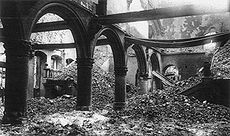
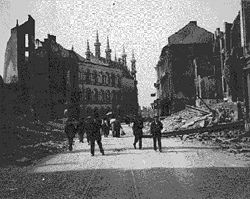
On August 25, 1914 the German army ravaged the city of Leuven
Leuven
Leuven is the capital of the province of Flemish Brabant in the Flemish Region, Belgium...
, deliberately burning the University
Catholic University of Leuven
The Catholic University of Leuven, or of Louvain, was the largest, oldest and most prominent university in Belgium. The university was founded in 1425 as the University of Leuven by John IV, Duke of Brabant and approved by a Papal bull by Pope Martin V.During France's occupation of Belgium in the...
's library of 300,000 medieval books and manuscripts with gasoline, killing 248 residents and expelling the entire population of 10,000. Civilian homes were set on fire and citizens often shot in the place they stood. Over 2,000 buildings were destroyed and large amounts of strategic materials, foodstuffs and modern industrial equipment were looted and transferred to Germany. These actions brought worldwide condemnation.
In Brabant
Province of Brabant
Brabant was a province of the United Kingdom of the Netherlands from 1815 until 1830 and a province of Belgium from 1830 until 1995, when it was split into the Dutch-speaking Flemish Brabant, the French-speaking Walloon Brabant and the bilingual Brussels-Capital Region.-United Kingdom of the...
nuns were ordered by Germans to strip naked under the pretext that they were spies; in Aarschot
Aarschot
Aarschot is a city and municipality in the province of Flemish Brabant, in Flanders, one of the three regions of Belgium. The municipality comprises the city of Aarschot proper and the towns of Gelrode, Langdorp and Rillaar. On January 1, 2006 Aarschot had a total population of 27,864...
between August and September women were repeatedly victimised; just like looting and murder, rape was widespread.
Adolf Hitler
Adolf Hitler
Adolf Hitler was an Austrian-born German politician and the leader of the National Socialist German Workers Party , commonly referred to as the Nazi Party). He was Chancellor of Germany from 1933 to 1945, and head of state from 1934 to 1945...
would later state that:
Wartime propaganda
Agreeing with the analysis of historian Susan Kingsley Kent, historian Nicoletta Gullace writes that "the invasion of Belgium, with its very real suffering, was nevertheless represented in a highly stylized way that dwelt on perverse sexual acts, lurid mutilations, and graphic accounts of child abuse of often dubious veracity." In Britain, many patriotic publicists propagated these stories on their own. For example popular writer William Le QueuxWilliam Le Queux
William Tufnell Le Queux was an Anglo-French journalist and writer. He was also a diplomat , a traveller , a flying buff who officiated at the first British air meeting at Doncaster in 1909, and a wireless pioneer who broadcast music from his own station long...
described the German army as "one vast gang of Jack-the-Rippers", and described in graphic detail events such as a governess hanged naked and mutilated, the bayoneting of a small baby, or the "screams of dying women", raped and "horribly mutilated" by German soldiers, accusing them of cutting the hands, feet, or breasts of their victims.
Gullace argues that "British propagandists were eager to move as quickly as possible from an explanation of the war that focused on the murder of an Austrian archduke and his wife by Serbian nationalists to the morally unambiguous question of the invasion of neutral Belgium." In support of her thesis, she quotes from two letters of Lord Bryce. In the first letter Bryce writes "There must be something fatally wrong with our so-called civilization for this Ser[b]ian cause so frightful a calamity has descended on all Europe." In a subsequent letter Bryce writes "The one thing we have to comfort us in this war is that we are all absolutely convinced of the justice of the cause, and of our duty, once Belgium had been invaded, to take up the sword."
Although the infamous German phrase "scrap of paper" (referring to the 1839 Treaty of London) galvanized a large segment of British intellectuals in support of the war, in more proletarian circles this imagery had less impact. For example, Labour politician Ramsay McDonald upon hearing about it, declared that "Never did we arm our people and ask them to give up their lives for a less good cause than this." British army recruiters reported problems in explaining the origins of the war in legalistic terms.
As the German advance in Belgium progressed, British newspapers started to publish stories on German atrocities. The British press, "quality
Quality press
Quality press is a category of newspapers in national circulation in the United Kingdom distinguished by their seriousness. The category used to be called "broadsheet" until several papers adopted a tabloid format. Both The Times and The Independent adopted a tabloid format in 2004...
" and tabloid alike, showed less interest in the "endless inventory of stolen property and requisitioned goods" that constituted the bulk of the official Belgian Reports. Instead, accounts of rape and bizarre mutilations flooded the British press. The intellectual discourse on the "scrap of paper" was then mixed with the more graphic imagery depicting Belgium as a brutalized woman, exemplified by the cartoons of Louis Raemaekers
Louis Raemaekers
Louis Raemaekers was a Dutch painter and cartoonist for the Amsterdam Telegraaf during World War I, noted for his anti-German stance....
, whose works were widely syndicated in the US.
Part of the press, for instance the editor of The Times
The Times
The Times is a British daily national newspaper, first published in London in 1785 under the title The Daily Universal Register . The Times and its sister paper The Sunday Times are published by Times Newspapers Limited, a subsidiary since 1981 of News International...
and Edward Tyas Cook
Edward Tyas Cook
Sir Edward Tyas Cook was an English journalist, biographer, and man of letters.-Biography:Born in Brighton, Cook was the youngest son of Silas Kemball Cook, secretary of the Royal Naval Hospital, Greenwich, and his wife, Emily, née Archer...
expressed concerns that haphazard stories, a few of which were proven as outright fabrications, would weaken the powerful imagery, and asked for a more structured approach. The German and American press questioned the veracity of many stories, and the fact that the British Press Bureau did not censor the stories put the British government in a delicate position. The Bryce Committee
Committee on Alleged German Outrages
The Committee on Alleged German Outrages, often called the Bryce Committee after its chair, Viscount James Bryce , is best known for producing the "Report of the Committee on Alleged German Outrages" published on May 12, 1915...
was eventually appointed in December 1914 to investigate. Bryce was considered highly suitable to lead the effort because his pre-war philo-Germanism and his good reputation in the United States where he had served as Britain's ambassador, as well as his legal expertise.
The commission's investigative efforts were however limited to previously recorded testimonies. Gullace argues that "the commission was in essence called upon to conduct a mock inquiry that would substitute the good name of Lord Bryce for the thousands of missing names of the anonymous victims whose stories appeared in the pages of the report." The commission published its report in May 1915. Charles Masterman, the director of the British War Propaganda Bureau, wrote to Bryce: "Your report has swept America. As you probably know even the most skeptical declare themselves converted, just because it is signed by you!" Translated in ten languages by June, the report was the basis for much subsequent wartime propaganda being used as a sourcebook for many other publications, ensuring that the atrocities became a leitmotif of the war's propaganda up to the final "Hang the Kaiser" campaign. For example, in 1917 Arnold J. Toynbee
Arnold J. Toynbee
Arnold Joseph Toynbee CH was a British historian whose twelve-volume analysis of the rise and fall of civilizations, A Study of History, 1934–1961, was a synthesis of world history, a metahistory based on universal rhythms of rise, flowering and decline, which examined history from a global...
published The German Terror in Belgium, which emphasized the most graphic accounts of "authentic" German sexual depravity, such as: "In the market-place of Gembloux
Gembloux
Gembloux is a Walloon municipality located in the Belgian province of Namur, on the axis Brussels-NamurOn 1 January 2006 the municipality had 21,964 inhabitants...
a Belgian despatch-rider saw the body of a woman pinned to the door of a house by a sword driven through her chest. The body was naked and the breasts had been cut off."
The British government regularly fabricated bizarre stories and supplied them to the public, such as Belgian nuns being tied to the clappers of church bells and crushed to death when the bells were rung. Reports paved the way for other war propaganda such as The Crucified Soldier
The Crucified Soldier
The Crucified Soldier refers to the widespread story of an Allied soldier serving in the Canadian Corps who may have been crucified with bayonets on a barn door or a tree, while fighting on the Western Front during World War I...
, The Angels of Mons
Angels of Mons
The Angels of Mons is a popular legend about a group of angels who supposedly protected members of the British army in the Battle of Mons at the outset of World War I...
, and the Kadaververwertungsanstalt
Kadaververwertungsanstalt
The Kadaververwertungsanstalten , also sometimes called the "German Corpse-Rendering Works" or "Tallow Factory" was one of the most notorious British anti-German propaganda efforts of World War I....
.
Much of the wartime publishing in Britain was in fact aimed at attracting American support. A 1929 article in the The Nation
The Nation
The Nation is the oldest continuously published weekly magazine in the United States. The periodical, devoted to politics and culture, is self-described as "the flagship of the left." Founded on July 6, 1865, It is published by The Nation Company, L.P., at 33 Irving Place, New York City.The Nation...
asserted: "In 1916 the Allies were putting forth every possible atrocity story to win neutral sympathy and American support. We were fed every day [...] stories of Belgian children whose hands were cut off, the Canadian soldier who was crucified to a barn door, the nurses whose breasts were cut off, the German habit of distilling glycerine and fat from their dead in order to obtain lubricants; and all the rest."
The fourth Liberty bond
Liberty bond
A Liberty Bond was a war bond that was sold in the United States to support the allied cause in World War I. Subscribing to the bonds became a symbol of patriotic duty in the United States and introduced the idea of financial securities to many citizens for the first time. The Act of Congress which...
drive of 1918 employed a "Remember Belgium" poster depicting the silhouette of a young Belgian girl being dragged by a German soldier on the background of a burning village; historian Kimberly Jensen interprets this imagery as "They are alone in the night, and rape seems imminent. The poster demonstrates that leaders drew on the American public's knowledge of and assumptions about the use of rape in the German invasion of Belgium."
In his book Roosevelt and Hitler, author Robert E. Herzstein stated that "The Germans could not seem to find a way to counteract powerful British propaganda about the 'Rape of Belgium' and other alleged atrocities. About the legacy of the propaganda, Gullace comments that "one of the tragedies of the British effort to manufacture truth is the way authentic suffering was rendered suspect by fabricated tales."
Later analysis
Even today, the war crimes of August 1914 are often dismissed as British propaganda. Modern historians are likely to be much less confident that reports of rape were wholesale fabrications, which was assumed in the 1920s and '30s. There is an ongoing debate between those who believe the German army acted primarily out of paranoia and those who emphasize additional causes (Lipkes).Zuckerman documents the continuing oppression of Belgians under German occupation, arguing that this was the real "Rape of Belgium".
Author Simon Winder notes that the German army was undoubtedly brutal in Belgium, but only to a degree the British were well acquainted with from their own behavior, such as in China or South Africa.
Historical studies
In-depth historical studies on this subject include:- The Rape of Belgium: The Untold Story of World War 1 by Larry Zuckerman
- Rehearsals: The German Army in Belgium, August 1914 by Jeff Lipkes
- German Atrocities 1914: A History of Denial by John Horne and Alan Kramer
- Horne and Kramer give many explanations; firstly (but not only), the collective fear of the People's War:
A German official in Dinant
On 6 May 2001, in Dinant, Walter Kolbow, a high secretary at the German ministry of defence, placed a wreath and bowed before a monument to the victims bearing the inscription: To the 674 Dinantais martyrs, innocent victims of German barbarism.External links
- H-Net Review of Horne & Kramer, The German Atrocities of 1914 : A History of Denial.
- H-Net Review of L. Zuckerman, The Rape of Belgium: The Untold Story of World War I.
- HistoryOfWar.org Review of J. Lipkes, Rehearsals: The German Army in Belgium, August 1914.
- H-Net Review of J. Lipkes Rehearsals: The German Army in Belgium, August 1914 by Jeffrey Smith.
- Prof. John Horne, German War Crimes.