

.gif)
Iris (anatomy)

Encyclopedia
The iris is a thin, circular structure in the eye
, responsible for controlling the diameter and size of the pupil
s and thus the amount of light reaching the retina
. "Eye color" is the color of the iris, which can be green, blue, or brown. In some cases it can be hazel (a combination of light brown, green and gold), grey, violet, or even pink. In response to the amount of light entering the eye, muscles attached to the iris expand or contract the aperture at the center of the iris, known as the pupil
. The larger the pupil, the more light can enter.
structure called the optic cup. The optic cup also produces the iris sphincter
and dilator muscles
.
ed fibrovascular tissue known as a stroma
and, beneath the stroma, pigmented epithelial cells.
The stroma connects to a sphincter
muscle (sphincter pupillae), which contracts the pupil
in a circular motion, and a set of dilator muscles (dilator pupillae) which pull the iris radially to enlarge the pupil, pulling it in folds. The back surface is covered by a heavily pigmented epithelial
layer that is two cells thick (the iris pigment epithelium), but the front surface has no epithelium. This anterior surface projects as the dilator muscles. The high pigment content blocks light from passing through the iris to the retina, restricting it to the pupil. The outer edge of the iris, known as the root, is attached to the sclera
and the anterior ciliary body
. The iris and ciliary body together are known as the anterior uvea
. Just in front of the root of the iris is the region referred to as the trabecular meshwork, through which the aqueous humour
constantly drains out of the eye, with the result that diseases of the iris often have important effects on intraocular pressure
, and body provide a lesser secondary pathway for the aqueous humour to drain from the eye.
The iris is divided into two major regions:
The collarette is the thickest region of the iris, separating the pupillary portion from the ciliary portion. The collarette is a rudiment of the coating of the embryonic pupil. It is typically defined as the region where the sphincter muscle and dilator muscle overlap. Radial ridges extend from the periphery to the pupillary zone, to supply the iris with blood vessels. The root of the iris is the thinnest and most peripheral.
The muscle cells of the iris are smooth muscle
in mammals and amphibians, but are striated muscle
in birds and reptiles. Many fish have neither, and, as a result, their irides are unable to dilate and contract, so that the pupil always remains of a fixed size.
The iris is usually strongly pigment
ed, with color
s ranging from brown to green, blue, grey, and hazel (which is how it earned its name, iris being Greek for "rainbow"1). Occasionally its color is due to lack of pigmentation, as in the pinkish-white of oculo-cutaneous albinism
, or to obscuration of its pigment by blood vessels, as in the red of an abnormally vascularised iris. Despite the wide range of colors, there is only one pigment that contributes substantially to normal human iris color, the dark pigment called melanin
. Structurally, this huge molecule is only slightly different from its equivalent found in skin
and hair
.
, which together make up an individual's epigenetic constitution in this context. A person's "eye color" is actually the color of one's iris, the cornea
being transparent and the white sclera
entirely outside the area of interest. It is a common misconception that the iris color is entirely due to its melanin pigment; this varies only from brown to black.
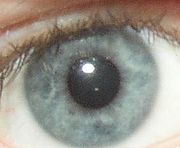

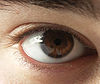 Melanin is yellowish-brown to dark brown in the stromal pigment cells, and black in the iris pigment epithelium
, which lies in a thin but very opaque layer across the back of the iris. Most human irides also show a condensation of the brownish stromal melanin in the thin anterior border
layer, which by its position has an overt influence on the overall color. The degree of dispersion of the melanin, which is in subcellular bundles called melanosomes, has some influence on the observed color, but melanosomes in the iris of humans and other vertebrates are not mobile, and the degree of pigment dispersion cannot be reversed. Abnormal clumping of melanosomes does occur in disease and may lead to irreversible changes in iris color (see heterochromia
, below). Colors other than brown or black are due to selective reflection and absorption from the other stromal components. Sometimes lipofuscin
, a yellow "wear and tear" pigment, also enters into the visible eye color, especially in aged or diseased green eyes (but not in healthy green human eyes).
The optical mechanisms by which the non-pigmented stromal components influence eye color are complex, and many erroneous statements exist in the literature. Simple selective absorption and reflection by biological molecules (hemoglobin
in the blood vessels, collagen
in the vessel and stroma) is the most important element. Rayleigh scattering
and Tyndall scattering
, (which also happen in the sky) and diffraction
also occur. Raman scattering
, and constructive interference, as in the feathers of birds, do not contribute to the color of the human eye, but interference phenomena are important in the brilliantly colored iris pigment cells (iridophores) in many animals. Interference effects can occur at both molecular and light microscopic scales, and are often associated (in melanin-bearing cells) with quasi-crystalline formations which enhance the optical effects. Interference is recognised by characteristic dependence of color on the angle of view, as seen in eyespot
s of some butterfly
wing
s, although the chemical components remain the same.
Caucasian babies are usually born blue-eyed since there is no pigment in the stroma, and appear blue due to scattering and selective absorption from the posterior epithelium. If melanin is deposited substantially, there will be brown or black color, if not, they will remain blue or grey.
Blue is one of the possible eye colors in humans. The "blue" allele
, existing in the Bey2 and Gey genes of chromosome 15
, is recessive. This means that both genes must have both blue alleles i.e. "blue-blue", in a person with blue eyes. If one of the alleles were not "blue" ("green" for Gey or "brown" for Bey2) then the person would have those colored eyes respectively. As either allele (though not both) can be passed on to offspring it is perfectly possible for someone who does not have blue eyes to have blue-eyed children. In general, blue eyed parents have blue eyed children; rare exceptions occur due to genes which control the pathway to determining eye color. Though this explanation gives an idea of eye color delineation, it is incomplete, and all the contributing factors towards eye color and its variation are not fully understood. Autosomal recessive/dominant traits in iris color are inherent in other species but coloration can follow a different pattern.
 Heterochromia (also known as a heterochromia iridis or heterochromia iridum) is an ocular condition in which one iris is a different color from the other iris (complete heterochromia), or where the part of one iris is a different color from the remainder (partial heterochromia or sectoral heterochromia). Uncommon in humans, it is often an indicator of ocular disease, such as chronic iritis or diffuse iris melanoma, but may also occur as a normal variant. Sectors or patches of strikingly different colors in the same iris are less common. Alexander the Great and Anastasios the First were dubbed dikoro*s (dikoros, "with two pupils") for their patent heterochromias. In their case, this was not a true dicoria
(two pupils in the same iris). Real polycoria
can be due to disease but is most often due to previous trauma or surgery.
In contrast, heterochromia and variegated iris patterns are common in veterinary practice. Siberian Huskies
show heterochromia, possibly analogous to the genetically-determined Waardenburg syndrome
of humans. Some white cat fancies (e.g., white Turkish Angora or white Turkish van cats) may show striking heterochromia, with the most common pattern being one uniformly blue, the other copper, orange, yellow or green. Striking variation within the same iris is also common in some animals, and is the norm in some species. Several herding breeds, particularly those with a blue merle coat color (such as Australian Shepherd
s and Border Collie
s) may show well-defined blue areas within a brown iris as well as separate blue and darker eyes. Some horses (usually within the white, spotted, palomino or cremello groups of breeds) may show amber, brown, white, and blue all within the same eye, without any sign of eye disease.
One eye with a white or bluish-white iris is also known as a walleye.
. This represents reflection of light from the back of the eye, and is closely related to the term red reflex, used by ophthalmologists and optometrists in describing appearances on fundal examination. "Red eye" is also commonly visible in photographs, giving them the "vampire effect."
When used as a descriptive term in medicine, the meaning of "red eye" is quite different, and indicates that the bulbar conjunctiva
is reddened due to dilatation of superficial blood vessels. Leaving aside rarities, it indicates surface infection (conjunctivitis
), intraocular inflammation (e.g., iridocyclitis
) or high intraocular pressure (acute glaucoma or occasionally severe, untreated chronic glaucoma). This use of "red eye" implies disease. The term is therefore not used in medicine for ocular albinism
, in which the eye is otherwise healthy despite an obviously red pupil and a translucent pinkish iris due to reflected light from the fundus. "Red eye" is used more loosely in veterinary practice, where investigation of eye diseases can be difficult, but even so albinotic breeds are easily recognised and are usually described as having "pink eye" rather than "red eye"
technique whose proponents believe that patterns, colors, and other characteristics of the iris can be examined to determine information about a patient's systemic
health. Practitioners match their observations to iris charts which divide the iris into zones corresponding to specific parts of the human body. Iridologists see the eyes as "windows" into the body's state of health.
Iridology is not supported by quality research studies and is considered pseudoscience by the majority of medical practitioners and eye care professionals.
Human eye
The human eye is an organ which reacts to light for several purposes. As a conscious sense organ, the eye allows vision. Rod and cone cells in the retina allow conscious light perception and vision including color differentiation and the perception of depth...
, responsible for controlling the diameter and size of the pupil
Pupil
The pupil is a hole located in the center of the iris of the eye that allows light to enter the retina. It appears black because most of the light entering the pupil is absorbed by the tissues inside the eye. In humans the pupil is round, but other species, such as some cats, have slit pupils. In...
s and thus the amount of light reaching the retina
Retina
The vertebrate retina is a light-sensitive tissue lining the inner surface of the eye. The optics of the eye create an image of the visual world on the retina, which serves much the same function as the film in a camera. Light striking the retina initiates a cascade of chemical and electrical...
. "Eye color" is the color of the iris, which can be green, blue, or brown. In some cases it can be hazel (a combination of light brown, green and gold), grey, violet, or even pink. In response to the amount of light entering the eye, muscles attached to the iris expand or contract the aperture at the center of the iris, known as the pupil
Pupil
The pupil is a hole located in the center of the iris of the eye that allows light to enter the retina. It appears black because most of the light entering the pupil is absorbed by the tissues inside the eye. In humans the pupil is round, but other species, such as some cats, have slit pupils. In...
. The larger the pupil, the more light can enter.
Embryology
The iris develops from the anterior two layers of an embryonic neuroectodermNeuroectoderm
Neuroectoderm is the term for ectoderm which receives Bone Morphogenetic Protein-inhibiting signals from proteins such as noggin, which leads to the development of the nervous system from this tissue....
structure called the optic cup. The optic cup also produces the iris sphincter
Iris sphincter muscle
The iris sphincter muscle is a muscle in the part of the eye called the iris...
and dilator muscles
Iris dilator muscle
The iris dilator muscle , is a smooth muscle of the eye, running radially in the iris and therefore fit as a dilator. It has its origin from the anterior epithelium. It is innervated by the sympathetic system, which acts by releasing noradrenaline, which acts on α1-receptors...
.
General structure
The iris consists of two layers: the front pigmentPigment
A pigment is a material that changes the color of reflected or transmitted light as the result of wavelength-selective absorption. This physical process differs from fluorescence, phosphorescence, and other forms of luminescence, in which a material emits light.Many materials selectively absorb...
ed fibrovascular tissue known as a stroma
Stroma of iris
The stroma of the iris consists of fibers and cells.The former are made up of delicate bundles of fibrous tissue; a few fibers at the circumference of the iris have a circular direction; but the majority radiate toward the pupil, forming by their interlacement delicate meshes in which the vessels...
and, beneath the stroma, pigmented epithelial cells.
The stroma connects to a sphincter
Sphincter
A sphincter is an anatomical structure, or a circular muscle, that normally maintains constriction of a natural body passage or orifice and which relaxes as required by normal physiological functioning...
muscle (sphincter pupillae), which contracts the pupil
Pupil
The pupil is a hole located in the center of the iris of the eye that allows light to enter the retina. It appears black because most of the light entering the pupil is absorbed by the tissues inside the eye. In humans the pupil is round, but other species, such as some cats, have slit pupils. In...
in a circular motion, and a set of dilator muscles (dilator pupillae) which pull the iris radially to enlarge the pupil, pulling it in folds. The back surface is covered by a heavily pigmented epithelial
Epithelium
Epithelium is one of the four basic types of animal tissue, along with connective tissue, muscle tissue and nervous tissue. Epithelial tissues line the cavities and surfaces of structures throughout the body, and also form many glands. Functions of epithelial cells include secretion, selective...
layer that is two cells thick (the iris pigment epithelium), but the front surface has no epithelium. This anterior surface projects as the dilator muscles. The high pigment content blocks light from passing through the iris to the retina, restricting it to the pupil. The outer edge of the iris, known as the root, is attached to the sclera
Sclera
The sclera , also known as the white or white of the eye, is the opaque , fibrous, protective, outer layer of the eye containing collagen and elastic fiber. In the development of the embryo, the sclera is derived from the neural crest...
and the anterior ciliary body
Ciliary body
The ciliary body is the circumferential tissue inside the eye composed of the ciliary muscle and ciliary processes. It is triangular in horizontal section and is coated by a double layer, the ciliary epithelium. This epithelium produces the aqueous humor. The inner layer is transparent and covers...
. The iris and ciliary body together are known as the anterior uvea
Uvea
The uvea , also called the uveal layer, uveal coat, uveal tract, or vascular tunic, is the pigmented middle of the three concentric layers that make up an eye. The name is possibly a reference to its reddish-blue or almost black colour, wrinkled appearance and grape-like size and shape when...
. Just in front of the root of the iris is the region referred to as the trabecular meshwork, through which the aqueous humour
Aqueous humour
The aqueous humour is a clear, gelatinous fluid similar to plasma, but containing low-protein concentrations. It is secreted from the ciliary epithelium, a structure supporting the lens. It is located in the space between the lens and the cornea...
constantly drains out of the eye, with the result that diseases of the iris often have important effects on intraocular pressure
Intraocular pressure
Intraocular pressure is the fluid pressure inside the eye. Tonometry is the method eye care professionals use to determine this. IOP is an important aspect in the evaluation of patients at risk from glaucoma...
, and body provide a lesser secondary pathway for the aqueous humour to drain from the eye.
The iris is divided into two major regions:
- The pupillary zone is the inner region whose edge forms the boundary of the pupil.
- The ciliary zone is the rest of the iris that extends to its origin at the ciliary body.
The collarette is the thickest region of the iris, separating the pupillary portion from the ciliary portion. The collarette is a rudiment of the coating of the embryonic pupil. It is typically defined as the region where the sphincter muscle and dilator muscle overlap. Radial ridges extend from the periphery to the pupillary zone, to supply the iris with blood vessels. The root of the iris is the thinnest and most peripheral.
The muscle cells of the iris are smooth muscle
Smooth muscle
Smooth muscle is an involuntary non-striated muscle. It is divided into two sub-groups; the single-unit and multiunit smooth muscle. Within single-unit smooth muscle tissues, the autonomic nervous system innervates a single cell within a sheet or bundle and the action potential is propagated by...
in mammals and amphibians, but are striated muscle
Striated muscle
Striated muscle tissue is a form of fibers that are combined into parallel fibers. More specifically, it can refer to:* Cardiac muscle .* Skeletal muscle* Branchiomeric muscles...
in birds and reptiles. Many fish have neither, and, as a result, their irides are unable to dilate and contract, so that the pupil always remains of a fixed size.
Histological features
From anterior (front) to posterior (back), the layers of the iris are:- Anterior limiting layer
- Stroma of irisStroma of irisThe stroma of the iris consists of fibers and cells.The former are made up of delicate bundles of fibrous tissue; a few fibers at the circumference of the iris have a circular direction; but the majority radiate toward the pupil, forming by their interlacement delicate meshes in which the vessels...
- Iris sphincter muscleIris sphincter muscleThe iris sphincter muscle is a muscle in the part of the eye called the iris...
- Iris dilator muscleIris dilator muscleThe iris dilator muscle , is a smooth muscle of the eye, running radially in the iris and therefore fit as a dilator. It has its origin from the anterior epithelium. It is innervated by the sympathetic system, which acts by releasing noradrenaline, which acts on α1-receptors...
- Anterior pigment myoepithelium
- Posterior pigment epithelium
Anterior surface features
- The Crypts of Fuchs are a series of openings located on either side of the collarette that allow the stroma and deeper iris tissues to be bathed in aqueous humor. Collagen trabeculae that surround the border of the crypts can be seen in blue irides.
- The pupillary ruffs (crenations) are a series of small ridges at the pupillary margin formed by the continuation of the pigmented epithelium from the posterior surface.
- The Circular contraction folds, also known as contraction furrows, are a series of circular bands or folds about midway between the collarette and the origin of the iris. These folds result from changes in the surface of the iris as it dilates.
- Crypts at the base of the iris are additional openings that can be observed close to the outermost part of the ciliary portion of the iris.
Posterior surface features
- The Radial contraction folds of Schwalbe are a series of very fine radial folds in the pupillary portion of the iris extending from the pupillary margin to the collarette. They are associated with the scalloped appearance of the pupillary ruff.
- The Structural folds of Schwalbe are radial folds extending from the border of the ciliary and pupillary zones that are much broader and more widely-spaced, continuous with the "valleys" between the ciliary processes.
- Some of the Circular contraction folds are a fine series of ridges that run near the pupillary margin and vary in thickness of the iris pigment epithelium; others are in ciliary portion of iris. It changes colors like a rainbow.
The iris is usually strongly pigment
Pigment
A pigment is a material that changes the color of reflected or transmitted light as the result of wavelength-selective absorption. This physical process differs from fluorescence, phosphorescence, and other forms of luminescence, in which a material emits light.Many materials selectively absorb...
ed, with color
Color
Color or colour is the visual perceptual property corresponding in humans to the categories called red, green, blue and others. Color derives from the spectrum of light interacting in the eye with the spectral sensitivities of the light receptors...
s ranging from brown to green, blue, grey, and hazel (which is how it earned its name, iris being Greek for "rainbow"1). Occasionally its color is due to lack of pigmentation, as in the pinkish-white of oculo-cutaneous albinism
Albinism
Albinism is a congenital disorder characterized by the complete or partial absence of pigment in the skin, hair and eyes due to absence or defect of an enzyme involved in the production of melanin...
, or to obscuration of its pigment by blood vessels, as in the red of an abnormally vascularised iris. Despite the wide range of colors, there is only one pigment that contributes substantially to normal human iris color, the dark pigment called melanin
Melanin
Melanin is a pigment that is ubiquitous in nature, being found in most organisms . In animals melanin pigments are derivatives of the amino acid tyrosine. The most common form of biological melanin is eumelanin, a brown-black polymer of dihydroxyindole carboxylic acids, and their reduced forms...
. Structurally, this huge molecule is only slightly different from its equivalent found in skin
Skin
-Dermis:The dermis is the layer of skin beneath the epidermis that consists of connective tissue and cushions the body from stress and strain. The dermis is tightly connected to the epidermis by a basement membrane. It also harbors many Mechanoreceptors that provide the sense of touch and heat...
and hair
Hair
Hair is a filamentous biomaterial, that grows from follicles found in the dermis. Found exclusively in mammals, hair is one of the defining characteristics of the mammalian class....
.
Genetic and physical factors determining iris color
Iris color is a highly complex phenomenon consisting of the combined effects of texture, pigmentation, fibrous tissue and blood vessels within the iris stromaStroma of iris
The stroma of the iris consists of fibers and cells.The former are made up of delicate bundles of fibrous tissue; a few fibers at the circumference of the iris have a circular direction; but the majority radiate toward the pupil, forming by their interlacement delicate meshes in which the vessels...
, which together make up an individual's epigenetic constitution in this context. A person's "eye color" is actually the color of one's iris, the cornea
Cornea
The cornea is the transparent front part of the eye that covers the iris, pupil, and anterior chamber. Together with the lens, the cornea refracts light, with the cornea accounting for approximately two-thirds of the eye's total optical power. In humans, the refractive power of the cornea is...
being transparent and the white sclera
Sclera
The sclera , also known as the white or white of the eye, is the opaque , fibrous, protective, outer layer of the eye containing collagen and elastic fiber. In the development of the embryo, the sclera is derived from the neural crest...
entirely outside the area of interest. It is a common misconception that the iris color is entirely due to its melanin pigment; this varies only from brown to black.
Iris pigment epithelium
The iris pigment epithelium is a two-cell thick layer of cuboidal cells lying behind the iris. Both layers are jet black due to the numerous large melanosomes which pack the cytoplasm of each cell. Towards the central axis, the IPE terminates at the pupillary margin...
, which lies in a thin but very opaque layer across the back of the iris. Most human irides also show a condensation of the brownish stromal melanin in the thin anterior border
Anterior border
Anterior border can refer to:* Anterior margin of pancreas* Anterior border of lung...
layer, which by its position has an overt influence on the overall color. The degree of dispersion of the melanin, which is in subcellular bundles called melanosomes, has some influence on the observed color, but melanosomes in the iris of humans and other vertebrates are not mobile, and the degree of pigment dispersion cannot be reversed. Abnormal clumping of melanosomes does occur in disease and may lead to irreversible changes in iris color (see heterochromia
Heterochromia
In anatomy, heterochromia refers to a difference in coloration, usually of the iris but also of hair or skin. Heterochromia is a result of the relative excess or lack of melanin...
, below). Colors other than brown or black are due to selective reflection and absorption from the other stromal components. Sometimes lipofuscin
Lipofuscin
Lipofuscin is the name given to finely granular yellow-brown pigment granules composed of lipid-containing residues of lysosomal digestion. It is considered one of the aging or "wear-and-tear" pigments, found in the liver, kidney, heart muscle, adrenals, nerve cells, and ganglion cells...
, a yellow "wear and tear" pigment, also enters into the visible eye color, especially in aged or diseased green eyes (but not in healthy green human eyes).
The optical mechanisms by which the non-pigmented stromal components influence eye color are complex, and many erroneous statements exist in the literature. Simple selective absorption and reflection by biological molecules (hemoglobin
Hemoglobin
Hemoglobin is the iron-containing oxygen-transport metalloprotein in the red blood cells of all vertebrates, with the exception of the fish family Channichthyidae, as well as the tissues of some invertebrates...
in the blood vessels, collagen
Collagen
Collagen is a group of naturally occurring proteins found in animals, especially in the flesh and connective tissues of mammals. It is the main component of connective tissue, and is the most abundant protein in mammals, making up about 25% to 35% of the whole-body protein content...
in the vessel and stroma) is the most important element. Rayleigh scattering
Rayleigh scattering
Rayleigh scattering, named after the British physicist Lord Rayleigh, is the elastic scattering of light or other electromagnetic radiation by particles much smaller than the wavelength of the light. The particles may be individual atoms or molecules. It can occur when light travels through...
and Tyndall scattering
Tyndall effect
The Tyndall effect, also known as Tyndall scattering, is light scattering by particles in a colloid or particles in a fine suspension. It is named after the 19th century physicist John Tyndall. It is similar to Rayleigh scattering, in that the intensity of the scattered light depends on the fourth...
, (which also happen in the sky) and diffraction
Diffraction
Diffraction refers to various phenomena which occur when a wave encounters an obstacle. Italian scientist Francesco Maria Grimaldi coined the word "diffraction" and was the first to record accurate observations of the phenomenon in 1665...
also occur. Raman scattering
Raman scattering
Raman scattering or the Raman effect is the inelastic scattering of a photon. It was discovered by Sir Chandrasekhara Venkata Raman and Kariamanickam Srinivasa Krishnan in liquids, and by Grigory Landsberg and Leonid Mandelstam in crystals....
, and constructive interference, as in the feathers of birds, do not contribute to the color of the human eye, but interference phenomena are important in the brilliantly colored iris pigment cells (iridophores) in many animals. Interference effects can occur at both molecular and light microscopic scales, and are often associated (in melanin-bearing cells) with quasi-crystalline formations which enhance the optical effects. Interference is recognised by characteristic dependence of color on the angle of view, as seen in eyespot
Eyespot (mimicry)
An eyespot is an eye-like marking. They are found on butterflies, reptiles, birds and fish. In members of the Felidae family , the white circular markings on the backs of the ears are termed ocelli, and they are functionally similar to eyespots in other animals.Eyespots may be a form of...
s of some butterfly
Butterfly
A butterfly is a mainly day-flying insect of the order Lepidoptera, which includes the butterflies and moths. Like other holometabolous insects, the butterfly's life cycle consists of four parts: egg, larva, pupa and adult. Most species are diurnal. Butterflies have large, often brightly coloured...
wing
Wing
A wing is an appendage with a surface that produces lift for flight or propulsion through the atmosphere, or through another gaseous or liquid fluid...
s, although the chemical components remain the same.
Caucasian babies are usually born blue-eyed since there is no pigment in the stroma, and appear blue due to scattering and selective absorption from the posterior epithelium. If melanin is deposited substantially, there will be brown or black color, if not, they will remain blue or grey.
Blue is one of the possible eye colors in humans. The "blue" allele
Allele
An allele is one of two or more forms of a gene or a genetic locus . "Allel" is an abbreviation of allelomorph. Sometimes, different alleles can result in different observable phenotypic traits, such as different pigmentation...
, existing in the Bey2 and Gey genes of chromosome 15
Chromosome 15 (human)
right|frame|Human chromosome 15Chromosome 15 is one of the 23 pairs of chromosomes in humans. People normally have two copies of this chromosome. Chromosome 15 spans about 106 million base pairs and represents between 3% and 3.5% of the total DNA in cells.Identifying genes on each chromosome is an...
, is recessive. This means that both genes must have both blue alleles i.e. "blue-blue", in a person with blue eyes. If one of the alleles were not "blue" ("green" for Gey or "brown" for Bey2) then the person would have those colored eyes respectively. As either allele (though not both) can be passed on to offspring it is perfectly possible for someone who does not have blue eyes to have blue-eyed children. In general, blue eyed parents have blue eyed children; rare exceptions occur due to genes which control the pathway to determining eye color. Though this explanation gives an idea of eye color delineation, it is incomplete, and all the contributing factors towards eye color and its variation are not fully understood. Autosomal recessive/dominant traits in iris color are inherent in other species but coloration can follow a different pattern.
Different colors in the two eyes
Dicoria
Dicoria is a genus of flowering plants in the daisy family. It contains two species. In the United States Dicoria is morphologically variable, but all plants are assigned to the single species Dicoria canescens-External links:**...
(two pupils in the same iris). Real polycoria
Polycoria
Polycoria is a pathological condition of the eye characterized by more than one pupillary opening in the iris. It may be congenital or result from a disease affecting the iris....
can be due to disease but is most often due to previous trauma or surgery.
In contrast, heterochromia and variegated iris patterns are common in veterinary practice. Siberian Huskies
Siberian Husky
The Siberian Husky is a medium-size, dense-coat working dog breed that originated in north-eastern Siberia. The breed belongs to the Spitz genetic family...
show heterochromia, possibly analogous to the genetically-determined Waardenburg syndrome
Waardenburg syndrome
Waardenburg syndrome Waardenburg syndrome Waardenburg syndrome (also Waardenburg Shah Syndrome, Waardenburg-Klein syndrome, Mende's syndrome II, Van der Hoeve-Halbertsma-Waardenburg syndrome, Ptosis-Epicanthus syndrome, Van der Hoeve-Halbertsma-Gualdi syndrome, Waardenburg type Pierpont,[5] Van...
of humans. Some white cat fancies (e.g., white Turkish Angora or white Turkish van cats) may show striking heterochromia, with the most common pattern being one uniformly blue, the other copper, orange, yellow or green. Striking variation within the same iris is also common in some animals, and is the norm in some species. Several herding breeds, particularly those with a blue merle coat color (such as Australian Shepherd
Australian Shepherd
The Australian shepherd is a breed of herding dog that was developed on ranches in the Western United States. Despite its name, the breed, commonly known as an Aussie, did not originate in Australia They acquired their name because some of the Australian sheepdogs arrived in the United States with...
s and Border Collie
Border Collie
The Border Collie is a herding dog breed developed in the Anglo-Scottish border region for herding livestock, especially sheep. It is the most widespread of the collie breeds....
s) may show well-defined blue areas within a brown iris as well as separate blue and darker eyes. Some horses (usually within the white, spotted, palomino or cremello groups of breeds) may show amber, brown, white, and blue all within the same eye, without any sign of eye disease.
One eye with a white or bluish-white iris is also known as a walleye.
Conjunctivitis or "Red Eye"
When photographed with a flash, the iris constricts but not fast enough to avoid the red-eye effectRed-eye effect
The red-eye effect in photography is the common appearance of red pupils in color photographs of eyes. It occurs when using a photographic flash very close to the camera lens , in ambient low light. The effect appears in the eyes of humans and animals that have no tapetum lucidum, hence no...
. This represents reflection of light from the back of the eye, and is closely related to the term red reflex, used by ophthalmologists and optometrists in describing appearances on fundal examination. "Red eye" is also commonly visible in photographs, giving them the "vampire effect."
When used as a descriptive term in medicine, the meaning of "red eye" is quite different, and indicates that the bulbar conjunctiva
Conjunctiva
The conjunctiva covers the sclera and lines the inside of the eyelids. It is composed of rare stratified columnar epithelium.-Function:...
is reddened due to dilatation of superficial blood vessels. Leaving aside rarities, it indicates surface infection (conjunctivitis
Conjunctivitis
Conjunctivitis refers to inflammation of the conjunctiva...
), intraocular inflammation (e.g., iridocyclitis
Iridocyclitis
Iridocyclitis, a type of anterior uveitis, is a condition in which the uvea of the eye is inflamed.Iridocyclitis isInflammation of the iris and the ciliary body.- Symptoms :Symptoms include:* Photophobia* Redness* Watering of the eyes* Lacrimation...
) or high intraocular pressure (acute glaucoma or occasionally severe, untreated chronic glaucoma). This use of "red eye" implies disease. The term is therefore not used in medicine for ocular albinism
Ocular albinism
Ocular albinism is a form of albinism which, in contrast to oculocutaneous albinism, presents primarily in the eyes. There are multiple forms of ocular albinism, which are clinically similar.Both known genes are on the X chromosome...
, in which the eye is otherwise healthy despite an obviously red pupil and a translucent pinkish iris due to reflected light from the fundus. "Red eye" is used more loosely in veterinary practice, where investigation of eye diseases can be difficult, but even so albinotic breeds are easily recognised and are usually described as having "pink eye" rather than "red eye"
Alternative medicine
Iridology (also known as iridodiagnosis) is an alternative medicineAlternative medicine
Alternative medicine is any healing practice, "that does not fall within the realm of conventional medicine." It is based on historical or cultural traditions, rather than on scientific evidence....
technique whose proponents believe that patterns, colors, and other characteristics of the iris can be examined to determine information about a patient's systemic
Systemic
Systemic refers to something that is spread throughout, system-wide, affecting a group or system such as a body, economy, market or society as a whole. Systemic may also refer to:-In medicine:...
health. Practitioners match their observations to iris charts which divide the iris into zones corresponding to specific parts of the human body. Iridologists see the eyes as "windows" into the body's state of health.
Iridology is not supported by quality research studies and is considered pseudoscience by the majority of medical practitioners and eye care professionals.
External links
- Detailed photographs of human irides - "Sagittal Section Through the Eyeball"