


Red tide

Encyclopedia
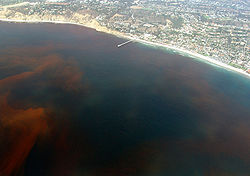
Algal bloom
An algal bloom is a rapid increase or accumulation in the population of algae in an aquatic system. Algal blooms may occur in freshwater as well as marine environments. Typically, only one or a small number of phytoplankton species are involved, and some blooms may be recognized by discoloration...
(large concentrations of aquatic microorganisms), an event in which estuarine, marine, or fresh water algae accumulate rapidly in the water column and results in discoloration of the surface water. It is usually found in coastal areas.
These algae, known as phytoplankton
Phytoplankton
Phytoplankton are the autotrophic component of the plankton community. The name comes from the Greek words φυτόν , meaning "plant", and πλαγκτός , meaning "wanderer" or "drifter". Most phytoplankton are too small to be individually seen with the unaided eye...
, are single-celled protists, plant-like organisms that can form dense, visible patches near the water's surface. Certain species of phytoplankton
Phytoplankton
Phytoplankton are the autotrophic component of the plankton community. The name comes from the Greek words φυτόν , meaning "plant", and πλαγκτός , meaning "wanderer" or "drifter". Most phytoplankton are too small to be individually seen with the unaided eye...
, dinoflagellate
Dinoflagellate
The dinoflagellates are a large group of flagellate protists. Most are marine plankton, but they are common in fresh water habitats as well. Their populations are distributed depending on temperature, salinity, or depth...
s, contain photosynthetic pigments that vary in color from green to brown to red.
When the algae are present in high concentrations, the water appears to be discolored or murky, varying in color from purple to almost pink, normally being red or green. Not all algal blooms are dense enough to cause water discoloration, and not all discolored waters associated with algal blooms are red. Additionally, red tides are not typically associated with tidal movement of water, hence the preference among scientists to use the term algal bloom.
Some red tides are associated with the production of natural toxins, depletion of dissolved oxygen or other harmful effects, and are generally described as harmful algal blooms. The most conspicuous effects of these kind of red tides are the associated wildlife mortalities of marine and coastal species of fish, birds, marine mammals, and other organisms. In the case of Florida red tides, these mortalities are caused by exposure to a potent neurotoxin called brevetoxin
Brevetoxin
Brevetoxin , or brevetoxins, are a suite of cyclic polyether compounds produced naturally by a species of dinoflagellate known as Karenia brevis...
which is produced naturally by the marine algae Karenia brevis
Karenia brevis
Karenia brevis is a marine dinoflagellate common in Gulf of Mexico waters, and is the organism responsible for Florida red tide, as well as red tide in Texas.-Description:K...
.
Overview
Red tides in the Gulf of Mexico are a result of high concentrations of Karenia brevis
Karenia brevis
Karenia brevis is a marine dinoflagellate common in Gulf of Mexico waters, and is the organism responsible for Florida red tide, as well as red tide in Texas.-Description:K...
, a microscopic marine algae that occurs naturally but normally in lower concentrations. In high concentrations, its toxin paralyzes the central nervous system of fish so they cannot breathe. Dead fish wash up on Gulf of Mexico
Gulf of Mexico
The Gulf of Mexico is a partially landlocked ocean basin largely surrounded by the North American continent and the island of Cuba. It is bounded on the northeast, north and northwest by the Gulf Coast of the United States, on the southwest and south by Mexico, and on the southeast by Cuba. In...
beaches. Dense concentrations appear as discolored water, often reddish in color. It is a natural phenomenon, but the exact cause or combination of factors that result in a red tide outbreak are unknown. Red tide causes economic harm and for this reason red tide outbreaks are carefully monitored. For example, the Florida Fish and Wildlife Conservation Commission
Florida Fish and Wildlife Conservation Commission
The Florida Fish and Wildlife Conservation Commission is a Florida government agency charged with managing the state's fish and wildlife resources, regulating Florida's fisheries and wildlife, and enforcing related laws...
provides an up-to-date status report on the red tide in Florida. Texas also provides a current status report.
Red tide is also potentially harmful to human health. Humans can become seriously ill from eating oysters and other shellfish contaminated with red tide toxin.
The cause of red tides is controversial. Red tides occur off coasts all over the world and have occurred for thousands of years. Not all red tides have toxins or are harmful.
Definition
Red tide is a colloquial term used to refer to one of a variety of natural phenomena known as a harmful algal blooms or HABs. The term red tide specifically refers to blooms of a species of dinoflagellate
Dinoflagellate
The dinoflagellates are a large group of flagellate protists. Most are marine plankton, but they are common in fresh water habitats as well. Their populations are distributed depending on temperature, salinity, or depth...
known as Karenia brevis
Karenia brevis
Karenia brevis is a marine dinoflagellate common in Gulf of Mexico waters, and is the organism responsible for Florida red tide, as well as red tide in Texas.-Description:K...
. It is sometimes used to refer more broadly to other types of algal blooms as well.
The term red tide is being phased out among researchers for the following reasons:
- Red tides are not necessarily red and many have no discoloration at all.
- They are unrelated to movements of the tides.
- The term is imprecisely used to refer to a wide variety of algal species that are known as bloom-formers.
As a technical term it is being replaced in favour of more precise terminology including the generic term harmful algal bloom for harmful species, and algal bloom for non-harmful species.
The term red tide is most often used in the United States of America to refer to Karenia brevis blooms in the eastern Gulf of Mexico
Gulf of Mexico
The Gulf of Mexico is a partially landlocked ocean basin largely surrounded by the North American continent and the island of Cuba. It is bounded on the northeast, north and northwest by the Gulf Coast of the United States, on the southwest and south by Mexico, and on the southeast by Cuba. In...
, also called the Florida red tide. These blooms occur almost annually along Florida waters. The density of these organisms during a bloom can exceed tens of millions of cells per litre of seawater, and often discolor the water a deep reddish-brown hue.
The term red tide is also sometimes used to describe harmful algal blooms on the northern east coast of the United States, particularly in the Gulf of Maine
Gulf of Maine
The Gulf of Maine is a large gulf of the Atlantic Ocean on the east coast of North America.It is delineated by Cape Cod at the eastern tip of Massachusetts in the southwest and Cape Sable at the southern tip of Nova Scotia in the northeast. It includes the entire coastlines of the U.S...
. This type of bloom is caused by another species of dinoflagellate
Dinoflagellate
The dinoflagellates are a large group of flagellate protists. Most are marine plankton, but they are common in fresh water habitats as well. Their populations are distributed depending on temperature, salinity, or depth...
known as Alexandrium fundyense
Alexandrium fundyense
Alexandrium fundyense is a dinoflagellate. It produces toxins that induce paralytic shellfish poisoning , and is a common cause of red tide.-References:...
. These blooms of organisms cause severe disruptions in fisheries
Fishery
Generally, a fishery is an entity engaged in raising or harvesting fish which is determined by some authority to be a fishery. According to the FAO, a fishery is typically defined in terms of the "people involved, species or type of fish, area of water or seabed, method of fishing, class of boats,...
of these waters as the toxins in these organism cause filter-feeding shellfish
Shellfish
Shellfish is a culinary and fisheries term for exoskeleton-bearing aquatic invertebrates used as food, including various species of molluscs, crustaceans, and echinoderms. Although most kinds of shellfish are harvested from saltwater environments, some kinds are found only in freshwater...
in affected waters to become poisonous for human consumption due to saxitoxin
Saxitoxin
Saxitoxin is a neurotoxin naturally produced by certain species of marine dinoflagellates and cyanobacteria Saxitoxin (STX) is a neurotoxin naturally produced by certain species of marine dinoflagellates (Alexandrium sp., Gymnodinium sp., Pyrodinium sp.) and cyanobacteria Saxitoxin (STX) is a...
.
Causes of red tide
The occurrence of red tides in some locations appear to be entirely natural (algal blooms are a seasonal occurrence resulting from coastal upwelling, a natural result of the movement of certain ocean currents) while in others they appear to be a result of increased nutrient loading from human activities. The growth of marine phytoplankton is generally limited by the availability of nitrates and phosphates, which can be abundant in agricultural run-off as well as coastal upwelling zones. Coastal water pollutionWater pollution
Water pollution is the contamination of water bodies . Water pollution occurs when pollutants are discharged directly or indirectly into water bodies without adequate treatment to remove harmful compounds....
produced by humans and systematic increase in sea water temperature
Global warming
Global warming refers to the rising average temperature of Earth's atmosphere and oceans and its projected continuation. In the last 100 years, Earth's average surface temperature increased by about with about two thirds of the increase occurring over just the last three decades...
have also been implicated as contributing factors in red tides. Other factors such as iron-rich dust influx from large desert areas such as the Saharan desert are thought to play a major role in causing red tides. Some algal blooms on the Pacific coast have also been linked to occurrences of large-scale climatic oscillations such as El Niño events. While red tides in the Gulf of Mexico have been occurring since the time of early explorers such as Cabeza de Vaca, it is unclear what initiates these blooms and how large a role anthropogenic
Anthropogenic
Human impact on the environment or anthropogenic impact on the environment includes impacts on biophysical environments, biodiversity and other resources. The term anthropogenic designates an effect or object resulting from human activity. The term was first used in the technical sense by Russian...
and natural factors play in their development. It is also debated whether the apparent increase in frequency and severity of algal blooms in various parts of the world is in fact a real increase or is due to increased observation effort and advances in species identification methods.
Notable occurrences
- 1972: A red tide was caused in New England by a toxic dinoflagellateDinoflagellateThe dinoflagellates are a large group of flagellate protists. Most are marine plankton, but they are common in fresh water habitats as well. Their populations are distributed depending on temperature, salinity, or depth...
Alexandrium (Gonyaulax) tamarense. The red tides caused by the dinoflagellate Gonyaulax are serious because this organism produces saxitonin & gonyautoxins which accumulate in shellfish and if ingested may lead to paralytic shellfish poisoning and can lead to death - 2005: The Canadian red tide was discovered to have come further south than it has in years prior by the ship (R/V) Oceanus, closing shellfish beds in Maine and Massachusetts and alerting authorities as far south as MontaukMontauk, New YorkMontauk [ˈmɒntɒk] is a census-designated place that roughly corresponds to the hamlet with the same name located in the town of East Hampton in Suffolk County, New York, United States on the South Shore of Long Island. As of the United States 2000 Census, the CDP population was 3,851 as of 2000...
(Long IslandLong IslandLong Island is an island located in the southeast part of the U.S. state of New York, just east of Manhattan. Stretching northeast into the Atlantic Ocean, Long Island contains four counties, two of which are boroughs of New York City , and two of which are mainly suburban...
, NY) to check their beds. Experts who discovered the reproductive cysts in the seabed warn of a possible spread to Long Island in the future, halting the area's fishing and shellfish industry and threatening the tourist trade, which constitutes a significant portion of the island's economy.
- No deaths of humans have been attributed to Florida red tide, but people may experience respiratory irritation (coughing, sneezing, and tearing) when the red tide organism (Karenia brevis) is present along a coast and winds blow its toxic aerosol onshore. Swimming is usually safe, but skin irritation and burning is possible in areas of high concentration of red tide.
- 2011: Gulf of Mexico
See also
- Algal bloomAlgal bloomAn algal bloom is a rapid increase or accumulation in the population of algae in an aquatic system. Algal blooms may occur in freshwater as well as marine environments. Typically, only one or a small number of phytoplankton species are involved, and some blooms may be recognized by discoloration...
- BrevetoxinBrevetoxinBrevetoxin , or brevetoxins, are a suite of cyclic polyether compounds produced naturally by a species of dinoflagellate known as Karenia brevis...
- CiguateraCiguateraCiguatera is a foodborne illness caused by eating certain reef fishes whose flesh is contaminated with toxins originally produced by dinoflagellates such as Gambierdiscus toxicus which lives in tropical and subtropical waters. These dinoflagellates adhere to coral, algae and seaweed, where they are...
- DinoflagellateDinoflagellateThe dinoflagellates are a large group of flagellate protists. Most are marine plankton, but they are common in fresh water habitats as well. Their populations are distributed depending on temperature, salinity, or depth...
- Domoic acidDomoic acidDomoic acid , the neurotoxin that causes amnesic shellfish poisoning , also known as zombie acid, is a kainic acid analog, heterocyclic amino acid associated with certain harmful algal blooms.-Occurrence:...
- Fish killFish killThe term fish kill, known also as fish die-off and as fish mortality, is a localized die-off of fish populations which may also be associated with more generalised mortality of aquatic life...
- Harmful algal bloom
- The Marine Mammal CenterThe Marine Mammal CenterThe Marine Mammal Center is a private non-profit U.S. organization centered established in 1975 on rescuing, rehabilitating, and releasing injured marine mammals. It also serves as a center for environmental research and education regarding marine mammals, namely cetaceans and pinnipeds...
- Paralytic shellfish poisoningParalytic shellfish poisoningParalytic shellfish poisoning is one of the four recognized syndromes of shellfish poisoning, which share some common features and are primarily associated with bivalve mollusks . These shellfish are filter feeders and, therefore, accumulate toxins produced by microscopic algae, such as...
(PSP) - PfiesteriaPfiesteriaPfiesteria is a genus of heterotrophic dinoflagellates that has been associated with harmful algal blooms and fish kills. Pfiesteria complex organisms were claimed to be responsible for large fish kills in the 1980s and 1990s on the coast of North Carolina and in tributaries of the Chesapeake Bay...
- PhytoplanktonPhytoplanktonPhytoplankton are the autotrophic component of the plankton community. The name comes from the Greek words φυτόν , meaning "plant", and πλαγκτός , meaning "wanderer" or "drifter". Most phytoplankton are too small to be individually seen with the unaided eye...
- SaxitoxinSaxitoxinSaxitoxin is a neurotoxin naturally produced by certain species of marine dinoflagellates and cyanobacteria Saxitoxin (STX) is a neurotoxin naturally produced by certain species of marine dinoflagellates (Alexandrium sp., Gymnodinium sp., Pyrodinium sp.) and cyanobacteria Saxitoxin (STX) is a...
- GEOHABGEOHABGEOHAB is an international research programme on the Global Ecology and Oceanography of Harmful algal blooms.It was initiated in 1998 by the Scientific Committee on Oceanic Research and the Intergovernmental Oceanographic Commission of UNESCO....
External links
- Harmful Algae and Red Tide Information from the Coastal Ocean Institute, Woods Hole Oceanographic InstitutionWoods Hole Oceanographic InstitutionThe Woods Hole Oceanographic Institution is a private, nonprofit research and higher education facility dedicated to the study of all aspects of marine science and engineering and to the education of marine researchers. Established in 1930, it is the largest independent oceanographic research...
- Harmful Algal Bloom Operational Forecast System, NOAA
- Harmful Algal Bloom Programme of the IOC of UNESCO [IOC of UNESCO
- GEOHAB: The International IOC-SCOR Research Programme on the Global Ecology and Oceanography of Harmful Algal Blooms
- Toxic Blooms: Understanding Red Tides, a seminar by the Woods Hole Oceanographic InstitutionWoods Hole Oceanographic InstitutionThe Woods Hole Oceanographic Institution is a private, nonprofit research and higher education facility dedicated to the study of all aspects of marine science and engineering and to the education of marine researchers. Established in 1930, it is the largest independent oceanographic research...
- NOAA Marine Biotoxins Program, National Oceanic and Atmospheric AdministrationNational Oceanic and Atmospheric AdministrationThe National Oceanic and Atmospheric Administration , pronounced , like "noah", is a scientific agency within the United States Department of Commerce focused on the conditions of the oceans and the atmosphere...
- Gulf of Mexico Dead Zone and Red Tides
- Red Tide updates for the Gulf Coast of Florida provided by Mote Marine LaboratoryMote Marine LaboratoryMote Marine Laboratory is an independent not-for-profit marine research organization based on City Island in Sarasota, FL. The laboratory aims to advance the science of the sea, both through its marine and estuarine research labs and through the public Mote Aquarium and its affiliated educational...
in Sarasota, FL - California Program for Regional Enhanced Monitoring for PhycoToxins, California Department of Health Services and the University of California, Santa CruzUniversity of California, Santa CruzThe University of California, Santa Cruz, also known as UC Santa Cruz or UCSC, is a public, collegiate university; one of ten campuses in the University of California...
- Red Tide FAQ, Florida's Fish and Wildlife Research Institute
- Florida's Red Tide Report A Compilation of citizen based, media and official reports of the locations and severity of current Red Tide Blooms.
- Florida Red Tide A citizen based group dedicated to raising awareness of Red Tide, debunking myths, educating the public and taking action to promote or oceans health and help stop red tide.
- NIEHS study of airborne impacts of Florida red tide
- Washington State Shellfish Biotoxin Program
- Rescue Effort Under Way After 5th Dolphin Death
- abs-cbnnews.com, BFAR reiterates ban on eating shellfish from five provinces