

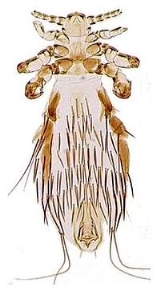
Louse

Encyclopedia
Lice is the common name for over 3,000 species of wingless insects of the order
Phthiraptera; three of which are classified as human disease agents. They are obligate
ectoparasites of every avian and mammalian order except for monotreme
s (the platypus
and echidna
s), bat
s, whales, dolphins, porpoises
and pangolin
s.
and other debris found on the host's body, but some species feed on sebaceous secretions
and blood
. Most are found only on specific types of animals, and, in some cases, only to a particular part of the body; some animals are known to host up to fifteen different species, although one to three is typical for mammals, and two to six for birds. For example, in humans, different species of louse inhabit the scalp and pubic hair. Lice generally cannot survive for long if removed from their host.
A louse's color varies from pale beige to dark gray; however, if feeding on blood, it may become considerably darker. Female lice are usually more common than the males, and some species are even known to be parthenogenetic
. A louse's egg
is commonly called a nit
. Many lice attach their eggs to their host's hair with specialized saliva
; the saliva/hair bond is very difficult to sever without specialized products. Lice inhabiting birds, however, may simply leave their eggs in parts of the body inaccessible to preening, such as the interior of feather shafts. Living lice eggs tend to be pale white. Dead lice eggs are more yellow.
Lice are exopterygote
s, being born as miniature versions of the adult, known as nymphs
. The young moult three times before reaching the final adult form, usually within a month of hatching.
It has been suggested that the order is contained by the Troctomorpha suborder of Psocoptera
.
, body lice
, and pubic lice
. Lice infestations can be controlled with lice combs, and medicated shampoos or washes. Adult and nymphal lice can survive on sheep-shearers' moccasins for up to 10 days, but microwaving the footwear for five minutes in a plastic bag will kill the lice.
evidence suggests that pubic lice spread to humans approximately 2,000,000 years ago from gorillas. Additionally, the DNA differences between head lice and body lice provide corroborating evidence that humans started losing body hair, also about 2,000,000 years ago.
Order (biology)
In scientific classification used in biology, the order is# a taxonomic rank used in the classification of organisms. Other well-known ranks are life, domain, kingdom, phylum, class, family, genus, and species, with order fitting in between class and family...
Phthiraptera; three of which are classified as human disease agents. They are obligate
Obligate parasite
An obligate parasite is a parasitic organism that cannot complete its life cycle without dependence on its host.-See also:*Obligate intracellular parasite*Parasitism*Parasitic plant*Facultative parasite...
ectoparasites of every avian and mammalian order except for monotreme
Monotreme
Monotremes are mammals that lay eggs instead of giving birth to live young like marsupials and placental mammals...
s (the platypus
Platypus
The platypus is a semi-aquatic mammal endemic to eastern Australia, including Tasmania. Together with the four species of echidna, it is one of the five extant species of monotremes, the only mammals that lay eggs instead of giving birth to live young...
and echidna
Echidna
Echidnas , also known as spiny anteaters, belong to the family Tachyglossidae in the monotreme order of egg-laying mammals. There are four extant species, which, together with the platypus, are the only surviving members of that order and are the only extant mammals that lay eggs...
s), bat
Bat
Bats are mammals of the order Chiroptera "hand" and pteron "wing") whose forelimbs form webbed wings, making them the only mammals naturally capable of true and sustained flight. By contrast, other mammals said to fly, such as flying squirrels, gliding possums, and colugos, glide rather than fly,...
s, whales, dolphins, porpoises
Cetacea
The order Cetacea includes the marine mammals commonly known as whales, dolphins, and porpoises. Cetus is Latin and is used in biological names to mean "whale"; its original meaning, "large sea animal", was more general. It comes from Ancient Greek , meaning "whale" or "any huge fish or sea...
and pangolin
Pangolin
A pangolin , also scaly anteater or Trenggiling, is a mammal of the order Pholidota. There is only one extant family and one genus of pangolins, comprising eight species. There are also a number of extinct taxa. Pangolins have large keratin scales covering their skin and are the only mammals with...
s.
Biology
Most lice are scavengers, feeding on skinSkin
-Dermis:The dermis is the layer of skin beneath the epidermis that consists of connective tissue and cushions the body from stress and strain. The dermis is tightly connected to the epidermis by a basement membrane. It also harbors many Mechanoreceptors that provide the sense of touch and heat...
and other debris found on the host's body, but some species feed on sebaceous secretions
Sebaceous gland
The sebaceous glands are microscopic glands in the skin that secrete an oily/waxy matter, called sebum, to lubricate and waterproof the skin and hair of mammals...
and blood
Blood
Blood is a specialized bodily fluid in animals that delivers necessary substances such as nutrients and oxygen to the cells and transports metabolic waste products away from those same cells....
. Most are found only on specific types of animals, and, in some cases, only to a particular part of the body; some animals are known to host up to fifteen different species, although one to three is typical for mammals, and two to six for birds. For example, in humans, different species of louse inhabit the scalp and pubic hair. Lice generally cannot survive for long if removed from their host.
A louse's color varies from pale beige to dark gray; however, if feeding on blood, it may become considerably darker. Female lice are usually more common than the males, and some species are even known to be parthenogenetic
Parthenogenesis
Parthenogenesis is a form of asexual reproduction found in females, where growth and development of embryos occur without fertilization by a male...
. A louse's egg
Egg (biology)
An egg is an organic vessel in which an embryo first begins to develop. In most birds, reptiles, insects, molluscs, fish, and monotremes, an egg is the zygote, resulting from fertilization of the ovum, which is expelled from the body and permitted to develop outside the body until the developing...
is commonly called a nit
Nit
* The egg of a louse* Head lice * A trivial detail; the object of nitpicking* Nit , a unit of luminance equivalent to one candela per square metre...
. Many lice attach their eggs to their host's hair with specialized saliva
Saliva
Saliva , referred to in various contexts as spit, spittle, drivel, drool, or slobber, is the watery substance produced in the mouths of humans and most other animals. Saliva is a component of oral fluid. In mammals, saliva is produced in and secreted from the three pairs of major salivary glands,...
; the saliva/hair bond is very difficult to sever without specialized products. Lice inhabiting birds, however, may simply leave their eggs in parts of the body inaccessible to preening, such as the interior of feather shafts. Living lice eggs tend to be pale white. Dead lice eggs are more yellow.
Lice are exopterygote
Exopterygota
The Exopterygota, also known as Hemipterodea, are a superorder of insects of the subclass Pterygota in the infraclass Neoptera, in which the young resemble adults but have externally-developing wings. They undergo a modest change between immature and adult, without going through a pupal stage...
s, being born as miniature versions of the adult, known as nymphs
Nymph (biology)
In biology, a nymph is the immature form of some invertebrates, particularly insects, which undergoes gradual metamorphosis before reaching its adult stage. Unlike a typical larva, a nymph's overall form already resembles that of the adult. In addition, while a nymph moults it never enters a...
. The young moult three times before reaching the final adult form, usually within a month of hatching.
Ecology
Lice are optimal model organisms to study the ecology of contagious pathogens since their quantities, sex-ratios etc. are easier to quantify than those of other pathogens. The ecology of avian lice has been studied more intensively than that of mammal lice.A few major trends
- The average number of lice per host tends to be higher in large-bodied bird species than in small ones.
- Louse individuals exhibit an aggregated distribution across bird individuals, i.e. most lice live on a few birds, while most birds are relatively free of lice. This pattern is more pronounced in territorial than in colonial—more social—bird species.
- Host taxa that dive under the water surface to feed on aquatic prey harbor fewer taxa of lice.
- Bird taxa that are capable of exerting stronger antiparasitic defense—such as stronger T cellT cellT cells or T lymphocytes belong to a group of white blood cells known as lymphocytes, and play a central role in cell-mediated immunity. They can be distinguished from other lymphocytes, such as B cells and natural killer cells , by the presence of a T cell receptor on the cell surface. They are...
immune response or larger uropygial glandUropygial glandThe uropygial gland, informally known as the preen gland, is a gland found in the large majority of birds that secretes an oil that birds use for preening. The chief compounds of preen oil are diester waxes called uropygiols....
s—harbor more taxa of Amblyceran lice than others. - Temporal bottlenecks in host population size may cause a long-lasting reduction of louse taxonomic richness. E.g., birds introduced into New ZealandNew ZealandNew Zealand is an island country in the south-western Pacific Ocean comprising two main landmasses and numerous smaller islands. The country is situated some east of Australia across the Tasman Sea, and roughly south of the Pacific island nations of New Caledonia, Fiji, and Tonga...
host fewer species of lice there than in Europe. - Louse sex ratios are more balanced in more social hosts and more female-biased in less social hosts, presumably due to the stronger isolation among louse subpopulations (living on separate birds) in the latter case.
A few effects of lice infestation upon the host
- Lice may reduce host life expectancy.
- Lice may transmit microbial diseases or helminth parasites.
- Ischnoceran lice may reduce the thermoregulation effect of the plumage, thus heavily infected birds lose more heat than other ones.
- Lice infestation is a disadvantage in the context of sexual rivalry.
Classification
The order has traditionally been divided into two suborders, the sucking lice (Anoplura) and the chewing lice (Mallophaga); however, recent classifications suggest that the Mallophaga are paraphyletic and four suborders are now recognized:- Anoplura: sucking lice, occurring on mammals exclusively
- RhyncophthirinaHaematomyzusThe genus Haematomyzus includes three species of lice that differ so markedly from all other lice that they have been placed in a suborder of their own. These unusual lice are ectoparasites of elephants and warthogs. Their mouthparts are elongated to form a drill-like structure that allows them to...
: parasites of elephants and warthogWarthogThe Warthog or Common Warthog is a wild member of the pig family that lives in grassland, savanna, and woodland in Sub-Saharan Africa. In the past it was commonly treated as a subspecies of P...
s - IschnoceraIschnoceraThe Ischnocera is a large suborder of lice mostly parasitic on birds but including a large family parasitic on mammals. The genus Trichophilopterus is also found on mammals but probably belongs to the "avian Ischnocera" and represents a host switch from birds to mammals...
: mostly avian chewing lice, however, one family parasitizes mammals - AmblyceraAmblyceraThe Amblycera are a large suborder of chewing lice, parasitic on both birds and mammals. The Amblycera are considered the most primitive suborder of lice.-Description:...
: a primitive suborder of chewing lice, widespread on birds, however, also live on South-American and Australian mammals
It has been suggested that the order is contained by the Troctomorpha suborder of Psocoptera
Psocoptera
Psocoptera are an order of insects that are commonly known as booklice, barklice or barkflies. They first appeared in the Permian period, 295–248 million years ago. They are often regarded as the most primitive of the hemipteroids. Their name originates from the Greek word psokos meaning...
.
Lice in humans
Humans host three different kinds of lice: head liceHead louse
The head louse is an obligate ectoparasite of humans. Head lice are wingless insects spending their entire life on human scalp and feeding exclusively on human blood...
, body lice
Body louse
The body louse is a louse which infests humans. The condition of being infested with head lice, body lice, or pubic lice is known as pediculosis.-Origins:...
, and pubic lice
Crab louse
Crab lice are parasitic insects notorious for infesting human pubic hair. The species may also live on other areas with hair, including the eyelashes. They feed exclusively on blood...
. Lice infestations can be controlled with lice combs, and medicated shampoos or washes. Adult and nymphal lice can survive on sheep-shearers' moccasins for up to 10 days, but microwaving the footwear for five minutes in a plastic bag will kill the lice.
Human lice and DNA discoveries
Lice have been the subject of significant DNA research that has led to discoveries on human evolution. For example, recent DNADNA
Deoxyribonucleic acid is a nucleic acid that contains the genetic instructions used in the development and functioning of all known living organisms . The DNA segments that carry this genetic information are called genes, but other DNA sequences have structural purposes, or are involved in...
evidence suggests that pubic lice spread to humans approximately 2,000,000 years ago from gorillas. Additionally, the DNA differences between head lice and body lice provide corroborating evidence that humans started losing body hair, also about 2,000,000 years ago.
See also
- Pest (organism)
- Use of DNA in forensic entomologyUse of DNA in forensic entomologyForensic entomology contains three aspects: medicocriminal entomology, urban entomology, and stored product entomology. This article focuses more on the medicocriminal aspect and how DNA is analyzed with various blood feeding insects.- Blood meal extraction :...
- Whale louseWhale louseA whale louse is a parasitic crustacean of the family Cyamidae. They are related to the better-known skeleton shrimp, most species of which are found in shallower waters. Whale lice are external parasites, found in skin lesions, genital folds, nostrils and eyes of marine mammals of the order Cetacea...
, unrelated crustaceans that live parasitically on marine mammals
External links
- National Pesticide Information Center – Understanding and Controlling Lice
- Bed-hopping led humans to 3 million-year itch
- Extensive scientific information at Phthiraptera Central
- body and head lice on the University of FloridaUniversity of FloridaThe University of Florida is an American public land-grant, sea-grant, and space-grant research university located on a campus in Gainesville, Florida. The university traces its historical origins to 1853, and has operated continuously on its present Gainesville campus since September 1906...
/Institute of Food and Agricultural SciencesInstitute of Food and Agricultural SciencesThe University of Florida’s Institute of Food and Agricultural Sciences is a federal-state-county partnership dedicated to developing knowledge in agriculture, human and natural resources, and the life sciences, and enhancing and sustaining the quality of human life by making that information...
Featured Creatures Web site - crab louse on the University of FloridaUniversity of FloridaThe University of Florida is an American public land-grant, sea-grant, and space-grant research university located on a campus in Gainesville, Florida. The university traces its historical origins to 1853, and has operated continuously on its present Gainesville campus since September 1906...
/Institute of Food and Agricultural SciencesInstitute of Food and Agricultural SciencesThe University of Florida’s Institute of Food and Agricultural Sciences is a federal-state-county partnership dedicated to developing knowledge in agriculture, human and natural resources, and the life sciences, and enhancing and sustaining the quality of human life by making that information...
Featured Creatures Web site - WebMD Lice Info
- Lice chapter in United States Environmental Protection Agency and University of FloridaUniversity of FloridaThe University of Florida is an American public land-grant, sea-grant, and space-grant research university located on a campus in Gainesville, Florida. The university traces its historical origins to 1853, and has operated continuously on its present Gainesville campus since September 1906...
/Institute of Food and Agricultural SciencesInstitute of Food and Agricultural SciencesThe University of Florida’s Institute of Food and Agricultural Sciences is a federal-state-county partnership dedicated to developing knowledge in agriculture, human and natural resources, and the life sciences, and enhancing and sustaining the quality of human life by making that information...
National Public Health Pesticide Applicator Training Manual - Pediculus humanus capitis head louse facts, myths, life cycle at MetaPathogen