

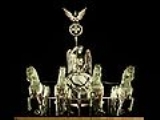
Quadriga

Encyclopedia
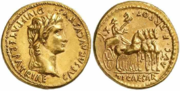
Chariot
The chariot is a type of horse carriage used in both peace and war as the chief vehicle of many ancient peoples. Ox carts, proto-chariots, were built by the Proto-Indo-Europeans and also built in Mesopotamia as early as 3000 BC. The original horse chariot was a fast, light, open, two wheeled...
drawn by four horse
Horse
The horse is one of two extant subspecies of Equus ferus, or the wild horse. It is a single-hooved mammal belonging to the taxonomic family Equidae. The horse has evolved over the past 45 to 55 million years from a small multi-toed creature into the large, single-toed animal of today...
s abreast (the Roman Empire
Roman Empire
The Roman Empire was the post-Republican period of the ancient Roman civilization, characterised by an autocratic form of government and large territorial holdings in Europe and around the Mediterranean....
's equivalent of Ancient Greek
Ancient Greece
Ancient Greece is a civilization belonging to a period of Greek history that lasted from the Archaic period of the 8th to 6th centuries BC to the end of antiquity. Immediately following this period was the beginning of the Early Middle Ages and the Byzantine era. Included in Ancient Greece is the...
tethrippon). It was raced in the Ancient Olympic Games and other contests. It is represented in profile as the chariot of gods and heroes
Greek mythology
Greek mythology is the body of myths and legends belonging to the ancient Greeks, concerning their gods and heroes, the nature of the world, and the origins and significance of their own cult and ritual practices. They were a part of religion in ancient Greece...
on Greek vases and in bas-relief. The quadriga was adopted in ancient Roman
Ancient Rome
Ancient Rome was a thriving civilization that grew on the Italian Peninsula as early as the 8th century BC. Located along the Mediterranean Sea and centered on the city of Rome, it expanded to one of the largest empires in the ancient world....
chariot racing
Chariot racing
Chariot racing was one of the most popular ancient Greek, Roman and Byzantine sports. Chariot racing was often dangerous to both driver and horse as they frequently suffered serious injury and even death, but generated strong spectator enthusiasm...
. Quadrigas were emblems of triumph; Victory
Victoria (mythology)
In ancient Roman religion, Victoria was the personified goddess of victory. She is the Roman equivalent of the Greek goddess Nike, and was associated with Bellona. She was adapted from the Sabine agricultural goddess Vacuna and had a temple on the Palatine Hill...
and Fame
Pheme
In Greek mythology, Pheme was the personification of fame and renown, her favour being notability, her wrath being scandalous rumors. She was a daughter either of Gaia or of Hope, was described as "she who initiates and furthers communication" and had an altar at Athens...
often are depicted as the triumphant woman driving it. In classical mythology
Classical mythology
Classical mythology or Greco-Roman mythology is the cultural reception of myths from the ancient Greeks and Romans. Along with philosophy and political thought, mythology represents one of the major survivals of classical antiquity throughout later Western culture.Classical mythology has provided...
, the quadriga is the chariot of the gods; Apollo
Apollo
Apollo is one of the most important and complex of the Olympian deities in Greek and Roman mythology...
was depicted driving his quadriga across the heavens, delivering daylight and dispersing the night.
The word quadriga may refer to the chariot alone, the four horses without it, or the combination.
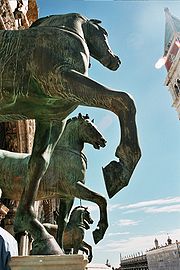
All modern quadrigas are based on the Triumphal Quadriga, a Roman or Greek sculpture
Classical sculpture
Classical sculpture refers to the forms of sculpture from Ancient Greece and Ancient Rome, as well as the Hellenized and Romanized civilizations under their rule or influence from about 500 BC to fall of Rome in AD 476. It also refers stylistically to modern sculptures done in a classical style....
which is the only surviving ancient quadriga. It was originally erected in the Hippodrome of Constantinople
Hippodrome of Constantinople
The Hippodrome of Constantinople was a circus that was the sporting and social centre of Constantinople, capital of the Byzantine Empire. Today it is a square named Sultanahmet Meydanı in the Turkish city of Istanbul, with only a few fragments of the original structure surviving...
, possibly on a triumphal arch
Triumphal arch
A triumphal arch is a monumental structure in the shape of an archway with one or more arched passageways, often designed to span a road. In its simplest form a triumphal arch consists of two massive piers connected by an arch, crowned with a flat entablature or attic on which a statue might be...
, and is now in St Mark's Basilica
St Mark's Basilica
The Patriarchal Cathedral Basilica of Saint Mark is the cathedral church of the Roman Catholic Archdiocese of Venice, northern Italy. It is the most famous of the city's churches and one of the best known examples of Byzantine architecture...
in Venice
Venice
Venice is a city in northern Italy which is renowned for the beauty of its setting, its architecture and its artworks. It is the capital of the Veneto region...
. It was looted by Venetian Crusaders in the Fourth Crusade
Fourth Crusade
The Fourth Crusade was originally intended to conquer Muslim-controlled Jerusalem by means of an invasion through Egypt. Instead, in April 1204, the Crusaders of Western Europe invaded and conquered the Christian city of Constantinople, capital of the Eastern Roman Empire...
of 1204 and placed on the terrace of the basilica. In 1797
French Revolutionary Wars: Campaigns of 1797
The French Revolutionary Wars continued from 1796, with France fighting the First Coalition.On 14 February, British admiral Jervis met and defeated a Spanish fleet off Portugal at the Battle of Cape St. Vincent. This prevented the Spanish fleet from rendezvousing with the French, removing a threat...
, Napoleon
Napoleon I of France
Napoleon Bonaparte was a French military and political leader during the latter stages of the French Revolution.As Napoleon I, he was Emperor of the French from 1804 to 1815...
carried the quadriga off to Paris
Paris
Paris is the capital and largest city in France, situated on the river Seine, in northern France, at the heart of the Île-de-France region...
, but in 1815 the horses were returned to Venice. Due to the effects of atmospheric pollution, the original quadriga was retired to a museum and replaced with a replica in the 1980s.
Modern quadrigas
Some of the most significant full-size free-standing sculptures of quadrigas include, in approximate chronological order:- The Berlin Quadriga was designed by Johann Gottfried SchadowJohann Gottfried SchadowJohann Gottfried Schadow was a German sculptor.-Biography:Schadow was born in Berlin, where his father was a poor tailor....
in 1793 as the Quadriga of Victory, as a symbol of peace (represented by the olive wreath carried by Victory). Located atop the Brandenburg GateBrandenburg GateThe Brandenburg Gate is a former city gate and one of the most well-known landmarks of Berlin and Germany. It is located west of the city centre at the junction of Unter den Linden and Ebertstraße, immediately west of the Pariser Platz. It is the only remaining gate of a series through which...
in BerlinBerlinBerlin is the capital city of Germany and is one of the 16 states of Germany. With a population of 3.45 million people, Berlin is Germany's largest city. It is the second most populous city proper and the seventh most populous urban area in the European Union...
, GermanyGermanyGermany , officially the Federal Republic of Germany , is a federal parliamentary republic in Europe. The country consists of 16 states while the capital and largest city is Berlin. Germany covers an area of 357,021 km2 and has a largely temperate seasonal climate...
, it was seized by NapoleonNapoleon I of FranceNapoleon Bonaparte was a French military and political leader during the latter stages of the French Revolution.As Napoleon I, he was Emperor of the French from 1804 to 1815...
during his occupation of BerlinWar of the Fourth CoalitionThe Fourth Coalition against Napoleon's French Empire was defeated in a war spanning 1806–1807. Coalition partners included Prussia, Russia, Saxony, Sweden, and the United Kingdom....
in 1806, and taken to Paris. It was returned to Berlin by Field Marshal Gebhard von BlücherGebhard Leberecht von BlücherGebhard Leberecht von Blücher, Fürst von Wahlstatt , Graf , later elevated to Fürst von Wahlstatt, was a Prussian Generalfeldmarschall who led his army against Napoleon I at the Battle of the Nations at Leipzig in 1813 and at the Battle of Waterloo in 1815 with the Duke of Wellington.He is...
in 1814. Her olive wreath was subsequently replaced by an Iron CrossIron CrossThe Iron Cross is a cross symbol typically in black with a white or silver outline that originated after 1219 when the Kingdom of Jerusalem granted the Teutonic Order the right to combine the Teutonic Black Cross placed above a silver Cross of Jerusalem....
. The statue suffered severe damage during the Second World WarWorld War IIWorld War II, or the Second World War , was a global conflict lasting from 1939 to 1945, involving most of the world's nations—including all of the great powers—eventually forming two opposing military alliances: the Allies and the Axis...
, and the association of the Iron Cross with PrussiaPrussiaPrussia was a German kingdom and historic state originating out of the Duchy of Prussia and the Margraviate of Brandenburg. For centuries, the House of Hohenzollern ruled Prussia, successfully expanding its size by way of an unusually well-organized and effective army. Prussia shaped the history...
n militarismMilitarismMilitarism is defined as: the belief or desire of a government or people that a country should maintain a strong military capability and be prepared to use it aggressively to defend or promote national interests....
convinced the Communist governmentSocialist Unity Party of GermanyThe Socialist Unity Party of Germany was the governing party of the German Democratic Republic from its formation on 7 October 1949 until the elections of March 1990. The SED was a communist political party with a Marxist-Leninist ideology...
of East Germany to remove this aspect of the statue after the war. The iron cross was restored after German reunificationGerman reunificationGerman reunification was the process in 1990 in which the German Democratic Republic joined the Federal Republic of Germany , and when Berlin reunited into a single city, as provided by its then Grundgesetz constitution Article 23. The start of this process is commonly referred by Germans as die...
in 1990. - The Carrousel quadriga is situated atop the Arc de Triomphe du CarrouselArc de Triomphe du CarrouselThe Arc de Triomphe du Carrousel is a triumphal arch in Paris, located in the Place du Carrousel on the site of the former Tuileries Palace. It was built between 1806 and 1808 to commemorate Napoleon's military victories of the previous year...
in ParisParisParis is the capital and largest city in France, situated on the river Seine, in northern France, at the heart of the Île-de-France region...
, FranceFranceThe French Republic , The French Republic , The French Republic , (commonly known as France , is a unitary semi-presidential republic in Western Europe with several overseas territories and islands located on other continents and in the Indian, Pacific, and Atlantic oceans. Metropolitan France...
. The arch itself was built to commemorate the victories of Napoleon, but the quadriga was sculpted by Baron François Joseph BosioFrançois Joseph BosioBaron François Joseph Bosio was a French sculptor who achieved distinction in the first quarter of the nineteenth century with his work for Napoleon and for the restored French monarchy.-Biography:...
to commemorate the Restoration of the Bourbons. The Restoration is represented by an allegorical goddess driving a quadriga, with gilded Victories accompanying it on each side. Circa 1815. - The Quadriga on the General Staff BuildingGeneral Staff Building (Saint Petersburg)The General Staff Building is an edifice with a 580 m long bow-shaped facade, situated on Palace Square in Saint Petersburg, Russia, in front of the Winter Palace.The building was designed by Carlo Rossi in the Empire style and built in 1819-1829...
on the Palace SquarePalace SquarePalace Square , connecting Nevsky Prospekt with Palace Bridge leading to Vasilievsky Island, is the central city square of St Petersburg and of the former Russian Empire...
in Saint PetersburgSaint PetersburgSaint Petersburg is a city and a federal subject of Russia located on the Neva River at the head of the Gulf of Finland on the Baltic Sea...
, 1819–1829 - The Quadriga on the Alexandrinsky TheaterAlexandrinsky TheaterThe Alexandrinsky Theatre or Russian State Pushkin Academy Drama Theater is a theatre in Saint Petersburg, Russia....
, in Saint PetersburgSaint PetersburgSaint Petersburg is a city and a federal subject of Russia located on the Neva River at the head of the Gulf of Finland on the Baltic Sea...
, 1828–1832 - The Panther Quadriga on the SemperoperSemperoperThe Semperoper is the opera house of the Sächsische Staatsoper Dresden and the concert hall of the Sächsische Staatskapelle Dresden . It is located near the Elbe River in the historic center of Dresden, Germany.The opera house was originally built by the architect Gottfried Semper in 1841...
in DresdenDresdenDresden is the capital city of the Free State of Saxony in Germany. It is situated in a valley on the River Elbe, near the Czech border. The Dresden conurbation is part of the Saxon Triangle metropolitan area....
, circa 1841 - The Quadriga on the BolshoiBolshoi TheatreThe Bolshoi Theatre is a historic theatre in Moscow, Russia, designed by architect Joseph Bové, which holds performances of ballet and opera. The Bolshoi Ballet and Bolshoi Opera are amongst the oldest and most renowned ballet and opera companies in the world...
, above the portico of the Bolshoi TheatreBolshoi TheatreThe Bolshoi Theatre is a historic theatre in Moscow, Russia, designed by architect Joseph Bové, which holds performances of ballet and opera. The Bolshoi Ballet and Bolshoi Opera are amongst the oldest and most renowned ballet and opera companies in the world...
designed by sculptor Peter Clodt von JürgensburgPeter Clodt von JürgensburgBaron Peter Clodt von Jürgensburg, known in Russian as Pyotr Karlovich Klodt , was a favourite sculptor of Nicholas I of Russia.Stemming from a distinguished family of Baltic Germans, Clodt von Jürgensburg, Klodt started his career as a professional artillery officer and amateur sculptor...
, circa 1850 - The SiegestorSiegestorThe Siegestor in Munich, is a three-arched triumphal arch crowned with a statue of Bavaria with a lion-quadriga, similar in style to the Arch of Constantine in Rome, the Marble Arch in London, the Arc de Triomphe in Paris and the Brandenburger Tor in Berlin...
(Victory Gate) in MunichMunichMunich The city's motto is "" . Before 2006, it was "Weltstadt mit Herz" . Its native name, , is derived from the Old High German Munichen, meaning "by the monks' place". The city's name derives from the monks of the Benedictine order who founded the city; hence the monk depicted on the city's coat...
is topped by a lion quadriga created by Martin von Wagner, circa 1852 - The Quadriga on the Royal Palace in BraunschweigBraunschweigBraunschweig , is a city of 247,400 people, located in the federal-state of Lower Saxony, Germany. It is located north of the Harz mountains at the farthest navigable point of the Oker river, which connects to the North Sea via the rivers Aller and Weser....
was erected in 1868 and destroyed in 1944 during the Second World War. It was reconstructed in 2008 and is considered as the largest one in Europe - Two Quadrigas on the Grand PalaisGrand PalaisThis article contains material abridged and translated from the French and Spanish Wikipedia.The Grand Palais des Champs-Elysées, commonly known as the Grand Palais , is a large historic site, exhibition hall and museum complex located at the Champs-Élysées in the 8th arrondissement of Paris, France...
in Paris, the work of French sculptor Georges RéciponGeorges RéciponGeorges Récipon was a French painter and sculptor.The son of a sculptor, Récipon's major work is probably his work at the Grand Palais in Paris, two monumental and exuberant quadrigas on the building's roof.Other work includes:...
, circa 1900 - Atop the Arch at Grand Army Plaza in BrooklynBrooklynBrooklyn is the most populous of New York City's five boroughs, with nearly 2.6 million residents, and the second-largest in area. Since 1896, Brooklyn has had the same boundaries as Kings County, which is now the most populous county in New York State and the second-most densely populated...
, New YorkNew YorkNew York is a state in the Northeastern region of the United States. It is the nation's third most populous state. New York is bordered by New Jersey and Pennsylvania to the south, and by Connecticut, Massachusetts and Vermont to the east...
, lady ColumbiaHistorical ColumbiaColumbia is an historical and poetic name for America – and the early United States of America in particular, for which it is also the name of its female personification...
, an allegorical representation of the United States, rides in a chariot drawn by two horses. Two winged Victory figures, each leading a horse, trumpet Columbia's arrival. The sculptor was Frederick William MacMonniesFrederick William MacMonniesFrederick William MacMonnies was the best known expatriate American sculptor of the Beaux-Arts school, as successful and lauded in France as he was in the United States...
, done circa 1900. - Victory and Progress, horse drawn chariots by J. Massey RhindJ. Massey RhindJohn Massey Rhind was a Scottish-American sculptor. Among Rhind's better known works is the marble statue of Dr. Crawford W. Long located in the National Statuary Hall Collection in Washington D.C...
on the Wayne County BuildingWayne County BuildingThe Wayne County Building is a lowrise government structure in Detroit, Michigan. It stands at 600 Randolph Street, and formerly contained the Wayne County administrative offices and its courthouse. The current administrative offices are located in the Guardian Building at 500 Griswold Street...
in Detroit, MichiganDetroit, MichiganDetroit is the major city among the primary cultural, financial, and transportation centers in the Metro Detroit area, a region of 5.2 million people. As the seat of Wayne County, the city of Detroit is the largest city in the U.S. state of Michigan and serves as a major port on the Detroit River...
, circa 1900 - The Quadriga of Brabant, situated on top from Parc du Cinquantenaire (1880-1905); built for the 50 years of Belgian Independence, in BrusselsBrusselsBrussels , officially the Brussels Region or Brussels-Capital Region , is the capital of Belgium and the de facto capital of the European Union...
, BelgiumBelgiumBelgium , officially the Kingdom of Belgium, is a federal state in Western Europe. It is a founding member of the European Union and hosts the EU's headquarters, and those of several other major international organisations such as NATO.Belgium is also a member of, or affiliated to, many...
, was built in 1905 by Thomas VinçotteThomas VinçotteBaron Thomas Jules Vinçotte was a Belgian sculptor and medallist.- Life :Vinçotte was the son of Jean-Marie Vinçotte, born in Borgerhout and brother of the engineer Robert Vinçotte...
and Jules LagaeJules LagaeJules Lagae was a Belgian sculptor and medallist, born in Roeselare. Lagae was taught by Joseph Jacquet and Charles van der Stappen at the Académie Royale des Beaux-Arts in Brussels. He also worked with Jef Lambeaux and Julien Dillens.... - Progress of the StateProgress of the StateProgress of the State is the title of a group of sculptural figures that sits above the south portico, at the main entrance to the state capitol at Saint Paul, in the U.S. state of Minnesota....
at the Minnesota State CapitolMinnesota State CapitolThe Minnesota State Capitol is located in Minnesota's capital city, Saint Paul, and houses the Minnesota Senate, Minnesota House of Representatives, the Office of the Attorney General and the Office of the Governor...
is unique for being entirely covered in gold leafGold leafright|thumb|250px|[[Burnishing]] gold leaf with an [[agate]] stone tool, during the water gilding processGold leaf is gold that has been hammered into extremely thin sheets and is often used for gilding. Gold leaf is available in a wide variety of karats and shades...
, and is situated above a building entrance rather than a triumphal arch. It was sculpted by Daniel Chester FrenchDaniel Chester FrenchDaniel Chester French was an American sculptor. His best-known work is the sculpture of a seated Abraham Lincoln at the Lincoln Memorial in Washington, D.C.-Life and career:...
and Edward Clark PotterEdward Clark PotterEdward Clark Potter was an American sculptor best known for his equestrian and animal statues. His works include the "Fortitude" lion in front of the New York Public Library.-Early years:...
and put in place in 1906. - The Monument to Vittorio Emanuele II (Monument of Victor Emmanuel IIVictor Emmanuel II of ItalyVictor Emanuel II was king of Sardinia from 1849 and, on 17 March 1861, he assumed the title King of Italy to become the first king of a united Italy since the 6th century, a title he held until his death in 1878...
) or Altare della Patria (Altar of the Nation) or "Il Vittoriano" in RomeRomeRome is the capital of Italy and the country's largest and most populated city and comune, with over 2.7 million residents in . The city is located in the central-western portion of the Italian Peninsula, on the Tiber River within the Lazio region of Italy.Rome's history spans two and a half...
, ItalyItalyItaly , officially the Italian Republic languages]] under the European Charter for Regional or Minority Languages. In each of these, Italy's official name is as follows:;;;;;;;;), is a unitary parliamentary republic in South-Central Europe. To the north it borders France, Switzerland, Austria and...
features two statues of goddess VictoriaVictoria (mythology)In ancient Roman religion, Victoria was the personified goddess of victory. She is the Roman equivalent of the Greek goddess Nike, and was associated with Bellona. She was adapted from the Sabine agricultural goddess Vacuna and had a temple on the Palatine Hill...
riding on quadrigas. Begun 1911, completed in 1935 - The Wellington Arch Quadriga is situated atop the Wellington ArchWellington ArchWellington Arch, also known as Constitution Arch or the Green Park Arch, is a triumphal arch located to the south of Hyde Park in central London and at the north western corner of Green Park...
in LondonLondonLondon is the capital city of :England and the :United Kingdom, the largest metropolitan area in the United Kingdom, and the largest urban zone in the European Union by most measures. Located on the River Thames, London has been a major settlement for two millennia, its history going back to its...
, EnglandEnglandEngland is a country that is part of the United Kingdom. It shares land borders with Scotland to the north and Wales to the west; the Irish Sea is to the north west, the Celtic Sea to the south west, with the North Sea to the east and the English Channel to the south separating it from continental...
. It was designed by Adrian Jones in 1912. The sculpture shows a small boy (actually the son of Lord MichelhamHerbert Stern, 1st Baron MichelhamHerbert Stern, 1st Baron Michelham , known as Sir Herbert Stern, Bt, between July and December 1905, was a British financier and philanthropist.-Background:...
, the man who funded the sculpture) leading the quadriga, with Peace descending upon it from heaven.
In popular culture
- Quadriga is used as a name for an Aragami in the Playstation Portable game, God EaterGod EaterGods Eater Burst is a 2011 action-adventure video game exclusively for the PlayStation Portable developed and published by Namco Bandai Games in Japan and published by D3Publisher, a sister company of Namco Bandai Games, in North America. The game was originally released in Japan as on February...
.
See also
- Horses of Saint MarkHorses of Saint MarkThe Triumphal Quadriga or Horses of St Mark's is a set of bronze statues of four horses, originally part of a monument depicting a quadriga , which have been set into the facade of St Mark's Basilica in Venice, northern Italy, since the 13th century.-Origins:The sculptures date from late classical...
in Venice, remnants of a quadriga of ancient Rome & Nova Roma taken by Enrico DandoloEnrico DandoloEnrico Dandolo — anglicised as Henry Dandolo and Latinized as Henricus Dandulus — was the 41st Doge of Venice from 1195 until his death...
.