

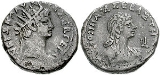
Poppaea Sabina

Encyclopedia
Poppaea Sabina (30–65) and sometimes referred to as Poppaea Sabina the Younger to differentiate her from her mother of the same name, was a Roman Empress as the second wife of the Emperor
Nero
. Prior to this she was the wife of the future Emperor Otho
. The historians of antiquity
describe her as a beautiful woman who used intrigues to become empress.
in AD 30 as the daughter of Titus Ollius and Poppaea Sabina the Elder. Most evidence suggesting Poppaea's Pompeiian origins comes from 20th century excavations of the town, destroyed in the AD 79 eruption of Mount Vesuvius
. For instance, legal documents found during excavations in nearby Herculaneum
described her as being the owner of a brick- or tile-work business in the Pompeii area. It is very likely that Poppaea's family came from Pompeii, and the common belief is that they might have been the owners of the House of the Menander (a house in Pompeii named for the painting of the fourth century BC playwright Menander
that is found there). Although ancient sources do not directly state this, the legal documents in Herculaneum and evidence found in Pompeii for a prominent local family of the gens Poppaei makes Poppaea's Pompeiian origins much more likely.
Even though a Roman villa in nearby Torre Annunziata
(formerly known as Oplontis
), located not far from Pompeii, is referred to as the Villa Poppaea
as though it were certain, it is most likely that this villa was not hers.
However, it should be noted that reconstruction began in 62 AD, a possible result of seismic activity having damaged the villa or a result of the marriage between Poppaea and the Emperor Nero. The matter is still under heavy investigation by those working for the Oplontis Project.
in the reign of the Emperor Tiberius
. Ollius' friendship with the infamous Imperial palace guardsman Lucius Aelius Sejanus ruined him, before gaining public office. Titus Ollius was from Picenum (modern Marche
and Abruzzo
, Italy
) and he was an unknown minor character in Imperial politics. Titus Ollius died in 31.
praises as a wealthy woman and a woman of distinction. Tacitus describes her as ‘the loveliest woman of her day’. In 47, she committed suicide as an innocent victim of the intrigues of the Roman Empress Valeria Messalina, having been charged with having adultery with former consul Decimus Valerius Asiaticus
.
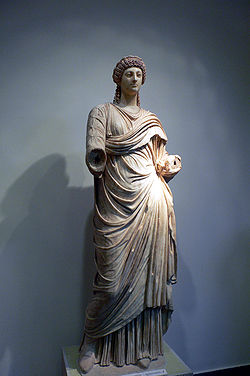 The father of Poppaea Sabina the Elder was a certain Gaius Poppaeus Sabinus. This man of humble birth was consul in 9 and was the governor of Moesia
from 12 - 35. Passed during his consulship was the Lex Papia Poppaea
, a law meant to strengthen and encourage marriage. During his consulship, the future Emperor Vespasian
was born. During the reign of the Emperor Tiberius, he received a military triumph, for ending a revolt in Thrace
in 26. From 15 until his death, he served as Imperial Proconsul
(or Governor) of Greece
and in other provinces. This competent administrator enjoyed the friendship of the Emperors Augustus
and Tiberius. He died in late December of AD 35 from natural causes. After his death, Poppaea Sabina the Younger assumed the name of her maternal grandfather.
After Titus Ollius's death, Poppaea's mother remarried Publius Cornelius Lentulus Scipio (I). Lentulus Scipio was a divisional commander in 22, consul in 24 and later a senator. Publius Cornelius Lentulus Scipio (II) was most probably Poppaea's stepbrother. Lentulus Scipio II served as a consul in 56 and he later served as a senator.
, a man of equestrian rank. They married in 44, when Poppaea was 14 years old. He was the leader of the Praetorian Guard
during the first ten years of the reign of the Emperor Claudius
, until 51, when Claudius's new wife Agrippina the Younger
removed him from this position. Agrippina regarded him as loyal to the deceased Messalina's memory and replaced him with Sextus Afranius Burrus
. Later, under Nero
he was executed. During their marriage, Poppaea gave birth to his son, a younger Rufrius Crispinus, who, after her death, would be drowned by Nero while out on a fishing trip.
, a good friend of the new Emperor Nero
, who was seven years younger than she was. Nero fell in love with Poppaea and she became Nero's mistress. According to Tacitus
, Poppaea divorced Otho in 58 and focused her attentions solely on becoming empress of Rome and Nero's new wife. Otho was ordered away to be governor of Lusitania
. A decade later, he became emperor briefly after Nero's death in succession to
Galba
. Suetonius
places these events after 59.
, Poppaea was ambitious, ruthless, and bisexual. He reports that Poppaea married Otho
to get close to Nero
and then, in turn, became Nero's favorite mistress.
mentions how Poppaea's husband, Otho
, was not sent away until after Agrippina's death, which makes it very unlikely that an already married woman would be pressing Nero to marry her. Some modern historians, however, theorize that Nero's decision to kill Agrippina was prompted by her plotting to set Gaius Rubellius Plautus
(Nero's maternal second cousin) on the throne, rather than as a result of Poppaea's motives.
Still, Tacitus claims that, with Agrippina gone, Poppaea pressured Nero to divorce and later execute his first wife and stepsister Claudia Octavia
in order to marry Poppaea. Octavia was initially dismissed to Campania
(which by coincidence is the same general geographic area that Pompeii
, Poppaea's place of birth as noted above, is located in), and then imprisoned on the island of Ventotene
(a common place of banishment for members of the Imperial family who fell from favor), on a charge of adultery
. Once more, as with the death of Agrippina, modern historians question Poppaea's pressure as Nero's true motive. During his eight year marriage to Claudia Octavia
, Nero had produced no children, and in AD 62, around the time that he divorced Octavia, Poppaea was pregnant. When this happened, Nero divorced Octavia, claimed she was barren, and he married Poppaea two weeks after the divorce.
The historian Josephus
, on the other hand, tells us of a very different Poppaea. He calls her a deeply religious woman (perhaps privately a Jewish proselyte) who urged Nero to show compassion, namely to the Jewish people. However, she harmed the Jews by securing the position of procurator of Judaea
for her friend's husband, Gessius Florus
, in 64.
She bore Nero one daughter, Claudia Augusta
, born on 21 January 63, who died at only four months of age. At the birth of Claudia, Nero honored mother and child with the title of Augusta
.
, while she was awaiting the birth of her second child in the summer of 65, she quarreled fiercely with Nero over him spending too much time at the races. In a fit of rage, Nero kicked her in the abdomen, so causing her death. Tacitus
, on the other hand, places the death after the Quinquennial Neronia and claims Nero's kick was a "casual outburst." Tacitus also mentions that some writers (now lost) claimed Nero poisoned her, though Tacitus does not believe them. Cassius Dio claims Nero leapt upon her belly, but admits that he doesn't know if it was intentional or an accident.
Modern historians, though, should keep in mind Suetonius, Tacitus and Cassius Dio's severe bias against Nero and the impossibility of them knowing private events, and hence recognize that Poppaea may have simply died due to fatal miscarriage
complications or in childbirth
(in which case the second child also did not survive).
When Poppaea died in 65, Nero
went into deep mourning. Her body was not cremated, it was stuffed with spices, embalmed and put in the Mausoleum of Augustus
. She was given a state funeral
. Nero praised her during the funeral eulogy and gave her divine honors. It is said that Nero "burned ten years' worth of Arabia's incense production at her funeral.
. In the 1951 film version, she is strangled to death by Nero after the Roman populace revolts against them both.
Another portrayal of Poppaea is featured in the 1932 film The Sign of the Cross
. Here, she is seen bathing in asses' milk. Daringly for the time, she is portrayed (by Claudette Colbert
) as being openly bisexual, suggestively inviting a female slave to bathe with her in the asses' milk, but lusting after Roman soldier Marcus Superbus (Fredric March
).
In 1976 the epic BBC TV series "I, Claudius", one episode, Poppaea was played by Sally Bazely
Played by Georgie Glen in the epic TV series 'Rome' (2005)
Kara Tointon played Poppaea in 2003's 'Boudica' aka "Warrior Queen" in the US
Poppaea is portrayed by Catherine McCormack
in the 2006 BBC docu-drama Ancient Rome: The Rise and Fall of an Empire
. In this interpretation, she is kicked to death by her husband, Emperor Nero, after offhandedly and uncritically mentioning a minor glitch during his performance at the Quinquennial Neronia
. Her corpse is later shown mounted on display.
Roman Emperor
The Roman emperor was the ruler of the Roman State during the imperial period . The Romans had no single term for the office although at any given time, a given title was associated with the emperor...
Nero
Nero
Nero , was Roman Emperor from 54 to 68, and the last in the Julio-Claudian dynasty. Nero was adopted by his great-uncle Claudius to become his heir and successor, and succeeded to the throne in 54 following Claudius' death....
. Prior to this she was the wife of the future Emperor Otho
Otho
Otho , was Roman Emperor for three months, from 15 January to 16 April 69. He was the second emperor of the Year of the four emperors.- Birth and lineage :...
. The historians of antiquity
Classical antiquity
Classical antiquity is a broad term for a long period of cultural history centered on the Mediterranean Sea, comprising the interlocking civilizations of ancient Greece and ancient Rome, collectively known as the Greco-Roman world...
describe her as a beautiful woman who used intrigues to become empress.
Birth in Pompeii
Poppaea Sabina the Younger was born in PompeiiPompeii
The city of Pompeii is a partially buried Roman town-city near modern Naples in the Italian region of Campania, in the territory of the comune of Pompei. Along with Herculaneum, Pompeii was destroyed and completely buried during a long catastrophic eruption of the volcano Mount Vesuvius spanning...
in AD 30 as the daughter of Titus Ollius and Poppaea Sabina the Elder. Most evidence suggesting Poppaea's Pompeiian origins comes from 20th century excavations of the town, destroyed in the AD 79 eruption of Mount Vesuvius
Mount Vesuvius
Mount Vesuvius is a stratovolcano in the Gulf of Naples, Italy, about east of Naples and a short distance from the shore. It is the only volcano on the European mainland to have erupted within the last hundred years, although it is not currently erupting...
. For instance, legal documents found during excavations in nearby Herculaneum
Herculaneum
Herculaneum was an ancient Roman town destroyed by volcanic pyroclastic flows in AD 79, located in the territory of the current commune of Ercolano, in the Italian region of Campania in the shadow of Mt...
described her as being the owner of a brick- or tile-work business in the Pompeii area. It is very likely that Poppaea's family came from Pompeii, and the common belief is that they might have been the owners of the House of the Menander (a house in Pompeii named for the painting of the fourth century BC playwright Menander
Menander
Menander , Greek dramatist, the best-known representative of Athenian New Comedy, was the son of well-to-do parents; his father Diopeithes is identified by some with the Athenian general and governor of the Thracian Chersonese known from the speech of Demosthenes De Chersoneso...
that is found there). Although ancient sources do not directly state this, the legal documents in Herculaneum and evidence found in Pompeii for a prominent local family of the gens Poppaei makes Poppaea's Pompeiian origins much more likely.
Even though a Roman villa in nearby Torre Annunziata
Torre Annunziata
Torre Annunziata is a city and comune in the province of Naples, region of Campania in Italy. It is located at the Gulf of Naples at the foot of Mt. Vesuvius.-History:...
(formerly known as Oplontis
Oplontis
Oplontis was a town near Pompeii, in the Roman Empire. On August 24, AD 79, the eruption of Mount Vesuvius buried it under a deep layer of ash. It is today the location of the Villa Poppaea, the villa of the wife of Emperor Nero, which was excavated in the mid-20th century and is open to the...
), located not far from Pompeii, is referred to as the Villa Poppaea
Villa Poppaea
The Villa Poppaea is a Roman villa situated between Naples and Sorrento, in southern Italy, which dates from the early Imperial times.The villa is a large structure situated in the Roman town of Oplontis , about ten metres below the modern level...
as though it were certain, it is most likely that this villa was not hers.
However, it should be noted that reconstruction began in 62 AD, a possible result of seismic activity having damaged the villa or a result of the marriage between Poppaea and the Emperor Nero. The matter is still under heavy investigation by those working for the Oplontis Project.
Father
Titus Ollius was a quaestorQuaestor
A Quaestor was a type of public official in the "Cursus honorum" system who supervised financial affairs. In the Roman Republic a quaestor was an elected official whereas, with the autocratic government of the Roman Empire, quaestors were simply appointed....
in the reign of the Emperor Tiberius
Tiberius
Tiberius , was Roman Emperor from 14 AD to 37 AD. Tiberius was by birth a Claudian, son of Tiberius Claudius Nero and Livia Drusilla. His mother divorced Nero and married Augustus in 39 BC, making him a step-son of Octavian...
. Ollius' friendship with the infamous Imperial palace guardsman Lucius Aelius Sejanus ruined him, before gaining public office. Titus Ollius was from Picenum (modern Marche
Marche
The population density in the region is below the national average. In 2008, it was 161.5 inhabitants per km2, compared to the national figure of 198.8. It is highest in the province of Ancona , and lowest in the province of Macerata...
and Abruzzo
Abruzzo
Abruzzo is a region in Italy, its western border lying less than due east of Rome. Abruzzo borders the region of Marche to the north, Lazio to the west and south-west, Molise to the south-east, and the Adriatic Sea to the east...
, Italy
Italy
Italy , officially the Italian Republic languages]] under the European Charter for Regional or Minority Languages. In each of these, Italy's official name is as follows:;;;;;;;;), is a unitary parliamentary republic in South-Central Europe. To the north it borders France, Switzerland, Austria and...
) and he was an unknown minor character in Imperial politics. Titus Ollius died in 31.
Mother
Poppaea Sabina the Elder was a distinguished woman, whom TacitusTacitus
Publius Cornelius Tacitus was a senator and a historian of the Roman Empire. The surviving portions of his two major works—the Annals and the Histories—examine the reigns of the Roman Emperors Tiberius, Claudius, Nero and those who reigned in the Year of the Four Emperors...
praises as a wealthy woman and a woman of distinction. Tacitus describes her as ‘the loveliest woman of her day’. In 47, she committed suicide as an innocent victim of the intrigues of the Roman Empress Valeria Messalina, having been charged with having adultery with former consul Decimus Valerius Asiaticus
Decimus Valerius Asiaticus
Decimus Valerius Asiaticus was the husband of Lollia Saturnina, the sister of Caligula' third wife, Lollia Paulina, was twice a Roman consul , resigning early from his second suffect consulship, according to Dio Cassius , in order to avoid becoming involved in the conspiracies of the court—a...
.
Moesia
Moesia was an ancient region and later Roman province situated in the Balkans, along the south bank of the Danube River. It included territories of modern-day Southern Serbia , Northern Republic of Macedonia, Northern Bulgaria, Romanian Dobrudja, Southern Moldova, and Budjak .-History:In ancient...
from 12 - 35. Passed during his consulship was the Lex Papia Poppaea
Lex Papia Poppaea
The Lex Papia Poppaea was a Roman law introduced in AD 9 to encourage and strengthen marriage. It included provisions against adultery and celibacy and complemented and supplemented Augustus' Lex Julia de Maritandis Ordinibus of 18 BC and the Lex Iulia de Adulteriis Coercendis of 17 BC. The lex...
, a law meant to strengthen and encourage marriage. During his consulship, the future Emperor Vespasian
Vespasian
Vespasian , was Roman Emperor from 69 AD to 79 AD. Vespasian was the founder of the Flavian dynasty, which ruled the Empire for a quarter century. Vespasian was descended from a family of equestrians, who rose into the senatorial rank under the Emperors of the Julio-Claudian dynasty...
was born. During the reign of the Emperor Tiberius, he received a military triumph, for ending a revolt in Thrace
Thrace
Thrace is a historical and geographic area in southeast Europe. As a geographical concept, Thrace designates a region bounded by the Balkan Mountains on the north, Rhodope Mountains and the Aegean Sea on the south, and by the Black Sea and the Sea of Marmara on the east...
in 26. From 15 until his death, he served as Imperial Proconsul
Proconsul
A proconsul was a governor of a province in the Roman Republic appointed for one year by the senate. In modern usage, the title has been used for a person from one country ruling another country or bluntly interfering in another country's internal affairs.-Ancient Rome:In the Roman Republic, a...
(or Governor) of Greece
Greece
Greece , officially the Hellenic Republic , and historically Hellas or the Republic of Greece in English, is a country in southeastern Europe....
and in other provinces. This competent administrator enjoyed the friendship of the Emperors Augustus
Augustus
Augustus ;23 September 63 BC – 19 August AD 14) is considered the first emperor of the Roman Empire, which he ruled alone from 27 BC until his death in 14 AD.The dates of his rule are contemporary dates; Augustus lived under two calendars, the Roman Republican until 45 BC, and the Julian...
and Tiberius. He died in late December of AD 35 from natural causes. After his death, Poppaea Sabina the Younger assumed the name of her maternal grandfather.
After Titus Ollius's death, Poppaea's mother remarried Publius Cornelius Lentulus Scipio (I). Lentulus Scipio was a divisional commander in 22, consul in 24 and later a senator. Publius Cornelius Lentulus Scipio (II) was most probably Poppaea's stepbrother. Lentulus Scipio II served as a consul in 56 and he later served as a senator.
First marriage to Rufrius Crispinus
Poppaea's first marriage was to Rufrius CrispinusRufrius Crispinus
Rufrius Crispinus was a knight who lived during the later Julio-Claudian dynasty. The satirist Juvenal spitefully described him as one the "dregs" of the "Nile", indicating his Egyptian origin. It is believed he came to Rome as a fish merchant. Under the Roman Emperor Claudius he was the commander...
, a man of equestrian rank. They married in 44, when Poppaea was 14 years old. He was the leader of the Praetorian Guard
Praetorian Guard
The Praetorian Guard was a force of bodyguards used by Roman Emperors. The title was already used during the Roman Republic for the guards of Roman generals, at least since the rise to prominence of the Scipio family around 275 BC...
during the first ten years of the reign of the Emperor Claudius
Claudius
Claudius , was Roman Emperor from 41 to 54. A member of the Julio-Claudian dynasty, he was the son of Drusus and Antonia Minor. He was born at Lugdunum in Gaul and was the first Roman Emperor to be born outside Italy...
, until 51, when Claudius's new wife Agrippina the Younger
Agrippina the Younger
Julia Agrippina, most commonly referred to as Agrippina Minor or Agrippina the Younger, and after 50 known as Julia Augusta Agrippina was a Roman Empress and one of the more prominent women in the Julio-Claudian dynasty...
removed him from this position. Agrippina regarded him as loyal to the deceased Messalina's memory and replaced him with Sextus Afranius Burrus
Sextus Afranius Burrus
Sextus Afranius Burrus , Praetorian prefect, was advisor to Roman Emperor Nero and, together with Seneca the Younger, very powerful in the early years of Nero's reign....
. Later, under Nero
Nero
Nero , was Roman Emperor from 54 to 68, and the last in the Julio-Claudian dynasty. Nero was adopted by his great-uncle Claudius to become his heir and successor, and succeeded to the throne in 54 following Claudius' death....
he was executed. During their marriage, Poppaea gave birth to his son, a younger Rufrius Crispinus, who, after her death, would be drowned by Nero while out on a fishing trip.
Second marriage to Otho
Poppaea then married OthoOtho
Otho , was Roman Emperor for three months, from 15 January to 16 April 69. He was the second emperor of the Year of the four emperors.- Birth and lineage :...
, a good friend of the new Emperor Nero
Nero
Nero , was Roman Emperor from 54 to 68, and the last in the Julio-Claudian dynasty. Nero was adopted by his great-uncle Claudius to become his heir and successor, and succeeded to the throne in 54 following Claudius' death....
, who was seven years younger than she was. Nero fell in love with Poppaea and she became Nero's mistress. According to Tacitus
Tacitus
Publius Cornelius Tacitus was a senator and a historian of the Roman Empire. The surviving portions of his two major works—the Annals and the Histories—examine the reigns of the Roman Emperors Tiberius, Claudius, Nero and those who reigned in the Year of the Four Emperors...
, Poppaea divorced Otho in 58 and focused her attentions solely on becoming empress of Rome and Nero's new wife. Otho was ordered away to be governor of Lusitania
Lusitania
Lusitania or Hispania Lusitania was an ancient Roman province including approximately all of modern Portugal south of the Douro river and part of modern Spain . It was named after the Lusitani or Lusitanian people...
. A decade later, he became emperor briefly after Nero's death in succession to
Year of the Four Emperors
The Year of the Four Emperors was a year in the history of the Roman Empire, AD 69, in which four emperors ruled in a remarkable succession. These four emperors were Galba, Otho, Vitellius, and Vespasian....
Galba
Galba
Galba , was Roman Emperor for seven months from 68 to 69. Galba was the governor of Hispania Tarraconensis, and made a bid for the throne during the rebellion of Julius Vindex...
. Suetonius
Suetonius
Gaius Suetonius Tranquillus, commonly known as Suetonius , was a Roman historian belonging to the equestrian order in the early Imperial era....
places these events after 59.
Empress and Marriage to Nero
According to TacitusTacitus
Publius Cornelius Tacitus was a senator and a historian of the Roman Empire. The surviving portions of his two major works—the Annals and the Histories—examine the reigns of the Roman Emperors Tiberius, Claudius, Nero and those who reigned in the Year of the Four Emperors...
, Poppaea was ambitious, ruthless, and bisexual. He reports that Poppaea married Otho
Otho
Otho , was Roman Emperor for three months, from 15 January to 16 April 69. He was the second emperor of the Year of the four emperors.- Birth and lineage :...
to get close to Nero
Nero
Nero , was Roman Emperor from 54 to 68, and the last in the Julio-Claudian dynasty. Nero was adopted by his great-uncle Claudius to become his heir and successor, and succeeded to the throne in 54 following Claudius' death....
and then, in turn, became Nero's favorite mistress.
Poppaea's involvement in the deaths of Agrippina the Younger and Claudia Octavia
Tacitus claims that Poppaea was the reason that Nero murdered his mother. Poppaea induced Nero to murder Agrippina in 59 so that she could marry him. Modern sources, though, question the reliability of this story as Nero did not marry Poppaea until 62. Additionally, SuetoniusSuetonius
Gaius Suetonius Tranquillus, commonly known as Suetonius , was a Roman historian belonging to the equestrian order in the early Imperial era....
mentions how Poppaea's husband, Otho
Otho
Otho , was Roman Emperor for three months, from 15 January to 16 April 69. He was the second emperor of the Year of the four emperors.- Birth and lineage :...
, was not sent away until after Agrippina's death, which makes it very unlikely that an already married woman would be pressing Nero to marry her. Some modern historians, however, theorize that Nero's decision to kill Agrippina was prompted by her plotting to set Gaius Rubellius Plautus
Rubellius Plautus
Gaius Rubellius Plautus was a Roman noble and a political rival of Emperor Nero. Through his mother Julia, he was a relative of the Julio-Claudian dynasty. He was the grandson of Drusus , and the great-grandson of Tiberius and his brother Drusus...
(Nero's maternal second cousin) on the throne, rather than as a result of Poppaea's motives.
Still, Tacitus claims that, with Agrippina gone, Poppaea pressured Nero to divorce and later execute his first wife and stepsister Claudia Octavia
Claudia Octavia
Claudia Octavia was an Empress of Rome. She was a great-niece of the Emperor Tiberius, paternal first cousin of the Emperor Caligula, daughter of the Emperor Claudius, and stepsister and first wife of the Emperor Nero...
in order to marry Poppaea. Octavia was initially dismissed to Campania
Campania
Campania is a region in southern Italy. The region has a population of around 5.8 million people, making it the second-most-populous region of Italy; its total area of 13,590 km² makes it the most densely populated region in the country...
(which by coincidence is the same general geographic area that Pompeii
Pompeii
The city of Pompeii is a partially buried Roman town-city near modern Naples in the Italian region of Campania, in the territory of the comune of Pompei. Along with Herculaneum, Pompeii was destroyed and completely buried during a long catastrophic eruption of the volcano Mount Vesuvius spanning...
, Poppaea's place of birth as noted above, is located in), and then imprisoned on the island of Ventotene
Ventotene
Ventotene, in Roman times known as Pandataria or Pandateria from the Greek Pandoteira, is one of the Pontine Islands in the Tyrrhenian Sea, off the coast of Gaeta right at the border between Lazio and Campania, Italy...
(a common place of banishment for members of the Imperial family who fell from favor), on a charge of adultery
Adultery
Adultery is sexual infidelity to one's spouse, and is a form of extramarital sex. It originally referred only to sex between a woman who was married and a person other than her spouse. Even in cases of separation from one's spouse, an extramarital affair is still considered adultery.Adultery is...
. Once more, as with the death of Agrippina, modern historians question Poppaea's pressure as Nero's true motive. During his eight year marriage to Claudia Octavia
Claudia Octavia
Claudia Octavia was an Empress of Rome. She was a great-niece of the Emperor Tiberius, paternal first cousin of the Emperor Caligula, daughter of the Emperor Claudius, and stepsister and first wife of the Emperor Nero...
, Nero had produced no children, and in AD 62, around the time that he divorced Octavia, Poppaea was pregnant. When this happened, Nero divorced Octavia, claimed she was barren, and he married Poppaea two weeks after the divorce.
The historian Josephus
Josephus
Titus Flavius Josephus , also called Joseph ben Matityahu , was a 1st-century Romano-Jewish historian and hagiographer of priestly and royal ancestry who recorded Jewish history, with special emphasis on the 1st century AD and the First Jewish–Roman War, which resulted in the Destruction of...
, on the other hand, tells us of a very different Poppaea. He calls her a deeply religious woman (perhaps privately a Jewish proselyte) who urged Nero to show compassion, namely to the Jewish people. However, she harmed the Jews by securing the position of procurator of Judaea
Iudaea Province
Judaea or Iudaea are terms used by historians to refer to the Roman province that extended over parts of the former regions of the Hasmonean and Herodian kingdoms of Israel...
for her friend's husband, Gessius Florus
Gessius Florus
Gessius Florus was the Roman procurator of Judea from 64 until 66. Born in Clazomenae, Florus was appointed to replace Lucceius Albinus as procurator by the Emperor Nero due to his wife's friendship with Nero's wife Poppaea...
, in 64.
She bore Nero one daughter, Claudia Augusta
Claudia Augusta
Claudia Augusta was the only daughter of the Roman Emperor Nero by his second wife Roman Empress Poppaea Sabina. She was born in Antium on 21 January 63....
, born on 21 January 63, who died at only four months of age. At the birth of Claudia, Nero honored mother and child with the title of Augusta
Augusta (honorific)
Augusta was the imperial honorific title of empresses. It was given to the women of the Roman and Byzantine imperial families. In the third century, Augustae could also receive the titles of Mater castrorum and Mater Patriae .The title implied the greatest prestige, with the Augustae able to...
.
Death
The cause and timing of Poppaea's death is uncertain. According to SuetoniusSuetonius
Gaius Suetonius Tranquillus, commonly known as Suetonius , was a Roman historian belonging to the equestrian order in the early Imperial era....
, while she was awaiting the birth of her second child in the summer of 65, she quarreled fiercely with Nero over him spending too much time at the races. In a fit of rage, Nero kicked her in the abdomen, so causing her death. Tacitus
Tacitus
Publius Cornelius Tacitus was a senator and a historian of the Roman Empire. The surviving portions of his two major works—the Annals and the Histories—examine the reigns of the Roman Emperors Tiberius, Claudius, Nero and those who reigned in the Year of the Four Emperors...
, on the other hand, places the death after the Quinquennial Neronia and claims Nero's kick was a "casual outburst." Tacitus also mentions that some writers (now lost) claimed Nero poisoned her, though Tacitus does not believe them. Cassius Dio claims Nero leapt upon her belly, but admits that he doesn't know if it was intentional or an accident.
Modern historians, though, should keep in mind Suetonius, Tacitus and Cassius Dio's severe bias against Nero and the impossibility of them knowing private events, and hence recognize that Poppaea may have simply died due to fatal miscarriage
Miscarriage
Miscarriage or spontaneous abortion is the spontaneous end of a pregnancy at a stage where the embryo or fetus is incapable of surviving independently, generally defined in humans at prior to 20 weeks of gestation...
complications or in childbirth
Childbirth
Childbirth is the culmination of a human pregnancy or gestation period with the birth of one or more newborn infants from a woman's uterus...
(in which case the second child also did not survive).
When Poppaea died in 65, Nero
Nero
Nero , was Roman Emperor from 54 to 68, and the last in the Julio-Claudian dynasty. Nero was adopted by his great-uncle Claudius to become his heir and successor, and succeeded to the throne in 54 following Claudius' death....
went into deep mourning. Her body was not cremated, it was stuffed with spices, embalmed and put in the Mausoleum of Augustus
Mausoleum of Augustus
The Mausoleum of Augustus is a large tomb built by the Roman Emperor Augustus in 28 BC on the Campus Martius in Rome, Italy. The Mausoleum, now located on the Piazza Augusto Imperatore, is no longer open to tourists, and the ravages of time and carelessness have stripped the ruins bare...
. She was given a state funeral
State funeral
A state funeral is a public funeral ceremony, observing the strict rules of protocol, held to honor heads of state or other important people of national significance. State funerals usually include much pomp and ceremony as well as religious overtones and distinctive elements of military tradition...
. Nero praised her during the funeral eulogy and gave her divine honors. It is said that Nero "burned ten years' worth of Arabia's incense production at her funeral.
Reputation
According to Cassius Dio, Poppaea enjoyed having milk baths. She would have them daily, because she was once told "therein lurked a magic which would dispel all diseases and blights from her beauty."In film
Poppea appears as a character in several versions of Quo VadisQuo Vadis (novel)
Quo Vadis: A Narrative of the Time of Nero, commonly known as Quo Vadis, is a historical novel written by Henryk Sienkiewicz in Polish. Quo vadis is Latin for "Where are you going?" and alludes to the apocryphal Acts of Peter, in which Peter flees Rome but on his way meets Jesus and asks him why he...
. In the 1951 film version, she is strangled to death by Nero after the Roman populace revolts against them both.
Another portrayal of Poppaea is featured in the 1932 film The Sign of the Cross
The Sign of the Cross (film)
The Sign of the Cross is a pre-Code epic film released by Paramount Pictures, produced and directed by Cecil B. DeMille from a screenplay by Waldemar Young and Sidney Buchman, and based on the original 1895 play by Wilson Barrett....
. Here, she is seen bathing in asses' milk. Daringly for the time, she is portrayed (by Claudette Colbert
Claudette Colbert
Claudette Colbert was a French-born American-based actress of stage and film.Born in Paris, France and raised in New York City, Colbert began her career in Broadway productions during the 1920s, progressing to film with the advent of talking pictures...
) as being openly bisexual, suggestively inviting a female slave to bathe with her in the asses' milk, but lusting after Roman soldier Marcus Superbus (Fredric March
Fredric March
Fredric March was an American stage and film actor. He won the Academy Award for Best Actor in 1932 for Dr. Jekyll and Mr...
).
In 1976 the epic BBC TV series "I, Claudius", one episode, Poppaea was played by Sally Bazely
Played by Georgie Glen in the epic TV series 'Rome' (2005)
Kara Tointon played Poppaea in 2003's 'Boudica' aka "Warrior Queen" in the US
Poppaea is portrayed by Catherine McCormack
Catherine McCormack
Catherine McCormack is an English actress, known for her stage acting as well as her screen performances in films such as Braveheart, Spy Game and Dangerous Beauty.- Early life :...
in the 2006 BBC docu-drama Ancient Rome: The Rise and Fall of an Empire
Ancient Rome: The Rise and Fall of an Empire
Ancient Rome: The Rise and Fall of an Empire is a 2006 BBC One docudrama series, with each episode looking at a different key turning point in the history of the Roman Empire.-Production:...
. In this interpretation, she is kicked to death by her husband, Emperor Nero, after offhandedly and uncritically mentioning a minor glitch during his performance at the Quinquennial Neronia
Quinquennial Neronia
The quinquennial Neronia was a massive Greek-style festival created by Nero. The festival was in three parts. The first was music, oratory and poetry, the second was gymnastics, and the third was riding...
. Her corpse is later shown mounted on display.
Primary sources
- Publius Cornelius Tacitus, Annals xiii.45-46, xiv.63-64, xvi.6
- SuetoniusSuetoniusGaius Suetonius Tranquillus, commonly known as Suetonius , was a Roman historian belonging to the equestrian order in the early Imperial era....
, Lives of Caesars Life of Nero 35, Life of Otho 3 - Cassius Dio, Roman History LXII.11-13, LXII.27, LXIII.9, LXIII.11, LXIII.13
External links
- Poppea Sabina entry in historical sourcebook by Mahlon H. Smith