


Greengage

Encyclopedia
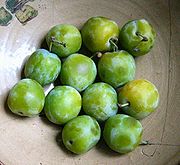
The greengages, also known as the Reine Claudes, are the edible drupaceous
fruit
s of a cultivar
group of the common European plum
. The first true greengage was bred in Moissac, France, from a green-fruited wild plum (Canerik) originally found in Asia Minor
; the original greengage cultivar nowadays survives in an almost unchanged form as 'Reine Claude Verte'.
Technically, greengages are a variety of the gages, scientifically named Prunus domestica
subsp. italica var. claudiana. The gages (P. d. ssp. italica) otherwise include the large and usually purple to blackish but occasionally bright yellow round plums (var. subrotunda, e.g. the Ontario plum), as well as the ancient and little-known Austria
n varieties punze (var. rotunda) and weinkriech (var. vinaria).
s (usually between 2 and 4 cm diameter). The skin ranges in colour from green
to yellow
ish, with a pale blue "blush" in some cultivars; a few Reine Claudes – such as 'Graf Althanns' –, are reddish-purple due to crossbreeding with other plums. Greengages are grown in temperate areas and are known for the rich, confectionery flavour. They are considered to be among of the finest dessert plums.
. "Green Gages" were imported into England
from France in 1724 by Sir William Gage, 7th Baronet, from whom they get their English name. Allegedly, the labels identifying the French plum trees were lost in transit to Gage's home in Bury St. Edmunds
. Soon after, Greengages were cultivated in the American colonies
, even being grown on the plantations of American presidents
George Washington
(1732–1799) and Thomas Jefferson
(1743–1826). However, their cultivation in North America
has declined significantly since the eighteenth century.
The name Reine Claude (French
for "Queen Claude"), by which they are known in France, is in honour of Claude
(1499–1524), the Duchess of Brittany, who became the queen consort
of King Francis I of France
(1494–1547). Greengages are also called la bonne reine (French for "the good Queen") in France.
 Greengages are widely grown in particular in western Europe
. The core of their range extends from France
to southern England
. In Germany
, where they are called Reneklode or Ringlotte, numerous cultivar
s have been developed too. In Poland
, they are known as renkloda and also widely grown, typically for stewing in syrup to make a compote
.
At least the green cultivar
s breed more-or-less true from seed, and several similar cultivars produced from seedlings are now available; some of these include other plum cultivars in their parentage. Widely grown cultivars include:
Drupe
In botany, a drupe is a fruit in which an outer fleshy part surrounds a shell of hardened endocarp with a seed inside. These fruits develop from a single carpel, and mostly from flowers with superior ovaries...
fruit
Fruit
In broad terms, a fruit is a structure of a plant that contains its seeds.The term has different meanings dependent on context. In non-technical usage, such as food preparation, fruit normally means the fleshy seed-associated structures of certain plants that are sweet and edible in the raw state,...
s of a cultivar
Cultivar
A cultivar'Cultivar has two meanings as explained under Formal definition. When used in reference to a taxon, the word does not apply to an individual plant but to all those plants sharing the unique characteristics that define the cultivar. is a plant or group of plants selected for desirable...
group of the common European plum
Plum
A plum or gage is a stone fruit tree in the genus Prunus, subgenus Prunus. The subgenus is distinguished from other subgenera in the shoots having a terminal bud and solitary side buds , the flowers in groups of one to five together on short stems, and the fruit having a groove running down one...
. The first true greengage was bred in Moissac, France, from a green-fruited wild plum (Canerik) originally found in Asia Minor
Asia Minor
Asia Minor is a geographical location at the westernmost protrusion of Asia, also called Anatolia, and corresponds to the western two thirds of the Asian part of Turkey...
; the original greengage cultivar nowadays survives in an almost unchanged form as 'Reine Claude Verte'.
Technically, greengages are a variety of the gages, scientifically named Prunus domestica
Prunus domestica
Prunus domestica is a Prunus species with many varieties. These are often called "plums" in common English, though not all plums belong to this species. Its hybrid parentage is believed to be Prunus spinosa and Prunus cerasifera var. divaricata...
subsp. italica var. claudiana. The gages (P. d. ssp. italica) otherwise include the large and usually purple to blackish but occasionally bright yellow round plums (var. subrotunda, e.g. the Ontario plum), as well as the ancient and little-known Austria
Austria
Austria , officially the Republic of Austria , is a landlocked country of roughly 8.4 million people in Central Europe. It is bordered by the Czech Republic and Germany to the north, Slovakia and Hungary to the east, Slovenia and Italy to the south, and Switzerland and Liechtenstein to the...
n varieties punze (var. rotunda) and weinkriech (var. vinaria).
Description
Greengage fruit are identified by their round-oval shape and smooth-textured pale green flesh; they are on average smaller than round plums but larger than mirabelle plumMirabelle plum
The mirabelle plum, also known as the mirabelle prune , is the edible drupaceous fruit of the mirabelle prune tree, a cultivar of the plum tree of the genus Prunus...
s (usually between 2 and 4 cm diameter). The skin ranges in colour from green
Green
Green is a color, the perception of which is evoked by light having a spectrum dominated by energy with a wavelength of roughly 520–570 nanometres. In the subtractive color system, it is not a primary color, but is created out of a mixture of yellow and blue, or yellow and cyan; it is considered...
to yellow
Yellow
Yellow is the color evoked by light that stimulates both the L and M cone cells of the retina about equally, with no significant stimulation of the S cone cells. Light with a wavelength of 570–590 nm is yellow, as is light with a suitable mixture of red and green...
ish, with a pale blue "blush" in some cultivars; a few Reine Claudes – such as 'Graf Althanns' –, are reddish-purple due to crossbreeding with other plums. Greengages are grown in temperate areas and are known for the rich, confectionery flavour. They are considered to be among of the finest dessert plums.
History and etymology
Sources attribute the origin of the name "greengage" variably to several members of the Gage family. One account states that the cultivar was brought into England by the Rev. John Gage who obtained them from the Chartreuse MonasteryGrande Chartreuse
Grande Chartreuse is the head monastery of the Carthusian order. It is located in the Chartreuse Mountains, north of the city of Grenoble, in the commune of Saint-Pierre-de-Chartreuse , France. Originally, the château belonged to the See of Grenoble...
. "Green Gages" were imported into England
England
England is a country that is part of the United Kingdom. It shares land borders with Scotland to the north and Wales to the west; the Irish Sea is to the north west, the Celtic Sea to the south west, with the North Sea to the east and the English Channel to the south separating it from continental...
from France in 1724 by Sir William Gage, 7th Baronet, from whom they get their English name. Allegedly, the labels identifying the French plum trees were lost in transit to Gage's home in Bury St. Edmunds
Bury St. Edmunds
Bury St Edmunds is a market town in the county of Suffolk, England, and formerly the county town of West Suffolk. It is the main town in the borough of St Edmundsbury and known for the ruined abbey near the town centre...
. Soon after, Greengages were cultivated in the American colonies
Colonial America
The colonial history of the United States covers the history from the start of European settlement and especially the history of the thirteen colonies of Britain until they declared independence in 1776. In the late 16th century, England, France, Spain and the Netherlands launched major...
, even being grown on the plantations of American presidents
President of the United States
The President of the United States of America is the head of state and head of government of the United States. The president leads the executive branch of the federal government and is the commander-in-chief of the United States Armed Forces....
George Washington
George Washington
George Washington was the dominant military and political leader of the new United States of America from 1775 to 1799. He led the American victory over Great Britain in the American Revolutionary War as commander-in-chief of the Continental Army from 1775 to 1783, and presided over the writing of...
(1732–1799) and Thomas Jefferson
Thomas Jefferson
Thomas Jefferson was the principal author of the United States Declaration of Independence and the Statute of Virginia for Religious Freedom , the third President of the United States and founder of the University of Virginia...
(1743–1826). However, their cultivation in North America
North America
North America is a continent wholly within the Northern Hemisphere and almost wholly within the Western Hemisphere. It is also considered a northern subcontinent of the Americas...
has declined significantly since the eighteenth century.
The name Reine Claude (French
French language
French is a Romance language spoken as a first language in France, the Romandy region in Switzerland, Wallonia and Brussels in Belgium, Monaco, the regions of Quebec and Acadia in Canada, and by various communities elsewhere. Second-language speakers of French are distributed throughout many parts...
for "Queen Claude"), by which they are known in France, is in honour of Claude
Claude of France
Claude of France was a princess and queen consort of France and ruling Duchess of Brittany. She was the eldest daughter of Louis XII of France and Anne, Duchess of Brittany....
(1499–1524), the Duchess of Brittany, who became the queen consort
Queen consort
A queen consort is the wife of a reigning king. A queen consort usually shares her husband's rank and holds the feminine equivalent of the king's monarchical titles. Historically, queens consort do not share the king regnant's political and military powers. Most queens in history were queens consort...
of King Francis I of France
Francis I of France
Francis I was King of France from 1515 until his death. During his reign, huge cultural changes took place in France and he has been called France's original Renaissance monarch...
(1494–1547). Greengages are also called la bonne reine (French for "the good Queen") in France.
Cultivation
Europe
Europe is, by convention, one of the world's seven continents. Comprising the westernmost peninsula of Eurasia, Europe is generally 'divided' from Asia to its east by the watershed divides of the Ural and Caucasus Mountains, the Ural River, the Caspian and Black Seas, and the waterways connecting...
. The core of their range extends from France
France
The French Republic , The French Republic , The French Republic , (commonly known as France , is a unitary semi-presidential republic in Western Europe with several overseas territories and islands located on other continents and in the Indian, Pacific, and Atlantic oceans. Metropolitan France...
to southern England
England
England is a country that is part of the United Kingdom. It shares land borders with Scotland to the north and Wales to the west; the Irish Sea is to the north west, the Celtic Sea to the south west, with the North Sea to the east and the English Channel to the south separating it from continental...
. In Germany
Germany
Germany , officially the Federal Republic of Germany , is a federal parliamentary republic in Europe. The country consists of 16 states while the capital and largest city is Berlin. Germany covers an area of 357,021 km2 and has a largely temperate seasonal climate...
, where they are called Reneklode or Ringlotte, numerous cultivar
Cultivar
A cultivar'Cultivar has two meanings as explained under Formal definition. When used in reference to a taxon, the word does not apply to an individual plant but to all those plants sharing the unique characteristics that define the cultivar. is a plant or group of plants selected for desirable...
s have been developed too. In Poland
Poland
Poland , officially the Republic of Poland , is a country in Central Europe bordered by Germany to the west; the Czech Republic and Slovakia to the south; Ukraine, Belarus and Lithuania to the east; and the Baltic Sea and Kaliningrad Oblast, a Russian exclave, to the north...
, they are known as renkloda and also widely grown, typically for stewing in syrup to make a compote
Compote
Compote is a dessert originating from 17th century France made of whole or pieces of fruit in sugar syrup. Whole fruits are immersed in water and with sugar and spices added to the dish, over gentle heat. The syrup may be seasoned with vanilla, lemon or orange peel, cinnamon sticks or powder,...
.
At least the green cultivar
Cultivar
A cultivar'Cultivar has two meanings as explained under Formal definition. When used in reference to a taxon, the word does not apply to an individual plant but to all those plants sharing the unique characteristics that define the cultivar. is a plant or group of plants selected for desirable...
s breed more-or-less true from seed, and several similar cultivars produced from seedlings are now available; some of these include other plum cultivars in their parentage. Widely grown cultivars include: