
|
|
|
|
Jukebox
|
| |
|
| |
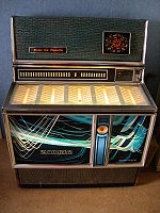
A jukebox is a partially automated music-playing device, usually a coin-operated machine, that can play specially selected songs from self-contained media.

Discussion
Ask a question about 'Jukebox'
Start a new discussion about 'Jukebox'
Answer questions from other users
|
Recent Posts

Encyclopedia
A jukebox is a partially automated music-playing device, usually a coin-operated machine, that can play specially selected songs from self-contained media. The traditional jukebox is rather large with a rounded top and has colored lighting on the front of the machine on its vertical sides. The classic jukebox has buttons with letters and numbers on them that, when combined, are used to indicate a specific song from a particular record.
History Coin-operated music boxes and player pianos carved out a place for automatic pay-per-tune music in fairgrounds, amusement parks and other public places (such as train stations in Switzerland) a few decades before the introduction of reliable coin-operated phonographs. The first jukebox was an automatic phonograph produced in 1927 by Rowe International, then known as AMI. Some of these automatic musical instruments were extremely well built and have survived to this day in the hands of collectors and museums. But commercially they could not compete with the jukebox in the long run since they were limited to the instrument (or instruments) used in their construction, and could not reproduce the human voice.
The immediate ancestor of the jukebox, called the "Coin-slot phonograph", was the first medium of sound recording encountered by the general public, before mass produced home audio equipment became common. Such machines began to be mass produced in 1889, using phonograph cylinders for records. The earliest machines played only a single record (of about 2 minutes of music or other entertainment), but soon devices were developed that allowed customers to choose between multiple records. In the 1910s the cylinder gradually was superseded by the gramophone record. In 1928, Justus P. Seepburg, who manufactured player pianos, created an electrostatic loudspeaker combined with a record player that was coin operated and gave the listener a choice of eight records. The term "juke box" came into use in the United States in the 1930s, apparently derived from the African-American slang term "juke" or "jook", meaning "dance". The shellac 78 rpm record dominated jukeboxes until the Seeburg Corporation introduced an all 45 rpm vinyl record jukebox in 1950.
Wallboxes were an important, and profitable, part of any jukebox installation. Basically a remote control, they enabled patrons to select tunes from their table or booth. The most famous is the Seeburg 3W1, introduced in 1949 as companion to the new 100-select Model M100A jukebox. Stereo sound became popular in the early 1960s, and wallboxes of the era were designed with built-in speakers to provide patrons a sample of this latest technology. Interestingly, for the next several years, there were very few stereo 45 rpm records made; the "little LP" (also referred to as "stereo 7") was designed and manufactured specifically for jukeboxes. It played at 33 1/3 rpm and was the same physical size as the 45 rpm records, to retain compatibility with the jukebox mechanisms.
Some jukeboxes during this time were able to play other special 33 discs of 45 size, which provide a longer song or multiple songs, for a higher price. These specialty records (known as EPs, for "extended play") were provided by the unique vendor that supplied records to the operator. Those decades also produced models with ornate lighting, disco and psychedelic effects, and other cosmetic improvements while the internal mechanisms remained moderately stable by comparison. Song-popularity counters told the operator the number of times each record was played (A and B side were generally not distinguished), with the result that popular records remained, while lesser-played songs were replaced with the latest hits.
Jukeboxes and their ancestors were a very profitable industry from the 1890s on. They were most popular from the 1940s through the mid-1960s, particularly during the 1950s. Today they are often associated with early rock and roll music, but were very popular in the swing music era as well. As a result, stores and restaurants with a retro theme, such as the Johnny Rockets chain, include jukeboxes.
Starting in the 1980s, compact discs became the norm for modern jukeboxes. Towards the end of the 20th century several companies started introducing completely digital jukeboxes which did not use physical recordings. The music selection and playback system was replaced by a dedicated proprietary computer. A selection of songs suitable to the venue where the jukebox is located are generally cached in the local storage of the machine. The true advantage of this design is the seemingly endless selection of music available instantly to the customer by automatic download from an internet connection. The world's first commercial digital jukebox was demonstrated by TouchTunes Music Corporation of Montreal in May 1994, and becoming available outside Canada in September 1998. The product, named Genesis, had a selection of 750 songs and no ability for instant download.
Aesthetic style
The first jukeboxes were simply wooden boxes with coin slots and a few buttons. Over time they became more and more decorated, using color lights, rotating lights, chrome, bubble tubes, ceiling lamps, and other visual gimmicks. Many consider the 1940s to be the "golden age" of jukebox styling with the gothic-like curvaceous "electric rainbow cathedral" look. World War II and the Great Depression were over, so the new designs and sales choices reflected the festive mood. The first model manufactured after WWII was the Model A, produced by AMI. Affectionately referred to as the "Mother of Plastic", it featured large areas of opalescent plastics and colored gemstones.
Styling progressed from the plain wooden boxes in the early thirties to beautiful light shows with marbelized plastic and color animation in the Wurlitzer 850 Peacock of 1941. But after the United States entered the war, metal and plastic were needed for the war effort. Jukeboxes were considered "nonessential", and none were produced until 1946. The 1942 Wurlitzer 950 featured wooden coin chutes to save on metal. At the end of the war, in 1946, jukebox production resumed and several "new" companies joined the frey.
They did not last.The Wurlitzer model "1015-Bubbler" typifies the look and is arguably the most popular jukebox design of all time. Many of these survived into the '50s in active use and are instead associated with the '50s in pop culture despite their '40s origin because of their unique visual prominence and production volume. Designed by stylist Paul Fuller, it is rumored that when entertainment equipment factories were redirected toward the war effort, Paul had more time to focus on aesthetic design. This extra time resulted in one of the greatest designs in iconic pop culture.
After the '40s, the styles generally became more box-like and "high-tech" in look, distancing themselves from "classic" influences such as ancient Greek, renaissance, and Gothic motifs found in the '40s models.
Also, the post-'40s models needed more panel space for the increased number of record titles they could present on selection buttons, reducing the space available for decoration. This is partly due to improved record storage and dispatching technology and partly due to the transition from the 78-rpm disks to the 45-rpm disks, which were more compact.
Jukeboxes from the 1940s are called Golden Age because of the yellow catalin plastic. Jukeboxes from the 1950s are called Silver Age because of the predominant chrome styling.
"Rock-Ola" is actually based on the name of the company founder, David Cullen Rockola, and is not a portmanteau of Rock and Victrola. Rock-ola was founded many years before the term "Rock" was applied to music at all.
Notable Models
- Rock-Ola model 1413 Premier (1942) - Resembles something from a science fiction movie. It has a distinctive blue-green glowing "eye globe" in the lower-middle of its gill-like grille.
- Rock-Ola model 1422 and 1426 (1946-47) - Beautiful use of rainbow-colored leafy-spiral grill-work resembling violin stems.
- 1953 Seeburg M100C - This machine played 50 45 rpm records making it a 100 play. Mirrors on the inside rotating animation in the pilasters. Chrome glass tubes in the front, very colorful. This is mostly noted for its repeated appearance in the sit-com "Happy Days".
- 1954 Rock-Ola 1438 Comet - This was the first 45 RPM Record machine that Rockola offered Exclusively as 45 rpm only. It played 60 45 rpm records (120 Selection) It seemed to share a lot of features from the Seeburg M100C (Pilasters) Curved glass and also had an animated title bar which was square, hence it rotated 4 times to make allow all the selections. Selections were made via one button as to the later typical two. but still had a personal style that many people enjoyed.
- 1954 Seeburg HF100R - This machine played 50 45 rpm records. Featured glass panels and Icicle chrome on the grill. It had a bandshell appearance with anodized chrome. It had 5 speakers to give the listener better sound "all around the Jukebox"
- 1962 Rock-Ola Princess - The name is applied to several different models that vary drastically in appearance. This model is popular today for nostalgic use in homes due to its compact size. The most desirable Princess model has a visible mechanism, something nearly universally desired by home jukebox owners.
- Wurlitzer Model 750 and 750E (1941) - In some ways a precursor to the famous 1015, but with a rounder look.
- Wurlitzer Model 800 (1941) - Very bold looking model that in some ways resembles a shuttle launch with its two side rockets. A flame-like glimmer was created by internal rotating tubes casting waving shadow patterns against the lights.
- Wurlitzer Model 850 (1941) - Some of the most artistic grille work. The highlight was a revolving polarizer peacock color animation.
- Wurlitzer Model 950 (1942) - In some ways a visual hybrid between models 800 and 1015. Black metal edging gives this a look reminiscent of ancient Greek design.
- Wurlitzer Model 1015 (1948) - Considered by many to be the universal design for a jukebox. This is the model with the color-changing columns and bubble tubes and the arching top. Reproductions of this version are made by many commercial jukebox manufacturers to this day. The original played 78 rpm records, but it is available today with CD, 45, and even digital download.
- Wurlitzer Models 1080 and 1080-A (1947-48) - Another model that seems to have heavy Greek influence. This model was not as colored-light intensive of other models of the era, but makes very stylish use of wood and classical curves.
- Wurlitzer Jukebox Model 1100 (1948-49) - Represents a transition style between the 40s and 50s jukebox styling when the record player area started opening up behind larger glass displays. Heavy use of chrome styling.
- AMI "Top Flight" Model (1936-38) - Very distinctive grille-work with a sleek, metallic Sci-Fi feel. (Produced by Rowe International, then known as AMI)
- AMI Model "A" Jukebox of (1946-47) - Unique "space helmet" look. In many ways the styling was ahead of its time. The model A was also the first jukebox to play both side of every record. It held 20 78-rpm discs and offered patron 40 selections. (Produced by Rowe International, then known as AMI)
- Seeburg Model "G" - This Jukebox is known as the "Happy Days Machine," as it was used in the sitcom Happy Days. It was 100 play and features chrome pilasters.
- AMI Model "G" Jukebox of (1954) - Has the look of a "Fish Tank" and has been named so. This was the first machine to use a folded horn concept speaker system (Produced by Rowe International, then known as AMI)
- AMI Model H, I, J and K All of these models had the 50's car windshield look. (eg: 1958 Plymouth front windshield [wrap around]) This was a new concept and currently people in Europe grab these machines as fast as they can. Last year for this style for AMI was 1960 and was the model K. The model I remains at this time time the MOST desirable machine to own. (Produced by Rowe International, then known as AMI)
- AMI Continental - Often compared to the Jetsons' car, this model has the selections on a curved vertical board. The mechanism is visible through a clear dome on the top of the main body. This model is especially popular today in Europe.
External links
- TouchTunes Jukebox
- Provider of digital music to several jukeboxes
- Maker of Digital and CD Jukeboxes
- Wurlitzer Jukebox
- Rock-Ola Jukebox
- Rock-Ola UK
- Jukebox-Archive with forum, serial numbers, classified ads and parts
- Home of the British-made BAL-AMI Jukeboxes
-
- Jukebox France
|
| |
|
|