


Quadraphonic

Encyclopedia
_label.svg.png)
Sound
Sound is a mechanical wave that is an oscillation of pressure transmitted through a solid, liquid, or gas, composed of frequencies within the range of hearing and of a level sufficiently strong to be heard, or the sensation stimulated in organs of hearing by such vibrations.-Propagation of...
– the most widely used early term for what is now called 4.0 surround sound
Surround sound
Surround sound encompasses a range of techniques such as for enriching the sound reproduction quality of an audio source with audio channels reproduced via additional, discrete speakers. Surround sound is characterized by a listener location or sweet spot where the audio effects work best, and...
– uses four channels in which speakers are positioned at the four corners of the listening space, reproducing signals that are (wholly or in part) independent of one another. Quadraphonic audio was the earliest consumer offering in surround sound. It was a commercial failure due to many technical problems and format incompatibilities. Quadraphonic audio formats were more expensive to produce than standard two-channel stereo. Playback required additional speakers and specially designed decoders and amplifiers.
The rise of home theatre products in the late 1980s and early 1990s brought multi-channel audio recording back to into popularity, although in new digitally based formats. Thousands of quadraphonic recordings were made during the 1970s, and some of these recordings have been reissued in modern surround sound formats such as DTS, Dolby Digital
Dolby Digital
Dolby Digital is the name for audio compression technologies developed by Dolby Laboratories. It was originally called Dolby Stereo Digital until 1994. Except for Dolby TrueHD, the audio compression is lossy. The first use of Dolby Digital was to provide digital sound in cinemas from 35mm film prints...
, DVD-Audio
DVD-Audio
DVD-Audio is a digital format for delivering high-fidelity audio content on a DVD. DVD-Audio is not intended to be a video delivery format and is not the same as video DVDs containing concert films or music videos....
and Super Audio CD
Super Audio CD
Super Audio CD is a high-resolution, read-only optical disc for audio storage. Sony and Philips Electronics jointly developed the technology, and publicized it in 1999. It is designated as the Scarlet Book standard. Sony and Philips previously collaborated to define the Compact Disc standard...
.
In 1967 the rock group Pink Floyd
Pink Floyd
Pink Floyd were an English rock band that achieved worldwide success with their progressive and psychedelic rock music. Their work is marked by the use of philosophical lyrics, sonic experimentation, innovative album art, and elaborate live shows. Pink Floyd are one of the most commercially...
performed the first-ever surround sound concert at “Games for May”, a lavish affair at London
London
London is the capital city of :England and the :United Kingdom, the largest metropolitan area in the United Kingdom, and the largest urban zone in the European Union by most measures. Located on the River Thames, London has been a major settlement for two millennia, its history going back to its...
’s Queen Elizabeth Hall
Queen Elizabeth Hall
The Queen Elizabeth Hall is a music venue on the South Bank in London, United Kingdom that hosts daily classical, jazz, and avant-garde music and dance performances. The QEH forms part of Southbank Centre arts complex and stands alongside the Royal Festival Hall, which was built for the Festival...
where the band debuts its custom-made quadraphonic speaker system. The control device they had made, the Azimuth Co-ordinator
Azimuth co-ordinator
The Azimuth Co-ordinator was the first panning control for a quadraphonic sound system, at that time a new concept. Pink Floyd became the first band to use it in their early shows.The Azimuth Co-ordinator uses four rotary rheostats housed in a large box...
, is now displayed at London's Victoria and Albert Museum
Victoria and Albert Museum
The Victoria and Albert Museum , set in the Brompton district of The Royal Borough of Kensington and Chelsea, London, England, is the world's largest museum of decorative arts and design, housing a permanent collection of over 4.5 million objects...
, as part of their Theatre Collections gallery.
History
The first medium for 4-channel sound was the quadraphonic reel-to-reel tape, introduced to the American market by the Vanguard Recording Society in June 1969. RCA RecordsRCA Records
RCA Records is one of the flagship labels of Sony Music Entertainment. The RCA initials stand for Radio Corporation of America , which was the parent corporation from 1929 to 1985 and a partner from 1985 to 1986.RCA's Canadian unit is Sony's oldest label...
followed, in April 1970, with its announcement of Quad-8 or Quadraphonic 8-Track Tape (later shortened to just Q8). These eventually appeared in Sept. 1970.
"Quad" (as it became known) did not remain restricted to the discrete channel format used in the quadraphonic reel-to-reel or Quad-8. Quadraphonic vinyl albums appeared, which used several different and incompatible modes. The first of these, known as QS or Command Quadraphonic, was developed by Sansui Electric. A so-called matrix format, it utilized four sound channels which were "encoded" into two stereo album tracks. These were, then, "decoded" back into the original four sound channels. The QS system debuted in the United States in March 1971.
The second Quad vinyl record format, known as SQ, also utilized a matrix-type system of encoding and decoding. It was developed and marketed by Columbia Records
Columbia Records
Columbia Records is an American record label, owned by Japan's Sony Music Entertainment, operating under the Columbia Music Group with Aware Records. It was founded in 1888, evolving from an earlier enterprise, the American Graphophone Company — successor to the Volta Graphophone Company...
and Sony
Sony
, commonly referred to as Sony, is a Japanese multinational conglomerate corporation headquartered in Minato, Tokyo, Japan and the world's fifth largest media conglomerate measured by revenues....
and entered the US market in April 1971. The SQ format would also be used by companies such as EMI
EMI
The EMI Group, also known as EMI Music or simply EMI, is a multinational music company headquartered in London, United Kingdom. It is the fourth-largest business group and family of record labels in the recording industry and one of the "big four" record companies. EMI Group also has a major...
in Great Britain, who pressed several SQ album releases. The sound separation of the SQ system was greatly improved by the introduction of SQ Full Logic decoding, in 1975.
The third major format for 4-channel vinyl LPs, known as CD-4 or Quadradisc, was devised by the Japanese JVC
JVC
, usually referred to as JVC, is a Japanese international consumer and professional electronics corporation based in Yokohama, Japan which was founded in 1927...
Corporation along with its United States counterpart, RCA
RCA
RCA Corporation, founded as the Radio Corporation of America, was an American electronics company in existence from 1919 to 1986. The RCA trademark is currently owned by the French conglomerate Technicolor SA through RCA Trademark Management S.A., a company owned by Technicolor...
. This quadraphonic format was first marketed in the United States in May 1972. A fully discreet sound mode, it eschewed the previous matrix systems in favor of a more complex -and sonically separate- method of 4-channel reproduction. A high-frequency "carrier wave" instructed a "CD-4 demodulator" on how to separate the four sound channels within the vinyl album.
Audio on vinyl records was problematic because one of the systems was based on discrete sound channels (allowing for full separation of the four original recorded channels, albeit with restricted high-frequency response and reduced record life), while two others were matrix encoded into two tracks that would also play back in standard, two-channel, stereo on normal audio equipment (so-called 'compatible' quadraphonic).
There were some experiments done with radio
Radio
Radio is the transmission of signals through free space by modulation of electromagnetic waves with frequencies below those of visible light. Electromagnetic radiation travels by means of oscillating electromagnetic fields that pass through the air and the vacuum of space...
broadcasts (e.g. a Cliff Richard
Cliff Richard
Sir Cliff Richard, OBE is a British pop singer, musician, performer, actor, and philanthropist who has sold over an estimated 250 million records worldwide....
concert by the BBC
BBC
The British Broadcasting Corporation is a British public service broadcaster. Its headquarters is at Broadcasting House in the City of Westminster, London. It is the largest broadcaster in the world, with about 23,000 staff...
), but they were short-lived. One radio series, Double Exposure, was briefly syndicated throughout the United States to various FM stations; it was made up of jazz, rock and pop music that had been commercially released in one of the quadraphonic record or tape systems. One of the longest-lived radio broadcasts was WQSR-FM "Quad 102½" in Sarasota, Florida. Throughout most of the 1970s this station broadcast a signal which could be tuned as two separate stations with conventional stereo receivers. In addition, San Francisco classical music station KKHI
KKHI (defunct)
*For current station at 95.7 FM in San Francisco, see KGMZKKHI was a classical music station in San Francisco, California operating on both AM and FM .-Profile:...
broadcast the San Francisco Opera
San Francisco Opera
San Francisco Opera is an American opera company, based in San Francisco, California.It was founded in 1923 by Gaetano Merola and is the second largest opera company in North America...
in 'compatible' (that is, matrix encoded) quadraphonic format during the 1970s as did Chicago station WFMT's live "Chicago Lyric Opera" broadcasts.. KRMH-FM ("Good Karma Radio")(San Marcos/Austin, Texas) broadcast in "Quad Stereo" in the early 1970s from its studios and transmitter near Buda, Texas.
Discrete formats
Discrete reproduction is the only true Quadraphonic system. As its name suggests, with discrete formats the original four audio channels are passed through a four-channel transmission medium and presented to a four-channel reproduction system and fed to four speakers. This is defined as a 4–4–4 system.To transmit 4 individual audio signals in a compatible manner, there must be four simultaneous linear equations to reproduce the original 4 audio signals at the output. The term 'compatible' indicates that:
(a) A single channel (mono) system will reproduce all four audio signals in its one speaker.
(b) A two-channel (stereo) system will reproduce the Left Front & Left Back audio signals in the Left speaker and the Right Front & Right Back signals in the Right Speaker.
A full, four-channel (Quadraphonic) system will reproduce the Left Front, Left Back, Right Front, and Right Back audio signals in each of four separate speakers.
CD-4 (Compatible Discrete 4) / Quadradisc


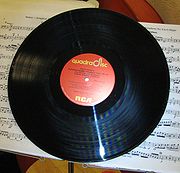
Compact Disc
The Compact Disc is an optical disc used to store digital data. It was originally developed to store and playback sound recordings exclusively, but later expanded to encompass data storage , write-once audio and data storage , rewritable media , Video Compact Discs , Super Video Compact Discs ,...
) was introduced in May 1972 as a discrete quadraphonic system created by JVC
JVC
, usually referred to as JVC, is a Japanese international consumer and professional electronics corporation based in Yokohama, Japan which was founded in 1927...
and RCA
RCA
RCA Corporation, founded as the Radio Corporation of America, was an American electronics company in existence from 1919 to 1986. The RCA trademark is currently owned by the French conglomerate Technicolor SA through RCA Trademark Management S.A., a company owned by Technicolor...
. Record companies who adopted this format include Arista
Arista Records
Arista was an American record label. It was a wholly owned subsidiary of Sony Music Entertainment and operated under the RCA Music Group. The label was founded in 1974 by Clive Davis, who formerly worked for CBS Records...
, Atlantic
Atlantic Records
Atlantic Records is an American record label best known for its many recordings of rhythm and blues, rock and roll, and jazz...
, Capricorn
Capricorn Records
Capricorn Records was an independent record label which was launched by Phil Walden, Alan Walden, and Frank Fenter in 1969 in Macon, Georgia.-First Incarnation:...
, Elektra
Elektra Records
Elektra Records is an American record label owned by Warner Music Group. In 2004, it was consolidated into WMG's Atlantic Records Group. After five years of dormancy, the label was revived by Atlantic in 2009....
, Fantasy
Fantasy Records
Fantasy Records is a United States-based record label that was founded by Max and Sol Weiss in 1949 in San Francisco, California. They had previously operated a record-pressing plant called Circle Record Company before forming the Fantasy label...
, JVC
JVC
, usually referred to as JVC, is a Japanese international consumer and professional electronics corporation based in Yokohama, Japan which was founded in 1927...
, Nonesuch
Nonesuch Records
Nonesuch Records is an American record label, owned by Warner Music Group and distributed by Warner Bros. Records.-Company history:Nonesuch was founded in 1964 by Jac Holzman to produce "fine records at the same price as a trade paperback", which would be half the price of a normal LP...
, A & M, Reprise
Reprise Records
Reprise Records is an American record label, founded in 1960 by Frank Sinatra. It is owned by Warner Music Group, and operated through Warner Bros. Records.-Beginnings:...
and Warner
Warner Music Group
Warner Music Group is the third largest business group and family of record labels in the recording industry, making it one of the big four record companies...
.
This was the only fully discrete quadraphonic phonograph record system to gain major industry acceptance.
In the CD-4 system, the quadraphonic audio was divided into left and right channels which were recorded orthogonally in the vertical plane of the disc groove, which is the case with normal stereo. The audio frequencies (20 Hz to 15 kHz), often referred to as the sum channel, would contain the sum of the left front plus left back signals in the left channel and the sum of the right front plus the right back signals in the right channel. In other words, if you looked at the audio frequencies only, you had an ordinary stereo recording. Along with this audio, a separate 30 kHz carrier was recorded on each groove wall. The carrier on each side carried the difference signal for that side. This was the information that enabled a combined signal to be resolved into two separate signals. For the left carrier it would be left front minus left back, and for the right carrier it would be the right front minus the right back. These audio signals were modulated onto the carriers using a special FM-PM-SSBFM (frequency modulation-phase modulation-single sideband frequency modulation) technique. This created an extended carrier frequency range from 18 kHz to 45 kHz for the left and right channels. The algebraic addition and subtraction of the sum and difference signals would then yield compatible and discrete quadraphonic playback. CD-4 was responsible for major improvements in phonograph technology including better compliance, lower distortion levels, pick-up cartridges with a significantly higher frequency range, and new record compounds such as Q-540, which were highly anti-static. A typical CD-4 system would have a turntable with a CD-4 cartridge, a CD-4 demodulator, a discrete four-channel amplifier, and (ideally) four full-range loudspeakers. Some manufactures built the CD-4 demodulator into complete four-channel receivers.
Simply put, CD-4 consists of four recorded signals (LF, LB, RB, RF) and the following coding matrix, similar to FM broadcast stereo multiplexing.
The CD-4 encoding/decoding matrix:
- (LF+LB)+(LF-LB)=2LF or left front
- (LF+LB)-(LF-LB)=2LB or left back
- (RF+RB)+(RF-RB)=2RF or right front
- (RF+RB)-(RF-RB)=2RB or right back
Although CD-4 (and quadraphonic audio in general) failed due to late FCC approval of FM quadraphonic broadcasting, the improvements CD-4 engendered spilled over into, and substantially improved, the production of conventional stereo LP records.
UD-4 / UMX

Denon
is a Japanese electronics company that was involved in the early stages of development of digital audio technology, while specializing in the manufacture of high-fidelity professional and consumer audio equipment. For many decades, Denon was a brand name of Nippon-Columbia, including the Nippon...
). This is a hybrid discrete/matrix system. Only 35 to 40 items are encoded in this format, and it was marketed only in the UK, Europe and Japan.
A regular matrix decoder could be used to play back these recordings, but, by adding a special cartridge and a UD-4 demodulator, two supplementary channels could be extracted and used to enhance directional resolution. UD-4 systems first encoded the four original channels into four new channels. Two of these new channels contained the original four channels, matrix encoded. The other two contained only band-limited localization information, and were encoded with carriers similar to the CD-4 system. UD-4 was less critical in its set-up than CD-4, because the carriers did not have to carry frequencies as high as those found in the CD-4 system.
Q4 / Quadraphonic Reel To Reel
Often judged by audiophiles to be the best of the old Quad formats, this system was based on the reel-to-reel-type 1/4" tape format, fully discrete and with full bandwidth (unlike the Q8 Cartridge system, which had limited dynamic range). This format was available only in the USA. Playback machines were either dedicated quad machines or 4-track open reel systems, usually running at a speed of 7.5IPS (double the speed of the 8-Track systems), providing even better sound quality.Quad-8 (Q8) / Quadraphonic 8-Track
Quadraphonic 8-Track was a discrete 4-Channel Tape Cartridge system announced by RCA Records in April 1970 and introduced in Sept. 1970, and first called Quad-8 (later shortened to just Q8). The format was almost identical in appearance to stereo 8-tracks8-track cartridge
Stereo 8, commonly known as the eight-track cartridge, eight-track tape, or simply eight-track, is a magnetic tape sound recording technology. It was popular in the United States from the mid-1960s through the late 1970s, but was relatively unknown in many European countries...
, except for a small sensing notch in the upper left corner of the cartridge. This signalled a quadraphonic 8-track player to combine the odd tracks as audio channels for Program 1, and the even tracks as channels for Program 2. The format was not backward compatible with stereo or mono players – although quadraphonic players would play stereo 8-tracks, playing quadraphonic tapes on stereo players results in hearing only one-half the channels at a time. Some stereo (two-channel) 8-track players simulated quadraphonic sound through the upmixing of stereo 8-tracks, but these were not true quadraphonic 8-track players.
The last release in the quadraphonic 8-track format was in 1978, although most had stopped appearing by the end of 1976.
Matrix formats
With matrix formats, the four channels are converted (encoded) down to two channels. These are then passed through a two-channel transmission medium (usually an LP record) before being decoded back to four channels and presented to four speakers. The systems were based on the work of Peter Scheiber, who created the basic mathematical formulae used to matrix four channels into two. This 4:2:4 process could not be accomplished without information loss. That is to say, the four channels produced at the final stage were not identical to those with which the process had begun.SQ / Stereo Quadraphonic

Columbia Records
Columbia Records is an American record label, owned by Japan's Sony Music Entertainment, operating under the Columbia Music Group with Aware Records. It was founded in 1888, evolving from an earlier enterprise, the American Graphophone Company — successor to the Volta Graphophone Company...
in 1971. Record companies who adopted this format include: Angel
Angel Records
Angel Records is a record label belonging to EMI. It was formed in 1953 and specialised in classical music, but included an occasional operetta or Broadway score...
, CTI
CTI Records
CTI Records was a jazz record label founded in 1967 by producer/A&R manager Creed Taylor. Initially, CTI was a subsidiary of A&M Records, but the label went independent in 1970...
, Columbia
Columbia Records
Columbia Records is an American record label, owned by Japan's Sony Music Entertainment, operating under the Columbia Music Group with Aware Records. It was founded in 1888, evolving from an earlier enterprise, the American Graphophone Company — successor to the Volta Graphophone Company...
, EMI
EMI
The EMI Group, also known as EMI Music or simply EMI, is a multinational music company headquartered in London, United Kingdom. It is the fourth-largest business group and family of record labels in the recording industry and one of the "big four" record companies. EMI Group also has a major...
, Epic
Epic Records
Epic Records is an American record label, owned by Sony Music Entertainment. Though it was originally conceived as a jazz imprint, it has since expanded to represent various genres. L.A...
, Eurodisc, Harvest
Harvest Records
-References:* Harvest Records collectors guide ISBN 978-5-9622-0021-7...
, HMV
HMV
His Master's Voice is a trademark in the music business, and for many years was the name of a large record label. The name was coined in 1899 as the title of a painting of the dog Nipper listening to a wind-up gramophone...
, Seraphim
Seraphim Records
Seraphim Records is the sister label of Angel Records.-History:During the 1960s through the 1980s, it was Angel's low-price label; recordings that had originally been released on the Angel label were re-released at a bargain price on the Seraphim label...
, Supraphon
Supraphon
Supraphon Music Publishing is a Czech record label, it is oriented mainly towards publishing classical music, with an emphasis on Czech and Slovak composers.- History :...
and Vanguard
Vanguard Records
Vanguard Records is a record label set up in 1950 by brothers Maynard and Seymour Solomon in New York. It started as a classical label, but is perhaps best known for its catalogue of recordings by a number of pivotal folk and blues artists from the 1960s; the Bach Guild was a subsidiary...
.
SQ stands for "Stereo Quadraphonic." This system made good sense, as, in the absence of a quad decoder, SQ-encoded records would play as normal stereo records, and CBS stated their desire to maintain excellent compatibility between their SQ-encoded records and standard stereo systems.
The early SQ decoders could not produce more than 3 dB of separation from front to back. Early "Logic" circuits were introduced to enhance separation to 20 dB, but provided poor performance, very noticeable gain-pumping and an unstable 'swaying' soundfield. The SQ system also faced resistance from broadcasters since, while essentially a two-channel system and totally stereo-compatible, it could have substantial mono compatibility problems, which posed serious problems with all televisions and monophonic radios of the era. By the time that the most advanced logic system was introduced for SQ, the Tate Directional Enhancement System, "quad" was already considered a failure.
A Prologic II decoder will recover some of the surround sound information present in an SQ mix, as the matrices used are somewhat similar, but directional cues will not be properly located. Some of the SQ mixes are still present on CDs, especially on early, non-remastered editions, on which the original master is, in itself, SQ. (SQ is compatible with two-channel stereo, so there was no need to create a stereo version.)
| Basic SQ Encoding Matrix | Left Front | Right Front | Left Back | Right Back |
|---|---|---|---|---|
| Left Total | 1.0 | 0.0 | -j0.7 | 0.7 |
| Right Total | 0.0 | 1.0 | -0.7 | j0.7 |
j = + 90° phase-shift
To provide mono-compatibility a variation on this matrix was proposed:
| Modified SQ Encoding Matrix | Left Front | Right Front | Left Back | Right Back |
|---|---|---|---|---|
| Left Total | 1.0 | 0.0 | 0.7 | -j0.7 |
| Right Total | 0.0 | 1.0 | -j0.7 | 0.7 |
j = + 90° phase-shift
The four channels were coded and decoded normally in this proposal, but the back-center channel
Center channel
Center channel refers to an audio channel common to many surround sound formats. It is the channel that is mostly, or fully, dedicated to the reproduction of the dialogue of an audiovisual program...
was coded in phase and therefore decoded in front-center.
QS / Quadraphonic Sound

Sansui
) is a Japanese manufacturer of audio and video equipment. Headquartered in Tokyo, Japan, it is part of Grande Holdings, a Chinese Hong Kong-based conglomerate, which also owns Japanese brands Akai and Nakamichi....
, adopted by ABC, Advent, Bluesway, Candide, Command, Decca, Impulse, Longines, MCA, Ovation, Pye, Turnabout and Vox record companies. It was freely licensed to record companies, but was rarely found on receivers other than those made by Sansui. The QS matrix has been found to offer the advantages of excellent diagonal separation and stereo compatibility, and although the adjacent speaker separation is only 3 dB, this symmetrical distribution produces more stable quadraphonic images. Sansui's decoders also had good stereo-to-quad capabilities, wrapping the L-R panorama to LB-LF-RF-RB in a horseshoe topology. Two outboard decoders, the QSD-1 and -2, as well as the QRX- series of larger receiver-amplifiers, incorporated this matrix and up-conversion.
The QS matrix system was employed to create the five-channel Quintaphonic Sound system used for première engagements of the 1975 film Tommy
Tommy (film)
Tommy is a 1975 British musical film based upon The Who's 1969 rock opera album musical Tommy. It was directed by Ken Russell and featured a star-studded cast, including the band members themselves...
. The left and right 35mm magnetic soundtracks were QS-encoded to create four channels around the cinema audience, while the centre mag track was assigned to the speaker behind the screen. The mag FX track was unused. This channel layout came close (5.0) to the now common 5.1 surround sound layout.
| QS Encoding Matrix | Left Front | Right Front | Left Back | Right Back |
|---|---|---|---|---|
| Left Total | 0.92 | 0.38 | j0.92 | j0.38 |
| Right Total | 0.38 | 0.92 | -j0.38 | -j0.92 |
j = + 90° phase-shift
EV / Stereo-4
EV - Developed by Electro Voice, also known as Stereo-4. Despite heavy promotion by RadioShackRadioShack
RadioShack Corporation is an American franchise of electronics retail stores in the United States, as well as parts of Europe, South America and Africa. As of 2008, RadioShack reported net sales and operating revenues of $4.81 billion. The headquarters of RadioShack is located in Downtown...
stores in the USA, very few items were encoded in this format. Stereo-4 decoders were especially good at producing credible 4-channel effects from 2-channel stereo recordings.
DY / Dynaquad
DY - Developed by Dynaco, also known as Dynaquad. The four speakers were arranged in a diamond (centre-front, centre-left, centre-rear, centre-right). The encoding was unusual in that it did not use 90° phase shifters. Very few items are encoded in this format, although it did inspire the "Hafler circuit" described below.A much simpler form of the Dynaco patent keeps the four speakers in their normal left and right plus front and rear positions. The left and right rear speakers are connected to the two-channel stereo amplifier via a passive matrix circuit, while the front ones stay directly connected to the amplifier. A lot of stereo material, recorded with a central, non-directional microphone (so-called kidney sensitivity diagram) placed in front of the orchestra, possessed suitable difference signals across the stereo signals. When taken across this passive speaker matrix for the rear channels, these produced a quasi-quadraphonic effect at low cost (the patent specifies the use of one fixed 10 ohm resistor and three variable 20 ohm resistors in a star arrangement). Especially for classical music, a fine impression of concert-hall ambience is achieved with such a system.
Dynaco sold this matrix circuit with a large and triple high-wattage potentiometer inside, for a sum equivalent to 70 euros (about 100 US dollars) or so in present-day currency. Electronic amateurs could build this circuit much more cheaply – e.g., with a four-position switch (four steps in level of the rear sound from min. to max. level) using fixed resistors of, for example, 20, 10, 5 and 0 (short-circuit) ohms. Because, in practice, only the highest level was of any use, a more basic set-up with only the fixed 10 ohm resistor at close-to-zero cost is possible.
Note that the system requires more or less flat impedance curves for the rear speakers to work properly, which was often the case in the tube-amplifier days. Tube amplifiers had a constant impedance over a wide range, and worked best with high-efficiency speakers. Later on, when transistor amplifiers were used, speakers tended to lose that design feature. (Lower impedance meant higher power output for these amplifiers, compensating for the lower efficiency of such designs.) The system worked best using a transistor-based stereo amplifier, low-efficiency front speakers, and high-efficiency, constant impedance rear speakers.
Matrix H
Matrix H was a system developed by BBCBBC
The British Broadcasting Corporation is a British public service broadcaster. Its headquarters is at Broadcasting House in the City of Westminster, London. It is the largest broadcaster in the world, with about 23,000 staff...
engineers to carry quadraphonic sound via FM radio in a way that would be compatible with existing mono and stereo receivers. Several quadraphonic programmes were made for Radios 3
BBC Radio 3
BBC Radio 3 is a national radio station operated by the BBC within the United Kingdom. Its output centres on classical music and opera, but jazz, world music, drama, culture and the arts also feature. The station is the world’s most significant commissioner of new music, and its New Generation...
and 4
BBC Radio 4
BBC Radio 4 is a British domestic radio station, operated and owned by the BBC, that broadcasts a wide variety of spoken-word programmes, including news, drama, comedy, science and history. It replaced the BBC Home Service in 1967. The station controller is currently Gwyneth Williams, and the...
, including a number of plays and some Promenade Concerts
The Proms
The Proms, more formally known as The BBC Proms, or The Henry Wood Promenade Concerts presented by the BBC, is an eight-week summer season of daily orchestral classical music concerts and other events held annually, predominantly in the Royal Albert Hall in London...
, while Radio 1
BBC Radio 1
BBC Radio 1 is a British national radio station operated by the British Broadcasting Corporation which also broadcasts internationally, specialising in current popular music and chart hits throughout the day. Radio 1 provides alternative genres after 7:00pm including electronic dance, hip hop, rock...
carried quadraphonic session recordings by various bands. The "H" has no meaning; they called the first matrix they assessed Matrix A, and then worked through the alphabet. The BBC later cooperated with the developers of Ambisonics
Ambisonics
Ambisonics is a series of recording and replay techniques using multichannel mixing technology that can be used live or in the studio. By encoding and decoding sound information on a number of channels, a 2-dimensional or 3-dimensional sound field can be presented...
to produce BBC/NRDC System HJ. This was based on tolerance zones designed to include modified versions of both Matrix H and the prototype two-channel encoding of Ambisonics
Ambisonics
Ambisonics is a series of recording and replay techniques using multichannel mixing technology that can be used live or in the studio. By encoding and decoding sound information on a number of channels, a 2-dimensional or 3-dimensional sound field can be presented...
, known as System 45J. Subsequently, the Nippon-Columbia UMX matrix was brought into the standard, leading to the final UHJ
Ambisonic UHJ format
Ambisonic UHJ format is a development of the Ambisonic surround sound system designed to allow Ambisonic recordings to be carried by mono- and stereo-compatible media. It is a hierarchy of systems in which the recorded soundfield will be reproduced with a degree of accuracy that varies according to...
name now associated with Ambisonics
Ambisonics
Ambisonics is a series of recording and replay techniques using multichannel mixing technology that can be used live or in the studio. By encoding and decoding sound information on a number of channels, a 2-dimensional or 3-dimensional sound field can be presented...
.
Hafler circuit
A passive Hafler circuit mimics the effect of matrix decoding but without using costly electronics. It does this by recovering the ambient sound from a stereo recording. Named after its early proponent audio engineer David HaflerDavid Hafler
David Hafler was an American audio engineer. He was best known for his work on an improved version of the Williamson amplifier using the ultra-linear circuit of Alan Blumlein....
, the circuit exploits the high amount of stereo separation in the front speakers. Using the circuit typically reduces this stereo separation by only about 2 dB.
The rear sound level in a live performance recorded in stereo is reproduced about 7 dB below the front level, but clearly audible. The rear ambient sounds, applause, and coughs from the audience, are sometimes received out of phase by the stereo microphones, while sounds from the musicians mostly are in "synchronous phase". Thus, if rear speakers are fed with the difference between the stereo channels, audience noises and reverberation from the auditorium may be heard from behind the listener. This can be most easily achieved by wiring two similar additional rear speakers in series between the live feeds (positive terminals) from the stereo amplifier. Alternatively, one rear speaker can be used on its own. This is the type of quad setup used by Seeburg
Seeburg Corporation
Seeburg was an American design and manufacturing company of automated musical equipment, such as orchestrions, jukeboxes, and vending equipment.- History :...
jukeboxes that had quadraphonic sound. (See External links for a circuit diagram.)
See also
- AmbisonicsAmbisonicsAmbisonics is a series of recording and replay techniques using multichannel mixing technology that can be used live or in the studio. By encoding and decoding sound information on a number of channels, a 2-dimensional or 3-dimensional sound field can be presented...
- Azimuth co-ordinatorAzimuth co-ordinatorThe Azimuth Co-ordinator was the first panning control for a quadraphonic sound system, at that time a new concept. Pink Floyd became the first band to use it in their early shows.The Azimuth Co-ordinator uses four rotary rheostats housed in a large box...
- Four-channel compact disc digital audioFour-channel compact disc digital audioCompact Disc recordings contain two channels of 44.1-kHz 16-bit linear PCM audio. However, creators of the CD originally contemplated a four-channel, or quadraphonic, mode as well....
- Matrix decoderMatrix decoderMatrix decoder is an audio technology where a finite number of discrete audio channels are decoded into a larger number of channels on play back...
- Multitrack recordingMultitrack recordingMultitrack recording is a method of sound recording that allows for the separate recording of multiple sound sources to create a cohesive whole...
- Surround soundSurround soundSurround sound encompasses a range of techniques such as for enriching the sound reproduction quality of an audio source with audio channels reproduced via additional, discrete speakers. Surround sound is characterized by a listener location or sweet spot where the audio effects work best, and...
External links
- Mark Anderson. Quadraphonic discography
- List of quadraphonic 8-tracks
- QuadrophonicQuad
- SurroundSound - Quad and surround music discussion group
- Quadraphonic website by Wendy Carlos
- Hafler circuit
- Dolby surround