
All Topics  
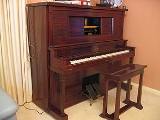
Player piano

 
Player Piano

   Email Print
   Bookmark   Link


Player piano


The player piano is a self-playing piano
Piano

The piano is a musical instrument played by means of a keyboard instrument. Widely used in Western music for solo performance, ensemble use, chamber music, and accompaniment, the piano is also very popular as an aid to musical composition and rehearsal....
, containing a pneumatic mechanism that plays on the piano action pre-programmed music
Music

Music is an art form whose media is sound organized in time. Common elements of music are pitch , rhythm , dynamics , and the sonic qualities of timbre and texture ....
 via perforated paper rolls. The rise of the player piano grew with the rise of the mass-produced piano in the house and the sheet music industry explosion of the late 19th and early 20th century.


Discussion
Ask a question about 'Player piano'
Start a new discussion about 'Player piano'
Answer questions from other users
Full Discussion Forum


Encyclopedia


Pianola1
The player piano is a self-playing piano
Piano

The piano is a musical instrument played by means of a keyboard instrument. Widely used in Western music for solo performance, ensemble use, chamber music, and accompaniment, the piano is also very popular as an aid to musical composition and rehearsal....
, containing a pneumatic mechanism that plays on the piano action pre-programmed music
Music

Music is an art form whose media is sound organized in time. Common elements of music are pitch , rhythm , dynamics , and the sonic qualities of timbre and texture ....
 via perforated paper rolls. The rise of the player piano grew with the rise of the mass-produced piano in the house and the sheet music industry explosion of the late 19th and early 20th century. The advent of electrical amplification in home music reproduction via the gramophone
Gramophone record

A gramophone record is an analog signal sound storage medium consisting of a flat disc with an inscribed modulated spiral groove usually starting near the periphery and ending near the centre of the disc....
 and wireless
Radio

Radio is the transmission of signals, by modulation of electromagnetic radiation with frequency below those of visible light.Electromagnetic radiation radio propagation by means of oscillating electromagnetic fields that pass through the air and the vacuum of space....
 in the mid 1920s caused the eventual decline in popularity.

Antecedents of the Player Piano

The idea of automatic musical devices can be traced back many centuries. The idea of using pinned barrels to operate percussion mechanisms (such as striking bells in a clock) was perfected long before the invention of the piano. These devices were later extended to operate musical box
Musical box

A musical box is a 19th century automatic musical instrument that produces sounds by the use of a set of pins placed on a revolving cylinder or disc so as to strike the tuned teeth of a comb....
es, which contain a set of tuned metal teeth plucked by the player mechanism.

An early musical instrument to be automated was the organ
Organ (music)

The organ is a keyboard instrument of one or more divisions, each played with its own keyboard played either Manual or Pedal clavier. The organ is one of the oldest musical instruments in the European classical music....
, which is comparatively easy to operate automatically. The power for the notes is provided by air from a bellows system, and the organist or player device only has to operate a valve to control the available air. The playing task is ideally performed by a pinned barrel, and the art of barrel organ
Barrel organ

A barrel organ is a mechanical musical instrument consisting of bellows and one or more ranks of organ pipe housed in a case, usually of wood, and often highly decorated....
s was well advanced by the mid eighteenth century.

The pianoforte is a complex instrument, requiring each note to be struck with a different force to control the dynamics of the performance. The entire force required to sound the note must be given by the performer hitting the keys. It proved to be difficult for a player device to combine a variable percussive force and a controlled note duration. Barrels do not provide a percussive force, but a relatively gentle switching motion.

Early barrel pianos move the hammer back and forwards continuously as the operator turns the handle, but the hammers do not strike the strings until moved slightly forwards by a pin in the barrel. The hammers hit repeatedly until the pin is removed. This plays the note, but at a fixed dynamic and with a tremolo action quite unlike a pianist.

The development of the player piano was the gradual overcoming of the various difficulties of controlled percussive striking and note duration. The earliest practical piano playing device was probably the Forneaux Pianista, which used compressed air to inflate a bellows when the barrel pin opened a valve. This bellows struck the piano key and so played the note.

The acceleration of developments leading to the pneumatic 'player' device started in the 1840s and began to reach some recognizable device in the 1870s. The start of the player period can probably be seen as the Centennial Exposition of 1876 in Philadelphia, USA. At this exhibition were a number of automatic player devices, including the Pianista, that contained the elements which would lead to the player.

The earliest description of a piano playing device using perforated paper rolls was Claude Seytre's French patent of 1842. The concept was sound, but the device described was impractical in the way it read the roll and operated the piano.

In 1847 Alexander Bain
Alexander Bain (inventor)

Alexander Bain , was a Scottish instrument inventor, technician, and clockmaker. He invented the electric clock, the electric printing telegraph, and the first facsimile machine ....
 described a device that used a paper roll as a 'travelling valve' that allowed air to flow through the reeds of a reed organ. Simple reed and pipe organs using this sort of system are still being produced. However, the air flow is not sufficient to drive a piano mechanism. In 1848 Charles Dawson of England described a more complex travelling valve device which added little to Bain.

Hunt & Bradish of the USA, 1849, used a roll read by sprung fingers, the springs being strong enough to operate the piano mechanism directly. This device applied the entire playing strength to the paper, so would have shredded it rapidly, and the device would have had to be as wide as the piano keyboard!

In 1851 Pape, England, submitted a patent that recognized the need to remove the playing force from the paper, using light springs to read the roll and activate a more robust device which plays the note - a mechanical amplifier.

The first device to address the practical requirement of operating a piano mechanism was Forneaux's, of 1863. This recognized that a hard strike was needed to throw the hammer towards the keys. It used a traditional barrel, but tripped a pneumatic device that inflated bellows rapidly to operate the note. In 1871 a perforated cardboard book was substituted for the barrel, but it was still read using sprung fingers. This device entered manufacture, and is generally regarded as the first practical player device. It was exhibited in Philadelphia in 1876.

Van Dusen's American patent of 1867 was the first to describe a pneumatic striker operated by a roll. It was probably based on the work of John McTammany.

A leap in thought occurred in the 1873 patent of the Schmoele brothers. They described a 'double valve' system which acted as a pneumatic amplifier, reading the roll electrically and operating the pneumatic with an electromagnet. They also exhibited at Philadelphia. With some modification, and pneumatic reading of the roll, this would become the final player piano some 20 years later, although the Schmoele brothers never benefitted from it.

In 1876, John McTammany exhibited a working player in Philadelphia that used a paper roll read using sprung fingers whose slight movement triggered a mechanical player device. This operated a reed organ. McTammany had been experimenting since the mid 1860s, and went on to be one of the key names in the early player industry. He claimed to be the inventor of the 'player', but not the 'player piano' - an important distinction.

Summary: in 1876, in Philadelphia, three working devices were exhibited that between them contained almost all the components that the final player piano would require. However, it was to be 20 years before all these aspects were combined. Surprisingly, the missing component was the pneumatic reading of the roll. This was in all probability due to the lack of suitably flexible airtight material to translate the air flow into the mechanical movement needed to trigger the player device.

History of the Player Piano


1876-1890

Following the Philadelphia exhibition, the mechanical music business began to grow rapidly. Various companies were founded in the later 1870s to manufacture and sell automated reed organs. Most significant to the development of the player piano was the Aeolian Company, founded as the Mechanical Orguinette Company in 1878, initially as retailer of small reed organs made by the Munroe Organ Company and others.

These instruments started out with valveless actions, the air flowing through the paper operating the reed directly. Throughout this period, the instruments grew larger and more complex, and valves were added to switch the air flow, so ensuring faster response and requiring smaller holes in the paper. The idea of incorporating the new player devices into pianos developed over this period. Needham filed a patent in 1880 describing a pneumatic player device in a piano.

The main technical development of this period was the double valve system, which enabled machines to switch the volume of air needed to operate piano actions. The valves effectively worked as amplifiers, a small air flow being used to switch a much large volume of air.

Inventors persisted with the early cumbersome mechanical linkage systems for a long time, although the valve system was considerable simpler. The main reason for this appears to be that no suitable airtight thin leather was available to make the small pouches which inflate to operate the valves. The pioneer inventor John McTammany comments that inventors have to work within the limits of their age, and that when solving a problem they look for answers among what is at hand. Without pouch leather being available, they couldn't invent a machine that used it. By the late 1880s the development of suitable pneumatic materials and leathers had advanced sufficiently that effective and reliable player mechanisms were starting to enter the marketplace.

1890-1900

In 1896, Theodore P. Brown introduced and marketed the "Aeriol Piano", which was the first substantially complete player piano. That same year Wilcox and White introduced their "Angelus" cabinet player which was a modification of their earlier grand and upright player pianos. None of the early player pianos was a success though John McTammany (self-proclaimed 'inventor of the player') credited Brown as the first to organize in a practical manner the ideas others had developed over the previous 20 years.

Through the middle 1890s, Edwin S. Votey developed his piano playing device, the Pianola. This was offered to the Aeolian Company to sell alongside their range of reed organ
Reed organ

A reed organ, also called parlor organ, pump organ, cabinet organ, cottage organ, is an organ that generates its sounds using free metal reed ....
s. It was launched in 1897, and very aggressively marketed over the following years. It was the advertising organized by Harry Tremaine and the Wilcox and White Company that established the market for piano playing devices. Without Tremaine's business acumen there probably would never have been a player piano industry.

In these early years the main demand was for cabinet players and it was some years before the public preferred to buy an entirely new self-contained instrument and trade in their old perfectly good regular pianos. As market demand changed the "internal player" came back into view and was developed again, this time in earnest.

1900-1910

The Pianola was advertised in one of the most high-profile campaigns ever, making unprecedented use of full-page color adverts. It cost $250 (£65) - a large sum of money at the time. Other, cheaper, makes were launched. A standard 65-note format evolved, with 11¼ inch wide rolls and holes spaced 6 to the inch, although several player manufacturers used their own form of roll incompatible with other makes.

Huge sums were spent - by 1903 the Aeolian Company had more than 9000 roll titles in their catalog, adding 200 titles per month. Many companies' catalogs ran to thousands of rolls, mainly of light, religious or classical music. Ragtime music did feature, but not commonly: in this period, the player was being sold on its artistic capabilities to rich buyers.

The pioneer of this decade was Melville Clark, who introduced two key ideas: the full-scale roll which could play every note on the piano keyboard, and the internal player as standard. Both ideas were ridiculed by his competitors as unnecessary or impractical, but Clark rapidly won both battles.

By the end of the decade the piano player device was obsolete, as was the 65-note format. This was a major catastrophe for many small manufacturers, who had spent all their capital on setting up 65-note player operations, and the result was rapid consolidation in the industry.

A new full-scale roll format, playing all 88 notes, was agreed at an industry conference in Buffalo in 1908, the so called Buffalo Convention
Buffalo Convention

The Buffalo Convention of December 10, 1908 established two future roll formats for the USA-producers of piano rolls for Player pianos. The two formats had different punchings of 65 and 88 notes, but the same width ....
. This kept the 11¼ inch roll, but now had smaller holes spaced at 9 to the inch. Any player made anywhere in the world could now play any make of roll. Understanding the need for compatibility was the defining moment of the player industry. The consensus was key to avoiding a costly format war
Format war

A format war describes competition between mutually incompatible proprietary formats, typically for data storage devices and recording formats for electronic media....
, which plagued almost every other form of entertainment media that followed roll music.

While the player piano matured in America, a young inventor in Germany, Edwin Welte, was working on a player which controlled all the aspects of the performance automatically, so that his machine would play back a recorded performance exactly as if the original pianist was sitting at the piano keyboard. This device, the Welte-Mignon
Welte-Mignon

M. Welte & Sons, Freiburg and New York was a manufacturer of orchestrions, Organ s and reproducing pianos.From 1832 until 1932, the firm produced mechanical musical Instruments of the highest quality....
, was launched in 1904. This created new marketing opportunities, as manufacturers could now get the foremost pianists and composers of the day to record their performances on a piano roll, allowing owners of player pianos to experience such a performance in their own homes on their own instruments, exactly as the original pianist had played it.

From the early days, manufacturers sought to create mechanisms which would pick out the melody of a musical composition over the background of the rest of the music in the same manner as a live pianist. The true player piano was designed to be a fully interactive musical experience rather than merely an automatic instrument and hence they are fitted with interactive control levers intended for the "player pianist" or "pianolist" to create a music performance to their own taste. The player piano would provide aspiring pianists and music lovers with the technical dexterity they lacked whilst permitting them to control the musical performance interactively as if they were an accomplished pianist.

Aeolian introduced Metrostyle in 1901 and the Themodist in 1904, the latter being an invention "bringing out the melody clearly above the accompaniment." With sales growing rapidly, and the instruments themselves relatively mature, this decade saw a wider variety of rolls become available. Two major advances were the introduction of the hand-played roll, both classical and popular, and the word roll. The hand-played roll introduced musical phrasing into the roll, so that the player pianist did not have to introduce this by using the tempo controls - something that few owners ever felt much inclination to do. Word rolls made it simple to use the player to accompany singing in the home, a very popular activity in the years before radio and acceptable disc recordings became available.

The other major advance was the arrival of major commercial rivals for the Welte-Mignon: the Ampico and the Duo-Art systems, both launched around 1914. When World War I came in 1914 and German patents were seized in the US, these two companies were left to compete with each other. In England, Aeolian had a huge factory and sales network, so easily outsold the Ampico. It is estimated that perhaps 5% of players sold were reproducing pianos.

In America by the end of the decade, the new ‘jazz age' and the rise of the fox-trot confirmed the player piano as the instrument of popular music, with classical music increasingly relegated to the reproducing piano. Most American roll companies stopped offering large classical catalogs before 1920, and abandoned ‘instrumental' rolls (those without words) within a few years.

Things were somewhat different in England, where the Aeolian Company continued to promote classical material to a receptive public (this was the era that was to give birth to John Reith's BBC, after all). Word rolls never became the norm in England, always being charged at a 20% premium over non-word rolls. As a result, post-World War I American and British roll collections look very different.

1920-1930

This was the decade that saw the player piano reach its peak, and then its rapid decline. The peak sales of instruments and rolls were in the first few years of the decade. At one point, more than half of all pianos being made in America contained a player unit. The player piano was not an obscure by-line - it was the dominant force in the industry.

In the early 1920s, pretty well every pianist of note, both in classical and popular fields, were called on to make rolls.

Little new technically arose through the 1920s. Perhaps the most significant was the launch of a significantly improved form of the Ampico system, the Ampico B, in 1926. This was accompanied by an automatic recording device that could record a pianist's note timings and dynamics.

The technical advances of the 1920s were instead in radio
Radio

Radio is the transmission of signals, by modulation of electromagnetic radiation with frequency below those of visible light.Electromagnetic radiation radio propagation by means of oscillating electromagnetic fields that pass through the air and the vacuum of space....
 technology. The key development there was the introduction of amplification, so that it was possible to sit around the radio and listen as a family, unlike the earlier crystal sets which required the use of headphones. Amplification was also applied to the recording of 78 rpm records, the electrical recording systems introduced around 1925 allowing a major rise in sound quality. Radio and these new records rapidly eroded the market for the player piano, and it was declining from the mid 1920s onwards. Novel attempts to combine the appeal of the player piano and its new rivals were made by building radios and/or phonographs into player pianos themselves, but even this could not entice the public to continue buying player pianos.

When the Wall Street crash came in October 1929, the player piano was already in a very weak position, and sales effectively ceased. Only a few well-capitalized companies continued in business after this. Many of these companies were the result of consolidation throughout the 1920s, which had already seen the loss of most names, particularly in the roll making field.

1930-1950

A few companies struggled on through the 1930s. In 1931 Aeolian purchased the American Piano Company, makers of the Ampico. To bring capital to the business they sold off all their overseas assets, so the large piano factory at Hayes was closed and sold with one month's notice. The joint Aeolian-American operation stopped making new classical rolls and concentrated on popular material, and the final new rolls were issued in the late 1930s.

A major survivor throughout this was the QRS piano roll company, originally an offshoot of Melville Clarke's operation. Owned by the mid 1920s by Max Kortlander, and funded by his income as a composer, QRS continued to issue rolls, all of them created by J. Lawrence Cook , chief roll arranger from 1921 to 1961 (he topped up his income as a postal worker). Thanks to QRS, roll repertoire is available from the 1930s and 1940s.

Other than QRS, the end of the 1930s had seen the end of the player piano era. The lingering roll production in England finally ceased in 1941 when paper rationing made it impossible to continue. The Aeolian Duo-Art recording machinery was destroyed by bombing during the World War II
World War II

World War II, or the Second World War , was a global military conflict which involved a Participants in World War II, including all of the great powers, organised into two opposing military alliances: the Allies of World War II and the Axis powers....
, as was the Welte factory in Freiburg
Freiburg

Freiburg im Breisgau is a city in Baden-W?rttemberg, Germany, in the Breisgau region on the western edge of the Black Forest. It straddles the Dreisam river, on the foothills of the Schlossberg....
.

An interesting sideline of the war was reproducing piano's pneumatic technology -- the aircraft training simulator. This was a device that moved realistically in response to a pilot's operation of the controls, powered by suction and bellows. These were introduced by the Link company in America, and the British equivalent was the Silloth trainer based on Duo-Art technology. The electronic descendants of these devices are now widespread.

However, the immediate aftermath of the war saw the growth of interest in this lost era. Richard Simonton
Richard Simonton

Richard Simonton , also known under the pseudonym Doug Malloy, was a Hollywood businessman and entrepreneur, known for his involvement in the Hollywood community, his rescue of the steamboat the Delta Queen, his work in preserving the work of musicians in the Welte-Mignon piano rolls, and for founding the American Theatre Organ Society....
 purchased the surviving Welte-Mignon rolls from Edwin Welte, and first disc recordings were made of the performances. The enthusiast era had, tentatively, begun.

1950-present

Player Piano Keyboard
During the early 1950s a number of collectors began to rescue player pianos and all the other instruments of the 1920s and earlier. Amongst them was Frank Holland, who formed his collection while working in Canada. On returning to England he located a number of like-minded enthusiasts and started to hold meetings at his house in west London. In 1959 this was formalized as ‘The Player Piano Group'. By the early 1960s, Frank Holland had formed the British Piano Museum (now the Musical Museum) in Brentford. His enthusiasm and effort was the focus of the preservation movement in the UK.

In America, another collector was Harvey Roehl, who was so enthused by the players that in 1961 he published a book called Player Piano Treasury. This sold by the tens of thousands, and was followed by books on how to rebuild and restore these instruments. Harvey Roehl's Vestal Press was a major driving force in raising awareness of the player piano within the general population.

Other societies worldwide were formed to preserve and study all aspects of mechanical music, such as the Musical Box Society International (MBSI) and the Automatic Musical Instrument Collectors' Association (AMICA: http://www.amica.org) in America.

In 1961, Max Kortlander died of an unexpected heart attack and QRS was run by his wife until she sold the company to Ramsi Tick in 1966, in whom it found another stalwart champion whose business philosophy was not so much profit as to limit losses. QRS's presence ensured that owners of newly-awakened players could purchase rolls of the latest titles, so ensuring that the instrument remained current, not just a historical curiosity.

So great was the revival that in the 1960s, production of player pianos started again. Aeolian revived the Pianola, albeit this time in a small spinet piano suited to post-war housing. Other manufacturers followed, and production has continued intermittently ever since. QRS today offer a traditional player piano in their Story and Clark piano.

In recent years there has been greater focus on full rebuilding as original instruments finally stop working. Early enthusiasts could often get by with limited patching, but the repair requirements have slowly risen, although even to this day it is possible to find original 1920s instruments that still work after a fashion - a tribute to their quality, and an indication of their continued popularity.

Types of player pianos


Whilst there are many minor differences between manufacturers a player piano is a piano that contains a manually controlled pneumatically operating piano player mechanism. It is intended that the operator manually manipulates the control levers in order to produce a musical performance. Various aids to the human operator were developed.

Split stack control These instruments (the vast majority of all player pianos) have the pneumatic player mechanism divided into two approximately equal halves. The operator can lower the volume of either half of the keyboard independently of the other in order to create musical effects.

Theme control These instruments have peripheral pneumatic hardware systems fitted which, when used in conjunction with special music rolls, are able to highlight those notes in the score which are intended to be accented away from those whose volume it is desired to subdue. Basic theme pianos subdue all notes and release full power to only those notes which are align with special music roll "theme" perforations. More subtle systems (such as Hupfeld's "Solodant" and Aeolian's "Themodist") have a graduated theme control where the background subdued level and the foreground melody level are both controllable. The nature of the mechanism is such that where a chord occurs notes to be they have to be advanced slightly away from their neighbors in order for the mechanism to identify them.

Isolated theme The hardware of these pianos is able to pick out the melody notes away from their background accompaniment within the entire range of the keyboard without the necessity for breaking up chords i.e. a software workaround. Manufacturers of these systems were the UK "Dalian" and "Kastonome" and the US "Solo Carola".

Steinwaywelte1919
Reproducing Pianos These are fully automated versions of the player piano requiring no human manual control in order to produce the illusion of a live musical performance. This is achieved by the utilization of music rolls where tempo mapping is fully incorporated into the music rolls i.e. the note lengths of a live performance have been captured. This obviates any need for manual tempo lever manipulation. The volume dynamics are created by peripheral pneumatic expression accessories under control from system-specific music roll coding. This obviates the need for human manipulation of the manual dynamic control levers. Typically an electric motor provides power to remove the human operator from the necessity to provide motive power by treadling. Most reproducing pianos are capable of manual over-ride operation and many are constructed for dual functionality both as regular player pianos and also as reproducing pianos. Numerous companies made these utilizing different technology. The first successful instrument was called the "Mignon" launched by Welte in 1904.

Coinplayerpiano
Orchestrions and Nickelodeons These are automated instruments typically intended from use in a coin-operated commercial setting rather than any domestic one. Various manufacturers made numerous ranges of instruments featuring different combinations of pianos, organ pipework, percussion and other fittings. They were eventually superseded by the juke box following the introduction of effective electrical sound amplification

Player mechanism


The player mechanism is essentially a bank of switches activated by software. The switches are pneumatically operating valves which switch on the motive force used to play the piano action. This motive force is created by switching suction into a miniature collapsible pneumatic bellows with one assembly assigned to each individual note. The valve switching system is triggered by the music roll. As the paper perforations run over the music reading bar (known as the "tracker bar") air is allowed to enter. This causes a pressure differential within the mechanism triggering the switching valves to operate. The note channels can be either on or off hence the music roll can be regarded as an early form of programmable binary software.

The apparatus operates from suction generated by two foot-treadled bellows coupled to a pressure equalizing reservoir system to even the air flow. The motive force may be used to power peripheral mechanisms within the piano operating sustain pedal function, music roll centering and suchlike.

Player pianos are all fitted with hand levers for the performer to vary volume and speed to imitate a live performer. As such they may be regarded as the first truly interactive acoustic music making machine ; something without any parallel until only the past half-decade with the advances in modern computing technology and software.

Music rolls


Music roll
Music roll

A music roll is a storage medium used to operate a mechanical organ, carillon#Musical characteristics or orchestrion. Originally made of paper, modern rolls are sometimes made of thin plastic or PET film ....
s for pneumatic player pianos, often known as piano roll
Piano roll

A piano roll is the music storage medium used to operate the player piano, pianola or a reproducing piano. The piano roll was the first medium which could be produced and copied industrially and made it possible to provide the customer with actual music fast and easily....
s, consist of a continuous sheet of paper rolled on to a spool. The spool fits into the player piano spool box whereupon the free end of the music sheet is hooked onto the take-up spool which will unwind the roll at an even pace across the reading mechanism (the "tracker bar") The music score to be played is programmed onto the paper by means of perforations. Different player systems have different perforation sizes, channel layouts and spool fittings though the majority conform to one or two predominant formats latterly adopted as the industry standard.

Music is programmed via a number of methods. 1) the music is marked out on master stencil on a purely metronomic basis direct from the printed sheet music with the player-pianists being left to create their own music performance 2) the music stencil is created metronomically via a piano-keyboard operated punch machine 3) a live performance is played onto a special piano connected to an electronically operated marking mechanism and a physical stencil is produced from this live output either as-is or after some general regularisation of tempo where necessary 4) modern computer software and midi software can be used to create piano roll stencils for operating modern-day perforating machines and create new titles.

The player piano sold globally in its heyday and music rolls were manufactured extensively in the USA, as well as most European countries, including South America and Australia. Even New Zealand had their own home-grown roll brand and machinery. A vast number of titles from all manufacturers survive to this day and roll still turn up regularly in large quantities.

The last remaining mass producer of piano rolls in the world, QRS Music, halted production of the rolls on December 31, 2008.

Preservation and restoration


Roll scanning has made significant advances in recent years, applying technology to possibly the most obvious yet hardest of all conservation and preservation topics, the replication of aging and disintegrating piano rolls.

Roll scanning is the process of reading a music roll into a computerised form that can be used for any purpose, such as cutting new rolls or operating old or new instruments directly. This uses the same technology as domestic flatbed scanners, hence the term roll scanner. The ubiquity of computers makes scanning fundamental to the preservation of rolls of all types, as well as providing the basis for secondary activities such as operating instruments directly. Roll master re-creation is the process of understanding how the roll was originally manufactured so that errors arising from the scanning are removed and the computer works to the same accuracy as the original perforators in the roll factory. This allows exact replica rolls to be made, and maximises the accuracy of any secondary activity.

Reasons for replicating the master roll Replication of the original master from which a perforated paper roll was created is the highest aim of roll scanning. Roll masters are not literally replicated, because they were originally large cardboard rolls, but re-created in a computerised form. The rationale is that if you start with the master in this form you can do anything with the music – cut new rolls, operate player pianos fitted with electronic valves, or simulate a performance for playing on modern instruments – all without introducing any errors.

Why is this so? The simple answer is that virtually all rolls were punched in fixed rows, where punches will occur only in one row or the next, but never in between: the roll is a digital storage medium. Scanning simply counts the distance from the start of the roll to each note event, giving an analogue, and hence inaccurate, representation of the roll. If instead you count in rows, you have an exact representation of the original roll – a perfect digital copy. This can be done by applying knowledge about the original roll’s creation to the scan. Once the master has been recreated, you have perfect and complete knowledge about the roll, and anything you want to do after this can be done to the accuracy of the original roll. If you stick with the analogue version all its timing errors are carried through to whatever you do with it, and frequently amplified along the way. This is particularly true when making recut rolls, where imposing the punch-row spacing of the perforator over the (different) row spacing of the original roll causes surprisingly obvious and audible errors. However, even analogue uses of the scan, such as operating instruments directly, benefits from the recreated master because of the way it removes timing errors from the basic scan, and in so doing allows the accuracy of the scanner itself to be calibrated.

Roll scanning itself is not of major significance – it simply adds optical technology to the pneumatic, electrical and mechanical technologies previously used to extract data from perforated paper. The ability to store the extracted data on electronic media marked the start of the modern era of scanning, but did little more than act as a substitute for the paper roll. The most familiar such system is the Marantz Pianocorder, but at least two systems were produced, by Wayne Stahnke and Peter Phillips, to operate pneumatic pianos.

From having the performance in ‘streaming’ form on a tape to extracting the note events into a list in a computer is a fairly small step. Such computerisation of the scanned data adds the ability to edit and manipulate it. The key advance we are concerned about here is the manipulation that converts the analogue scan data to a replica of the perforation master. The first serious and sustained roll master replication exercise was probably that of Wayne Stahnke, who described his by-then completed methods in the Mechanical Music Digest in March 1996, and used them to practical advantage in his Rachmaninoff-Bösendorfer CDs. He started with a pneumatic roll reader (from the mid 1970s, for the IMI Cassette Converter system and later projects) and later moved to an optical system. He has been offering commercial scanning and roll master re-creation since the mid 1990s.

Within UK Player Piano Group circles the topic of recreating roll masters was already well established by 1996. Rex Lawson had raised the topic as part of his work developing a perforation-level roll editor software suite for his Perforetur rolls, and the topic was publicly discussed in the PPG bulletin during winter 1994/5 when Rex explained precisely why rolls should be copied punch-for-punch, digitally.

Richard Stibbons started his roll-scanning attempts in the mid 1990s, and described his progress in PPG article “The PC Pianola” in December 1995. Soon afterwards he adopted the master replication idea, described very thoroughly in September 2000. This led directly to the launch of the Rollscanners group in February 2001.

The aim of this group has been to focus and publicise scanning efforts worldwide, encouraging sharing of progress and knowledge, a radical shift from the earlier essentially private attempts.

Modern player pianos

Disklavierplayer
Disklaviersilencer
Later developments of the reproducing piano include the use of magnetic tape
Magnetic tape

Magnetic tape is a medium for magnetic recording generally consisting of a thin magnetizable coating on a long and narrow strip of plastic. Nearly all recording tape is of this type, whether used for recording Audio frequency or video or for computer data storage....
 and floppy disk
Floppy disk

A floppy disk is a data storage medium that is composed of a disk of thin, flexible magnetic storage medium encased in a square or rectangle plastic shell....
s, rather than piano rolls, to record and play back the music; and, in the case of one instrument made by Bösendorfer
Bösendorfer

B?sendorfer is an Austrian piano manufacturer, now a wholly owned subsidiary of Yamaha. B?sendorfer pianos are noted for their dark, full-bodied sound compared with other top models....
, computer
Computer

A computer is a machine that manipulates Data according to a list of Code .The first devices that resemble modern computers date to the mid-20th century , although the computer concept and various machines similar to computers existed earlier....
 assisted playback.

Almost all modern player pianos use MIDI
Musical Instrument Digital Interface

MIDI is an industry-standard communications protocol defined in 1982 that enables electronic musical instruments such as keyboard controllers, computers, and other electronic equipment to communicate, control, and synchronize with each other....
 to interface with computer equipment. Most modern player pianos come with an electronic device that can record and playback MIDI files on floppy disks and/or CD-ROM
CD-ROM

CD-ROM is a pre-pressed Compact Disc that contains Computer data storage accessible to, but not writable by, a computer. While the Compact Disc format was originally designed for music storage and playback, the 1985 Yellow Book standard developed by Sony and Philips adapted the format to hold any form of Binary file....
s, and a MIDI interface that enables computers to drive the piano directly for more advanced operations. The MIDI files can trigger electromagnetic devices called solenoids, which use electric current to drive small mechanical pistons mounted to the key action inside the piano. Live performance or computer generated music can be recorded in MIDI file format for accurate reproduction later on such instruments. MIDI files containing converted antique piano-rolls can be purchased on the Internet.

, several player piano conversion kits are available (PianoDisc, Pianomation, etc.), allowing the owners of normal pianos to convert them into computer controlled instruments. The conversion process usually involves cutting open the bottom of the piano to install mechanical parts under the keyboard, although one organization - Logos Foundation - has manufactured a portable, external kit.

Player pianos versus electric pianos

A player piano is neither an electric piano
Electric piano

An electric piano is an electric musical instrument. The popularity of the electric piano began to grow in the late 1960s, reaching its greatest height during the 1970s....
, electronic piano
Electronic piano

An electronic piano is a keyboard instrument designed to simulate the timbre of a piano using analog circuitry.Electronic Piano was also the trade name used for Wurlitzer's popular line of electric pianos, which were produced from the 1950s to the 1980s, although this was not actually what is now commonly known as an electronic pian...
, nor a digital piano
Digital piano

A digital piano is a modern electronic musical instrument designed to serve primarily as an alternative to a traditional piano, both in the way it feels to play and in the sound produced....
. The distinction between these instruments lies in the way sounds are produced. A player piano is an acoustic piano where the sound is produced mechanically by moving keys which cause hammers to strike the piano strings.

Works consulted

  • Reblitz, Arthur A. Player Piano Servicing and Rebuilding. ISBN 0-911572-40-6 Lanham, Maryland: Vestal Press, 1985.
  • Reblitz, Arthur A. The Golden Age of Automatic Musical Instruments. ISBN 0-9705951-0-7 Woodsville, New Hampshire: Mechanical Music Press, 2001.
  • White, William Braid. Regulation and Repair of Piano and Player Mechanism together with Tuning as Science and Art. New York: Edward Lyman Bill, 1909.


See also


Related instruments and mechanisms

  • Barrel piano
    Barrel piano

    A barrel piano is a forerunner of the modern player piano. Unlike the pneumatic player piano, the barrel piano was operated by turning a hand crank....
  • Mechanical organ
    Mechanical organ

    A Mechanical organ is an organ that is self playing, rather than played by a musician.Usually, mechanical organs are pipe organs although some instruments were built using reeds similar to those found in a harmonium....
  • Orchestrion
    Orchestrion

    An orchestrion is a generic name for a machine that plays music and is designed to sound like an orchestra or band. Orchestrions may be operated by means of a large barrel organ or by a Music roll and less commonly Book music....
  • Piano roll
    Piano roll

    A piano roll is the music storage medium used to operate the player piano, pianola or a reproducing piano. The piano roll was the first medium which could be produced and copied industrially and made it possible to provide the customer with actual music fast and easily....
  • Punched tape
    Punched tape

    Punched tape or paper tape is a largely obsolete form of data storage, consisting of a long strip of paper in which holes are punched to store data....
  • Reproducing piano


Composers for the player piano

  • George Antheil
    George Antheil

    George Antheil was an United States avant-garde composer, pianist, author and inventor....
  • George Gershwin
    George Gershwin

    George Gershwin was an American composer and pianist. He wrote most of his vocal and theatrical works in collaboration with his elder brother, lyricist Ira Gershwin....
  • Enrique Granados
    Enrique Granados

    Pantal?on Enrique Costanzo Granados y Campi?a was a Spain Catalonia pianist and composer of european classical music. His music is in a uniquely Spanish style and, as such, representative of musical nationalism....
  • Edvard Grieg
    Edvard Grieg

    Edvard Grieg was a Norway composer and pianist who composed in the Romantic period. He is best known for his Piano Concerto , for his incidental music to Henrik Ibsen's Play Peer Gynt , and for his collection of piano miniatures Lyric Pieces....
  • Percy Grainger
    Percy Grainger

    George Percy Grainger was an Australian-born composer, pianist and champion of the saxophone and the concert band, who worked under the stage name of Percy Aldridge Grainger....
  • György Ligeti
  • Conlon Nancarrow
    Conlon Nancarrow

    Conlon Nancarrow was a United States-born composer who lived and worked in Mexico for most of his life. He became a Mexican citizen in 1955.Nancarrow is best remembered for the pieces he wrote for the player piano....
  • Igor Stravinsky
    Igor Stravinsky

    Igor Fyodorovich Stravinsky was a Russian-born composer, considered by many to be the most influential composer of 20th century music. He was a quintessentially Cosmopolitanism Russian who was named by Time as one of the 100 most influential people of the century....


External links

  • - the national UK player piano & related instrument society
  • - online discussion group
  • general player and reproducing piano history
  • Portal for Reproducing Pianos
  • - extensive player piano and player organ historic info site
  • - Listen to MIDI files created by scanning player piano rolls.
  • a forum (with searchable archives) on musical instruments that play themselves
  • USA-based organization.
  • realtime composition for computer-controlled player piano by Karlheinz Essl
    Karlheinz Essl

    Karlheinz Essl is an Austrian composer, performer, sound artist, Improvisation and composition teacher....