

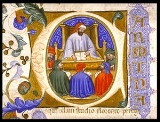
Anicius Manlius Severinus Boethius

Encyclopedia
Anicius Manlius Severinus Boëthius, commonly called Boethius (ca. 480–524 or 525 AD) was a philosopher of the early 6th century. He was born in Rome
to an ancient and important family which included emperors Petronius Maximus
and Olybrius
and many consuls
. His father, Flavius Manlius Boethius, was consul in 487 after Odoacer
deposed the last Western Roman Emperor. Boethius, of the noble Anicia
family, entered public life at a young age and was already a senator by the age of 25.
Boethius himself was consul in 510 in the kingdom of the Ostrogoths. In 522 he saw his two sons become consuls. Boethius was imprisoned and eventually executed by King Theodoric the Great
, who suspected him of conspiring with the Eastern Empire
. While jailed, Boethius composed his Consolation of Philosophy
, a philosophical treatise on fortune, death, and other issues. The Consolation became one of the most popular and influential works of the Middle Ages. A link between Boethius and a mathematical boardgame Rithmomachia has been made.
in 487. However, his father died when Boethius was young, and he was adopted by another patrician, Quintus Aurelius Memmius Symmachus
. Memmius Symmachus raised him and instilled in him a love for literature and philosophy. Both Memmius Symmachus and Boethius were fluent in Greek
, an increasingly rare skill at the time in the Western Empire, which has led some scholars to think that Boethius was educated in the East. According to John Moorhead, the traditional view is that Boethius studied in Athens
based on Cassiodorus
's rhetoric describing Boethius' learning in one of his letters. The French scholar Pierre Courcelle has argued that Boethius studied at Alexandria
with the Neo-Platonist philosopher Ammonius Hermiae
. However, Moorhead observes that the evidence supporting Boethius having studied in Alexandria "is not as strong as it may appear", and concludes "Perhaps Boethius was able to acquire his formidable learning without travelling."
Although Boethius is believed to have been born into a Christian
family, some scholars have conjectured that he abandoned Christianity for paganism
, perhaps on his deathbed. Momigliano argues "many people have turned to Christianity for consolation. Boethius turned to paganism. His Christianity collapsed — it collapsed so thoroughly that perhaps he did not even notice its disappearance."
However, while this has been a popular idea among scholars of the eighteenth and nineteenth centuries, it does not reflect the majority of current scholarship on the matter.
Due to his erudition, Boethius entered the service of Theodoric the Great
. His earliest documented acts on behalf of the Ostrogothic ruler was to investigate allegations that the paymaster of Theodoric's Bodyguards had debased the coins of their pay, to produce a water-clock which Theodoric intended to give to king Gundobad
of the Burgunds, and to recruit a lyre-player to perform for king Clovis
of the Franks
.
Boethius married his foster-father's daughter Rusticus, and their children included two boys, Symmachus
and Boethius
. He held many important offices during Theodoric's reign, including being appointed consul for the year 510, but Boethius confesses in his De consolatione philosophiae that his greatest achievement was to have both his sons made consuls for the same year (522), and finding himself sitting "between the two consuls and as if it were a military triumph let your largess fulfil the wildest expectations of the people packed in their seats around you."
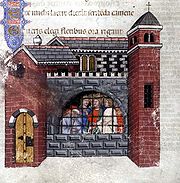 In 522, the same year his two sons were appointed joint consuls, Boethius accepted the appointment to the position of magister officiorum
, the head of all the government and court services. Also in 520, Boethius was working to revitalize the relationship between the Church in Rome and the Church in Constantinople
. This may have led to loss of favour.
That following year, however, Boethius fell from power, was imprisoned and eventually executed. The primary sources are in general agreement over the facts of what happened. At a meeting of the Royal Council in Verona, the referandarius
Cyprianus accused the ex-consul Caecina Decius Faustus Albinus
of treasonous correspondence with Justin I
. Boethius leapt to his defense, crying, "The charge of Cyprianus is false, but if Albinus did that, so also have I and the whole senate with one accord done it; it is false, my Lord King." Cyprianus then also accused Boethius of the same crime, and produced three men who claimed they had witnessed the crime. Boethius and Basilius were arrested. First the pair were detained in the baptistery of a church, then Boethius was exiled to the Ager Calventianus, a distant country estate, where he was put to death. Not long afterwards Theodoric had Boethius' father-in-law Symmachus put to death, according to Procopius
, on the ground that he and Boethius together were planning a revolution, and confiscated their property.
"The basic facts in the case are not in dispute," writes Jeffrey Richards. "What is disputed about this sequence of events is the interpretation that should be put on them." Boethius claims his crime was seeking "the safety of the Senate." He describes the three witnesses against him as dishonorable: Basilius had been dismissed from Royal service for his debts, while Venantius Opilio
and Gaudentius had been exiled for fraud. However, other sources depict these men in far more positive light: for example Cassiodorus
describes Cyprianus and Opilio as "utterly scrupulous, just and loyal" and mentions they are brothers and grandsons of the consul Opilio; Theodoric was feeling threatened by international events: the Acacian Schism
had been resolved, and the Catholic Christians
aristocrats of his kingdom were seeking to renew their ties with Constantinople; the Catholic Hilderic
became king of the Vandals
and put his sister Amalafrida
to death; and Arian Christians
in the East were being persecuted. Then there is the matter that his previous ties to Theodahad
, Boethius apparently found himself on the wrong side in the succession dispute following the untimely death of Eutharic
, Theodoric's announced heir.
The method of Boethius' execution varies in the sources; he was perhaps killed with an axe or a sword, or was clubbed to death. His remains were entombed in the church of San Pietro in Ciel d'Oro
in Pavia. In Dante
's Paradise of The Divine Comedy
, the spirit of Boethius is pointed out by St. Thomas Aquinas:
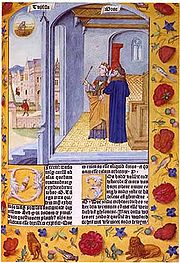 Boethius's best known work is the Consolation of Philosophy
(De consolatione philosophiae), which he wrote most likely while in exile under house arrest
or in prison while awaiting his execution, but his lifelong project was a deliberate attempt to preserve ancient classical knowledge, particularly philosophy. This work represented an imaginary dialogue between himself and philosophy, with philosophy being personified by a woman. The book argues that despite the apparent inequality of the world, there is, in Platonic
fashion, a higher power and everything else is secondary to that divine Providence. There are several manuscripts that have survived and been expansively edited, translated and printed throughout the late 15th century and forward in Europe. He intended to translate all the works of Aristotle
and Plato
from the original Greek
into Latin
. His completed translations of Aristotle's works on logic
were the only significant portions of Aristotle available in Europe until the 12th century. However, some of his translations (such as his treatment of the topoi in The Topics
) were mixed with his own commentary, which reflected both Aristotelian and Platonic concepts.
Unfortunately, the commentaries themselves were lost. In addition to his commentary on the Topics, Boethius composed two treatises on Topical argumentation, In Ciceronis Topica and De topicis differentiis. The first work has six books, and is largely a response to Cicero's Topica. The first book of In Ciceronis Topica begins with a dedication to Patricius. It includes distinctions and assertions important to Boethius's overall philosophy, such as his view of the role of philosophy to "establish our judgment concerning the governing of life", and definitions of logic from Plato, Aristotle and Cicero. He breaks logic into three parts, that which defines, that which divides, and that which deduces. He asserts there to be three types of arguments, those of necessity, of ready believability, and sophistry. He follows Aristotle in defining one sort of Topic as the maximal proposition; these are propositions which are somehow shown to be universal or readily believable. The other sort of Topic, the differentiae, are "Topics that contain and include the maximal propositions"; means of categorizing the Topics which Boethius credits to Cicero. Book II covers two kinds of topics, those from related things and those from extrinsic topics. Book III discusses the relationship between things studied through Topics, Topics themselves, and the nature of definition. Book IV analyzes partition, designation and relationships between things (such as pairing, numbering, genus and species, etc.). After a review of his terms, Boethius spends Book V discussing Stoic logic and Aristotelian causation. Book VI relates the nature of the Topic to causes.
In Topicis Differentiis has four books; Book I discusses the nature of rhetorical and dialectical Topics together, Boethius's overall purpose being "to show what the Topics are, what their differentiae are, and which are suited for what syllogisms". He distinguishes between argument (that which constitutes belief) and argumentation (that which demonstrates belief). Propositions are divided into three parts, those that are universal, those that are particular, and those that are somewhere in between. These distinctions, and others, are applicable to both types of Topical argument, rhetorical and dialectical. Books II and III are primarily focused on Topics of dialectic (syllogisms), while Book IV concentrates on the unit of the rhetorical Topic, the enthymeme. Topical argumentation is at the core of Boethius’s conception of dialectic, which “have categorical rather than conditional conclusions, and he conceives of the discovery of an argument as the discovery of a middle term capable of linking the two terms of the desired conclusion”. Not only are these texts of paramount importance to the study of Boethius, they are also crucial to the history of topical lore. It is largely due to Boethius that the Topics of Aristotle and Cicero were revived, and the Boethian tradition of topical argumentation spans its influence throughout the Middle Ages and into the early Renaissance: “In the works of Ockham, Buridan, Albert of Saxony, and the Pseudo-Scotus, for instance, many of the rules of consequence bear a strong resemblance to or are simply identical with certain Boethian Topics . . . Boethius’s influence, direct and indirect, on this tradition is enormous”.
It was also in De Topicis Differentiis that Boethius made a unique contribution to the discourse on dialectic and rhetoric. Topical argumentation for Boethius is dependent upon a new category for the topics discussed by Aristotle and Cicero, and "[u]nlike Aristotle, Boethius recognizes two different types of Topics. First, he says, a Topic is a maximal proposition (maxima propositio), or principle; but there is a second kind of Topic, which he calls the differentia of a maximal proposition..." . Maximal propositions are "propositions [that are] known per se, and no proof can be found for these.". This is the basis for the idea that demonstration (or the construction of arguments) is dependent ultimately upon ideas or proofs that are known so well and are so fundamental to human understanding of logic that no other proofs come before it. They must hold true in and of themselves. According to Stump, "the role of maximal propositions in argumentation is to ensure the truth of a conclusion by ensuring the truth of its premises either directly or indirectly.". These propositions would be used in constructing arguments through the "Differentia," which is the second part of Boethius' theory. This is "the genus of the intermediate in the argument". So maximal propositions allow room for an argument to be founded in some sense of logic while differentia are critical for the demonstration and construction of arguments.
Boethius’ definition of “differentiae” is that they are “the Topics of arguments...The Topics which are the Differentiae of [maximal] propositions are more universal than those propositions, just as rationality is more universal than man.”. This is the second part of Boethius’ unique contribution to the field of rhetoric. Differentia operate under maximal propositions to “be of use in finding maximal propositions as well as intermediate terms,” or the premises that follow maximal propositions.
Though Boethius is drawing from Aristotle’s Topics, Differentiae are not the same as Topics in some ways. Boethius arranges differentia through statements, instead of generalized groups as Aristotle does. Stump articulates the difference. They are “expressed as words or phrases whose expansion into appropriate propositions is neither intended nor readily conceivable”, unlike Aristotle’s clearly defined four groups of Topics. Aristotle had hundreds of topics organized into those four groups, whereas Boethius has twenty-eight “Topics” that are “highly ordered among themselves.”. This distinction is necessary to understand Boethius as separate from past rhetorical theories.
Maximal propositions and Differentiae belong not only to rhetoric, but also to dialectic. Boethius define dialectic through an analysis of “thesis” and hypothetical propositions. He claims that “[t]here are two kinds of questions. One is that called, ‘thesis’ by the [Greek] dialecticians. This is the kind of question which asks about and discusses things stripped of relation to other circumstances; it is the sort of question dialecticians most frequently dispute about – for example, ‘Is pleasure the greatest good?’ [or] ‘Should one marry?’”. Dialectic has “dialectical topics” as well as “dialectical-rhetorical topics,” all of which are still discussed in De Topicis Differentiis.Dialectic, especially in Book I, comprises a major component of Boethius’ discussion on Topics.
Boethius planned to completely translate Plato's Dialogues, but there is no known surviving translation, if it was actually ever begun.
Boethius intended to pass on the great Greco-Roman culture to future generations by writing manuals on music and astronomy, geometry, and arithmetic.
Several of Boethius' writings, which were largely influential during the Middle Ages, drew from the thinking of Porphyry
and Iamblichus. Boethius wrote a commentary on the Isagoge
by Porphyry
, which highlighted the existence of the problem of universals
: whether these concepts are subsistent entities which would exist whether anyone thought of them, or whether they only exist as ideas. This topic concerning the ontological nature of universal ideas was one of the most vocal controversies in medieval philosophy
.
Besides these advanced philosophical works, Boethius is also reported to have translated important Greek texts for the topics of the quadrivium
His loose translation of Nicomachus
's treatise on arithmetic (De institutione arithmetica libri duo) and his textbook on music (De institutione musica libri quinque, unfinished) contributed to medieval education. De arithmetica, begins with modular arithmetic, such as even and odd, evenly-even, evenly-odd, and oddly-even. He then turns to unpredicted complexity by categorizing numbers and parts of numbers.
His translations of Euclid
on geometry and Ptolemy
on astronomy, if they were completed, no longer survive. Boethius made Latin translations of Aristotle's De interpretation and Categories with commentaries. These were widely used during the Middle Ages.
Boethius' De institutione musica, was one of the first musical works to be printed in Venice between the years of 1491 and 1492. It was written toward the beginning of the sixth century and helped medieval authors during the ninth century understand Greek music.
In his "De Musica", Boethius introduced the fourfold classification of music:
In one of his works within De institutione musica, was to say "Music is so naturally united with us that we cannot be free from it even if we so desired."
During the Middle Ages, Boethius was connected to several texts that were used to teach liberal arts. Although he did not address the subject of trivium, he did write many treatises explaining the principles of rhetoric, grammar, and logic. During the Middle Ages, his works of these disciplines were commonly used when studying the three elementary arts.
Boethius also wrote Christian theological treatises, which generally supported the orthodox position against Arianism
and other dissident forms of Christianity. These included On the Trinity, On the Catholic Faith, and a Book against Eutychius and Nestorius.
Lorenzo Valla
described Boethius as the last of the Romans
and the first of the scholastic philosophers
. Despite the use of his mathematical texts in the early universities, it is his final work, the Consolation of Philosophy
, that assured his legacy in the Middle Ages
and beyond. This work is cast as a dialogue between Boethius himself, at first bitter and despairing over his imprisonment, and the spirit of philosophy, depicted as a woman of wisdom and compassion. "Alternately composed in prose and verse, the Consolation teaches acceptance of hardship in a spirit of philosophical detachment from misfortune." Parts of the work are reminiscent of the Socratic method
of Plato's dialogues, as the spirit of philosophy questions Boethius and challenges his emotional reactions to adversity. The work was translated into Old English
by King Alfred, and into later English
by Chaucer
and Queen Elizabeth; many manuscripts survive and it was extensively edited, translated and printed throughout Europe
from the 14th century onwards. Many commentaries on it were compiled and it has been one of the most influential books in European culture. No complete bibliography has ever been assembled but it would run into thousands of items.
"The Boethian Wheel" is a model for Boethius' belief that history is a wheel, that Boethius uses frequently in the Consolation; it remained very popular throughout the Middle Ages, and is still often seen today. As the wheel turns those that have power and wealth will turn to dust; men may rise from poverty and hunger to greatness, while those who are great may fall with the turn of the wheel. It was represented in the Middle Ages in many relics of art depicting the rise and fall of man. Descriptions of "The Boethian Wheel" can be found in the literature of the Middle Ages from the Romance of the Rose to Chaucer.
 Boethius is recognized as a martyr for the Catholic faith by the Roman Martyrology
. His cult is held in Pavia and in the Church of Santa Maria in Portico in Rome. His feast day is October 23. He was declared a saint by the Sacred Congregation of Rites in 1883, and Pope Benedict XVI explains the relevance of Boethius to modern day Christians by linking his teachings to an understanding of Providence.
Rome
Rome is the capital of Italy and the country's largest and most populated city and comune, with over 2.7 million residents in . The city is located in the central-western portion of the Italian Peninsula, on the Tiber River within the Lazio region of Italy.Rome's history spans two and a half...
to an ancient and important family which included emperors Petronius Maximus
Petronius Maximus
Flavius Petronius Maximus was Western Roman Emperor for two and a half months in 455. A wealthy senator and a prominent aristocrat, he was instrumental in the murders of the Western Roman magister militum, Flavius Aëtius, and the Western Roman Emperor Valentinian III...
and Olybrius
Olybrius
Anicius Olybrius was Western Roman Emperor from April or May 472 to his death. He was in reality a puppet ruler, put on the throne by the Roman general of Germanic descent Ricimer, and was mainly interested in religion, while the actual power was held by Ricimer and his nephew Gundobad.-Family and...
and many consuls
Roman consul
A consul served in the highest elected political office of the Roman Republic.Each year, two consuls were elected together, to serve for a one-year term. Each consul was given veto power over his colleague and the officials would alternate each month...
. His father, Flavius Manlius Boethius, was consul in 487 after Odoacer
Odoacer
Flavius Odoacer , also known as Flavius Odovacer, was the first King of Italy. His reign is commonly seen as marking the end of the Western Roman Empire. Though the real power in Italy was in his hands, he represented himself as the client of Julius Nepos and, after Nepos' death in 480, of the...
deposed the last Western Roman Emperor. Boethius, of the noble Anicia
Anicia (gens)
The gens Anicia was a plebeian family at Rome, mentioned first towards the end of the 4th century BC The first of the Anicii under to achieve prominence under the Republic was Lucius Anicius Gallus, who conducted the war against the Illyrii during the Third Macedonian War, in 168 BC.A noble family...
family, entered public life at a young age and was already a senator by the age of 25.
Boethius himself was consul in 510 in the kingdom of the Ostrogoths. In 522 he saw his two sons become consuls. Boethius was imprisoned and eventually executed by King Theodoric the Great
Theodoric the Great
Theodoric the Great was king of the Ostrogoths , ruler of Italy , regent of the Visigoths , and a viceroy of the Eastern Roman Empire...
, who suspected him of conspiring with the Eastern Empire
Byzantine Empire
The Byzantine Empire was the Eastern Roman Empire during the periods of Late Antiquity and the Middle Ages, centred on the capital of Constantinople. Known simply as the Roman Empire or Romania to its inhabitants and neighbours, the Empire was the direct continuation of the Ancient Roman State...
. While jailed, Boethius composed his Consolation of Philosophy
Consolation of Philosophy
Consolation of Philosophy is a philosophical work by Boethius, written around the year 524. It has been described as the single most important and influential work in the West on Medieval and early Renaissance Christianity, and is also the last great Western work that can be called Classical.-...
, a philosophical treatise on fortune, death, and other issues. The Consolation became one of the most popular and influential works of the Middle Ages. A link between Boethius and a mathematical boardgame Rithmomachia has been made.
Early life
Boethius' exact birth date is unknown. Boethius was born to a patrician family; his father Manlius Boethius' was appointed consulRoman consul
A consul served in the highest elected political office of the Roman Republic.Each year, two consuls were elected together, to serve for a one-year term. Each consul was given veto power over his colleague and the officials would alternate each month...
in 487. However, his father died when Boethius was young, and he was adopted by another patrician, Quintus Aurelius Memmius Symmachus
Quintus Aurelius Memmius Symmachus
Quintus Aurelius Memmius Symmachus was a Roman aristocrat and a historian of the 6th century. Prominent during his lifetime for as a patron of secular learning, consul for the year 485, and for his support of Pope Symmachus in the schism over his election, Memmius Symmachus was executed with his...
. Memmius Symmachus raised him and instilled in him a love for literature and philosophy. Both Memmius Symmachus and Boethius were fluent in Greek
Greek language
Greek is an independent branch of the Indo-European family of languages. Native to the southern Balkans, it has the longest documented history of any Indo-European language, spanning 34 centuries of written records. Its writing system has been the Greek alphabet for the majority of its history;...
, an increasingly rare skill at the time in the Western Empire, which has led some scholars to think that Boethius was educated in the East. According to John Moorhead, the traditional view is that Boethius studied in Athens
Athens
Athens , is the capital and largest city of Greece. Athens dominates the Attica region and is one of the world's oldest cities, as its recorded history spans around 3,400 years. Classical Athens was a powerful city-state...
based on Cassiodorus
Cassiodorus
Flavius Magnus Aurelius Cassiodorus Senator , commonly known as Cassiodorus, was a Roman statesman and writer, serving in the administration of Theodoric the Great, king of the Ostrogoths. Senator was part of his surname, not his rank.- Life :Cassiodorus was born at Scylletium, near Catanzaro in...
's rhetoric describing Boethius' learning in one of his letters. The French scholar Pierre Courcelle has argued that Boethius studied at Alexandria
Alexandria
Alexandria is the second-largest city of Egypt, with a population of 4.1 million, extending about along the coast of the Mediterranean Sea in the north central part of the country; it is also the largest city lying directly on the Mediterranean coast. It is Egypt's largest seaport, serving...
with the Neo-Platonist philosopher Ammonius Hermiae
Ammonius Hermiae
Ammonius Hermiae was a Greek philosopher, and the son of the Neoplatonist philosophers Hermias and Aedesia. He was a pupil of Proclus in Athens, and taught at Alexandria for most of his life, writing commentaries on Plato, Aristotle, and other philosophers....
. However, Moorhead observes that the evidence supporting Boethius having studied in Alexandria "is not as strong as it may appear", and concludes "Perhaps Boethius was able to acquire his formidable learning without travelling."
Although Boethius is believed to have been born into a Christian
Christian
A Christian is a person who adheres to Christianity, an Abrahamic, monotheistic religion based on the life and teachings of Jesus of Nazareth as recorded in the Canonical gospels and the letters of the New Testament...
family, some scholars have conjectured that he abandoned Christianity for paganism
Paganism
Paganism is a blanket term, typically used to refer to non-Abrahamic, indigenous polytheistic religious traditions....
, perhaps on his deathbed. Momigliano argues "many people have turned to Christianity for consolation. Boethius turned to paganism. His Christianity collapsed — it collapsed so thoroughly that perhaps he did not even notice its disappearance."
However, while this has been a popular idea among scholars of the eighteenth and nineteenth centuries, it does not reflect the majority of current scholarship on the matter.
Due to his erudition, Boethius entered the service of Theodoric the Great
Theodoric the Great
Theodoric the Great was king of the Ostrogoths , ruler of Italy , regent of the Visigoths , and a viceroy of the Eastern Roman Empire...
. His earliest documented acts on behalf of the Ostrogothic ruler was to investigate allegations that the paymaster of Theodoric's Bodyguards had debased the coins of their pay, to produce a water-clock which Theodoric intended to give to king Gundobad
Gundobad
Gundobad was King of the Burgundians , succeeding his father Gundioc of Burgundy. Previous to this, he had been a Patrician of the Western Roman Empire in 472–473, succeeding his uncle Ricimer.- Early life :...
of the Burgunds, and to recruit a lyre-player to perform for king Clovis
Clovis I
Clovis Leuthwig was the first King of the Franks to unite all the Frankish tribes under one ruler, changing the leadership from a group of royal chieftains, to rule by kings, ensuring that the kingship was held by his heirs. He was also the first Catholic King to rule over Gaul . He was the son...
of the Franks
Franks
The Franks were a confederation of Germanic tribes first attested in the third century AD as living north and east of the Lower Rhine River. From the third to fifth centuries some Franks raided Roman territory while other Franks joined the Roman troops in Gaul. Only the Salian Franks formed a...
.
Boethius married his foster-father's daughter Rusticus, and their children included two boys, Symmachus
Symmachus (consul 522)
Flavius Symmachus was a Roman politician during the Ostrogothic kingdom in Italy.Son of the philosopher Anicius Manlius Severinus Boethius and of Rusticiana he was the brother of Boethius, with whom he shared the consulate, chosen by the Ostrogothic court.His father fell into disgrace with the...
and Boethius
Boethius (consul 522)
Flavius Boethius was a Roman politician during the Ostrogothic kingdom in Italy.Son of the philosopher Anicius Manlius Severinus Boethius and of Rusticiana he was the brother of Symmachus, with whom he shared the consulate, chosen by the Ostrogothic court.His father fell into disgrace with the...
. He held many important offices during Theodoric's reign, including being appointed consul for the year 510, but Boethius confesses in his De consolatione philosophiae that his greatest achievement was to have both his sons made consuls for the same year (522), and finding himself sitting "between the two consuls and as if it were a military triumph let your largess fulfil the wildest expectations of the people packed in their seats around you."
Fall and death
Magister officiorum
The magister officiorum was one of the most senior administrative officials in the late Roman Empire and the early centuries of the Byzantine Empire...
, the head of all the government and court services. Also in 520, Boethius was working to revitalize the relationship between the Church in Rome and the Church in Constantinople
Constantinople
Constantinople was the capital of the Roman, Eastern Roman, Byzantine, Latin, and Ottoman Empires. Throughout most of the Middle Ages, Constantinople was Europe's largest and wealthiest city.-Names:...
. This may have led to loss of favour.
That following year, however, Boethius fell from power, was imprisoned and eventually executed. The primary sources are in general agreement over the facts of what happened. At a meeting of the Royal Council in Verona, the referandarius
Referendary
Referendary is the English form or rendering of a number of administrative positions, of various rank, in chanceries and other official organisations.-Secular:...
Cyprianus accused the ex-consul Caecina Decius Faustus Albinus
Albinus (consul 493)
Albinus, or Caecina Decius Faustus Albinus, was a Roman politician during the reign of Theodoric the Great. He held the consulship with Flavius Eusebius in 493...
of treasonous correspondence with Justin I
Justin I
Justin I was Byzantine Emperor from 518 to 527. He rose through the ranks of the army and ultimately became its Emperor, in spite of the fact he was illiterate and almost 70 years old at the time of accession...
. Boethius leapt to his defense, crying, "The charge of Cyprianus is false, but if Albinus did that, so also have I and the whole senate with one accord done it; it is false, my Lord King." Cyprianus then also accused Boethius of the same crime, and produced three men who claimed they had witnessed the crime. Boethius and Basilius were arrested. First the pair were detained in the baptistery of a church, then Boethius was exiled to the Ager Calventianus, a distant country estate, where he was put to death. Not long afterwards Theodoric had Boethius' father-in-law Symmachus put to death, according to Procopius
Procopius
Procopius of Caesarea was a prominent Byzantine scholar from Palestine. Accompanying the general Belisarius in the wars of the Emperor Justinian I, he became the principal historian of the 6th century, writing the Wars of Justinian, the Buildings of Justinian and the celebrated Secret History...
, on the ground that he and Boethius together were planning a revolution, and confiscated their property.
"The basic facts in the case are not in dispute," writes Jeffrey Richards. "What is disputed about this sequence of events is the interpretation that should be put on them." Boethius claims his crime was seeking "the safety of the Senate." He describes the three witnesses against him as dishonorable: Basilius had been dismissed from Royal service for his debts, while Venantius Opilio
Venantius Opilio
Venantius Opilio was a Roman politician during the reign of Theodoric the Great. Although he was consul as the junior colleague of emperor Justin I in 524, Opilio is best known as one of the three men Boethius claimed in his De consolatione philosophiae provided evidence of his treason against...
and Gaudentius had been exiled for fraud. However, other sources depict these men in far more positive light: for example Cassiodorus
Cassiodorus
Flavius Magnus Aurelius Cassiodorus Senator , commonly known as Cassiodorus, was a Roman statesman and writer, serving in the administration of Theodoric the Great, king of the Ostrogoths. Senator was part of his surname, not his rank.- Life :Cassiodorus was born at Scylletium, near Catanzaro in...
describes Cyprianus and Opilio as "utterly scrupulous, just and loyal" and mentions they are brothers and grandsons of the consul Opilio; Theodoric was feeling threatened by international events: the Acacian Schism
Acacian schism
The Acacian schism between the Eastern and Western Christian Churches lasted thirty-five years, from 484-519. It resulted from a drift in the leaders of Eastern Christianity toward Monophysitism, and Emperor Zeno's unsuccessful attempt to reconcile the parties with the Henotikon.-Chronology:In the...
had been resolved, and the Catholic Christians
Catholicism
Catholicism is a broad term for the body of the Catholic faith, its theologies and doctrines, its liturgical, ethical, spiritual, and behavioral characteristics, as well as a religious people as a whole....
aristocrats of his kingdom were seeking to renew their ties with Constantinople; the Catholic Hilderic
Hilderic
Hilderic was the penultimate king of the Vandals and Alans in North Africa in Late Antiquity . Although dead by the time the Vandal kingdom was overthrown in 534, he nevertheless played a key role in that event....
became king of the Vandals
Vandals
The Vandals were an East Germanic tribe that entered the late Roman Empire during the 5th century. The Vandals under king Genseric entered Africa in 429 and by 439 established a kingdom which included the Roman Africa province, besides the islands of Sicily, Corsica, Sardinia and the Balearics....
and put his sister Amalafrida
Amalafrida
Amalafrida was the daughter of Theodemir, king of the Ostrogoths, and his wife Erelieva. She was the sister of Theodoric the Great, and mother of Theodahad, both of whom also were kings of the Ostrogoths....
to death; and Arian Christians
Arianism
Arianism is the theological teaching attributed to Arius , a Christian presbyter from Alexandria, Egypt, concerning the relationship of the entities of the Trinity and the precise nature of the Son of God as being a subordinate entity to God the Father...
in the East were being persecuted. Then there is the matter that his previous ties to Theodahad
Theodahad
Theodahad was the King of the Ostrogoths from 534 to 536 and a nephew of Theodoric the Great through his sister Amalafrida. He might have arrived in Italy with Theodoric and was an elderly man at the time of his succession...
, Boethius apparently found himself on the wrong side in the succession dispute following the untimely death of Eutharic
Eutharic
Eutharic Cilliga was a Visigothic prince from Iberia who, during the early 6th century, served as Roman Consul and "son in arms" alongside the Byzantine emperor Justin I...
, Theodoric's announced heir.
The method of Boethius' execution varies in the sources; he was perhaps killed with an axe or a sword, or was clubbed to death. His remains were entombed in the church of San Pietro in Ciel d'Oro
San Pietro in Ciel d'Oro
San Pietro in Ciel d'Oro is a Roman Catholic basilica of the Augustinians in Pavia, Italy, in the Lombardy region. Its name refers to the mosaics of gold leaf behind glass tesserae that formerly decorated the ceiling of the apse. The plain exterior is of brick, with sandstone quoins and window...
in Pavia. In Dante
DANTE
Delivery of Advanced Network Technology to Europe is a not-for-profit organisation that plans, builds and operates the international networks that interconnect the various national research and education networks in Europe and surrounding regions...
's Paradise of The Divine Comedy
The Divine Comedy
The Divine Comedy is an epic poem written by Dante Alighieri between 1308 and his death in 1321. It is widely considered the preeminent work of Italian literature, and is seen as one of the greatest works of world literature...
, the spirit of Boethius is pointed out by St. Thomas Aquinas:
- Now if thy mental eye conducted be
- From light to light as I resound their frame,
- The eighth well worth attention thou wilt see.
- The soul who pointed out the world's dark ways,
- To all who listen, its deceits unfolding.
- Beneath in Cieldauro lies the frame
- Whence it was driven; from woe and exile to
- This fair abode of peace and bliss it came.
Works
Consolation of Philosophy
Consolation of Philosophy is a philosophical work by Boethius, written around the year 524. It has been described as the single most important and influential work in the West on Medieval and early Renaissance Christianity, and is also the last great Western work that can be called Classical.-...
(De consolatione philosophiae), which he wrote most likely while in exile under house arrest
House arrest
In justice and law, house arrest is a measure by which a person is confined by the authorities to his or her residence. Travel is usually restricted, if allowed at all...
or in prison while awaiting his execution, but his lifelong project was a deliberate attempt to preserve ancient classical knowledge, particularly philosophy. This work represented an imaginary dialogue between himself and philosophy, with philosophy being personified by a woman. The book argues that despite the apparent inequality of the world, there is, in Platonic
Platonism
Platonism is the philosophy of Plato or the name of other philosophical systems considered closely derived from it. In a narrower sense the term might indicate the doctrine of Platonic realism...
fashion, a higher power and everything else is secondary to that divine Providence. There are several manuscripts that have survived and been expansively edited, translated and printed throughout the late 15th century and forward in Europe. He intended to translate all the works of Aristotle
Aristotle
Aristotle was a Greek philosopher and polymath, a student of Plato and teacher of Alexander the Great. His writings cover many subjects, including physics, metaphysics, poetry, theater, music, logic, rhetoric, linguistics, politics, government, ethics, biology, and zoology...
and Plato
Plato
Plato , was a Classical Greek philosopher, mathematician, student of Socrates, writer of philosophical dialogues, and founder of the Academy in Athens, the first institution of higher learning in the Western world. Along with his mentor, Socrates, and his student, Aristotle, Plato helped to lay the...
from the original Greek
Greek language
Greek is an independent branch of the Indo-European family of languages. Native to the southern Balkans, it has the longest documented history of any Indo-European language, spanning 34 centuries of written records. Its writing system has been the Greek alphabet for the majority of its history;...
into Latin
Latin
Latin is an Italic language originally spoken in Latium and Ancient Rome. It, along with most European languages, is a descendant of the ancient Proto-Indo-European language. Although it is considered a dead language, a number of scholars and members of the Christian clergy speak it fluently, and...
. His completed translations of Aristotle's works on logic
Logic
In philosophy, Logic is the formal systematic study of the principles of valid inference and correct reasoning. Logic is used in most intellectual activities, but is studied primarily in the disciplines of philosophy, mathematics, semantics, and computer science...
were the only significant portions of Aristotle available in Europe until the 12th century. However, some of his translations (such as his treatment of the topoi in The Topics
Topics (Aristotle)
The Topics is the name given to one of Aristotle's six works on logic collectively known as the Organon. The other five are:*Categories*De Interpretatione*Prior Analytics*Posterior Analytics*On Sophistical Refutations...
) were mixed with his own commentary, which reflected both Aristotelian and Platonic concepts.
Unfortunately, the commentaries themselves were lost. In addition to his commentary on the Topics, Boethius composed two treatises on Topical argumentation, In Ciceronis Topica and De topicis differentiis. The first work has six books, and is largely a response to Cicero's Topica. The first book of In Ciceronis Topica begins with a dedication to Patricius. It includes distinctions and assertions important to Boethius's overall philosophy, such as his view of the role of philosophy to "establish our judgment concerning the governing of life", and definitions of logic from Plato, Aristotle and Cicero. He breaks logic into three parts, that which defines, that which divides, and that which deduces. He asserts there to be three types of arguments, those of necessity, of ready believability, and sophistry. He follows Aristotle in defining one sort of Topic as the maximal proposition; these are propositions which are somehow shown to be universal or readily believable. The other sort of Topic, the differentiae, are "Topics that contain and include the maximal propositions"; means of categorizing the Topics which Boethius credits to Cicero. Book II covers two kinds of topics, those from related things and those from extrinsic topics. Book III discusses the relationship between things studied through Topics, Topics themselves, and the nature of definition. Book IV analyzes partition, designation and relationships between things (such as pairing, numbering, genus and species, etc.). After a review of his terms, Boethius spends Book V discussing Stoic logic and Aristotelian causation. Book VI relates the nature of the Topic to causes.
In Topicis Differentiis has four books; Book I discusses the nature of rhetorical and dialectical Topics together, Boethius's overall purpose being "to show what the Topics are, what their differentiae are, and which are suited for what syllogisms". He distinguishes between argument (that which constitutes belief) and argumentation (that which demonstrates belief). Propositions are divided into three parts, those that are universal, those that are particular, and those that are somewhere in between. These distinctions, and others, are applicable to both types of Topical argument, rhetorical and dialectical. Books II and III are primarily focused on Topics of dialectic (syllogisms), while Book IV concentrates on the unit of the rhetorical Topic, the enthymeme. Topical argumentation is at the core of Boethius’s conception of dialectic, which “have categorical rather than conditional conclusions, and he conceives of the discovery of an argument as the discovery of a middle term capable of linking the two terms of the desired conclusion”. Not only are these texts of paramount importance to the study of Boethius, they are also crucial to the history of topical lore. It is largely due to Boethius that the Topics of Aristotle and Cicero were revived, and the Boethian tradition of topical argumentation spans its influence throughout the Middle Ages and into the early Renaissance: “In the works of Ockham, Buridan, Albert of Saxony, and the Pseudo-Scotus, for instance, many of the rules of consequence bear a strong resemblance to or are simply identical with certain Boethian Topics . . . Boethius’s influence, direct and indirect, on this tradition is enormous”.
It was also in De Topicis Differentiis that Boethius made a unique contribution to the discourse on dialectic and rhetoric. Topical argumentation for Boethius is dependent upon a new category for the topics discussed by Aristotle and Cicero, and "[u]nlike Aristotle, Boethius recognizes two different types of Topics. First, he says, a Topic is a maximal proposition (maxima propositio), or principle; but there is a second kind of Topic, which he calls the differentia of a maximal proposition..." . Maximal propositions are "propositions [that are] known per se, and no proof can be found for these.". This is the basis for the idea that demonstration (or the construction of arguments) is dependent ultimately upon ideas or proofs that are known so well and are so fundamental to human understanding of logic that no other proofs come before it. They must hold true in and of themselves. According to Stump, "the role of maximal propositions in argumentation is to ensure the truth of a conclusion by ensuring the truth of its premises either directly or indirectly.". These propositions would be used in constructing arguments through the "Differentia," which is the second part of Boethius' theory. This is "the genus of the intermediate in the argument". So maximal propositions allow room for an argument to be founded in some sense of logic while differentia are critical for the demonstration and construction of arguments.
Boethius’ definition of “differentiae” is that they are “the Topics of arguments...The Topics which are the Differentiae of [maximal] propositions are more universal than those propositions, just as rationality is more universal than man.”. This is the second part of Boethius’ unique contribution to the field of rhetoric. Differentia operate under maximal propositions to “be of use in finding maximal propositions as well as intermediate terms,” or the premises that follow maximal propositions.
Though Boethius is drawing from Aristotle’s Topics, Differentiae are not the same as Topics in some ways. Boethius arranges differentia through statements, instead of generalized groups as Aristotle does. Stump articulates the difference. They are “expressed as words or phrases whose expansion into appropriate propositions is neither intended nor readily conceivable”, unlike Aristotle’s clearly defined four groups of Topics. Aristotle had hundreds of topics organized into those four groups, whereas Boethius has twenty-eight “Topics” that are “highly ordered among themselves.”. This distinction is necessary to understand Boethius as separate from past rhetorical theories.
Maximal propositions and Differentiae belong not only to rhetoric, but also to dialectic. Boethius define dialectic through an analysis of “thesis” and hypothetical propositions. He claims that “[t]here are two kinds of questions. One is that called, ‘thesis’ by the [Greek] dialecticians. This is the kind of question which asks about and discusses things stripped of relation to other circumstances; it is the sort of question dialecticians most frequently dispute about – for example, ‘Is pleasure the greatest good?’ [or] ‘Should one marry?’”. Dialectic has “dialectical topics” as well as “dialectical-rhetorical topics,” all of which are still discussed in De Topicis Differentiis.Dialectic, especially in Book I, comprises a major component of Boethius’ discussion on Topics.
Boethius planned to completely translate Plato's Dialogues, but there is no known surviving translation, if it was actually ever begun.
Boethius intended to pass on the great Greco-Roman culture to future generations by writing manuals on music and astronomy, geometry, and arithmetic.
Several of Boethius' writings, which were largely influential during the Middle Ages, drew from the thinking of Porphyry
Porphyry (philosopher)
Porphyry of Tyre , Porphyrios, AD 234–c. 305) was a Neoplatonic philosopher who was born in Tyre. He edited and published the Enneads, the only collection of the work of his teacher Plotinus. He also wrote many works himself on a wide variety of topics...
and Iamblichus. Boethius wrote a commentary on the Isagoge
Isagoge
The Isagoge or "Introduction" to Aristotle's "Categories", written by Porphyry in Greek and translated into Latin by Boethius, was the standard textbook on logic for at least a millennium after his death. It was composed by Porphyry in Sicily during the years 268-270, and sent to Chrysaorium,...
by Porphyry
Porphyry (philosopher)
Porphyry of Tyre , Porphyrios, AD 234–c. 305) was a Neoplatonic philosopher who was born in Tyre. He edited and published the Enneads, the only collection of the work of his teacher Plotinus. He also wrote many works himself on a wide variety of topics...
, which highlighted the existence of the problem of universals
Problem of universals
The problem of universals is an ancient problem in metaphysics about whether universals exist. Universals are general or abstract qualities, characteristics, properties, kinds or relations, such as being male/female, solid/liquid/gas or a certain colour, that can be predicated of individuals or...
: whether these concepts are subsistent entities which would exist whether anyone thought of them, or whether they only exist as ideas. This topic concerning the ontological nature of universal ideas was one of the most vocal controversies in medieval philosophy
Medieval philosophy
Medieval philosophy is the philosophy in the era now known as medieval or the Middle Ages, the period roughly extending from the fall of the Western Roman Empire in the fifth century AD to the Renaissance in the sixteenth century...
.
Besides these advanced philosophical works, Boethius is also reported to have translated important Greek texts for the topics of the quadrivium
Quadrivium
The quadrivium comprised the four subjects, or arts, taught in medieval universities, after teaching the trivium. The word is Latin, meaning "the four ways" , and its use for the 4 subjects has been attributed to Boethius or Cassiodorus in the 6th century...
His loose translation of Nicomachus
Nicomachus
Nicomachus was an important mathematician in the ancient world and is best known for his works Introduction to Arithmetic and Manual of Harmonics in Greek. He was born in Gerasa, in the Roman province of Syria , and was strongly influenced by Aristotle...
's treatise on arithmetic (De institutione arithmetica libri duo) and his textbook on music (De institutione musica libri quinque, unfinished) contributed to medieval education. De arithmetica, begins with modular arithmetic, such as even and odd, evenly-even, evenly-odd, and oddly-even. He then turns to unpredicted complexity by categorizing numbers and parts of numbers.
His translations of Euclid
Euclid
Euclid , fl. 300 BC, also known as Euclid of Alexandria, was a Greek mathematician, often referred to as the "Father of Geometry". He was active in Alexandria during the reign of Ptolemy I...
on geometry and Ptolemy
Ptolemy
Claudius Ptolemy , was a Roman citizen of Egypt who wrote in Greek. He was a mathematician, astronomer, geographer, astrologer, and poet of a single epigram in the Greek Anthology. He lived in Egypt under Roman rule, and is believed to have been born in the town of Ptolemais Hermiou in the...
on astronomy, if they were completed, no longer survive. Boethius made Latin translations of Aristotle's De interpretation and Categories with commentaries. These were widely used during the Middle Ages.
Boethius' De institutione musica, was one of the first musical works to be printed in Venice between the years of 1491 and 1492. It was written toward the beginning of the sixth century and helped medieval authors during the ninth century understand Greek music.
In his "De Musica", Boethius introduced the fourfold classification of music:
- Musica mundana — music of the spheres/world
- Musica humana — harmony of human body and spiritual harmony
- Musica instrumentalis — instrumental music (incl. human voice)
- Musica divina — music of the gods
In one of his works within De institutione musica, was to say "Music is so naturally united with us that we cannot be free from it even if we so desired."
During the Middle Ages, Boethius was connected to several texts that were used to teach liberal arts. Although he did not address the subject of trivium, he did write many treatises explaining the principles of rhetoric, grammar, and logic. During the Middle Ages, his works of these disciplines were commonly used when studying the three elementary arts.
Boethius also wrote Christian theological treatises, which generally supported the orthodox position against Arianism
Arianism
Arianism is the theological teaching attributed to Arius , a Christian presbyter from Alexandria, Egypt, concerning the relationship of the entities of the Trinity and the precise nature of the Son of God as being a subordinate entity to God the Father...
and other dissident forms of Christianity. These included On the Trinity, On the Catholic Faith, and a Book against Eutychius and Nestorius.
Lorenzo Valla
Lorenzo Valla
Lorenzo Valla was an Italian humanist, rhetorician, and educator. His family was from Piacenza; his father, Luciave della Valla, was a lawyer....
described Boethius as the last of the Romans
Last of the Romans
The description Last of the Romans has historically been given to any man thought to embody the values of Ancient Roman civilization - values which, by implication, became extinct on his death....
and the first of the scholastic philosophers
Scholasticism
Scholasticism is a method of critical thought which dominated teaching by the academics of medieval universities in Europe from about 1100–1500, and a program of employing that method in articulating and defending orthodoxy in an increasingly pluralistic context...
. Despite the use of his mathematical texts in the early universities, it is his final work, the Consolation of Philosophy
Consolation of Philosophy
Consolation of Philosophy is a philosophical work by Boethius, written around the year 524. It has been described as the single most important and influential work in the West on Medieval and early Renaissance Christianity, and is also the last great Western work that can be called Classical.-...
, that assured his legacy in the Middle Ages
Middle Ages
The Middle Ages is a periodization of European history from the 5th century to the 15th century. The Middle Ages follows the fall of the Western Roman Empire in 476 and precedes the Early Modern Era. It is the middle period of a three-period division of Western history: Classic, Medieval and Modern...
and beyond. This work is cast as a dialogue between Boethius himself, at first bitter and despairing over his imprisonment, and the spirit of philosophy, depicted as a woman of wisdom and compassion. "Alternately composed in prose and verse, the Consolation teaches acceptance of hardship in a spirit of philosophical detachment from misfortune." Parts of the work are reminiscent of the Socratic method
Socratic method
The Socratic method , named after the classical Greek philosopher Socrates, is a form of inquiry and debate between individuals with opposing viewpoints based on asking and answering questions to stimulate critical thinking and to illuminate ideas...
of Plato's dialogues, as the spirit of philosophy questions Boethius and challenges his emotional reactions to adversity. The work was translated into Old English
Old English language
Old English or Anglo-Saxon is an early form of the English language that was spoken and written by the Anglo-Saxons and their descendants in parts of what are now England and southeastern Scotland between at least the mid-5th century and the mid-12th century...
by King Alfred, and into later English
English language
English is a West Germanic language that arose in the Anglo-Saxon kingdoms of England and spread into what was to become south-east Scotland under the influence of the Anglian medieval kingdom of Northumbria...
by Chaucer
Geoffrey Chaucer
Geoffrey Chaucer , known as the Father of English literature, is widely considered the greatest English poet of the Middle Ages and was the first poet to have been buried in Poet's Corner of Westminster Abbey...
and Queen Elizabeth; many manuscripts survive and it was extensively edited, translated and printed throughout Europe
Europe
Europe is, by convention, one of the world's seven continents. Comprising the westernmost peninsula of Eurasia, Europe is generally 'divided' from Asia to its east by the watershed divides of the Ural and Caucasus Mountains, the Ural River, the Caspian and Black Seas, and the waterways connecting...
from the 14th century onwards. Many commentaries on it were compiled and it has been one of the most influential books in European culture. No complete bibliography has ever been assembled but it would run into thousands of items.
"The Boethian Wheel" is a model for Boethius' belief that history is a wheel, that Boethius uses frequently in the Consolation; it remained very popular throughout the Middle Ages, and is still often seen today. As the wheel turns those that have power and wealth will turn to dust; men may rise from poverty and hunger to greatness, while those who are great may fall with the turn of the wheel. It was represented in the Middle Ages in many relics of art depicting the rise and fall of man. Descriptions of "The Boethian Wheel" can be found in the literature of the Middle Ages from the Romance of the Rose to Chaucer.
Veneration
Roman Martyrology
The Roman Martyrology is the official martyrology of the Roman Rite of the Roman Catholic Church. It provides an extensive but not exhaustive list of the saints recognized by the Church.-History:...
. His cult is held in Pavia and in the Church of Santa Maria in Portico in Rome. His feast day is October 23. He was declared a saint by the Sacred Congregation of Rites in 1883, and Pope Benedict XVI explains the relevance of Boethius to modern day Christians by linking his teachings to an understanding of Providence.
Discography
- Carlo ForlivesiCarlo ForlivesiCarlo Forlivesi is an Italian composer, performer and researcher.Forlivesi was born in Faenza, Emilia-Romagna. He studied at Bologna Conservatory, Milan Conservatory and the Accademia Nazionale di Santa Cecilia of Rome...
, Boethius (2008) for biwaBiwaThe is a Japanese short-necked fretted lute, often used in narrative storytelling. The biwa is the chosen instrument of Benten, goddess of music, eloquence, poetry, and education in Japanese Shinto....
. The piece is included in the CD album SILENZIOSA LUNASilenziosa LunaSilenziosa Luna - 沈黙の月 is an album of Italian composer Carlo Forlivesi. It was released in 2008 by ALM Records ....
(ALCD 76).
Works
De Musica — Boethius De Trinitate (On the Holy Trinity) — Boethius Theological Tractates; Christian Classics Ethereal Library- A 10th century manuscript of Institutio Arithmetica is available online from Lund University, Sweden
- The Geoffrey Freudlin 1885 edition of the Arithmetica, from the Cornell Library Historical Mathematics Monographs
- Online Galleries, History of Science Collections, University of Oklahoma Libraries High resolution images of works by Boethius in .jpg and .tiff format.
On Boethius
- Blessed Severinus Boethius at Patron Saints Index
- Blackwood, Stephen.Stephen J. BlackwoodStephen James Blackwood is a scholar, academic administrator, and social entrepreneur born in 1975. He is the founding president of Ralston College, a start-up institution of higher education in Savannah. He also sits on the board of the Caring for Carcinoid Foundation...
The Meters of Boethius: Rhythmic Therapy in the Consolation of Philosophy. - The Contribution of Boethius to the Development of Medieval Logic
- Boethius at The Online Library of Liberty
- On Boethius and Cassiodorus — Pope Benedict XVIPope Benedict XVIBenedict XVI is the 265th and current Pope, by virtue of his office of Bishop of Rome, the Sovereign of the Vatican City State and the leader of the Catholic Church as well as the other 22 sui iuris Eastern Catholic Churches in full communion with the Holy See...